Time for a laugh in a world that is not so funny.
Archives for category: Humor
This is an essay that was written by a South Carolina school superintendent named John Taylor in 2002. It was originally called “Absolutely the Best Dentists.” It was supposed to be a satire, but reality overtook the jokes, and it was retitled “No Dentist Left Behind.” It was reprinted again and again. It was supposed to be funny.
Imagine a government system to rate dentists by the number of cavities their patients have. When the dentist in the story says that he chooses to serve patients in a poor neighborhood, and he can’t control how often they brush their teeth or what they eat, he is too to stop making excuses.
A dozen years ago this story was a satire. It was laughable and absurd on its face. Now it is federal policy, an integral part of Race to the Top. No one is laughing.
Paula Poundstone, comedian, has advice for parents: break your children’s addiction to electronic devices. Is she right or wrong? Who made the decision that all the tests had to be taken online? This leads to a need to teach keyboarding schools in kindergarten or earlier. Shouldn’t children spend time making things, not just consuming what someone else has made? Shouldn’t they have time to use their own imagination, not just imbibe the products of someone else’s imagination?
She writes:
Screen devices wreak havoc with the brain’s frontal lobe. Diagnosis of ADHD in our children has taken a steep rise since the proliferation of screen devices.
Yet, even when presented with that information, parents often won’t hear of protecting their kids from the harmful effects of screen devices. “Kids love them!” they say. Yes, they do, and kids would love heroin if we gave it to them. I’m told that after the initial vomiting stage it can be a hoot!
We didn’t know this when we first brought these shiny new toys into homes. But, now, we do know. Still, adults aren’t doing anything about it. Why? Because we’re addicted. Addiction hampers judgment.
You see it. Everywhere you look people are staring at their flat things. We’re terrified of being bored. No one drifts or wonders. If Robert Frost had lived today he would have written, “Whose woods are these? I think I’ll Google it.”
Screens are tearing away our real connections. Ads for “family cars” show every family member on a different device. Applebees, Chili’s, Olive Garden and some IHOPs are putting tablets on their tables. These restaurants claim they are providing tablets just to make ordering easier. Well, gee, if saying, “May I please have chicken fingers?” is too difficult for our young ones, wouldn’t we want to work on that?
The tech industry has profited from the “Every child must have a laptop in the classroom” push, but education hasn’t. Research shows that the brain retains information better read from paper than from a screen, and students who take notes by hand are more successful on tests than those who type their notes on a computer.
Yet, art, music, sports, play, healthy meals and green space — things we know help the developing brain — are on the chopping block of school districts’ budgets annually.
Even knowing this, at the suggestion that we get screen devices out of our classrooms and away from our children, people gasp, “But they’ll need them for the world of the future!”
Our children will need fully-functioning brains for the world of the future. Let’s put that first.
As we wait impatiently to learn what the reauthorization of the Elementary and Secondary Act will mean for classrooms across the nation, as we hold our breath while elected officials decide how public schools should function (as if they knew how), the New York Times has a wonderful parody of legislation to guarantee that our elected officials are smart enough to do their jobs.
It is called The Smartness Act of 2015, and it consists of tests for elected officials. If we were serious, we would require all state and federal officials to take the eighth grade mathematics test (PARCC or SBAC) and publish their scores.
The parody starts like this:
PUBLIC LAW 114–69 114th CONGRESS
An Act
To ensure that elected and appointed officials of State and Municipal governments are sufficiently prepared (i.e., “get it”) to enforce the Basic Skills provision of the No Child Left Behind Act of 2001, the United States Federal government has enacted the Common Core Standards Reform Act for Government Officials.
Be it enacted by the Senate and House of Representatives of the United States of America in Congress assembled,
SECTION 1. SHORT TITLE.
This Act may be cited as “The Smartness Act of 2015.”
SEC. 2. PURPOSE.
The purpose of this Act is to improve the implementation (i.e., “doing it”) of Basic Skills by establishing minimum academic standards for State and Municipal government officials that must be achieved within sixty (60) days of their taking office. It is believed that core knowledge provides a foundation for being “smart” and that smartness is in the best interests of the United States of America, now more than ever what with computers and all.
SEC. 3. RESPONSIBILITIES OF GOVERNMENT OFFICIALS.
(a) Common Core Standard 1 English Language Arts (ELA)
(1) Read one (1) book in its entirety.
(A) Pop-up books, picture books, other nice books with cardboard pages, joke books, motor vehicle manuals, foldout maps and really thick magazines will not be considered in compliance with CCS1 except in the following States that have been granted waivers: Illinois, Ohio, Michigan, Texas, Georgia, South Carolina, Wyoming and any other State with legalized casino gambling.
(B) Cliff’s Notes, Spark Notes or other study guides will not be permitted as substitutes for reading a book except for “Beowulf,” “Middlemarch,” “Ulysses,” “The Godfather” and anything by Gabriel García Márquez. In the case of “The Godfather,” viewing the filmed versions (“The Godfather” Part 1 and Part II, but not Part III, so disappointing) will satisfy the requirement in the following States that have been granted waivers: New York, New Jersey, Florida, California and Nevada. Alternatively, line recitations as spoken by the films’ main characters (e.g., “Don’t ask me about my business, Kay”) will also satisfy the requirement in those States.
(C) The approved book must be written in English except for any book written in Latin. If you can understand Latin, go for it, Sophocles. Books whose original language is French and were translated into English will be prohibited except for “The Charterhouse of Parma,” which many government officials liked for some bizarre reason a while back, but no other French book like “Madame Bovary,” “In Search of Lost Time,” “The Stranger” or those paperbacks that look rained on and never move from the outdoor tables in Montmartre. It’s all so pretentious. Speaking of pretentious, any book by Gertrude Stein will not be in compliance with CCS1 even though, technically, she was an American and wrote in a language that sounds like it could be English. Can anyone explain “Tender Buttons”? “Stick stick call then, stick stick sticking, sticking with a chicken. Sticking in a extra succession, sticking in.” Really?
Paul Lauter, distinguished author and scholar, found the following disciplinary principles, which were posted in German state schools in the early twentieth century, circa 1910.
The basic idea: No excuses! Conform! Obey! Authority is always right!
Sound familiar?
Translation:
–Students must sit up straight
–Hands must be kept together on the desk (table)
–Feet must be placed side by side on the floor.
–Students must keep their eyes on the teacher.
–Laughing, whispering, talking, moving or looking around are forbidden.
–Students must signal with the pointer finger of the right hand; the left hand supporting the elbow.

Hope I am not too late in posting this wonderful piece, which appears on NYC teacher Arthur Goldstein’s blog NYC Educator.
Arthur says the writer of this send-up is anonymous. Credit to him for posting it on this day.
It begins like this:
Ineffective: You don’t know how to cook a turkey. You serve a chicken instead. Half your family doesn’t show because they are unmotivated by your invitation, which was issued at the last minute via facebook. The other half turn on the football game and fall asleep. Your aunt tells your uncle where to stick the drumstick and a brawl erupts. Food is served on paper plates in front of the TV. You watch the game, and root for the Redskins.
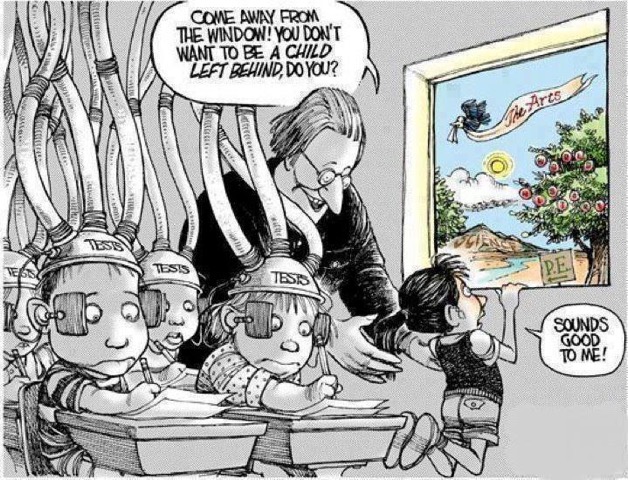
A time to laugh and celebrate that the dumb policies of No Child Left Behind and Race to the Top are widely recognized as failures and will soon go into the dustbin of history, where they belong. To make a better world for children and educators, the fight goes on, to replace poor leaders and failed policies, to save public education from privatization, and to make real the elusive promise of equality of educational opportunity: for all, not some.
This is one of the best parodies ever, using an all-purpose clip that has served many parodists in the past.
I have seen this clip used at least half a dozen times to ridicule education scams and frauds.
In this case, the clip parodies the New York State Education Department, determined to shove Common Core standards and tests down the throats of the state’s children and furious that parents are opting out.
This will give you a good laugh!
SomeDam Poet writes poems—some might say doggerel—almost daily. They are consistently witty and wise.
Here are his/her thoughts on economists (with apologies to the great economists who understand that the classroom is not a factory or a field and that children are not units of production or widgets):
“Economists are like psychics”
Economists are like psychics,
This cannot be denied.
Cuz if, by chance, they get it right,
It’s greatly AMPLIFIED!!
But mostly, they just get it wrong,
And utter not a word
For them to actually point this out
Would really be unheard.
And when their goof’s so blatant
They really can’t ignore it,
They simply claim they “found a flaw”
And “makeup will restore it”
And another:
“What if?”
What if false were true?
What if night were day?
What if economists knew
About the things they say?
This is a hilarious video.
It is a “bad lip-reading” of the Republican debate on Fox News.
I don’t know who makes these videos; they are clever and amazing. This one has been viewed more than 5 million times.
If you want to learn a bit more about the “Bad Lip Reader,” here is an interview just published in the New York Times.
Enjoy! You need a laugh today.

 Diane Ravitch's blog