Archives for category: Hoax


A Corporate Reform group in Tennessee released its own poll claiming that most voters in the state approve of annual testing.

The group called SCORE was created in 2009 by former Republican Senator Bill Frist to promote the Common Core State Standards. Being fast to accept CCSS before they were finished or even released put Tennessee in an advantageous spot for Race to the Top funding. The state won $500 million from Arne Duncan’s competition. $100 Million was set aside for the Achievement School District, which gathered the state’s lowest performing schools, located mostly in Memphis and Nashville, and handed them over to charter operators. The ASD promised to raise the state’s lowest-performing schools into the top 20%. The ASD was a complete failure. It did not raise any low-performing schools into the top 20%. Most made no progress at all.

Tennesse’s SCORE is a member of the rightwing network called PIE (Policy Innovators in Education), created by the Thomas B. Fordham Institute to connect groups that were disrupting and privatizing public education. Like other members of PIE, SCORE favors charter schools.

The board of SCORE is loaded with millionaires and billionaires who should be supporting the state’s public schools, which enroll nearly 90% of the state’s children, but prefer to disrupt and privatize them.

Five years ago, a public school parent blogger called out SCORE for making money off Common Core products. Open this link to see some eye-popping financial transactions, where RTTT money goes into the coffers of corporations owned by board members, who in turn make campaign contributions to Republican Governor BillHaslam. (Former Governor Haslam is now on the board of Teach for America.) The Gates Foundation helped to fund SCORE.

In addition to the oligarchs identified in the preceding post, the SCORE boards includes these super-wealthy Tennesseans:

Pitt Hyde of the Memphis Hyde Family Foundation. Owns AutoZone and the Memphis Grizzlies. The Hyde Family Foundation is the largest funder of the Tennessee Charter School Center.
 
Janet Ayers of the Ayers Foundation, also a funder of Common Core. 
 
Dee Haslam, married to the former governor’s brother. They own Pilot gas stations and the Cleveland Browns. Worth $1.8 billion, according to Wikipedia.
 
Orrin Ingram of the local billionaire family that has pushed charter schools.

Apparently the only plan that SCORE has for Tennessee’s public school students is to inflict Common Core and standardized testing.

SCORE has lots of money, but no imagination and no sense of the public good.

It is committed to charter schools, privatization, and accountability (but only for public schools).


Bill Phillis, retired deputy superintendent of schools for the state of Ohio, finds it hard to believe that a state legislature would seize control of a school district and remove its elected school board from office. When did Republicans become diehard enemies of local control? It has become clear that the state has no ideas about how to help low-scoring districts. None.

He writes:

Never thought this would happen in America
 
The state is in the process of replacing elected school board members in Youngstown. The electors in Youngstown elected board members. These board members will be replaced via the HB 70 process.
 
The Youngstown Board of Education has not been in control of the district for several years. State control of the district has not resulted in improvement. Therefore, elected board members are being removed from office because the state’s improvement process has failed. Sounds logical.
 
Youngstown board members have not been convicted of any crimes which would be cause for removal from office. Their hands have been tied by HB 70.
 
Congress and some state legislatures across the nation have not demonstrated a stellar performance. Should those elected officials be replaced by some convoluted appointment process?
 
How can Ohio legislators and the Governor allow this despicable process to come to fruition? HB 70 was enacted in less than 24 hours with no public input. The legislature could repeal HB 70 in less than 24 hours.


California is paying a high price for its notoriously lax law for authorizing charter schools, which was revised in recent weeks.

Tom Ultican sees a striking similarity between the Inspire charter chain, which enrolls home schoolers, and the A3 chain, which went up in flames with a loss to taxpayers of at least $50 million.

Inspire Charter School mirrors the methods of A3 Education. It employs practices strikingly similar to those that led to May’s 67-count indictment against A3’s leaders. Furthermore, the California Charter School Association (CCSA) took the same unusual step of sharing concerns about Inspire and A3 with California authorities. They are virtual schools that concentrate on obtaining authorization from small school districts. These systems have a similar structure in which a central organization controls the schools that are contracting with it and they transfer funds among multiple organizations making it difficult to monitor their activities. Students at both Inspire and A3 struggle academically.

The Acton-Aqua Dulce Unified School District is infamous for authorizing suspect charter applications while not having the resources to adequately monitor those schools. It has 1085 public school students and 14,734 charter school students. Acton-Aqua Dulce authorized Inspire’s first charter school which was located in Los Angeles County. Strangely, Inspire Charter grew from 151 students in the 2014-15 school year to 4,321 students in the 2018-19 school year and then closed up shop this June 30th.

Founder Nick Nichols needed a program that would service his target audience of home school students.  The Inspire 2016 tax form shows that he purchased curriculum from Academic Arts and Action for $149,625. This is notable because the chairman of Academic Arts and Action was Jason Schrock and the President was Sean McManus. That is the same Schrock and McManus indicted in the A3 scandal.

The education writer for the San Diego Union Tribune (UT), Kristen Taketa, has been relentlessly pursuing the Inspire story. She explains one of the the charters selling points,

“Inspire parents have been able to spend state-provided money on expenses they say are educational, from Disneyland annual passes to private ice skating coaching. The list of places where Inspire parents could spend school funds has included Costco, Amazon, Big Air Trampoline Park, Medieval Times, Guitar Center and the DNA testing company 23 and Me, according to Inspire’s list of approved vendors.”

Inspire provides each parent $2600 to $3000 to spend on field trips and other educational resources.

Last year Nick Nichols oversaw nine schools with 23,300 total students. In the 2016-17 school year, Inspire took in $76,018,441 yet their debt was skyrocketing. Their pay for officers went from $65,318 for the 2014-15 school year to $2,011,898 in the 2016-17 school year. Nick Nichols did especially well.

Inspire Income-Debt-Wages-Table

Data from Inspire Tax Documents

The UT’s Taketa reports, “Inspire expects to pull in $285 million in state funding this school year.”

Inspire just secured another $50,000,000 loan from the California School Finance Authority. With booming student daily attendance income and large financial backing from the state, it is strange that Nick Nichols chose now to take a temporary leave of absence. Former Mount Diablo Superintendent and Inspire’s chief operating officer, Steven Lawrence, is taking over as executive director.

As Ultican shows, Inspire’s students have very poor academic results.

How much longer will this charade continue with state money? Will someone wake up the taxpayer’s and legislators?

William J. Gumbert has posted a series of analyses of charter school performance and demographics in Texas, based on public data compiled by the state. This is a summary of earlier posts. You may recall from an earlier post about Houston that the state commissioner of education is threatening to take control of the Houston Independent School District because of the persistently low rest scores of one school, Wheatley High School. Please check out its demographics in the chart below.


By:  William J. Gumbert


Ever since the “A Nation at Risk: The Imperative for Educational Reform” report was released in 1983, corporate education reformers and privately funded, “public policy” organizations have promoted the “privatization of public schools”.  In 1995, the Texas Legislature gave in to the political rhetoric and authorized privately-operated charters (“charters”) to open and independently operate public schools with taxpayer funding.  As a result, taxpayers are funding a “dual education system” that consists of locally governed, community-based school districts and State approved charters.

Charters promised to improve student results by transferring the control of public schools to private organizations that had more autonomy to expend taxpayer funding without community oversight.  However, charters have not fulfilled their promise.  Despite the State funneling over $22.5 billion of taxpayer funding to privately-operated charters over the last 24 years, charters have not to produced better student outcomes than community-based school districts.   Most recently, 86.2% of community-based school districts received an “A” or “B” rating pursuant to the State’s 2019 Academic Accountability Ratings.  In comparison, only 58.6% of charters received an “A” or “B” rating. In addition, almost 1 of every 5 charters received a “D” or “F” rating from the State.

Despite the Perception – Charters Serve a Different Student Population:   Charter advocates have consistently promoted that charters serve a higher percentage of “economically-disadvantaged” and “minority” students from underserved communities.  But charters have also routinely stated that their student populations closely correlate with the school districts they choose to operate within. In this regard, Houston ISD and Dallas ISD collectively have over 75,000 students enrolled in State approved charters and both districts serve student populations that are at least 80% “economically-disadvantaged” and “minority”.   Thus, it is fair to say that both charters and school districts serve a high percentage of “economically-disadvantaged” and “minority” students.  However, the similarities in the types of students served by charters and school districts stop here.

The reality is that charters “underserve” many of the student subgroups that the “No Child Left Behind Act” identified as having potential achievement, opportunity or learning gaps in comparison to their peers.  The Texas Education Agency (“TEA”) tracks the performance of student subgroups in Texas public schools and while “economically-disadvantaged” and “minority” students are identified as subgroups, so are “at risk”, “special education”, “disciplinary” and “mobile” students.

With the needs of each student being unique, it is important to emphasize that a student can be included in more than one subgroup.   For example, a student can be identified solely as “economically-disadvantaged” or a student can be “economically-disadvantaged”, “at risk” and “mobile”.  The more subgroups that are applicable to a student, the more challenging it becomes to ensure that student is successful.   I highlight that “challenging” is not referenced as an excuse for schools to have low student performance, but rather to recognize the additional time, effort, care and resources that are required to help certain students overcome adverse circumstances and obtain a quality education.

A review of the student subgroups reported by TEA shows that privately-operated charters enroll a significantly lower percentage of “at risk”, “disciplinary placement” and “special education’ students than community-based school districts.  TEA data also demonstrates that charters enroll students with significantly lower “student mobility”.   Why?  It is hard to definitively say. But these types of students have proven to be more costly to serve, require the most effort to achieve good “test scores” and are the least likely to continue on the “road to college”.  It may also be that charters do not actively recruit students in these subgroups.  Either way, here are the facts.

 “At Risk” Students:  Students identified as “at risk” of dropping out are performing below academic standards and/or are confronting other challenges.  TEA’s definition of “at risk” includes a student that:

  • Did not perform satisfactorily on a readiness or assessment instrument;
  • Has a grade below 70 in 2 or more subjects in the foundation curriculum for the preceding or current school year;
  • Is of limited English proficiency;
  • Was not advanced from one grade level to the next for one or more school years; and
  • Has been placed in an alternative education program in the preceding or current school year.

As shown below, despite having a large presence in each of the 5 urban school districts listed below, some of the largest charters enroll 19.3% fewer “at risk” students.   In other words, for every 1,000- seat school campus, the school districts serve 193 more students that have been identified as “at risk” of dropping out.   While it may be surprising to some, the listed charters also serve a lower percentage of “at risk” students than the statewide average.


Privately-Operated Charter “At Risk”

Students

School District “At Risk”

Students

IDEA Public Schools 45.9% Houston ISD 71.7%
Harmony School of Excellence – Houston 43.5% Dallas ISD 63.2%
KIPP, Inc. – Houston 46.7% Austin ISD 51.3%
Uplift Education 54.8% San Antonio ISD 73.5%
YES Prep. 50.2% Fort Worth ISD 77.8%
Average – 5 Charters 48.2% Average – 5 School Districts 67.5%
5 Charters: Avg. Per 1,000 Seat Campus 482 Students 5 Districts:  Avg. Per 1,000 Seat Campus 675 Students
                                                                   State Average:   50.8% or 508 Students  


Disciplinary Placements:  TEA data shows that 73,713 students have been identified as “Disciplinary Placements” in public schools.  These are students that have previously had behavioral issues or been placed in a District Alternative Education Program (“DAEP”).  By law, privately-operated charters can exclude enrollment to this student subgroup and most charters do. In fact, charter proponents have previously stated that many charters are not prepared and could not afford to serve these students.  As such, the responsibility to deploy the educational services and resources needed to serve “disciplinary” students resides mostly with school districts.  Once again, despite having a large presence in the same 5 school districts, the same charters served only 11 “disciplinary” students and the school districts welcomed 6,532 “disciplinary” students.

Privately-Operated Charter Discipline

Students

School District Discipline

Students

IDEA Public Schools 0 Houston ISD 1,996
Harmony School of Excellence – Houston 0 Dallas ISD 1,843
KIPP, Inc. – Houston 0 Austin ISD 1,140
Uplift Education 0 San Antonio ISD 879
YES Prep. 11 Fort Worth ISD 674
  Total – 5 Charters 11   Total – 5 School Districts 6,532


 Special Education:  Students identified with physical or learning disabilities comprise an average of 9.1% of all students in Texas public schools.  But at the same charters listed below, only 6.2% of students are identified by TEA as “students with disabilities”.   The enrollment gap for “student with disabilities” among certain charters and school districts can be alarming, especially since it is permitted to occur with the State’s blessing.  For example, IDEA Public Schools is rapidly expanding in Austin ISD, but Austin ISD welcomes more than double the percentage of “students with disabilities”.   For every campus with 1,000 students, IDEA only serves 52 students with “special needs” and Austin ISD serves 109 students with “special needs”.  If Austin ISD served the same percentage of “students with disabilities” as IDEA, it would serve an estimated 4,500 fewer students with “special needs”.

Privately-Operated Charter Special Education Students School District Special Education Students
IDEA Public Schools 5.2% Houston ISD 7.1%
Harmony School of Excellence – Houston 6.3% Dallas ISD 8.2%
KIPP, Inc. – Houston 6.3% Austin ISD 10.9%
Uplift Education 7.0% San Antonio ISD 10.3%
YES Prep. 6.1% Fort Worth ISD 8.3%
Average – 5 Charters 6.2% Average – 5 School Districts 9.0%
  State Average: 9.1%  


Student Mobility:  TEA defines “student mobility” as the percentage of students that were enrolled at a campus for less than 83% of the school year.  In other words, the “student mobility” rate refers to the volume of students that were not consistently enrolled in a charter/school district throughout a school year.  With an inconsistent learning environment, students that regularly change schools are faced with unique social and educational challenges in comparison to other students.  For example, Education Week has reported that: “various studies have found student mobility – and particularly multiple moves – associated with lower school engagement, poorer grades in reading (particularly in math), and a higher risk of dropping out of high school”.

As summarized below, the “student mobility” rate of the listed school districts is a challenging 20.3%, while the “student mobility” rate of the charters is only 6.3%.   As such, for every 1,000-seat campus, the school districts must meet the unique challenges of educating 203 “mobile” students during a school year.  In comparison, the charter campus has a much more stable population with only 63 “mobile” students.


Privately-Operated Charter Student

Mobility Rate

School District Student

Mobility Rate

IDEA Public Schools 7.0% Houston ISD 19.2%
Harmony School of Excellence – Houston 10.0% Dallas ISD 19.9%
KIPP, Inc. – Houston 4.5% Austin ISD 17.9%
Uplift Education 5.5% San Antonio ISD 23.6%
YES Prep. 4.4% Fort Worth ISD 21.1%
Average – 5 Charters 6.3% Average – 5 School Districts 20.3%
5 Charters:  Avg. Per 1,000 Seat Campus 63 Students 5 Districts:  Avg. Per 1,000 Seat Campus 203 Students
                                                                   State Average: 16.0% or 160 Students  

Comparison of Campuses Located Within 3 Miles of Each Other:  While each student subgroup presents unique challenges, schools that are primarily comprised of students in multiple subgroups have the most challenges to consistently achieve high student performance. In this regard, it is not a coincidence that many school district campuses labeled as “low performing” by the State are comprised of students included in multiple subgroups.

The table below further illustrates the disparities of the student populations enrolled at State approved charters and school districts by comparing the student populations of 7 charter campuses that are located within 3 miles of a school district campus.   In each comparison, the charter campus competing for students with a nearby school district campus served fewer “at risk”, “disciplinary”, “special education” and “mobile” students.  It most cases, the differences were substantial.  On average, for each 1,000-seat campus, the comparisons revealed that the charter campuses served:

  • 325 fewer “at risk” students;
  • 65 fewer “special education” students;
  • 199 fewer “mobile” students; and
  • No charter campus enrolled a student with a “discipline placement”.
Campus “At Risk” Discipline

Placement

Special Education Student Mobility
Wheatley H.S.     (Houston ISD) 88.1% 36 19.0% 31.2%
YES Prep. – 5th Ward 51.1% None 7.6% 4.4%
Travis H.S.         (Austin ISD) 77.1% 46 14.2% 30.3%
IDEA Allan College Prep. 53.7% None 10.4% 8.6%
Morningside M.S.   (Fort Worth ISD) 88.0% 2 14.1% 25.9%
Uplift Mighty M.S. 67.8% None 10.7% 2.9%
Sharpstown H.S.    (Houston ISD) 90.2% 39 9.7% 30.9%
KIPP Sharpstown College Prep. 52.2% None 5.4% 4.4%
Douglass Elem.      (SAISD) 78.5% 6 9.6% 28.7%
IDEA Carver Academy 17.4% None 5.1% 9.5%
Andress H.S.         (El Paso ISD) 66.3% 51 21.1% 18.0%
Harmony School of Excel. – El Paso 49.4% 0 8.5% 12.1%
Carter H.S.          (Dallas ISD) 70.7% 20 11.8% 24.0%
Uplift Hampton Prep.  H.S. 39.5% None 6.4% 7.6%
Average –  7 School District Campuses 79.8% 26 14.2% 27.0%
Average –  7 Charter Campuses 47.3% None 7.7% 7.1%
Average Charter Difference Per 1,000 Seat Campus 325 Fewer Students 65 Fewer Students 199 Fewer Students


Conclusion:  The “A Nation at Risk” report started the false narrative that our public schools were failing and the attack on school districts has continued ever since.  These strategic attacks have served to fuel the “privatization of public education agenda” of corporate reformers and society-controlling billionaires that persuaded the Legislature to provide privately-operated charters with the freedom to expand in local communities with taxpayer funding.

The State has provided privately-operated charters with many educational advantages to produce better student outcomes than community-based school districts.  These advantages include less taxpayer oversight; greater instructional, staffing and enrollment flexibility; and the ability to stop serving students by closing campuses.  Privately-operated charters are also permitted to underserve certain student subgroups that have been identified as having potential achievement, opportunity or learning gaps, such as “at risk”, “disciplinary”, “special education” and “mobile” students.

With all the educational advantages afforded to State approved charters, common sense tells us that charters should be outperforming school districts by a wide margin.  But despite these advantages and 24 years of experimentation, the State’s 2019 Academic Accountability Ratings document that privately-operated charters continue to produce lower student outcomes than locally governed school districts!

It is time for the State to apologize to school district teachers, support staffs, administrators and Boards of Trustees across the State and admit that “privatization” was a misguided experiment.   It is time for the Legislature to apologize to taxpayers for increasing the costs of public education by diverting over $22.5 billion of taxpayer funding to privately-operated charters that have failed to consistently improve student outcomes in local communities.  It is time to implement education policies that are based upon the facts, not political charades or charter advertisements.  The future of young Texans is counting on it!


DISCLOSURES:  The author is a voluntary advocate for public education and this material solely reflects the opinions of the author.  The author has not been compensated in any manner for the preparation of this material.  The material is based upon information provided by the Texas Education Agency, TXSchools.gov and other publicly available information.  While the author believes these sources to be reliable, the author has not independently verified the information.  All readers are encouraged to complete their own review and make their own independent conclusions.


William J. Gumbert has prepared statistical analyses of charter performance in Texas, based on state data.

Charters boast of their “success,” but the reality is far different from their claims. They don’t enroll similar demographics, their attrition rate is staggering, and their “wait lists” are unverified.

Their claims are a marketing tool.

They are not better than public schools.

They undermine and disrupt communities without producing better results.

Yet Texas is plunging headlong into this strategy that creates a dual system but benefits few students.


Texas Charter Schools – Perception May Not Be Reality

Part 5: The State’s Efforts to “Privatize” Public Education in Local Communities is “Simply Indefensible”

By: William J. Gumbert

If you are a parent residing in an urban or suburban area of Texas, it is likely that you have received promotional materials recruiting your child to enroll at a privately operated, charter school (“charters”). Charters are taxpayer funded, private organizations that the State approves to independently operate schools in community-based school districts. Despite it being your students, schools, tax dollars and communities, the State has unilaterally decided that a “dual education system”, consisting of locally governed, community-based school districts and State approved, privately governed charters, is best for local communities. The State has also conveniently and unilaterally decided to share the public education funding of local communities with privately governed charters.

To conclude this series on Texas charter schools, Part 5 uses the lyrics of Robert Palmer’s hit song “Simply Irresistible” to demonstrate that the State’s politically driven and orchestrated efforts to “privatize” public education in local communities is “Simply Indefensible”. Since the song was a hit in 1988, feel free to click on the YouTube video of the “Donnie and Marie Show” below to remember the vibe.

Screen Shot 2019-09-03 at 10.26.40 PM

“How Can It Be Permissible”:

Without the approval of taxpayers and local communities: State approved charters:

  • Transfer the control and governance of public schools from local communities to privately-operated charters;
  • Divert funding from community-based school districts to privately-operated charters. The State has already provided charters with over $22.5 billion of taxpayer funding;
  • Increase the debt burden of taxpayers as charters are free to incur long-term bond debt without taxpayer approval;
  • Increase the segregation of students attending public schools in certain communities; and
  • Reduce the quality of schools in many community-based school districts as 20.4% of all charter campuses are rated as “low performing” (rated equivalent of “D” or “F”) by the State’s 2018 Academic Accountability Ratings.

    “She Compromise My Principle – Yeah, Yeah”:

    Every community has a fundamental responsibility to provide a quality public education that equally serves the unique needs of every student. As public servants, community-based school districts embrace this responsibility as all students are welcome and no student is turned away. If there is not room, community-based school districts hire more teachers and make room. In comparison, the State’s deliberate intervention in local communities allows privately-operated charters to:

    • Serve a limited number of students and NOT enroll all students;
    • Recruit the targeted students and families they desire to serve;
    • Deny enrollment to students with “discipline histories”;
    • ▪ Serve a lower percentage of “students with disabilities”;
    • Serve a lower percentage of students “at risk” of dropping out; and
    • Disrupt the education of over 12,800 “economically-disadvantaged” students due to charter closures in the last 5-years.

    “That Kind of Love is Mythical”:

    The promotion of charters is primarily coordinated by charter advocacy organizations that are intended to support and grow the charter school movement. Although not all-inclusive, these organizations train charter administrators, teachers and parents to be advocates, they assist organizations to start new charters, and they coordinate the political strategy to secure favorable support from the Legislature. But it is not publicized that these advocacy organizations are funded by private donors and fueled by privately funded “public policy” organizations that desire to “privatize” public education across Texas.

    To demonstrate parent demand and to garner political support, charter advocacy organizations have notoriously publicized a “wait list” of students. But charters do not publicize the alarming 33.8% attrition rate of students in grades 7-12 that decided to transfer to another Texas public school to start year 2017/18. Charters also do not publicize that the desires of families on “wait lists” are a lower priority than the desire of charters to expand in other regions of the State. By charters expanding in other regions, without expanding current schools to serve students on “wait lists”, charters are choosing to have families “stuck” on the wait list”. In addition, charters strategically attempt to maintain a “wait list” to ensure that their taxpayer funding is preserved as existing students transfer to community-based school districts or another Texas public school in the future.

    In Texas, the promoted (unverified) “wait list” is 141,000 students. However, taking a deeper dive, a more realistic estimate is closer to 75,000 students or an amount that is very similar to the 73,713 disciplinary students that are intentionally denied service by charters. This estimate was derived from certain enrollment statistics in a study funded by the KLE Foundation entitled: “An Analysis of Austin area Charter School Waitlists and Enrollment”. It is important to note that the KLE Foundation is also funding the expansion of charters in Austin.

    “She’s Anything But Typical”:

    In comparison to community-based school districts, charters serve the unique needs of students by:

    • Employing teachers with lower experience;
    • Deploying higher class sizes;
    • ▪ Having higher teacher turnover
    • Spending less on “student instruction”;
    • Offering fewer co/extra-curricular activities;
    • ▪ Having limited career and technical training; and
    • Closing 108 charters

    .

    “She’s a Craze You’d Endorse, She’s a Powerful Force”:

  • The charter movement is coordinated by “public policy” and “education reform” organizations that circumvent the voice of local taxpayers by strategically controlling our elected officials at the State and Federal levels. In politics, money is power and the rich and powerful support the charter school movement. As a result, many elected officials are politically motivated to endorse and support the “charter craze”. The following quote from the Texas Charter Schools Association, an advocacy organization to support and expand charters, provides an indication of the movement’s focus on political patronage:

    “Generally speaking, we have a broad enough bipartisan coalition in the House and Senate that largely will prevent anything existential happening to charters” – CEO of TCSA

    “You’re Obliged to Conform, When There’s No Other Course”:

    It is interesting that the Legislature continues to increase the transparency requirements of community-based school districts to enhance the involvement of taxpayers, but at the same time, the State forces charters upon taxpayers by unilaterally controlling the expansion and taxpayer funding of charters. In this regard, taxpayers do not receive public notice of the charters that the State approves to operate in local communities. The State does not notify taxpayers of the public funding it provides to charters and the State has ensured that taxpayers cannot prohibit or limit the bond debt incurred by charters to finance the construction of new charter schools in local communities (charters are granted the ability to incur bond debt without voter approval). Lastly, with charters having “privately appointed boards”, the State has also ensured that taxpayers cannot democratically elect the governing boards of charters and in fact, the State does not even require charters to meet in the communities they serve.

    “She Used to Look Good to Me, But Now I Find Her”:

    The original purpose of charters was to improve the educational opportunities of “economically-disadvantaged” students in urban areas and to develop and share instructional innovations to enhance the education of all students. However, the charter school movement has evolved into an aggressive, strategic and “non-cooperative” movement that is coordinated by “special interests” to “privatize” and “control” the public education system in local communities. Since charters have introduced “private business practices” into public education, the charter movement could be characterized as a “hostile takeover” of public schools and the tax dollars of Texas communities.

    “Simply Indefensible” … “There’s No Tellin Where the Money Went”:

    The charter facts are “irrefutable”;

    Charter expenditures are “inscrutable”;

    Special interests have made charters politically “irresistible”; and

    By the State providing privately governed charters with taxpayer funding, “there’s no tellin where the money went”.

    With the education of children and taxpayer funding at stake, the State’s deliberate and politically-motivated actions to “privatize” public education in local communities is:

    “Simply Indefensible”

    DISCLOSURES: The author is a voluntary advocate for public education and this material solely reflects the opinions of the author. The author has not been compensated in any manner for the preparation of this material. The material is based upon various sources, including but not limited to, the Texas Education Agency, Txschools.org; Texas Academic Performance Reports, tpeir-Texas Education Reports, Texas Higher Education Coordinating Board, KXAN and other publicly available information. While the author believes these sources to be reliable, the author has not independently verified the information. All readers are encouraged to complete their own review of the charter school movement in Texas, including the material referenced herein and make their own independent conclusions.

Carl Petersen, a veteran of the charter wars in Los Angeles, writes her about the serious defect in the charter reform law.

The law finally allows local school boards to determine whether proposed charter schools will damage the fiscal stability of the public schools, a welcome change.

But it also allows the unelected County Board of Education to overturn the decisions of the elected district school board. If the elected school boards determine that the proposed charter will damage the district, the unelected County Board can reject the decision of the local elected board. That is just plain wrong.

And nowhere is it wronger than in Los Angeles, where Corporate Reformers funded by billionaires fight to control the LAUSD school board. When the public manages to get the upper hand, the decisions of the school board can be overruled by a charter-friendly unelected county school board.

The county board in LA is dominated by phony Reformers, including the candidate who lost to George McKenna, a true friend of public schools, and Kate Braude, the executive director of astroturf Speak Up, the voice of the charter industry.

Elected officials should have the last word, not charter shills.

A friend advised me that there will be a show tonight at 10 PM on a cable called TruTV.

The show is called “Adam Ruins Everything.”

Tonight Adam will “ruin” one of Corporate Reform’s favorite causes.

There will be a cameo appearance by one of our favorite bloggers.

I am not allowed to share the secret.

Please watch and prepare to enjoy.

When I first started writing this blog in 2012, Louisiana’s then Governor Bobby Jindal was crowing about his new voucher plan. He and his state commissioner John White insisted that vouchers were a wonderful innovation. They would save poor children from failing public schools. They would give poor children the same choices that rich children have. All the DeVos baloney was served up.

We now know that none of this was true. Most of the voucher money went to backwoods evangelical church schools that did not have certified teachers or a real curriculum. Some of the voucher schools relied on the state money to keep their doors open. The “opportunity” was not for the students, but for the schools, which were glad to have the money from the state.

Now an organization called The Center for Investigative Reporting reveals what we anticipated: most students who use vouchers attend schools that are rated D or F by the State Education Department that funds them. The state is subsidizing no-quality education.

Read the article here.

The vouchers are an expensive hoax. They are not saving poor children from failing schools. Most of them ARE failing schools.

This story was produced by FOX8 WVUE, NOLA.com | The Times-Picayune and WWNO New Orleans Public Radio as part of Reveal’s Local Labs initiative, which supports lasting investigative reporting collaborations in communities across the United States.

Louisiana Gov. Bobby Jindal beamed with pride in April 2012, as he signed into law one of the most sweeping school choice expansions in the nation.

The law was lauded by the American Federation for Children, then chaired by future Education Secretary Betsy DeVos, and other school choice advocates. Like Jindal, they said it would free countless lower-income children from the worst public schools by allowing them to use state tax dollars in the form of vouchers to pay tuition at private schools, where they would ostensibly receive a better education.

“Our children do not have time to wait,” Jindal had said as he spent some of his waning political capital on what he felt would become a major part of his political legacy in Louisiana. “They only grow up once, and they have one shot to receive a quality education.”

Seven years later, however, the $40 million-a-year Louisiana Scholarship Program has failed to live up to its billing. The nearly 6,900 students who’ve left public schools have instead been placed into a system with numerous failing private schools that receive little oversight, a monthslong examination by a coalition of local and national media organizations has found.

Two-thirds of all students in the voucher system attended schools where they performed at a D or F level last school year, according to a data analysis by NOLA.com | The Times-Picayune, WVUE Fox 8 News, WWNO and Reveal from The Center for Investigative Reporting.

The Education Research Alliance at Tulane University has accomplished a spectacular feat with its latest report about the “academic progress” (or lack thereof) of the all-charter district in New Orleans. The report claims that the disruption strategy of school takeovers and closures is responsible for the academic improvements in the district, but at the same time admits “The average school improved from the first to the second year after it opened, but school performance remained mostly flat afterwards. Schools starting off above the state average saw slightly declining performance in later years.” Furthermore, “quality peaked around 2013 and has either stagnated or started to decline during 2014-2016.”

So, here is the New Orleans model: Close almost all public schools. Replace them with private charters. Fire all the teachers. Replace most of the teachers with inexperienced, ill-trained TFA recruits. Close low-performing charters and replace them with other charters. Keep disrupting and churning. In the first two years, scores will go up, then stall. By year eight, “quality” will stagnate or decline. The schools will be highly stratified and racially segregated. The few high-performing schools will have selective admissions.

Here is the report, released this morning.

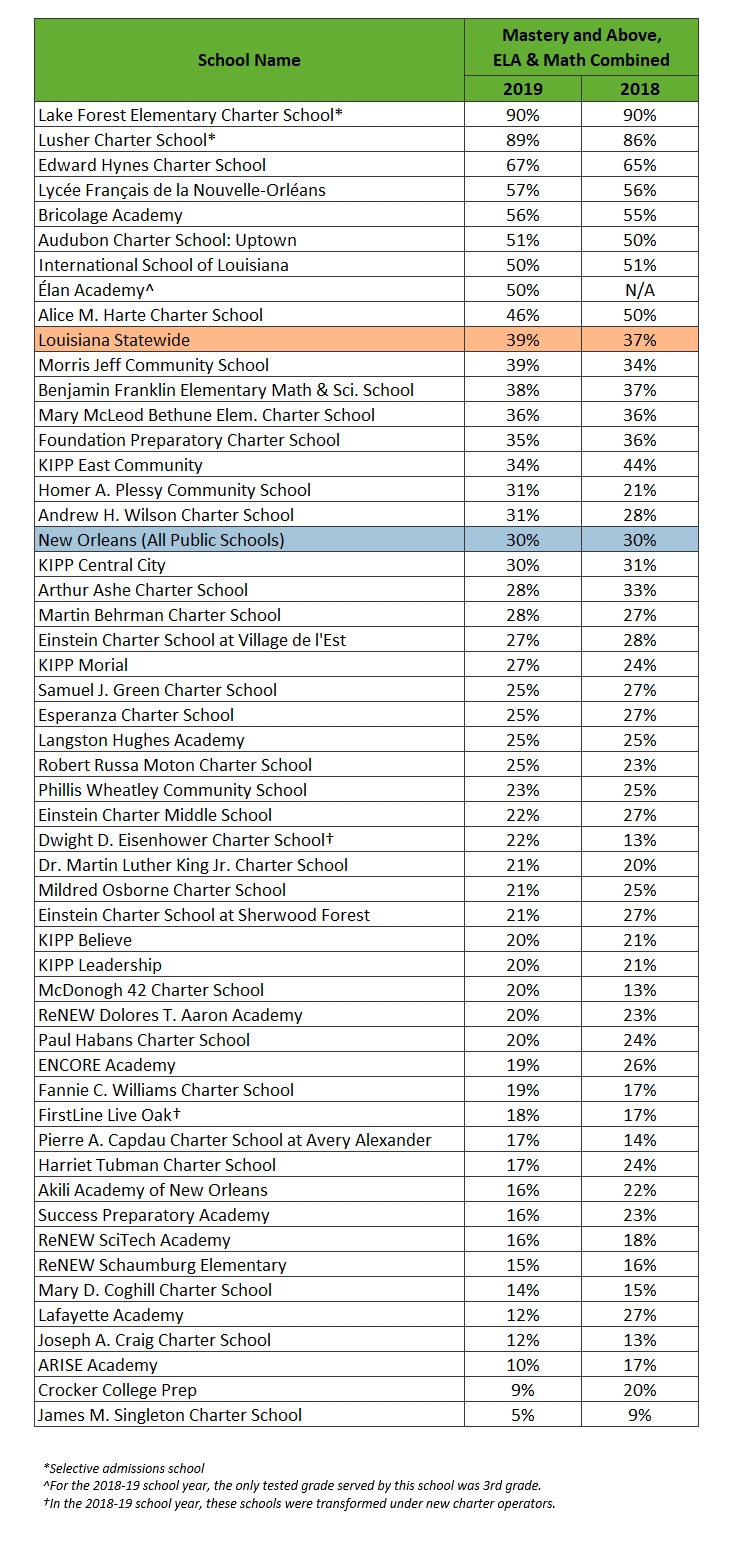
This report should be read in tandem with the latest state scores, which shows the all-charter district lagging far below state average scores, actually declining. Most charter schools in New Orleans, as detailed in this link prepared by a pro-charter organization, are very low-performing. The high-scoring schools have selective admissions.

New Orleans is one of the lowest performing districts in one of the lowest-performing states.It is a model of how privatization increases stratification and segregation. It should not be copied elsewhere.

But the report claims the success of the venture in school closings and privatization! Remember that the Education Research Alliance won a $10 million grant from Betsy DeVos after its report last year claiming the success of the privatization experiment.

Here is the press release for today’s report:

Study shows average public school quality has increased in New Orleans since Hurricane Katrina as a result of school closures, takeovers, and charter openings

New Orleans – The quality of New Orleans’ public schools improved considerably after Hurricane Katrina as a result of performance-based closures and takeovers, as well as charter openings, according to a new study from Education Research Alliance for New Orleans (ERA-New Orleans) at Tulane University. The study also found that variation in school quality has decreased, which means fewer students are in very low-performing schools.

Now an all-charter district, New Orleans public schools have returned to the control of the local school board. The city’s education leaders face challenging decisions about the district’s role in in school improvement, especially when and how the district should help support low-performing schools or take over these schools. This study provides insight into how these decisions can affect school quality.

“There are two main paths to improving the city’s schools: improving the ones we have or replacing them,” said ERA-New Orleans Director and lead author Douglas Harris. “Our findings suggest that we’ve been more successful with closing and taking over low-performing schools.”

The study’s authors analyzed data from 2002-2016 and found that the average New Orleans public school improved from the first to the second year after opening, but school performance remained mostly flat after the second year.

The study also examined factors beyond academic achievement to better understand how the city’s schools have evolved.

“The number of extracurricular activities that schools say they offer has increased over time,” co-author and ERA-New Orleans research analyst Alica Gerry said. “Also, there may have been a slight upward trend in the variety of school options in the city after the reforms, though this could just reflect school marketing rather than actual program offerings.”

“Students now have access to a wider range of higher quality schools than they did before, even in the first few years of reform,” Harris said. “School closures and takeovers should be a last resort, but they also show some promise when schools are consistently low-performing.”

The study’s authors are Douglas Harris (Tulane University), Lihan Liu (Tulane University), Alica Gerry (Tulane University), and Paula Arce-Trigatti (Rice University).

The novice journalist is likely to read the claims made about New Orleans—that outcomes improved because of charters and closing schools with low scores—and assume that this strategy of disruption is the key to good results. But unless they read the report closely, they may not notice that gains ended after the first or second year of an experiment now in its 15th year.

Expect more headlines about the New Orleans “miracle,” about the stagnation of market-based reforms in a city where most schools “perform” far below state averages.


The San Diego Union-Tribune featured a front-page top-of-the-fold story by Kristin Taketa about the deepening troubles of the “Inspire” charter chain, which is growing across the state despite academic and financial woes.

The headline: “Inspire Charter Schools Grow As Results Lag.”

The Inspire network of 12 home charter schools is quickly spreading its reach across California as some are calling into question its educational, organizational and financial practices.

At the heart of the Inspire network is a corporation whose CEO makes about $380,000 a year and who helped create the Inspire schools, which now pay his corporation 15 percent of the taxpayer funds they collect.

Inspire has grown in part by advertising that parents can decide how to spend$2,600 or more a year toward their child’s education, with a teacher’s approval. Inspire operates on the idea that parents should have freedom to decide how their children are educated.

Inspire parents have been able to spend state-provided money on expenses they say are educational, from Disneyland annual passes to private ice skating coaching. The list of places where Inspire parents could spend school funds has included Costco, Amazon, Big Air Trampoline Park, Medieval Times, Guitar Center and the DNA testing company 23 and Me, according to Inspire’s list of approved vendors.

Meanwhile, Inspire students are required to meet with teachers and turn in assignments once a month.

The charter network is based in Duarte and enrolled 23,400 students last year.

State data show that Inspire schools underperformed academically. Last year, all Inspire schools performed below the state average in English and math test scores, with some schools showing as few as 16 percent of their students passing math and as few as 25 percent passing English. The state average is 39 percent for math and 50 percent for English.

Put together, Inspire schools had an average graduation rate of 69 percent last year and produced seven graduates — out of 209— who met California state college or university admission requirements.

Why does the State Education Department tolerate this waste of children’s lives and taxpayers’ money?

When will the Legislature crack down on these sham schools?

The good news is that a major newspaper, the San Diego Union-Tribune, is assigning excellent reporters to cover these scandals, which are especially flagrant in California due to the state’s weak charter law, which assures that charters will be unregulated and unaccountable. In the past, the Union-Tribune was considered a conservative paper. It may still be. Conservatives should be outraged by this fraudulent education and blatant misuse of public funds.