The DeSantis regime threatened to prosecute television stations that aired ads supporting Amendment 4, the one that repeals the state ban on abortion. The order was blocked by the courts. When the lawyer for the state Department of Health was directed to sign a second letter reiterating the threat, he resigned.
The Miami Herald reported:
Gov. Ron DeSantis’ top deputies directed a Florida Health Department lawyer to threaten Florida television stations with criminal prosecution for running political advertisements that support enshrining abortion rights in the state’s Constitution, according to new court records.
Florida Department of Health General Counsel John Wilson said he was given pre-written letters from one of DeSantis’ lawyers on Oct. 3 and told to send them under his own name, he wrote in a sworn affidavit Monday.
Although he had never participated in any discussions about the letters, Wilson sent them anyway, he wrote, setting off a firestorm that led to a federal judge last week granting a temporary restraining order against the state.
Wilson abruptly quit on Oct. 10, writing in his resignation letter that “A man is nothing without his conscience.” The letter, first reported by the Herald/Times, did not explicitly say he was resigning over the controversy.
But in his affidavit, Wilson said the decision was made to avoid sending out more letters. “I resigned from my position as general counsel in lieu of complying with directives from [DeSantis General Counsel Ryan] Newman and [Deputy General Counsel Jed] Doty to send out further correspondence to media outlets,” he wrote.
Marc Caputo reported that negotiations are underway behind the scenes to persuade Nikki Haley to moderate a town hall with Trump in the last few days of the campaign. The Trump team knows that he has poor ratings among women, largely because of the reproductive rights issue. Haley might help him with women. He has already held events with MAGA women, including former Democratic Rep. Tulsi Gabbard in Wisconsin, Arkansas Gov. Sarah Huckabee Sanders in Michigan, Tennessee Sen. Marsha Blackburn in Michigan, Florida Rep. Anna Paulina Luna in North Carolina, and Fox News personality Harris Faulkner in Georgia. Haley would be a coup for him to reassure women who are angry that Trump’s Supreme Court eliminated their right to control their bodies.
Caputo writes in the Bulwark:
DONALD TRUMP’S ONETIME ambassador and former primary rival, Nikki Haley, is in talks to join him on the campaign trail in an attempt to win over disaffected Republicans, sources familiar with the discussions tell The Bulwark.
The details and dates for the joint appearance haven’t been fully worked out, but the likeliest scenario would put the two together at a town hall toward the end of the month, perhaps involving Fox News personality Sean Hannity, the sources said.
Facing a yawning gender gap, Trump’s campaign has hosted five other town halls moderated by female political figures since August, but none with the stature of Haley. The former UN Ambassador ran a tough primary race against Trump, becoming the last Republican standing against him. Though the primary ended on a contentious note, she spoke on his behalf at the Republican National Convention on July 16.
Since then, however, Haley and Trump have not appeared together. And she hinted that tensions still linger on her new SiriusXM satellite radio show last month.
“I don’t agree with Trump 100 percent of the time,” Haley said.
“I have not forgotten what he said about me. I’ve not forgotten what he said about my husband or his, you know, deployment time or his military service. I haven’t forgotten about his or his campaign’s tactics from, you know, putting a bird cage outside our hotel room to calling me ‘bird brain,’” Haley said on her show, adding that she’s still for Trump because she thinks he “will make the country better.”
Those comments garnered some attention in Trump’s orbit. One confidant of the ex-president privately joked that talk like that is usually taboo in his circles because “if you’re with him 99 percent of the time, you’re a fucking traitor in Trump’s eyes.”
But Trump prizes winning over servile loyalty, and he recognizes that Haley’s brand as an establishment Republican—one who respectfully disagrees with him on the margins—could help in November, even if he said the opposite during the primary.
A campaign ad released by former President Donald J. Trump in battleground states slams Vice President Harris for supporting taxpayer-funded transgender surgeries for prisoners and migrants, concluding: “Kamala is for they/them. President Trump is for you.”
But the Trump administration’s record on providing services for transgender people in the sprawling federal prison system, which houses thousands of undocumented immigrants awaiting trial or deportation, is more nuanced than the 30-second spot suggests.
Trump appointees at the Bureau of Prisons, a division of the Justice Department, provided an array of gender-affirming treatments, including hormone therapy, for a small group of inmates who requested it during Mr. Trump’s four years in office.
In a February 2018 budget memo to Congress, bureau officials wrote that under federal law, they were obligated to pay for a prisoner’s “surgery” if it was deemed medically necessary. Still, legal wrangling delayed the first such operation until 2022, long after Mr. Trump left office.
“Transgender offenders may require individual counseling and emotional support,” officials wrote. “Medical care may include pharmaceutical interventions (e.g., cross-gender hormone therapy), hair removal and surgery (if individualized assessment indicates surgical intervention is applicable).”
As we head toward the November election, Policy Matters Ohio’s Bailey Williams exposes recent history that has been little reported. In The Great Ohio Tax Shift, Williams explores simply and clearly the data showing that Ohio’s new billion dollar private school tuition voucher expansion is not the only factor that has threatened public school funding. For two decades now, legislators have been cutting taxes and reducing investment in public services, including public schools. And Ohio’s legislature has increased the tax burden on Ohio’s poorest citizens and made life easier for our state’s wealthiest citizens.
Even though Ohioans have watched the legislature toss a tax cut into budget after budget instead of funding needed services, the cumulative effects Baily presents in the new report are astounding:
“Ohio families with the least resources—those making less than $24,000—pay more annual taxes on average today than they did before 2005.
The average household among the top 1 of Ohio earners, with incomes above $647,000, now contribute over $52,000 per year less than they once did.
The result is a loss of about $12.8 billion a year in revenue….
Ohioans of color are significantly more likely to pay a higher share of their incomes in taxes… while white Ohioans are more likely to have benefited….
71% of the total value of personal income tax cuts has gone to the richest 20% of households….
Changes to sales taxes, excise taxes, and business taxes have, on average, increased taxes for the bottom 99% of Ohio’s households.
Changes to sales taxes, excise taxes, and business taxes have, on average, allowed the richest 1% of Ohio tax filers to pay nearly $600 per year less than they did before 2005.”
Bailey reminds us why we pay taxes and explains what has been sacrificed in Ohio: “Through the state tax system, Ohio can ensure every child gets a world-class education, every community is vibrant and healthy, and every Ohioan, of every race and gender, has a secure economic foundation on which to build our futures. But for a generation, lawmakers have instead used tax policy to create loopholes for the wealthy and influential, and provide special treatment for powerful corporations… The politicians who write state tax policy often justify their decisions with promises that when billionaires’ pockets overflow with profits, the benefits will trickle down to working families. Year after year—now decade after decade—the consequences have been clear: The people with the lowest incomes are paying a little more, the wealthy are paying much less, and Ohio has too few resources to serve its purpose: creating a state where everyone has what they need to live a good life.”
Ohio’s legislature has reduced progressive taxation as it has reduced dependence on income taxes and increased regressive sales, excise and business taxes: “Ohio policymakers have made significant changes to personal income taxes over the two decades, lowering rates and making our tax structure more regressive. Since 2005, almost every biennial budget passed by the Ohio state general assembly has included some form of reduction to the personal income tax, generally through broad tax rate cuts and elimination of top tax brackets. Some changes have benefited low-paid Ohioans: Increasing the threshold at which households begin to pay taxes means households with income below $26,050 don’t pay state income tax…. The creation of a 30% Earned Income Tax Credit has helped low-paid Ohioans.” However, “Other regressive changes in the tax code have completely erased the meager benefits of income tax cuts for the lowest-paid Ohioans. In fact, the lowest-income 20% now pay more on average in taxes than they did before the legislature began its tax cutting spree in 2005. Sales, excise, and business taxes now cost that group more each year on average—more than cancelling out the annual average $122 in income tax cuts this group benefits from….”
Most Ohioans are not prepared to gather and analyze this kind of technical information. Thanks to Bailey Williams and Policy Matters Ohio for this technical analysis. We have spent this year learning about the fiscal implications of the Legislature’s voucher expansion in the current biennial budget; now we are better prepared to understand why, in addition to perpetual voucher expansion, it has been such a struggle to press the Legislature to enact Ohio’s new public school funding formula, the Fair School Funding Plan, to rectify years of inadequate and inequitably distributed public school funding. Legislators have insisted on a slow, three-budget phase-in of the new formula and even now have been unwilling to commit to completing the full launch of the new plan in the budget they will begin negotiating in January. Many of us have realized that the Fair School Funding Plan’s delayed rollout has derived from perennial tax cutting in addition to the enactment of what’s turning out to be an annual billion dollar voucher explosion. Williams’ analysis, released last week, provides information essential to our grasping the complex fiscal realities that will be part of the upcoming state budget debate.
Please open the link to get the full picture of the tax-cutting that has helped the richest Ohioans, hurt the poorest, and undermined public services.
Let’s be clear about one thing: JD Vance lied about every important issue during his debate with Tim Walz. He lied about Obamacare (Trump did not save it, he repeatedly tried to kill it). He lied about Trump’s refusal to acknowledge he lost the 2020 election. He lied about January 6. And he lied about abortion, expressing his sorrow that Amber Thurman died of a botched abortion in Georgia because the state ban made it impossible for her to get the care she needed. I tweeted this yesterday: “JD Vance is sorry that Amber Thurman died but happy that Roe v. Wade was overturned, which led to Georgia’s ban on abortion care, which caused Amber’s death.” So much for contrition.
During the vice presidential debate Tuesday night, former President Trump tried to bail his running mate out of an abortion question with a series of half-truths and lies. “EVERYONE KNOWS I WOULD NOT SUPPORT A FEDERAL ABORTION BAN, UNDER ANY CIRCUMSTANCES, AND WOULD, IN FACT, VETO IT,” Trump posted to social media, “BECAUSE IT IS UP TO THE STATES TO DECIDE BASED ON THE WILL OF THEIR VOTERS (THE WILL OF THE PEOPLE!).”
This is a nonsensical sentence for many reasons. Among them: No one is saying that Congress would pass a new federal ban and hand it Trump to sign or veto. What Trump might do—what his allies want him to do—is enact a ban by enforcing the 1873 Comstock Act, which can’t be vetoed since it’s already on the books. Trump’s misdirection distracts from his consistent anti-abortion record while in office, what the Republican Party platform states, and the very public plans of his former staffers detailed in Project 2025, which Trump also pretends he has nothing to do with. That is part of the Trump-Vance campaign’s plan on abortion: to do whatever they can not to talk about that plan, or at least to confuse the public about what that plan is.
The questions moderators posed to vice presidential candidates Governor Tim Walz and Senator JD Vance on Tuesday night did little to clear matters up. They were not about abortion or abortion rights; they were questions about whether the candidates were lying about abortion.
The question one moderator asked Walz reinforced anti-abortion misinformation spread by Trump. “After Roe v. Wade was overturned, you signed a bill into law that made Minnesota one of the least restrictive states in the nation when it comes to abortion. Former President Trump said in the last debate that you believe abortion ‘in the ninth month is absolutely fine.’ Yes or no? Is that what you support?” asked Norah O’Donnell of CBS News. “I’ll give you two minutes.”
O’Donnell’s own news organization debunked this same “ninth month abortion” point after the last debate. “Former President Donald Trump falsely claimed during Tuesday night’s presidential debate that Vice President Kamala Harris’ running mate, Minnesota Gov. Tim Walz, supports the ‘execution’ of babies after they are born, repeating earlier false assertions that Democrats support killing babies,” CBS News fact-checker Laura Doan wrote way back on September 11.
Walz answered the question posed to him about Minnesota’s abortion law very, very briefly—“That’s not what the bill says”—before pointing out the simple truth that, via his appointments of Neil Gorsuch, Brett Kavanaugh, and Amy Coney Barrett, Donald Trump helped end the federal right to an abortion in this country. “He brags about how great it was that he put the judges in and overturned Roe v. Wade, 52 years of personal autonomy.”
Trump typically responds to this kind of argument by talking about “the will of the people,” as he did in his all-caps post. But when voters have been asked directly about abortion through ballot measures, they affirm the right to abortion. Trump is going to have his say as one of these voters: As a Florida resident, he will be able to vote on the Florida ballot measure that would repeal Florida’s post-Dobbs six-week abortion ban. He has said he would vote “no.” The Republican Party’s platform advances the idea that a fetus is a legal person with rights under the Fourteenth Amendment—which, should the courts agree, would effectively make abortion a crime in every state. Failing that, Trump’s former head of Health and Human Services, Roger Severino, argues that a national abortion ban alreadyexists, in his section of Project 2025’s “Mandate for Leadership.” This argument that the Comstock Act of 1873 could be enforced today to ban abortion is legally dubious at best, but it enjoys the support of 145 Republican members of Congress and has already been entertained at the Supreme Court by Justices Thomas and Alito.
The first abortion question moderators posed JD Vance was about whether he and Trump would create a federal pregnancy monitoring agency. “No, Norah, certainly we won’t,” he said, before launching into a lengthy digression about how the Republican Party needs to win back Americans’ trust on “this issue.” But having affirmed the importance of trust, in subsequent questions, he went on to lie spectacularly on two fronts: First, by saying “I never supported a national ban” (in 2022 he said he “would like abortion to be illegal nationally” and backed Lindsey Graham’s proposal for a federal abortion ban after 15 weeks), and later, by making an utterly bizarre claim about Minnesota abortion law. “The Minnesota law that you signed into law, the statute that you signed into law,” Vance said to Walz, “it says that a doctor who presides over an abortion where the baby survives, the doctor is under no obligation to provide lifesaving care to a baby who survives a botched late-term abortion.”
“The idea of abortion being performed after birth is sometimes used to stigmatize abortion care received later in pregnancy,” as the American College of Obstetricians and Gynecologists write in a fact sheet responding to such misinformation. Talking points like Trump’s also distort perinatal palliative care, ACOG points out, which is given to reduce the discomfort of sick or disabled newborns whose conditions cause them to die shortly after birth. “At no point in the course of delivering a newborn with life-limiting conditions and subsequently providing palliative care does the obstetrician–gynecologist end the life of the newborn receiving palliative care.”
Walz tried to push back again, to say this isn’t what the law said. Vance adopted a know-it-all debate club stance: “What was I wrong about? Governor, please tell me. What was I wrong about?”
In this way, the debate became more about competing claims of what the other person said than about clarifying the candidates’ actual positions. If this sounds tedious to you and impossible to follow, well, you’re not alone. The meta-debate about abortion is boring and exhausting. But you can see why Trump and Vance would prefer to stay there, in the meta-debate. So long as the campaign sows confusion and rewrites reality around a policy position that is wildly unpopular—restricting abortion access—it helps Trump.
Democrats should take every opportunity to argue for what they want and reassert reality, as Walz tried to do. But there’s still a lot further to go: According to a May 2024 Times/Siena poll, around 17 percent of registered voters in swing states said that Biden is more responsible “for the Supreme Court ending the constitutional right to abortion” than Trump. Twelve percent of Democrats in those states said the same thing. What more proof do Democrats need that they have more and better storytelling to do?
Yes. However, I would say that Democrats need more truth-telling to their voters. Leave the storytelling to JD.
At the recent Vice-Presidential debate, JD Vance engaged in sanewashing and normalizing Trump, falsely claiming that Trump tried to improve or salvage Obamacare. He lied, as LA Times’ Pulitzer-Prize winning columnist Michael Hiltzik shows. In fact, Trump and most other Republicans tried to kill Obamacare. Trump was also responsible for incompetent management of the federal response to COVID, which increased the death toll.
Every newspaper should either have its own Michael Hiltzik or repost his columns.
I love it more today than ever, because it applies so perfectly to how we must respond to the campaign claims of Donald Trump and JD Vance. Especially Trump’s assertions about his role — heroic, in his vision — in “saving” the Affordable Care Act and fighting the COVID pandemic.
I’ve written before about the firehouse of fabrication and grift emanating from the Trump campaign like a political miasma. On these topics, he has moved beyond his habit of merely concocting a false reality about, say, immigration and crime to deliberately concocting a false reality about himself.
Donald Trump could have destroyed [Obamacare]. Instead, he worked in a bipartisan way to ensure that Americans had access to affordable care.
— JD Vance, flagrantly lying about Trump’s management of the Affordable Care Act
To start by summarizing: Trump did everything in his power to destroy the Affordable Care Act, starting on the very first day of his term in 2017. On COVID, he did everything in his power to make America defenseless against the spreading pandemic.
Let’s take them in order.
Here’s what Trump said about the Affordable Care Act during his Sept. 10 debate with Kamala Harris: “I had a choice to make when I was president, do I save it and make it as good as it can be? Never going to be great. Or do I let it rot? … And I saved it. I did the right thing.”
This was the prelude to his head-scratching assertion that he has “concepts of a plan” to reform healthcare in the U.S. I examined what that might mean in a recent column, in which I explained that it would turn the U.S. healthcare system to the deadly dark ages when people with preexisting medical conditions would be either denied coverage or charged monstrous markups.
“Donald Trump has said that if we allow states to experiment a little bit on how to cover both the chronically ill, but the non-chronically ill … He actually implemented some of these regulations when he was president of the United States. And I think you can make a really good argument that it salvaged Obamacare. … Donald Trump could have destroyed the program. Instead, he worked in a bipartisan way to ensure that Americans had access to affordable care.”
Here’s what Trump actually did to the Affordable Care Act during his presidency. He had made repealing the ACA a core promise of his 2016 presidential campaign, stating on his website, “On day one of the Trump Administration, we will ask Congress to immediately deliver a full repeal of Obamacare.” (Thanks are due to the indispensable Jonathan Cohn of Huffpost for excavating the quote.)
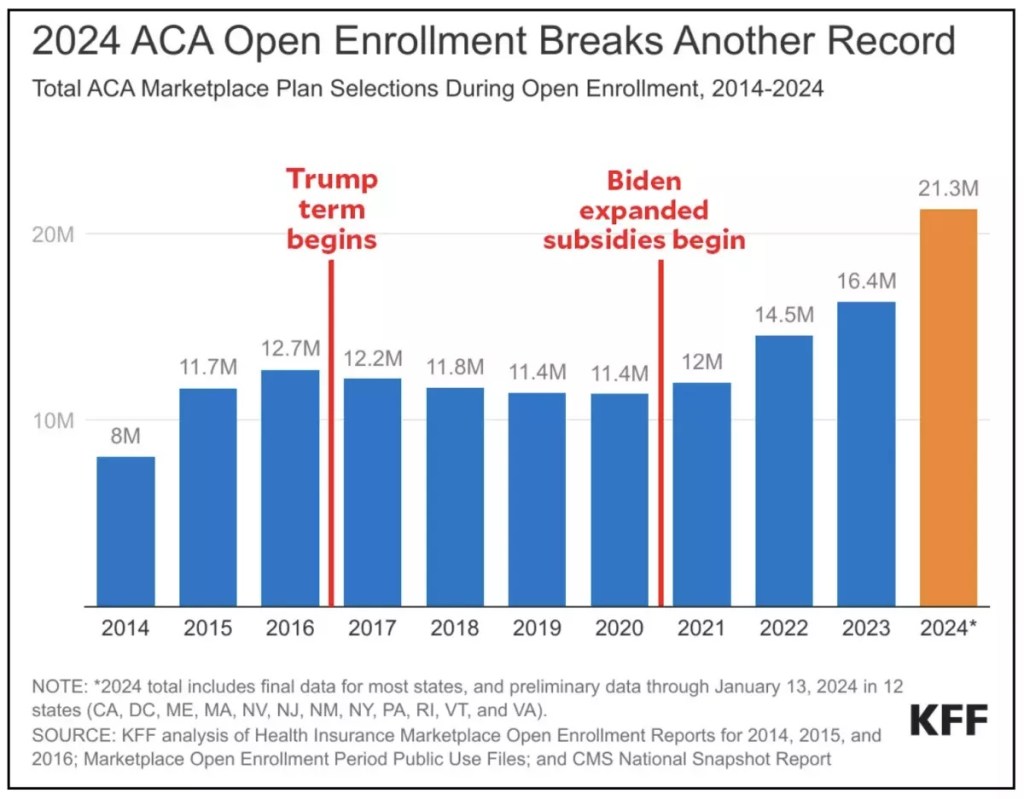
Trump drove down Obamacare enrollment every year he was in office; when Biden removed Trump’s obstacles, enrollment soared.
(KFF / Kevin Drum)
On Inauguration Day, Trump issued an executive order instructing the entire executive branch to find ways to “waive, defer, grant exemptions from, or delay the implementation of any provision or requirement” of the ACA.
During his presidency, he never abandoned the Republican dream of repealing Obamacare, even after July 28, 2017, when the late Sen. John McCain (R-Ariz.) strode to the Senate well and delivered a thumbs-down coup de grace to a GOP repeal bill.
Trump never ceased slandering the ACA as a “disaster.” He returned to the theme during last month’s debate: “Obamacare was lousy healthcare,” he said. “Always was. It’s not very good today.” As president, he threatened to make it “implode,” and used every tool he could get his fingers on to do so.
In September 2017 he slashed the advertising budget for the upcoming open enrollment period for individual insurance policies by a stunning 90%, to $10 million from the previous year’s $100 million. He also cut funds for nonprofit groups that employ “navigators,” those who help people in the individual market understand their options and sign up, by roughly 40%, to $36.8 million from $62.5 million.
Just after taking office, he abruptly canceled the customary last-minute advertising blitz to encourage enrollments in Obamacare plans before open enrollment ended on Jan. 31. The last minute surge in enrollments, which had occurred every previous year, vanished. The drop-off was particularly devastating because it was concentrated among the healthiest potential enrollees — those who often wait until the last minute to sign up and whose premiums generally subsidize older, less healthy patients.
The impact these policies had on enrollment was inescapable. In the three years before Trump took office, ACA marketplace plans experienced annual enrollment increases, to 12.7 million enrollees in 2016 from 8 million in 2014. During every year of the Trump administration, enrollment declined, falling to 11.4 million in 2020.
Every year since Joseph Biden took office, enrollment has increased, reaching a record 21.3 million this year — an 86% increase over Trump’s last year.
As for Vance’s fatuous claim that Trump “worked in a bipartisan way to ensure that Americans had access to affordable care,” you have the right to ask what Vance has been smoking.
The only bipartisanship on the ACA during the Trump years, Cohn observes, were the actions of GOP senators such as McCain and Lisa Murkowski of Alaska to cooperate with Democrats to stave off their fellow Republicans’ anti-ACA vandalism.
Now onto Trump’s fantasy vision of his role in fighting the COVID pandemic. Speaking in a low-energy, exhausted monotone at a speech Tuesday in Milwaukee and reading at times from a binder, he praised himself for instituting Operation Warp Speed, which funded COVID vaccine development in record time and got them rolled out in January 2021.
“We did a great job with the pandemic. Never got the credit we deserved,” he said. He then veered into blaming China for the pandemic, a familiar topic. He said bluntly that the pandemic was “caused by the Wuhan lab. I said that from the beginning, came from Wuhan. And the Wuhan lab, it wasn’t from bats in a cave that was 2,000 miles away. … It’s really the China virus.”
As for the rest of his COVID performance, he said this: “We did a great job with the ventilators, the masks and the gowns and everything. … When we got here the cupboards, our cupboards, I used to say our cupboards were bare. … No president put anything in for a pandemic.” Then he segued into praising himself for a big tax cut, and COVID was forgotten.
A few points about this spiel:
Trump is correct that Operation Warp Speed was a significant achievement. But he didn’t follow up by advocating for its product, the COVID vaccine. Instead, he has thrown in his lot with fanatical anti-vaccine agitators such as Robert F. Kennedy. He has repeated an anti-vax mantra, promising, “I will not give one penny to any school that has a vaccine mandate or a mask mandate.” This is a formula for exposing children to vaccine-preventable diseases such as measles and even polio.
Trump’s reference to the Wuhan Institute of Virology as the source of SARS-CoV-2, the virus that causes COVID, underscores how closely the so-called lab-leak theory of COVID’s origins is tied to right-wing partisan politics. The theory originated with Trump acolytes at the State Department, who saw the accusation as a convenient weapon in Trump’s economic war with China.
To this day, not a speck of evidence has been produced to validate this claim; scientists versed in the relevant disciplines of virology and epidemiology say the evidence overwhelmingly supports the hypothesis that the virus reached humans via the wildlife trade, and that its journey may well have started with bats thousands of miles from Wuhan, China.
Trump is lying when he says his predecessors in the White House left him without resources. The truth is that Trump himself hobbled pandemic response from the start.
In 2016, in the wake of the Ebola epidemic in Africa, President Obama had established the the Directorate for Global Health Security and Biodefense at the National Security Council “to prepare for and, if possible, prevent the next outbreak from becoming an epidemic or pandemic,” in the words of its senior director, Beth Campbell. Trump dissolved it in 2018.
Due to these steps, the U.S. was fated to sleepwalk into the pandemic. The COVID death toll in the U.S. stands at more than 1.2 million, and its reported death rate from COVID of 341.1 per 100,000 population is the highest in the developed world.
Ventilators, masks and gowns? Trump placed the procurement of this essential personal protective equipment in the hands of his son-in-law, Jared Kushner, who handled the task incompetently. Kushner turned away urgent appeals from state and local officials for those supplies.
“The notion of the federal stockpile was it’s supposed to be our stockpile, it’s not supposed to be states’ stockpiles that they then use,” Kushner said at a briefing.
Following his remarks, the website of the government’s national strategic stockpile of medicines and supplies was changed from asserting that its purpose was to “support” the emergency efforts of state, local and tribal authorities by ensuring that “the right medicines and supplies get to those who need them most.” The new language redefined the stockpile’s role as “to supplement state and local supplies … as a short-term stopgap.”
Supplies of ventilators, masks and gowns remained scarce through the first months of the pandemic. A procurement official at a Massachusetts hospital system told me of having had to cut a deal with a shadowy broker offering 250,000 Chinese-made masks at an inflated price, completing the transaction for $1 million at a darkened warehouse five hours from home.
Trump made anti-science incompetence and disregard for the welfare of Americans part of our history. The same thing, or worse, looms on the horizon in a second Trump term.
My comment: who can forget that dramatic moment in 2017 when the late Senator John McCain strode down to the well of the Senate to cast the deciding vote not to repeal Obamacare by dramatically extending his good arm and showing a thumb’s down gesture? Trump forgot.
As to COVID, why didn’t Trump take credit for the vaccines produced by Iperatuon Warp Speed? If the scientists had called it “the TRUMP vaccine, he probably would have boasted about it. Instead, he threw his support to the anti-VAXX conspiracy theorists, which surely contributed to the death toll.
One of the best passages appears on pp. 14-15, where the judge writes:
“It is not for a legislator, a judge, or a Commander from The Handmaid’s Tale to tellthese women what to do with their bodies during this period when the fetus cannot survive outside the womb any more so than society could–or should–force them to serve as a human tissue bank or to give up a kidney for the sake of another.”
The state can no longer enforce its ban on abortion that took effect in 2022, a Fulton County judge said Monday, allowing the procedure again to be performed in Georgia after a doctor detects fetal cardiac activity.
Fulton County Superior Judge Robert McBurney issued an order Monday that said abortions must be regulated as they were before Georgia’s 2019 law took effect in July 2022 — meaning the procedure is again allowed up until about 22 weeks of pregnancy.
Fulton County Superior Court Judge Robert McBurney wrote in his order that “liberty in Georgia includes in its meaning, in its protections, and in its bundle of rights the power of a woman to control her own body, to decide what happens to it and in it, and to reject state interference with her healthcare choices.”
For only the second time in its 179-year history, the prestigious magazine Scientific American issued a Presidential endorsement. It endorsed Kamala Harris. The only other endorsement in its history was four years ago for Joe Biden. The magazine cares deeply about science, climate change, health, and factual evidence. For these reasons, it opposes Trump.
The editors of Scientific American wrote:
In the November election, the U.S. faces two futures. In one, the new president offers the country better prospects, relying on science, solid evidence and the willingness to learn from experience. She pushes policies that boost good jobs nationwide by embracing technology and clean energy. She supports education, public health and reproductive rights. She treats the climate crisis as the emergency it is and seeks to mitigate its catastrophic storms, fires and droughts.
In the other future, the new president endangers public health and safety and rejects evidence, preferring instead nonsensical conspiracy fantasies. He ignores the climate crisis in favor of more pollution. He requires that federal officials show personal loyalty to him rather than upholding U.S. laws. He fills positions in federal science and other agencies with unqualified ideologues. He goads people into hate and division, and he inspires extremists at state and local levels to pass laws that disrupt education and make it harder to earn a living.
Only one of these futures will improve the fate of this country and the world. That is why, for only the second time in our magazine’s 179-year history, the editors of Scientific American are endorsing a candidate for president. That person is Kamala Harris.
Before making this endorsement, we evaluated Harris’s record as a U.S. senator and as vice president under Joe Biden, as well as policy proposals she’s made as a presidential candidate. Her opponent, Donald Trump, who was president from 2017 to 2021, also has a record—a disastrous one. Let’s compare.
The COVID pandemic has been the greatest test of the American health-care system in modern history. Harris was vice president of an administration that boosted widespread distribution of COVID vaccines and created a program for free mail-order COVID tests. Wastewater surveillance for viruses has improved, allowing public health officials to respond more quickly when levels are high. Bird flu now poses a new threat, highlighting the importance of the Biden-Harris administration’s Office of Pandemic Preparedness and Response Policy.
Trump touted his pandemic efforts during his first debate with Harris, but in 2020 he encouraged resistance to basic public health measures, spread misinformation about treatments and suggested injections of bleach could cure the disease. By the end of that year about 350,000 people in the U.S. had died of COVID; the current national total is well over a million. Trump and his staff had one great success: Operation Warp Speed, which developed effective COVID vaccines extremely quickly. Remarkably, however, Trump plans billion-dollar budget cuts to the Centers for Disease Control and Prevention and the National Institutes of Health, which started the COVID-vaccine research program. These steps are in line with the guidance of Project 2025, an extreme conservative blueprint for the next presidency drawn up by many former Trump staffers. He’s also talked about ending the Office of Pandemic Preparedness and Response Policy, calling it a pork project.
Trump appointed the conservative U.S. Supreme Court justices who overturned Roe v. Wade, removing the constitutional right to a basic health-care procedure. He spreads misinformation about abortion—during the September debate, he said some states support abortion into the ninth month and beyond, calling it “execution after birth.” No state allows this. He also refused to answer the question of whether he would veto a federal abortion ban, saying Congress would never approve such a ban in the first place. He made no mention of an executive order and praised the Supreme Court, three justices of which he placed, for sending abortion back to states to decide. This ruling led to a patchwork of laws and entire sections of the country where abortion is dangerously limited.
GUN SAFETY
The Biden-Harris administration closed the gun-show loophole, which had allowed people to buy guns without a license. The evidence is clear that easy access to guns in the U.S. has increased the risk of suicides, murder and firearm accidents. Harris supports a program that temporarily removes guns from people deemed dangerous by a court.
Trump promised the National Rifle Association that he would get rid of all Biden-Harris gun measures. Even after Trump was injured and a supporter was killed in an attempted assassination, the former president remained silent on gun safety. His running mate, J. D. Vance, said the increased number of school shootings was an unhappy “fact of life” and the solution was stronger school security.
ENVIRONMENT AND CLIMATE
Harris said pointedly during the September debate that climate change was real. She would continue the responsible leadership shown by Biden, who has undertaken the most substantial climate action of any president. The Biden-Harris administration restored U.S. membership in the Paris Agreement on coping with climate change. Harris’s election would continue IRA tax credits for clean energy, as well as regulations to reduce power-plant emissions and coal use. This approach puts the country on course to spend the authorized billions of dollars for renewable energy that should cut U.S. carbon emissions in half by 2030. The IRA also includes a commitment to broadening electric vehicle technology.
Trump has said climate change is a hoax, and he dodged the question “What would you do to fight climate change?” during the September debate. He pulled the U.S. out of the Paris Agreement. Under his direction the Environmental Protection Agency and other federal agencies abandoned more than 100 environmental policies and rules, many designed to ensure clean air and water, restrict the dangers of toxic chemicals and protect wildlife. He has also tried to revoke funding for satellite-based climate-research projects.
TECHNOLOGY
The Biden-Harris administration’s 2023 Executive Order on Safe, Secure and Trustworthy Development and Use of Artificial Intelligence requires that AI-based products be safe for consumers and national security. The CHIPS and Science Act invigorates the chipmaking industry and semiconductor research while growing the workforce. A new Trump administration would undo all of this work and quickly. Under the devious and divisive Project 2025 framework, technology safeguards on AI would be overturned. AI influences our criminal justice, labor and health-care systems. As is the rightful complaint now, there would be no knowing how these programs are developed, how they are tested or whether they even work.
The 2024 U.S. ballots are also about Congress and local officials—people who make decisions that affect our communities and families. Extremist state legislators in Ohio, for instance, have given politicians the right to revoke any rule from the state health department designed to limit the spread of contagious disease. Other states have passed similar measures. In education, many states now forbid lessons about racial bias. But research has shown such lessons reduce stereotypes and do not prompt schoolchildren to view one another negatively, regardless of their race. This is the kind of science MAGA politicians ignore, and such people do not deserve our votes.
At the top of the ballot, Harris does deserve our vote. She offers us a way forward lit by rationality and respect for all. Economically, the renewable-energy projects she supports will create new jobs in rural America. Her platform also increases tax deductions for new small businesses from $5,000 to $50,000, making it easier for them to turn a profit. Trump, a convicted felon who was also found liable of sexual abuse in a civil trial, offers a return to his dark fantasies and demagoguery, whether it’s denying the reality of climate change or the election results of 2020 that were confirmed by more than 60 court cases, including some that were overseen by judges whom he appointed.
One of two futures will materialize according to our choices in this election. Only one is a vote for reality and integrity. We urge you to vote for Kamala Harris.
Kavitha Surana of ProPublica wrote the story of what happened to Amber Nicole Thurman. She died because it was illegal in Georgia to give her the care she needed when she needed it. She didn’t have to die. The anti-abortion Republican legislators in her state killed her. The “pro-life” movement killed her. The conservative majority on the U.S. Supreme Court killed her. Governor Brian Kemp killed her. Shameful!
She’d taken abortion pills and encountered a rare complication; she had not expelled all of the fetal tissue from her body. She showed up at Piedmont Henry Hospital in need of a routine procedure to clear it from her uterus, called a dilation and curettage, or D&C.
In her final hours, Amber Nicole Thurman suffered from a grave infection that her suburban Atlanta hospital was well-equipped to treat.
But just that summer, her state had made performing the procedure a felony, with few exceptions. Any doctor who violated the new Georgia law could be prosecuted and face up to a decade in prison.
Thurman waited in pain in a hospital bed, worried about what would happen to her 6-year-old son, as doctors monitored her infection spreading, her blood pressure sinking and her organs beginning to fail.
It took 20 hours for doctors to finally operate. By then, it was too late.
The otherwise healthy 28-year-old medical assistant, who had her sights set on nursing school, should not have died, an official state committee recently concluded.
Tasked with examining pregnancy-related deaths to improve maternal health, the experts, including 10 doctors, deemed hers “preventable” and said the hospital’s delay in performing the critical procedure had a “large” impact on her fatal outcome.
Their reviews of individual patient cases are not made public. But ProPublica obtained reports that confirm that at least two women have already died after they couldn’t access legal abortions and timely medical care in their state.
There are almost certainly others.
Committees like the one in Georgia, set up in each state, often operate with a two-year lag behind the cases they examine, meaning that experts are only now beginning to delve into deaths that took place after the Supreme Court overturned the federal right to abortion.
Thurman’s case marks the first time an abortion-related death, officially deemed “preventable,” is coming to public light. ProPublica will share the story of the second in the coming days. We are also exploring other deaths that have not yet been reviewed but appear to be connected to abortion bans.
Doctors warned state legislators women would die if medical procedures sometimes needed to save lives became illegal.
Though Republican lawmakers who voted for state bans on abortion say the laws have exceptions to protect the “life of the mother,” medical experts cautioned that the language is not rooted in science and ignores the fast-moving realities of medicine.
The most restrictive state laws, experts predicted, would pit doctors’ fears of prosecution against their patients’ health needs, requiring providers to make sure their patient was inarguably on the brink of death or facing “irreversible” harm when they intervened with procedures like a D&C.
“They would feel the need to wait for a higher blood pressure, wait for a higher fever — really got to justify this one — bleed a little bit more,” Dr. Melissa Kottke, an OB-GYN at Emory, warned lawmakers in 2019 during one of the hearings over Georgia’s ban.
Doctors and a nurse involved in Thurman’s care declined to explain their thinking and did not respond to questions from ProPublica. Communications staff from the hospital did not respond to multiple requests for comment. Georgia’s Department of Public Health, which oversees the state maternal mortality review committee, said it cannot comment on ProPublica’s reporting because the committee’s cases are confidential and protected by federal law.
The availability of D&Cs for both abortions and routine miscarriage care helped save lives after the 1973 Supreme Court ruling in Roe v. Wade, studies show, reducing the rate of maternal deaths for women of color by up to 40% the first year after abortion became legal.
Such stories have been at the center of the upcoming presidential election, during which the right to abortion is on the ballot in 10 states.
But Republican legislators have rejected small efforts to expand and clarify health exceptions — even in Georgia, which has one of the nation’s highest rates of maternal mortality and where Black women are three times more likely to die from pregnancy-related complications than white women.
When its law went into effect in July 2022, Gov. Brian Kemp said he was “overjoyed” and believed the state had found an approach that would keep women “safe, healthy and informed.”
After advocates tried to block the ban in court, arguing the law put women in danger, attorneys for the state of Georgia accused them of “hyperbolic fear mongering.”
Two weeks later, Thurman was dead.
Thurman and her son in a photo she posted on social media the year before her death Credit: via Facebook
Thurman, who carried the full load of a single parent, loved being a mother. Every chance she got, she took her son to petting zoos, to pop-up museums and on planned trips, like one to a Florida beach. “The talks I have with my son are everything,” she posted on social media.
But when she learned she was pregnant with twins in the summer of 2022, she quickly decided she needed to preserve her newfound stability, her best friend, Ricaria Baker, told ProPublica. Thurman and her son had recently moved out of her family’s home and into a gated apartment complex with a pool, and she was planning to enroll in nursing school.
The timing could not have been worse. On July 20, the day Georgia’s law banning abortion at six weeks went into effect, her pregnancy had just passed that mark, according to records her family shared with ProPublica.
Thurman wanted a surgical abortion close to home and held out hope as advocates tried to get the ban paused in court, Baker said. But as her pregnancy progressed to its ninth week, she couldn’t wait any longer. She scheduled a D&C in North Carolina, where abortion at that stage was still legal, and on Aug. 13 woke up at 4 a.m. to make the journey with her best friend.
On their drive, they hit standstill traffic, Baker said. The clinic couldn’t hold Thurman’s spot longer than 15 minutes — it was inundated with women from other states where bans had taken effect. Instead, a clinic employee offered Thurman a two-pill abortion regimen approved by the U.S. Food and Drug Administration, mifepristone and misoprostol. Her pregnancy was well within the standard of care for that treatment.
Getting to the clinic had required scheduling a day off from work, finding a babysitter, making up an excuse to borrow a relative’s car and walking through a crowd of anti-abortion protesters. Thurman didn’t want to reschedule, Baker said.
At the clinic, Thurman sat through a counseling session in which she was told how to safely take the pills and instructed to go to the emergency room if complications developed. She signed a release saying she understood. She took the first pill there and insisted on driving home before any symptoms started, Baker said. She took the second pill the next day, as directed.
Deaths due to complications from abortion pills are extremely rare. Out of nearly 6 million women who’ve taken mifepristone in the U.S. since 2000, 32 deaths were reported to the FDA through 2022, regardless of whether the drug played a role. Of those, 11 patients developed sepsis. Most of the remaining cases involved intentional and accidental drug overdoses, suicide, homicide and ruptured ectopic pregnancies.
Baker and Thurman spoke every day that week. At first, there was only cramping, which Thurman expected. But days after she took the second pill, the pain increased and blood was soaking through more than one pad per hour. If she had lived nearby, the clinic in North Carolina would have performed a D&C for free as soon as she followed up, the executive director told ProPublica. But Thurman was four hours away.
On the evening of Aug. 18, Thurman vomited blood and passed out at home, according to 911 call logs. Her boyfriend called for an ambulance. Thurman arrived at Piedmont Henry Hospital in Stockbridge at 6:51 p.m.
ProPublica obtained the summary narrative of Thurman’s hospital stay provided to the maternal mortality review committee, as well as the group’s findings. The narrative is based on Thurman’s medical records, with identifying information removed. The committee does not interview doctors involved with the case or ask hospitals to respond to its findings. ProPublica also consulted with medical experts, including members of the committee, about the timeline of events.
Within Thurman’s first hours at the hospital, which says it is staffed at all hours with an OB who specializes in hospital care, it should have been clear that she was in danger, medical experts told ProPublica.
Her lower abdomen was tender, according to the summary. Her white blood cell count was critically high and her blood pressure perilously low — at one point, as Thurman got up to go to the bathroom, she fainted again and hit her head. Doctors noted a foul odor during a pelvic exam, and an ultrasound showed possible tissue in her uterus.
The standard treatment of sepsis is to start antibiotics and immediately seek and remove the source of the infection. For a septic abortion, that would include removing any remaining tissue from the uterus. One of the hospital network’s own practices describes a D&C as a “fairly common, minor surgical procedure” to be used after a miscarriage to remove fetal tissue.
After assessing her at 9:38 p.m., doctors started Thurman on antibiotics and an IV drip, the summary said. The OB-GYN noted the possibility of doing a D&C the next day.
But that didn’t happen the following morning, even when an OB diagnosed “acute severe sepsis.” By 5:14 a.m., Thurman was breathing rapidly and at risk of bleeding out, according to her vital signs. Even five liters of IV fluid had not moved her blood pressure out of the danger zone. Doctors escalated the antibiotics.
Instead of performing the newly criminalized procedure, they continued to gather information and dispense medicine, the summary shows.
Doctors had Thurman tested for sexually transmitted diseases and pneumonia.
They placed her on Levophed, a powerful blood pressure support that could do nothing to treat the infection and posed a new threat: The medication can constrict blood flow so much that patients could need an amputation once stabilized.
At 6:45 a.m., Thurman’s blood pressure continued to dip, and she was taken to the intensive care unit.
At 7:14 a.m., doctors discussed initiating a D&C. But it still didn’t happen. Two hours later, lab work indicated her organs were failing, according to experts who read her vital signs.
At 12:05 p.m., more than 17 hours after Thurman had arrived, a doctor who specializes in intensive care notified the OB-GYN that her condition was deteriorating.
Thurman was finally taken to an operating room at 2 p.m.
By then, the situation was so dire that doctors started with open abdominal surgery. They found that her bowel needed to be removed, but it was too risky to operate because not enough blood was flowing to the area — a possible complication from the blood pressure medication, an expert explained to ProPublica. The OB performed the D&C but immediately continued with a hysterectomy.
During surgery, Thurman’s heart stopped.
Her mother was praying in the waiting room when one of the doctors approached. “Come walk with me,” she said.
Until she got the call from the hospital, her mother had no idea Thurman had been pregnant. She recalled her daughter’s last words before she was wheeled into surgery — they had made no sense coming from a vibrant young woman who seemed to have her whole life ahead of her:
“Promise me you’ll take care of my son.”
Thurman and her son in a selfie she posted online in 2020, two years before her death Credit: via Facebook
Candi Miller’s health was so fragile, doctors warned having another baby could kill her.
But when the mother of three realized she had unintentionally gotten pregnant in the fall of 2022, Georgia’s new abortion ban gave her no choice. Although it made exceptions for acute, life-threatening emergencies, it didn’t account for chronic conditions, even those known to present lethal risks later in pregnancy.
At 41, Miller had lupus, diabetes and hypertension and didn’t want to wait until the situation became dire. So she avoided doctors and navigated an abortion on her own — a path many health experts feared would increase risks when women in America lost the constitutional right to obtain legal, medically supervised abortions.
Miller ordered abortion pills online, but she did not expel all the fetal tissue and would need a dilation and curettage procedure to clear it from her uterus and stave off sepsis, a grave and painful infection. In many states, this care, known as a D&C, is routine for both abortions and miscarriages. In Georgia, performing it had recently been made a felony, with few exceptions.
Due to Georgia’s harsh abortion law, she did not get the routine care that would have saved her life. She was killed by the law.
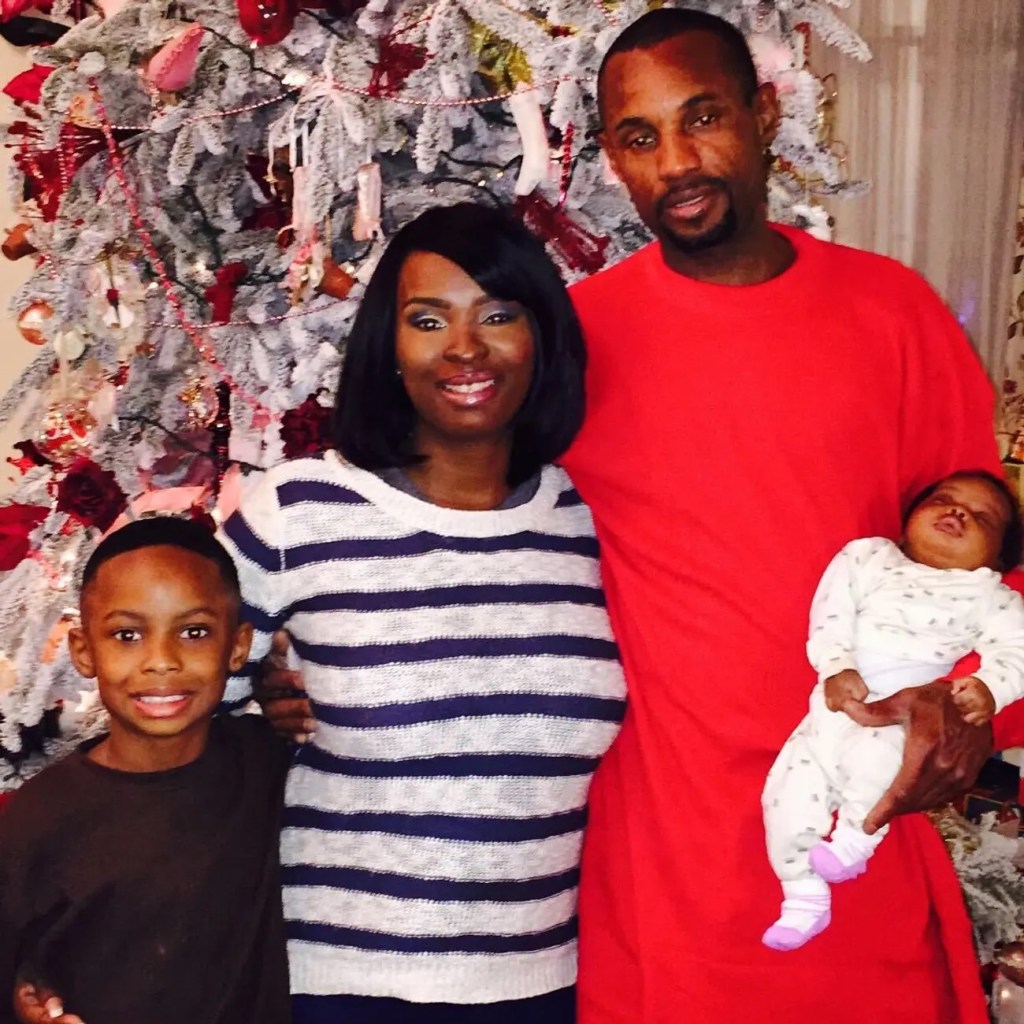
Candi Miller with her husband and her two children.



 Diane Ravitch's blog