Archives for category: Harris, Kamala

The CBS News program “60 Minutes” has interviewed every major-party candidate in Presidential elections since 1968. Not this year. Trump rejected the invitation. After Kamala’s interview appeared, Trump said repeatedly that her interview had been edited to show her more favorably. He complained to the FCC and demanded that CBS lose its license.

Trump loves to play the victim and the martyr, which helps him connect to his base. Playing the victim enables his base to forget that he is a billionaire, who lives in splendor, and a draft-dodger who belittles the military.

CBS doesn’t usually respond to complaints, but they did this time. They also invited him to appear at a time of his choosing. Trump prefers friendly interviewers.

The Los Angeles Times reported:

In a rare rebuke, the CBS news magazine “60 Minutes” denied charges by former President Trump that the program doctored an answer in Vice President Kamala Harris’ recent interview to make her look better to viewers.

CBS ran an excerpt of the Democratic presidential candidate’s interview on “Face the Nation” the day before it ran in a special edition of “60 Minutes” that aired Oct. 7. The answer to a query about the Biden’s administration’s handling of the Israel-Gaza war was different from the one that aired on the program.

In speeches and appearances on his favorite conservative media outlets, Trump, the Republican presidential nominee, insists CBS was deceiving the public by editing the answer for the program as a way to put Harris in a more favorable light.

“This is false,” the program said in a statement posted Sunday on X. “’60 Minutes’ gave an excerpt of our interview to ‘Face the Nation’ that used a longer section of her answer than that on ’60 Minutes.’ Same question. Same answer but a different portion of the response.”

The portion used on “60 Minutes” was “more succinct, which allows time for other subjects in a wide ranging 21 minute long segment.”
Harris’ entire answer appears in a transcript on the CBS News website.

Barack Obama is a skilled orator, probably the best of our time. In this 3-minute clip, he asks the quintessential question. Trump says to Kamala, “You were there for four years, why didn’t you solve the border problem?” Obama asks of Trump, “Dude, you were there for four years, why didn’t you solve the problem?”

I have recently been following @MarkHertling on Twitter. He had a long career in the U.S. Army. He frequently teaches the principles of leadership.

He recently tweeted what he calls “the traits of a successful leader.” Since we are about to select our national leader for the next four years, I decided to post his list:

At the @WimedicineOrg conference, a 3d yr resident asked me what traits I’ve seen in successful leaders.

Here’s what I said:
-Character, integrity and humility
-Accepting the inherent good in ALL people
-The ability to name the values that guide them
-Polished communication skills
-Presence
-A vision for the future
-The desire to develop others
-A desire to learn & grow daily
-Getting things done (while not seeking credit)

Eugene Robinson, a regular columnist for The Washington Post, says that Bret Baier intended to make Kamala Harris look bad when he interviewed her on FOX News, but he actually allowed her to demonstrate that she’s articulate, fearless, and strong.

He writes:

One of the people Vice President Kamala Harris might want to thank in her victory speech, if she wins the election, is Fox News anchor Bret Baier. His combative interview Wednesday gave Harris the chance to display qualities — and present facts — that Donald Trump desperately wants to keep hidden from the network’s millions of viewers.

Don’t take it from me; take it from Baier himself. He said afterward that he thought Harris came to the interview seeking “a viral moment” and added: “I think she may have gotten that.”

Baier was surely referring to the exchange about Trump’s repeated threat to deploy the U.S. military against domestic critics he calls “the enemy within” — using the language of totalitarian despots. Baier presented a too-brief clip from a town hall event, aired on Fox earlier Wednesday, in which Trump denied saying any such thing. This was gaslighting: A slightly longer clip would have shown Trump railing against “the enemy from within” and naming two leading Democrats, Reps. Nancy Pelosi and Adam Schiff, as being part of that “sick” group.

Baier obviously knew that — and Harris called him on it.

“Bret, I’m sorry, and with all due respect, that clip was not what he has been saying about the ‘enemy within,’ that he has repeated. … That’s not what you just showed,” Harris said forcefully. “Here’s the bottom line: He has repeated it many times, and you and I both know that. And you and I both know that he has talked about turning the American military on the American people. He has talked about going after people who are engaged in peaceful protest. He has talked about locking people up because they disagree with him.”

Only after having her say — and mentioning that retired Gen. Mark A. Milley, who was chairman of the Joint Chiefs of Staff under Trump, believes he is a threat to U.S. democracy and national security — did she let Baier move on to another topic.

Practically since the day Harris became the Democratic nominee, Fox News hosts and guests have blasted her for not doing more unscripted interviews. Wednesday’s half-hour encounter was a reminder that we should all be careful what we wish for.

From start to finish, Baier was more of an inquisitor than an interviewer; there was none of the deference that fellow Fox anchor Harris Faulkner had given Trump when she moderated his town hall. Baier repeatedly interrupted the vice president, trying to talk over her and posing questions seemingly cut and pasted from the list of Republican talking points.

Intentionally or not, all of this was a gift to Harris. She stood her ground, refuting the Trump campaign’s claim that she is weak and easily pushed around. She spoke fluently and cogently, putting to rest GOP claims that all she offers is word salad. She brushed off the most tendentious questions, engaged with the substantive ones, and insisted on finishing her answers whether or not Baier liked it.

When he laid an obvious trap, asking whether she thought the millions of voters who support Trump are “stupid,” she sidestepped it with ease. “Oh, God, I would never say that about the American people,” she said — before reminding Baier of some of the vicious things Trump does say about Americans who oppose him.

Harris got to present facts that Fox tries to keep its audience from learning. Viewers heard that Harris had just come from a rally attended by 100 prominent Republicans who are crossing party lines to endorse her candidacy. They heard about the host of Trump administration officials who oppose giving their former boss another term in office. They heard Harris say she does not favor “decriminalizing” undocumented border crossings, despite what some Fox hosts regularly claim.

Fox viewers heard, perhaps for the first time, that Harris has offered concrete plans to boost the economy and support middle-class families. And they learned about all the economists who say Trump’s policies, compared with hers, will make inflation much worse and add trillions of dollars to the national debt.

In a contest that polls show as margin-of-error close, will Harris’s foray into hostile territory make any difference? Who knows. It is hard for me to imagine anything Harris might say or do that would weaken the bond between Trump and the core MAGA faithful. They are accustomed to believing what their Dear Leader says over the “lies” told by their own eyes and ears.

But there are moderate Republicans and right-leaning independents who recognize Trump’s faults but have been told by Fox News that Harris is insubstantial, inarticulate and unqualified. If they watched the interview, they saw a woman whose policies they might not love but who has command of the issues, handles pressure with ease and is nobody’s pushover. Those voters saw a viable alternative to four more years of Trump and his insanity.

Some might think Baier was properly adversarial, others might think he was obnoxiously rude. Either way, the Harris campaign ought to send him flowers.

In my household, there was a vigorous debate about whether Kamala Harris should sit for an interview with Bret Baier of FOX News. Was it wise to enter the Lion’s den? I thought it was a great idea; Mary did not. From what I have read, it was a debate, not an interview, as Baier turned his questions into MAGA talking points.

Heather Cox Richardson watched the debate and believes that Kamala was dominant, even though Baier repeatedly interrupted her, spoke over her, and didn’t let her finish her answers to his questions.

She wrote:

Two Fox News Channel interviews bracketed today: one this morning with Republican presidential candidate Donald Trump in front of an audience of hand-picked Republican women in Georgia, the other by Democratic presidential candidate Vice President Kamala Harris with host Bret Baier. Together, the two were a performance of dominance. 

FNC billed Trump’s so-called town hall as a chance for female voters, a demographic that is swinging heavily to Harris, to ask Trump about issues they care about. But Hadas Gold and Liam Reilly of CNN reported that FNC had packed the audience with Trump supporters. The first question came from the president of the Fulton County Republican Women, though she was not identified as such. FNC then edited the broadcast to cut out remarks in which the attendees expressed support for Trump. 

It seems unlikely that Trump attracted any new voters by speaking to an audience of loyalists audibly cheering him on.

After Trump refused to debate her again, Harris voluntarily moved into his right-wing territory, agreeing to an interview with FNC host Bret Baier. In that interview, Baier reframed right-wing talking points as questions, essentially giving Trump a second shot at a debate. Baier kept talking over the vice president’s attempts to answer—even putting out a hand to interrupt her—in a stark contrast to FNC’s deference to Trump. Harris asked him to let her reply, and then answered his questions, sometimes testily, usually turning them into opportunities to contrast her own candidacy and record with Trump’s. 

Control of the interview changed abruptly when Harris called out Trump for referring to the “enemy within” and talking about using the American military against those he considers enemies. Baier used that opportunity to show a clip of Trump saying he wasn’t threatening anyone, but the clip was edited to remove his threats against “sick,” “evil,” “dangerous” “Marxists and communists and fascists” including Representative Adam Schiff (D-CA) and “the Pelosis”—presumably former House speaker Nancy Pelosi (D-CA) and her husband, who was attacked by a man with a hammer in 2022 by a man who wanted to force Nancy Pelosi to renounce the investigation into the 2016 Trump campaign’s ties to Russia. 

Harris had had enough propaganda.

“Bret, I’m sorry, and with all due respect, that clip was not what he has been saying about the enemy within that he has repeated when he’s speaking about the American people. That’s not what you just showed…. You and I both know that he’s talked about turning the American military on the American people. He has talked about going after people who are engaged in peaceful protest. He has talked about locking people up because they disagree with him. This is a democracy. And in a democracy, the president of the United States in the United States of America should be… able to handle criticism without saying he’d lock people up for doing it. And this is what is at stake, which is why you have someone like the former chairman of the Joint Chiefs of Staff saying what Mark Milley has said about Donald Trump being a threat to the United States of America.” 

Simply by going on the right-wing network, Harris was demonstrating dominance. Then, by answering as thoroughly as she did, she undercut the right-wing narrative that she is stupid and inarticulate. By calling out the FNC for deliberately misleading its viewers, she took command. Baier, rather than Harris, was the one doing the post-interview spinning.

Writer Peter Wehner, who worked for presidents Ronald Reagan, George H.W. Bush, and George W. Bush, wrote: “Bret Baier has rarely looked as bad (or tendentious) as he did in his interview with Kamala Harris. On the flip side, this was one of her best interviews. She dominated Bret. All in all it was quite a bad day for MAGA world’s most important media outlet.”

In between the two FNC events were two others that also told a story, this one about how the Republican Party’s descent into MAGA is creating a new political coalition to defend American principles.

Trump held a town hall with undecided Latino voters moderated by Mexican journalist Enrique Acevedo for Univision. Members of the audience asked excellent questions: how would he bring down household costs, who would take the jobs left behind by undocumented workers if Trump deported them and how much would that drive up food costs, why Trump took so long to stop the January 6 rioters, if he had caused deaths during the pandemic by misleading Americans, and if he agrees with his wife, Melania, about protecting abortion rights. 

But Trump did not answer the questions, instead regurgitating his usual talking points. He promised to produce more oil and gas, called undocumented immigrants criminals, repeated the lie about Haitian migrants eating pets, and, after notably referring to the January 6 rioters as “we” and law enforcement officers as “the others,” called January 6 “a day of love.” The audience did not appear convinced.

Meanwhile, Vice President Harris joined more than 100 Republicans in Pennsylvania, near the spot where George Washington and more than 2,000 Continental soldiers crossed the Delaware River on Christmas night 1776 to surprise a garrison of British soldiers at Trenton, New Jersey, where they won a strategic victory. 

Harris noted that those gathered were also near Philadelphia, where in 1787 delegates from across the country gathered to write and sign the U.S. Constitution. 

“That work was not easy. The founders often disagreed. Often quite passionately. But in the end, the Constitution of the United States laid out the foundations of our democracy, including the rule of law, that there would be checks and balances, that we would have free and fair elections and a peaceful transfer of power. And these principles and traditions have sustained our nation for over two centuries, sustained because generations of Americans, from all backgrounds, from all beliefs, have cherished them, upheld them, and defended them. 

“And now, the baton is in our hands,” she said. [A]t stake in this race are the democratic ideals that our founders and generations of Americans before us have fought for. At stake in this election is the Constitution of the United States…its very self.” 

Harris welcomed the Republicans in the crowd, saying that everyone there shared a core belief: “That we must put country before party.” The crowd chanted, “USA, USA, USA.” 

Harris noted that many of the Republicans on stage had taken the same oath to the Constitution that she had. “We here know the Constitution is not a relic from our past, but determines whether we are a country where the people can speak freely, and even criticize the president, without fear of being thrown in jail, or targeted by the military. Where the people can worship as they choose without the government interfering. Where you can vote without fear that your vote will be thrown away. All this and more depends on whether or not our leaders honor their oath to the Constitution.”

Trump, she pointed out, tried to overturn the will of the people expressed in a free and fair election, has vowed to use the military to go after any American who doesn’t support him, and has called for the “termination” of the Constitution. “It is clear,” she said, “Donald Trump is increasingly unstable and unhinged, and he is seeking unchecked power.” Trump, she said, “must never again stand behind the seal of the President of the United States.”

“And to those who are watching,” she said, “if you share that view, no matter your party, no matter who you voted for last time: There is a place for you in this campaign. The coalition we have built has room for everyone who is ready to turn the page on the chaos and instability of Donald Trump.”

“I pledge to you to be a President for all Americans. And I take that pledge seriously.”

She reiterated her promise to appoint a Republican to her cabinet and to establish a Council on Bipartisan Solutions to strengthen the middle class, secure the border, defend our freedoms, and maintain the nation’s leadership in the world. She noted that the country needs a healthy two-party system, and described how the Senate Intelligence Committee left partisanship at the door. It “was “country over party in action,” when she sat on the committee, she said, “[s]o I know it can be done.”

“[O]ur campaign is not a fight against something,” she said. “It is a fight for something. It is a fight for the fundamental principles upon which we were founded, It is a fight for a new generation of leadership that is optimistic about what we can achieve together—Republicans, Democrats, and independents who want to move past the politics of division and blame and get things done on behalf of the American people.

“[W]e are all here together this beautiful afternoon because we love our country…and we know the deep privilege and pride that comes with being an American and the duty that comes along with it…. Imperfect though we may be, America is still that ‘shining city upon a hill’ that inspires people around the world. And I do believe it is one of the highest forms of patriotism to fight for the ideals of our country.”

“So, to people from across Pennsylvania, and across our nation, let us together stand up for the rule of law, for our democratic ideals, and for the Constitution of the United States. And in twenty days, we have the power to chart a New Way Forward, one that is worthy of this magnificent country that we are all blessed to call home.” 

A man named Matthew D. Taylor (@TaylorMatthewD) writes on Twitter about a violent cult called the New Apostolic Reformation. NAR held a rally on Friday on the mall in Washington, DC. It was called the Million women March but it was decidedly anti-feminist. Its members and followers are passionately pro-Trump. The last speech of the day came from a leader who prophesied the election of Trump and described Kamala Harris to Jezebel. The tweets quote the Biblical passage in which Jezebel is thrown out of a window to the ground, where she is trampled by Jehu’s horse, then consumed by hungry dogs.

An illustration shows a pack of dogs consuming the body of a woman of color.

Is this an assassination threat?

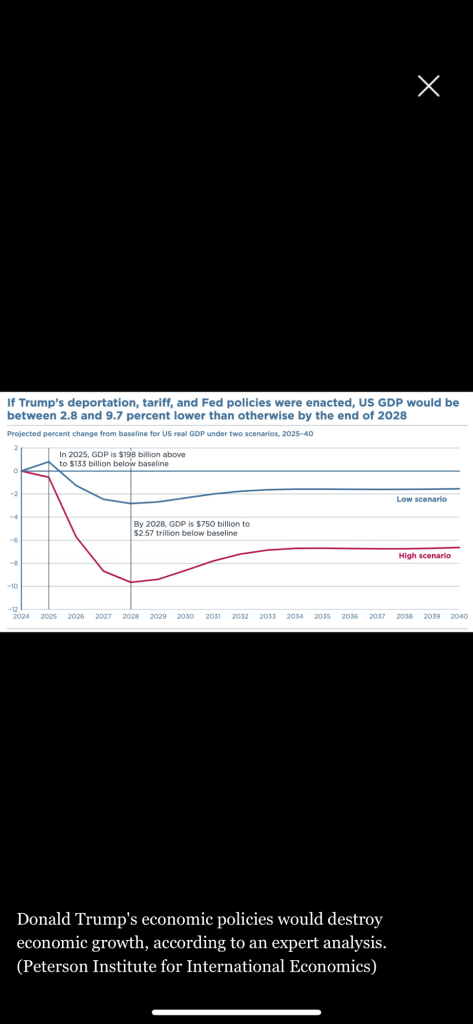
Michael Hiltzik, the business columnist of the Los Angeles Times, read a recent report by the Committee for a Responsible Federal Budget. The report said that Harris’s plans would add $3.5 trillion to the federal debt and Trump’s would add $7.5 trillion. I certainly don’t have the expertise to analyze these numbers, but Hiltzik does. That’s what this column is about. He explains why Trump’s policies would “crater the economy.”

He writes:

If you are wired into the flow of campaign news — as I am, for my sins — you will be inundated this week with reports of a new analysis of the fiscal impact of the economic proposals of Donald Trump and Kamala Harris.

Long story short: Trump’s would be much worse in terms of increasing the federal debt than Harris’. According to the study issued Monday by the Committee for a Responsible Federal Budget, Harris’ policies would expand the debt by $3.5 trillion over 10 years, Trump’s by $7.5 trillion.
These are eye-catching figures, to be sure. They’re also completely worthless for assessing the true economic effects of the candidates’ proposals, for several reasons.

One is the committee’s single-minded — indeed, simple-minded — focus on the direct effects of the proposals on the federal deficit and national debt. That’s not surprising, because (as I’ve reported in the past) the CRFB was created to be a deficit scold, funded by the late hedge fund billionaire Peter G. “Pete” Peterson.

For instance, the CRFB has been a consistent voice, as was Peterson, in campaigns to cut Social Security and Medicare benefits on the preposterous grounds that the U.S., the richest country on Earth, can’t afford the expense. (Peterson’s foundation still provides a significant portion of the committee’s budget.)

This focus on the national debt and the federal deficit as a linchpin of economic policy dates back to the 1940s among Republicans and the 1970s among Democrats. Throughout that period it made policymaking more austere and left the country without the resources to address real economic needs such as poverty while increasing inequality.

The harvest, as economist Brad DeLong of UC Berkeley has noted, was the rise of a policy that failed everyone but the rich. Trump would continue that policy; Harris would continue the Biden administration’s effort to return the U.S. to a government that serves all the people.

The worst shortcoming of the CRFB’s analysis is that it’s hopelessly narrow. Its focus is on the first-order effects of the individual proposals on federal income and spending, without paying much attention to the dynamic economic effects of those policies. Would the policy spur more growth over time, or less?

Another problem with the analysis is that the candidates’ proposals are inchoate — as the committee acknowledges. The committee cobbled together their purported platforms from written policy statements, social media posts and dubious other sources and then absurdly claimed that its effort helped to “clarify [the] policy details.”

The committee estimates the direct cost of Harris’ proposal to extend and increase the health insurance subsidies created by the Affordable Care Act and improved by the Biden administration at $350 billion to $600 billion over 10 years; but what would be the gains in gross domestic product from reducing the cost of healthcare for the average household?

The committee barely even acknowledges that this is a salient issue. It says that in some of its estimates it accounts for “dynamic feedback effects on revenue and spending,” but also says, “we do not account for possible changes in GDP resulting from the candidates’ policies.”

The committee’s treatment of Trump’s tariff proposals demonstrate the vacuum at the heart of its analysis. It treats the income from Trump’s proposal — a 10% to 20% tariff on most imported goods and 60% on Chinese imports — as a revenue gain for the federal budget. Economists are all but unanimous in regarding tariffs as a tax on American consumers, however — in other words, a tax transferring household income to the Treasury.

The committee writes: “Such a significant change to trade policy could have economic and geopolitical repercussions that go beyond what a standard tax model would estimate.” As a result, “the true economic impact is hard to predict.” Thanks for nothing.

Uncertainties about the details of the candidates’ proposals resulted in laughably wide ranges in the committee’s fiscal estimates. The effect on the deficit and debt of Harris’ proposals is estimated at zero to $8.1 trillion over 10 years. For Trump’s plans, the range is $1.45 trillion to $15.15 trillion. What are voters or policymakers supposed to do with those figures?

The CRFB also reports a “central” estimate for both — $3.5-trillion expansion of debt for Harris, $7.5 trillion for Trump — but doesn’t say much about how it arrived at those figures, other than to say that sometimes it just split the difference between the high and low estimates, and sometimes relied on estimates of the individual proposals by the Congressional Budget Office and the congressional Joint Committee on Taxation.

I asked the CRFB to comment on the shortcomings listed above, but haven’t received a response.

Despite all that, the CRFB analysis showed up on the morning web pages of major newspapers and other media coast to coast on Monday, as though its conclusions were credible, solid and bankable. (Here at The Times, we passed.)

Consider the CRFB’s treatment of Trump’s deportation policy, which he has called the “largest deportation program in American history,” affecting at least 11 million undocumented immigrants and millions more who are in the U.S. legally.

The committee says that might increase the deficit by anywhere from zero to $1 trillion over a decade, with a middle-of-the-road estimate of $350 billion — “chiefly,” it said, “by reducing the number of people paying federal taxes.” It also cites unspecified “additional economic effects of immigration.”

The CRFB might have profited from reading an analysis of the deportation proposal produced in March by the Peterson Institute for International Economics, which was also funded by Pete Peterson but, staffed by economic eggheads with a wider intellectual horizon, tends to take a more intelligent approach to economic policy.

“The immigrants being targeted for removal are the lifeblood of several parts of the US economy,” the institute observed. “Their deportation will … prompt US business owners to cut back or start fewer new businesses, … while scaling back production to reflect the loss of consumers for their goods.”

The institute cited estimates that a deportation program in effect from 2008 to 2014 cost the jobs of 88,000 U.S. native workers for every 1 million unauthorized immigrant workers deported. Arithmetic tells us that, in those terms, deporting 11 million immigrants would cost the jobs of about 968,000 U.S. natives.

“The disappearance of migrant workers … dries up local demand at grocery stores, leasing offices, and other nontraded services,” the institute reported. “The resulting blow to demand for all workers overwhelms the reduction in supply of foreign workers.”

The institute was a lot more free-spoken than the CRFB about the effect of Trump’s proposed policies on economic growth. Considering only the deportations, tariffs and Trump’s desire to exercise more control over the Federal Reserve System, it concluded that by the end of Trump’s term, U.S. GDP would be as much as 9.7% lower than otherwise, employment would fall by as much as 9%, and inflation would climb by as much as 7.4 percentage points.


An overly sedulous focus on deficit reduction as economic policy has caused “real harm [for] the nation’s most vulnerable groups, including millions of debt-saddled and downwardly mobile Americans,” economic historian David Stein of the Roosevelt Institute and UC Santa Barbara wrote last month. When it became Democratic orthodoxy under Presidents Carter and Clinton, the party pivoted to “‘Reagan Democrats’ and suburban white voters at the expense of the labor and civil rights movements.”

As the federal government pulled back, “state budgets were ravaged,” Stein wrote. State and local services were slashed. The efforts to control federal debt forced households to take on more debt.

The deficit scolds are still at it and still have vastly more credibility than they deserve. That’s clear from the CRFB’s analysis and the alacrity with which it was republished as “news” Monday. Efforts to turn policy back to the point that it benefits everyone, not just the rich, still have a long way to go in this country.

Trump is weird. He says outrageous things whenever he speaks, and no one is shocked anymore. He lies and makes things up, and it’s another day on the campaign trail. It’s just Trump being Trump.

Trump was furious at CBS “60 Minutes” for allegedly editing Kamala Harris’s comments about Israel. He called it “election interference” and demanded that the FCC strip away CBS license to broadcast. The first question that occurred to me was, how did he know what she said before the conversation was edited (which is customary)?

The Washington Post pulled no punches in its story, pointing out Trump’s authoritarian bent.

Former president Donald Trump said Thursday that CBS News should lose a broadcasting license over how it edited a “60 Minutes” interview with Vice President Kamala Harris, even though the federal government does not issue licenses for such television networks.

It was the latest example of Trump calling for media outlets that have angered him to lose their rights to broadcast — a push that evokes government control of media, which is a hallmark of authoritarianism.

Federal Communications Commission Chairwoman Jessica Rosenworcel denounced Trump’s latest call targeting CBS, flatly rejecting an idea the independent agency has ruled out under both the Biden and Trump administrations.

“While repeated attacks against broadcast stations by the former President may now be familiar, these threats against free speech are serious and should not be ignored,” Rosenworcel said in a statement. “As I’ve said before, the First Amendment is a cornerstone of our democracy. The FCC does not and will not revoke licenses for broadcast stations simply because a political candidate disagrees with or dislikes content or coverage.”

CBS declined to comment.

Trump has been fixated for days on Harris’s interview with “60 Minutes,” which came after he backed out of sitting for his own interview with the show, according to the network. Since Harris’s interview aired Monday night, Trump has focused on how it featured a shorter version of Harris’s answer to a question about Israel than was shown in a clip previewing the interview.

It is standard for television networks to edit interviews for broadcast, especially to fit time restraints.

“Her REAL ANSWER WAS CRAZY, OR DUMB, so they actually REPLACED it with another answer in order to save her or, at least, make her look better,” Trump claimed in a post on his social media platform Thursday morning. “A FAKE NEWS SCAM, which is totally illegal. TAKE AWAY THE CBS LICENSE.”

Trump went on to baselessly accuse Democrats of making CBS “do this,” calling it “Election Interference” and saying the party should be forced to concede the election.

He later suggested that all broadcast licenses “should be bid out to the Highest Bidder.”

Trump raised the issue again during an afternoon speech in Detroit, claiming the edited Harris interview “will go down as the single biggest scandal in broadcast history.”

The FCC says on its website that its “role in overseeing program content is very limited.” The agency licenses individual broadcast stations, not networks in their entirety.

“We do not license TV or radio networks (such as CBS, NBC, ABC or Fox) or other organizations that stations have relationships with, such as PBS or NPR, except if those entities are also station licensees,” the FCC website says.

It is not the first time Trump has called for a network to lose its broadcasting license because he was not happy with what aired or with how he was portrayed. Trump last month suggested ABC should lose its license over its moderating of the debate between him and Harris. Rosenworcel also rejected that suggestion at the time.

Even the FCC head during Trump’s presidency, Ajit Pai, had dismissed Trump’s talk of targeting broadcast licenses.

“I believe in the First Amendment,” Pai said in 2017 after Trump suggested NBC should face consequences for critical coverage of his administration. “The FCC, under my leadership, will stand for the First Amendment. Under the law, the FCC does not have the authority to revoke a license of a broadcast station based on the content of a particular newscast.”

Democrats have long criticized Trump over his authoritarian tendencies, both in his public comments and in his affinities for certain foreign leaders. He said last year that he would not be a dictator if he wins the November election — “except for Day 1,” a comment that Harris has continued to highlight through the final weeks of their race.

The “60 Minutes” episode broadcast Monday — a special pre-election episode — sparked controversy in the days before it aired. CBS said Trump pulled out of an interview with the show because it would be fact-checked, per usual. Trump’s campaign said Trump never fully committed to the interview but also acknowledged that fact-checking was an area of dispute.

In case you need to be reminded of what a great speaker looks and sounds like, watch President Obama. He spoke yesterday about the race for the Presidency. He explains: Trump is an untrustworthy buffoon: can you imagine him changing a tire? Kamala Harris is ready for the Presidency. Vote!

Thom Hartmann writes that Jill Stein is determined to help elect Trump, as she did in 2020. Her votes in swing states were enough to give Trump the electoral college. She’s pushing the same strategy now, aiming to tip the balance in crucial states towards Trump. As Hartmann points out, Stein has a relationship with Putin. NBC noticed that she sat Putin’s head table with Mike Flynn in 2015. Cozy. Why is a Green Party leader dining with Vlad?

Hartmann writes:

Jill Stein doesn’t give, as the old saying goes, a flying f*ck about democracy. Instead, she’s all about how famous she can become and how much money she can grift off her repeated presidential campaigns. It’s a damn dangerous game.

Fresh off her 2016 political quacksalvery, in which she handed that year’s election to Donald Trump, this professional grifter — who’s been doing real damage to the Green Party for over a decade — is trying to get Trump back into the White House.

As her Wisconsin campaign manager, Pete Karas, told Politico:

“We need to teach Democrats a lesson.”

Arguably, Democrats have already learned that lesson. 

In 2016, Hillary Clinton lost Wisconsin to Trump by 22,748 votes; Stein carried 31,072 votes. In Michigan the story was similar: Clinton lost to Trump by 10,704 votes while Stein carried 51,463. Ditto for Pennsylvania, where Trump won by 44,292 votes and Stein pulled in 49,941 votes.

Had Clinton carried those three states she would have become president. 

Those slim margins may be a distant memory, however, given how hard Stein is pounding on Wisconsin, Michigan, and Pennsylvania Democrats against President Biden’s unfortunate support of Israel’s brutal bombing campaign in Gaza. As Newsweek reported last week:

“In Michigan, a battleground state where the Greens are campaigning hard, and which has a large Arab American community, 40 percent of Muslim voters backed Stein versus just 12 percent for Harris and 18 percent for Trump, according to a late August poll by the Council on American-Islamic Relations (CAIR).

“Michigan has more than 200,000 Muslim voters and 300,000 with Middle Eastern or North African ancestry. Biden won there in 2020 by 154,000 votes, while Trump carried the state with a victory margin of just 10,700—or 0.23 percent—in 2016.

“In Wisconsin, the CAIR poll showed Stein on 44 percent and Harris on 29 percent, while she also leads the Democrat candidate among Muslims voters in Arizona.”

moderated the 2012 presidential debate between Stein and Libertarian Gary Johnson; she and Johnson both had the smell of cheap political hustlers to me then, a feeling that’s only been reinforced in the years since.

Stein certainly hasn’t done much to advance the stated goals of the Green Party. Back in the day, it was the Greens leading the charge against climate change and in favor of instant runoff voting, having considerable success with the latter.

David Cobb, a Texas environmental attorney, ran on the Green ticket in 2004 and was a regular on my radio program that year. He explicitly told people listening to my show in swing states to vote for John Kerry instead of him, calling it his “safe states” strategy.

He refused to campaign or even appear in battleground states, a statement of both high integrity and real patriotism.

Stein has neither. This is her third run for president (Howie Hawkins was the Green candidate in 2020 and was not on the ballot in most swing states.)

Instead, she’s bragging about how she’s going to hand the 2024 election to Donald Trump. Presumably, since her dinner with Putin, she’ll be spared the imprisonment that Trump says he’s preparing for the rest of us in politics and the media. As Stein boasted to Newsweek:

“Third Way found that, based on polling averages in battleground states, the 2020 margin of victory for Democrats would be lost in four states — Georgia, Michigan, North Carolina and Wisconsin — because of third party support.

“So they can’t win. There’s a fair amount of data now that suggests the Democrats have lost. Unless they give up their genocide.

“We’re doing outreach all the time to a lot of different groups, but it’s really been the Muslim Americans and Arab Americans who have really taken this campaign on like it’s theirs — like they have enormous ownership over this.”

Running for president and keeping an iron grip on the once-noble Green Party has become Stein’s singular mission. And she’s killing the Party — and its once-sterling reputation — in the process. As Alexandria Ocasio Cortez said:

“If you run for years in a row, and your party has not grown, has not added city council seats, down ballot seats and state electives, that’s bad leadership. And that to me is what’s upsetting.”

As Peter Rothpletz wrote for The New Republic in an article titled Jill Stein Is Killing the Green Party:

“As of July 2024, a mere 143 officeholders in the United States are affiliated with the Green Party. None of them are in statewide or federal offices. In fact, no Green Party candidate has ever won federal office. And Stein’s reign has been a period of indisputable decline, during which time the party’s membership—which peaked in 2004 at 319,000 registered members—has fallen to 234,000 today.”

Stein brought along a Fox “News” film crew when she crashed the 2016 Democratic National Convention in Philadelphia, cementing her reputation as a hustler who’ll hook up with anybody who’ll provide her with fame or fortune.

There are, apparently, no Democrats in America clean or pure or virginal enough for Stein; as Rothpletz reports, she even attacked Bernie Sanders for being a “DC insider” and “corrupted” by corporate money. 

Meanwhile, her campaign, theoretically opposed to giant monopolies and defense contractors, has taken money from Google, Lockheed Martin, Amazon, Microsoft, Apple, and McKinsey.

Stein is working hard to win the votes of disaffected Muslims in Michigan and Wisconsin, among other swing states, and could well deny Harris the White House this year just like she so proudly did to Clinton in 2016.

The unfortunate reality is that our system of democracy — created way back in 1789 — essentially requires a two-party system because we have first-past-the-post, winner-take-all elections. The result is that third parties alwaystear votes away from the major party with which they are most closely philosophically aligned.

And the Electoral College, by creating swing states, amplifies the problem.

Most other advanced democracies use a parliamentary or proportional representation system where the party that gets, for example, 12 percent of the votes gets 12 percent of the seats in Parliament. This allows for multiple parties and a more vibrant democracy.

However, it wasn’t until the year the Civil War started, 1861, that British philosopher John Stuart Mill published a how-to manual for multi-party parliamentary democracies in his book Considerations On Representative Government.

It was so widely distributed and read that nearly all of the world’s democracies today — all of them countries that became democracies after the late 1860s — use variations on Mill’s proportional representation parliamentary system.

The result for those nations is a plethora of parties representing a broad range of perspectives and priorities, all able to participate in the daily governance of their nation. Nobody gets shut out.

Governing becomes an exercise in coalition building, and nobody is excluded. If you want to get something done politically, you have to pull together a coalition of parties to agree with your policy.

Most European countries, for example, have political parties represented in their parliaments that range from the far left to the extreme right, with many across the spectrum of the middle. There’s even room for single issue parties; for example, several in Europe focus almost exclusively on the environment or immigration.

The result is typically an honest and wide-ranging discussion across society about the topics of the day, rather than a stilted debate among only two parties.

It’s how the Greens became part of today’s governing coalition in Germany, for example, and are able to influence the energy future of that nation. And because of that political diversity in the debates, the decisions made tend to be reasonably progressive: look at the politics and lifestyles in most European nations.

But until America adopts proportional representation nationwide (which would require a constitutional amendment) or instant runoff voting (which could be done by law), a vote for a third-party candidate will always damage the party most closely aligned with it. Jill Stein understands this well, but chooses to ignore (or to intentionally exploit) its consequences.

The Green Party — that I safely voted for in 2000 when I lived in non-swing-state Vermont — deserves a candidate who’ll work to produce real change rather than simply run repeated vanity campaigns that cripple our admittedly flawed electoral system.

It’s time to say “good bye” to Jill Stein and rescue — and then improve — our democratic republic.