Archives for category: Funding

Foxconn is the giant Taiwanese tech company that manufactures electronic products for major tech companies around the world. They are known for poor working conditions and long hours, also for employee suicides on the job. When Scott Walker was governor of Wisconsin, his great coup (or so he thought) was to woo Foxconn to open five “innovation centers” in the state. This was supposed to create jobs. Foxconn won billions in tax breaks and incentives. That was 2017. But not a single innovation center has opened, and according to this article, none is on track to open. While Walker made grandiose plans for Foxconn, he cut the budgets of schools and universities, which is the usual place to spur innovation.

Looks like he was hoaxed.

Electronics manufacturer Foxconn’s promised Wisconsin “innovation centers,” which are to employ hundreds of people in the state if they ever get built, are officially on hold after spending months empty and unused, as the company focuses on meeting revised deadlines on the LCD factory it promised would now open by next year. The news, reported earlier today by Wisconsin Public Radio, is another inexplicable twist in the nearly two-year train wreck that is Foxconn’s US manufacturing plans.

The company originally promised five so-called innovation centers throughout the state would that employ as many as 100 to 200 people each in high-skilled jobs, with the Milwaukee center promising as many as 500. Those jobs were to complement the more than 13,000 jobs Foxconn said its initial Wisconsin electronics manufacturing factory would bring to the US, in exchange for billions in tax breaks and incentives that Governor Scott Walker granted the company back in 2017.

Wendy Lecker is a civil rights attorney who writes frequently for the Stamford (CT) Advocate.

In this article, she takes issue with a public-private partnership that fails to address the state’s woefully School finance system.

Ray Dalio, a billionaire who wants to do good, has created a partnership with the state government that will operate outside public scrutiny. Dalio and the state will each contribute $100 million and raise another $100 million. This amount, she writes,  will barely scratch the surface of the state’s neediest children and schools.

Controversially, the Partnership insists on being exempt from Connecticut transparency and ethics rules. Supporters maintain that “innovation” is required to solve entrenched problems like poverty and struggling public schools, and addressing these sensitive issues can only be done in private.

When it comes to public education, the issues have already been addressed in a public forum- the CCJEF trial. The trial judge made thousands of public findings of fact in his 2016 decision in Connecticut’s school funding case, all based on evidence presented during the months-long public trial.

Among his findings are that Connecticut’s poorest districts have significantly lower levels of children who attend high quality preschool, and that preschool provides significant lasting benefits, particularly for poor children, such as: reduced grade repetition and special education identification rates, decreased behavioral problems, higher graduation and employment rates, higher lifetime earnings, reductions in involvement with the criminal justice system, reductions in the probability of being on welfare, and improved health measures.

The evidence at trial also proved that, despite higher need, Connecticut’s poorest districts could not afford an adequate supply of guidance counselors, social workers, psychologists, reading interventionists, special education teachers, and teachers and services for bilingual students. The lack of these essential services prevented these districts from successfully serving their neediest children. Districts often had to spend their Alliance District money, funds intended to be “extra,” to try to pay for at least some of these basic services and staff; and had to divert money intended for general education to cover growing special education costs.

This persuasive public evidence came from people who work in and belong to the communities shut out of the secretive Partnership for Connecticut leadership. They are the ones with the knowledge of what these communities lack and need.

The trial court findings paint a picture of districts in triage mode, trying to plug gaping holes caused by inadequate state education funding.

Unfortunately the same judge who reached these findings did not order the state to remedy the injustice, which only the state can do, not a public-private philanthropy operating behind closed doors.

This fascinating article about the fiscal crisis at experimental Hampshire College in Amherst, Massachusetts, suggests that all except the best-funded colleges are in danger of collapsing. The first risk is the coming contraction of the college-age population, which will decline by 280,000 by 2026. Second, the author suggests, the business model that colleges rely on threatens their future, with full-paying students subsidizing those who can’t afford to pay tuition.

Underlying these arguments is the fact that the cost of higher education has spiraled out of control. It’s hard to remember that there was a time when most community colleges were tuition-free because states and cities wanted to invest in the education of their citizens.

There are also decisions that colleges have made that strain their budgets, such as inflated administrative salaries and pouring millions into facilities instead of faculty salaries and scholarships. And the decision to shift from tenure track faculty to adjuncts has been a false saving, in my view.

Hampshire College is different. It was created specifically to enroll a diverse student body and to have a pedagogy that scorns grades and requirements and majors. But it is in deep trouble, financially. Last September it enrolled a freshman class of only 13. One has already left.

Poll most top educators about their ideal kind of learning for the 21st century, and they’ll probably sound a lot like a Hampshire student. The virtues of open-ended thinking and project-based learning will be familiar to any Washington parent who has toured a bougie preschool. But thanks to a slow recovery from the 2008 recession, rising student debt and class anxiety, parents and students are looking at college less as an intellectual experience and more as an insurance policy — and that calls for colleges that offer proven outcomes, measurable skills or exceptional prestige.

All this means that private colleges like Hampshire are struggling to find enough students able or willing to pay their high sticker prices, and the situation is only likely to get worse. Because of low birthrates following the Great Recession, Carleton College economist Nathan Grawe predicts that the four-year-college applicant pool is likely to shrink by almost 280,000 per class, over four years, starting in 2026, a year known in higher ed as “the Apocalypse.” As youth populations decline everywhere but the southern and western United States, colleges in New England and the Midwest will find it increasingly hard to lure students, particularly those able to pay.

The problem is the business model. Colleges have long counted on wealthy students to subsidize the cost of education for those who can’t afford it. But for many institutions, that is becoming untenable. With only a $52 million endowment, Hampshire is especiall vulnerable to this reality, but enrollment experts say it will affect many schools outside the most elite. Schools like Harvard, Princeton, Yale and MIT will be fine, says Jon Boeckenstedt, Oregon State University’s vice provost of enrollment management. “It’s those colleges in the middle of the curve, with good, solid, well-known reputations but not spectacular financial resources or academic reputation, that are feeling the pinch,” he explains.

Film-maker Ken Burns, a graduate of Hampshire, heads a group trying to raise $100 million. A new President is rallying supporters. But the future is uncertain.

If the economic troubles of elite liberal arts institutions have you mock-playing an air violin, consider the consequences. For one, there’ll be fiercer competition for spots at the most prestigious schools — a sport already so gruesome, actress Felicity Huffman is doing jail time for gaming it. For another, there will be fewer opportunities for low-income students who rely on generous financial aid packages at small liberal arts colleges as one of the few tickets into the upper class. It may also mean the retreat of the only part of higher education that is uniquely American. Residential liberal arts colleges are rare in other parts of the world. For more than 200 years, they’ve made American higher education an exceptional laboratory for fostering empathy, creativity and innovation. We’ve gotten so used to them, we may not notice what we’ve lost until it’s gone.
 

Carol Burris, a veteran educator and now executive director of the Network for Public Education, has conducted extensive research into the federal Charter Schools Program (CSP), which resulted in a report called Asleep at the Wheel. That report documented the waste of about $1 billion in federal funds spent on charters that either never opened or that opened and then closed in short order. At the time the CSP was created by the Clinton administration, there were fewer than 100 charters; the new program was supposed to help start-up charters. However, since Betsy DeVos became Secretary of Education, she has used the CSP as her personal slush fund, lavishing million on established corporate charter chains–especially IDEA and KIPP.

In this post, which appeared on Valerie Strauss’s Answer Sheet blog at the Washington Post, Burris describes the outraged reaction of the charter advocacy groups to Elizabeth Warren’s plan to end the federal CSP. She details that each of the major charter groups has received many millions of dollars from the federal government, in addition to the support they have received from billionaires, foundations, and Wall Street. They are angry that their federal money might be cut off.

Strauss invited charter advocates to respond, and she includes their responses in the post. They want the money, they all said, because it is all about the kids.


Troy Laraviere, president of the Chicago Principals and Administrators Association, writes in Crains Chicago Business that the Chicago Teachers Union is not demanding enough for the public schools.

He maintains that the Chicago schools are woefully understaffed as compared to other districts in Illinois.

He writes:

Chicago Public Schools is the most understaffed school district in Illinois. It is impossible to make a reasonable judgment about the current labor dispute between Chicago Public Schools and the Chicago Teachers Union without considering that fact. Even though the key issue in this labor dispute is CPS’ refusal to meet the teachers’ demand for adequate staffing, it seems that no one has attempted to find out what school staffing actually looks like.

Consider the following:
•The Illinois State Board of Education tracks staffing numbers for 861 school districts in our state. Chicago is ranked 861st—dead last—in the ratio of students-to-staff.
•The 20 most adequately staffed school districts in Illinois have 100 staff members for every 500 students.
•The average Illinois school district has 50 staff for every 500 students. In Chicago, however, our district has just 29 staff for the same 500 students.

On average, each Chicago school has 71 fewer staff than the top Illinois schools, and 21 fewer staff than the average Illinois school. Think about that for a moment. We would need 21 more staff in every Chicago school just to reach average staffing levels.

Those 21 missing staff members are music and art teachers to nurture a fuller array of student talents; classroom assistants and tutors; librarians to teach students how to evaluate the legitimacy of an information source in this age of omnipresent false information; classroom teachers to reduce class size in kindergarten through third grade; counselors to help students plan for their future; social workers to help students learn skills to cope with adverse circumstances such as homelessness, mental trauma and abuse; bilingual teachers to support students who are learning English, and security personnel to keep students safe, just to name a few. Think about the curricular, behavioral and academic development that Chicago students are not getting because those 21 staff members are not there to serve them.

Well, you have to start somewhere. The facts in Chicago demonstrate that the previous mayors–Rahm Emanuel and Richard Daley (the mayors from 1989-2019)–woefully underfunded the public schools as they diverted huge sums of public funding to luxury developments. Thirty years of underfunding shortchanged the students.

The CTU has been the leading edge of the fight to restore adequate funding to the schools and the children. Troy LaRaviere demonstrates that the changes are a beginning and that much more must be done to provide funding that the children of Chicago and their public schools need and deserve.


Tentative Agreement

Tonight’s Vote to Conditionally Suspend the Strike

CTU’s House of Delegates met tonight to consider a new tentative agreement. The terms of the tentative agreement can be downloaded from the MemberLink Portal. Delegates voted 364 to 242, with four abstentions, to accept the revised tentative agreement on the condition that Mayor Lightfoot agree to make up the days lost in the strike. The text of the resolution reads:

Be it resolved, that the Chicago Teachers Union House of Delegates will suspend the strike against the Chcago Public Schools immediately upon a CPS agreement with the CTU to restore with pay student instructional days lost during the strike. Per the CTU Constitution and By-laws, a referendum by the CTU’s entire CPS membership on contract ratification will be held within ten (10) days of suspending the strike.

So far, the mayor still insists that she will not schedule makeup days for students to regain class time and for us to recoup our lost workdays. Her hypocrisy, though, is clear to see. She and her bargaining team fanatically insisted that elementary teachers couldn’t have a 30-minute morning prep because it would “reduce instructional time.” Yet, now they have the opportunity to make up days of instruction. What reason, other than sheer vindictiveness, would they have for passing up this opportunity? That’s why we’ll still be on strike Thursday and until the mayor and CPS come to their senses and close this deal.

Tentative Agreement Highlights

Some major elements of the Tentative Agreement include:

  • A nurse in every school community every day.
  • A social worker in every school community every day.
  • Staffing Pipeline: $2.5 million in recruitment and training programs for clinicians, $2 million in tuition and licensure for nurses, increased investments in “grow your own” teacher pipeline programs and 50 percent tuition reimbursement for English Language and bilingual endorsement programs.
  • $35 million annually to reduce oversized K-12 classrooms across the district, prioritizing schools serving the most vulnerable students.
  • Unprecedented enforcement mechanisms for class size relief.
  • Sports Committee with an annual budget of $5 million (33 percent increase in annual funding) for increases to coaching stipends and new equipment/resources.
  • January 2019 0.8 percent increase in health care contribution rate rescinded as of 7/1/19; no plan changes to health insurance benefits and reductions in co-pays for mental health services and physical therapy.
  • Bank of sick days earned after July 1, 2012, increased from 40 to 244 days.
  • Development of special education Individual Education Plans (IEP) made solely by the IEP team; principals required to use substitutes or release time to provide adequate time for special education duties to the extent possible; common preparation periods with general education teachers where possible; special ed teachers last to be called to cover classes; $2.5 million annual fund to reduce workload.

Clarification on class size language

Many members have read the new language in Article 28 on Class Size and found the table and language confusing. We want to clarify how the new language improves on the class size language in our recently expired 2015-19 contract.

In that last contract, there were advisory class size limits for different grade levels. However, to relieve oversized classes only $6 million per year was allotted for the entire district. When a class was over the limit, the teacher would have to file for relief, a weak joint committee came and investigated. If there was money, and if there was will, the class might get a remedy.

In the tentative agreement, that protection still remains, but is strengthened. The same class size guidelines are maintained andthe pool of money to remedy oversized classes is increased more than five times, from $6 million to $35 million. The committee also has more power to award remedies.

The truly new part, however, is the automatically triggered hard cap on class sizes. Those classes that are over the limit by a set amount (differing based on grade level) will be immediately and automatically referred to the committee and relief for the those classes is mandated in the contract. There will be no need for a teacher to report their class and ask for help, the committee will automatically come out to relieve the problem.

Some have mistakenly read the higher numbers as eliminating the previous class size guidelines and raising them to allow even larger classes. That isn’t so. This language keeps the previous numbers and improves the enforcement mechanism quite a bit. Once the automatically triggered classes have been relieved, there is still a larger pool of money to relieve classes that may be over the existing guideline, but under the automatic trigger mark. Those classes will need to request relief, but will still have the stronger committee come to their aid and there will be more money available to solve their problems.

Day 11, Thursday

10:00am at City Hall

At 10:00 a.m. all members should meet at City Hall to demand Mayor Lightfoot agree to make up the strike days. Costumes are encouraged, especially if they’re red (no costume weaponry, though, please). We will not have pickets at school, but schools are encouraged to arrange breakfast or lunch meetings or conference calls to discuss the tentative agreement and our next steps as a union.

Day 10 Recap

Wednesday’s Actions

Our members maintained picket lines at every school today. At noon, in the cold and pouring rain, hundreds of CTU members met to protest “The 78” luxury real estate development. Like Lincoln Yards, The 78 got a huge TIF giveaway to develop already valuable land. The $700 million that Rahm and Lori gave them would have made a huge difference for our schools. We won’t stop reminding the public and the politicians that Chicago isn’t broke, the City’s priorities are.

New support from Springfield

As the bargaining team finalized the deal, new information emerged from Springfield.

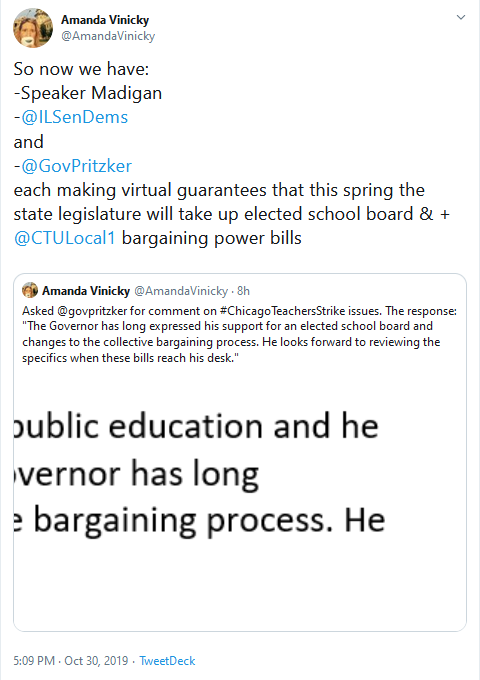
Tweet by Amanda Vinicky about Madigan and Cullerton pledging support to repeal IELRA Sec. 4.5

Looking ahead and building power

As you talk about the tentative agreement, it’s worth thinking about the conditions at your school. Whether or not this TA is ratified, we will eventually have a contract. It’s important that everyone build on the solidarity and momentum you’ve developed together on the picket line to enforce it. If the fight for good working and learning conditions were a war, the strike would be the “air war.” It can win a lot, but what ultimately determines day-to-day conditions is the “ground war”—the back-and-forth between administrators and staff in each school and workplace.

Read the TA (and the existing contract, for that matter) with an eye to the changes you want in your school. Try to come up with one change—big or small—that CTU members, together, want to see in your work environment. Then you can use our Campaign Planning Worksheet to brainstorm your campaign for when we return to work. When members at your school have agreed on a rough plan, check in with your organizer and/or field rep to talk through the details of putting it into action.

Union staff will continue to work hard in support of your rights. In your campaigns, they’ll help you refine your strategy and back you up. And they’ll always stand up for your rights in grievances and arbitration. If you organize well, you can make change without the long process of a grievance and help build your school’s solidarity and power.

Sent via ActionNetwork.org. To update your email address, change your name or address, or to stop receiving emails from Chicago Teachers Union, please click here.

The Chicago Teachers Union posted the following message from its legendary leader and president emerita, Karen Lewis:


CTU |

Diane-

When Lori ran for mayor, she gave us hope that she would represent real change in City Hall. She ran on our education platform and made a commitment to reverse years of failed policy and horrible planning by her predecessors.

She inherited a system built on revolving door leadership, misplaced investments, excessive standardized testing and few wraparound services for our students. And she took office on a promise of being a progressive, pro-education mayor who gave her word for an elected school board for our district, and said she would use her power to ensure that Chicago’s students have the resources they need regardless of where they live in this city.

It’s not too late.

For far too long, the students, families and educators of Chicago have been denied the high-quality neighborhood schools they deserve. Our students should be learning in safe and thriving environments with social workers, nurses and guidance counselors. Our educators deserve to work in well-equipped classrooms with manageable and enforceable class sizes. And Chicago’s families deserve an elected leader that stands by their promises and truly brings in the light for our great city.

Lori, keep your promises and let’s get this done. Our members have resolve and will not relent when it comes to the families they serve. I stand in solidarity with each and every teacher, PSRP, clinician, nurse and librarian, and urge them to stand firm in their fight and remain united in the struggle for the schools that our students and families deserve.

To them, I ask the questions I’ve always asked of them when making any decision: “Does it unite us? Does it build our power? Does it make us stronger?”

And remember, power concedes nothing without a demand. It never has, and it never will.

In solidarity,

Karen GJ Lewis, NBCT

CTU President Emerita

Chicago Teachers Union 1901 W. Carroll Ave.• Chicago, IL 60612 312-329-9100
www.ctulocal1.org
for the schools Chicago’s students deserve
Sent via ActionNetwork.org. To update your email address, change your name or address, or to stop receiving emails from Chicago Teachers Union, please click here.

In her education plan, Elizabeth Warren proposed eliminating the federal Charter Schools Program. This program was started in 1994 to help jumpstart new charter schools at a time when there were fewer than 100 charter schools in the nation. Now there are 7,000.

Today, the CSP has a budget of $440 million a year (which BETSY DeVos proposes to increase to $500 million a year). DeVos uses CSP as her personal slush fund to expand corporate charter chains. This past year, she gave $89 million to KIPP, $67 million to IDEA, and $10 million to Success Academy. None of these charter chains are struggling financially. All receive huge grants from the Waltons and other billionaires.

The Network for Public Education studied the expenditure of $4 billion by CSP from 2006-2014, predating the DeVos era. It’s report “Asleep at the Wheel,” determined that at least $1 billion of the funds spent by CSP during that period were wasted on charter schools that either never opened or closed soon after opening. Warren cited this report in her education plan, to justify eliminating the wasteful CSP.

The empire strikes back:

The CEO of KIPP (and husband of Wendy Kopp) sent this email to his mailing list:

Friends,

We can’t let Senator Warren’s plan of cutting charter school funding become reality. Join us today and help all kids achieve their dreams.
Richard

Richard Barth

CEO
KIPP Foundation


A friend received this email from the founder of IDEA, which has received $225 million from CSP in the last two years. Bote that it was sent during the workday.

From: Tom Torkelson <info@charterpac.org>
To:

Sent: Thu, Oct 24, 2019 2:26 pm
Subject: FW: Warren Proposes to Stop Federal Funding for Charter Schools

Friends,

I hope you saw Nina’s note below. Senator Warren has proposed to cut the entire charter schools federal program. We need your help today; don’t wait to support our efforts.

Tom

Tom Torkelson
Former Classroom Teacher and Charter School Founder

* title used for identification purposes only


From: Nina Rees <nina@charterpac.org>
Sent: Monday, October 21, 2019 7:18 PM
To: Tom Torkelson <tom@charterpac.org>
Subject: Warren Proposes to Stop Federal Funding for Charter Schools

Dear Friends —

Today Presidential candidate and Senator Elizabeth Warren called to end federal funding for the expansion of charter schools.

But we know that 5 million more families would choose a charter school if one could open near them. Senator Warren’s plan to starve charter schools of funding would destroy the dreams of a quality education for the families who need it most. The National Alliance for Public Charter Schools respondedsharply.

However, to protect as well as grow the Charter Schools Program, we must deploy all the tools available to us. Please contribute to the Charter Schools Action PAC today. A strong Charter Schools PAC helps reinforce our mission to candidates that need to know the impact of Senator Warren’s plan.

I’m writing today to ask for your help. Give today and share with 5 of your friends who support charter schools.  

It is not surprising that charter chains that enjoy many millions  of dollars from the CSP would fight to keep the federal spigot of cash flowing.


Chicago Teachers Union

NEWS ADVISORY:
For Immediate Release| ctulocal1.org

CONTACT: Chris Geovanis, 312-329-6250, 312-446-4939 (m), ChrisGeovanis@ctulocal1.org

Half of 1% of CPS budget stands between CTU, CPS and tentative agreement

CHICAGO, Oct. 27, 2019—CTU President Jesse Sharkey issued the following statement this evening, as CPS CEO Janice Jackson made her first appearance at the bargaining table.

Right now at the bargaining table, CPS is refusing to invest barely half of one percent of its annual budget to give our students the equity and educational justice they were promised. Amazon was set to get billions of dollars in public subsidies from the city. Lincoln Yards and the 78 got billions of public dollars to bankroll their new neighborhoods for rich people—dollars that should have gone to our schools. But CPS has yet to yield to provide a paltry fraction of those funds to support what our students need.

CPS has $38 million to settle a contract in one of the richest cities in the richest countries in the world. Yet today, their misplaced priorities will put us on the picket lines again tomorrow.

We have been attempting to bargain with CPS for ten months for the equity and educational justice our students were promised. It took a strike to get the mayor and CPS to just to trade proposals to bring down exploding class sizes and alleviate desperate shortages of school nurses, social workers, counselors, librarians and more. We shouldn’t have to work this hard—and we shouldn’t have to strike—to get our students what they deserve.

In 1995, the Illinois legislature gave total power and control of CPS to the mayor of Chicago, forcing us to jump through insane obstacles to get to an agreement, from super majorities to authorize a strike to constant obstacles just to bargain to get a nurse in school every day. No other teacher or school worker in any other school district in the state confronts this kind of obstruction.

We’re not yielding on our demands for equity and educational justice—and CPS has a path on the table right now to make a real downpayment on those promises. Let’s get it done.

# # #

The Chicago Teachers Union represents nearly 25,000 teachers and educational support personnel working in schools funded by City of Chicago School District 299, and by extension, the nearly 400,000 students and families they serve. The CTU is an affiliate of the American Federation of Teachers and the Illinois Federation of Teachers and is the third-largest teachers local in the United States. For more information, please visit the CTU website at www.ctulocal1.org.


Mercedes Schneider loves Elizabeth Warren’s plans for K-12 education.

Note that in Warren’s plan, the term, “public school” means traditional public school– the neighborhood school, sufficiently supported and defended against much of the corporate ed reform attack against it.

Warren’s education plan is refreshing to read, and extensive. I encourage readers to view Warren’s entire ed plan firsthand.

Below are some of my favorite parts. But my favorites-of-favorites is the ending of federal funding for charter schools and Warren’s pledge to fight against charter schools’ outsourcing operations to for-profit companies.

She proceeds to describe what she likes best in the Warren plan.

Schneider is a tough critic with a keen nose for fraud. When she likes something, pay attention.