Archives for category: Funding

Almost 90% of American students attend public schools, subject to democratic control. 6% of American students are enrolled in privately managed charter schools. Under the leadership of Betsy DeVos, it is obvious that the promotion of both charters and vouchers is central to the education policy of the Trump administration.

Two Democratic senators who are candidates for president, Bernie Sanders and Elizabeth Warren, have released education plans that recommend an end to federal support for charter schools (currently $440 million), which DeVos has handed out to corporate charter chains like IDEA and KIPP.

Senator Cory Booker, having equivocated during the campaign about his previous zealous support for charters, vouchers, and Betsy DeVos, surprisingly reversed course and wrote an article in the New York Times, once again stating his support for charters.

Since Senator Booker is polling at less than 2% in the primaries, he may be looking past the election to restore his relationship with his funders, who love charter schools and were disappointed by his apparent defection from their cause.

Leonie Haimson writes here about Senator Booker’s curious use of the word “boogeyman” to belittle critics of charter schools.

She notes that reporters at the New York Times have also used that term to belittle charter critics. Then she googled and found that the same word has been used by charter defenders thousands of times.

Haimson points out that charters in NYC divert more than $2 billion each year from the public school system. That money might have been spent to meet crucial capital needs and to reduce class sizes.

Also, Senator Booker did not mention that the national NAACP passed a resolution in 2016 calling for a moratorium on charters.

There are many reasons to be critical of charters, including their diversion of funding from public schools, their private governance, their long and well-documented record of waste, fraud, and abuse.

To dismiss all criticism of charters as a fear of a boogeyman is cynical, to say the least, and serves only the interests of the charter industry.


Let me explain why I post articles critical of billionaires on a blog about (mostly) education. Our nation, our states are underinvesting in education. Our teachers are underpaid. Class sizes, especially in urban districts, are too large. Too many teachers pay for supplies themselves. The rate of child poverty, which is correlated with low test scores, is very high (about 20%) compared to other developed nations. We can’t pay for education while lowering taxes and reducing revenues.

Michael Tomaskey makes the case in this important article that the concentration of wealth in a few hands is dangerous to democracy. The middle class is losing ground while money flows to the top. That’s wrong.

In addition, though he doesn’t mention it, some billionaires—the Waltons, for example, the DeVos family, Charles Koch—spend millions every year to eviscerate and privatize important civic institutions like public schools that belong to all of us.

Tomaskey writes:

This column is not a brief for Ms. Warren’s wealth tax or for her candidacy — I don’t have a preferred candidate. Instead, I want to make a simple plea to the country’s billionaires: Multibillion-dollar fortunes are often called excessive and decadent. But here’s something they’re rarely called but ought to be: anti-democratic. These fortunes will destroy our democracy.

Why “anti-democratic”? Why would it matter to our democracy whether Jeff Bezos is worth $113 billion (his current figure) or $13 billion?

Because any democracy needs a robust and thriving middle class, and we have spent the last 30 or so years transferring trillions of dollars from the middle class to the people at the very top. Just one set of numbers, from the University of California, Berkeley economist Gabriel Zucman: The 400 richest Americans — the top .00025 percent of the population — now own more of the country’s riches than the 150 million adults in the bottom 60 percent of wealth distribution. The 400’s share has tripled since the 1980s.

This is carnage, plain and simple. No democratic society can let that keep happening and expect to stay a democracy. It will produce a middle and working classes with no sense of security, and when people have no sense that the system is providing them with basic security, they’ll make some odd and desperate choices.

This is obviously not hypothetical. It’s happening. It’s what gave us Mr. Trump (well, that plus the campaign lies). It’s what made Britons vote Leave (well, that plus the campaign lies). It’s what has sparked protests from France to Chile to Lebanon, and it’s what is making the Chinese model — no democracy, but plenty of security — more attractive to a number of developing countries around the world than the American model. Our billionaires ought to ponder this.

I imagine that Mr. Gates is repulsed by Mr. Trump on some level, and at the end of the day probably couldn’t vote for him. But if I could meet Mr. Gates, I’d ask him: Sir, do you not see the link between your vast fortune and the ascendance of Donald Trump? If not, I implore you to connect some dots. Wealth has shifted to the top. It has been taken away from the middle class. That makes people anxious. Anxiety opens the door to demagogues. It’s not complicated.

We need changes in our laws and institutional structures that will alter what economists call pretax distribution. This is a point made by the economist Dean Baker — that income inequality is less a result of tax policy than laws and regulations that have made the rich richer before taxes are even imposed. These changes have to do with monopolies, patents, executive pay and other matters.

And yes, we do need to tax rich people more. In my lifetime, the top marginal tax rate has gone (roughly speaking) from 91 percent to 77 percent to 50 percent to 35 percent to today’s 37 percent. That’s too low. I’m not with Bernie Sanders, who says there should be no billionaires. That’s too punitive. But I do think Mr. Bezos could get by on $15 billion or so.

Billionaires will protest that they’d rather give it away than trust the government with it. I applaud their generosity. But even someone as rich as Michael Dell, who went on a rather infamous riff along these lines at Davos, could not build a nationwide high-speed rail system, clean the country’s air and water (and keep them clean), create a network of free opioid clinics across the country or give towns that have been hollowed out by the global economy a second chance. Only government can do those things.

Somebody has to pay more if government is to function and to pay for education, Social Security, healthcare, defense, and infrastructure. Why not those who have the most money?

Koby Levin of Chalkbeat reports that a study of the state takeover of Detroit’s public schools–which lasted for 15 years–was “a costly mistake.”

The state was supposed to solve intractable problems that elected school officials in Detroit could not.

It made things worse, according to a newly released report on the 15 years during which the Detroit school district was largely controlled by state-appointed officials.

The study, which was commissioned by the current school board, found a pattern of “startling mismanagement” in academic and financial matters whose consequences continue to weigh on the district’s future.

While some had hoped that the report would eventually lead to a lawsuit against the state, that seems unlikely. Instead, it provides a 172-page confirmation of what many Detroiters have argued for years: that installing state officials in place of the elected school board wasn’t enough to make the district’s problems disappear.

“The legacy of emergency management coupled with the continuing effect of inequitable school funding, will inevitably cause the District to hit a ceiling and impede its current progress toward a complete turnaround of traditional public education in Detroit,” the seven board members wrote in a statement in response to the report.

As state officials closed dozens of schools, they failed to adequately maintain the properties — “a costly mistake,” the report found, “as many of the vacant buildings have been stripped and/or vandalized.”

Tom Watkins, who was state superintendent from 2001 to 2005, said there was little hope of improving the district’s financial situation simply through effective management — not without solving underlying issues with declining enrollmentand Michigan’s school funding structure.

“It’s like trying to bail out a sinking yacht with a thimble,” he said.

The state threw everything it could think of at the struggling district–emergency management, charters galore–but not the funding needed.


If you live in Pennsylvania, please let your legislators know that you oppose the diversion of public funds to private and religious schools. Stop the DeVos agenda now! Vouchers do not help students or schools or districts! Multiple studies have shown that vouchers divert funding from public schools and reduce services to most students, and that the students who use vouchers actually lose ground compared to their peers who stay in public schools.

Dear Carol,

On Monday, November 18,The House Education Committee is scheduled to vote on voucher legislation under House Bill 1800 (Rep. Turzai, R-Allegheny). House Bill 1800 establishes a voucher program for students in the Harrisburg School District, which entered state receivership in June.  Adding tuition and transportation outlays, House Bill 1800 is estimated to cost the Harrisburg School District $5.5 million to $8.5 million. Could your district be next?

SEND YOUR EMAIL NOW BY CLICKING HERE.

Then call your representatives and ask them to vote NO on HB 1800.

You can find their number below, along with a sample script for your call:

House member contact info:

https://www.legis.state.pa.us/cfdocs/legis/home/member_information/contact.cfm?body=H


Sample Script

My name is (your name) and I am calling to let (your representative’s name) know that I am opposed to House Bill 1800 and any attempt to give public money to private schools with vouchers. Let’s support our public schools, not private schools with vouchers. Thank you.


Thanks for all you do!

Carol Burris

Donations to NPE Action (a 501(c)(4)) are not tax deductible, but they are needed to lobby and educate the public about the issues and candidates we support.

Republican Mike Turzai, Speaker of the House in Pennsylvania, is encouraging the state to adopt the Betsy DeVos agenda for diverting public funds to religious and private schools.

Turzai’s agenda is described here by Lawrence Feinberg, a school board member in Haverford Township and director of the Keystone State Education Coalition.

Feinberg writes:

The 2022 race for governor’s race has begun, and Pennsylvania House Speaker Mike Turzai wants to make it clear that he shares Betsy DeVos’ vision for privatization of public education.

In a recent Philadelphia Inquirer opinion piece, Turzai, R-Allegheny, touted our state “as a gold standard with respect to funding public school districts”, completely ignoring the fact that Pennsylvania is home to the widest per pupil funding gap between wealth and poor districts in the country.

Under his leadership, the Pennsylvania Legislature has been negligent, willfully and deliberately ignoring the state’s historic gross inequity in the distribution of school funding and locking students in poorer districts into their underfunded and under resourced predicament. A school funding lawsuit is pending, with the trial tentatively set to begin in summer 2020.

In fiscal 2015-16, only 36.8 percent of aggregate education funding came from the state while 57.2 percent came from local sources, according to the Pennsylvania Department of Education’s “Annual Financial Reports.”

The U.S. Census’ “Annual Survey of School System Finances” data from fiscal year 2015 ranks Pennsylvania 47th out of the 50 states in state support for public schools.

Instead of addressing the funding issue, he has consistently and aggressively promoted anything but democratically governed public schools that are accountable to taxpayers. While he supported the Financial Recovery Act of 2012 setting in motion a plan for distressed school districts to get back on track, he is thwarting that effort by ensuring that such districts remain in financial distress.

His signature tax credit program, which diverts public tax dollars to private and religious schools, skirts the Pennsylvania Constitution which explicitly says that “no money raised for the support of the public schools of the Commonwealth shall be appropriated to or used for the support of any sectarian school.”


The Resistance has opened a new front in Wisconsin!

The proper place for accountability is at the top: with those who decide how much money is available, and those who write the laws and the mandates and the regulations.

The legislature determines whether funding is available to reduce class size, to provide adequate staff, to offer appropriate compensation to those who work in the schools.

The lawmakers should be held accountable!

Get active! Get involved!

This notice was distributed by Heather DuBois Bourenane <hdb@wisconsinnetwork.org>


The Department of Public Instruction issues its school and district report cards today, a legislative mandate which requires our students and schools to be held accountable for many things they cannot control.

It’s only fair to hold our lawmakers accountable for the one thing they can control: their votes.

Today we have issued a new tool to help hold them accountable: our first ever Legislative Report Cards that help connect the dots between the performance of our legislators and the needs of our children.

Despite the countless successes of students and public schools around the state, we have invested in widening the gaps between “haves” and “have nots” — gaps that are reflected very clearly in standardized test results.  We know that Wisconsin has the worst racial performance gaps in the nation. We know that our funding formula is profoundly inequitable, unpredictable, and inadequate. We know we are worst in the nation for how we fund special education. Our support for bilingual and bicultural needs – which increased by zero dollars in this year’s budget – has been described as “pitiful.”

The 2019-2021 state budget made gains in some areas, but failed to even meet the 2/3 funding mark. 40% of districts received less aid this year than last year. We did not move the needle for our kids. How can we continue to hold our kids and schools “accountable” but not those whose votes reflect the state’s failure to meet our most basic expectations?

You asked for a tool for holding legislators accountable, and we created one: a rubric for assessing budget votes based on the priority needs of our students as outlined by the bipartisan Blue Ribbon Commission on School Funding and put forward in the budget requests of Governor Evers.

Click here to read the full release and access our Legislative Report Cards for all Wisconsin lawmakers: http://www.WisconsinNetwork.org/blog/report-cards.

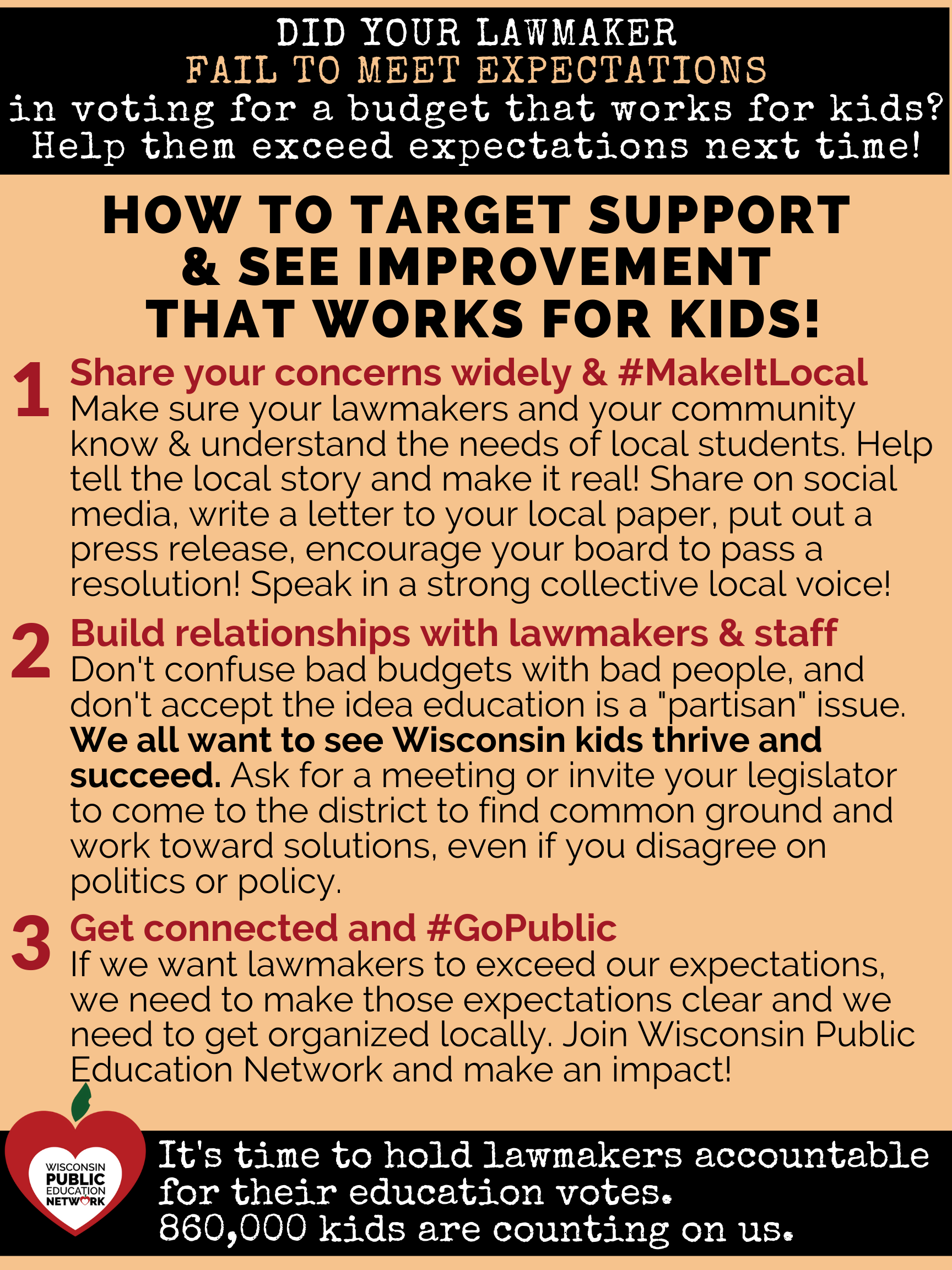
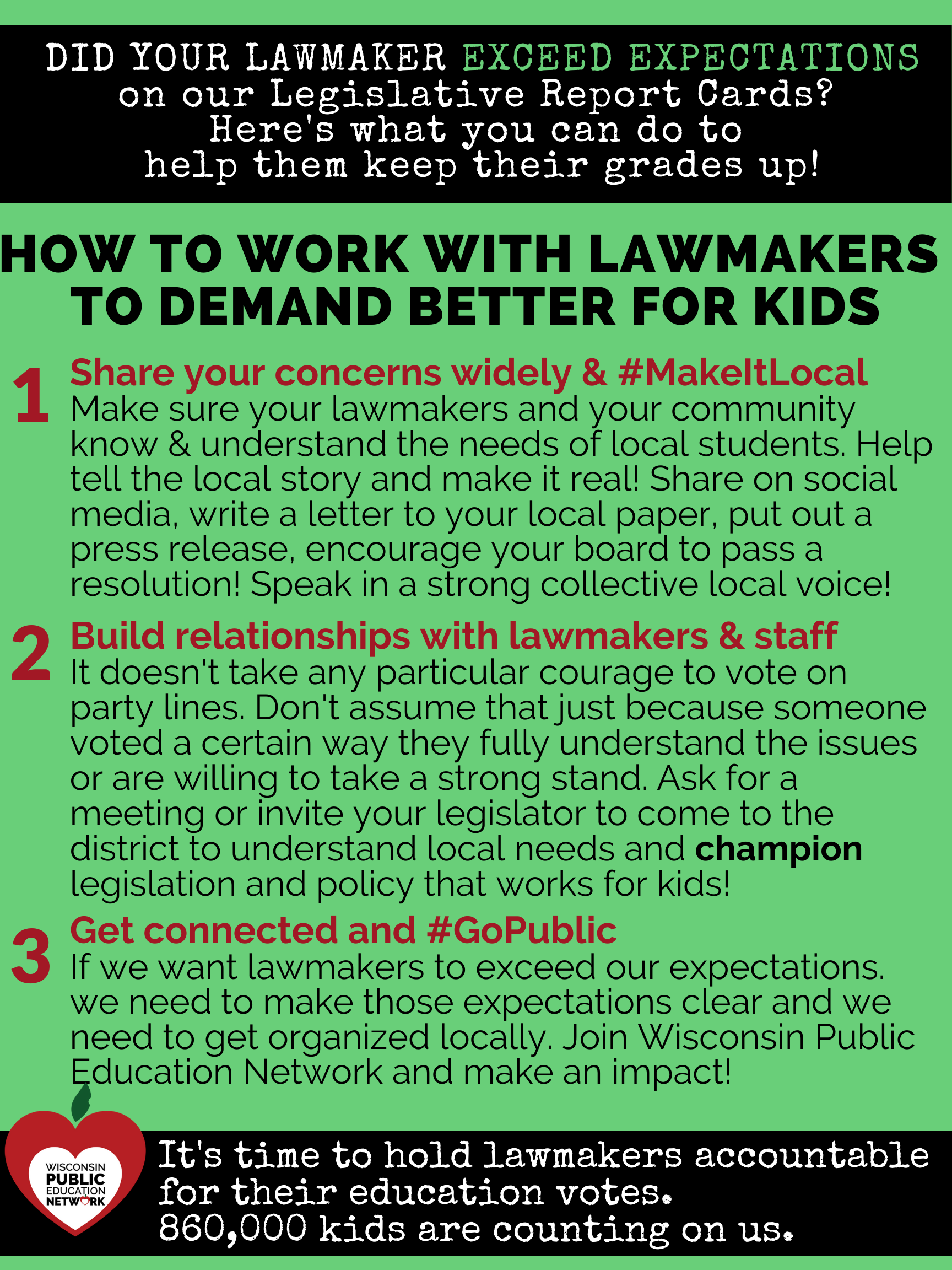
Then use the tools below to demand better. This isn’t about people – it’s about policy. It’s not about politics – it’s about what’s best for our kids. Take time to tell your local funding story and share details on what might have been different in your district if nearly a billion dollars hadn’t been cut from the proposed education budget this year. Look for local releases from our partners around the state and use them to shine a flashlight on Wisconsin’s school funding crisis.

Whether your lawmaker “exceeds” or “fails to meet” our high expectations, we all need to work together to ensure every student in every public school has equal opportunity thrive. We believe we can make that happen, and we call on all of you to join us in holding lawmakers accountable for making success a reality for every child in every public school in Wisconsin.

FOR IMMEDIATE RELEASE


Contacts: Heather DuBois Bourenane, Executive Director, Wisconsin Public Education Network, (608) 572-1696, hdb@WisconsinNetwork.org; Dr. Julie Underwood, President of the Wisconsin Alliance for Excellent Schools board of directors, julie.madison.wisconsin@gmail.com, (608) 469-2287

View this release online here.


Lawmakers Held Accountable for Votes on Education with Report Cards

As districts statewide receive state-mandated report cards, public education advocates demand an assessment of lawmakers who set budgets that determine schools’ ability to succeed


As the Wisconsin Department of Public Instruction issues its annual school and district report cards today, the nonpartisan Wisconsin Public Education Network is doing the same for state legislators.


The organization’s Legislative Report Cards provide much-needed political context for understanding how the DPI assesses school and district performance. They assess state lawmakers across five categories: K-12 budget overall, special education, bilingual/bicultural needs, mental health and public funding of private schools. The report cards are available to the public at http://www.WisconsinNetwork.org/blog/report-cards.


The DPI’s school and district report cards fulfill a state mandate to hold all schools “accountable” to taxpayers. That mandate was put forward in 2011, the same year Wisconsin saw the largest cuts to education funding in state history.


In conjunction with its Legislative Report Cards, the Wisconsin Public Education Network has issued the following statement:


“In Wisconsin, our lawmakers use report cards to hold our children and their schools accountable for circumstances and state-level policy decisions that are beyond their control. How well a school does on a report card is often closely connected to factors like revenue limits, the number of students living in poverty, the number of English-language learners and the resources available for serving students with disabilities. 


What the report cards do not reveal is the fact that Wisconsin is last in the nation in state support for students with disabilities, and last in the nation in state support for English language learners. The state does not live up to its commitment to support student mental needs and we lack a coherent state policy to support children challenged by poverty. We can trace these failures back to the statehouse, not the classroom.


 It only makes sense that we hold lawmakers accountable for their education votes.


Parents and communities are told that school report cards represent a single ‘snapshot’ of student performance, but that snapshot becomes a frozen image impacting property values and undermining the successes that cannot be accounted for using test scores and other data points. Research shows that test scores often measure little more than economic status. Holding our schools accountable for student needs while failing to provide sufficient resources to ensure student success is unfair and unethical.


Senator Luther Olsen has often said the state report cards should be used as a ‘flashlight’ and ‘not a hammer’ to demonstrate where we can best meet the needs of our students and schools.


We present these legislative report cards in the same spirit. They reflect a single snapshot: a picture of the budget votes of the elected officials who determine how much state aid is provided to our public schools. 


In 2019, Wisconsin legislators approved a budget that cut nearly $1 billion from the governor’s proposed public education budget, withholding much-needed aids for special education, mental health and English language learners, while failing to meet the much-touted goal of providing two-thirds of school funding.


Given the state’s continued refusal to provide the funding needed to close Wisconsin’s opportunity gaps, we are holding lawmakers accountable for their education votes.


The 2019 Legislative Report Cards reflect a failure to meet the expectations that were outlined clearly by the Blue Ribbon Commission on School Funding, at the budget hearings of the Joint Committee on Finance and by parents, board members, educators and school leaders statewide.


Public education should not be a partisan issue. Support for schools should not fall along party lines. We strongly encourage all who care about great public schools to take time to provide targeted support and encourage improvement from those legislators who fail to meet Wisconsin’s high expectations for supporting student success. Every child attending public school in Wisconsin deserves an equal opportunity to succeed, and our lawmakers, just as our schools, must be held accountable for making that opportunity equally accessible to all.”


About Wisconsin Public Education Network (WPEN)


Wisconsin Public Education Network is a nonpartisan grassroots coalition supporting strong public schools that provide equal opportunity for all students to thrive. The Network is a project of the Wisconsin Alliance for Excellent Schools (WAES), a 501(c)(3) nonprofit organization. Contributions can be sent to: P.O. Box 6592, Monona, WI 53716. Learn more at http://www.WisconsinNetwork.org.


Our reader Laura Chapman wrote about a newly elected member of the school board in Cincinnati. He is a local executive for TFA. The board on which he will serve pays TFA $100,000 to supply inexperienced teachers. He should resign his TFA position or resign from the board. At the very least, he should recuse himself from any discussions of contracts for his employer.

Chapman wrote:

Some details on Cincinnati Ohio elections.

Ben Lindy won a seat on the Cincinnati School Board. Lindy is CEO of Teach for America (TFA) in Southwestern Ohio. He will NOT step down as regional CEO of Teach for America (TFA) in Southwestern Ohio. He has at least one conflict of interest of course, because Cincinnati Public Schools has been co-opted into sending about $100,000 to Lindy’s operation to hire TFA’s.

Lindy got 20% of the vote. Local editorials supported Lindy and attacked the teacher union for not endorsing Lindy. Lindy also raised MORE money than all the other candidates, a whopping $165,398, all for a seat whose pay is capped at $5,000 annually.

TFA executives and staff in 21 states and 26 cities outside of Ohio contributed to his campaign. About $13,000, came from Leadership for Educational Equity or LEE. LEE trains and supports TFA alums (like Lindy) who run for local, state, and national public office. In these positions, they launch unjustified criticisms of public schools, teacher unions, and elected school boards. They aggrandize test scores and they market computers as if these devices offered more “personalized” learning than human teachers.

Lindy was also supported by funders of Accelerate Great Schools. Accelerate Great Schools is the local version of the “Education Cities” effort to put more districts into a portfolio model, managed like stocks in a portfolio. You add, keep, or close schools based on their outcomes, meaning the test scores of students (and other measures in Ohio’s Report Cards where schools are graded, A-F). The Accelerate Great Schools coalition includes: • Cincinnati Business Committee, • Cincinnati Regional Business Committee, • Farmer Family Foundation (wealth from Cintas services), • Haile U.S. Bank Foundation, • KnowledgeWorks Foundation (promoter of computers to replace teachers), and • Archdiocese of Cincinnati. https://www.accelerategreatschools.org/who-we-are/^

Accelerate Great Schools hopes to call the shots if they can get enough people on the school board who approve of TFA temps, the charter school test-em-til-they-drop philosophy, and a portfolio model of privately-managed schools. Lindy and local reporters did not report this factoid: Ben Lindy’s wife, Paige Elisha Lindy, is the Chief of Staff and Operations at Accelerate Great Schools. It is not surprising that Arthur Rock, founder of Intel, worth $340 million, contributed to $4000 to Lindy’s campaign or that KnowledgeWorks, promoter of computer- centric education is in the orbit of the Accelerator. https://www.followthemoney.org/entity-details?eid=37970366

This will not stop the the Cincinnati Education Justice Coalition, advocates for traditional public schools, from calling out the many efforts to undermine public education and deprofessionalize the work of teachers.


I am not sure that I agree with Steven Singer’s point here, that NAEP scores tell us nothing other than that students from affluent homes have higher test scores than students who live in poverty. 

His main point is undeniable. All standardized test scores are highly correlated with family income.

We could use income and poverty data to learn what the test scores tell us, without wasting billions on standardized tests and corrupting instruction.

But I think that NAEP does tell us something we need official confirmation for: the utter failure of Disruptive Corporate Reform.

The Disrupters have promised since No Child Left Behind was proposed in 2001 that they knew how to raise test scores and close achievement gaps: Test every child every year and hold schools accountable for rising or falling scores. That will do it, said George W. Bush, Margaret Spellings, Rod Paige and Sandy Kress. They rode the wave of the “Texas miracle,” which turned out to be non-existent. Texas in 2019 is stuck right in the middle of the distribution of states.

Then came Jeb Bush, with his fantastical claims of a “Florida miracle,” which are now repeated by Betsy DeVos. Look at the NAEP scores: Florida is right in the middle of the states. No miracle there.

Arne Duncan has been promoting Tennessee, which as one of the first Race to the Top states, which is also ensconced in the middle of the distribution.

Look for yourself.

Two states that were firmly under the control of Reform heroes, Louisiana and New Mexico, are at the tail end of the distribution.

What do the NAEP scores tell us?

Don’t look for miracles.

Don’t believe propaganda spun by snake-oil salesman.

Look to states and districts that are economically developed and that fund their schools adequately and fairly.

The scores in states may go up or down a few points, but the bottom line is that the basics matter most. That is, a state willing and able to support education and families able to support their children.


Craig’s Chicago Business acknowledges that the children in Chicago public schools need what the Chicago Teachers Union won in their contract negotiations. But still, they wonder, are taxpayers willing to pay the price? 

Now that financial details of the pact are starting to trickle out, it’s clear that the mayor was telling the truth—that is, for the teachers. And that truth raises a very significant question of whether the unprecedented, potentially $1.5 billion mayoral bet will be worth the cost to already struggling Chicago taxpayers.

That $1.5 billion figure comes from the Chicago Public Schools’ budget office. It’s at the high range of what officials say the new CTU deal will cost over the next five years cumulatively…

“The union won the strike. They absolutely won,” says Paul Vallas, a former CPS CEO who was one of Lightfoot’s rivals in the February mayoral election. “It’s going to be impossible for them to come up with that much dough without major tax increases if (Gov. J.B.) Pritzker does not fully fund the state’s new school-aid formula.”

Pritzker is working on that. But as Vallas noted, doing so likely depends on voters next year enacting the governor’s proposed graduated income tax amendment, and that’s no sure thing.

Overall, there is little dissent that putting increased staff resources into particularly needy schools—as the contract requires—is the right thing to do. Eventually, that should result in higher graduation rates and kids better prepared to enter the job market.

It is always good to get Vallas’ views, since he privatized schools in Philadelphia and New Orleans as his budget solution and ran unsuccessfully for mayor, governor, and lieutenant governor.

Are the voters in Illinois willing to pay higher taxes to improve conditions of learning, to assure smaller class sizes, and to get better prepared youth?

The Chicago teachers’ strike represents a change in Chicago, for sure. The harsh policies of Daley, Duncan, and Emanuel are over. A new day has dawned, with national implications.

It’s a definitive shift in the entire landscape, not just in Chicago, but throughout the U.S., away from privatization, school closures, charter schools, and the kind of Koch Brother-funding of private schools instead of public schools, a threat we’ve been fending off for the last 30 years,” said Jackson Potter, a high school teacher and union bargaining member in Chicago.

Potter continued, “This contract really represents advances—and not just trying to preserve what we had or prevent the annihilation of the public system—but how to expand it, fortify it, and have a considerable [investment] in low income students of color and their communities that starts to look more [like] what we see in wealthy white suburbs.”

The contract dealt a blow to the charter industry, with “hard caps on charter school expansion and enrollment growth.” The rightwing Heartland Institute called the settlement “a death blow to charter schools in the Windy City.”

Alas, the sustained efforts of the Disrupters foiled by one powerful teachers’ strike, joined by Chicago’s progressive new mayor!  Their policies of austerity and privatization undone. Calling the world’s smallest violin.

Thanks to the invaluable organization “In the Public Interest” for assembling these sources in one place.