Archives for category: Funding

Arnold and Carol Hillman spent their careers as educators in Pennsylvania. When they retired, they decided to live in a retirement community in South Carolina. But while other retirees were playing golf or relaxing at the pool, they decided to get involved in rural schools. They wanted to be helpful. After nine years in South Carolina, they decided to move closer to their children, so they moved to Massachusetts. I invited them to write about their experiences in South Carolina. And Arnold wrote this account, edited by Carol.

We have always been compulsive people. On a cold winter’s day in February of 2015, we decided to move to a senior community (Sun City) in Bluffton, South Carolina. We did have some friends there who encouraged us to join them. So, on July 31st of that year, we moved there— lock, stock and barrel.

It wasn’t more than a week or two, after disposing of our many boxes, that we decided to go to a local school board meeting. We lived in an especially wealthy area of SC. The reason for its wealth were the many grey heads that retired to SC because of the meager taxes that one had to pay. 

We were very surprised at the board meeting. There were issues that were foreign to us. Although much of the meeting revolved around educational issues, the tone of the meeting was not to our liking. For one thing, they never mentioned the students or education. The superintendent acted as if he was the school district attorney. He was later fired because of ethics violations. An elderly member of the board spoke about books that he did not like and made no sense. The meeting seemed disorganized from our perspective. We came away from the meeting with the idea of finding out more about education in South Carolina.

Since we were familiar with the superintendent’s organization in Pennsylvania, we discovered that the then Superintendent of Education in South Carolina was the former executive director of the SC organization of superintendents. We called her, Molly Spearman, and invoked our PA connection and got to speak with her. 

We said that we had been advocates for rural schools and communities for many years and would like to see if we could be of some assistance to them here in South Carolina. She told us of five rural school districts around the area in which we lived and suggested that we give them a call.

We called all five and only one returned our call. Dr. Vashti Washington, Superintendent of the Jasper County School District, one of the poorest districts in the state, said that she would be happy to see us and work out some things that we could do in the district.

We eventually began a program called “Roso” – Reach one Save one. It was already in the works at the Ridgeland Hardeeville High School. The assistant principal, L.R. Dinkins, had been looking for someone to help him get it started, and we were the ones.

The program involved mentoring 10 young men and 10 young women and having them mentor fifth graders who were having trouble in school. The program lasted from 2015-2021. It ended when Covid began. However, the students that we worked with are still in touch with us and many have been successful in their lives. Others have not had that kind of success.

During the time we were working at Ridgeland Hardeeville, we decided that we would try to visit as many rural school districts as we could. We wound up visiting 21 districts out of about 35 (consolidation has made that 30 rural districts).

We were astonished at what we saw in each of those districts. What we saw was the equivalent of shoveling against the tide. Administrators and teachers do their best without the proper resources. 

In some districts the buildings were dilapidated. One in particular startled us when we saw sewage seeping into the hallways. Fortunately, that school was closed and replaced by a new building.

Many school districts lacked teachers of science, math, and special education. Many rural districts recruited foreign teachers to fill vacancies, but these teachers often had difficulty communicating in English. Those who stayed for more than a year became more fluent in English and more successful as teachers. Nonetheless, rural districts often lacked the courses available in economically advantaged districts.

Most rural districts lacked student services. Guidance counselors and psychologists were in short supply, as were career counselors and STEM counselors.

Like many other rural areas across the country, Internet connections are not readily available in rural South Carolina. Thus many schools were unable to produce online coursework for their students during the pandemic.

Some of the outcomes were spectacular, but in the end the children did not get all that they needed for success in life.

As we have learned during our time in South Carolina, and over the past year, the children in the rural areas of South Carolina must climb mountains to gain the same kind of success that their brothers and sisters have in the well-resourced school districts.

Some statistics will show the differences. At the beginning of the 2024-25 school year there were 1,043 open positions for educators in South Carolina. Most of these vacancies were in rural school districts. From January 2020 till now, of the 75 school districts in SC, only 21 school districts have retained their school superintendents. Of those 72% that have left, many of them are from rural school districts.

South Carolina’s legislature and administration have succeeded in raising teachers’ salaries. However, their priorities have not addressed the problems with resources for rural schools. The new Superintendent of education is a right-wing conservative, with a former Heritage Foundation background and a less than stellar resume in education. She has instigated a program in cooperation with Prager University that will provide school districts with videos that rewrite American history to minimize the underside of the past..

The legislature and the administration have viewed budget surpluses as a means of getting votes from their constituents. Although state taxes are low, they have consistently rebated taxes to taxpayers. In the 2022 legislative session they rebated almost one billion dollars. This was done when school districts and other parts of the state could have used those funds to improve the number of children and other needy folks.

South Carolina does not fare well in comparison with other states in the nation when it comes to education. Looking at 4 differing rating agencies, SC ranks 44th, 43rd, 41st and 41st. You may not agree that these are the most accurate numbers, but a number of agencies use many variables to come to these conclusions.

And how is South Carolina doing in comparison to other states and the nation on national tests such as the ACTs? According to the South Carolina Department of Education and their statistics, the average of all states using an ACT composite is 19.4. South Carolina’s composite score is 18.4. The ACT is widely used in Southern and Mid-Western states. There are 24 states that use it primarily and of the 24, two states switched to the SATs, but still use the ACTs. Many of the rural school districts are far below the 18.4 mean.

To counter some of these negative things about South Carolina education, Carol and I, along with several rural school superintendents, created an organization called SCORS (South Carolina Organization of Rural Schools). Its purpose was to alert South Carolinians to the plight of rural schools and communities. We did research, wrotearticles, and even interviewed gubernatorial candidates. Most of what we did may have helped a small bit, but not enough to move either the legislature or the administration.

It will take many years and the rise of a new generation before anything changes in South Carolina. We still are in contact with many of the young people whom we mentored. 

Most of the students that we mentored came from very economically depressed backgrounds. Their parents sometimes worked two or three jobs. The students also worked to supplement family incomes. They were wonderful youngsters who would have had many more opportunities if they lived in different states.

We called the groups that we mentored Jasper Gentlemen (they all lived in Jasper County). The young ladies were named Diamonds and Pearls. As you suspect, I worked with the young men and Carol the young ladies. There were about 25 students in all. We took them to colleges in South Carolina and even sent some of them up to Howard University in Washington on bus trips set up by a friend who was the head of the Howard alumni association of South Carolina. Of all the students we mentored, none of them dropped out of high school. They all graduated.

I believe only about 30% of them went on to college. Many of the parents wanted the youngsters to stay home and did not want them to leave the area. Money was the biggest problem. The cost of college, even the state schools, was too much for the family to fund. Even with Pell grants and other scholarships it was just too much.

We did offer them some scholarships that we funded personally. Some of the students dropped out after their freshman year. We even had some athletes who got partial scholarships that did not last. Some of the South Carolina colleges, both public and private, had terrible 4-year graduation rates. One of them, a state school, had a 4-year graduation rate of 14.5%.

The “Corridor of Shame” refers to the rural school districts in South Carolina along route 95. It was part of a short documentary about education in South Carolina by Pat Conroy, whose book is about his teaching in Daufuskie Island. Most of the school districts in that area were predominantly African American.

It is difficult to describe the pervasive racism in South Carolina. It is not hidden. It is all on the surface. As members of the NAACP, Carol and I saw it everywhere–from gerrymandering of voting districts to the daily treatment of the African-American community. The neglect of human capital in South Carolina is astounding. Those in charge do not see education as an important economic development tool. Nor do they consider the tragic waste of human potential that is the result of neglecting education.

Here is an example of the blatant racism we saw. A good friend of ours–a person with a doctorate who teaches at a university—would always ask us to call to make restaurant reservations. She also asked that we call stores to get information about products. The rude treatment she received at car dealerships and local stores was beyond our comprehension. Of course, she is Black.

The children had to climb huge barriers compared to most students in the United States to get to college. It is a wonder to Carol and me that any of them were able to do it. We are so proud of some of them who not only got through school but went on to get master’s degrees. We are still not sure if we made a difference, but we tried. 

We are proud of our mentees. Some have climbed over the barriers to achieve success. Jeremiah comes from a wonderful family with few resources. He is the first of his siblings to go to college. He is a phenomenal football player and an even better student. He hopes to play in the NFL in a few years. He graduated from Hampton University and is studying for his master’s degree in logistics at Alabama State. He has one year of football eligibility. To complete his college degree, he took 21 credits in his final semester and was saddened when he got one B+ instead of all As.

Irvin was the valedictorian in his senior year at Ridgeland Hardeeville High School. He was also the drum major in the band, among many extracurricular activities. He went to Embry-Riddle Aeronautical University in Daytona, Florida. He applied for a job at Boeing. It took a year and some to get his security clearance. While he was waiting, he worked in construction. He now works at Boeing in Virginia on things he cannot tell me about.

Rashamel is closer to us than any of the other students. We have known him for 10 years. He is not only a fine student but a wonderful basketballl player. When he was in high school, he wrote for the local newspaper. They seem to have been written by a professional. His post-high school years were confounded by advice he got from his coaches to go to a community college in Rochester, New York. The school was set up for basketball. Since Rashamel was not an inner-city African American, his coach had no clue about how to approach him. He was placed in remedial courses. He got As and A+s. However, since these courses were non-credited, he was behind 15 credits when he left. He spent two years at South Carolina State, an HBCU, and did well academically. He did not enjoy playing there. He finally left and had a great year at Pfeiffer University in North Carolina. He is now taking his master’s degree in sports psychology and working two jobs in Augusta, Georgia.

Lakiasa entered the service because she did not know what she wanted to do in college. She enlisted in the Army where she was trained to help military personnel deal with financial problems. In the Army, she realized that she had grown up very poor. Her Army experience taught her how to handle money. In the three years that she has been in the Army, she has purchased her first car and is the only one in her family who has bought a house. Because she likes to help people, she has made plans to study and become a radiology technician.

Lataye went to a leadership camp between her sophomore and junior year in high school, sponsored by Clemson University. It was the first time she had seen a waterfall, went swimming in a lake, and sat around a campfire singing songs. As a result of that experience, she was determined to go to college. She was studying to be a teacher when she was invited to be a volunteer in the college’s lab school, where she taught math to fifth graders and followed them through their eighth grade year. She made the honor society’s

Geovana was her family’s interpreter. She was expected to go to college. She thought seriously about becoming an attorney. She now wants to be a peduatrician. She is working in a dermatologist’s office for the summer. She will spend a post-college year working while studying for the MCATS.

In the Fall of 2023, I was afflicted with chronic kidney disease. It came to a point where I was about to have dialysis. The only good hospital in the state was in Charleston. They invented a procedure that allowed me to get back to normal.

However, our children insisted that we move closer to them. We went up to Massachusetts to look around for a place that was close to our daughter. We found a continuous care community and moved in on October 23, 2024. We have been there ever since.

As I said, we are still in contact with many of the students we mentored and try and help out any way that we can. We are also in contact with a number of families. Many of them are still not doing well. We hope that the future holds more positive results for them. We miss them all.
 

Trump (or more likely, his puppetmaster Russell Vought, Director of the Office of Budget and Management [OMB]) pulled the wool over the eyes of the Republicans who control Congress.

Trump insisted that he would rein in the budget; he brought in Elon Musk and his Kiddie Corps, to shut down vital functions of the federal government and pare the federal workforce. But Trump’s newly enacted budget adds at least 3 trillions to the deficit.

But first a word about Russell Vought. He was the primary author and editor of Project 2025, which is a blueprint for Trump’s second term. He worked at the far-right Heritage Foundation before the election. Now as director of OMB, he holds the most consequential job in the federal government. OMB decides which programs are priorities and which are not, which need more funding and which do not.

To understand the Trump administration’s policies and goals, read Project 2025. During the campaign, Trump pretended to know nothing about Project 2025. He lied.

John Thompson, historian and retired teacher in Oklahoma, writes here about the real human costs of this evil plan.

He writes:

Even though my primary focus is on public education, I have been concentrating on President Trump’s so-called “Big, Beautiful Bill,” which is estimated to increase the federal deficit by $3.3 trillion, or more. 

My biggest concerns, however, were budget cuts that will likely result in the world-wide loss of untold millions of lives. For instance, even before Trump dramatically increased the subsidies for fossil fuel production, and undercut non-fossil fuel production, it was estimated that by 2049 global warming would cost the global economy $38 trillion per year, and that over 2 billion years of healthy lives would be lost by 2050.

Moreover, Robert F. Kennedy’s attacks on medical science and vaccines could result in pandemics that cost millions of lives. In fact, Kennedy’s attacks on Gavi vaccines would undermine a public health process which would likely save an estimated 8 million lives across the world by 2030.     

And it is estimated that the USAID programs Trump cut “have saved over 90 million lives over the past two decades.” It is now estimated that by 2030 those cuts could cost the lives of 14 million people.

Since the Trump plan passed through Congress, I’ve been catching up on the interconnected ways that it undermines education.

As Chalkbeat reported, this bill:

Slashes spending on Medicaid, which provides health insurance to some 37 million children and is a critical revenue source for schools. It also limits eligibility for the Supplemental Nutrition Assistance Program, or SNAP, which provides food assistance to over 13 million children and makes kids automatically eligible for free meals at school.

Its revised tax credit will hurt an additional two million children. 

Moreover, the cuts will hurt the funding of hospitals and other medical service providers.

And anti-immigration raids will increase chronic absenteeism rates, and “have significant effects on children’s physical and mental health, as well as on broader school climate.”

And that brings me back to the damage done to Oklahoma students. As the Oklahoma Voice reports:

The Trump administration is indefinitely withholding more than $70 million in federal education programs meant for Oklahoma students and educators, including money for teacher development, English learners, after-care programs and migrant children.

Every day I hear about the results caused by threats to the $15.68 million that were authorized, but not delivered for before- and after-school programs, and the “$6.43 million dedicated for the 13% of Oklahoma students learning English as their non-native language.” 

In the Oklahoma City Public Schools, for instance, “47% of students are learning English as their second language. The district expected $1.1 million in federal revenue from Title III, which supports English learners.”

Finally, I recently attended the OK Justice Circle’s Breaking Bread with the Hispanic Community where educators and service providers described the cruelty that Hispanic students were facing. For instance, as a panelist was leaving for the conference, a student told her that she is studying the Holocaust. The student was worried about the tragedies that immigrants like her were experiencing, and how awful they could become.

The educator further explained that a big majority of her students are Hispanic. Due in large part to the current deportation campaign, at times, absenteeism has surged to 30% to 40%. And many students come to school every day with their birth certificates in the backpack in case they have to face raids by the United States Immigration and Customs Enforcement (ICE).

The panelists explained how deportations of family members have produced a surge in the wide, interconnected, and painful crises that undermine student learning.

One of the services that schools can provide is referring students and families to nonprofit and public institutions. In an especially revealing set of discussions, educators described their “do-s and don’t-s” when sharing immigration information with patrons. 

But those statements are based on trust in the law and procedures that ICE agents are required to follow.  Today, it was agreed, it is hard to trust the immigration process.

As I struggled to reach the best possible emotional balance when evaluating the brutality imposed on children, families, and people across the world, I received a message from the Oklahoma Appleseed Center for Law and Justice. It’s Executive Director, Colleen McCarty, expressed the frustration that I continually hear:

Congress passed the so-called “Big Beautiful Bill”—a piece of legislation wrapped in soundbites and flag pins—that will strip thousands of Oklahomans of life-saving healthcare. It will supercharge Immigration and Customs Enforcement, giving new power and resources to deport millions of people, tear families apart, and criminalize human existence based on borders and skin color

But she is committed to “stand in one courtroom fighting for freedom,” even though she leaves “to find the government systematically dismantling it on the largest scale imaginable.” 

We also must continue to fight both legal and political battles in defense of our democracy.

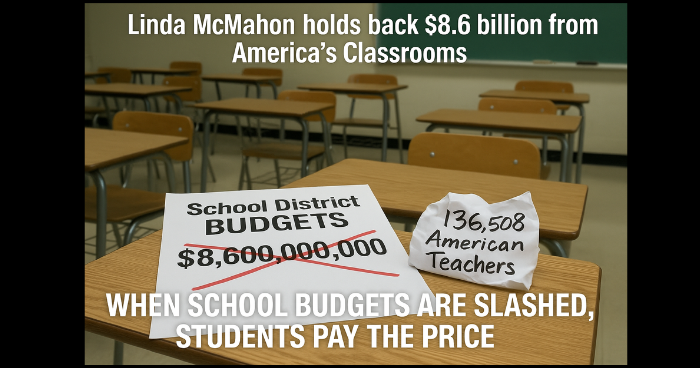
Secretary of Education Linda McMahon has frozen $8.6 billion that Congress appropriated for students this summer. The Administration is supposed to spend the money that Congress authorized and appropriated, not withhold it.

Write Secretary McMahon NOW.

The Network for Public Education urges you to take action!

Open the link and fill out the form to lodge your protest.

#RELEASEFUNDS4SCHOOLS

Just weeks before the school year begins, Secretary of Education Linda McMahon is refusing to release $8.6 billion in federal funds that Congress approved for public schools.

This is more than a funding freeze—it’s a test run for permanent cuts. And unless we act now, our schools will pay the price. Send your letter to Linda McMahon.

2. Email Congress. Even if you’ve written before, send another message.

3. Call the U.S. Department of Education: 1-800-647-8733. Press 5 to report a violation of law regarding the lack of disbursement of approved federal funds by the U.S. Department of Education.  You can leave a message. 

#ReleaseFunds4Schools

TAKE ACTION

FIRST NAME *

LAST NAME *

EMAIL *

STREET ADDRESS *

CITY *

ZIP/POSTAL CODE *

Not in US?

  • Opt in to email updates from Network for Public Education 

Network for Public Education

P.O. Box 227
New York, New York 10156

info@networkforpubliceducation.org
(646) 678-4477

We are a 501 (c)(3). Please make a tax deductible donation to the Network for Public Education.

EIN 35-2532243

Open the link and add your name!!

William J. Broad, science writer for The New York Times, reports on the Trump administration’s draconian cuts to scientific research. As the U.S. cuts back on investments in basic research, China is increasing its spending.

I invite anyone who reads this to try to explain why this administration is reducing spending on scientific research.

Broad writes:

President Trump’s budget plan guts federal science funding for the next fiscal year, according to an overview published by an external group. Particularly at risk is the category of basic research — the blue-sky variety meant to push back the frontiers of human knowledge and sow practical spinoffs and breakthroughs in such everyday fields as health care and artificial intelligence.

The group says it would fall by more than one-third.

The new analysis, made public Wednesday by the American Association for the Advancement of Science, a general scientific society based in Washington, D.C., added up cuts to the budgets of hundreds of federal agencies and programs that do scientific research or provide grants to universities and research bodies. It then compared the funding appropriated for the current fiscal year with the administration’s proposals for fiscal year 2026.

For basic science research, the association reported that the overall budget would fall to $30 billion from $45 billion, a drop of roughly 34 percent. For science funding overall — which includes money for basic, applied and developmental work, as well as for facilities for research and development — the analysis found that the federal budget would fall to $154 billion from $198 billion, a drop of 22 percent.

The new analysis shows that the Trump administration’s budget plan, if adopted, “would essentially end America’s longstanding role as the world leader in science and innovation,” said Toby Smith, senior vice president for government relations and public policy at the Association of American Universities.

His group, Mr. Smith added, is working with Congress to develop “a funding plan for strategic investment that would help to sustain continued American scientific leadership rather than destroying it.”

Mary Woolley, president of Research America, a nonprofit group that promotes science, said the new analysis showed that the budget plan “is threatening not only science but the American public. If approved by Congress, it will make the public less safe, poorer and sicker.”

Victoria LaCivita, a spokeswoman for the White House Office of Science and Technology Policy, did not reply to a request for comment on the new analysis.

In early May, the White House unveiled a budget blueprint that listed proposed cuts to a handful of science agencies. For instance, it sought a reduction in the budget of the National Science Foundation, which sponsors much basic research, to $3.9 billion from $8.8 billion, a drop of 55.8 percent.

Alessandra Zimmermann, a budget analyst at the science association, said in an interview that the comprehensive analysis drew on several hundred proposed budgets from federal science agencies and programs, as well as figures supplied by the White House Office of Management and Budget. In May, the budget office made public the rough sketch of the administration’s overall proposal for next year but included only a small number of science agencies and figures.

The Gutting of America’s Medical Research: Here Is Every Canceled or Delayed N.I.H. Grant. Some cuts have been starkly visible, but the country’s medical grant-making machinery has also radically transformed outside the public eye.

Ms. Zimmermann added that the association’s new compilations would be updated as new budget data from federal agencies and programs became available. However, she said, the group’s estimates of cuts to federal basic research are “not going to be undone by a minor number change.”

The science group has long recorded the ups and downs of the federal government’s annual spending on science. Taking inflation into account, Ms. Zimmermann said the administration’s proposed cut of $44 billion would, if approved, make the $154 billion figure the smallest amount that the federal government has spent on science in this century…

In May, science appeared to be high on the list for significant funding cuts, while large increases were proposed for the Pentagon and Homeland Security. Until the science association updated its reports on the proposed presidential budget for fiscal year 2026, however, the public had no clear indication of the overall size of the federal cuts.

The proposed drop in federal funding for science research, if approved by Congress, could let China match or take the lead in global science investments, Ms. Zimmermann said.

In April, the science group published figuresshowing that China had greatly increased support for its scientific enterprise in the past two decades. As of 2023 — the most recent year available for comparisons — China’s investment was close to equaling that of the United States.

Experts say it could take years of data gathering to know if China is pulling into the lead.

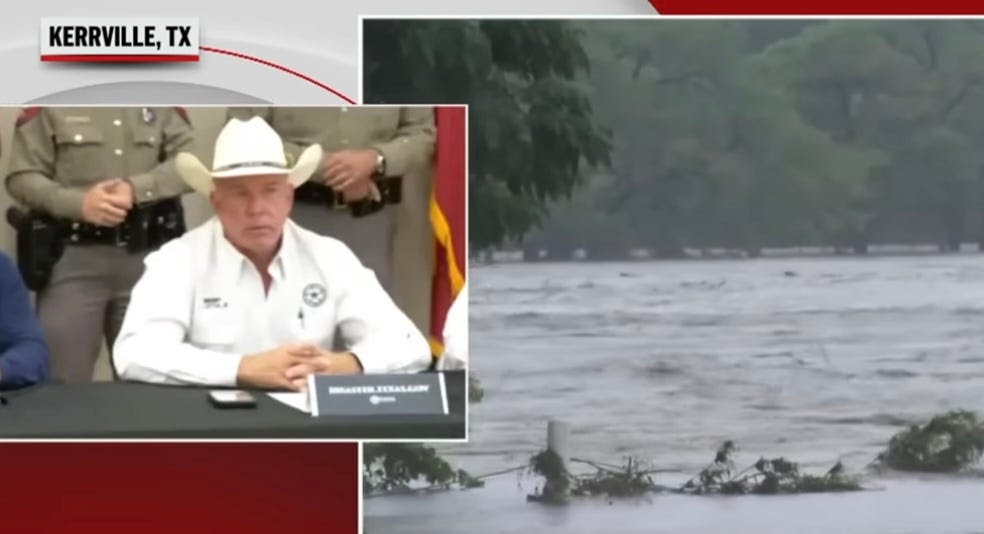
Since the disaster in Texas, where more than 100 lives were lost to a flash flood in the middle of the night, Senator Ted Cruz has been readily available to comment for every television camera.

He has warned Democrats and Republicans alike not to politicize the tragic events (forgetting that Republicans pounced on the Los Angeles fires to blame Democrats and DEI as the 98-mile-an-hour winds were still spreading disaster. They blamed Mayor Karen Bass [who is female and Black], they blamed the female leaders of the LA Fire Department, they blamed Governor Gavin Newsom for refusing to turn on an imaginary faucet in Northern California).

What Cruz has not mentioned is that he inserted a cut into Trump’s Big Ugly Bill that slashed $150 million from the National Oceanic and Atmospheric Administration’s budget for forecasting the weather.

The Guardian reported:

“There’s no doubt afterwards we are going to have a serious retrospective as you do after any disaster and say, ‘OK what could be done differently to prevent this disaster?’” Cruz told Fox News. “The fact you have girls asleep in their cabins when flood waters are rising, something went wrong there. We’ve got to fix that and have a better system of warnings to get kids out of harm’s way.”

The National Weather Service has faced scrutiny in the wake of the disaster after underestimating the amount of rainfall that was dumped upon central Texas, triggering floods that caused the deaths and about $20bn in estimated economic damages. Late-night alerts about the dangerous floods were issued by the service but the timeliness of the response, and coordination with local emergency services, will be reviewed by officials.

But before his Grecian holiday, Cruz ensured a reduction in funding to the National Oceanic and Atmospheric Administration’s (Noaa) efforts to improve future weather forecasting of events that cause the sort of extreme floods that are being worsened by the human-caused climate crisis.

Cruz inserted language into the Republicans’ “big beautiful” reconciliation bill, before its signing by Donald Trump on Friday, that eliminates a $150m fund to “accelerate advances and improvements in researchobservation systems, modeling, forecasting, assessments, and dissemination of information to the public” around weather forecasting.

Cruz was vacationing in Greece with his family when the flood occurred. A few years ago, when the power grid in Texas collapsed during a bitter cold spell, Cruz and family were on their way to Cancun. Maybe he should put out public alerts about his vacations so we can all be prepared for disasters.

Politifact debunked the claim that Trump totally defunded NOAA and the National Weather Service, it acknowledged that cuts were made (at the insistence of DOGE).

“While the administration has not defunded the NWS or NOAA, it is proposing in 2026 to cut significant research arms of the agency, including the Office of Atmospheric Research, a major hot bed of research,” Matt Lanza, Houston-based meteorologist and editor of The Eyewall, a hurricane and extreme weather website, told PolitiFact. “Multiple labs that produce forecasting tools and research used to improve forecasting would also be impacted. The reorganization that’s proposed would decimate NOAA’s research capability.” 

As part of his war on “woke,” Florida Governor Ron DeSantis packed the board of New College with likeminded right wingers intent on purging the small college’s progressive character.

Two financial officers who were ousted during the transition revealed that the DeSantis board dipped into restricted gifts to pay the bloated salary of DeSantis-selected President, Richard Corcoran, a politician with no academic credentials. In other words, one of DeSantis’s cronies.

Suncoast Searchlight reported:

Two former top finance officers at the New College Foundation say they were ousted in 2023 after pushing back against college administrators who sought to use donor-restricted funds to cover President Richard Corcoran’s salary and benefits — a move they said would violate the terms of the donations.

Ron McDonough, the foundation’s former director of finance, and Declan Sheehy, former director of philanthropy, said they warned administrators not to misuse a major gift — the largest donation in the school’s history — which they said was not intended to fund administrative salaries.

Both said their contracts were terminated after they raised concerns internally. 

“The college was trying to find the money to pay the president,” McDonough said. “And I kept on going back, saying, ‘We don’t have this unrestricted money.’”

The accounts of their final days on the job, shared publicly for the first time with Suncoast Searchlight, come as former foundation board members and alumni demand greater transparency and accountability from New College amid rising costs and sweeping institutional change.

Since Gov. Ron DeSantis appointed a new slate of trustees in early 2023, the small liberal arts college has undergone a dramatic transformation — eliminating its Gender Studies program, reshaping student life, and launching a costly new athletics department. Critics say the administration has also sidelined financial safeguards, raising questions about whether the college is honoring donor intent and maintaining public trust.

Last month, a group of former foundation board members sent Corcoran and New College Foundation executive director Sydney Gruters a demand letter requesting an audit of how restricted donor funds were used and threatening legal action if they do not comply. The letter follows a string of high-profile board resignations and dismissals, including those who held key financial oversight roles.

Their exits, and the college’s move last year to hand Corcoran the unilateral power to fire foundation board members, have deepened fears that independent checks on the foundation’s spending are being systematically dismantled.

A “direct support organization” with close ties to New College, the foundation has never operated independently of the school. But in giving the college president the power to unilaterally remove board members last year, the Board of Trustees further eroded its autonomy. 

“Good governance is not a side item,” said Hazel Bradford, a former foundation board member who sat on the organization’s investments committee and resigned in April, citing concerns about the college’s handling of the foundation. “It’s the beginning and end of any foundation handling other people’s money…”

After the DeSantis-backed overhaul of the Board of Trustees, New College named Corcoran president in early 2023, approving a compensation package that made him the highest-paid president in the college’s history —earning more than $1 million a year in salary and perks.

Because state law limits taxpayer funding for university administrator compensation to $200,000 — an amount that covered only the first four monthsof Corcoran’s salary — New College has turned to its foundation, which manages the school’s endowment and donor funds, to make up the difference.

“Corcoran’s salary is not a one-time thing,” said McDonough. “It’s not sustainable…” 

So the new leadership had to find money to pay Corcoran’s lavish salary, and they turned to the College’s foundation. Most of its funds were restricted by donors for purposes like scholarships. Donor intent is a crucial concept. If a donor give $1 million for scholarships, it should not be used to pay the College president’s salary. Future fundraising will be crippled by violation of that trust.

The older alumni, graduates of the only progressive college in the state, are not likely to make new donations to New College. The new alumni do not yet exist. Maybe Betsy DeVos will bail out New College, which is no longer “new.”

The disastrous floods that swept through Hill Country and caused the deaths of 80 or more people were made worse by human error.

The New York Times found that the local branches of the National Weather Service were short on staff; critical positions were empty. The computer specialists who worked for Elon Musk in an operation called DOGE decided that too many people worked for the National Weather Service. Some meteorologists took buyouts, others resigned.

Furthermore the affected area did not have an early warning ststem. Local taxpayers didn’t want to pay for it.

The quasi-libertarian belief that we don’t need government services and we shouldn’t pay for them took a toll on innocent people.

The combination of Musk’s ruthless cost-cutting and local hostility to taxes set the stage for a disastrous tragedy.

The Times reported:

Crucial positions at the local offices of the National Weather Service were unfilled as severe rainfall inundated parts of Central Texas on Friday morning, prompting some experts to question whether staffing shortages made it harder for the forecasting agency to coordinate with local emergency managers as floodwaters rose. 

Texas officials appeared to blame the Weather Service for issuing forecasts on Wednesday that underestimated how much rain was coming. But former Weather Service officials said the forecasts were as good as could be expected, given the enormous levels of rainfall and the storm’s unusually abrupt escalation.

The staffing shortages suggested a separate problem, those former officials said — the loss of experienced people who would typically have helped communicate with local authorities in the hours after flash flood warnings were issued overnight. 

The shortages are among the factors likely to be scrutinized as the death toll climbs from the floods. Separate questions have emerged about the preparedness of local communities, including Kerr County’s apparent lack of a local flood warning system. The county, roughly 50 miles northwest of San Antonio, is where many of the deaths occurred. 

In an interview, Rob Kelly, the Kerr County judge and its most senior elected official, said the county did not have a warning system because such systems are expensive, and local residents are resistant to new spending. 

“Taxpayers won’t pay for it,” Mr. Kelly said. Asked if people might reconsider in light of the catastrophe, he said, “I don’t know.”

The National Weather Service’s San Angelo office, which is responsible for some of the areas hit hardest by Friday’s flooding, was missing a senior hydrologist, staff forecaster and meteorologist in charge, according to Tom Fahy, the legislative director for the National Weather Service Employees Organization, the union that represents Weather Service workers.

The Weather Service’s nearby San Antonio office, which covers other areas hit by the floods, also had significant vacancies, including a warning coordination meteorologist and science officer, Mr. Fahy said. Staff members in those positions are meant to work with local emergency managers to plan for floods, including when and how to warn local residents and help them evacuate.

That office’s warning coordination meteorologist left on April 30, after taking the early retirement package the Trump administration used to reduce the number of federal employees, according to a person with knowledge of his departure. 

Sign up for Your Places: Extreme Weather.  Get notified about extreme weather before it happens with custom alerts for places in the U.S. you choose. Get it sent to your inbox.

Some of the openings may predate the current Trump administration. But at both offices, the vacancy rate is roughly double what it was when Mr. Trump returned to the White House in January, according to Mr. Fahy.

In 2017, Trump pushed through a 1.4% tax on college endowments. Not on all colleges, but on those that had a large endowment relative to the size of their student body. No President had ever thought to tax endowments, which typically subsidize scholarships and maintenance.

This time around, Trump proposed a draconian increase in the tax on college endowments, 4% for some, 8% for another group, and 21% for the colleges with the largest endowments.

But Republicans wanted to shield one college: the ultra conservative Hillsdale College in Michigan.

They tried eliminating the tax from religious colleges, but the Senate Parliamentarian nixed that idea.

They finally settled on a solution that protected Hillsdale and certain other private colleges.

Emma Whitfield of Forbes wrote:

These 26 Rich Private Colleges Just Got A Tax Cut From Republicans

Republicans were aiming to shield Hillsdale College, a small conservative Christian liberal arts school in Michigan, from the endowment tax.

While 11 schools, including Princeton, MIT, Yale and Harvard, were hit with a higher tax on their endowments’ investment earnings, Congress exempted wealthy small schools, including Swarthmore, Amherst, Hillsdale and CalTech, from the levy.


Strange things happen when details of a massive tax and budget bill, like the one President Donald Trump signed yesterday, are tweaked behind closed doors. Among them: A couple dozen of the nation’s wealthiest small private colleges will be getting a tax cut next year, even as bigger rich universities, including Princeton, MIT, Yale and Harvard, will be slammed with higher taxes.

It all began as an effort by House Republicans to dramatically raise the excise tax imposed on the earnings of college endowments, and particularly the endowments of wealthy “woke” schools like Harvard University that they (and President Donald Trump) have targeted.

But as it turns out, while Harvard’s tax bill will likely more than double, some smaller schools with famously left-leaning student bodies (e.g. Swarthmore College and Amherst College) are getting tax relief. That’s because schools with fewer than 3,000 full-time equivalent tuition-paying students will be exempt from the revamped endowment tax beginning next year. It currently applies to private schools with more than 500 full-time equivalent tuition-paying students and endowments worth more than $500,000 per student.

Using the latest available federal data from fiscal year 2023, Forbes identified at least 26 wealthy colleges that are likely subject to the endowment tax now, but will be exempt next year based on their size. Along with top liberal arts schools like Williams College, Wellesley College, Amherst and Swarthmore, the list includes the California Institute of Technology, a STEM powerhouse, and the Julliard School, the New York city institution known for its music, dance and drama training. Grinnell College in Iowa, which enrolled 1,790 students in 2023, will save around $2.4 million in tax each year as a result of the change, President Anne Harris said in an email to Forbes.


Here’s what happened. As passed by the House in late May, the One Big Beautiful Bill (its Trumpian name) increased the current 1.4% excise tax on college endowments’ investment earnings to as high as 21% for the richest institutions—those with endowments worth more than $2 million a student. (While these schools are all non-profits and traditionally tax exempt, the 1.4% tax on investment earnings was introduced by Trump’s big 2017 tax bill. According to Internal Revenue Service data, 56 schools paid a total of $381 million in endowment tax in calendar 2023.)

Along with raising the rate, the House voted to exempt from the tax both religiously-affiliated schools (think the University of Notre Dame) and those that don’t take federal student financial aid. (The religious exemption was structured in a way that Harvard, founded by the Puritans to train ministers, wouldn’t qualify.) The House also sought to penalize schools like Columbia University, with heavy international student enrollments, by excluding students who aren’t U.S. citizens or lawful permanent residents from the per capita calculations.

Then the bill went to the Senate, where the Finance Committee settled on more modest–albeit still stiff–rate hikes. Schools with endowments of $500,000 to $750,000 per capita would still pay at a 1.4% rate, while those with endowments above $750,000 and up to $2 million would pay 4%. Those with endowments worth more than $2 million per student would pay an 8% tax on their earnings, not the 21% passed by the House.

Enter Senate Parliamentarian Elizabeth MacDonough, who makes decisions on the Senate’s Byrd rule, which requires parts of a budget reconciliation bill like this one to have a primary purpose related to the budget—not other types of policy. The Byrd rule was put in place because reconciliation isn’t subject to filibuster. “You can’t get into a lot of prescriptive activity” in a budget reconciliation bill, explains Dean Zerbe, a national managing director for Alliantgroup, who worked on college endowment issues back when he was tax counsel for Sen. Chuck Grassley (R-Iowa). “Like, ‘you’ve got to hop on one foot,’ or ‘you’ve got to make tuition affordable,’ or ‘you’ve got to do better in terms of admission.’”

The Parliamentarian ruled that those three House provisions—exempting religious-affiliated schools, exempting schools that don’t take federal aid, and excluding foreign students from the per capita calculation—didn’t pass the Byrd test.

At that point, Republican senators settled on the 3,000-student threshold in large part to specifically exempt one school from the tax: Hillsdale College, an ultra-conservative, Christian liberal arts college in Hillsdale, Michigan and a GOP darling. It enrolled 1,794 students in 2023, had an endowment worth $584,000 per-student, and notably accepts no federal money, including student aid. (So both the religious exemption and the one for schools taking no federal student aid would have presumably shielded Hillsdale from the endowment tax—before the Parliamentarian gave them the thumbs down.)

There was also a broader group of small schools pushing for the exemption, notes Jonathan Fansmith, senior vice president for government relations and national engagement at the American Council on Education. “They made an argument that I think got some positive reception among Republican senators of saying that essentially, while their endowments may be big relative to the fact that they have small student bodies … their endowments weren’t big.” A school like Amherst, he adds, “might have a big endowment for a small school, but they don’t have a big endowment relative to the Ivies and the more heavily resourced [universities].”

House Republicans, under intense pressure to meet Trump’s July 4th deadline, ended up accepting the final Senate product in full. That meant exempting the smaller schools, including the “woke” ones, while levying a rate of up to 8% on the endowments of bigger schools. Congress’ Joint Committee on Taxation estimates colleges will now pay an extra $761 million in tax over 10 years, compared to the extra $6.7 billion they would have paid under the House version with its higher 21% rate and broader reach.

Based on data from 2023, Forbes estimates that at least 11 universities will have their endowment earnings taxed at an 8% or 4% rate in 2026, while five will continue to pay the 1.4% rate.


Three schools—Princeton University, Yale University, and the Massachusetts Institute of Technology—will likely be required to pay an 8% excise tax on their endowment earnings. Another eight, including Harvard, Stanford University, Dartmouth College and Vanderbilt University, will likely pay a 4% tax. The remaining five schools—Emory University, Duke University, Washington University in St Louis, the University of Pennsylvania, and Brown University—would pay the same 1.4% endowment tax rate they’re paying now, based on fiscal 2023 numbers.

One school that will likely pay 4% is the University of Notre Dame, a Catholic-affiliated school which would have been exempt from the tax were it not for the Byrd rule. “We are deeply disappointed by the removal of language protecting religious institutions of higher education from the endowment tax before passage of the final bill,” Notre Dame wrote in a statement to Forbes. “Any expansion of the endowment tax threatens to undermine the ability of a broad range of faith-based institutions to serve their religious purpose. We are proud to have stood with a coalition of these institutions against that threat, and we are encouraged by the strong support for a religious exemption received from both chambers.”

Fansmith, for his part, won’t call the exemption of the small schools a win. “We think the tax is a bad idea and it’s bad policy, and no schools should be paying it. But, by the standard that fewer schools are paying, it’s better, but it’s still not good,” he says. “It’s not really about revenue,” adds Fansmith. “It’s really about punishing these schools that right now a segment of the Republican party doesn’t like.” The schools make the argument that it’s students who are being punished, since around half of endowment spending pays for student scholarships.

Meanwhile, Zerbe warns the now exempt schools shouldn’t take that status for granted. “Once revenue raisers are in play and out there, they come back again and again,” he says. “It would be a disaster for [colleges] to think somehow this was a win for them. This was a billion dollar hit on them and there’s more to come later.”

To see the list of private colleges that were exempted, and those that will see an increase, open the article.

Among its many stupid decisions, Elon Musk’s DOGE cut the staff of NOAA and the Natuonal Weather Service. Experts warned that people would die without accurate warnings. Trump ignored the warnings; so did Republicans in Congress. The cuts were imposed. The savings were a pittance. Unprepared for the storm and flooding in Texas a few days ago, people died.

Ron Filipowski wrote at The Meidas Report:

As the best and the brightest were being fired at the National Weather Service and the National Oceanic and Atmospheric Administration by senseless and draconian ‘DOGE’ cuts earlier this year under Trump, with no reason given except for the need to cut a paltry amount of the government’s budget, experts warned repeatedly that the cuts would have deadly consequences during the storm season. And they have.

Dozens and dozens of stories have been written in the media citing hundreds of experts which said that weather forecasting was never going to be the same, and that inaccurate forecasts were going to lead to fewer evacuations, impaired preparedness of first responders, and deadly consequences. I quoted many of them in my daily Bulletins and wrote about this issue nearly 20 different times. 

And the chickens have come home to roost. Hundreds of people have already been killed across the US in a variety of storms including deadly tornadoes – many of which were inaccurately forecasted. And we are just entering peak hurricane season. Meteorologist Chris Vagasky posted earlier this spring on social media: “The world’s example for weather services is being destroyed.” 

Now, after severe flooding in non-evacuated areas in Texas has left at least 24 dead with dozens more missing, including several young girls at a summer camp, Texas officials are blaming their failure to act on a faulty forecast by Donald Trump’s new National Weather Service gutted by cuts to their operating budget and most experienced personnel. 

At a press conference last night, one official said: “The original forecast we received on Wednesday from the National Weather Service predicted 3-6” of rain in the Concho Valley and 4-8” of rain in the hill country. The amount of rain that fell in these locations was never in any of their forecasts. Everybody got the forecast from the National Weather Service. They did not predict the amount of rain that we saw.” 

Reuters published a story just a few days ago, one of many warning about this problem: “In May, every living former director of the NWS signed on to an open letter with a warning that, if continued, Trump’s cuts to federal weather forecasting would create ‘needless loss of life’. Despite bipartisan congressional pushback for a restoration in staffing and funding to the NWS, sharp budget cuts remain on pace in projections for the 2026 budget for the NOAA, the parent organization of the NWS.”

But Commerce Secretary Howard Lutnick, whose agency oversees NOAA, testified before Congress on June 5 that the cuts wouldn’t be a problem because “we are transforming how we track storms and forecast weather with cutting-edge technology. Under no circumstances am I going to let public safety or public forecasting be touched.” Apparently the “cutting edge technology” hasn’t arrived yet.

And now presumably FEMA will be called upon to help pick up the pieces of shattered lives in Texas – an agency that Trump said repeatedly that he wants to abolish. In fact, Trump’s first FEMA director Cameron Hamilton was fired one day after he testified before Congress that FEMA should not be abolished. 

The voters of Texas decided that they wanted Donald Trump and Greg Abbott to be in charge of the government services they received. That is exactly what they are getting. And as of this writing on Saturday morning, Trump still hasn’t said a word about the storm and the little girls who were killed at the camp. 

However, Trump was seen dancing on the balcony of the White House last night celebrating the latest round of cuts in his budget bill that just became law so billionaires and corporations can have huge tax cuts. People are dying and more will die because of their recklessness, just like we saw during covid. And now millions won’t even have health insurance to deal with the consequences.

Jan Resseger reports on an unprecedented stoppage in federal funding of Congressionally authorized school programs. School districts across the nation were informed on June 30 that the funding for five important programs would be withheld on July 1 pending further review. The administration really would like to terminate the programs but since they can’t do that under current law, they decided to withhold funding for undetermined reasons for an indeterminate length of time.

She writes:

Last week, this blog reported, Chaos and Confusion at U.S. Department of Education May Threaten School Programming this Fall.”  This week the situation intensified.

“The U.S. Department of Education told states in a three-sentence memo on Monday afternoon (June 30) that when federal funding for the next school year arrived July 1, as it typically does and is supposed to under federal law, funding for five key programs would not be there.”  Education Week‘Mark Lieberman published that explanation on Tuesday, July 1, 2025, the day the federal funding failed to arrive.  Lieberman adds: “Those formula programs—worth $6.8 billion in total—are under review, the memo said, without specifying when the review would wrap up, what the review is aiming to determine, or whether the funds will go out once it’s finished.”

The problem is that the funds aren’t merely late; the Trump administration is trying to cancel the programs altogether.  The NY Times‘ Sarah Mervosh and Michael Bender explain: “The administration has suggested that it may seek to eliminate the nearly $7 billion in frozen funding. Russell Vought, the director of the White House Office of Management and Budget, said during a Senate Appropriations Committee hearing last week that the administration was considering ways to claw back the funding through a process known as rescission. The administration would formally ask lawmakers to claw back a set of funds it has targeted for cuts. Even if Congress fails to vote on the request, the president’s timing would trigger a law that freezes the money until it ultimately expires. ‘No decision has been made,’ Mr. Vought said.”

In an article published on Monday afternoon, right after states received the memo declaring that funding would not arrive as scheduled, Education Week‘s Lieberman provides some background: “(I)n an unsigned email message sent after 2 p.m. Monday… the Education Department informed states that the agency won’t be sending states any money tomorrow from the following programs:

  • “Title I-C for migrant education ($375 million),
  • “Title II-A for professional development ($2.2 billion),
  • “Title III-A for English-learner services ($890 million),
  • “Title IV-A for academic enrichment ($1.3 billion),
  • “Title IV-B for before-and after-school programs ($1.4 billion.).”

Lieberman adds: “In a separate email sent (Monday) at 4:27 p.m., the department told congressional staffers that it’s holding back funds from all the programs listed above, as well as grants for adult basic and literacy education ($729 million nationwide). Questions about the changes, the letter says, must go to the Office of Management and Budget, not the Education Department.”

The elimination of these programs had been proposed in the Trump administration’s formal FY 2026 budget proposal for next fiscal year—which, if passed by Congress, would fund public schools beginning in fall 2026. In proposing to cancel the programs this fall, the Trump administration is attempting to eliminate programs already promised under an FY 2025 continuing budget resolution. (To make things even more complicated, it’s important to remember that the “One Big Beautiful” bill is a tax and reconciliation bill and not, in fact, the current year’s FY 2025 federal budget—which remains unaddressed by Congress.)

Last week Mark Lieberman clarified the schedule by which federal public school funding is supposed to be delivered: “The federal fiscal year begins Oct. 1, but for most education programs, half the upcoming year’s allocated funding flows to states each year on July 1. Congress still hasn’t agreed on a final budget for the current fiscal year, even though it’s almost over.  Instead, lawmakers in March approved a continuing resolution bill that broadly carries over funding levels from the previous fiscal year. That means states and schools have been expecting for months that funding levels for key federal programs would closely mirror last year’s numbers. Thousands of school districts and nearly 30 states have already locked in their own budgets for the upcoming fiscal year.”

In his coverage on Monday, June 30, of the complex wrangling behind the holdup of funds for the current school year, Lieberman places responsibility not on Linda McMahon or staff at the Department of Education, but instead on Russell Vought, who was the co-author of the Heritage Foundation’s Project 2025 and who now heads the Office for Management and Budget:

“Lawsuits are likely to follow, as they have for similar funding changes the administration implemented earlier this year. Federal law prohibits the executive branch from withholding congressionally appropriated funds unless it gives federal lawmakers an opportunity to approve or reject the move within 45 days. The U.S. Constitution gives Congress, not the president, the power of the purse—but top administration official Russell Vought, whom Trump appointed to lead the Office of Management and Budget, has said he believes restrictions on impoundment are unconstitutional. On Capitol Hill last week, Vought said the administration hadn’t decided whether to ask Congress for permission to impound education funding.”

Last week, the Washington Post‘Jeff Stein, Hannah Natanson, Carolyn Johnson, and Dan Diamond predicted that Russell Vought will attempt to interfere with spending as the year continues: “Though billionaire Elon Musk’s U.S. DOGE Service drew significant attention for its speedy cuts, Russell Vought, Trump’s budget director, is expected to be key to the coming fight over spending. Vought has spearheaded the administration’s campaign to assert sweeping executive power over spending, arguing that the Impoundment Control Act, the law at issue now, is unconstitutional. The Trump administration has justified its cost-cutting measures by pointing out that the United States is $36 trillion in debt, although the type of funding that officials have targeted represents a small fraction of the overall budget.”

Although costs for federally funded 21st Century Learning Center after-school programs, federally funded professional development programs for teachers, federally funded classes for English language learners in public schools, federally funded programs for the education of the children of migrant workers, and federally funded academic enrichment programs make up only a minute percentage of the federal budget, the abrupt obliteration of these programs will cause enormous disruption right now as public school leaders are getting crucial programming for their schools in place for fall. Public schools are incredibly complex institutions. In addition to providing special services for disabled students, school boards and school leaders patch together local, state, and federal dollars for programming to serve the specific needs of their students, which differ by region, by the income level of a school district’s families, by the primary languages of the families in their communities, and by enormous inequity in states’ investment in public education.

Clearly Russell Vought neither understands nor cares how the programs he is is cutting will affect students. Clearly he fails to grasp how these cuts will interfere with hiring already underway for the upcoming school year or how the absence of these funding streams will undermine the stability of public school operations come September.

On the other hand, say I, maybe Russell Vought knew exactly what it mean to freeze funds at the last minute. Maybe his intent was to sow chaos and disruption. Maybe he wanted to send a message to Congress: we can withhold funds Congress appropriated without regard to the law. Maybe he wanted to send a message to states and school districts: If the program is important to you, pay for it yourself. Stop expecting the federal government to send you money.