Archives for category: Funding

Vouchers died in the Oklahoma legislature, for now. The sponsor of voucher legislation pulled the bill, saying he didn’t want it to squeak through. Probably, he didn’t have the votes.

No reference was made, apparently, to the research showing that vouchers don’t improve academic performance and often depress it.

“A divisive school-choice proposal that would create state-funded education savings accounts allowing students to attend private schools is off the legislative agenda, at least for now.

“Sen. Rob Standridge, R-Norman, pulled Senate Bill 560 from consideration on Wednesday, which appears to eliminate the possibility of school vouchers becoming law this session.

“The move was a bit of a surprise. Five senators had signed on as co-authors, and Standridge had collected letters of support from political groups and religious leaders.

“Up against the committee deadline, though, Standridge felt he didn’t have the votes.

“I don’t want to pass it by a thin margin,” Standridge told senators in an appropriations committee meeting Wednesday morning. “I want us to feel good about this.”

“The bill had squeaked through the education committee Feb. 20 by a vote of 9 to 7.

“An education savings account – or education scholarship account, as SB 560 called it – gives parents a portion of the state funding used to educate their child, and the parents can spend the money on private school tuition or other qualifying expenses. Critics of education savings accounts and other forms of school choice say such programs siphon money from district schools, hurting public education, and channel it to private schools, often religious ones.

“Oklahoma City Public Schools Superintendent Aurora Lora, in a written statement, urged senators to reject the proposal because it would compound budget cuts that public schools have already endured.

“Vouchers are not the answer to improving educational outcomes for all students, especially in the current budget crisis,” she wrote.

“The Oklahoma State School Boards Association also opposed the measure.

“I appreciate the Senate for not moving forward with a divisive bill that distracts from the most important issues facing Oklahoma’s nearly 700,000 public school students: a historic teacher shortage and severe budget cuts,” Executive Director Shawn Hime said.

“Standridge, however, said he’s not giving up, and like-minded legislators have encouraged him to reintroduce education savings accounts through another avenue, such as in the budget negotiation process. “We’ll see what tomorrow brings,” he said.

“Standridge’s proposal would have varied students’ fund amounts based on their families’ household income, and the total number of participants would have been capped at 1 percent of all public school students.

“Based on those parameters and others, Senate staff estimated public schools could see an estimated net loss of $16 million the first year. More than $5 million would have remained in the school funding formula for 7,000 students who were no longer in public school.

“The School Boards Association ran its own fiscal analysis, finding that the proposal would divert from public schools up to $30 million in the first year and $1.6 billion over a decade.”
For the second time in the past year, the Kansas Supreme Court ruled that the state is not spending enough on public schools. Governor Sam Brownback has tried to prove that he could be the nation’s leading tax-cutter, but his tax cuts have generated large budget deficits. Now that he is under court order to raise education spending, his response is not to come up with new money but to offer school choice. This lays bare the rationale for school choice as a way to cut costs and to avoid providing adequate resources.

In a unanimous ruling, the court said black, Hispanic and poor students were especially harmed by the lack of funding, pointing to lagging test scores and graduation rates. The justices set a June 30 deadline for lawmakers to pass a new constitutional funding formula, sending them scrambling to find more money to pay for a solution.

This is the second time in about a year that Kansas’ highest court has ruled against the state’s approach to paying for schools, just as Mr. Brownback finds himself wrestling with growing budget deficits and as his relations with fellow Republicans have deteriorated to new lows.

Mr. Brownback, who has made cutting taxes and shrinking government the centerpiece of his administration since taking office in 2011, championed the largest tax cuts in state history, turning Kansas into a national testing ground for his staunchly conservative philosophy. But the state has since struggled with gaping deficits, and patience has run thin, even among some former allies.

Just last month, the Republican-dominated Legislature approved a tax increase that would have raised more than $1 billion to help narrow the budget gap — a bold rejection of Mr. Brownback’s vision. In the end, the governor vetoed the measure, and he barely survived an override attempt. The school funding ruling now adds yet another layer of fiscal trouble for Kansas and political tumult for Mr. Brownback.

“Either the governor will have to bend, or we have to get enough votes in the House and Senate to override him,” Dinah Sykes, a Republican state senator, said, noting that lawmakers will have to get to work immediately to find money in the budget to satisfy the court’s requirements. “I thought that the tax plan that we put on his desk that was vetoed, I thought that was a compromise,” Ms. Sykes said.

Governor Brownback doesn’t want to raise taxes, he doesn’t want to provide extra funding, so he turns to choice as his only answer:

Mr. Brownback, who is barred by term limits from seeking re-election next year, has faced plunging approval ratings and increasingly criticism from the moderate wing of the Republican Party. In a statement, he acknowledged that some students in Kansas had not received a suitable education, calling for a new funding formula to “right this wrong.”

“The Kansas Legislature has the opportunity to engage in transformative educational reform by passing a school funding system that puts students first,” Mr. Brownback said. “Success is not measured in dollars spent, but in higher student performance.”

He made a pitch for schools outside of the public education system, suggesting that parents “should be given the opportunity and resources to set their child up for success through other educational choices.”

The hollowness of this offer is transparent.

Governor Nathan Deal never gives up in his effort to defund the state’s public schools. Last November, the voters soundly rejected his proposal to create a district where he could gather low-scoring schools, eliminate local control, and give them to charter operators.

Now he is back with tax credits to funnel money into vouchers.

Here is an analysis by the Georgia Budget and Policy Institute, which projects that this plan will cost $100 million annually by 2023:

https://gbpi.org/2017/ballooning-tax-credit-private-school-scholarships/

“State lawmakers are considering a bill that proposes to swell the annual price of Georgia’s tax credit for private school scholarships. House Bill 217 raises the cap to $100 million from the current $58 million on a program that diverts tax revenue from the state to organizations that provide private school scholarships. The tax credit would leave the state short $42 million that could be used for more proven investments, including high quality childcare, services for schools serving impoverished children or need-based financial aid for low-income students. In addition there is little information about who participates in the program and none about its impact on student learning. In 2015 Gov. Nathan Deal’s Education Reform Commission outlined recommendations to increase the program’s transparency and report more information about participants. The recommendations are not yet adopted.

“Overview of Proposal

“Under current law, taxpayers can receive a dollar-for-dollar tax credit in exchange for contributions to a student scholarship organization. Individuals can donate up to $1,000, couples up to $2,500 and corporations up to $10,000 each year. The annual cap on contributions is $58 million.

“Students can receive a scholarship if they are Georgia residents eligible to enroll in pre-kindergarten, kindergarten or first grade or attend a public school for six weeks. The attendance requirement is waived if the student is otherwise required to attend a public school identified as low performing, suffered from a documented case of bullying or is homeschooled for at least one year.

“The proposal outlined in HB 217 increases the cap by 10 percent annually if contributors claimed the total amount of available tax the prior year until the $100 million cap is reached.”


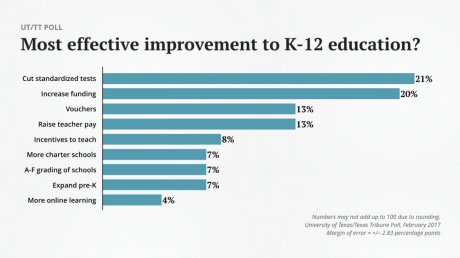
The University of Texas and the Texas Tribune conducted a statewide poll of public opinion about the direction of education reform.

Here are the results. The public makes more sense than their elected officials, who waste their energy and breath advocating for school choice. But the public wants less testing and more funding. School choice has a low priority.

c5cvpsqu0ae2uy8

By the way, I will be speaking in Austin on March 29 at the Austin Marriott North at Round Rock, sponsored by Friends of Texas Public Schools. If you want to attend, contact Jennifer Storm, at stormj@fotps.org for information.

For me, this is a makeup session for the event in 2014, when FOTPS honored me as Friend of the year, and I got stuck in New York City by a blizzard. The fake media called Snowmageddon.

I owe a debt to the public schools of Texas, which educated me. To quote Hank Williams, I’m hoping to set the woods on fire and stop the cranks in the legislature who want to defund public schools and spend public money on nonpublic schools.

Tomorrow, I will be speaking at the annual meeting of the National Art Education Association in New York City. I will be in discussion with our beloved reader and frequent commenter Laura Chapman, who has devoted her life to art education. If you happen to be in New York City, we will be in the Grand Ballroom of the New York Hilton at noon.

Make no mistake. Federal support for the arts, humanities, culture, and education are under assault. The president wants to boost spending on the military and make deep cuts everywhere else. We know where the cuts will hurt most, even though the savings will be minuscule: the arts, the humanities, culture, and education.

Here is a statement issued by Lincoln Center and its partner institutions. I am aware of many families and foundations in New York and across the nation that generously fund the arts as a treasure for all. I am not aware of the Trump family name as a sponsor of any of them. He could change that negative impression by increasing funding for the National Endowments for the Arts and the Humanities.


PRESS CONTACT
Mary Caraccioli / 212.875.5100 / mcaraccioli@lincolncenter.org
From our stages and screens at Lincoln Center in New York City—which draw more than six million people to the largest performing arts center in the world—to theaters, concert halls, and galleries across America, the arts inspire and delight people from every walk of life, at every stage of life.

A child’s early introduction to ballet teaches strength and discipline. A veteran’s exposure to art therapy brings healing and hope. A student’s participation in music class improves math scores and critical thinking skills. Art shapes achievement, with profound and practical effects.

Still more, art anchors communities. In American cities and towns, arts institutions and districts are breathing life into neighborhoods—attracting investment, spurring development, fueling innovation, and creating jobs. Arts and culture help power the U.S. economy at the astounding level of $704.2 billion each year.

Beyond our shores, American arts institutions are the envy of the world. In a unique public-private model, private sources provide the vast majority of funding for our artists and arts organizations. Government helps in targeted ways at pivotal moments, for example, by providing early funding to get projects off the ground or helping to create or expand promising initiatives to achieve greater reach and impact.

Underlying all of this is the National Endowment for the Arts.

For more than 50 years, the NEA has provided leadership in the public arts arena. Yet today it faces an uncertain future as its federal funding is considered for elimination. The total cost of the NEA is less than one dollar a year for every American. But because it is so successful and its imprimatur so prestigious, every dollar the NEA contributes leads to nine additional dollars being donated from other sources.

A great America needs that kind of return.

We hold close the words of Lincoln Center’s inaugural president, John D. Rockefeller III, who said, “The arts are not for the privileged few, but for the many. Their place is not on the periphery of daily life, but at its center. They should function not merely as another form of entertainment but, rather, should contribute significantly to our well-being and happiness.”

To preserve the human and economic benefits of the arts, we urge continued federal support for the National Endowment for the Arts.

The Chamber Music Society of Lincoln Center
Suzanne Davidson, Executive Director

Film Society of Lincoln Center
Lesli Klainberg, Executive Director

Jazz at Lincoln Center
Greg Scholl, Executive Director

The Juilliard School
Joseph W. Polisi, President

Lincoln Center Theater
André Bishop, Producing Artistic Director

The Metropolitan Opera
Peter Gelb, General Manager

New York City Ballet
Katherine E. Brown, Executive Director

New York Philharmonic
Matthew VanBesien, President

The New York Public Library for the Performing Arts
Jacqueline Z. Davis, Barbara G. & Lawrence A. Fleischman Executive Director

School of American Ballet
Marjorie Van Dercook, Executive Director

Lincoln Center for the Performing Arts
Liza Parker, Chief Operating Officer

You may recall that voters in Massachusetts overwhelmingly rejected a ballot referendum to expand charter schools in the state. The vote was 62-38%, with only wealthy districts (which are not targeted for charters) supporting the referendum. The state has not yet reached its “cap” on charters, so new ones are still opening, despite the clear public objection to them. The public understands that every dollar for a charter is taken away from their local public schools.

On Monday night, the State Board of Education rejected a request to double the enrollment of the Pioneer Valley Chinese Immersion Charter School. Last November, the community voted against charter expansion because of the drain on the resources of the public schools.

“HADLEY — After hearing testimony that the Pioneer Valley Chinese Immersion Charter School is draining resources from local school districts and not educating a sufficiently diverse student body, the state’s Board of Elementary and Secondary Education on Monday turned down a proposed expansion to nearly double its enrollment.

“In a voice vote about four hours into its meeting in Malden, the board denied a 452-student enrollment increase at the charter school recommended by Mitchell D. Chester, the commissioner of elementary and secondary education. Chester called the decade-old school an “exemplar” of what the charter-school movement is about.

“But Michael Morris, acting superintendent for the Amherst-Pelham Regional School District, told the board that adding students would be transferring funds from schools where underserved students are educated to one attended by more privileged children. Amherst, Morris said, is already sending $2.24 million from the school and town budgets to the charter school.

“Morris also presented statistics showing that the demographics indicate the charter school is not meeting its mission, with PVCICS having fewer low-income students and English language learners than Amherst schools, and special education children often returning to Amherst after being enrolled in the Hadley school.”

Barbara Madeline, president of the Massachusetts Teachers Association, said that the school should be investigated for its failure to meet the needs of students with disabilities.

Peter Greene read Betsy DeVos’s speech to CPAC and realized that she totally misunderstood why Obama and Duncan’s reforms failed. It wasn’t because they spent money. It was because they spent money on bad ideas. Now she proposes to spend money on vouchers, which have failed miserably, and on charters, which Obama and Duncan promoted. What is new about her approach? She is candid: she wants to destroy public education. Obama and Duncan either believed or pretended that public education would get better because of high-stakes testing, punishments, and charter schools. They were wrong. DeVos is wrong too. The difference is that we already know she is wrong, but she doesn’t.

Greene writes:

“School improvement grants were like food stamps that could only be spent on baby formula, ostrich eggs, and venison—and it didn’t matter if the families receiving the stamps lived on a farm with fresh milk and chicken eggs, or if they were vegetarians, or if they lived where no store sells ostrich eggs, or if there were no babies in the family. The Department of Education used the grants to dictate strategy and buy compliance with their micro-managing notions about how schools had to be fixed.

“As with many classic reform moves, plenty of folks on the ground level could have told the reformers what was wrong with their plan. But as DeVos’s comments show, the damage of School Improvement Grants is not only in wasted money, it’s also in convicting the wrong suspect and discrediting a whole reform approach.

“DeVos and other conservative reformers are taking the real lesson of the grant program’s failure: “spending money on the wrong thing for schools doesn’t help,” and shortening it to a far more damaging assessment: “spending money on schools doesn’t help.”

“The Obama-Duncan-King program didn’t just fail, they say, but it also helped discredit the whole idea of funding schools at all. Thanks Obama.”

Given the miserable failure of school choice in Michigan and Detroit, you would think DeVos was open to reflecting on the error of her ideas. But don’t make that mistake. Her ideas of school “reform” are based on ideology and theology. They won’t change. They can’t be proved or disproved. They are set in stone. Evidence doesn’t matter.

If allowed to do her wishes, public schools will be defunded (they are “godless”), unions will disappear, for-profit entrepreneurs will cash in, and a million weeds will bloom.

The Education Law Center lists the most fiscally distressed districts in the nation. You will note that one of them is Shelby County, Tennessee, where the Gates Foundation and Stand for Children expended a great deal of effort to introduce charters and district consolidation as a mini-bandaid to the district’s financial problems. The Gates Foundation paid to bring in the Boston Consulting Group to offer advice a few years back on merging districts, not on how to solve its fiscal problems. The Gates Foundation gave Shelby County a grant of $90 million over seven years to improve teacher quality. Yet Gates never addressed the basic fiscal disadvantage of the district. Presumably he thought that if he could VAM the teachers, then the test scores would go up, and the district’s budget would not matter. But it does matter. Once again, the Gates Foundation proved that it addresses the wrong problems and diverts attention from the need for a fair tax code that would reduce the billions accumulated by people like Bill Gates!

ELC RELEASES 2017 LIST OF NATION’S MOST FISCALLY DISADVANTAGED SCHOOL DISTRICTS

47 Districts in 20 States

Education Law Center released today the 2017 list of the most financially strapped public school districts in the nation. The 2017 list includes 47 school districts in 20 states, with every region of the country represented. Over 1.5 million children are educated in these districts, attending underfunded schools under severe fiscal distress.

The report – “America’s Most Fiscally Disadvantaged School Districts” &#45 identifies school districts across the country with higher than average student need and lower than average funding when compared to other districts in their regional labor market.

“A district’s funding level relative to other districts in the same labor market is perhaps the most important factor in whether schools have the resources they need, including effective teachers,” said Dr. Bruce Baker of the Rutgers Graduate School of Education and a co-author of the report. “School districts must compete for teachers and support staff, the largest share of any district’s budget. Districts are fiscally disadvantaged if they don’t have the funding to offer competitive wages and comparable working conditions relative to nearby districts and other professions.”

Among the report’s key findings are:

Sumter, South Carolina, and Shelby County, Tennessee, face extreme fiscal conditions, with nearly 3 times area poverty rates and less than 84 and 83 percent, respectively, of the average state and local revenue per pupil. School funding levels in Tennessee and South Carolina are among the lowest in the nation.

Reading and Allentown, Pennsylvania, are also in extreme distress, with nearly 2.5 times area poverty rates and below 80 percent of the average state and local revenue per pupil.

Chicago and Philadelphia are again the most fiscally disadvantaged large urban districts in the nation. Illinois and Pennsylvania have a highly regressive school funding systems, marked by wide funding disparities between low and high poverty districts.

California has the highest number of fiscally disadvantaged districts.

Massachusetts has a relatively progressive funding system, but Lowell is severely disadvantaged with a poverty rate 2.6 times higher than surrounding areas and only 83 percent of the average state and local revenue per pupil.

Connecticut has four districts on the list, while Michigan and Arizona have three fiscally disadvantaged districts.
“These findings again show that Governors and Legislatures in far too many states stubbornly resist investing in K &#45 12 education so all children have the resources needed to succeed in school,” said David Sciarra, ELC Executive Director and a report co-author. “The states with districts on this list chronically underfund their poorest schools, leaving behind thousands of vulnerable children. This is our national hall of shame.”

America’s Most Fiscally Disadvantaged School Districts is a companion report to Is School Funding Fair? A National Report Card. For the complete Report Card, please visit: http://www.schoolfundingfairness.org

Education Law Center Press Contact:
Sharon Krengel
Policy and Outreach Director
skrengel@edlawcenter.org
973-624-1815, x 24

On Monday, I was in Commerce, Texas, to speak at Texas A&M’s campus there. I met some wonderful Texans and was treated royally by President Ray Keck and Vice President Noah Nelson.

I had a Q&A with the education faculty, then had an interview with the local NPR station, then lectured to the campus community.

The big issue in Texas right now is that Lt. Gov. Dan Patrick is pushing for vouchers. I explained that vouchers have consistently failed and that they will draw resources from the public schools that most children attend, which are already underfunded.

This link has the short interview and a summary of my talk.

http://ketr.org/post/diane-ravitch-texas-senate-bill-means-less-money-public-schools

Barbara Miner is a veteran journalist based in Milwaukee, where she writes often about the stat’s disastrous voucher plan. In 2013, she published a book called “Lessons from the Heartland: A Turbulent Half-Century of Public Education in an Iconic American City.”

In this article in the Los Angeles Times, Miner warns that the public must keep watch on DeVos because her goal is to legitimize vouchers for religious schools across the nation.

She warns:

“DeVos, now confirmed as secretary of Education, is not just another inexperienced member of the president’s Cabinet. She is an ideologue with a singular educational passion — replacing our system of democratically controlled public schools with a universal voucher program that privileges private and religious ones.

“If you care about our public schools and our democracy, you should be worried.”

Miner describes how Milwaukee and Wisconsin were taken in by bait and switch.

“Milwaukee’s program began in 1990, when the state Legislature passed a bill allowing 300 students in seven nonsectarian private schools to receive taxpayer-funded tuition vouchers. It was billed as a small, low-cost experiment to help poor black children, and had a five-year sunset clause.

“That was the bait. The first “switch” came a few weeks later, when the Republican governor eliminated the sunset clause. Ever since, vouchers have been a divisive yet permanent fixture in Wisconsin.

“Conservatives have consistently expanded the program, especially when Republicans controlled the state government. (Vouchers have never been put to a public vote in Wisconsin.) Today, some 33,000 students in 212 schools receive publicly funded vouchers, not just in Milwaukee but throughout Wisconsin. If it were its own school district, the voucher program would be the state’s second largest. The overwhelming majority of the schools are religious.

“Voucher schools are private schools that have applied for a state-funded program that pays tuition for some or all of its student body. Even if every single student at a school receives a publicly funded voucher, as is the case in 22 of Milwaukee’s schools, that school is still defined as private.

“Because they are defined as “private,” voucher schools operate by separate rules, with minimal public oversight or transparency. They can sidestep basic constitutional protections such as freedom of speech. They do not have to provide the same level of second-language or special-education services. They can suspend or expel students without legal due process. They can ignore the state’s requirements for open meetings and records. They can disregard state law prohibiting discrimination against students on grounds of sex, pregnancy, sexual orientation, or marital or parental status.”

Since 1990, the people of Wisconsin have paid more than $2 billion for vouchers, mostly to religious institutions. This has been an expensive experiment.

“Privatizing an essential public function and forcing the public to pay for it, even while removing it from meaningful public oversight, weakens our democracy.”