I wrote an article for the New York Review of Books about the proposed Trump-DeVos budget.
The whole world needs to know what Trump and DeVos want to do to limit access to college and to undermine public education.
I wrote an article for the New York Review of Books about the proposed Trump-DeVos budget.
The whole world needs to know what Trump and DeVos want to do to limit access to college and to undermine public education.
The Texas PTA is furious at Lt. Governor Dan Patrick and his allies in the State Senate.
Just when it seemed that the legislature was going to increase funding for the state’s woefully underfunded public schools, the Senate insisted on attaching voucher legislation. The House had already defeated vouchers, but the Senate came back a second time and was defeated again. The Senate held the budget hostage.
Meanwhile due to the stubborn Dan Patrick, millions of children across the state will be deprived of the schools they need.
Way to go, Texas PTA!
William Mathis explores the lies at the heart of Trump’s education budget.
He writes:
Trump’s Education Budget: A Paradise Lost?
“But all was false and hollow; though his tongue Dropp’d manna and could make the worse appear the better reason.”
■ John Milton, Paradise Lost, II.I.112
We had a vision of a more perfect nation where democracy and equality were more than aspirations. We believed we could make this piece of paradise real with the unity of the people and the purposefulness of our governments. But this has been reduced to an endless series of false and hollow incantations whose life-span is as transient as its denial in the next morning’s news cycle.
In 1965, the federal government, driven by the obligation to provide equal opportunities to the least fortunate of our citizens, passed the Elementary and Secondary Education Act. It was intended to lift the nation by strengthening our poorest children and schools, improving the quality of teaching, opening the doors of higher education, and providing skills to adults. It embraced the ideal voiced by the late President Kennedy that “a rising tide lifts all boats.” And the emphasis was on building the common good. By widely investing in our citizens, we invest in the health of our society and economy.
Those principles have found no refuge in the work of President Trump and Education Secretary DeVos; all that remains of these great purposes are a confusion of empty words made to appear as if the worst were the better. Larded with phrases like “commitment to improving education” and “maintaining support for the nation’s most vulnerable students,” Trump proposes to slash federal education programs by $9.2 billion dollars, or 13.5%. This is on top of past unmet needs, since federal obligations to poor and special education children have never been fully met. Starved programs are now set to have their rations reduced or cut entirely.
With a remarkable lack of compassion, the Special Olympics budget was zeroed. Twenty-two programs are eliminated including community learning centers, arts, pre-school and teacher improvement.
Blind to clear evidence, every dollar invested in high-quality early childhood education returns eight dollars in positive social outcomes such as reduced unemployment, stable families, less incarceration and the like. Yet the Trump budget treats this wise and productive investment as another area to defund: Head Start and childcare are slotted for small reductions, while preschool development grants are entirely eliminated.
It doesn’t get any easier for poor and middle-class students as they get older. Loan forgiveness programs for new college graduates working in schools or government would be eliminated. Student loan interest would be increased. In Trump’s plan, 300,000 students would lose their work-study jobs. In all, $143 billion would be removed over ten years.
Why make these cuts? The proposal calls for an increase in defense spending of more than $50 billion (a 10% increase) plus tax cuts for the wealthy – and that money has to come from somewhere. By these deeds, a capacity for war is valued more than the needs of the citizenry.
Yet, Trump says “education is the civil rights issue of our time.” This budget raises questions about whether his true objective is to cut civil rights. The proposal’s centerpiece is school choice. The budget seeks to funnel $1.4 billion, in new as well as repurposed funds, into private schools. The “civil rights” framing is stunning doubletalk, since a growing body of independent research shows that school choice segregates students by race, handicap and socioeconomic level.
While there are well-funded partisans who claim that school choice results in better education, an objective look at the data says otherwise. Four recent major studies have examined test-score outcomes for voucher students—in DC, Indiana, Ohio and Louisiana—and all four studies show these students doing worse than if they had stayed in public school. The results for charter schools don’t look good enough to justify the rhetoric. Charter schools and public schools perform about the same in terms of test-score outcomes, with poor schools and exceptional schools being distributed among both sectors. In short, school choice is not a way to increase achievement or equality.
At all levels, the the federal government’s long-standing commitment to tackling inequality is left behind. Instead the budget addresses these concerns by reducing services and by growing a competitive choice system that pits schools and families against each other. In this jarring half-light of contradictions, the worst is claimed to be the better.
The election promises still resonate. Manufacturing was to be restored, the little guy would be taken care of, and the dispossessed would have a champion to restore an imagined great Utopia. Instead, it is a coarsened, contradictory and conflicted selfishness, which lessens the common good. It promises manna but takes from the needy to give to the rich. It is far more dangerous than an education appropriation. Its values threaten our democratic society. Instead of a paradise regained, it is a paradise lost.
William J. Mathis is the Managing Director of the National Education Policy Center and vice-chair of The Vermont State Board of Education. The views expressed are those of the author and do not necessarily reflect the views of any group with which he is affiliated.
John Kuhn is superintendent of a school district in Texas. He is one of the nation’s most eloquent spokesmen for children and public schools. He first came to national attention when he spoke at the Save Our Schools March in Washington, D.C. In 2011.
He describes the recent legislative session, where an effort was made to improve school funding, but the Semate leaders knowingly sabotaged it.
He writes:
“There was a dramatic showdown in the Texas legislature two days ago.
“First, some backstory. A year or so ago, well over half the school districts in the state sued Texas for funding schools inequitably. Schools in wealthier areas with higher property values get significantly more education funding per pupil than school districts in areas with lower values, even though it is in the poor areas where one finds larger concentrations of students with illnesses, learning disabilities, and challenging home situations that make them more difficult (and more expensive) to educate.
“The Supreme Court, against all odds, found this system to “meet minimum constitutional standards.” Many were left flabbergasted trying to process how such a system truly meets the state constitution’s directive that the legislature “make suitable provision” for a free, statewide network of efficiently-resourced public schools. While holding back their gavel (and justice), the state’s justices did see fit to wag their fingers at legislators, calling the state’s school funding mechanism “Byzantine” (which apparently means awful) while stating clearly that it was up to the legislative branch not the judicial branch to decide how to fund schools. (This is akin to a parent nagging their kids from the couch to pick up their socks while making it clear they won’t be getting up to make sure the job gets done nor enacting any punishment if it doesn’t.)
“Before the ruling, several state lawmakers predicted that school districts would prevail and expressed some relief because, as they noted, the state legislators in Texas have never seriously addressed school finance without a judicial gun to their heads. After the ruling, state legislators nonetheless expressed confidently that they would repair school finance because it was their job to do so and the Supreme Court had called them out. They were ready to show leadership, they assured us all.
“Well, here we are, nearing the end of the legislative session.
“Let me note before getting into the legislative blow-by-blow that funding schools inequitably appears to be the inevitable result of our politics and our social realities in America. Other nations that outperform us on international student assessments either limit the testing population to only strong academic students (a la China) or (a la Scandinavia) have far more equal and just societies than ours, resulting in far lower rates of childhood poverty and far more equitably-resourced public school systems. Elected officials here, however, are under heavy political pressure from voters to do two contradictory things. One, voters expect them to keep taxes low, Two, voters expect them to provide high quality public schools with things like chess programs, extracurriculars, field trips, newer computers, up-to-date career and tech training programs, great math scores, etc., etc.
“You can’t really have both because ultimately you get what you pay for, but inequity provides a way to come close to at least appearing to have your cake and eat it too. By funding schools based on property value, legislators save the taxpayers money by reducing overall school expenditures at the state level to the maximum extent possible, while ensuring that the wealthy areas–where more people have voice and political clout–get the schools that meet the minimum expectations of politically-active Texas parents. One researcher noted a phenomenon called “inequitable equilibrium” wherein states are forced by judges to adjust school spending to make it more fair but then, over time, without fail, the state legislatures pass new laws and find workarounds to return to the socially acceptable maximum level of school funding inequity. This explains why Texas and many other states have witnessed repeated school finance lawsuits, one after another. Inequity is inevitable in our political and social reality. Voters in centers of power and influence are able to ignore something as esoteric as inequity so long as it only affects relatively voiceless populations in inner cities, border towns, and fading farm towns.
“Now people like me (politically active folks raising kids in underfunded school districts) tend to respond to this frustrating reality by moralizing. We write letters, publish editorials, and give speeches. We talk about what’s right and fair and just. We try to animate others to support the morally (and constitutionally) right thing to do. But then, at the end of the day, a majority of Texas voters still install leaders who are openly antagonistic to justice. We live in a post-justice world. And our moral message finds some listeners, but voting majorities in Texas primaries still nominate candidates who are religious but not moral, who play-act as righteous representatives of the people’s hearts and values but who, in the crucible of leadership, more and more of the time reveal themselves to be really pretty bad people who are effectively incapable of moral leadership. We keep electing carnival show barkers who are better at sound bites than sane decisions. Governance has devolved into something like pro wrestling, but it’s school children in underfunded schools who are getting hit with folding chairs.
“So that’s the background. An inequitable school funding system with the back-handed imprimatur of the state Supreme Court, and legislators assuring us that they’ll rise to the occasion and fix it, even though the Supreme Court is fine with it as is.
“Mmm-hmm.
“So here was the showdown: this session the House of Representatives passed a bill adding $1.8 billion in new school funding and making tweaks to move the system more toward equity. The Senate took that bill, gutted half the money, watered down the equity provisions and–even though the House had made it clear that they wouldn’t support any legislation creating a voucher system directing state education funds to private schools–the Senate attached a voucher provision to the House bill. The House responded by requesting a conference to iron out differences in the bill, insisting clearly that the voucher language was unacceptable, and the Senate refused to agree to a conference.
“So school funding reform in Texas is dead. The Senate held equity hostage and demanded vouchers. The House, to its eternal credit, refused to negotiate over something as basic as the word “public” in public education actually meaning what it plainly means. And the Senate shot the hostage.
“They shot my son’s chance at going to a public school that isn’t getting half the per student funds of school districts north of Dallas. They made sure my son will have older books, fewer computers, and lower-paid teachers than kids born into wealthier families who will very soo be competing with him for admission into the state’s best universities and who later will be competing with him in the Texas job market. The Senate harmed my son, and hundreds of thousands of sons and daughter’s that they have condemned yet again to underfunded educational experiences, and all because folks making huge donations to them badly want vouchers.
“To top it off, these legislators will continue to grade school districts on neutral criteria. That is, even as they hamstring schools like mine by keeping them on a short funding leash, they will insist that their school accountability system–which treats all schools the same no matter their funding level–differentiates between good schools and bad. It is illegitimate to grade schools on uniform criteria while refusing to fund schools uniformly. State-approved school accountability systems with no “curve” in place for schools that the same state leaders have seen fit to significantly underfund amount to sabotage. This underhanded approach guarantees that most poorer communities’ schools will be branded as worse schools. This will translate to several harmful realities for regular folks: lower property values in communities where schools are underfunded, more limited ability for those communities to attract new businesses and new jobs, financial harm to homeowners, and educational harm to their children. Test-based school accountability combined with inequitable school funding is state-sponsored sabotage of cities.
“Ultimately, by inequitably funding public schools and then publicly labelling the lower-funded ones as failures, the state isn’t just treating teachers and children shamefully, it is undermining entire cities and towns. It is kneecapping places with lower property values and playing favorites by blessing schools in some areas and cursing schools in other areas.”
It may be morally wrong, but it is apparently politically right. This endless, blatant educational injustice reflects who we are now in America.
-John Kuhn
Sent via the Samsung Galaxy S7 edge, an AT&T 4G LTE smartphone
Arthur Camins, writing at the Huffington Post,analyzes the Trump-DeVos education budget and declares it to be “cruel and unusual punishment,” targeted to harm the nation’s neediest children.
http://m.huffpost.com/us/entry/us_59243736e4b07617ae4cbf7f
He writes:
“President Trump’s budget proposal violates the Eighth Amendment to the Constitution’s ban on cruel and unusual punishment. The crime it punishes is not being wealthy, healthy and deserving of tax cuts. Budgets are values statements. Trump’s first full education budget proposal is no exception. Its $9.2 Billion or 13.6% cut in the spending level approved by the already spendthrift conservative Congress also violates the values of most Americans. Bigly. It cuts programs that help most children in order to fund programs to help a few children– and facilitate tax cuts for the wealthy.
“As a citizen, lifelong educator and grandfather, I am appalled. We have schools not just to benefit individual children. Effective, humane, well-funded, equitable schools make for a better society. With its emphasis on privately governed charter schools and vouchers to attend private schools, Trump’s budget says that somehow parents’ individual decisions about education are automatically better than democratic community decisions. Choices by either individuals or groups are neither inherently good nor bad. That is a function of the values that guide them. The foundational value of Trump’s education budget is, “Just look out for yourself.” Most of us, I think, reject that dystopian idea.”
Trump and a DeVos say they want to help every get a better education, but they know schoice will not do that.
“Donald Trump, Betsy DeVos, and their supporters do not want to spread charter schools to provide more effective education to more children than in neighborhood public schools. We already know that they will not.
“They don’t want charter schools to compete for students with public schools because such competition leads to innovative improvements. They don’t want to replace democratic- with private-governance of schools because it is more efficient, or more responsive to students needs, or results in better decision-making, or is less vulnerable to corruption. We already know that the opposite is the case.
“They do not want to replace taxpayer funded public education that enrolls the vast majority of local children with tax credits for vouchers to attend the private school of their parents’ choosing because it will lead to a more equitable education for all students. We already know that it will not.
“They do not want to shift targeted federal education funds into block grants to states because it will result in better outcomes for all children. We already know that it will not.
“In fact, education policies that rely on market forces and individual choice have always had only three goals: Profit for individual investors, the protection, and enhancement of the privileges of the few, and legalized segregation. Make no mistake. Republicans have no intention of increasing education funds at the local or state levels. That would violate their core values: Keep as much of their wealth as possible. Pay as little in taxes as they can get away with to help other folks. Pander to people who want a religious or segregated education on the public’s dime.”
You may recall reading a story recently about Jared Kushner’s sister soliciting investments in Kushner real estate deals at a meeting in Beijing, where she promised that investors of at least $500,000 would get a green card in exchange. Investing in charter school construction is another way in which the EB-5 visas are up for grabs.
This story from South Carolina demonstrates how foreign investors are buying green cards by investing in charter school construction, and the middlemen are raking in money at exorbitant interest rates.
A handful of S.C. charter schools — finally in new school buildings — are poised to pay out millions in taxpayer dollars to middlemen, developers and foreign investors who want green cards.
The money, paid in the form of high-interest rent payments on the new school facilities, has some critics saying that the state’s taxpayers are getting duped. Money they believe is paying for S.C. students’ education is instead going to this relatively new network of out-of-state players who are charging high interest rates, as well as wealthy Chinese nationals searching for a quicker path into to the country.
And it’s all happening with federal government approval.
“They were taken for a terrific ride and are paying this high interest rate. It’s remarkable,” said David North, a fellow with the conservative Center for Immigration Studies in Washington, D.C., “They could end up paying more in interest than the (cost to construct the school).”
Figuring out just who is getting paid what is complicated and is not readily available in one place. Take, for example, Lowcountry Montessori School in Port Royal, a charter school that serves about 400 students in preschool through the 11th grade.
Through a controversial federal program called EB-5, the school received $1.5 million from three foreign investors to build its school building that opened last school year on Broad River Drive.
Critics have long charged that the program allows rich immigrants to buy their way into the country. And in recent years, cases of fraud and concerns about national security have also plagued the program.
The Port Royal school’s financial arrangement was put together by American Charter Development, a Utah-based company, that secured another $4 million for the new building and constructed the school.
The school is now leasing its $5.5 million building from ACD at a whopping 9 percent annual rate of the school’s construction costs. If the school were to make only the minimum payments over the course of the 20-year lease, $5.6 million of its $10.3 million in lease payments would be interest, according to the school’s most recent audit.
Worked into those lease payments is another key player — Utah-based Education Fund of America, a for-profit company which is receiving a 7.3 percent annual fee on the $1.5 million it secured in EB-5 funding for the school.
And then there are the three unnamed foreign entrepreneurs who actually invested the $1.5 million. The school will pay them back as well, likely including a small return on their investment of around 1 percent, say those familiar with the EB-5 program. The repayment is also included in the lease arrangement.
By comparison, the Beaufort County School District is paying just 1.6 percent interest on its construction bonds for its new May River High School that opened last year.
Read more here: http://www.thestate.com/news/state/south-carolina/article151566537.html#storylink=cpy
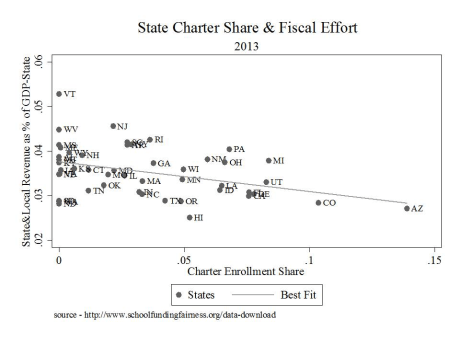
Bruce Baker at Rutgers University created a valuable graph that shows the relationship between every states’ number of charter schools and its fiscal effort.
Some states appear to think that opening charters relieves them of their responsibility to fund public schools. They choose to “reform” by handing schools off to private entrepreneurs, thus relieving the state of the duty to provide adequate and equitable funding.
Politico Morning Education reports that the movement to make community college tuition-freeis spreading.
“STATES PICKING UP FIGHT FOR FREE COLLEGE: The push for free college didn’t die when Hillary Clinton lost the presidential election in November. Rather, the movement championed by Democrats last year has maintained momentum in what has been a big year for free college advocates. At least five states, including some red ones, have adopted or expanded programs to cover tuition for students, and more could still win approval. “It was a huge year for the movement,” said Martha Kanter, a former Education undersecretary under Barack Obama who is now executive director of the College Promise Campaign, which helps build and expand tuition-free programs.
“- Tennessee Gov. Bill Haslam is expected to sign a bill soon expanding the state’s well-known free college program to older adults. The program is currently available only to students who just graduated from high school. Lawmakers in New York last month approved a plan to provide free public college for students from families making $125,000 a year or less. The Hawaii legislature provided funding for free community college, as well, and Arkansas and Indiana approved programs to waive tuition for students pursuing degrees in desirable fields such as those in science, technology, engineering and math (so-called STEM fields). A grant program to cover tuition for some college students won approval in Montana, though lawmakers have yet to allocate funding for it. Rhode Island could be next. Lawmakers there are considering a statewide free college proposal.”
This will help many students achieve at least two years of college without being burdened by heavy debt
John Thompson, historian and teacher, submitted this article:
The Oklahoma City Public Schools is being clobbered by state budget cuts that could approach $50 million over two years. Anyone who doubts that money matters should take note of the collapse in morale as exhausted educators flee even faster from the school system and, often, the profession.
I remain a loyal supporter of President Obama, but we can’t forget that when his administration gave the OKCPS around $50 million, most of it had punitive strings attached. The regulations that accompanied Obama’s School Improvement Grants (SIG) made it virtually inevitable that its $5 million per school grants, and the energies of educators, would mostly be wasted. The predictable result was an increase in teacher turnover, educators who are even more inexperienced and beaten down, and legislators who are even less likely to fund urban schools.
I understand why President Obama felt obligated to promote teacher-bashing policies as a part of a “carrot and stick” approach to school improvement. It hurts to ask but, gosh, what if we could have spent the additional $50 million in ways that made sense?
Oklahoma City’s SIG efforts failed, but they did so across the nation. Even the corporate reform true believer Matt Barnum acknowledges, “Past research on federal turnaround programs have shown positive effects in California and Massachusetts, mixed or no effects in North Carolina, Tennessee and Michigan, and negative results in Texas.” But, he grasps at straws citing the 3rd year of California SIG, which seems to be an exception because its “gains in student learning likely stemmed from improvements in the professional opportunities for teachers.” Barnum then claims, illogically, that a study of the Ohio SIG gives evidence that the federal program “produced notable gains.”
https://www.brookings.edu/research/continued-support-for-improving-the-lowest-performing-schools/
Actually, the authors, Deven Carlson, Stéphane Lavertu, Jill Lindsey, and Sunny L. Munn conclude:
Overall, the study provides convincing evidence that interventions such as the SIG turnaround
models have the potential to improve school quality very quickly, which is consistent with the
theory underlying school turnaround reforms as well as research in other contexts. We also find,
however, that initial positive impacts dissipated after the first 2-3 years of implementation.
Click to access EvaluatingtheOhioImprovementProcess_Final_4.11.17.pdf
Curiously, student achievement gains occurred during the chaotic years of the school turnarounds and transformations, but not afterwards. How could that be possible?
When announcing the SIG experiment, President Obama’s Secretary of Education Arne Duncan claimed that The Turnaround Challenge was his “bible.” But, that study and a large body of social science and cognitive science explained that “aligning curricula to higher standards, improving instruction, using data effectively, [and] providing targeted extra help to students … is not enough to meet the challenges that educators – and students – face in high-poverty schools.” But, that shortcut was encourageded by SIG regulations.
Click to access TheTurnaroundChallenge_SupplementalReport.pdf
http://www.livingindialogue.com/real-crisis-in-education-reformers-refuse-to-learn/
Carlson et. al also conducted qualitative research which yielded three “Three key takeaways” from the state’s SIG effort, Ohio Improvement Process (OIP):
Additional funding for improvement personnel was the largest contributor to successes. OIP was hindered by culture challenges, most notably being a perception of compliance being more important than student improvement and stakeholder fatigue from too much change. Lastly, schools that experienced high levels of principal turnover or low principal effectiveness saw more challenges implementing OIP. Even in a school with strong principal leadership and relatively high fidelity of OIP implementation, student academic performance has not improved on state tests.
A generation of well-funded, output-driven school reforms has shown that old-fashioned, input-driven efforts like hiring counselors and mentors can increase graduation rates, and teacher supports are more likely to raise math scores, especially for younger students. But as was reported in the qualitative portion of the new SIG study, the key issue is whether low-skilled students can be taught to read for comprehension, and accountability-driven reform has failed at that task. We have long known that students must “learn to read,” in order to then “read to learn.” Test-driven reform has often demonstrated a capacity to raise test scores by teaching kids to decode, but it has been an utter failure in improving the reading skills necessary for meaningful learning.
Sure enough, an Ohio SIG leader explained:
We are working extremely hard trying a number of different things. We have … (a) phenomenal curriculum and instruction department; we have a scope and sequence, teachers receive a pacing guide; we offer extensive PD, we buy new resources – students are really resource rich. But (we’re) not really able to answer the question of why no growth, except that that we just haven’t hit the mark in how to help students who are not reading on grade level.”
In other words, the driving force of the SIG was a rebranding of the simplistic, and doomed, instruction-driven, curriculum-driven shortcut for improving the highest-challenge schools. As one leader explained, “The Ohio Improvement Process is teaching and learning. That’s the bottom line.”
But what were they teaching? First, they focused on math and reading test scores. More fundamentally, as one district leader explained the goal, “We decided on using that as a formative assessment to guide our work throughout the district, throughout the school year to better prepare our students to take the summative assessment, for them to be successful in the summative assessment.”
What teacher wouldn’t be thrilled to learn that they are no longer required to teach-to-the-test? To teach in high-pressure SIG schools, they must only teach to high-stakes summative assessments!
Not surprisingly, Carlson et. al learned that, “There is lots of push back from staff on testing because kids are tested a lot here.” Given the long history of the latest, half-baked “silver bullets” being repeatedly imposed on schools, it wouldn’t be surprising to hear, “During the first two years of OIP implementation, teachers felt the focus was on compliance.” The rushed turnarounds and transformations, especially in the first 2/3rds of the program, resulted in teachers “in the compliance mode going through the motions.”
But here’s the kicker. The seeds of so-called student performance gains were nurtured during this time of the “perception of compliance being more important that student improvement.” And there are only two explanations for that counter-intuitive pattern. Perhaps, more money works. Or perhaps the culture of compliance “works.” Under-the-gun educators will find a way to jack up test metrics even when they are meaningless.
To really improve high-challenge schools, we must first lay a foundation of student supports. Teacher supports using aligned and paced instruction can’t work until aligned and coordinated socio-emotional supports are in place. School improvement requires administrators to break out of their cultures of compliance and invest in the team effort to create trusting and loving school cultures.
As in Ohio, the SIG was driven by “a lack of understanding on the state’s part regarding what actually happens during the course of a day in some schools. … It’s like triage all day. Teachers are spent at the end of the day or they can’t really take the time to focus on this OIP because you know ‘Johnny’s mom got shot yesterday, they witnessed the murder,’ or …”
It’s not enough to do what one district did and purchase “fidget boxes” and “wiggle seats” to settle down students who are acting out their distress. As Johns Hopkins’ research shows, a system must establish Early Warning Systems to address chronic absenteeism before it spins out of control, and train and organize a “second team” of caring adults to make home visits and provide remediation.
Click to access NYC-Chronic-Absenteeism-Impact-Report.pdf
In theory, schools could have used SIG to invest in wraparound services so that its teacher supports could then produce better instruction, but I expect that Ohio’s (and Oklahoma City’s) experiences were typical. There are only so many hours in a day, and so many days in a three-year grant. When SIG demanded “transformative” gains in bubble-in scores in such a short time, systems did what they do best. They complied, hoping that “this too will pass.”
In my experience, teachers have been more successful in finding new careers than finding ways to teach for mastery in SIG-driven, test-driven schools. Fortunately, SIG is dead. Unfortunately, mandates for its failed approach to instruction are not. But, this post-reform hangover shouldn’t persist much longer than the so-called student performance gains that were produced by its turnarounds and transformations.
I just hope that the demand that educators give up a pound of flesh before legislators will adequately fund our schools might also fade away.
The legislation passed by the House of Representatives aims to cut Medicaid by $880 billion over ten years, and a relatively small but significant chunk of that money pays for special education services in schools.
The new law would cut Medicaid by $880 billion, or 25 percent, over 10 years and impose a “per-capita cap” on funding for certain groups of people, such as children and the elderly — a dramatic change that would convert Medicaid from an entitlement designed to cover any costs incurred to a more limited program.
AASA, an advocacy association for school superintendents, estimates that school districts receive about $4 billion in Medicaid reimbursements annually. In a January survey of nearly 1,000 district officials in 42 states, nearly 70 percent of districts reported that they used the money to pay the salaries of health care professionals who serve special education students.
Republicans say federal health programs must be restructured to curb their soaring costs — the biggest driver of projected budget deficits — and force a smarter allocation of limited resources.
But in a letter sent to top lawmakers this week, a coalition of school educators and advocacy organizations said such efforts would force states to “ration health care for children.”
The advocates argued that under the House bill, the federal government would transfer the burden of health care to states, which would result in higher taxes, eligibility cuts or curtailed services for children. And they said that schools would have to compete for funding with other entities, like hospitals and clinics, that serve Medicaid-eligible children.
The ability of school systems to provide services mandated under the federal Individuals With Disabilities Education Act would be strained. The law is supposed to ensure that students with disabilities receive high-quality educational services, but it has historically been underfunded.
“School-based Medicaid programs serve as a lifeline to children who can’t access critical health care and health services outside of their school,” said the letter sent this week by the Save Medicaid in Schools Coalition, which consists of more than 50 organizations, including the American Civil Liberties Union, the Disability Rights Education and Defense Fund, and the School Superintendents Association.
It is time for all concerned about children with special needs to contact their Senators and make sure that this cut to the most vulnerable children is eliminated. When Congress mandated that school districts include children with disabilities, it promised to pay 40% of the costs. It has never come close to fulfilling that promise. This cruel cut by the House of Representatives would shift even more of the burden for a Congressional mandate to the schools.

 Diane Ravitch's blog