Archives for category: Freedom of Speech

Jeffrey Toobin, a lawyer who writes on legal issues for The New Yorker and other publications, here discusses the clear and present danger to freedom of the press in the new era of Donald Trump.


His article centers on a lawsuit filed by the wrestler Hulk Hogan against a website called Gawker, which posted video of Hogan having sex with his best friend’s wife. The jury awarded Hogan $140 million and Gawker was driven out of business.


The lawsuit was (at the time) secretly funded by Peter Thiel, a tech billionaire who supported Trump in the election. He was angry at Gawker for publicizing the fact that he is gay.


Toobin writes:


Since the nineteen-sixties, a series of Supreme Court precedents, most of them involving newspapers, have made libel cases very difficult to win, in part because plaintiffs bear the burden of proving that the stories about them are false. In these cases, the Court came close to saying, but never quite said, that publication of the truth was always protected by the First Amendment. But, in an age when Internet publishers can, with a few clicks, distribute revenge porn, medical records, and sex tapes—all of it truthful and accurate—courts are having second thoughts about guaranteeing First Amendment protection. Hulk Hogan conceded that Gawker’s story about him was true, yet he still won a vast judgment and, not incidentally, drove the Web site out of business. The prospect of liability, perhaps existential in nature, for true stories presents a chilling risk for those who rely on the First Amendment.


The Hogan case had another dimension that was equally ominous for media organizations. The courtroom battle took place as Donald Trump’s candidacy for President was accelerating, and it drew on some of the same political forces. Although for years Hogan had honed an image of himself as a lovably egomaniacal celebrity, his Tampa lawyers successfully presented him as a rugged Everyman who was victimized by a group of privileged snobs. On the campaign trail, Trump turned contempt for the media into a central part of his quest for the Presidency. At rallies, he used the people inside the penned press enclosures as foils and targets. Pointing to the journalists, Trump would call them “disgusting reporters,” “horrible people,” and “scum.” As President-elect, he has used his platform and his Twitter feed to tap a deep reservoir of cultural resentment against, among others, flag burners, the cast of “Hamilton,” and the staff of the Times.


There are many fascinating and salacious details to this story. You will have to read it for yourself. But here are the non-salacious parts:


Thiel became a billionaire as an early investor in Facebook and Paypal, but, as Valleywag gleefully recounted, his subsequent business ventures were less successful. “a facebook billionaire’s big dumb failure,” read one headline, referring to the fate of a hedge fund he founded. Valleywag also mocked Thiel’s politics (“facebook backer wishes women couldn’t vote”) and his passion for “seasteading,” in which wealthy exiles would set up sovereign communities on ships, where they would be free from taxes or government regulation. Finally, in 2007, Gawker published a post, ostensibly about discrimination in the venture-capital industry, with the headline “peter thiel is totally gay, people.” His sexual orientation may have been well known in the Silicon Valley business community, but Thiel had never disclosed it to the public. All of this, predictably, enraged him. (Denton, who is gay, has stood by the post.)


By 2016, Thiel had become Trump’s most outspoken supporter in the tech community, and it is through him that the nexus between the Trump campaign and the Hogan lawsuit becomes clearest. Thiel’s politics are heterodox, but he shares with the President-elect an aversion to regulation and taxes and a skepticism about free trade. Temperamentally, both men have a vindictive spirit toward their enemies and a willingness to spend money to punish them. For this reason, after Charles Harder filed his lawsuits against Gawker, Thiel, through an intermediary, reached out to him and offered to pay Hogan’s legal fees, as long as Thiel’s involvement was not disclosed. “One of the striking things is that if you’re middle class, if you’re upper middle class, if you’re a single-digit millionaire like Hulk Hogan, you have no effective access to a legal system,” Thiel said recently, at the National Press Club.


Apparently, Hogan’s best friend supplied the sex tape to Gawker, and Hogan sued him and gained the copyright. That enabled him to sue Gawker for violation of his copyright.


As Harder [Hogan’s lawyer] and others have pointed out, Thiel had the legal right to pay Hogan’s legal fees. “I could have done the case on a contingency,” Harder told me. “It happens all the time. I could have gone to a litigation-financing company. That happens all the time, too. Hulk Hogan could have paid for it out of pocket. Or a rich relative could have paid for it. If I had done it pro bono, would that have been wrong? Or a public-interest organization that believes in privacy could have paid for it. There are lots of different scenarios. The law is very clear that what he did is entirely legal and ethical.” Harder declined to say when he found out that it was Thiel who was paying the bills or how much Thiel invested in the case, other than to stipulate that the trial cost less than ten million dollars. Thiel first disclosed his involvement in an interview with Forbes, earlier this year.


It might have been permissible, but Thiel was a billionaire paying to put a publication out of business. He later acknowledged that he financed the case not because he wanted Hogan to be compensated for harm he suffered but, rather, to punish Gawker. “This is not about the First Amendment,” Thiel said at the Press Club. “It is about the most egregious violation of privacy imaginable. Publishing a sex tape, surreptitiously, done in the privacy of someone’s bedroom, and to hide behind the First Amendment, behind journalism—that is an insult to journalists.”
The key issue in a right-to-privacy lawsuit like Hogan’s is whether the published material should be treated as news. “In the past, there was a tendency in courts to defer to the press on what’s newsworthy,” Amy Gajda, the author of “The First Amendment Bubble,” told me. In 1975, a man named Oliver Sipple saved President Gerald Ford from an assassination attempt in San Francisco. In the course of celebrating Sipple’s heroism, the San Francisco Chronicle revealed that he was gay. Sipple sued the paper for invading his privacy, but he lost the case, because the courts regarded his background as newsworthy. In a similar vein, the Supreme Court in 2001 ruled that a radio commentator could not be held liable for broadcasting a telephone conversation that had been illegally recorded by a third party. Justice John Paul Stevens’s opinion acknowledged that the Court had repeatedly refused “to answer categorically whether truthful publication may ever be punished consistent with the First Amendment,” but in this case, at least, making the commentator liable would threaten “the core purposes of the First Amendment because it imposes sanctions on the publication of truthful information of public concern.”


This kind of deference to journalistic judgment about what constitutes “truthful information of public concern” may be a vestige of a more orderly period in journalistic history….


The clearest winner in the Hogan case has been Charles Harder, who has become the de-facto general counsel for the Trump backlash against the press. On behalf of Melania Trump, Harder filed a libel suit in Maryland against the American Web site of London’s Daily Mail, which reported that she had once worked as an escort. (The Mail withdrew the story, but the case is still pending.) Again on behalf of Melania Trump, Harder demanded the withdrawal of a YouTube video asserting that her son Barron Trump was autistic. (The creator took down the video and apologized.) Harder also represents Roger Ailes, the former president of Fox News and sometime Trump adviser, who resigned earlier this year in a sexual-harassment scandal. On behalf of Ailes, Harder wrote to New York, which had run several pieces critical of Ailes, asking that the publication preserve all records relating to Ailes and his wife, Elizabeth; this kind of request is often a prelude to a lawsuit, though none has been filed. (Harder did not specify errors in any pieces.) Harder recently settled two other cases against Gawker, both apparently financed by Thiel.


Like Trump, Harder consumes news avidly, if critically. “I’m pro press,” he told me. “I’m pro responsible press.” Like Thiel, Harder celebrates not just the victory of his client but the extinction of his opponent. “Gawker did a lot of bad things,” he told me. “I think that they’re not doing bad things anymore. Their modus operandi was character assassination. The fact that they are not doing it anymore doesn’t bother me.”


For decades, the news media benefitted from the deference paid by courts to the judgments of newspaper editors. The judge in federal court treated Gawker’s editors as if they were running a newspaper, and he declined to second-guess them about what constitutes the news. The jury in state court did the opposite. The question now is whether the law, instead of treating every publication as a newspaper, will start to treat all publications as Web sites—with the same skepticism and hostility displayed by the jury in Tampa. The new President and his fellow-billionaires, like Thiel, will certainly welcome a legal environment that is less forgiving of media organizations. Trump’s victory, along with Hulk Hogan’s, suggests that the public may well take their side, too. ♦


In the aftermath of the “Hamilton” incident, there were many reactions as to the appropriateness of the cast giving a polite statement to the Vice-President-elect about their hope that the new administration would represent all Americans. Donald Trump was angry and demanded an apology. Pence said he wasn’t troubled and enjoyed the show and recommended it to others. I’m with Pence on this one. His response was just right. In this country, people heckle those in power. As it happened, the cast did not heckle or jeer. Their statement was polite.

Trump tweeted that they were “very rude.”

Here are Ken Bernstein’s thoughts on the matter.

If anyone wants to get rid of their tickets to the show, there are many eager to buy them. The show is sold out on Broadway until August 2017.

Arthur Goldstein teaches English language learners in a high school in Queens. He is active in his union and more often than not, a thorn in its side. He writes a blog where he speaks his mind, protected by tenure.

He addresses the question that most educators will have to face in the days ahead. What do you tell the students? What do you say to Hispanic students? to Black students? to gay students? Do you still teach an anti-bias curriculum? an anti-bullying program? If you do, are you criticizing the President-elect?

Goldstein writes:

In this post, he calls on the Chancellor of the New York City public schools to put a letter in his file. He also offers a graphic/meme that he hopes will appear in every classroom in the city (or state or nation).

Chancellor Fariña declared there would be no overt political talk in class. To a degree, I understand that. It’s not my place to tell kids who I voted for. It’s not my place to tell them who to vote for either. I would never do such a thing. But I knew they would ask me anyway.

Nonetheless, on Monday, I wore a tie a little bit like the one on the right. You wouldn’t notice what was on it unless you looked closely. When the kids asked me who I was voting for, I showed them the tie. I told them that a donkey represented Democrats, and an elephant represented Republicans. They didn’t know that. They looked at my tie and said, “Oh, you’re voting for Hillary.” I was glad they asked, because I needed them to know I would not vote for someone who hated them and everything they stood for, to wit, the American dream.

I also needed them to know that I stood against all the bigoted and xenophobic statements our President-elect made. I’m sorry, Chancellor Fariña, but I’m a teacher, and unlike Donald Trump, I stand for basic decency. My classroom rule, really my only one, is, “We will treat one another with respect.”

Donald Trump failed to treat a wide swath of people with respect. He’s a hateful, vicious bully. There are all sorts of anti-bullying campaigns that go in in city schools, and I fail to see why Donald Trump should get a pass simply for having lied his way to the Presidency. So I specifically repudiated a whole group of his insidious statements. I also added LGBT to my group, and told my kids that we would not tolerate slurs to gay people in my classroom. Even my kids seem to expect a pass on that. They won’t get one.

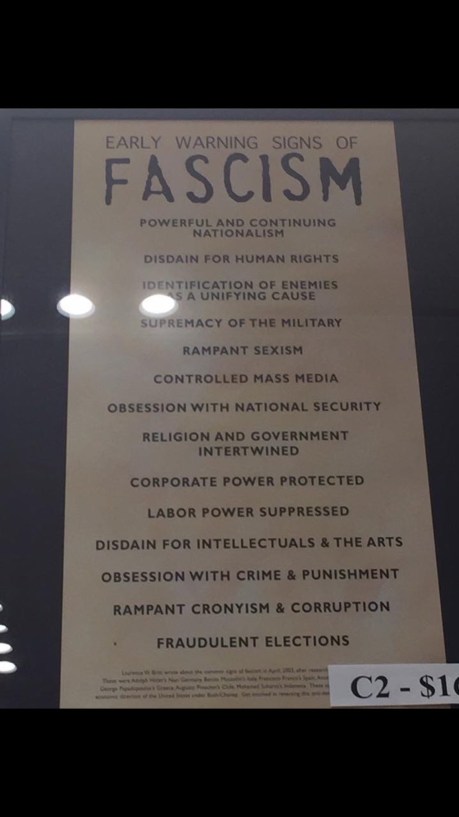
A history teacher at Mountain View High School in Mountain View, California, was suspended after comparing the rise of Trump to the rise of Hitler.

“Frank Navarro, who’s taught at the school for 40 years, was asked to leave midday Thursday after a parent sent an email to the school expressing concerns about statements Navarro made in class. Mountain View/Los Altos High School District Superintendent Jeff Harding confirmed the incident Friday but declined to describe the parent’s complaints.

“Navarro, an expert on the Holocaust, said school officials declined to read him the email and also declined his request to review the lesson plan with him.

“This feels like we’re trying to squash free speech,” he said. “Everything I talk about is factually based. They can go and check it out. “It’s not propaganda or bias if it’s based on hard facts.”

“Though Navarro said school officials originally told him to return on Wednesday, Harding said he could return as early as Monday….

“Navarro, who is Mexican-American and was raised in Oakland, said he’s concerned for many of his students during this political climate.

“I’ve had Mexican kids come and say, ‘Hey, Mr. Navarro, I might be deported,’ ” he said.

“Is it better to see bigotry and say nothing? That’s what the principal was telling me (during our conversation). In my silence, I would be substantiating the bigotry.”

The Arizona Republic is a conservative newspaper. Since, 1890, when it was founded, it has never endorsed a Democrat for President. Until now. It published an editorial endorsing Hillary Clinton and said that Donald Trump was neither conservative nor qualified.

Then the death threats began. On her show tonight, Rachel Maddox put this into context. Forty years ago, she said, an investigative reporter for the newspaper was murdered by a bomb placed in his car. Now, the callers invoke the name of the assassinated reporter, Don Bolles.

This was the response of the newspaper’s publisher to the death threats. It is magnificent. It gives us hope for the survival of basic democratic values long after this vicious, degrading election is over.

Please read it.

The New York Times wrote  about the control of the mass media by billionaires, an issue that should concern us all. Not only do they own the media, some use it to promote their financial self-interest and political ideology.


This is is not an entirely new phenomenon, the story notes, mentioning William Randolph Hearst as an example. But Hearst co-existed with thousands of community newspapers. In this age of concentrated ownership of the media, a handful of moguls own the news.


Jim Rutenberg, the reporter, points out an ominous development. Billionaire Peter Thiel bankrolled a lawsuit by wrestler Hulk Hoganagainst Gawker.com, a gossip website, as payback for Gawker’s report that he was gay. Hogan won $140 million, which, if upheld on appeal, would put Gawker out of business.


This is an ingenious way to stifle dissent. If a billionaire doesn’t like a website, he or she can sue it into bankruptcy.

Rachel Rich is a retired English teacher who has taken a deep interest in standardized testing. She wrote the following review of one of the two federally subsidized tests. Normally, I would tell you which test she has analyzed, but I have recently become acutely aware that the testing corporations hire security agencies to scan the Internet, looking for blogs and tweets that dare to mention their name. If you mention their name, the testing corporation goes to the Internet Service Provider and complains that you violated their copyright. The ISP then deletes your post or tweet. So I won’t tell you which national test she is writing about. I will just give you a hint: it is not the one that is CCRAP spelled backwards. It is the other one. (Let’s see if they miss this one.)


Rachel Rich writes:


S——r B—–ed Exposed


The online Third Grade SB Practice Test is the tip of the testing iceberg, but presumably made of the same basic material as the larger, submerged test. The “real” test is so hidden from view that you, other parents, teachers and even the students themselves are not even allowed to whisper about it, let alone criticize. Given that other standardized tests publish their questions once the test is over, the SB never-ending code of silence is unprecedented, probably to hide flaws. If the public mini-version is any indication, the final is a sloppily written, tricky, grossly unfair mess.

The current level of censorship surrounding SB would make Nixon proud. The test originators, Pearson, CTB/McGraw-Hill, and AIR, unleash internet spies like TRAXX and Caveon who set webcrawlers after key words like test names. Next, human spies dig into the Facebook, Twitter and other accounts of any griping parents, teachers, bloggers and especially children!


SB even sends out annual flyers to school administrators detailing how to spy on kids’ Facebook and Twitter accounts. Principals are supposed to suspend kids as young as eight simply for telling their parents there was a question about the Wizard of Oz on a Common Core test. Teachers are forced to sign gag orders or face firing for discussing the uber-test even in the most general terms. And right this very minute testing companies are forcing the removal of internet discussions under threat of lawsuits. Censorship is now as common as head lice in kindergarten.

 
Now let’s find out what they’re hiding:


The Language Arts Third Grade SB Practice Test is twenty pages long! Since it’s supposed to take an hour, we can easily calculate the length of the final. Officially third graders need at least seven hours to finish the math and English portions combined, meaning the real deal is a grueling 140 pages long!!! Tenth graders are assigned at least 8 1/2 hours, which would mean their tests are about 170 pages long! Endurance is now as key as knowledge. One kid told me afterwards his fingers hurt.

The test opens with a colossal three page reading passage totaling 580 words. That is triple the length of passages in other tests, a length only suitable for in-class discussion, not a cold read. Still the test repeats this flaw with similar, lengthy, redundant passages. Such a quantum leap in expectations renders all comparisons with other tests useless, meaning it can’t be proven to be a legitimate measure.

Previous tests were only 60-120 minutes long, while today’s third graders must sit still for 90 minute intervals totaling a minimum of seven hours for English and math combined. This minimum doesn’t include time needed for individual log-in, bathroom breaks, computer crashes, or SB transmission snafus. Already heaped with challenges, special education students need up to fifteen hours to finish, though knowing in advance they’ll probably fail. Even recent immigrants who can’t read English are required to simply sit and stare at the screen until the clock runs out. Test makers call that rigor, but it’s really just plain mean and stupid.

Sophisticated computer skills are required of kids, even though the makers don’t have their own act together. I had to click back and forth between passage and questions, which sent my answers into a black hole, as does pressing the tab button during typing. Eight-year-olds are also expected to highlight, drag and type fluently, which most cannot. I wanted to throw myself off the front porch as a martyr for the millions biting their nails and pulling out their eyebrows in sheer frustration.

Question 1: “Click the two details that best support this conclusion.” Kids are faced with choices twenty words long, although adult tests typically warm up with soft pitches, like choosing from short phrases.


SB, way to destroy kids’ confidence right out of the gate!

Questions 2, 11, 13, 27 have a Part A/Part B format. Question 2: “This question has two parts. First, answer part A. Then, answer part B.” This format is unfamiliar to adults, let alone eight-year-olds. Since these quirks don’t exist on the ACT, ASVAB, or Meyers-Briggs, etc., they negate the Smarter Balanced claim that they prepare K-12 students for future tests. Equally befuddling, the fifth choice for Question 2 Part B is on the next page and since you can only open one page at a time, even I, an adult, overlooked it.

 
So why such trickiness? Teacher, teacher, I know! The more students SB fails, the more test prep they sell! As soon as last year’s testing month was over, SB solicited teachers through our district email to purchase out of their own pockets tutorials for improving student scores. In some districts they even use school contact lists to advertise directly to parents! These profits from the private sector are on top of their profits from federal and state funds. In 2012 alone, a year of limited pilot testing, the industry pocketed a cool $8.1 billion. No one is saying what today’s total is, probably for fear of alerting the public to this gigantic waste of tax dollars.

 
Question 3: “Arrange the events from the passage in the order in which they happen. Click on the sentences to drag them into the correct locations.” Many eight-year-olds don’t have the experience, let alone the dexterity to do this. Consequently they fail not from lack of knowledge, but from a lack of intelligent tests.

 
Question 5: “What inference can be made about the author’s message about animals? Include information from the passage to support your answer.” Also, Question 12: “What inference can be made about why the author includes the backpack in the passage?” Where do I begin? Little children’s brains can’t “infer” anything, because they still think only literally. It’s developmentally impossible for them to read between the lines or think figuratively. To say, “The girl has a chip on her shoulder” merely signals them to look for something on her shoulder, not that she’s angry. Teaching inference at this age is as unrealistic as trying to potty train every single one-year-old. Sure, a few precocious babies might succeed, but the rest will be driven batty.

 
These little kids are even required to type their answers! You have to be living in la-la land to expect fluent keyboarding at the age of eight. According to the US Census, a whopping 16% of students lack the home computers or hand-held devices necessary for practice, and most schools don’t have enough computers for all. Ironically, exploding testing expenditures have also forced most districts to drop keyboarding courses.

 
This boondoggle isn’t age appropriate precisely because zero elementary specialists were allowed to help with its design. Instead, reps from the College Board, ACT and Aspire idiotically “backward mapped” expectations for each age starting with college entrance exams and assuming every child should attend college. No Child Left Behind agreed, but who do you think set that agenda for US Department of Education?

 
No joke, SB requires a B to pass!!! That’s to align with a B requirement for college entrance. But as kids didn’t we all need only a C to pass? Even reading levels are now one full year higher by graduation. No wonder only about a third pass. Meanwhile, doesn’t requiring all students be college eligible mean they all must be above average? Hard to believe intelligent adults fall for this. It’s oxymoronic!

 
Question 10: “The author uses a word that means placed one on top of another.”


Punctuation rules require quotation marks around “placed one on top of another”. Rushing to publication in just nine months, test makers clearly ignored the thousands of pleas for corrections, proving once again that they’re not about quality, but about profits. Investment sites squealed with delight over the chance to stuff $2.2 trillion dollars in public education funds into their private pockets.

 
Question 16 has a typographical error: “Move the groups of sentences so that the group that makes the bestbeginning (sic) comes first.” Even English majors don’t agree on the correct sequence for this story, but they do agree SB should have hired a copy editor. I actually heard one test designer complain that since corrections impact multiple contractors, from software to print, they’re just too expensive to make. That’s because they’re beholden to shareholders, not students.

 
Question 21’s phrasing is light years above grade level: “Which of the following sentences has an error in grammar usage?” Seriously? Why not, “Which sentence uses incorrect grammar?” Strangely, teachers aren’t even allowed to help kids understand these obtuse questions, but instead must parrot “Do your best.” Kids get so stressed out not knowing what they’re supposed to do that SB manuals actually detail how to handle crying, vomiting and peeing pants. You wouldn’t believe how many parents and teachers tell me this is actually happening to their own students! It’s epidemic.

 
Question 23: Who in their right mind gives a listening test about The International Space Station to third graders? On what planet do little ones have either the background or the interest? It’s also grossly unfair because they don’t study this until the fourth grade. Besides, not everyone is a white, suburban, middle-class kid whose school and parents can afford trips to the planetarium.

 
No surprise, SB has never passed any validity studies that compare it with other measures such as the NAEP, PISA, SAT, ACT, high school or college graduation rates. In fact, they’ve quietly issued disclaimers. If the test did have validity, they’d be crowing it from the rooftops. But why should they bother when they’ve already pocketed the cash?

 
Now would someone please blow the lid off the real test, preferably before quitting or retiring?!

 
Rachel Rich

Jonathan Pelto recounts here the story of PARCC’s efforts to stifle hundreds of bloggers.


Can a multinational corporation stifle free speech?


Can teachers and parents speak about and criticize the tests that children are required to take?


Can Pearson/PARCC hide behind copyright law to prevent any open discussion of the quality and developmental appropriateness of the tests they create?


When a conscientious teacher writes that the test her students took in fourth grade were written in language appropriate for sixth and seventh grade, isn’t this information that parents and the public need to know?


Is the copyright law being used to hide the shoddy quality of Pearson’s work?


Does the “fair use doctrine,” which permits limited quoting from copyrighted material, pertain to standardized tests?


Is it possible to give a test to millions of children and expect that none of the questions will be discussed at home, on social media, or in teachers’ lounges?


The executives at PARCC continue to delete Tweets (and possibly my post about the deletions, which disappeared in the middle of the night of Friday the 13, between 10:46 pm, when it was posted, and 4:45 am, when a reader informed me that it was gone).


Julian Vasquez Heilig decided that it would be a useful exercise for his education policy students to study these issues. He posts the disputed posts and challenges his students to examine the issues


Here is his assignment.


The question:


Is the analysis of PARCC tests fair use for research and scholarly purposes?


Over the past few days, the leadership of the PARCC Common Core consortium moved forcefully to threaten bloggers with legal action who dared to describe the contents of its fourth grade tests. Even tweets were taken down, based on PARCC’s complaints to Twitter. One of my own posts was hacked late Friday night.


One of the board members of the Network For Public Education, Bertis Downs, is an attorney who represents the rock group REM and deals often with issues of copyright and intellectual property. He wrote to Laura Slover of PARCC to tell her that the testing company’s position had little merit. Most of what she objected to was descriptions of the test questions, which is not copyrighted. There is an issue as to whether the copyrighted material is subject to the fair use doctrine, which permits the reprinting of a limited amount of copyrighted material (up to 300 words) without violating the copright.


As the hacking and bullying and removal of innocuous tweets continued, we realized that we are not powerless. Leonie Haimson, another  board member of NPE, posted the original post that PARCC objected to on her blog. That post was sent to NPE’s Education Bloggers Network, which consists of more than 300 bloggers. (Jonathan Pelto administers the Education Bloggers Network; contact him if you blog and want to join. He can be reached at jonpelto@gmail.com.)


Instead of being suppressed or redacted, the post on Celia Oyler’s blog is getting wide distribution.


They have the money. We have the numbers. There is power in our numbers.