At a time when the Republican super majorities in the Kentucky Legislature would seem to have more pressing issues to face – Covid-shuttered schools and businesses, unemployment supplements, eviction waivers, universal Covid testing and tracing – they nonetheless carry on with a new drive-by attempt at teacher pension “reform” which, once again, is a thinly veiled attempt to dismantle (let us be honest and use the proper term – gut) the Kentucky teacher defined benefit pension plan; kill it once and for all.
The idea of properly funding the plan, according to relevant GASB accounting standards, and repairing the damage inflicted over several decades of underfunding – is one legislators choose to duck. Better to chisel Kentucky’s way out of the debt it has run up through using funds that should have gone to the teacher pension (known as the actuarially required contribution), and which were instead used for other purposes. Perhaps they are following the lead of Kentucky Senator Mitch McConnell who refuses to allow federal aid to states beset with heavy, unforeseen expenses during a worldwide pandemic.
Rather than supply much-needed and adequate funding to TRS, (some $2 Billion per year for the foreseeable future) legislators instead prefer to “reform” the plan, placing new-hires into the old “beating-a-dead-horse” hybrid pension system.
Why not simply begin to pay back the missing funding and repair the damage inflicted by the legislature, and not by teachers who have dependably paid one of the highest pension contribution rates in the country (13%)?
The federal CARES Act included the Paycheck Protection Program to help struggling small businesses and nonprofits survive the pandemic. Lobbyists for the charter industry slipped in a provision enabling charter schools to apply for PPP funding, even though they experienced no financial losses. Charter schools got a share of the $13.2 billion allotted to the nation’s early 100,000 public schools. The average public school received about $135,000 to meet the expenses of the pandemic. On the advice of their lobbyists, some 1200 charters also sought and won PPP funding. Thus charters drew funding from two sources; public schools were not eligible for PPP funding. Charters that applied for PPP funding won six times as much federal money as public schools.
Primavera online charter school, like many businesses this spring, sought help from the federal Paycheck Protection Program to weather the economic disruption of the COVID-19 pandemic.
The Chandler-based school received a PPP loan of nearly $2.2 million, the largest forgivable loan among the 132 Arizona charter schools that obtained them.
But Primavera’s loan appears to have been more of a bonus than a lifeline.
The school, which like all Arizona public schools didn’t lose state funding because of the pandemic, ended its fiscal year on June 30 with $8.8 million in the bank — almost double the annual payroll costs for its 85 teachers, records show.
The school also shipped $10 million to its lone shareholder: StrongMind, an affiliated company owned by Primavera’s founder and former CEO Damian Creamer.
The school’s annual audit indicates Creamer controls both Primavera and StrongMind, noting he has “the ability to influence the school’s operations for the benefit of StrongMind.” Primavera paid StrongMind nearly $23 million this past fiscal year for software and curriculum services, records show.
Creamer declined to comment.
An Arizona Republic review of more than 100 charter school financial records, audits and federal Small Business Administration documents found the overwhelming majority of the Arizona charter schools that obtained PPP loans didn’t need the money.
John Todd, a longtime auditor of Arizona charter schools, said there are numerous problems with fully funded charter schools getting PPP loans intended to help struggling businesses.
“The PPP loans are taxpayer dollars intended to help the needy, not the greedy,” Todd said.
A few charters, including Legacy Traditional Schools, repaid several million dollars worth of PPP loans after The Republic reported in August that Legacy and other operators had millions of dollars in the bank when they received loans.
Most charters that got loans didn’t need them
The Republic found that most of the charter schools getting PPP funds padded their cash balances (savings accounts), and a few for-profit charter operations, like Primavera, gave money away to shareholders that matched or exceeded their PPP loan amounts.
Further, The Republic found that PPP loans didn’t significantly enhance teacher pay at schools that received them. The 132 Arizona charter school loan recipients, on average, paid their teachers several thousands dollars less than the statewide average.The 132 charter schools receiving PPP loans increased teacher pay by an average of 5% — an amount similar to all 555 charter operations and 263 school districts.
Arizona public schools saw no major job losses or layoffs this year because the state Legislature fully funded schools and gave them additional money to raise teacher pay.
Creamer is among the prominent figures who’ve made millions of dollars operating Arizona charter schools. His online alternative school boasts more than 20,000 full- and part-time students. Primavera paid Creamer $10.1 million in 2017 and 2018.
A spokesman for StrongMind declined to say how much the company paid Creamer.
Ian Kidd, superintendent of Pima Prevention Partnership, said financially strong charter schools that took PPP loans open themselves to criticism and scrutiny.
“I don’t subscribe to making money off of students. It’s not appropriate,” Kidd said.
Kidd said he obtained PPP loans for his three charter schools, but the money was used to cover social and behavioral services for low-income, at-risk kids. His three charters had a combined negative $7,031 in cash balances, even after getting PPP loans.
The SBA, under pressure from news outlets, recently released specific figures for all PPP loan recipients. Previously, it released only the names of the borrowers and loan ranges above $150,000.
The earlier SBA records had indicated about 100 Arizona charter schools had received up to $100 million in PPP loans. The new data shows about 30 more charter schools got loans.
Several watchdog groups, including Accountable.Us, have panned the loan program for enriching companies that didn’t need the money while shutting out many minority- and women-owned businesses.
Kyle Herrig, president of Accountable.Us, which compiled a database of all PPP recipients, said there has been widespread fraud and abuse of the program, including celebrities and wealthy companies getting loans.
“The Trump administration’s faulty design and mismanagement of the Paycheck Protection Program let thousands of mom-and-pop businesses slip through the cracks without adequate aid while charter schools cashed in,” Herrig said…
Arizona Schools Superintendent Kathy Hoffman, who also is a member of the Charter Board, said she was astonished by The Republic’s findings.
“It saddens me those dollars are not going to students,” she said. “It’s very excessive. These dollars should be going where they are needed most, and that’s the students and instructional needs.”
Hoffman, a Democrat, said Republican Gov. Doug Ducey and the GOP-controlled Legislature should consider reducing state funding for full-time virtual charter schools like Primavera, which receives nearly the same per-student funding as brick-and-mortar schools that have more costs.
Ducey, at a news conference Wednesday, declined to answer questions regarding Hoffman’s proposal. He also declined to answer whether charter schools that received the PPP loans should return the money or have their state funding reduced by an amount equal to the loans.
Ducey said the PPP loans were a federal issue, but added: “I want to make sure all public schools have available funding.”
Creamer has been a major political donor to Ducey, records show.
Creamer spent at least $137,650 during the past two elections to mostly help conservative Republicans retain control of the Legislature. Among his political giving was $50,000 in December 2019 to the Republican Legislative Victory Fund, state campaign finance records show.
There has been no significant effort by Republicans in the Legislature to change the funding formula for online charter schools. A few of those lawmakers have financial interests in charter schools…
Paying shareholders, boosting reserves
In addition to Primavera, at least three other charter school operators that received PPP loans paid distributions to shareholders. Most of the rest put large sums in savings.
• The year-end cash balance for the 132 Arizona charter schools that received $51.8 million in PPP loans in April and May, increased by $62.6 million. Individually, cash balances increased for 87% of the loan recipients.
• Twenty-one charter schools that received PPP loans increased their cash reserves by at least $1 million, with Primavera seeing a $3.3 million increase.
Educational Options Foundation of Peoria, which got a $278,292 loan, saw its cash balance increase by $2 million to $13.7 million. The school has enough money to operate for four years without additional money. The state Charter Board only requires schools to have one month of cash liquidity. A call to the school was not returned.
• For-profit charters Humanities and Sciences Academy in Tempe and Accelerated Learning Center in Phoenix made shareholder distributions of $388,770 and $230,000 this past fiscal year, respectively. Both amounts exceed the charters’ PPP loans.
The Montessori Schoolhouse of Tucson gave a shareholder distribution of $92,372, equal to about 72% of its PPP loan.
Calls to the three schools were not returned.
Jim Hall, a former public school administrator who runs Arizonans for Charter School Accountability, compiled financial records from charter schools that received PPP loans and said he concluded that they didn’t need the money.
Hall said those loans should have gone to small businesses that have struggled to make payroll or mortgage payments. He said several of the charter operators engaged in “unmitigated greed.”
What follows is an alarming story about a young man who hoaxed thousands of people on Twitter, including Trump. The real shocker is not this particular story—which is so absurd that it’s funny— but the fact that it is so easy to set up fake accounts, collect money for fake causes, and impersonate others. This is a cautionary story for our times.
Jack Nicas wrote:
Last month, between tweets disputing his election loss, President Trump posted an article from a conservative website that said his sister Elizabeth Trump Grau had just joined Twitter to publicly back her brother’s fight to overturn the vote.
“Thank you Elizabeth,” Mr. Trump wrote on Twitter. “LOVE!”
But the Twitter account that prompted the article was not his sister’s. It was a fake profile run by Josh Hall, a 21-year-old food-delivery driver in Mechanicsburg, Pa.
“I was like, ‘Oh, my goodness. He actually thinks it’s his sister,’” Mr. Hall, a fervent Trump supporter, said in an interview last week.
It was a surreal coda to nearly a year of deception for Mr. Hall. Since February, he had posed as political figures and their families on Twitter, including five of the president’s relatives. He had pretended to be Robert Trump, the president’s brother; Barron Trump, the president’s 14-year-old son; and Dr. Deborah L. Birx, the White House coronavirus response coordinator. The accounts collectively amassed more than 160,000 followers.
Using their identities, he gained attention by mixing off-color political commentary with wild conspiracy theories, including one that the government wanted to implant Americans with microchips, and another that John F. Kennedy Jr., who died in a plane crash in 1999, was alive and about to replace Mike Pence as vice president.
“There was no nefarious intention behind it,” Mr. Hall said. “I was just trying to rally up MAGA supporters and have fun.”
Many of those “Make America Great Again” followers appeared to believe the posts. Records also show that some accounts served another purpose: directing people to give Mr. Hall money. They promoted a fund-raiser for a political group Mr. Hall created called “Gay Voices for Trump.” In an interview, he admitted that the group didn’t exist. The fund-raiser brought in more than $7,300.
Mr. Hall’s Twitter spree seems to be a case of mischief spun out of control, illustrating how a person simply needs a phone and some knowledge of the internet to start trouble that gets the attention of hundreds of thousands of people.
Mr. Hall was hardly the first self-professed Trump fan to try to profit off fellow Trump backers. Federal prosecutors, for example, said in August that Steve Bannon, President Trump’s former adviser, and three others had solicited donations to build a border wall and then pocketed more than $1 million.
Beware of salesmen in plaid jackets selling snake oil.
And he was hardly the first person to create a fake online persona. Fake accounts have been instrumental in the spread of conspiracy theories, and scammers have repeatedly posed as celebrities, soldiers and even Mark Zuckerberg to defraud people on Facebook, Twitter and Instagram.
Those companies said they remove millions of fake profiles each year. Yet Mr. Hall showed that it was still fairly simple to impersonate key White House officials and the president’s family, including his teenage son, and amass tens of thousands of followers before Twitter took notice.
Millions of people have been lured down dark internet rabbit holes like QAnon, a pro-Trump conspiracy theory that claims satanic Democrats abuse and eat children and is fueled by someone posing as a government official. By comparison, Mr. Hall was a small-timer. His escapades in the alternate reality universe might have gone unnoticed — until Mr. Trump’s mistaken tweet elevated him to the big time of MAGA misinformation.
The New York Times identified Mr. Hall as the person behind the fake Trump accounts, which have now all been taken down by Twitter, and constructed a recap of his deception via screenshots of some of his tweets and an archive of many others collected by Ian Kennedy and Melinda Haughey, University of Washington researchers who use software to save millions of tweets about the election and pandemic. The Times also interviewed Mr. Hall, people close to him and people he misled online.
Mr. Hall said he became interested in politics in 2016 when he was a teenager, energized by Mr. Trump. “I kind of thought he was like a clown at first,” he said. “But the more I heard him talk, I realized: Yeah, he says kind of off-the-wall things, but I do agree with what he’s saying.”
He dreamed of becoming a conservative talk-radio host, he said, so he opted against college and decided to instead build a persona online. He sparred with liberals on Twitter; created a “public figure” page on Facebook; and self-published a 49-page e-book on Amazon called “Hall Nation” that detailed his “38 essential rules to live life in order to be happy and successful.” (The first rule? “Insults are a good thing.”)
Offline, he was not so successful. He struggled to hold a job, he said, including stints as a hotel clerk and sandwich maker. Most recently, he delivered food for DoorDash.
But online, he started to develop a small following. In January, he asked followers to help him pay for a lawyer, saying “a Planned Parenthood loving radical leftist” whom he used to date had accused him of harassment. He also began selling T-shirts that said “Josh Hall did nothing wrong.” He raised $815 on GoFundMe. Court documents indicate he is using a public defender. A hearing in the case is scheduled for later this month.
Mr. Hall said that around that time Twitter suspended his account without explanation. “Once I got banned from Twitter, my attitude was kind of like, ‘What the hell, I’m just going to have fun now,’” he said. (A Twitter spokesman said the company suspended his original account because he had created multiple accounts under different identities.)
So he started a new account under a different name: Rod Blagojevich, the former Democratic governor of Illinois best known for trying to sell a U.S. Senate seat. Mr. Blagojevich’s prison sentence had just been commuted by President Trump, making him a sudden ally in the eyes of some conservatives.
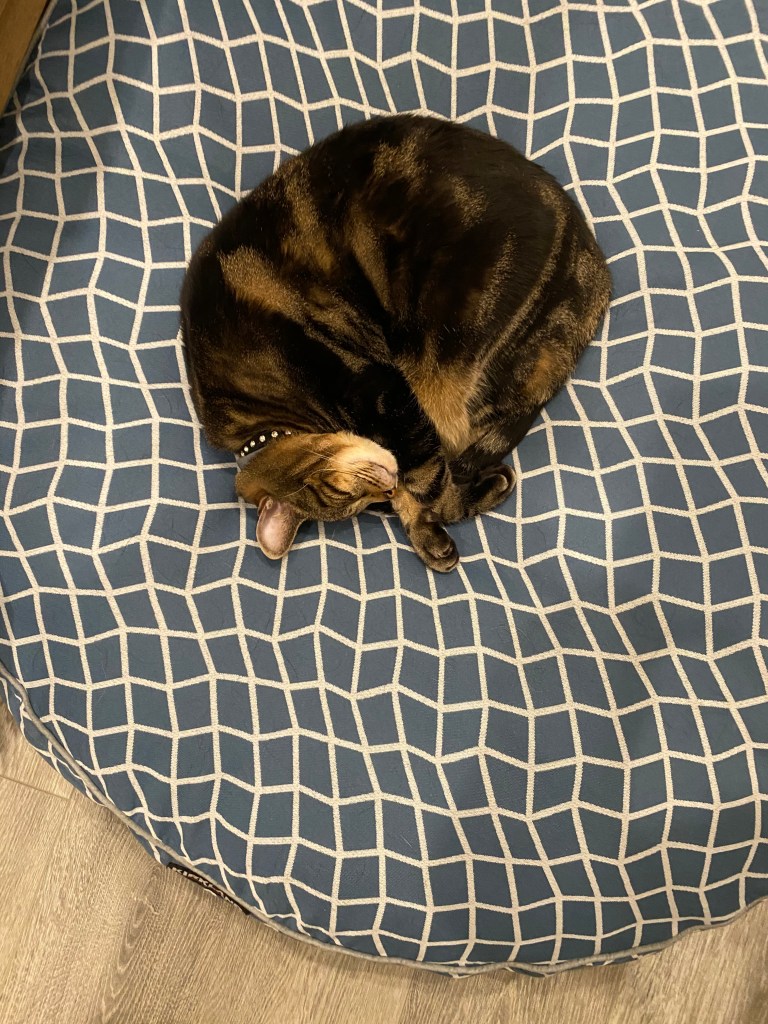
Our cat Dandelion (Dandy) resting on Mitzi’s bed. Mitzi was unhappy about this.
“OBAMA STARTED THE CORONAVIRUS,” Mr. Hall wrote on Feb. 27 under Mr. Blagojevich’s photo and a profile named @GovBlago. It was typical fare for the account, which eventually drew more than 26,000 followers. For much of the time it was active, the profile included a disclaimer in its bio that it was a parody account, which Twitter allows under some conditions.
The rest of Mr. Hall’s impostor accounts did not include such disclaimers.
Twitter eventually removed the @GovBlago account, prompting Mr. Hall to impersonate someone else in the headlines: Dr. Birx, the White House official working on the pandemic. “The media is lying to you about this virus,” he wrote as @DoctorBirx on April 22. The pandemic was “plotted by the powers that be to crash our economy in hopes that Trump will pay for it in November.”
Mitzi, a wonderful 100-lb certified purebred mutt, at rest on her bed.
“Uncle Rob runs Gay Voices For Trump with @TheBiTrumpGuy, although I am very much a heterosexual male. It’s the Trump genes – we love women,” Mr. Hall wrote as Robert Trump in July. “But we are trying to reach out to LGBT and other minority voters. Josh is doing great work so please give him a follow and support him!” The tweets brought Mr. Hall’s real profile thousands of new followers.Tracking Disinformation ›
Not long after, Mr. Hall started messaging Trump supporters as Robert Trump, asking them to donate to a fund-raiser for his group, according to screenshots posted online by two people who received the messages.
“Hey patriot. Would really appreciate if you have a couple of bucks to spare to organization,” he wrote, according to one screenshot.
Mr. Hall denied he sent such messages and suggested that the screenshots had been fabricated. “I would tell you if I did,” he said. “I should have used better judgment and stuff. But I didn’t deliberately try and dupe people out of money.”
His fund-raiser on the website GoFundMe called his group “a grass-roots coalition of LGBT Americans” and said all donations would go to “field organizing, events and merchandise.” He brought in $7,384.
Mr. Hall admitted last week that the group didn’t exist. He didn’t do more than register about 100 people to vote. “I didn’t end up ever really doing anything with the Gay Voices for Trump,” he said. “So I never got the funds from it.” He said the money was still with GoFundMe.
A GoFundMe spokeswoman said that the organizer behind the fund-raiser — an account named Josh H. — had withdrawn the money. She said GoFundMe was now investigating how the funds were used and that the company would give refunds to any donors who requested one.
Mr. Hall didn’t respond to follow-up questions about the fund-raiser.
Moonrise over harbor in Greenport, New Tork
Josiah Bruns, an engineer from Goffstown, N.H., donated $100. With his donation, he left a comment: “Uncle Rob Trump asked me too.”
Mr. Bruns said in an interview that a QAnon message board had led him to the Robert Trump account, which also promoted the conspiracy theory. “We’re trained on the Q research board to always question everything,” he said, adding that he used those lessons to scrutinize the Robert Trump account. “I’m probably 65 percent sure that it was real.”
After The Times told Mr. Bruns that he had been deceived, he said he didn’t mind. In the future, he said, he would apply more research techniques he had learned from the QAnon movement to decipher what was real on the internet. The web is a minefield of lies, he said, “especially if it’s something you want to believe, because those are the easiest lies to fall for.”
In August, Robert Trump died. The news drew scrutiny to the fake Robert Trump account, and some of its followers began to suspect that Mr. Hall was behind it, given the pattern of tweets between the profiles. In response, Mr. Hall said on Twitter that the fake account was run by “a close political friend of mine” who “did not know about Mr. Trump’s serious condition.”
He began impersonating different Trump relatives, including Fred Trump III, the president’s nephew; Maryanne Trump Barry, the president’s sister and a federal judge; and Barron Trump, the president’s teenage son.
“COVID is a scam,” he wrote on Aug. 23 as Barron Trump, a fake account that attracted more than 34,000 followers in eight days. On Aug. 25, the account posted: “Q is real. The more the media delegitimizes it, the more it shows that they’re scared.”
The Trump Organization, which has spoken on behalf of the Trump family members in the past, did not respond to requests for comment. The White House declined to comment.
The Twitter spokesman said the company eventually took down all of Mr. Hall’s accounts for violating its rules on impersonation and evading a previous ban from the site. In response to questions about why someone could create accounts impersonating the president’s teenage son and a White House official, the spokesman said in an email, “We’re committed to protecting the integrity of the conversation on Twitter, and we’re working hard to ensure that violations of our rules against impersonation, particularly when people are attempting to spread misinformation, are addressed quickly and consistently.”
A review on Saturday showed nearly 100 fake Barron Trump accounts were still active on Twitter, not counting those that identified as parodies.
Without a Twitter account, Mr. Hall felt left out after the election, as many fellow Trump supporters convened on Twitter to claim that the vote was rigged. “Why not make a comeback?” he recalled thinking. “I’m going to do something to spice things up.”
On the afternoon of Wednesday, Nov. 18, he created a new impostor, this time posing as the father of Kamala Harris, the vice president-elect. “My daughter is not who she portrays herself to be. She is dangerous for our democracy,” he posted.
The tweet got little attention, so he abandoned that fake for another Trump sibling. The final living sibling he hadn’t tried was Ms. Trump Grau, the president’s older sister, who is in her late 70s, lives in Florida and has hardly said anything public since her brother was elected.
Mr. Hall changed the name, photos and bio of the Mr. Harris account and erased the old posts. Then he started with a new message: “This election inspired me to break my silence,” he wrote under a photo of Ms. Trump Grau and the username @TheBettyTrump. “My brother Don won this election.”
He went viral again, collecting about 20,000 followers in 24 hours. Mr. Hall delighted many of his followers with dozens more juvenile and bizarre tweets, including claims that President-elect Biden is a pathological liar, Ms. Harris is a communist and Michelle Obama is a man.
Mr. Hall collected over $7,000 with his fake “Gay Voices for Trump” Twitter account. Photo by Ben Mack on Pexels.com
On Nov. 20, Mr. Hall said, he woke up and checked the president’s Twitter account, as he did most mornings. “I was like shellshocked,” he said.
He quickly began bragging on Snapchat that President Trump had tweeted about his fake account. “My friend was joking, ‘Maybe he’s not close with his sister, and you just brought him and his sister a lot closer,’” he said. “So I kind of felt good about that.”
Within hours, the account was outed as a fake.
Mr. Hall argued that his accounts were clear parodies, if anyone just looked at what they posted. As Ms. Trump Grau, for instance, he called the CNN anchor Anderson Cooper “Anderson Pooper” and said he would cover the legal fees of anyone who poured gravy down the pants of Chris Wallace, the Fox News anchor.
“I’m a big Trump supporter, but I’m thinking, ‘He’s got to know that that’s a parody,’” he said. “How does he not know?”
The leader of Paramount Charter School in Broward County, now closed, was indicted for theft of federal funds. The school opened in 2015, promising to provide an education that would meet “the highest academic and personal standards.” Didn’t happen, say parents. After compiling a terrible academic record, the school closed in 2017.
Shauta Freeman, who said she sent three children there from 2015 to 2016, said the lights cut off at times, the water wouldn’t run, and so many teachers were fired that students from various grade levels were crowded into one room. “It was a nightmare.”
Now, the former president of the school, Jimika Williams, has been federally indicted on the charge of stealing federal funds from the school and committing wire fraud.…
The indictment accuses Williams of embezzling nearly $389,000 in funds intended to go toward the school’s operating expenses. Instead, the indictment says they were used to buy a new car, pay her rent at a lavish Davie home and other expenses.
According to the indictment, Williams transferred funds from the school’s bank account to a shell account she set up to “deceive” other members of the governing board, auditors, local education authorities and others...
Freeman said the school initially sounded amazing when she first enrolled her children. But shortly after starting school she said her kids reported being left outside for long stretches of time, little to no instruction, days without lunch, and fighting between teachers and students...
According to the indictment, while Paramount struggled to staff classrooms and properly educate students, Williams made off with hundreds of thousands of dollars meant for the school.
Between 2015 and 2017, the indictment says she made almost monthly transfers between the school’s account and a shell account she created for sums ranging from $3,000 to $50,000 at a time.
This kind of behavior can be expected in states where anyone can open a charter school, and where oversight, accountability, and transparency are lax.
Oklahoma Governor Kevin Stitt kicked his own appointee off the State Board of Education who made the terrible error of trying to claw back millions from a for-profit charter school and supported a mask mandate in all public schools.
Gov. Kevin Stitt abruptly replaced one of his own appointees to the Oklahoma State Board of Education this week.
He also recently drew public criticism from school choice advocates for leading a delay of approval for a couple of private schools to begin accepting state-funded scholarships for disabled students and foster children over questions about whether the schools’ anti-discrimination policies met minimum state and federal requirements.
Many elected officials wondered why Stitt would appoint someone to the State Board who has no knowledge of Oklahoma’s schools and no qualifications. State Superintendent Joy Hofmeister praised Kurt Bollenbach, who was dumped by Stitt, apparently for being too responsible.
Hofmeister released this statement:
“Kurt Bollenbach has been an exceptional board member whose legal acumen, breadth of experience and commitment to excellence have been of great value to the State Board of Education. He is a man of tremendous principle and integrity. Of course, I look forward to meeting his successor on the board, Ms. Crabtree, and anticipate a good working relationship with her, but I will miss Kurt’s bold leadership.”
Melissa Crabtree is an ardent opponent of wearing face masks. She will, one expects, continue to oppose science and public health measures as a member of the state board.
As a reader in Okahoma said to me in an email, “I think I am living in bizarro world.”
Attorney General William Barr said Tuesday the Justice Department has not uncovered evidence of widespread voter fraud that would change the outcome of the 2020 presidential election.
His comments come despite President Donald Trump’s repeated claims that the election was stolen, and his refusal to concede his loss to President-Elect Joe Biden.
In an interview with The Associated Press, Barr said U.S. attorneys and FBI agents have been working to follow up specific complaints and information they’ve received, but they’ve uncovered no evidence that would change the outcome of the election.
“To date, we have not seen fraud on a scale that could have affected a different outcome in the election,” Barr told the AP.
When will Trump stop claiming that the election was “stolen”? When will he stop undermining our democracy?
When the Trump team and the president himself pressured Michigan Republican officials to overturn the vote in their state, only one man said no. He said he had to follow the law. He was a hero of democracy.
His name is Aaron Van Langevelde.
“We must not attempt to exercise power we simply don’t have,” declared Van Langevelde, a member of Michigan’s board of state canvassers, the ministerial body with sole authority to make official Joe Biden’s victory over Trump. “As John Adams once said, ‘We are a government of laws, not men.’ This board needs to adhere to that principle here today. This board must do its part to uphold the rule of law and comply with our legal duty to certify this election.”
Rob Schofield of North Carolina Policy Watch lives in a state taken over by the Tea Party, who are intent on selling off whatever they can to private industry.
We have fallen victim to corporate propaganda and allowed the corporate foxes into our henhouses.
He has written a brilliant article about what we are losing as our public sector is diminished and privatized. Americans who are concerned about our culture and our society should join the fight against the privatization of everything.
Something strange happened in my neighborhood the other day. It was a warm and pleasant Thursday – the day on which a city sanitation truck arrives each week to empty the trash bins.
The truck just didn’t come.
A couple of days later, another equally strange thing occurred: Our postal carrier didn’t make it to our neighborhood.
There were no holidays that I’d missed and no readily discoverable public explanations for the lapses.
Of course, neither of these developments was completely unprecedented. In the past, during hurricanes and snowstorms, such services have occasionally been interrupted. And neither was a life and death matter. The trash truck finally arrived a few days later and our mailbox was fairly stuffed the next day.
My guess/fear was that COVID might have taken a toll on the local sanitation team. And we all know of the struggles the U.S. Postal Service has been enduring.
But, in both instances – modest and unexplained failures in two core public services that have been utterly reliable for decades – there was something disquieting and noteworthy.
There was a time in our country – not that long ago – in which top-notch public services and structures were not just taken for granted, but widely accepted as points of common civic pride. Almost all Americans knew of the U.S. Postal Service motto: “Neither snow nor rain nor heat nor gloom of night stays these couriers from the swift completion of their appointed rounds.”
Public schools and city halls often featured architecturally impressive buildings that served as important community hubs and gathering places. And public service employment – as a teacher, an employee of a state administrative agency, or yes, a postal worker or a trash truck driver – was widely viewed as an honorable and respectable middle-class career.
Today, it seems, our attitudes and expectations have been altered by a half-century of relentless and cynical messaging from conservative politicians, media outlets and think tanks that has helped set in motion a kind of vicious cycle.
First, government services and structures are demonized as inherently corrupt, inefficient and “the problem.”
Next, politicians demand that these structures and services operate “more efficiently” – “like a business” – so that taxes can be reduced.
After that – not surprisingly given the fact that most private businesses in a capitalist economy fail – numerous public structures and services (like schools, transportation, parks and even mail delivery and trash services) struggle to fulfill their missions.
After that, the whole cycle is repeated again and again until, at some point – especially in moments of crisis and extra stress like, say, a health pandemic – structures and services simply start to crumble and even fade away.
We’re witnessing this phenomenon play out right now in our public schools in North Carolina – particularly in some smaller and mid-sized counties, where the relentless pressure brought on by a decade of budget cuts, privatization (i.e. competition from voucher and charter schools that’s siphoning off families of means), and now the pandemic, is posing what amounts to an existential threat.
Last week, a former school board member in Granville County told Policy Watch education reporter Greg Childress that the public school system there has entered something akin to a death spiral in response to these pressures.
Meanwhile, in New Hanover County, a recent story in the Port City Daily paints a sobering, if familiar, portrait of how performance in that county’s system has been badly damaged by the resegregation that has followed in the wake of the county’s decision to, in effect, heed “market forces” – in this case, the demand of more affluent, mostly white families for “neighborhood schools.”
And so it goes for many other public structures and services as well.
From our torn and threadbare mental health system to our eviscerated environmental protection structures to our frequently overwhelmed courts, prisons and jails to our dog-eared parks and highway rest stops, the destructive cycle of reduced services and disinvestment continues to repeat itself.…
All we lack right at present is the awareness, imagination and will to make it happen.
The Washington Monthy writes that Trump had an elaborate plan, dreamed up by one of his inner circle (Stephen Miller?) Jared Kushner?), to demand a halt to the counting on Election Day, knowing that the mail-in ballots would favor Biden. But then FOX News called Arizona for Biden, and his plan was foiled. He was furious and demanded that FOX retract its call, but it did not back down. He even attacked the person who heads FOX’s Decision Desk, but to no avail.
Donald Trump telegraphed his plan to steal the election in the days leading up to Nov. 3. He wanted to declare victory on election night, stop the counting mail-in votes he considered illegal, and, if necessary, send the election to the judiciary and eventually the Supreme Court.
Implementing that strategy would require a public relations effort in which Trump made at least a plausible case that he had won re-election. Michigan and Wisconsin looked out of reach. So the president would need to maintain the illusion that he was winning the rest of his 2016 states to have any pathway to 270 electoral votes. The most vulnerable were Pennsylvania and Arizona.
Republicans had ensured, via the courts, that Pennsylvania couldn’t begin counting mail-in ballots prior to November 3rd. So Trump was relying on an early lead in that state coming from those who had voted in person on Election Day. That made Arizona pivotal to the public relations campaign for Trump to claim victory.
But at 11:20 pm on Tuesday, Fox News foiled the plan by calling Arizona for Biden. The Associated Press followed at 2:50 AM. Eventually, they were joined by NPR, “PBS NewsHour,” Univision, USA Today, and The Wall Street Journal. With Arizona gone, Trump would have no clear path to 270 electoral votes.
Sam Wineburg and Nadav Ziv, professor and student at Stanford University, maintain that it is crucial to teach students how to recognize misinformation, a point that the recent election made clear. The Republican Party repeatedly called Democratic candidates “radical socialists” and smeared any proposal to improve the lives of people as “socialism.”
They wrote in the Los Angeles Times:
The 2020 election has once again demonstrated how easy it is to spread misinformation online. And universities across the U.S. are failing in teaching students how to identify it. Many colleges offer students guides to evaluate the trustworthiness of websites. But too many of them base their advice on a report from 1998. That’s nine years before the first iPhone, and 18 years before Russian interference sparked an urgent discussion on how we interpret information online.
There’s something deeply wrong with using advice on the internet of 20 years ago to teach students how they should interact with the internet of today. That demands 21st century skills.
In a report released last month that we co-authored for the Stanford History Education Group, we saw what happens when educators provide students with outdated advice. Most of the 263 college students we tested floundered when trying to discern fact from fiction online.
Students viewed a post of a “news story” from the Seattle Tribune, a satirical site whose masthead proudly proclaimed that “any resemblance to the truth is purely coincidental.” Two-thirds failed to identify the story as satirical.
On another task, students examined a site offering “nonpartisan” research that argued against raising the minimum wage. The site is actually run by a PR firm that also represents the restaurant industry. Nine in 10 students never made that connection.
Why are intelligent students falling for misinformation they could easily identify with a quick search? It’s not that they lacked strategies. It’s that the strategies deployed were forged during the internet’s Paleolithic era. To students’ detriment, many of these strategies remain prominent on colleges’ and universities’ guides for web credibility.
Students displayed an almost religious faith in the meaning of domains — particularly dot-orgs. “Reliable sources have .org at the end of the URL,” said one sophomore. Numerouscollege internet guides suggest that dot-orgs are credible because they are restricted to nonprofits. That’s just plain wrong.Anyone can purchase or acquire a dot-org, including for-profit companies such as Craigslist and hate groups such as Stormfront.
Students similarly turned to a site’s “About” page to determine credibility. One prominent university says an About page can “help determine a mission, point of view, or agenda.” A media outlet tells readers to be skeptical if the About page’s language is “melodramatic and seems overblown.” But dispassionate language is just as dangerous when it confers legitimacy on a shady site. Students should be told that, like Instagram profiles, About pages present curated portraits of how people and organizations want to be perceived.
One of the most common tools for teaching web credibility is called the CRAAP test (standing for Currency, Relevance, Authority, Accuracy and Purpose), popularized by a librarian at Cal State Chico. Versions of it are used by universities across the United States, including at other schools in the Cal State and University of Californiasystems.
The CRAAP test assumes that websites are like print texts — the best way to evaluate them is to read them carefully. Except skilled web searchers do the opposite. When professional fact-checkers land on an unfamiliar site, their first move is to leave it by opening new tabs and checking other sources.
There’s good news too. Our study shows that students who followed the same method as professional fact-checkers upped their chances for success. They learned that the Seattle Tribune was fake news and discovered that the “nonpartisan” Employment Policies Institute was managed by a PR firm that also represents the restaurant industry and opposes raising the minimum wage.
Some institutions, including Rowan University and the University of Louisville, are creating materials based on what fact-checkers do. Their lesson plans equip students with strategies to be intelligent digital consumers. And even modest interventions — in one case just 150 minutes in two college classes — can lead to marked improvements.
We’re in the midst of an infodemic that imperils our students’ ability to make informed decisions. Changing course will require multiple tactics. First and foremost, we need to cut the CRAAP and stop teaching ineffective strategies. We need to create a menu of regularly updated courses that teach students how to recognize misinformation, empowering them to be engaged and thoughtful citizens.
Additionally, we need to work together across departments and specializations rather than mainly putting this challenge on the shoulders of college librarians. Overhauling a 20th century curriculum for a digital 21st century requires a group effort.
Doctors who develop a patient’s treatment plan without considering medical advances are negligent. And universities are derelict when they teach or provide source evaluation strategies without considering how today’s internet functions.
Because when anti-vaccine content goes mainstream, when Holocaust deniers peddle digital pseudo-histories, and when issues such as gerrymandering and police brutality are litigated online, no one can afford to shelter in place.
Sam Wineburg is a professor of education at Stanford University. His latest book is “Why Learn History (When It’s Already on Your Phone.)” Nadav Ziv is a junior majoring in international relations at Stanford.





 Diane Ravitch's blog