Archives for category: For-Profit

This is the story of an enthusiastic young teacher who eagerly sought a position in a Michigan charter school, only to be disillusioned by the administration’s indifference to teachers and their views about their work.

When teachers in the charter school became frustrated by their powerlessness, they decided to form a union. Bad idea. The enthusiastic young teacher was out of a job and out of teaching.

The story is bigger than just one person, however. It is the story of how charters began with the sponsorship of the nation’s most important union leader, Albert Shanker, but is now vehemently opposed to unions.

Nationally, 93% of charter schools are non-union. Their teachers are at-will employees.

In Michigan, 79% of the charters operate for profit.

This was not what Shanker had in mind.

When reformers wonder why unions oppose charter schools, it is because the overwhelming majority of charter schools do not permit their teachers to join a union and to have a voice in their working conditions, in the curriculum, or discipline policies, or anything else.

The money behind the charter movement never wanted unions in their schools.

[Michigan’s] focus on free markets and privatization — 79 percent of Michigan’s charter schools are run by for-profit management companies— set a somewhat strained tone between the local unions and the charter movement. Nationally a similar phenomenon was occurring, resulting in the AFT and the National Education Association, the two largest teachers unions, taking national stances against charters as well. In 1993, one year after the first charter opened, Shanker himself renounced the idea, calling charters an anti-union “gimmick.”

As unions pushed against charter schools, the education reform movement shoved back with a narrative of schools in crisis, which largely blamed incompetent teachers, and the unions protecting them, for the achievement gap. Charter schools could do their part in this generation’s civil rights battle — education equality — by using their flexibility to get around unions and collective bargaining, and instead stand up for hiring-and-firing latitude.

While the Michigan Association of Public School Academies’ spokesperson Buddy Moorehouse says the coalition for charter school leaders “does not have an official stance on unions” (MT tried getting in touch with president Dan Quisenberry on several occasions but he would only speak through Moorehouse), their website indicates partiality explaining that most charter schools don’t have unions because they “prefer the ability to [be] innovative and remove the red tape element when a teacher is not performing.”

The Great Lakes Education Project, a Michigan-based charter advocacy group, more accurately highlights the dichotomy between unions and charter schools. Funded largely by the right-to-work, union adverse DeVos clan, the organization has been forthright in its declaration of union failures, stating on its website in 2004 that unions are “status quo forces looking to protect their cash cow.”

The entire article is worth reading to understand the politics of unions and charters. Unions are now trying to organize charter teachers, and they hail each school that they win as a big success, but the reality is that the charter movement is at heart a union-busting movement. Its leaders are hostile to unions, as they are to public audits and any other intrusion on their freedom to operate as they wish with public money.

Mitchell Robinson, professor of music education and blogger, ponders whether the education wars are winding down. He thinks not. The contention over policy issues remains profound.

To help explicate the issues, he has compiled a brief guide to the different “sides.” In a recent post by Sam Chaltain, who does think the battles are subsiding and a new convergence is on the horizon, one side is the “practitioners, and the other is the “policymakers.” Robinson says the labels illustrate a clash of views.

Robinson writes:

“Mr. Chaltain’s descriptors for the two sides in the war on education are revealing, in that he sees a clear distinction between those who actually teach (the “practitioners”), and those who establish and enforce the rules and policies that govern that practice (the “policy makers”). Perhaps unintentionally, his labels also highlight a major flaw in our current education enterprise: public education policy is being written and administrated largely by persons who have not themselves attended public schools, have no degrees or certification in education, have never taught, and have spent little time in public schools. Whatever meager educational background that the members of what I term the Deformer “edu-tribe” may have is often accrued through alternative routes to the classroom (i.e., Teach for America, The New Teacher Project, the Michigan Teacher Corps), and their educational credentials are often received via online programs that require little or no actual teaching experience, residencies or interactions with other teachers or professors with actual teaching experience.

“Many of the “foot soldiers” in the Deformer army wind up in high-level positions in state departments of education, policy think-tanks, on school boards and as leaders of high-profile charter school networks. They reach these positions of power and authority with shockingly little experience in classrooms, or working with children, but exert out-sized influence on the shape and nature of public education. These members of the Deformer “advance force” parrot a regressive agenda of union-busting, tenure-smashing, and teacher-demonizing, paired with an obsessive devotion to standardized testing, “data driven decision making”, charter school expansion, and privatization as the “answers” to the “crisis in public education”–while remaining seemingly oblivious to the fact that it was their policies that manufactured the crisis they claim to be addressing, and which are paying off so handsomely for the investors who fund their charter schools and pay their generous salaries.”

On the other side are what Robinson calls “the Guardians of Oublic Education.”

“The members of this army largely consist of teachers, retired teachers, and teacher educators, most of whom have significant experience as classroom teachers, multiple degrees in education, and a career commitment to children, schools and education. Few Guardians entered the profession by alternative routes, instead earning their credentials in traditional colleges and universities, under the tutelage of professors who had themselves been classroom teachers before moving to higher education. Many of these activists earn graduate degrees in their chosen field–even as states now refuse to pay for additional degrees–and seek out weekend and summer professional development opportunities at their own expense in order to remain certified.

“The activism practiced by these Guardians is not their sole focus as professionals–rather, these teachers blog at night after lessons have been planned, and kids put to bed, or on rare quiet weekend mornings and afternoons when a few minutes can be stolen from other tasks and responsibilities. And the conflict in which they are engaged is a non-linear war–they are fighting not just the Deformers, but also their support staff in their underground bunkers, typing away on banks of sleek laptops as they push back against kindergarten teachers furiously hammering out their frustrated rants on the ridiculousness of testing 6 year olds, or 3rd grade teachers pointing out the illogic of retaining 8 year olds who struggle with reading.”

The “Deformers” are well-paid. But the Guardians work not for money but for conviction.

“These writers and activists don’t receive a penny for their efforts, in stark opposition to the Deformers’ forces, who are stunningly well-compensated for their work. Instead, these bloggers often toil away in anonymity, providing a voice for the thousands of teachers that have been silenced for speaking out against the reform agenda.”

He provides a list for each side. My lists would be longer. Make your own lists or additions. I would certainly place ALEC, Jeb Bush, Scott Walker, John Kasich, Rick Scott, Rick Snyder, and a number of academics and philanthropists on the Deformer list.

Blogger Educational Alchemy sees behind the Department of Education smokescreen. The goal of the Obama administration’s “Testing Action Plan” is not what it appears.

Now that almost every school is testing online, it is time to move on to the next stage of the education revolution. Outsourcing online testing to vendors.

The wave of the future: Competency-based assessments.

Here is an excerpt:

This is what the “Testing Action Plan” (TAP) says:

The new plan will “include competency-based assessments, innovative item types.” It states also “The Department will also share tools already available to do this work, including The Council of Chief State School Officers’ (CCSSO) Comprehensive Statewide Assessment Systems: A Framework for the Role of the State Education Agency in Improving Quality and Reducing Burden and Achieve’s Student Assessment Inventory for School Districts.”

This is what it means:

Remember CCSSO? They are the ones who crafted the Common Core State Standards. The standards were developed to create a “standardized” system that allows third-party companies to develop systems for outsourcing education. Now with a set of “national” standards as benchmarks, instruction can be metered out by online edu-tech companies who provide new “competency” based instruction and assessment. No teacher required.

In 2010, the Foundation for Excellence in Education (who supported Common Core) convened the Digital Learning Council, a diverse group of more than 100 leaders in education, government, philanthropy, business, technology and members of policy think tanks led by Co-Chairmen Jeb Bush, and Bob Wise (both integral in the creation and promotion of Common Core). It’s an ALEC model-endorsed comprehensive framework of state-level policies and actions “designed to advance the meaningful and thoughtful integration of technology into K12 public education.”

This idea is stated again toward the end of the Testing Action Plan (TAP): “Congress should continue to require the Department to work with external assessment experts to ensure states are using high-quality assessments that are aligned with state-developed standards and valid for the purposes for which they are used.”

TAP Says:

“…the Department granted a temporary waiver to New Hampshire to pilot a competency-based assessment system in four districts ….” as a way to set a national example. (and), “The Department will work with external assessment experts…”

What this means:

The department will outsource education curriculum and assessment to corporations just like it did in NH where they “…have adopted unique and innovative learning approaches, such as digital learning, that create a more flexible learning schedule that extends beyond the school day.”

The Alliance for Excellent Education (Bob Wise serves as president) in 2013 stated: “Competency-based advancement is an important part of New Hampshire’s strategy for implementing the Common Core State Standards.”

Read the post with care. Every element is there for a transition to the next stage of relinquishing control of curriculum and assessment to the vendors.

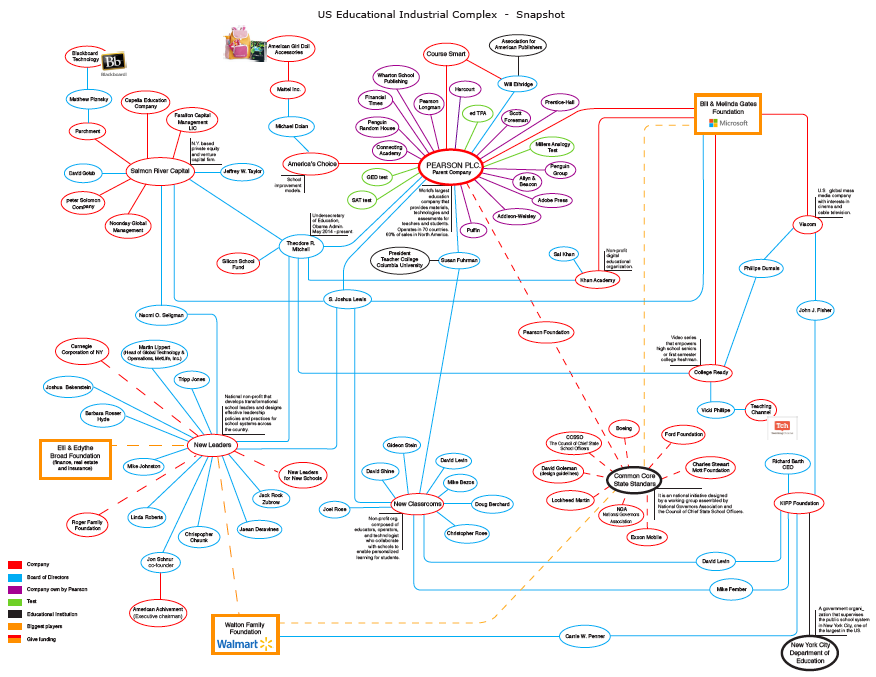
Dipti Desai is a professor of the arts and art education at New York University. She teaches both pre-service and in-service art teachers. As she watched what was happening in the world of education, she decided to create a graphic to illustrate the “Educational Industrial Complex.” Readers may know that when President Dwight D. Eisenhower was leaving office after his second term, he warned voters to be wary of the “Military Industrial Complex.” Who knew that in 2015 we would have to keep our eyes on the “educational industrial complex,” a combination of corporations, philanthropies, government agencies, and the organizations that promote privatization and high-stakes testing?

edcomplex


The report can be downloaded here.

This is a very interesting interview with Bobby Turner, who is the partner of Andre Agassi in opening new charter schools for profit across the country. He seems to think that destroying public education is a way to perform good works.

Charity is laudable, Bobby Turner says, but if you really want to raise enough money to improve a thorny social problem you have to introduce the profit motive.

An associate of 1980s junk bond king Michael Milken who made a fortune in real estate, Turner is now turning that personal philosophy into action.

He set up a company last year called Turner Impact Capital that seeks investors to pay for blue-collar housing, promising returns more typical of ­conventional moneymaking businesses.

And already some big names are risking capital to invest with Turner, a deeply connected Los Angeles financier who already has a similar fund with former tennis star Andre Agassi to build inner-city charter schools.

The Turner Multifamily Impact Fund launched in June so far has drawn investments from high-profile hedge fund manager Bill Ackman; Citi Community Capital, a division of Citibank that invests in affordable housing; the University of Michigan endowment; and Rockefeller Brothers Fund, a philanthropic organization operated by the Rockefeller family.

This is the reasoning of the hedge fund managers and equity investors who are privatizing public schools. If they can generate a profit, taking public money that should be paying for the arts, for raising teachers’ salaries, and for reducing class sizes, they think they are doing good works. Please, someone, tell them they should stick to selling stuff and leave the taxpayer money for the kids, not for investors and profits. They are getting rich, and they are not doing good. They are hurting children.

Andrew Rotherham is a reformer who runs a consulting business. He is on many boards, including Campbell Brown’s 74. He used to write a regular column for TIME, now he writes for US News. He typically discloses his conflicts of interest at the end of his articles.

In this article, he tries to explain why it is so difficult for public companies to succeed in the public education sector. He says that the market makes demands for performance indicators that lead to poor decisions. His example is Joel Klein’s Amplify, which Rotherham thinks was too good for the market. (Amplify is or was a client of Rotherham’s business). Other commentators attributed Amplify’s failure to the poor quality of its tablets, some of whose screens cracked and chargers melted after delivery to Guilford County, NC. Rotherham also explains the poor stock performance of K12 (another of his past or present clients) by saying that the market forced it to enroll students who were “ill-suited” to its model.

He writes:

Pressure to hit revenue and growth expectations drives companies to attract customers who are a poor fit. That’s why Edison ended up in Philadelphia. It’s also why the online learning company K12 got caught in a perverse spiral when enrollment expectations drove it to recruit students who were ill-suited to succeed in the company’s model. The more such students the company signed up, the more its academic results suffered. 

All in all, his explanation of why businesses fail is a good explanation of why “reform” by test scores fails. Reformers think they can reach the projected “profits” by setting audacious goals, pressuring and intimidating educators, and closing schools. Those tactics don’t work in business, and they don’t work in education.

PS: apologies to readers for the several typos in the original. I wrote this while riding in a taxi on a bumpy highway. But no excuses. I should have read it before posting it.

A report in the Wall Street Journal describes the gold-rush atmosphere that attracts real estate investors to charter schools. The risk in the investment is diminished because the schools have a steady stream of government funds. The charters are almost always non-union. The biggest risk is that the people running the schools are unqualified to run a school and the school may fail.

Real-estate investors are showing an increasing interest in charter school development as the demand grows for classroom seats and some state and local governments become more willing to help finance charter-school projects.

Almost all charter schools are operated by nonprofit organizations. But these groups often rent and buy their buildings from private real-estate developers, and that is creating a new niche asset for some investors.

One of the latest entrants to the charter real-estate business is Northstar Commercial Partners, a Denver-based private-equity firm that is raising a $100 million fund. It will focus on converting charter schools out of vacant office, industrial and retail properties that can be purchased for less than half of what they would cost to build, according to Northstar Chief Executive Brian Watson.

Meanwhile, investment manager Bobby Turner, who founded Turner Impact Capital LLC in 2013, is raising his second fund with tennis legend Andre Agassi for building new charter schools, this one with a goal of $400 million.

And established players in the business are seeing volume increases on chart school developments. For example, a venture of HighMark School Development and EPR Properties, a real-estate investment trust, spent more than $118 million in 2014 on acquisition, renovation and construction, compared with $34 million in 2011.

“There’s no shortage of cash,” said Patrick Beausoleil, a HighMark vice president.

The rise in investment activity partly reflects the growth of the charter school movement, which has been overcoming political opposition in many states. During the 2014-2015 school year, 500 new public charter schools opened nationwide, for a total of more than 6,700 enrolling about 2.9 million students, according to the National Alliance for Public Charter Schools.

Some states are beginning to make financing tools available to charter schools that had been limited to traditional public schools. For example, the states of Texas, Colorado and Utah now backstop tax exempt bond issues for some charter schools, reducing their capital costs when acquiring facilities, according to Scott Rolfs, managing director of B.C. Ziegler & Co., a niche investment-banking firm that has underwritten more than $600 million in charter school bonds.

But the growing role of for-profit real-estate developers has added a new dimension to the debate over charters, which are taxpayer funded and independently operated schools that are largely free of union rules. Critics say charter schools are in danger of cutting costly deals with developers who are more concerned with investment return than educating children. The result can lead to failed schools.

One of the biggest investment funds is the one created by Turner Impact Capital and tennis star Andre Agassi. Agassi is a high-school dropout. It seems that to start new charter schools, no education is necessary.

Reader Chiara sent the following comment about new funding by the U.S. Department of Education for for-profit ventures. Since when did ED become a source of venture capital for start-ups?

“Duncan’s cranking up the private sector subsidy funding on his way out the door:

“On Wednesday the department will announce a pilot program that will allow federal grants and loans to flow to educational-technology companies that team up with colleges and third-party “quality-assurance entities” to offer coding boot camps, MOOCs, short-term certificates, and other credentials.”

“Partnering with accredited schools to deliver tech skills for credit is a dangerous back door to access federal student loans,” wrote Clint Schmidt He called for the department to put “a rigorous standard in place” before federal aid could cover boot-camp tuition.

“The risk is a short-term, money-grabbing mind-set”

Nothing could possibly go wrong there, right? Public money to ed-tech companies. They’re doing this…. because for-profit, online colleges were such a smashing success?

Is there some reason the federal government feels they have to market and fund ed-tech? Is there a shortage of salespeople at these companies or something so we have to provide publicly-paid salespeople for their product?

http://chronicle.com/article/A-Boon-to-Boot-Camps-US/233742″

Here’s another description: http://www.washingtonpost.com/business/economy/us-looks-to-let-students-use-federal-aid-for-training-bootcamps/2015/10/14/9a4eba38-72bb-11e5-8d93-0af317ed58c9_story.html?postshare=7671444875772458

U.S. Deputy Secretary Ted Mitchell was formerly CEO of NewSchools Venture Fund, which invested in these kinds of business ventures, as well as charter chains. He has no problem with for-profit education; NSVF supported it when he was in charge.

The Foundation for Excellence in Education, the privatization/testing advocacy group founded by Jeb Bush, will hold its national summit in Denver on October 22-23.

Since Jeb stepped down to run for President, Condi Rice is the new leader. You may recall that she became an education expert in 2012 when she led a task force with Joel Klein that declared that American public schools are so dreadful that they are a threat to national security. The cure, they said, was charters, vouchers, and the Common Core.

Please note that if you are a blogger, you must submit samples of your work to prove you love corporate reform: charters, vouchers, school closings, high-stakes testing, merit pay, etc., or you will not be admitted.

The most newsworthy portion of the summit will be the session on “proven strategies” to improve student achievement. Since none of the corporate reform strategies have any evidence to support them, this will be a challenge for those hoping for proof, not ideological blather.

The latest press release:

From: “Foundation for Excellence in Education”

To: gorlewsj@newpaltz.edu
Sent: Thursday, October 8, 2015 10:21:15 AM
Subject: MEDIA ADVISORY: 2015 National Summit on Education Reform hosted by Dr. Condoleezza Rice

FOR IMMEDIATE RELEASE:
October 8, 2015 Contact: Press Office
850-391-4090
PressShop@excelined.org

MEDIA ADVISORY: 2015 National Summit on Education Reform hosted by Dr. Condoleezza Rice

On October 22-23, Dr. Condoleezza Rice, 66th U.S. Secretary of State and board chair of the Foundation for Excellence in Education (ExcelinEd) will host the organization’s eighth annual National Summit on Education Reform. Media registration is now open for media wishing to cover the two-day event. Credentials must be requested in advance of the start of the summit.

The nation’s premier annual education forum immerses policymakers in two days of in-depth discussions on proven and innovative strategies to improve student achievement.

The following event is OPEN PRESS:

2015 National Summit on Education Reform

Presented by the Foundation for Excellence in Education
October 22-23, 2015
Hyatt Regency Denver at Colorado Convention Center
650 15th Street
Denver, CO 80202

Credentialing:

All members of the media, including bloggers, who plan to cover the Summit must be credentialed by the Foundation for Excellence in Education. All media must apply for advance credentials online via the Media Registration Form by Monday October 19 COB. Advance registration is strongly encouraged as space is limited and onsite registration may be subject to delays.

To apply for media credentials, please complete the Media Registration Form.

As the Foundation is sensitive to the need to make travel plans, notification of credential approval will be made via email within one week of receiving the requested information.

Specific credentialing requirements exist for freelance writers and bloggers. In addition to completing the online form, as soon as possible please email the following information to

PressShop@ExcelinEd.org:

Freelance Writers: Freelance writers wishing to cover the Summit must submit a letter of assignment or letter of intent from the media outlet being represented.

Bloggers: Bloggers wishing to receive credentials must have regular posts about education and policy issues, and other related news, and have a significant following. Proof of coverage may be provided in the following form: a URL to your site’s main page as well as a link to a bylined article posted within the last few months.

Check-In:

For planning purposes, media check-in will open on Thursday, October 22 and Friday, October 23 at 7:00 a.m. and continue throughout the day, both days of the conference.

Upon check-in at the event, approved media will be asked to present a current year news media credential in conjunction with a government-issued photo ID, such as a valid state driver’s license or passport. If a current year news media credential is not available, a valid business card in conjunction with a government-issued photo ID, such as a valid state driver’s license or passport, may be accepted.

Previous accreditation to Foundation for Excellence in Education events does not guarantee the issuance of media or blogger credentials for the 2015 National Summit on Education Reform.

The Foundation for Excellence in Education, in its sole discretion, reserves the right to withhold press credentials from members of the news media, limit the number of credentials assigned to any news organization and revoke credentials from members of the news media before or during the event for any reason. Acceptance of press credentials constitutes agreement by the bearer and his/her organization to abide by any terms set forth by the Foundation for Excellence in Education.

Access:

As in years past, media credentials must be worn at all times in order to gain access to designated press areas to cover the conference sessions.

The Media Filing center will be available to all credentialed media on a first come, first serve basis, during operating hours for the entirety of the two-day Summit. Other designated press areas will be accessible based on Summit agenda.

Coverage:

Members of the media are welcome to cover the conference, including keynote, general and strategy sessions from designated press areas. Participation in Q&A segments is reserved for registered attendees of the event.

A live feed of the general and keynote sessions will be available in the Media Filing Center. Additionally, there will be closed-circuit televisions and mult boxes for access to clean audio feeds of the general and keynote sessions.

Technical Details:

Complimentary internet access will be provided in the Media Filing Center and ballroom. Please note that this network will be available to all members of the media, which may cause a high volume of traffic at times.

A live webcast of the general and keynote sessions will also be available. Details are forthcoming. News organizations may live stream the Summit in its entirety, upload video content to websites and/or archive footage.

Agenda & Speakers:

The week of the Summit, a full itinerary of the conference events, as well as technical and logistical specifications for media, will be distributed to registered and confirmed media outlets and bloggers.

In the meantime, a complete list of speakers featured during the 2015 summit and a full agenda for the two-day event may be found at ExcelinEd.org/National-Summit/2015-Agenda.

Confirmed media will receive access to the official #EIE15 app accessible via smartphone or tablet, offering real-time updates on speakers, the agenda and strategy sessions.

Join the Conversation:

Follow #EIE15 and @ExcelinEd on Twitter for the latest news and updates regarding the 2015 Summit.

Special Requests:

Once approved, credentialed media may alert us of any special coverage needs or requests, including but not limited to the following topics, and we will do our best to accommodate:

If you would like to pre-arrange an interview with one of the speakers in advance of or during the Summit;
If you need to request private interview space for a specific and consolidated time period;

If you are interested in covering the event live, plan to park a satellite truck onsite and/or have questions regarding cable runs; and

If you are a network or cable and wish to attend the technical walk-through;
In some cases, specific deadlines apply. Space is limited.

Thank you for your interest in covering the Foundation for Excellence in Education’s eighth annual National Summit on Education Reform. We hope to see you in Denver.

###

For more information visit http://www.ExcelinEd.org.

The Foundation for Excellence in Education is transforming education for the 21st century economy by working with lawmakers, policymakers, educators and parents to advance education reform across America. ExcelinEd is a 501(c)(3) non-profit organization. In 2014, ExcelinEd received more than 85 percent of its operating revenue from private family foundations. Learn more at ExcelinEd.org.

CONTACT US
P.O. Box 10691
Tallahassee, Florida
32302-2691
850-391-4090
info@excelined.org
The Detroit News reports that investigators are reviewing contracts made during Barbara Byrd-Bennett’s time as chief academic auditor for the Detroit public schools under Robert Bobb.

“Barbara Byrd-Bennett, who was the chief academic and accountability auditor for DPS from 2009-11, was convicted of one count of fraud in federal court. Federal authorities alleged that as CEO of the Chicago Public Schools, she steered $23 million in no-bid contracts to two education firms in return for $2.3 million in bribes and kickbacks.

“One of those firms, Synesi Associates LLC, which trains principals and school administrators, was awarded contracts with DPS while Byrd-Bennett was working for the district, according to records posted on the DPS’ website….

“According to six-month expenditure reports from May and November 2011, DPS paid $1,487,654.08 to Synesi for “Consultant Services/Curriculum/Office of Accountability.”

“The report from November 2011 also lists an invoice of $128,698.77 to Synesi as “disapproved.”
In a statement Tuesday, a DPS spokeswoman said the district is cooperating with authorities.”