Archives for category: For-Profit

Faculty members, staff, and students are unhappy with the selection of Margaret Spellings as the new president of the University of North Carolina. Her experience as Secretary of Education for President George W. Bush propelled her into this position.

In this article, two faculty  members–Altha Cravey,  associate professor of geography at the University of North Carolina at Chapel Hill, and Robert Siegel, associate professor of English at East Carolina University–challenge Spellings’ lucrative association in recent years with predatory for-profit institutions and a debt-collection agency. They believe that her background does not fit the needs of a world-class institution that seeks to provide high quality at relatively low costs for students.

They write:

UNC needs a president who will help the university system continue to give students the best education possible while avoiding unnecessary tuition hikes. Unfortunately, Spellings’ background of supporting for-profit colleges who prey on students – and then profiting off those same students when they default on their loans – suggests that she and the Board of Governors have very distinct priorities.

Spellings made over $330,000 working for the Apollo Group, the parent company of University of Phoenix, a for-profit online college that has been widely criticized for taking advantage of its students and delivering poor results. Although federal education funds account for nearly 90 percent of the company’s revenue, graduation rates were as low as 4 percent under Spellings’ tenure.

IN A STATE THAT CLAIMS TO VALUE PUBLIC EDUCATION AND PRIDES ITSELF ON A TOP-NOTCH UNIVERSITY SYSTEM, STUDENTS SHOULD NOT BE VIEWED AS “CUSTOMERS” TO PROFIT FROM AND THEN DISCARD.

The Apollo Group’s corporate goals are to increase shareholders’ profits by lowering standards and raising admission and fees. The company has even come under fire for targeting veterans to obtain G.I. Bill funding. After a federal investigation into the Apollo Group’s practices, the for-profit company laid off 600 workers and closed 115 “campuses” – while its founder received a $5 million “retirement bonus.”

The investigation found that students who attend for-profit colleges end up defaulting on their student loans at nearly three times the rate of students who attended public and nonprofit schools. As a result, nearly half of all student loan defaults nationwide are from students who attended for-profit colleges.

That’s why it is particularly troubling that Spellings also served as board chair of the Ceannate Corporation, a student loan collection agency. Student loan debt now accounts for the highest percentage of consumer debt, and despite widespread calls to reform the student loan industry, Spellings and the Ceannate Corporation have simply profited off of it….

Spellings’ defense of for-profit colleges is perhaps just as disturbing as the predatory practices these institutions use to fleece students. “(For-profit colleges) invented higher education in a way that was more convenient for working adults, and many in traditional higher education have responded,” she told the Board of Governors. “The reason I did it was because I learned a lot about how we can serve our students and think of them as customers in providing a product in convenient ways for them.”

In another article, Glenda Elizabeth Gilmore, a professor of history at Yale University who holds UNC degrees, cites statements that Spellings has made recently and in the past that cast doubt on her willingness to welcome gay students and faculty on campus. Gilmore insists that Spellings must publicly accept UNC’s non-discrimination policy  or resign.

Spellings seems unwilling to do that. When asked at the news conference about her past comments regarding gay citizens, she responded, “I’m not going to comment on those lifestyles.” Then she explained her demand as secretary of education that PBS refund federal money spent on the animated program “Buster the Bunny” because it included four gay characters among many. Her opposition, she said, was “a matter of how we use taxpayer dollars.”

Part of her job as president of UNC will be to “use taxpayer dollars” to foster a welcoming environment and combat discrimination based on sexual orientation. Moreover, she actually has the responsibility to “comment on those lifestyles” by demonstratively welcoming them to UNC.


Peter Greene educated himself about “social impact bonds” and has graciously taken on the task of explaining what they are and how they work.


He writes:


Here’s the basic structure of a Social Impact Bond. Note: I am not an economist, banker, or investment counselor, nor do I play one on TV, so I may cut a few corners here.


My house is drafty. My windows leak and my heating bill is $10,000 a year.


My landlord goes to the bank. She says, “Banker, I would like a bond of $4,000 for new storm windows. I think they would reduce my annual heating bill by $3,000.”


And the investor issues a bond for the program costs, in return for which he gets a healthy cut of the $3K saved by installing the new windows. My landlord’s savings from the successful Stop Freezing My Butt Off Social Program become the bond holder’s profit– but only if our goals are met.


Typically a third party will come in to judge the result, making sure that I didn’t just turn the thermostat down or it wasn’t just a warm winter or my landlord didn’t actually save $6K and hide it from the bondholder. Also, it’s worth noting that bonds generally come with negotiated maturity dates, at which point the original loan amount is to be paid back. And remember kids– bond holders are different from investors. An investor owns part of the company, but a bondholder is just a fancy debtor, and as such has legal priority for being paid back.


In this example, the government is, more or less, my landlord. For a more thorough explanation, we can look here. Here’s the shortened version of their explanation:


In the classic… social impact bond, a government agency sets a specific, measurable social outcome they want to see achieved within a well-defined population over a period of time. …The government then contracts with an external organization—sometimes called an intermediary—that is in charge of achieving that outcome. … The intermediary hires and manages service providers who perform the interventions intended to achieve the desired outcome. Because the government does not pay until and unless the outcome is achieved, the intermediary raises money from outside investors. These investors will be repaid and receive a return on their investment for taking on the performance risk of the interventions if and only if the outcome is achieved.


Okay, Watch Carefully Now


From New York Times coverage of a SIB program that failed. “Social Impact Bonds offer a strikingly different way to pay for social programs. Governments, rather than tapping taxpayers, can turn to outside investors and philanthropists for funds, and reward them only for programs that work.” If the program fails, the taxpayers are off the hook. If it succeeds, the bond holders are paid off with what would have been taxpayer savings of taxpayer dollars.


But the finances get muddier because in the couple of years we’ve been trying this, we’ve learned a useful insight:


“The tool of ‘pay for success’ is much better suited to expanding an existing program,” Andrea Phillips, vice president of Goldman’s urban investment group, said in an interview on Wednesday. “That is something we’ve already learned through this.”


But issuing bonds for existing programs means we’ll have public and private money swimming in the same pool.


For the rest, and the links, open the article.

Clever equity investors! Goldman Sachs is profiting by investing in Social Impact Bonds, which pay off by helping pre-schoolers avoid placement in special education. The pilot program is in Utah. Goldman Sachs makes money for every child who is not referred to special education services.

But critics are skeptical:

“Nine early-education experts reviewed the program for The New York Times and identified irregularities in how the program’s success was measured. These seemed to significantly overstate the effect of the investment.

“Goldman said its investment helped almost 99 percent of the Utah children it was tracking to avoid special education.

“Researchers say well-funded preschool programs can reduce the proportion of students needing special education by 50 percent at most, usually nearer 10 or 20 percent.

“The success rate in the Utah program was based on what researchers say was a faulty assumption — that many of the school children would have needed special education without the preschool.

“This overstatement means that Goldman and its philanthropic partner, the J.B. & M.K. Pritzker Family Foundation, received more in payments than they should have. The bank was paid for each at-risk child who ended up not needing special education after leaving the preschool program.

“The Utah school district’s methodology, which led to large numbers of children being identified as at risk, was adopted by Goldman when it negotiated its investment.

“As long as 50 percent of the children in the program avoid special education, Goldman will earn back its money and 5 percent interest — more than Utah would have paid if it had borrowed the money through the bond market.”

Anthony Cody gives us an overview of the past 14 years, in which the common theme is that teachers cannot be trusted to grade or assess their students.

Having survived the onerous and intrusive NCLB and the teacher-bashing of Race to the Top, educators and a growing part of the public realize that it is not the schools that are failing, it is the “reforms” of Bush and Obama.

So with the failure of test-based accountability, the next wave of disruptive innovation is upon us. Led by former Gates executive Tom Vanderbilt Ark, the latest thing is competency based learning and competency based assessment. The idea is even embedded in the President’s “Testing Action Plan.”

Cody writes:

“We have been badgered for the past 14 years by reformers insisting on the fierce urgency of change, and they have had their way – twice! First, seven years of NCLB, followed by the past seven years of Race to the Top, and now the “next generation” of tests, which were promised to be “smarter,” computer-adapted, and deliver results more quickly. None of it worked. Scores on the independent NAEP tests are flat or down. The SBAC and PARCC tests are more difficult without being any “smarter” in telling us about what our students can do. The idea that these tests could somehow promote and measure creativity and critical thinking is debunked. The growing opt out movement poses a huge threat to the standardized testing “measure to manage” paradigm.

“So what is to be done?

“Reinvent the tests once again, using technology. And who better for the job than Tom Vander Ark, formerly of the Gates Foundation, and now associated with a long list of education technology companies. The latest package of solutions is being called “competency based learning,” and it was featured prominently in the Department of Education’s latest “Testing Action Plan.”

So here we go again, but this time with the technology leading the way. This is the breakthrough that equity investors have been waiting for.

Don’t fall for it. Empower teachers, not computers, to assess their students.

Stop the financialization and monetization of public education. Don’t be fooled.

This is the story of an enthusiastic young teacher who eagerly sought a position in a Michigan charter school, only to be disillusioned by the administration’s indifference to teachers and their views about their work.

When teachers in the charter school became frustrated by their powerlessness, they decided to form a union. Bad idea. The enthusiastic young teacher was out of a job and out of teaching.

The story is bigger than just one person, however. It is the story of how charters began with the sponsorship of the nation’s most important union leader, Albert Shanker, but is now vehemently opposed to unions.

Nationally, 93% of charter schools are non-union. Their teachers are at-will employees.

In Michigan, 79% of the charters operate for profit.

This was not what Shanker had in mind.

When reformers wonder why unions oppose charter schools, it is because the overwhelming majority of charter schools do not permit their teachers to join a union and to have a voice in their working conditions, in the curriculum, or discipline policies, or anything else.

The money behind the charter movement never wanted unions in their schools.

[Michigan’s] focus on free markets and privatization — 79 percent of Michigan’s charter schools are run by for-profit management companies— set a somewhat strained tone between the local unions and the charter movement. Nationally a similar phenomenon was occurring, resulting in the AFT and the National Education Association, the two largest teachers unions, taking national stances against charters as well. In 1993, one year after the first charter opened, Shanker himself renounced the idea, calling charters an anti-union “gimmick.”

As unions pushed against charter schools, the education reform movement shoved back with a narrative of schools in crisis, which largely blamed incompetent teachers, and the unions protecting them, for the achievement gap. Charter schools could do their part in this generation’s civil rights battle — education equality — by using their flexibility to get around unions and collective bargaining, and instead stand up for hiring-and-firing latitude.

While the Michigan Association of Public School Academies’ spokesperson Buddy Moorehouse says the coalition for charter school leaders “does not have an official stance on unions” (MT tried getting in touch with president Dan Quisenberry on several occasions but he would only speak through Moorehouse), their website indicates partiality explaining that most charter schools don’t have unions because they “prefer the ability to [be] innovative and remove the red tape element when a teacher is not performing.”

The Great Lakes Education Project, a Michigan-based charter advocacy group, more accurately highlights the dichotomy between unions and charter schools. Funded largely by the right-to-work, union adverse DeVos clan, the organization has been forthright in its declaration of union failures, stating on its website in 2004 that unions are “status quo forces looking to protect their cash cow.”

The entire article is worth reading to understand the politics of unions and charters. Unions are now trying to organize charter teachers, and they hail each school that they win as a big success, but the reality is that the charter movement is at heart a union-busting movement. Its leaders are hostile to unions, as they are to public audits and any other intrusion on their freedom to operate as they wish with public money.

Mitchell Robinson, professor of music education and blogger, ponders whether the education wars are winding down. He thinks not. The contention over policy issues remains profound.

To help explicate the issues, he has compiled a brief guide to the different “sides.” In a recent post by Sam Chaltain, who does think the battles are subsiding and a new convergence is on the horizon, one side is the “practitioners, and the other is the “policymakers.” Robinson says the labels illustrate a clash of views.

Robinson writes:

“Mr. Chaltain’s descriptors for the two sides in the war on education are revealing, in that he sees a clear distinction between those who actually teach (the “practitioners”), and those who establish and enforce the rules and policies that govern that practice (the “policy makers”). Perhaps unintentionally, his labels also highlight a major flaw in our current education enterprise: public education policy is being written and administrated largely by persons who have not themselves attended public schools, have no degrees or certification in education, have never taught, and have spent little time in public schools. Whatever meager educational background that the members of what I term the Deformer “edu-tribe” may have is often accrued through alternative routes to the classroom (i.e., Teach for America, The New Teacher Project, the Michigan Teacher Corps), and their educational credentials are often received via online programs that require little or no actual teaching experience, residencies or interactions with other teachers or professors with actual teaching experience.

“Many of the “foot soldiers” in the Deformer army wind up in high-level positions in state departments of education, policy think-tanks, on school boards and as leaders of high-profile charter school networks. They reach these positions of power and authority with shockingly little experience in classrooms, or working with children, but exert out-sized influence on the shape and nature of public education. These members of the Deformer “advance force” parrot a regressive agenda of union-busting, tenure-smashing, and teacher-demonizing, paired with an obsessive devotion to standardized testing, “data driven decision making”, charter school expansion, and privatization as the “answers” to the “crisis in public education”–while remaining seemingly oblivious to the fact that it was their policies that manufactured the crisis they claim to be addressing, and which are paying off so handsomely for the investors who fund their charter schools and pay their generous salaries.”

On the other side are what Robinson calls “the Guardians of Oublic Education.”

“The members of this army largely consist of teachers, retired teachers, and teacher educators, most of whom have significant experience as classroom teachers, multiple degrees in education, and a career commitment to children, schools and education. Few Guardians entered the profession by alternative routes, instead earning their credentials in traditional colleges and universities, under the tutelage of professors who had themselves been classroom teachers before moving to higher education. Many of these activists earn graduate degrees in their chosen field–even as states now refuse to pay for additional degrees–and seek out weekend and summer professional development opportunities at their own expense in order to remain certified.

“The activism practiced by these Guardians is not their sole focus as professionals–rather, these teachers blog at night after lessons have been planned, and kids put to bed, or on rare quiet weekend mornings and afternoons when a few minutes can be stolen from other tasks and responsibilities. And the conflict in which they are engaged is a non-linear war–they are fighting not just the Deformers, but also their support staff in their underground bunkers, typing away on banks of sleek laptops as they push back against kindergarten teachers furiously hammering out their frustrated rants on the ridiculousness of testing 6 year olds, or 3rd grade teachers pointing out the illogic of retaining 8 year olds who struggle with reading.”

The “Deformers” are well-paid. But the Guardians work not for money but for conviction.

“These writers and activists don’t receive a penny for their efforts, in stark opposition to the Deformers’ forces, who are stunningly well-compensated for their work. Instead, these bloggers often toil away in anonymity, providing a voice for the thousands of teachers that have been silenced for speaking out against the reform agenda.”

He provides a list for each side. My lists would be longer. Make your own lists or additions. I would certainly place ALEC, Jeb Bush, Scott Walker, John Kasich, Rick Scott, Rick Snyder, and a number of academics and philanthropists on the Deformer list.

Blogger Educational Alchemy sees behind the Department of Education smokescreen. The goal of the Obama administration’s “Testing Action Plan” is not what it appears.

Now that almost every school is testing online, it is time to move on to the next stage of the education revolution. Outsourcing online testing to vendors.

The wave of the future: Competency-based assessments.

Here is an excerpt:

This is what the “Testing Action Plan” (TAP) says:

The new plan will “include competency-based assessments, innovative item types.” It states also “The Department will also share tools already available to do this work, including The Council of Chief State School Officers’ (CCSSO) Comprehensive Statewide Assessment Systems: A Framework for the Role of the State Education Agency in Improving Quality and Reducing Burden and Achieve’s Student Assessment Inventory for School Districts.”

This is what it means:

Remember CCSSO? They are the ones who crafted the Common Core State Standards. The standards were developed to create a “standardized” system that allows third-party companies to develop systems for outsourcing education. Now with a set of “national” standards as benchmarks, instruction can be metered out by online edu-tech companies who provide new “competency” based instruction and assessment. No teacher required.

In 2010, the Foundation for Excellence in Education (who supported Common Core) convened the Digital Learning Council, a diverse group of more than 100 leaders in education, government, philanthropy, business, technology and members of policy think tanks led by Co-Chairmen Jeb Bush, and Bob Wise (both integral in the creation and promotion of Common Core). It’s an ALEC model-endorsed comprehensive framework of state-level policies and actions “designed to advance the meaningful and thoughtful integration of technology into K12 public education.”

This idea is stated again toward the end of the Testing Action Plan (TAP): “Congress should continue to require the Department to work with external assessment experts to ensure states are using high-quality assessments that are aligned with state-developed standards and valid for the purposes for which they are used.”

TAP Says:

“…the Department granted a temporary waiver to New Hampshire to pilot a competency-based assessment system in four districts ….” as a way to set a national example. (and), “The Department will work with external assessment experts…”

What this means:

The department will outsource education curriculum and assessment to corporations just like it did in NH where they “…have adopted unique and innovative learning approaches, such as digital learning, that create a more flexible learning schedule that extends beyond the school day.”

The Alliance for Excellent Education (Bob Wise serves as president) in 2013 stated: “Competency-based advancement is an important part of New Hampshire’s strategy for implementing the Common Core State Standards.”

Read the post with care. Every element is there for a transition to the next stage of relinquishing control of curriculum and assessment to the vendors.

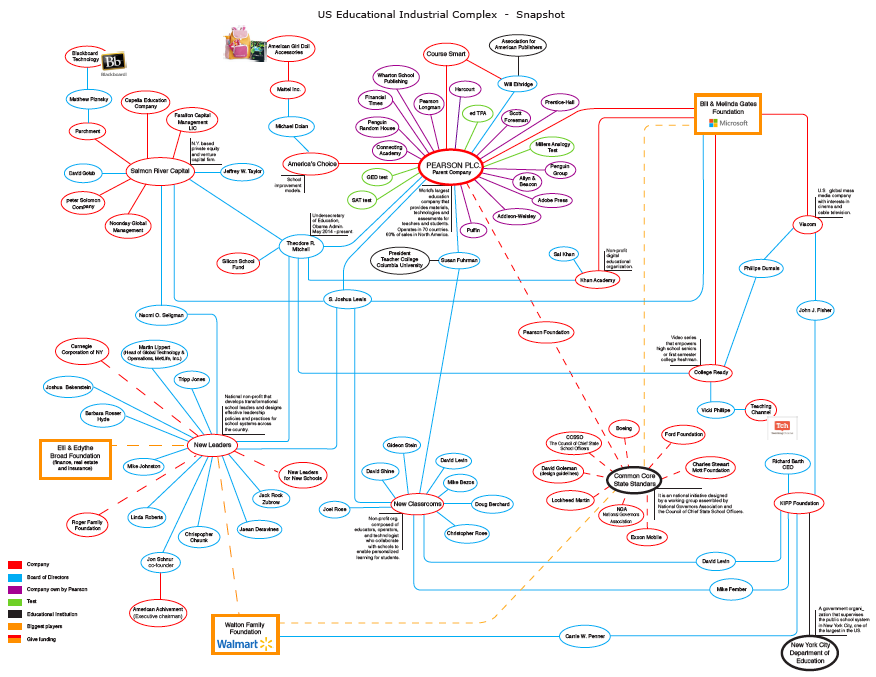
Dipti Desai is a professor of the arts and art education at New York University. She teaches both pre-service and in-service art teachers. As she watched what was happening in the world of education, she decided to create a graphic to illustrate the “Educational Industrial Complex.” Readers may know that when President Dwight D. Eisenhower was leaving office after his second term, he warned voters to be wary of the “Military Industrial Complex.” Who knew that in 2015 we would have to keep our eyes on the “educational industrial complex,” a combination of corporations, philanthropies, government agencies, and the organizations that promote privatization and high-stakes testing?

edcomplex


The report can be downloaded here.

This is a very interesting interview with Bobby Turner, who is the partner of Andre Agassi in opening new charter schools for profit across the country. He seems to think that destroying public education is a way to perform good works.

Charity is laudable, Bobby Turner says, but if you really want to raise enough money to improve a thorny social problem you have to introduce the profit motive.

An associate of 1980s junk bond king Michael Milken who made a fortune in real estate, Turner is now turning that personal philosophy into action.

He set up a company last year called Turner Impact Capital that seeks investors to pay for blue-collar housing, promising returns more typical of ­conventional moneymaking businesses.

And already some big names are risking capital to invest with Turner, a deeply connected Los Angeles financier who already has a similar fund with former tennis star Andre Agassi to build inner-city charter schools.

The Turner Multifamily Impact Fund launched in June so far has drawn investments from high-profile hedge fund manager Bill Ackman; Citi Community Capital, a division of Citibank that invests in affordable housing; the University of Michigan endowment; and Rockefeller Brothers Fund, a philanthropic organization operated by the Rockefeller family.

This is the reasoning of the hedge fund managers and equity investors who are privatizing public schools. If they can generate a profit, taking public money that should be paying for the arts, for raising teachers’ salaries, and for reducing class sizes, they think they are doing good works. Please, someone, tell them they should stick to selling stuff and leave the taxpayer money for the kids, not for investors and profits. They are getting rich, and they are not doing good. They are hurting children.

Andrew Rotherham is a reformer who runs a consulting business. He is on many boards, including Campbell Brown’s 74. He used to write a regular column for TIME, now he writes for US News. He typically discloses his conflicts of interest at the end of his articles.

In this article, he tries to explain why it is so difficult for public companies to succeed in the public education sector. He says that the market makes demands for performance indicators that lead to poor decisions. His example is Joel Klein’s Amplify, which Rotherham thinks was too good for the market. (Amplify is or was a client of Rotherham’s business). Other commentators attributed Amplify’s failure to the poor quality of its tablets, some of whose screens cracked and chargers melted after delivery to Guilford County, NC. Rotherham also explains the poor stock performance of K12 (another of his past or present clients) by saying that the market forced it to enroll students who were “ill-suited” to its model.

He writes:

Pressure to hit revenue and growth expectations drives companies to attract customers who are a poor fit. That’s why Edison ended up in Philadelphia. It’s also why the online learning company K12 got caught in a perverse spiral when enrollment expectations drove it to recruit students who were ill-suited to succeed in the company’s model. The more such students the company signed up, the more its academic results suffered. 

All in all, his explanation of why businesses fail is a good explanation of why “reform” by test scores fails. Reformers think they can reach the projected “profits” by setting audacious goals, pressuring and intimidating educators, and closing schools. Those tactics don’t work in business, and they don’t work in education.

PS: apologies to readers for the several typos in the original. I wrote this while riding in a taxi on a bumpy highway. But no excuses. I should have read it before posting it.