Archives for category: For-Profit

Forbes’ education writer Wesley Whistle writes about the lawsuit filed by AFT against Betsy DeVos for her failure to protect the students who were defrauded by colleges and universities, mostly for-profit.

DeVos rolled back an Obama-era regulation intended to prevent colleges from loading students with high debts and worthless degrees.

Secretary of Education Betsy DeVos has one more lawsuit to deal with this week. Yesterday, one of the largest teachers unions in the country filed suit against DeVos and the Department of Education (Department). The American Federation of Teachers (AFT) is suing DeVos for repealing the “gainful employment” regulation that is meant to protect student borrowers from programs that load them up with debt that doesn’t yield a job with an income sufficient to repay their student loans.

The complaint from AFT—filed by the National Student Legal Defense Network (NSLDN)—says the repeal of the rule was illegal and didn’t provide the proper justification required in federal rulemaking. The lawsuit asks the court to reinstate the rule to protect students from low-quality degrees and unmanageable debt.

“With this lawsuit we are going to strike down DeVos’ illegal repeal of the gainful employment rule and protect students from schools that leave borrowers with worthless degrees and debt they can never repay,” said Aaron Ament, president of NSLDN, in a press release.

In her continued effort to repeal or rewrite higher education regulations, Secretary DeVos first delayed, then delayed some more, and finally repealed the 2014 gainful employment regulation in July 2019. The Secretary claimed the rule unfairly targeted for-profit colleges—an industry rife with predatory practices, fraud, and abysmal outcomes for students—even though it was not a regulation solely for for-profit schools.

Under the Higher Education Act, career-oriented programs (think welding or nursing) and all programs at for-profit colleges must show that they lead to “gainful employment” for their graduates. This provision has appeared in some form since the Higher Education Act was first passed in 1965. After years without specificity of what this actually meant, the Obama Administration issued a regulation to finally put some teeth on one of the few accountability tools in higher education.

The rule basically created a debt-to-income measurement so that if these programs left their graduates with sky-high debt and too little income to repay it they would lose access to federal student aid—grants and loans. Issuing this regulation was meant to protect students from programs that would saddle them with debt they’d either never repay or struggle to do so. And it would protect taxpayers from having to foot the bill for loans that won’t be repaid because low-quality programs didn’t get their graduates in jobs with salaries sufficient to repay their debt.

All kinds of programs failed the gainful employment rule. For example, a dental laboratory technology certificate program left graduates with median earnings under $7,000, well under the federal poverty level. And it impacted all degree levels and types of schools. A graduate certificate at Harvard even failed the test. It was far from perfect as it didn’t address the schools that failed to graduate their students but left them with debt they cannot afford, but it was a one of the few protections students had.

When DeVos repealed the regulation she said that transparency was enough and released new data on the College Scorecard that showed debt and earnings for each program. While that is a great step in the right direction, it is far from enough. Research has shown that transparency cannot replace accountability and isn’t sufficient to protect students and taxpayers. Reinstating this rule would go a long way to ensure students aren’t left with worthless degrees and unaffordable debt.


Steven Singer reviews SLAYING GOLIATH in the pages of the Pittsburgh Post-Gazette. 

He writes:

The whole text is about the community of teachers, parents, students and concerned citizens who’ve been fighting against the corporate interests trying to destroy public education.

And let me tell you, it’s like nothing 
I’ve ever read. This is a history torn from the front page. It’s a continuation of her previous two books — 2010’s “The Life and Death of the American School System,” which was a history of the decadeslong plot, and 2013’s “Reign of Error,” which was also a research-based guide to stopping the destruction. “Slaying Goliath” is a chronicle of how the movement to counter the disruptors is succeeding.

One of the things I love about it is that term — the “disruptors.” She says that it’s time we stop calling the anti-public school crowd “education reformers.” They don’t deserve that label. They aren’t trying to bring about the positive change typically associated with reform. They’re trying to disrupt our school system like a hedge fund manager or vulture capitalist would do to a business in a hostile takeover.

However, the tide has finally turned against them. After three decades, it’s become painfully clear that the snake oil they are selling just doesn’t work. Our public schools are NOT failing — they’re struggling under reduced funding and the needs of students who are increasingly living in poverty. Standardized testing is NOT an effective way to assess learning; it mainly reflects family income. Charter schools are NOT producing better academic outcomes than authentic public schools; in fact, they often do much worse while denying students basic services and scamming the public.

Where the book is truly unique is in its celebration of the education activist community. Diane Ravitch talks about groups like Journey for Justice, United Opt Out, the Badass Teachers Association, and her own organization, the Network for Public Education. She talks about education bloggers, researchers, journalists, student protestors and parent groups.

In short, Ms. Ravitch’s book is not just about the Goliath of the disruptors. It’s a celebration of everyday Davids who stand up to the hulking beast and armed with only their slingshots of facts have continually beaned him between the eyes.

The Los Angeles Times published this story of a for-profit film school that made bold promises to students, folded, then sued its former students for not paying their debts.

Only two months into pursuing his dream to be a sound engineer, David Gross knew he’d made a mistake.

The single father in 2013 signed up at a for-profit college in Burbank that convinced him it was his path to a Hollywood job. But after two classes, he realized it was “definitely not what I was promised,” he said.

Gross took a leave of absence. But before he decided whether to return, the U.S. Department of Education forced the school, Video Symphony EnterTraining, to close after an investigation found altered records and thousands of dollars in missing financial aid money.

Five years later, Video Symphony, now transformed into a debt holding company, took aim at Gross. It sued him for $14,000 — the amount covering almost eight months of the program that it says Gross attended, and including federal loan amounts the government refused to give the school after the allegations of misconduct.

More than 500 lawsuits have been filed against the school’s ex-students by Michael Flanagan, the educator-turned-debt collector who owned Video Symphony. He says students signed binding contracts and are obligated to pay.

“This is not money you were getting for free,” Flanagan said in a recent interview with the Los Angeles Times. “Demonstrate that you don’t owe the money and we will certainly revise and drop or reduce the demand, but essentially every single person here owes the money.”

Students and legal experts say the cases are more complicated. They claim Video Symphony broke its end of the deal by not providing the education it advertised, letting them believe they were receiving federal aid when they weren’t and failing to keep accurate records.

The story of Video Symphony highlights a larger problem with regulation of for-profit colleges and the aftermath when they fail, say legal experts: No level of government, from local prosecutors to federal and state education officials, has enough interest or responsibility to examine these cases.

In California, oversight of for-profit colleges and student loan debt remains convoluted and unreliable, despite years of reforms. Its patchwork nature has left each student to fight their own battle in a limited debt collection court that lacks the jurisdiction to look at the complaints collectively.

The result, said multiple legal experts familiar with the cases, is that Flanagan has won many lawsuits — collecting more than $300,000 — when students attempt to represent themselves or fail to show up at court, a common occurrence for those without legal savvy who don’t understand that not being present means losing.

Robert Muth, managing attorney of the Veterans Legal Clinic at the San Diego School of Law, has successfully represented two veterans sued by Video Symphony. He said the lack of scrutiny by authorities is “surprising.”

Attorneys at Public Counsel, a Los Angeles nonprofit legal firm that has successfully defended several Video Symphony students, have argued in court that there may be issues of fraud if the cases are viewed as a whole. Like multiple attorneys who have defended Video Symphony clients and spoke with The Times, they believe the lawsuits should be examined by state or local prosecutors, who have the ability to file civil actions on behalf of residents.

The Times found that the offices of Los Angeles County Dist. Atty. Jackie Lacey and state Atty. Gen. Xavier Becerra were contacted about Video Symphony, but so far have taken no action on behalf of the students.

Lacey’s office referred students to Public Counsel. Becerra’s office declined to comment on Video Symphony, issuing a statement that it was “deeply disturbed by the lack of accountability of for-profit colleges” in general and “focused on system-wide fixes.”

Large-scale for-profit failures such as Corinthian Colleges, ITT Tech and L.A.-based Dream Center schools have received such scrutiny from public prosecutors for similar complaints — though the financial stakes were higher.

In 2013, then-Atty. Gen. Kamala Harris filed a civil action against now-defunct Corinthian Colleges on behalf of its 27,000 California students. Investigations found the school used deceptive marketing and unfair debt collection practices. Harris won a default judgment that required Corinthian to pay more than $800 million in restitution to students. Becerra has also weighed in on high-profile failures and the resulting debt, including an ongoing civil suit against Ashford College, an online for-profit owned by a San Diego company.

Prosecutors are meant to be the last line of defense for for-profit students in California, though. Another source of frustration for those familiar with Video Symphony is the track record of a key state regulator, the California Bureau for Private Postsecondary Education, a troubled agency whose future will be debated by legislators in coming months. The agency is charged with investigation and oversight of the state’s 700 for-profit colleges, which cater largely to low-income people, veterans and students of color.

Valerie Strauss, veteran education writer at the Washington Post, interviewed me about my new book SLAYING GOLIATH. 

Her questions get to the heart of the book. I hope you will read the exchange.

Samuel Abrams is the leading national authority on the history of Chris Whittle and the Edison Project. His book Education and the Commercial Mindset recounts the story of the Edison Project, its highs, its lows, its shape shifting.

Abrams was a teacher in a public high school in Manhattan until he earned his doctorate. Now he is director of the National Center for the Study of Privatization at Teachers College, Columbia University.

In this post, he updates the status of Edison.

EdisonLearning Terminated in Chicago

EdisonLearning, the for-profit school management company, is a shrinking shadow of its once prominent self. Launched with much fanfare in 1991 as the Edison Project and taken public as a Wall Street darling by Merrill Lynch in 1999 as Edison Schools, the company changed its name a second time to EdisonLearning in 2008. At its height, the company in 2003 managed 133 schools enrolling 80,000 students in cities across the country. The company is now down to running two credit-recovery centers in Ohio and six alternative schools in Florida.

The latest bad news for the company, reported Chalkbeat in September, came in Chicago. After five years of running four credit-recovery centers in the Windy City, the company saw its contract terminated. School district officials concluded that students at the company’s schools “weren’t receiving enough in-person instruction and that its online curriculum offered mostly low-level tasks.”

In addition to faulting EdisonLearning for inadequate instruction, district officials took EdisonLearning to task for charging its own schools significant fees to use the company’s software. One official on this account, according to Chalkbeat, derided the company as a “money factory.”

Such criticism dovetails with censure of the company by district officials as well as former employees in Ohio, as reported by ProPublica in 2015, for aggressive marketing and for overstating attendance to collect per-pupil funding from the state.

Transforming Edison into a profitable operation has been an unending enterprise, as documented in the book Education and the Commercial Mindset(2016). The company, as the Edison Project, was initially slated to run a national network of for-profit private schools. But that plan hinged on the introduction of vouchers. With Bill Clinton’s defeat of George H.W. Bush in 1992, vouchers stood no chance of becoming a national reality in the near future. The company accordingly transmuted into a subcontractor, selling its management services to municipalities as well as charter boards to run schools.

This new model led to substantial growth and much support on Wall Street. When Merrill Lynch took Edison Schools public in 1999, the company was valued at $900 million. But with growth came mounting losses. Upon reaching its peak with 133 schools in 2003, the company shifted gears to focus more on providing school districts with professional development, curriculum guidance, and computer software for assessing student progress. The company moved further in this direction in 2008 when it changed its name for a second time to EdisonLearning.

In 2013, the company was forced to split. Its owner, Liberty Partners, a private equity group based in New York that purchased the company in 2003 for $91 million, was winding down. In what amounted to a fire sale, Liberty managed to sell only EdisonLearning’s supplementary educational services division to Catapult Learning, based in Camden, NJ, for $18 million. The remainder of the company trudged on in managing 11 schools, four online academies, and 13 credit-recovery centers. As Chalkbeat reported, with the nullification of the contract in Chicago, EdisonLearning is now down to two credit-recovery centers and six alternative schools.

Thousands of teachers in Florida are rallying at the state capitol today to demand higher wages and better working conditions. The Republican-dominated legislature has been handing out public monies to charter schools and for voucher programs, but ignoring the public schools that enroll 85% of the state’s students. Several of the key legislators are related to charter operators. Conflicts of interest are not a problem in Florida. The State Commissioner of Education Richard Corcoran–former Speaker of the House–is married to a charter operator.

Bernie Sanders wrote a message of support to the teachers who are speaking out. It appeared in the Sun Sentinel. 

Every Democratic candidate should heed Senator Sanders’ advice (except, of course, billionaire Michael Bloomberg, who wants more privatization, merit pay, and larger class sizes).

This week, tens of thousands of teachers from across Florida are rallying outside the state capitol to demand real support for their public schools. They are taking this action despite the outrageous threats from Republican officials to fire them just for standing up for their students. These educators are part of a massive nationwide movement, from Maine to California, that’s fighting back against years of underfunding, privatization, and draconian high-stakes testing. I am proud to stand with them in this struggle.

Florida educators have good reason to be angry. Their pay is among the lowest in the nation and far too many support staff live below the poverty line. Gov. Ron DeSantis and his fellow Republicans have refused to increase pay for veteran teachers, and yet just last year, they gave corporations half a trillion dollars in tax breaks. As a result, large numbers of teachers are leaving the profession and this year, more than 300,000 children entered classrooms without a full-time teacher.

The indignities and stresses of high stakes testing are another reason teachers are quitting in droves. Like in other states, educators are being made to teach to the test and schools are being forced to sacrifice important subjects like arts education. But in Florida, children are required to take their first standardized test within 30 days of beginning kindergarten and Governor DeSantis wants to extend harsh accountability requirements to preschoolers. That’s not only absurd, it’s also pointless given that testing such young children in this way does not yield reliable results.

Florida’s Republican leaders are also forcing children with severe cognitive disabilities to take standardized tests. This is downright abusive. In one case, the state required the teacher of a critically ill boy with cerebral palsy to regularly document his medical condition. They did not stop even when he lay in a coma on his deathbed. Sadly, the list of such horror stories in the state of Florida goes on and on.

Florida is ground zero of a school privatization movement intent on destroying public education. It has the largest private school voucher program in the country, and each year almost $1 billion in state money goes to private instead of public schools. These private schools operate with little to no accountability and in many cases their students’ math and reading skills have declined.

Moreover, almost half of the charter schools in the state are run by for-profit corporations. These schools perform no better than traditional public schools, yet they still benefit from public support. Between 2006 and 2014, more than a third of the Florida charter schools that received federal funding — almost $35 million — have either closed or never opened to begin with.

It is long past time we put an end to these attacks on public education. Under my Thurgood Marshall Plan, taxpayer money will be used to invest in our teachers and students, and not in corporate welfare. We will establish a national minimum salary of $60,000 for educators; triple funding for Title I schools; and strengthen the Individuals with Disabilities in Education Act (IDEA) by ensuring that the federal government provides 50 percent of the support for students with special needs. We will combat privatization by eliminating school voucher programs and placing a moratorium on the expansion of charter schools. And we will put an end to high-stakes testing once and for all.

Betsy DeVos and her billionaire friends in the Walton and Koch families do not want any of this to happen. If it were up to them, we would continue to give corporations trillions of dollars in tax breaks and starve our public education system of the resources it needs to be the best in the world.


What happens when Florida’s biggest for-profit charter chain takes over three low-performing public schools? Follow the money. Ka-Ching!

Sue Legg of the Florida League of Women Voters guides you through a path paved with greenbacks. 

Here is her summary:

The whole sordid affair was orchestrated by the current Senate Ed. Committee Chair.  Millions of dollars were poured into the K12 consolidated school that were not available until the state took the school over. The political and financial maneuvers were beyond sad.  Problem students were given 45 day suspensions.  They were given laptops and access to online courses made available by the once bankrupt Doral College which the Ed Chair manages.  Most disappeared. The school grades rose the first year, and now the elementary students are back to a ‘D’ grade.  These racially and economically segregated schools are the result of choice policies. 

Remember when the three Jefferson County schools were closed and taken over by Academica, the largest for-profit charter management company in the state?  The story makes your hair curl.  Here is a report by WLRN news that details where the money came from and where it went.

New funding included a $2.5 million special appropriation from the Florida Legislature, $2 million from federal startup grant funds, and a $1.9 million interest free loan from Academica’s Somerset division.  This was funding denied unless it became a charter district. Academica received $327,000 in fees in 2017-18 to manage the fewer than 800 student K12 school.  The per student cost rose to $16,600 which school leaders recognize cannot be sustained.  The state pays much less.

The behind the scenes orchestrators for the takeover were Senators Manny Diaz and Anitere Flores, both of whom have close ties to Academica. Diaz is an administrator at Doral College and is Chair of the Senate Education Committee.  Flores is deputy Majority Leader for the Florida Senate and moved from being the head of Doral College to the Academica foundation.  The current Doral College president, Rodriquez,  was named to supervise the transition of the Jefferson County schools to Academica.

In previous posts, I reported on a series of misdeedsassociated with Diaz and Flores related to their association with Doral College.  The college was bankrupt and had no students or faculty when Academica took it on.  It now offers online courses to Academica students.  The credit was worthless because the college had no accreditation.  Diaz worked to get a private school accreditation agency to recognize the college.  Diaz’s personal interest is noted here.  

What is the result of the takeover?  Behavioral specialists were hired to help students, teacher salaries increased, and the physical facilities were improved. Initially, the school grades rose to a ‘C’, but the elementary school has now reverted to a ‘D’.  The increase in the percentage of students passing the FSA state examinations in order to raise the school grades may have had as much to do with discipline policies as with learning strategies.  The charter school policy created a 45 day suspension policy in which students were given a laptop and sent home.  They were to take online classes from Doral College.  Many students never returned.  It is one way to raise school grades…just limit which students take the tests.

How convenient when those who give and those who receive public funds are one and the same.


This is a book you will want to read if you are a parent, a teacher, a teacher educator.

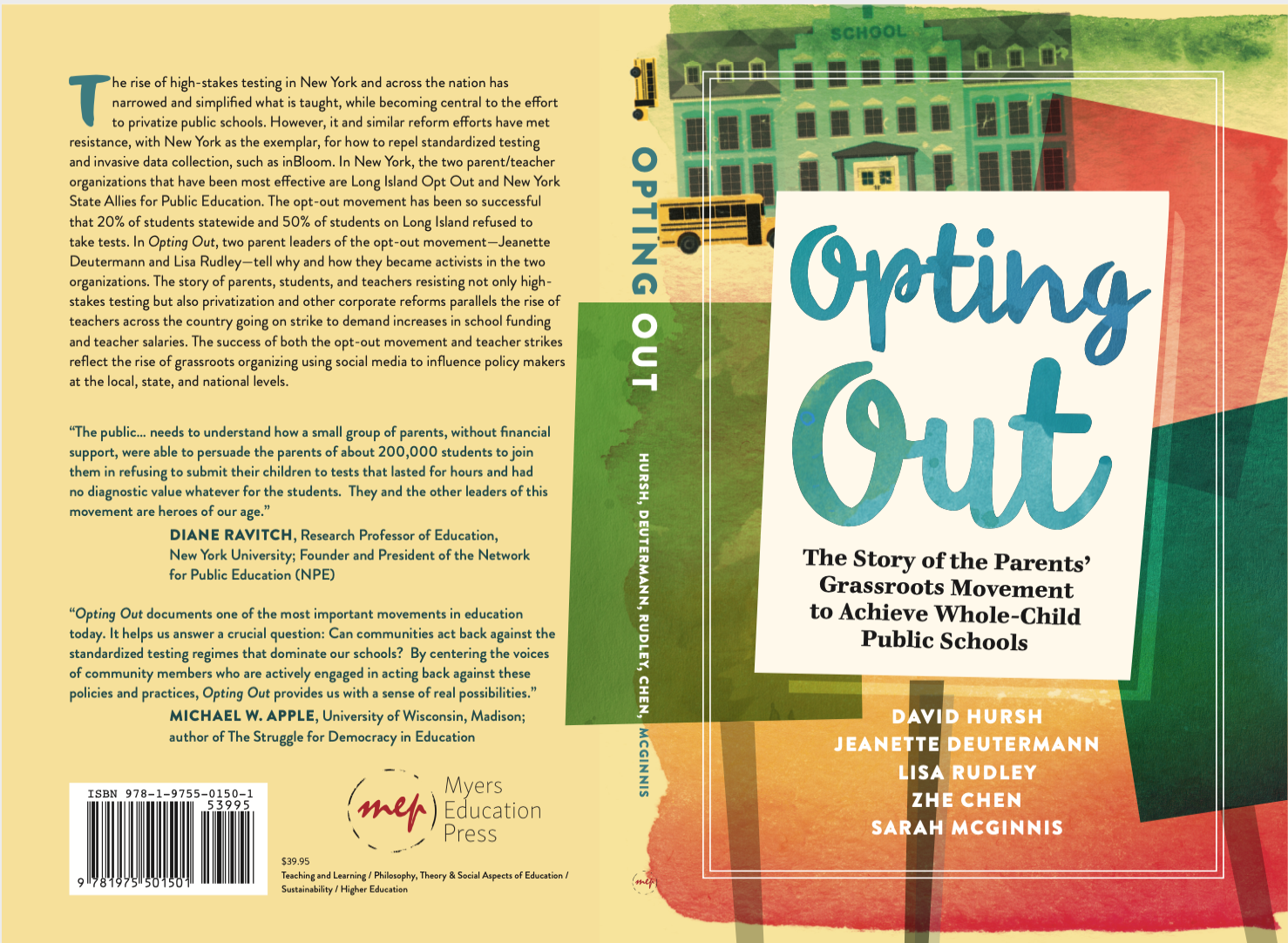
Opting Out: The Story of the Parents’ Grassroots Movement to Achieve Whole-Child Schools is an essential addition to your bookshelf.

It was written by Professor David Hursh of the University of Rochester and parents leaders of the New York Opt Out movement Jeanette Deutermann, Lisa Rudley, and Hursh’s graduate students, Zhe Chen and Sarah McGinnis.

Together they explain the origins and development of the one of the most significant parent-led reactions against high-stakes testing and in favor of education that is devoted to the full development of children as healthy and happy human beings. The media liked to present the Opt Out movement as a “union-led” action, but that was always a false narrative. It was created and led by parent activists who volunteered their time and energy to save their children from test centric classrooms and wanted a “whole-child” education that helped their children become eager and engaged learners.

David Hursh has written and lectured about the assault on public education and the dangers of high-stakes testing.

https://www.waikato.ac.nz/wmier/news-events/prof-david-hursh-on-the-takeover-of-public-education

University of Rochester Meliora Address (2013): High-stakes testing and the decline of teaching. https://www.youtube.com/watch?v=GIQu2Hh_YkI

Keynote address: New York State as a cautionary tale (2014). New Zealand union of primary teachers and administrators. https://www.youtube.com/watch?v=hW4vZGsLiL4

The parent co-authors are leaders of the New York State Opt Out movement, primarily through their role in New York State Allies for Public Education, which has organized hundreds of thousands of parents to say no to excessive and pointless testing, whose only beneficiaries are the big testing corporations.

The parents of the Opt Out movement are a stellar example of the Resistance that is bringing an end to this current era of child abuse and test-driven miseducation.

I was happy to endorse the book and am pleased now to recommend it to you.


In this post, Peter Greene reviews Edspeak and Doubletalk, the glossary co-written by me and Nancy Bailey.

This is the book you need, the scorecard, to identify the players in the fast-moving world of reform propaganda and over-hyped programs.

This resulting book, Edspeak and Doubletalk: A Glossary to Decipher Hypocrisy and Save Public Schooling, is exceptionally useful as a quick-reference resource. If you are a regular reader of this or other education blogs, you know that there is a forest of acronyms, a Grand Canyon’s worth of program names and purposes, and enough different edu-focused organizations to pave a road to the moon and back. This book makes for a quick and easy reference for it all, and more. Chapters are organized by general topic, such as Charter Schools and Choice, English Language Learners, Technology, and Separation of Church and State. There are guides to the various players, both in the chapter on Groups Fighting Corporate “Reform” and School Reform Groups and Terms, or “Money Talks.”

Greene writes:
The book comes with an on-line supplement–an e-book– and the promise of online updates to come. It’s enlightening to browse the book– I’ve already encountered many terms and programs and policies that I had never heard of before (Paideia Program, anyone?)– but I’ve also already used it as a substitute for my usual research assistant (Dr. Google) to look up a couple of terms and organizations. 
 
Explanations are short, clear, and to the point, which is half the battle, since eduspeak relies on a cloud of smoke and fuzz to obscure what’s really going on. Well, Bailey and Ravitch know what’s really going on in debates that have become “highly politicized.” This book will be useful to the general reader, but I’d recommend it for every teacher. Keep a copy in your desk drawer and every time a communique comes across your desk that makes you think, “What the heck is this? Who are these people anyway, and what the heck are they talking about?” just pull out your copy and start translating. 

Stuart Egan is an National Board Certified Teacher in North Carolina. He writes here about the horrible policies imposed on public schools in North Carolina since Tea Party Republicans took over the state’s General Assembly.

North Carolina was once considered the most progressive state in the South, for its dedication to improving public schools and honoring fine teachers. It had the highest proportion of National Board Certified teachers in the nation.

But then the Tea Party arrived in 2010 with an ALEC agenda of disruption and destruction.

Egan writes:

When the GOP won control of both houses in the North Carolina General Assembly in the elections of 2010, it was the first time that the Republicans had that sort of power since 1896. Add to that the election of Pat McCrory as governor in 2012, and the GOP has been able to run through multiple pieces of legislation that have literally changed a once progressive state into one of regression. From the Voter ID law to HB2 to fast tracking fracking to neglecting coal ash pools, the powers that-now-be have furthered an agenda that has simply been exclusionary, discriminatory, and narrow-minded.

And nowhere is that more evident than the treatment of public education.

Make no mistake. The GOP-led General Assembly has been using a deliberate playbook that other states have seen implemented in various ways. Look at Ohio and New Orleans and their for-profit charter school implementation. Look at New York State and the Opt-Out Movement against standardized testing.  Look at Florida and its Jeb Bush school grading system. In fact, look anywhere in the country and you will see a variety of “reform” movements that are not really meant to “reform” public schools, but rather re-form public schools in an image of a profit making enterprise that excludes the very students, teachers, and communities that rely on the public schools to help as the Rev. William Barber would say “create the public.”

North Carolina’s situation may be no different than what other states are experiencing, but how our politicians have proceeded in their attempt to dismantle public education is worth exploring.

Specifically, the last nine-year period in North Carolina has been a calculated attempt at undermining public schools with over twenty different actions that have been deliberately crafted and executed along three different fronts: actions against teachers, actions against public schools, and actions to deceive the public.

Read on to learn about the calculated and vicious attack on public schools and their teachers. This is a record of shame that undermines the public good.