Archives for category: Florida

Governor Ron DeSantis believes he should control everything, not just state government. He has made schools one of his top issues, by promoting a medley of policies.

He ridiculed mask mandates. He got the legislature to pass a bill banning “WOKE” activities and “critical race theory” in schools, colleges, and the workplace. Federal courts have already struck down parts of this law (e.g. demanding that college professors teach only the views approved by DeSantis). He got the legislature to pass a law called “Don’t Say Gay” that prohibits any teaching about gender in K-3 and throws into question the legitimacy of any mention of gender in other grades. He stands in opposition to any workplace training in diversity, equity and inclusion.

Have you ever heard of a state governor endorsing candidates in local school board elections?

At the last election, DeSantis endorsed 73 local school board candidates who share his hard-right views. More than half won. Most of the same candidates were endorsed by the fringe group “Moms for Liberty.” Where the DeSantis candidates won a majority, they wasted no time in firing the superintendent. Teachers in DeSantis-led counties must be very careful in teaching about race, racism, gender, American history or anything likely to offend the ideologues who control the board.

Politico reported on the swift actions taken by DeSantis-endorsed school boards:

TALLAHASSEE, Fla. — Republican Gov. Ron DeSantis put his weight behind dozens of conservative school board candidates across Florida during the midterms. Now they’re in office — and are purging some educational leaders who enforced Covid-19 mandates.

New board members in two GOP-leaning counties essentially sacked their school superintendents over the span of one week. The ousters were spurred by how the superintendents carried out local policies like efforts to support the rights of parents, an issue inflamed by schools imposing student mask mandates last fall in defiance of DeSantis.

And while not tied to the 2022 election, the school board in Broward County earlier this month fired its superintendent through an effort led by five members appointed by DeSantis. All combined, school boards with ties to DeSantis pushed out three superintendents in November alone — and each of them served over districts that implemented student mask mandates.

“We had a wave in school districts that spit in parents’ faces,” said state Rep. Randy Fine (R-Palm Bay), who earlier this year sought to punish schools with mask mandates. “And now the people who did that are gone.”

In Brevard and Sarasota counties, embattled school leaders have faced immediate pressure from newly-installed board members and offered to leave voluntarily rather than risk a vote on their terminations.

The boards in both counties now have conservative majorities who sought a change in leadership immediately after the midterms. Although school boards are nonpartisan posts, lines between Democratic and Republican candidates were drawn in many counties through endorsements from each party as well as outside groups. The newly-elected board members in these cases support parental rights while opposing critical race theory and teaching gender orientation in schools.

DeSantis in particular used his clout to endorse more than two dozen school board candidates during the 2022 election cycle, a rare move for a Florida governor that came with $1,000 cash contributions from DeSantis and other GOP lawmakers. Most of the candidates DeSantis endorsed won their elections and are now transforming the make-up of school district leadership and will have huge influence over policies affecting hundreds of thousands of students in the state.

Both Sarasota and Brevard’s school boards put the superintendents on the chopping block the same day that new members endorsed by DeSantis and conservative organizations like Moms for Liberty were sworn into office.

A poster helping those who want to run for a school board position is seen in the hallway.
A poster helping those who want to run for a school board position is seen in the hallway during the inaugural Moms For Liberty Summit at the Tampa Marriott Water Street on July 15, 2022 in Tampa, Fla. | Octavio Jones/Getty Images

Sarasota board members called Superintendent Brennan Asplen’s job into question at a meeting Tuesday night specially called to discuss his contract. After fielding about four hours of public comment, mostly in support of the superintendent, board members vented criticisms over student performance in reading, how he handled masking students and a perceived lack of transparency from Asplen.

Understanding he may not have a job much longer, Asplen offered up his resignation on Monday night — the day before the board met to weigh his ouster. But the superintendent also fought at the meeting to keep his job by attempting to punch holes in the critiques from board members.

“I have a feeling I’m going to be fired after tonight because I just can’t hold this back,” Asplen told the board from as a preface.

Asplen said that some of the board’s comments were “ridiculous” given that he had been at the school since 2020, a timeframe that included the Covid-19 pandemic. And yet despite the coronavirus uprooting education, Sarasota earned “A” grades from the state both years. The superintendent also claimed he was being shut out by board members since the election and noted that he enacted a mandatory student masking policy for only three weeks, and that was due to Sarasota’s board voting 3-2 in favor of the mandate.

Here is an account of the firing in Sarasota, where the superintendent revealed that he is a “conservative Republican.”

This is a question that I hope someone in Florida will answer.

On several occasions in the past year, Governor DeSantis has appointed his loyalists to fill vacancies on local school boards.

In one county, his appointees fired the district superintendent and school board attorney at their first public meeting.

Just days ago, he appointed a campaign donor to the Miami-Dade school board.

Florida Governor Ron DeSantis has a problem: he cannot tolerate dissent or what he sees as disobedience to his wishes. He seems to think that he can order or legislate complete subservience to his beliefs.

DeSantis fired Hillsborough County’s state attorney, Andrew Warren, who was twice elected to his post by the voters of the county. Warren has sued to have his position restored. The trial began this week.

The firing of Warren, like DeSantis’ firing of elected local school board members, suggests a man with an authoritarian temperament who recognizes no limits on his power.

The Miami Herald reported:

Lawyers will square off this week in a Tallahassee courtroom for a politically charged trial that’s expected to center on one question:

What was Gov. Ron DeSantis’ motive for yanking Andrew Warren from office? In a surprise move in August that made national headlines, Warren, Hillsborough County’s twice-elected state attorney, was suspended from his duties and escorted out of his office by a sheriff’s deputy. It happened as DeSantis held a rally-style news conference at the Hillsborough County Sheriff’s Office at which he and others lamented aspects of Warren’s progressive approach to criminal justice.

Warren is asking a federal judge to reinstate him. He says the suspension was political retaliation against his right to free speech. DeSantis says he did it because Warren refused to enforce state laws.

Warren is asking a federal judge to reinstate him. He says the suspension was political retaliation against his right to free speech. DeSantis says he did it because Warren refused to enforce state laws.

WHO WILL TESTIFY?

Warren’s lawyers in recent weeks have deposed nine witnesses. They include several members of the governor’s staff, among them his former press secretary Christina Pushaw, who famously tweeted the night before the suspension to prepare for the “liberal media meltdown of the year…”

The governor’s lawyers deposed five people. They include two Hillsborough prosecutors who may offer insight into Warren’s policy against prosecuting certain minor offenses — one of the reasons the governor cited in accusing Warren of neglecting his duties.

The actual written policy indicates individual prosecutors should use their discretion in deciding whether to pursue such crimes. Warren contends the policies were not a blanket refusal to enforce laws.

The local sheriff complained that Warren refused to prosecute homeless people who slept in business parking lots for trespassing. Warren said that prosecuting them would not solve the problem of homelessness.

Among a deluge of exhibits to hit the court file: a memo that the governor’s staff prepared before Warren’s suspension, noting that Warren was described in a news story as something close to a “social justice warrior.”

It mentioned his refusal to prosecute 67 protesters who were arrested on unlawful assembly charges during protests over the murder of George Floyd.

The memo seemed to express particular concern over Warren’s stance on abortion, and his having signed a pledge with other elected prosecutors to refrain from prosecuting abortion-related cases. (Warren signed a similar pledge against prosecuting transgender healthcare cases.) The memo included a legal analysis of how the governor could justify suspending him.

What seemed to anger DeSantis most was that Warren made clear that he would not prosecute people who defied the state’s abortion ban. To DeSantis, Warren was “woke” and, as the Governor likes to say, Florida is where “woke” goes to die.

How could Governor DeSantis ignore a state prosecutor who defied him? That’s why he fired him.

Read more at: https://www.miamiherald.com/news/politics-government/state-politics/article269344527.html#storylink=cpy

When Florida Governor Ron DeSantis won re-election, he declared that Florida is the state where WOKE goes to die. By WOKE, he means any teaching about racism that makes white students uncomfortable. Teaching anti-racism is WOKE.

Well, WOKE isn’t dead yet.

A federal judge ruled yesterday that the WOKE act is “dystopian” and banned its enforcement in higher education.

A federal judge on Thursday ordered Florida to stop enforcing its new Stop WOKE Act at the state’s public colleges and universities.

The ruling came in two lawsuits — one filed by a University of South Florida student and professor and another led by Florida A&M law professor LeRoy Pernell — both alleging that the law illegally prevents frank discussions about the nation’s racial history in classrooms. The same judge issued a ruling in August that blocked the law from applying to workplace training.

The legislation prohibits advancing concepts that make anyone feel “guilt, anguish or other psychological distress” related to race, color, national origin or sex because of actions “committed in the past.” It is also tied to proposed regulations that would govern tenure reviews of faculty members.

Professor Adriana Novoa and student Sam Rechek, both from USF, argued the law was unconstitutional. The state countered that it has not harmed the plaintiffs and does not prohibit some of the discussions of the race-related topics mentioned in the lawsuit.

In Pernell’s lawsuit also challenging the act, the same defense lawyers wrote that because faculty members are employees of the state, “the First Amendment simply has no application in this context” because their employer “has simply chosen to regulate its own speech.”

Adam Steinbaugh, a lawyer for the Foundation for Individual Rights Expression, said the ruling was important for faculty of all political persuasions — including those who may have favored the Stop WOKE Act. The foundation is representing Novoa and Rechek.

The ruling “recognizes that faculty members are hired by the state but they don’t speak for the state,” Steinbaugh said. “They’re hired to engage in the robust exchange of views and ideas. Some of those views and ideas are going to be ones the state doesn’t like.”

In his 139-page order issuing a preliminary injunction against the law, U.S. District Judge Mark Walker quoted George Orwell. “‘It was a bright cold day in April, and the clocks were striking thirteen,’ and the powers in charge of Florida’s public university system have declared the State has unfettered authority to muzzle its professors in the name of ‘freedom,’ ” his ruling said.

He wrote that the state was trying to argue that professors only had academic freedom if they expressed the viewpoint of the state. “This is positively dystopian,” he wrote.

In a statement, USF said, “We are carefully reviewing the order and will promptly update our guidance, as needed.”

University of Florida Provost Joe Glover said the school was suspending its investigation procedures for reported violations of the law. The State University System said it does not comment on pending litigation. And the office of Gov. Ron DeSantis, who pushed the law, did not respond to requests for comment.

Steinbaugh, the plaintiffs’ lawyer, said he expects the state to appeal Walker’s ruling.

Novoa contended that she would have to remove readings from her courses, such as one about Jackie Robinson, the first Black man to play in baseball’s major leagues. A court filing said her instruction “advances and engages the question of how baseball’s racial past continues to shape both the game and society today.” In its response, the state contended that the act applied to the present, not historical fact.

Faculty in the Pernell case alleged universities had been taking down “public-facing statements that espoused anti-racist principles” and canceling anti-racist trainings, “creating a climate of increased racial hostility and harassment” and “generating fear among plaintiffs and other Black instructors and students who teach or take coursework in which the viewpoints disfavored by the Legislature are likely to be discussed.”

DeSantis first unveiled the framework for the law in December 2021 as he ramped up his fight against the influence of critical race theory and “wokeness” in schools and businesses across the state. Its formal name is the Stop the Wrongs to Our Kids and Employees Act.

During the 2022 legislative session, the measure spurred fierce debates and criticism, particularly from Democrats and Black lawmakers who said it would exacerbate inequities faced by minorities. The law took effect July 1.

Read more at: https://www.miamiherald.com/news/local/education/article268882172.html#storylink=cpy

Republicans across the country are eying Florida Governor DeSantis as the new Trump, who will lead them to victory in 2024.

Given his hard-right politics, it’s hard to understand the breadth of his victory as similar hardliners across the country were losing.

The Miami Herald wrote:

What forecasters predicted would be a “red wave” did make landfall in Florida on Tuesday night, but it washed over so much of the state that it sent only a “ripple” in races across the country as Democrats had a better-than-expected showing up and down the ballot.

Shortly after polls closed on election night, Ron DeSantis quickly and overwhelmingly won a second term as governor, with a margin of victory that reached nearly 20 percentage points statewide. The Republican governor made gains in each of Florida’s 67 counties, managing to flip eight of the 13 counties he had lost in his first election in 2018.

One of those counties — Miami-Dade — is where DeSantis saw his biggest gain, with a 16-point improvement over his 2018 performance. He also improved by nearly 16 points in Hendry County and by more than 14 points in Osceola County.

Those three counties, not coincidentally, are also the three most Hispanic counties in the state, and DeSantis’ ability to win a larger share of Hispanic voters was a key driver of his remarkable victory. The governor also narrowly won the vote in majority white precincts and more than doubled his vote share in majority Black precincts, capturing more than 16% of the vote in those areas.

DeSantis’ decisive victory, contrasted with Republicans’ lackluster performance elsewhere in the country, have become fodder for conservatives, who are increasingly wondering if DeSantis may make a more effective party leader than former President Donald Trump.

  • ☝️ You can watch highlights from DeSantis’ victory speech at our TikTok.

Trump hasn’t enjoyed seeing GOP elected officials and conservative media question his grip over the party….

As DeSantis works to raise his influence at the national level, back in Florida, he is likely to double down on his conservative policy agenda. Republican legislative leaders have signaled they intend to keep moving Florida forward under his vision, including whether to further restrict access to abortion.

Why was abortion a crucial issue in other states, but not in Florida? Why did usually Democratic districts turn red?

Ron DeSantis is a bully and a braggart. Under his autocratic rule, the people of Florida are “free” to do what he tells them to do. The Miami Herald endorsed his opponent Charlie Crist.

Gov. Ron DeSantis’ Florida is a place of meanness. It’s a place where dissent is muzzled, where personal rights triumph over the greater good, where winning is more important than unity — especially if that victory moves him closer to a White House run.

That’s not the Florida we had four years ago. And it’s not a Florida that voters should tolerate for the next four years. There’s a far better choice in the Nov. 8 election: Democrat Charlie Crist.

DeSantis’ first term in office has been defined by stunt after stunt and made-for-Fox-News grandstanding as he claims successive wins in the culture wars created by the politics of division that he exploits for his own gain. Meanwhile, real crises such as the lack of affordable housing and property insurance are barely addressed.

There was the recent taxpayer-funded flight of Venezuelan asylum seekers from Texas to Martha’s Vineyard. The migrants reportedly were duped into believing they would get jobs, but instead ended up on the Massachusetts vacation island, pawns in DeSantis’ thirst for attention. His willingness to upend the lives of vulnerable people for self-aggrandizing publicity appears to have also been behind his boastful announcement in August of the arrest of 20 people, ex-offenders he said voted illegally. However, those arrested have told the Herald that their county election supervisor’s office said they could cast ballots after Floridians approved the restoration of voting rights for some ex-felons.

DeSantis’ own administration was responsible for flagging ineligible voters, but didn’t. Friday, a Miami circuit court judge threw out a criminal case against one of the people DeSantis accused of committing election fraud in the 2020 election.

There’s DeSantis’ crusade to protect white Floridians from alleged reverse racism at the hands of so-called “woke” teachers and workplace diversity trainers. His targeting of drag queens and a Miami bar because a parent brought their child to a popular drag brunch. His use of “parental rights” to create a new culture war surrounding the teaching of LGBTQ+ issues at schools. His exploitation of the COVID pandemic and masking of children as political tools to proclaim Florida as the “free” state — as long as your version of freedom agrees with his.

LOYAL SUPPORTERS

Still, we can’t deny that DeSantis is a highly popular governor within the state and beyond, depending on one’s political leaning. He has loyal supporters; and he is a Trump-like figure without the buffoonery; and he can deftly play both sides against the middle.

While denigrating teachers at traditional public schools, for instance, the governor guaranteed $500 million to raise the minimum teacher salary and provide raises for veteran teachers and other instructional personnel; secured the highest-ever per-pupil spending totals at $7,793 per student; replaced standardized tests in schools; invested more than $124 million for Florida’s Historically Black Colleges and Universities; and gave parents an outsize voice in their children’s education — just one skirmish in his culture wars.

Similarly, he pushed to reopen the state during the COVID-19 pandemic sooner than many others and less safely. His reelection ads tie Florida’s fast economic rebound to his actions to reopen the state early. But, again, he used the pandemic as a political opportunity, pushing unproven treatment, instead of vaccines, to counter the omicron variant; initially refusing to release the names of facilities where long-term-care residents and staff have been exposed; overseeing a health department accused of undercounting the number of dead; downplaying vaccines while areas with his supporters got theirs first; handcuffing local officials from imposing stringent measures to fight the pandemic. And let’s not get into his threats against school districts that wanted to order mask mandates.

More than 80,000 Floridians have died of COVID, something DeSantis has rarely, if ever, acknowledged.

DeSantis, 44, is governor, yes, but with a broad streak of autocrat. He flaunts Florida’s “freedom,” but it’s granted only to a special few. He wants to control every aspect of how Florida functions. He targets people and communities who disagree with him. He pits Floridians against each other to reap political power. There’s no place for dissent — or even normal discussion — in the DeSantis administration, as demonstrated by his attacks against media to deflect potential governmental blame — even as Hurricane Ian’s victims were still being counted. He is an avenging governor, punishing Disney for supporting LGBTQ+ rights. The compliant Republican Legislature aids and abets him, cowed into compliance by his brutal style of politics.

HAS THE KNOW-HOW

Crist, 66, is seasoned, smart and reasonable. He treats people with courtesy, in contrast to DeSantis, who publicly snapped at high school students for wearing masks and accuse them of engaging in “COVID theater.”

Crist has detailed plans on how to tackle the affordable-housing crisis, one of the most important quality-of-life issues in the state. He’s a consensus builder, something we have missed since DeSantis took office, and he knows intimately how government works. There certainly are knocks against Crist. He’s been criticized as a career politician and political chameleon. And it’s true that he’s a former Republican governor-turned-independent-turned-Democratic congressman who is now running for governor again.

But he says the Republican Party left him, not the other way around, a realization shared by many traditional Republicans. But more than anything, Crist is what we need to return Florida to normalcy and common decency. He would stop the culture wars over made-up issues that have no bearing on Floridians’ everyday lives and get on with the business of governing.

And no matter how much Republicans try to paint Crist as a leftist or socialist, he’s not. Instead, he’s that rarely seen breed in the Florida politics of today: a moderate. As a Republican governor, he displayed independence when he vetoed a bill that would have forced women to undergo an ultrasound before having an abortion. And though he came under attack earlier this year from his Democratic primary opponent, Nikki Fried for his word-parsing when it comes to abortion rights, he has made it clear he will protect a woman’s right to choose by signing an executive order on his first day in office.

ABORTION RESTRICTIONS

DeSantis, on the other hand, has vowed to “expand pro-life protections” after the U.S. Supreme Court overturned Roe v. Wade. Republicans control the Legislature, and it’s very likely they will further restrict the 15-week abortion ban they passed this year. Make no mistake: Reproductive rights are at stake in this year’s gubernatorial election.

DeSantis has done little, if anything, to address the exorbitant costs of buying and renting a home. Imagine if the governor dedicated only a fraction of the attention he’s devoted to bashing “critical race theory” to affordable housing. He has recommended lawmakers fully fund the state’s affordable-housing trust fund over the years. But he has never pushed his Republican allies in the Legislature to come up with comprehensive solutions to the issue — and actually signed a bill that enshrines into law lawmakers’ habit of raiding that trust fund for other purposes. Crist would expand down-payment assistance programs and appoint a “housing czar” to help local governments meet housing-affordability goals. In July, he told the Editorial Board that he wants a “Wall Street crackdown” on companies that “are buying huge tracts of land to flip and make a quick profit,” raising costs for working and middle-class families. Taking on those big companies will be a challenge with a GOP-controlled Legislature. As governor, Crist approved cuts to the Sadowski housing trust fund, but said that was necessary during the Great Recession. He now says he wants to fully fund it and would work to repeal the bill DeSantis signed.

We give DeSantis credit for spearheading the recovery in Southwest Florida from the ravages of Hurricane Ian with a billion-dollar price tag. He’s put on his boots — yes, those white ones — and launched a fast-moving recovery plan. For example, it only took the state a few weeks to repair a crucial bridge into Sanibel, not the months predicted. That’s what we would expect from any state’s executive leader. However, Crist has rightly criticized DeSantis for allowing the state’s other crisis, property insurance, to balloon. Hurricane Ian threatens to turn that crisis into a catastrophe. Under DeSantis’ leadership, the Legislature passed Band-Aid reforms during a hasty, three-day special legislative session. Since then, you hardly hear the governor talk about the issue, despite homeowners losing coverage or facing jaw-dropping premium hikes.

But there’s plenty of talk about those deviant drag queens. Crist has a seven-point plan to fix the state’s property insurance system. He would require, for example, that large companies that provide car insurance also provide homeowners. That would address the cherry-picking that insurers do — leaving many Floridians out in the cold. It’s a start, and we’d like to learn more.

WINS AND LOSSES

Crist’s political resume is hard to beat. He served in the Florida Senate, then as the state’s education commissioner, attorney general and Republican governor for one term — before winning the St. Petersburg congressional seat he has held since 2017. He has also lost elections: in 2010, to U.S. Sen. Marco Rubio and, in 2014, when he came within one point of ousting then-Gov. Rick Scott. All of that experience gives him a deep understanding of Florida and how the Legislature works.

▪ On issues of law and order, Crist wants the state to allow felons who have completed their sentences to vote — even while continuing to pay fines or restitution — as Florida’s Amendment 4 was supposed to do, before Republican lawmakers undercut it. Floridians voted to restore the voting rights of former felons, and they deserve a governor who will honor that intent. Though Crist was nicknamed “Chain Gang Charlie” in the 1990s for championing roadside prison work crews in Florida, when he became governor, he restored voting rights to 155,000 convicted felons, streamlining the clemency process and rejecting a policy rooted in the Jim Crow era — a stand-out accomplishment for civil rights, despite former Gov. Rick Scott’s subsequent decision to revoke the measure.

Crist would also seek to expunge marijuana possession charges and sentences, a measure that would fall in line with President Biden’s pardon this month of people convicted of marijuana possession charges under federal law. He supports legalizing recreational marijuana, saying any taxes on it could go toward raises for veteran teachers. ▪ On gun control, Crist said he supports a supports a ban on military-style rifles, saying they “shouldn’t be on the streets of America.” South Florida suffered through the Parkland school shooting. There is no question that we agree.

▪ Climate change and environmental issues are becoming an increasingly urgent in Florida, with Hurricane Ian as just the most recent example. Crist is the right choice to fight for environmental causes, even when facing pressure from business interests — and that’s based on his record. As governor, he hosted a climate change summit in Miami all the way back in 2007 — early days for that topic. He also clashed with Florida Power & Light on rate increases. He wants utility companies to have less control over the state agency that oversees them by allowing voters to decide whether to retain members of the the Public Service Commission, which has been notorious for going along with FPL’s requests. Crist came close to finalizing a historic $1.75 billion Everglades land deal to help restore the flow of water from Lake Okeechobee to the Everglades. Though most of the purchase fell through when the Great Recession hit, Crist understands that preserving Florida’s environment is critical, ultimately, a pro-business stance. Crist said he will work to attract technology and other clean industries to Florida, which would help reduce the state’s economic reliance on tourism. Crist is all-in on solar power, saying the state should lead the way. DeSantis, too, has been an ally of the Everglades and supports building a reservoir to clean and send more water south. Soon after taking office, he created an algae-bloom task force and appointed a chief resilience officer. He spearheaded the creation of a state program that helps communities pay for projects that mitigate the impacts of sea-level rise. He signed the “Clean Waterways Act” to minimize the impact of known sources of nutrient pollution. And for Miami-Dade, he announced a $20 million investment into the protection and preservation of Biscayne Bay, a joint funding initiative between the state for important infrastructure updates and new technology to help predict and prevent sanitary sewer overflows into the bay. But climate change and the state’s reliance on fossil fuels aren’t topics you hear the governor discuss, or even acknowledge.

▪ On voting rights, Crist would push to reverse the limits on mail-in ballots imposed by the Legislature under DeSantis. He also wants to declare Election Day a state holiday, to allow more people to vote, and he would push the Legislature to move primaries from the slow middle of the summer — August — to the spring, when more voters are in the state. Those are common-sense changes that would encourage people to vote. Except for some high spots, DeSantis has deeply damaged our state in four years. Instead of bringing us together so that, united, we can confront and solve our biggest challenges, he has pushed us apart. Instead of working for the betterment of everyone, he has worked only for the betterment of himself and his drive for higher office. Instead of encouraging us to reach for our better selves, he has sown suspicion and scorn. He has marginalized, penalized and ostracized entire groups of people — his constituents — though he spurns them relentlessly. Four more years of this, and what will be left of civil society in Florida? We’ll become unrecognizable. Charlie Crist is the best choice. He’ll work to unite us — Democrats, Republicans and independents alike. He’s what Florida needs — now.

The Miami Herald Editorial Board recommends CHARLIE CRIST for Florida governor.

Read more at: https://www.miamiherald.com/opinion/editorials/article267265987.html#storylink=cpy

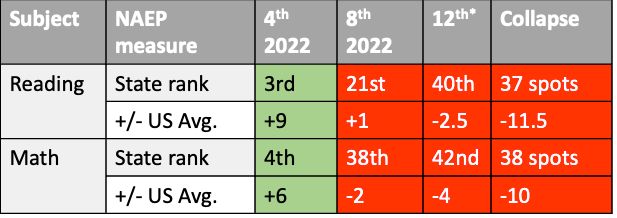
Billy Townsend, Florida blogger, has reported regularly on Florida’s gaming of NAEP scores. He writes here that Governor Ron DeSantis is carrying out Jeb Bush’s old trick to inflate 4th grade NAEP scores. He calls the governor Ron Jebsantis. The trick is third grade retention, which ensures that the lowest scoring third graders never take the fourth grade NAEP test (the kids who take the NAEP test are selected at random).

Thus, DeSantis put out a flashy press release celebrating fourth grade NAEP scores in the test scores recently released. But, as usual, DeSantis neglects to mention the collapse of eighth grade NAEP scores. Somehow the kids who were retained in third grade managed to skip fourth grade and rejoin their classmates by eighth grade.

Here are his numbers, drawn from NAEP reports:

With that in mind, here is a view of Florida’s 2022 NAEP scores peaking in elementary school and dramatically worsening with the older cohorts —- which is ALL of the red numbers after the green baseline.

I personally put no stock in the twelfth grade numbers (which Billy extrapolated) because NAEP stopped testing seniors a decade ago. Seniors know that NAEP doesn’t count and they don’t do their best. Some don’t even try. Their answer sheets had doodles, or some just picked the (A) answer to every question or some were blank.

But the stark drop from fourth grade to eighth grade says something’s fishy in Florida.

The conservative news site “The74 Miliion” revealed a dubious expenditure by the far-right group that calls itself “Moms for Liberty.” The group is known for its advocacy against “critical race theory,” teaching about gender, and masking.

Moms for Liberty, one of the fastest-growing and most recognized conservative parent advocacy groups in the nation, paid $21,357 to a company owned by the husband of one of its founding members, campaign finance records show.

The group doled out the money to Microtargeted Media, founded by Christian Ziegler, a current Sarasota County commissioner and vice chairman of the Florida GOP, in late August.

Moms for Liberty was founded by three people, Tina Descovich, Tiffany Justice and Bridget Ziegler, Christian’s wife, who served as its director through February 2021. Bridget Ziegler joined the Sarasota County School Board in 2014 and was re-elected this summer.

Bridget Ziegler (Twitter)

She was not named by the two other founders in numerous early press interviews, an omission some critics charged was meant to distance the group from Florida’s GOP power structure. Descovich said Ziegler stepped away to pursue other interests. Moms for Liberty contributed $250 to her school board campaign in mid-July, records show. Related:Moms for Liberty Co-Founder on Parent ‘Warriors’ Who Challenge School Boards

Bridget Ziegler could not be reached for comment. Her husband, who responded to The 74 through Twitter Thursday evening, would not discuss his company’s work for Moms for Liberty.

“I don’t share information about my clients as I do not speak for them,” Christian Ziegler wrote. “You can contact Tina directly for any additional insight.”

Microtargeted Media, which specializes in targeted text messaging and digital advertising,has made hundreds of thousands of dollars from right-wing political campaigns. Its recent clients also include Florida state Sen. Joe Gruters, chairman of the Florida GOP and an ardent Trump supporter. His campaign paid the company nearly $28,000 for its services.

Florida Conservatives United, a PAC, has paid Microtargeted Media more than $15,000.

The endorsement of the Miami Herald matters in Florida. I hope it matters enough to elect Val Demings. Its editorial board gave a resounding endorsement to Congresswoman Val Demings, a former chief of police. Her story is inspiring. She was born to parents who worked as a maid and a janitor. Her first job was as a dishwasher. She is articulate, accomplished, and deeply committed to the ideals this country professes.

The race for Florida’s U.S. Senate seat is the most consequential on the Nov. 8 ballot. Its outcome will determine not only the direction of the state, but could impact which party controls the Senate. Republican incumbent Marco Rubio, 51, Miami’s homegrown son, has been in the Senate since 2011 and has been a politician for 24 years. Despite all the experience under his belt, his intelligence and innate political talent, he hasn’t lived up to the expectations that this son of Cuban immigrants would usher the GOP into a new era. In 2013, Time declared him “The Republican Savior,” calling him the new voice of the GOP.

But today, he appears more comfortable playing the role of apologist for Donald Trump — the newer, dangerously bombastic voice of the GOP — despite being ridiculed by the former president during his 2016 presidential run and more preoccupied with his own political future than representing his constituents.

In 2020, for example, Rubio went so far as to praise Trump supporters in Texas who used their vehicles to try to run a busload of Joe Biden backers off the road. Someone could have been killed. Floridians have a better alternative. The Herald Editorial Board recommends Democrat Val Demings, a Central Florida congresswoman who previously served as the first female police chief of Orlando.

Her voice is grounded in the real world, bringing toughness, yes, but also an empathy for struggling Americans that we have not heard from the more-removed, more-political Rubio. Although Republicans have tried to cast any Democrat as a “socialist,” she’s a moderate with a practical approach to the issues and a rich life and professional experience.

Born in Jacksonville to a maid and a janitor, Demings started working at 14 as a dishwasher, later became a social worker and changed careers to become a police officer. She rose through the ranks of the Orlando Police Department to become, in 2007, a ”police chief with a social worker’s heart” — without losing her “tough on crime” responsibilities, she told the Editorial Board.

Demings, 65, can connect the dots between Capitol Hill’s ivory tower and the real world. She was first elected to the U.S. House in 2016 and, in 2020, was picked to be one of the House managers who argued for Trump’s impeachment in the Senate.

Her policing background should appeal to voters concerned about public safety. Her social-worker roots should resonate with voters looking for someone who understands the plight of Floridians working hard to make ends meet in this economy.

“The best indicator of future performance is to look at past performance,” Demings told the Editorial Board. “My dedication, my commitment to the oath of office as a police officer, a police chief, member of Congress, and certainly as a senator, I take it extremely serious. And I will show up for Florida.”

Demings already has landed some solid wins as a U.S. representative. Rubio speaks dismissively of her bill to name a post office in honor of a police officer in her district who was shot and killed in the line of duty, something she pushed through with bipartisan support and of which she is rightly proud.

But Demings has sponsored and pushed through other, substantive legislation. “The first piece of legislation that I passed — and was signed into law by President Trump — was legislation that would help fund mental-health programs for law-enforcement officers,” she told the Editorial Board. “They see the worst of the worst every day and have to deal with it and then go home to their own families.” Blue lives obviously matter to her.

In 2019, Demings also sponsored, with Republican U.S. Rep Elise Stefanik, of New York, the Vladimir Putin Transparency Act, directing U.S. intelligence agencies to give reports to Congress about the Russian president’s financial assets and hidden networks. It passed in the House. It did not have a Senate counterpart, but was included in Defending American Security from Kremlin Aggression Act sponsored by U.S. Sens. Lindsey Graham, R-South Carolina, and Bob Menendez, D-New Jersey.

Demings told the Editorial Board the top issue in this race is inflation. She touted her vote on the Inflation Reduction Act this year, which capped the cost of insulin for Medicare beneficiaries and made investments in clean energy. Rubio voted against the legislation. His campaign ignored requests for an interview with the Editorial Board.

Protecting the environment and combating climate change, which is making hurricanes stronger and wetter, are two other priorities for Demings. That requires “not being global-warming deniers, or climate-change deniers, but really taking that seriously and investing,” she said. Rubio has been a staunch supporter of Everglades-restoration efforts. But for years he questioned the scientific consensus that human activity is causing global temperatures to climb. He somehow recognized the issue in a 2019 column for USA Today, writing that Floridians “are right to be concerned about the changing climate” but said that humans can better mitigate sea-level rise and flooding, rather than addressing the source of the problem: our reliance on fossil fuels.

Demings’ other priorities are public safety and protecting “constitutional rights.” This is where you see the sharpest contrast between Demings and Rubio. Rubio called a bill to codify same-sex marriage into federal law a “stupid waste of time,” part of the agenda of “a bunch of Marxist misfits.” The legislation seeks to protect that right should a 2015 landmark U.S. Supreme Court ruling be reversed, as Roe v. Wade was in June. The U.S. House passed the legislation with historic GOP support, but needs enough votes to overcome a filibuster in the Senate. Senators like Rubio stand in the way. Gay marriage isn’t a “Marxist” concoction, it’s a human right that the majority of Americans support.

Demings supports abortions up to the point of viability and wants to codify reproductive rights into federal law. Rubio has pitched himself as “100% pro-life,” but also has said he would support legislation with exceptions for rape and incest, like the 15-week federal ban he’s co-sponsored — if that’s what it takes to get a bill passed.

In other words, such compassionate exceptions are, to Rubio, merely a concession. He told CBS4 host Jim DeFede, “I am in favor of laws that protect human life. I do not believe that the dignity and the worth of human life is tied to the circumstances of their conception, but I recognize that’s not a majority position.”

That is one of the reasons this Senate race is important. It’s about numbers. Whoever controls Congress can either advance or take away reproductive rights if they have enough votes. M

MA longstanding and generally justified criticism of Rubio is that he misses a lot of Senate votes. Demings has said he has one of the worst attendance records in the Senate. By mid-summer this year, Rubio had missed 9.2% of 3,744 roll-call votes since 2011. According to the fact-checking site PolitiFact, that is well above the average of 2.3%, though his attendance improved in recent years. Most of his absences happened during his 2016 presidential run.

Back then, he vowed not to run for reelection to the Senate, then went back on his word. He was reelected with 52% of the vote. Since then, Rubio’s career has been defined by walking the fine line between doing what’s right for the United States and what’s right for his career — most notably, staying on the good side of the mercurial Trump and his base. He hasn’t struck the right balance.

Sometimes we still see in Rubio a glimpse of the smart, eloquent statesman who began his career as a West Miami councilman. In 1999, the Herald Editorial Board recommended him for a Florida House seat, saying he displayed a “thoughtful and idealistic sense of politics.” He won that race and went on to become the speaker of the Florida House. In 2010, we recommended him again for his U.S. Senate seat. We remember him leading the Gang of Eight on a historic bipartisan immigration reform package in 2013 that would have offered a pathway to citizenship for immigrants in the country illegally. But when it failed, Rubio couldn’t run away fast enough from the legislation that had pushed him onto the nation stage.

There was the Rubio who warned Americans six years ago about the “reckless and dangerous” Trump, but soon emerged as the Trump sycophant who’s all too eager to rationalize the former president’s attacks on decency and democracy.

He differentiated himself from some of his Republican colleagues when he voted to certify the results of the 2020 election in Arizona and Pennsylvania. When the U.S. Capitol attack was happening on Jan. 6, he tweeted: “There is nothing patriotic about what is occurring on Capitol Hill. This is 3rd world style anti-American anarchy.”

But he returned to the GOP fold when, in a video posted on Twitter two days later, he blamed the “liberal” press, social-media platforms and state election officials — everyone but the former president and his lies — for millions of Americans not trusting the election results.

He has called the Jan. 6 commission to investigate the attacks a “partisan sham.” And he offered an insultingly silly defense of Trump’s removal of classified documents after he lost the election, calling the FBI search of Mar-a-Lago a partisan witch hunt over a “storage” issue.

Rubio was one of the architects of the Paycheck Protection Program that provided loans for small businesses during the COVID-19 pandemic. as part of the 2020 CARES Act. He said in Tuesday’s debate that the program kept the country out of economic disaster despite significant issues with the backlog of unforgiven loans and the disproportionate impact of the backlog on minority and low-income communities.

He also pushed to double the maximum child tax credit from $1,000 to $2,000 in the 2017 Tax Cuts and Jobs Act.

With the Pulse nightclub slaughter in 2016 in Orlando and the recent life sentence given Nikolas Cruz after pleading guilty to the Parkland school massacre in 2018, gun control is an ever-present issue in Florida. Rubio even said that the Pulse shooting spurred him to run for reelection in 2016 and that he would support raising the age limit to buy a rifle. Though he has filed legislation to support the expansion of red-flag laws that allow a judge to take away guns from people deemed dangerous, he voted against a common-sense — and timid — bipartisan gun-control law President Biden signed after the Uvalde school shooting in May. Among other things, it funded mental-health services in schools, another issue brought up by the Cruz case. Rubio has scoffed at even popular, moderate gun-control measures like enhanced background checks. He then offered an insulting excuse for it during he Tuesday debate: “Every one of these shooters would have passed the background check that [Demings] keeps insisting on,” he said.

Foreign policy has been Rubio’s strongest suit. He’s the vice chair of the Senate Select Committee on Intelligence. He has made his opposition to China and the Cuban and Venezuelan regimes a trademark. But Demings still holds her own here. In her interview with the Board, she was well-versed on how events in Latin America are local issues in South Florida. On Cuba, Demings denounced the current island government and said she supports the U.S. embargo. She’s against reestablishing diplomatic ties with the regime. On Haiti, Demings was emphatic that the United States should not intervene militarily, despite the chaos currently engulfing that country. Instead, the United States should name an envoy to Haiti to help stabilize its teetering government. On the issue of the Biden administration turning away Venezuelan refugees escaping their country at the U.S.-Mexico border under Title 42, a Trump-era policy, Demings said that it is “a beneficial tool until we can get some other things in place.” The United States needs to speed up the processing of asylum claims, hire more border-security officers and invest in technology, she said.

We repeat, the race for Florida’s U.S. Senate seat is the most consequential on the Nov. 8 ballot. It is not an overstatement to caution that the winner will either push back hard against those who have our democracy under assault or push our democracy closer to the brink of irreparable damage. Rubio too often shirked his responsibility to push back. We think Demings will stand up for our democratic values.

The Miami Herald Editorial Board recommends VAL DEMINGS for the U.S. Senate.

Read more at: https://www.miamiherald.com/opinion/editorials/article267542102.html#storylink=cpy
The faculty senate of the University of Florida voted to reject Nebraska Senator Ben Sasse as the new president. Sasse was the sole finalist. The decision will be made by the university’s board of trusteees.

The University of Florida’s Faculty Senate on Thursday voted to support a no-confidence resolution against Nebraska GOP Sen. Ben Sasse, who was the sole finalist to be the next UF president.

“The Senate held an emergency meeting on the resolution, which questioned Sasse’s qualifications and a search committee’s decision to name him as the only finalist for the job. Senators voted 67-15 to pass the measure, after some criticized the search process and past statements made by Sasse on issues such as LGBTQ rights,” The Gainsville Sun reported.

Students have also protested the highly controversial search process which resulted in Sasse being the only finalist.

“The UF board of trustees is scheduled to consider Sasse for the position Tuesday,” the newspaper reported. “The Nebraska Republican is currently serving his second term in the Senate and was previously president of Midland University, a 1,400-student Lutheran school in Nebraska.”

The University of Florida has over 50,000 students.

“Sasse was announced Oct. 6 as the sole finalist for the UF presidency, after a search process that was conducted largely in secret,” the newspaper reported. “UF stated that its search committee reached out to more than 700 people and focused on a dozen candidates, including nine sitting presidents at major research universities.”