Archives for category: Education Reform

New Hampshire’s state motto is ”Live Free or Die.” For reasons explained in this article, New Hampshire became a magnet for libertarians whose goal was to abolish government. Last year, The New Republic published a delightful article by Patrick Blanchfield about Grafton, New Hampshire, a town that went libertarian and was soon overrun by a hungry and bold bear population. Certain conveniences are sacrificed in a town, and now a state, where the highest ideal for large numbers of people is the lowest possible taxes.

While Grafton strived to be a Free Town, free of regulations, with low taxes, and a limited government. other libertarians had a bigger dream: to turn NewHampshire into a Free State. The article cited here describes this project and attributes it to a young academic named Jason Sorens. His idea was that a relatively small number of libertarian activists could move to a small state, take over its government, and implement their ideas. it has happened in New Hampshire. The libertarians now control the Republican Party, which controls the state.

In 2003, libertarians formed the NH Liberty Alliance, which rates legislators based on their adherence to libertarian principles.

The Liberty Alliance has since shed its nonpartisan guise to become the dominant bloc within the House Republican caucus. This year, the alliance gave 150 representatives “A“ grades and another 45 received a “B” for voting as recommended on between 87 and 100 percent of 49 tracked bills. All were Republicans.

In fact, among House Republicans, only eight received the lowest score. In other words, 195 members of the caucus, which numbered 213 when the session began and 211 when it ended, aligned themselves closely with the alliance. The “nonpartisan” alliance has placed itself at the forefront of the partisan contest.

Meanwhile, of the 177 Democrats, 18 were given a “D” grade and 24 received an “F,” while the other 135 were graded “CT,” or “constitutional threat,” and “considered unfaithful to their oath of office to uphold the New Hampshire Constitution and the principle of liberty.”

Candidates endorsed by the Liberty Alliance have received financial support from national political committees — Make Liberty Win and Americans for Prosperity — which together spent some $1.4 million on New Hampshire legislative races in 2020.

Americans for Prosperity is the name of the Koch network.

“The liberty movement has made a lot of progress,” Sorens said, highlighting the reduction in both business and property taxes, repeal of the interest and dividends tax and introduction of an expansive school choice program in the last legislative session. He also pointed to legislation repealing the certificate of need process, granting the right to carry a firearm without a license, deregulating home-schooling, reforming civil asset forfeiture, restricting eminent domain, decriminalizing marijuana possession, allowing medicinal marijuana and easing regulation of micro- and nanobreweries.

On October 27, the New York City Council Committee on Education held a hearing on a bill to reduce class size. The chairman of the committee is Mark Treyger, a former teacher. The city’s Department of Education opposes the bill, based on the strain on facilities (there is never a problem finding space for a new charter school).

I testified in favor of class size reduction, along with Regent Kathy Cashin (a former teacher, principal, and superintendent), as well as a number of parent advocates and Leonie Haimson, CEO of Class Size Matters.

Here is my statement, tailored to fit a 2-minute time limit.

I should have added this additional point.

Some people have said to me, “When I was in school, we had 40 or 50 kids in a class. Why do kids today need classes any smaller.?”

Answer: In those old days, schools operated on the principle of sink or swim. Those who couldn’t keep up either flunked or dropped out. Now we expect all students to finish high school. That can’t happen if class sizes are so large that children who struggle are overlooked.”

The Network for Public Education blog posted this excellent explanation of why the Republican laws banning teaching about racism are wrong. They assert that white children will feel bad about themselves if they learn the truth about the past, about whites’ oppression of Blacks, about lynching and massacres and white supremacy.

From the blog Edukention, a response to the concern that teaching about racial history and institutional racism will make white children feel bad. 

One of the myths about teaching accurate racial history and institutional racism is that it will make white children feel bad about themselves. In most cases, this is a trumped up idea intended to dissuade teachers from teaching accurately and it is a rationale for abusing teachers, administrators, and school boards into supporting a white supremacist curriculum. It makes NO SENSE that an accurate education would make the learners “feel bad” about themselves. What they are learning is what was done BEFORE they were alive; they didn’t do anything wrong. They are learning about what OTHER PEOPLE did.

It’s like saying we shouldn’t teach about World War II because it might make Germans, Italians, and Japanese people feel bad about themselves. I’m ¼ German, and I never once felt the slightest bit of guilt or self-loathing when I learned about Nazi Germany. In fact, I felt good because I learned that people who share my heritage who were wrongheaded in their ideas were defeated and then later they made peace with their past, established a better set of conditions, and became important leaders and global citizens–although far from perfect, of course.

It’s not fun to learn about injustice, especially if you are benefitting from that injustice. We can file these feelings under “growing pains,” which is when you learn something that makes you feel temporarily bad but is ultimately important to be a functioning, ethical adult. For example, think about Santa Claus, the Easter Bunny, the Tooth Fairy, or any myths that are prominent among children in your culture. Eventually, the truth must out. Life is not fair, and it’s less fair from some than others. Much less fair. To a degree that takes lives and livelihoods from some and makes it much easier for others.

Over the course of centuries, white people have allowed themselves to be treated with a level of care and respect they have not granted to people of color. After so much time, it can seem natural that some deserve more than others. THAT’S where unfair privilege comes in. Some of us (white, wealthy, male, straight, abled) have a lot of privilege. Yeah, it sucks to have that pointed out, but we have to be adults. We need to learn about it, accept it, and make the necessary changes to make ourselves and our world better.

Children and adolescents are especially attuned to fairness, and as they mature they are rarely wounded when they understand that they must share in fair ways.

Read the full post here.

You can view the post at this link : https://networkforpubliceducation.org/blog-content/edukention-good-teaching-about-race-does-not-make-white-children-feel-bad-about-themselves/

Jan Resseger provides a useful and disturbing overview of vouchers, which began in 1991 in Milwaukee. The funder that inspired the Milwaukee voucher program, paid its legal costs, and kept it going while it was challenged in court was the rightwing Lynde and Harry Bradley Foundation, led by Mike Joyce. When vouchers were launched thirty years ago, their promoters said they would “save” poor black children who were “trapped” in “failing public schools.” Five years later, Cleveland adopted its own voucher program. Vouchers have not been an academic success, as promised, but libertarians and conservatives continued to demand more vouchers and charters because choice is choice, even when it doesn’t produce the promised results. A while back, while doing research for a book, I interviewed Alan Borsuk, who has been writing about Milwaukee schools for years, and he gave me this summary: the three sectors–charters, vouchers, public–get about the same results, and the results are low for all three sectors (the public sector has a disproportionately large number of students with disabilities who are not wanted by the other two sectors). On the National Assessment of Educational Progress, black students in Milwaukee score at about the same level as their peers in poor, underfunded southern states.

Jan writes:

Milwaukee, the oldest publicly funded, private school voucher program in the United States just marked its 30th anniversary. Wisconsin vouchers have been a model for voucher expansion all over the country, which makes this a good time to review the impact of the growth of diversion of tax dollars to cover private school costs.

In a two part review for the Milwaukee Journal Sentinel, Alan J. Borsuk, senior fellow in law and public policy at the Marquette University Law School reflects on the operation and public policy impact of the now 30-year-old Milwaukee voucher program, and more generally on the implications of the growing use of school vouchers.

Borsuk begins by noting that in Wisconsin, vouchers are now so old they have lost some of their luster. He believes the public ought to be watching more closely: “In Wisconsin, the sector wars between public school people and school choice people are kind of old hat. The hottest cup of coffee served in the last generation of education around here seems lukewarm now. But that is also a good reason to re-cap the impact of providing public support for thousands of children to attend private and religious schools….”

Based on his study of the Milwaukee voucher program over its 30 year history, Borsuk offers 10 primarily descriptive observations:

  1. “The voucher movement is big. It started out in Fall 1991 with 337 students in seven schools… By last fall, about 28,000 children, around a quarter of all Milwaukee children receiving publicly funded education, were going to about 115 private schools.”
  2. “It really is school choice… (N)o one has ever been required or assigned to use a voucher to go to a private school… Thousands of parents want their kids to attend private and, most cases, religious schools, and vouchers make that possible.”
  3. “Vouchers haven’t solved the success gaps in education.  One of the primary claims of voucher supporters… was that giving parents more freedom to choose schools, coupled with competition among schools… would drive big improvements in overall academic success…. Nope. Overall, the reading and math scores of students using vouchers aren’t much different than students in Milwaukee Public Schools—and proficiency rates in both streams of schools have been generally unchanged… at depressingly low levels. Whatever is needed to… start up booming academic achievement, vouchers aren’t it.”
  4. “Vouchers have impacted Milwaukee Public Schools (MPS) negatively… (O)verall, in large part due to voucher use and charter enrollment, enrollment in MPS has fallen steadily for more than a decade, and that is not good for the system… Also, MPS has a higher percentage of students with special needs and students who have chronic behavior problems than schools in other sectors have.”
  5. “The voucher movement is religious… (F)or the last five years, more than $200 million a year in state money has been spent on vouchers, the strong majority of it at religious schools. Those schools cover a wide range of religions—Catholic, Lutheran, other Christian denominations, Muslim, Jewish—and there are almost no limits on how religion is taught or practiced in those schools.  Both Wisconsin and U.S. supreme courts have ruled it is not a violation of separation of church and state, on the theory that the state is supporting parents choosing schools and not the state choosing schools.”
  6. “Milwaukee taught the country. One important lesson was how not to do vouchers… People with limited or dubious qualifications opened schools… Some schools were outrageously bad.  Many were just mediocre and poorly run.  It was only by launching regulations and creating some oversight that bad financial practices and… bad educational practice was reined in and many schools closed.”
  7. “School choice movement is stable. In the 2010s, it seemed like every two years, when the state budget was developed, big changes were made…. Voucher programs were added for Racine, for the rest of Wisconsin, and for students with special needs… Now, especially with split control of state government, nothing is changing.”
  8. “Vouchers keep private schools going… At many private schools, more than 90%  of students are supported by vouchers of more than $8,000 per student per year… Milwaukee has a much more vibrant private school sector than many comparable cities.  Is this a public good?…  (S)aying vouchers are keeping the private school sector going is stating a fact.”
  9. “Vouchers fractured education politics… The intense battles between public school people… and voucher people meant there wasn’t a united front in responding to the needs of all the children in the city.  The division and divisiveness remain….”
  10. “The voucher school roster has improved… (T)he closing of many of the poorest schools has moved the overall record of private schools in a positive direction.”

Borsuk’s analysis presents a pretty objective analysis of many aspects of Wisconsin vouchers, but he entirely fails to address what across many states is the most serious concern: vouchers eat up a huge and growing portion of state education funding in Wisconsin and other states where voucher programs have grown over the years. Borsuk points out that the Milwaukee school district’s loss of students has been bad for the public schools.  What he doesn’t mention is that as students leave for private schools, in some states they carry the voucher funding out of their local school district’s budget.  But even when the state pays directly for the cost of the voucher, the school district loses the voucher student’s per-pupil state funding, and because many school district costs are fixed, the district loses funds needed for programming for the majority of a community’s students—the children enrolled in the public schools.

While Borsuk doesn’t mention the fiscal impact on public schools of the growth of vouchers across his state, in a 2017 brief from the National Education Policy Center, the University of Wisconsin’s Ellie Bruecker does evaluate the fiscal impact of Wisconsin’s vouchers on the state’s public schools:  “The program as currently structured appears likely to exacerbate existing inequities in state school financing. Taxpayers in many communities will be burdened with higher tax costs without seeing that burden translate into more spending on students attending local public schools. Moreover, the relative amount of money the state allocates to each public school student it supports is likely to decline. As more states enact or expand voucher programs, the case of Wisconsin offers a cautionary tale. Statewide voucher programs have the potential to seriously exacerbate funding disparities in the public system.”

Additionally voucher programs educate the few at the expense of the millions of children who continue to be enrolled in the public schools which lose the funding. For the Phi Delta Kappan, Mark Berends explains that today, while they are expensive, voucher programs serve relatively few students: “The number of school voucher programs has increased dramatically over the last two-decades. In 2000, there were just five such programs in operation in school districts and states… by 2010, the number had increased to 12, and by 2021, it had climbed to 29… (T)he number of students participating in voucher programs… has increased significantly in the last decade, though the total number of students receiving vouchers remains a tiny fraction of the total number of students in the U.S. (about 0.5%).” (Emphasis is mine.)

And while the voucher program in Wisconsin may have reached a stable plateau, in Ohio, like many other states, legislatures are making big new investments in private school vouchers.  Writing for the Columbus DispatchAnna Staver and Grace Deng report: “School choice advocates say… they want Ohio and eventually the country to give a voucher to any kid who wants one. ‘People are cutting their cable and buying individual channels and personalizing what they want for their own entertainment,’ said Greg Lawson, a research fellow at the… Buckeye Institute. ‘It’s about choice. It’s about empowering folks. People want choice in their food, in their entertainment. Education should be that too.’”

Staver and Deng summarize the history of the recent rapid expansion of these programs, “(T)he rules that govern eligibility get a little more expansive every year.  At first, only students assigned to schools in ‘academic emergency’—the state’s lowest rating—for three consecutive years could apply for a voucher. A year later it became schools in either academic emergency or academic watch for three years.  Six months after that, the requirement dropped to two of the last three years. In 2013, lawmakers created an income-based scholarship for all kids regardless of their home district… Today, roughly half of Ohio’s families are eligible for an income-based voucher because the limit for a family of four (is) $65,500 of annual household income.”

In the state budget passed at the end of June, the Ohio Legislature raised the size of each voucher in another program, EdChoice, from $4,650 for students in grades K-8 to $5,500 and for students in high school from $6,000 to $7,500. Previously only 60,000 students could qualify for EdChoice statewide, but in the new budget, the Legislature eliminated any cap on the program’s size  While there used to be a 75 day window for submitting an application for an EdChoice voucher, there is now a rolling window with no closing date.  And beginning with the FY 26 school year students will no longer be required to attend a public school in the year prior to qualifying for a voucher. Today high school students need not attend a public school in the year before qualifying, but as of 2026, no student will need to have attended a public school prior to qualifying.

In Ohio, it never seems to stop. Last Wednesday members of the Ohio House held a press conference to promote House Bill 290, introduced last spring as what its sponsor is reported to have called “a legislative intent bill” for the purpose of promoting widespread discussion of universal vouchers.

Open the link and read the rest. The legislative strategy for vouchers is the camel’s nose under the tent. The first act is to provide vouchers for poor students trapped in failing schools, so there are income limits and requirements that students were enrolled in a low-performing school. In the second act, the income limit for eligible students is raised, or vouchers are enacted for students with special needs (even though these students abandon their federally-guaranteed rights when they leave public schools). Next step, students applying for vouchers need never have attended public schools, so they are not being “saved from failing schools” because they never attended public schools. The ultimate goal is universal vouchers, because choice may be academically ineffective but choice is good. In reality, as Jan points out, choice defunds the public schools that most students attend, so choice is not good after all.

Nancy Bailey is a retired teacher who battles misinformation and propaganda. In this post, she dissects a new film called “The Truth About Reading,” which is riddled with half-truths and omissions. It is yet another alarmist film that calls parents to the barricades to engage in another round of The Reading Wars.

She begins:

Americans are getting primed with a trailer for a new documentary called The Truth About Reading. It’s said there needs to be a grassroots movement of parents and educators who are angry and say enough is enough.

Wouldn’t it be better if teachers and parents met and shared their concerns about reading at their schools? Schools do various reading programs that might need review, especially if students have difficulty learning.

Open the link and read on.

Eric Adams, the Democratic candidate for mayor, is sure to be elected mayor of New York City in November, succeeding Bill De Blasio. The current Mayor Bill De Blasio announced the end of testing four-year-olds for entry into gifted programs. Adams asserted his intention to keep gifted programs, but without details.

Eric Adams said on Friday that he would keep New York City’s elementary school gifted and talented program if, as expected, he wins the general election for mayor next month — a clear rebuke to Mayor Bill de Blasio, who recently announced plans to eliminate the program.

“There’s a new mayor next year, that mayor must evaluate how he’s going to deal with the gifted and talented program,” Mr. Adams, the Democratic nominee for mayor, said in an interview with CNN. “He can’t get rid of it until next year,” he added of Mr. de Blasio.

Asked directly whether he would eliminate the gifted program, Mr. Adams replied, “no I would not, I would expand the opportunities for accelerated learning.”

In another break with Mr. de Blasio, Mr. Adams said in a radio interview on Friday that he supported requiring students to receive a coronavirus vaccine to attend class — an action the mayor has steadfastly resisted over concerns it could motivate some parents to keep their children home.

Peter Greene points out that U.S. News used to be a news magazine, but has turned itself into a ranking agency, mainly of colleges, then high schools, and now…wait for it…elementary and middle schools! Does it get any more ridiculous than that?

Its rankings are based mainly on test scores, which are guaranteed to favor schools that are the whitest and most affluent.

 US News was once a magazine, but these days it’s arguably most famous as a Ranker of Things, especially schools. They rank colleges and high schools annually, and despite the fact that these rankings are hugely questionable (see herehere and here), they are uncritically reprinted, quoted, and used by the fortunate top tier as a marketing tool. 

So I’m sure from their perspective it makes sense to extend the brand by ranking elementary and middle schools. This is just as bad an idea as you think it is, and raises some big questions.

How do they do it?

I first guessed a system that used darts, a blindfold, and the broad side of a barn. But no–it’s worse than that.Scoring was almost entirely rooted in students’ performance on mathematics and reading/language arts state assessments.So, standardized test scores from 2018-2019. But also demographics worked in by soaking the test results in a sophisticated stew of argle-bargle fertilizer, because US News employs data strategists instead of journalists….

As many Wags on Twitter (a fine band name) observed, we can look for US News to continue to expand its brand. First obvious choice is rankings for pre-schools, but why stop there? America needs to know–where are the top-ranked playgrounds in the country? Whose mini-van back seat is producing the leaders of tomorrow? Which were the top-ranked fetuses of the year, and which uteruses are the best? Top-ranked sperm?

 
My dream is that the world greets this latest rank adventure with a massive yawn, but they won’t. People love rankings, love them so much that too many don’t even pause to ask, “Rank based on what, exactly?” Nobody anywhere is going to benefit from the sophistication of their analysis; the best we can hope for is that schools do not follow the lead of colleges and some high schools and start trying to game the system (“Sorry, Mrs. Potts, but your child is going to bring down our ranking with their test scores, so we’re booting little Pat out of kindergarten.”)


Just stop, US News. Just stop
.

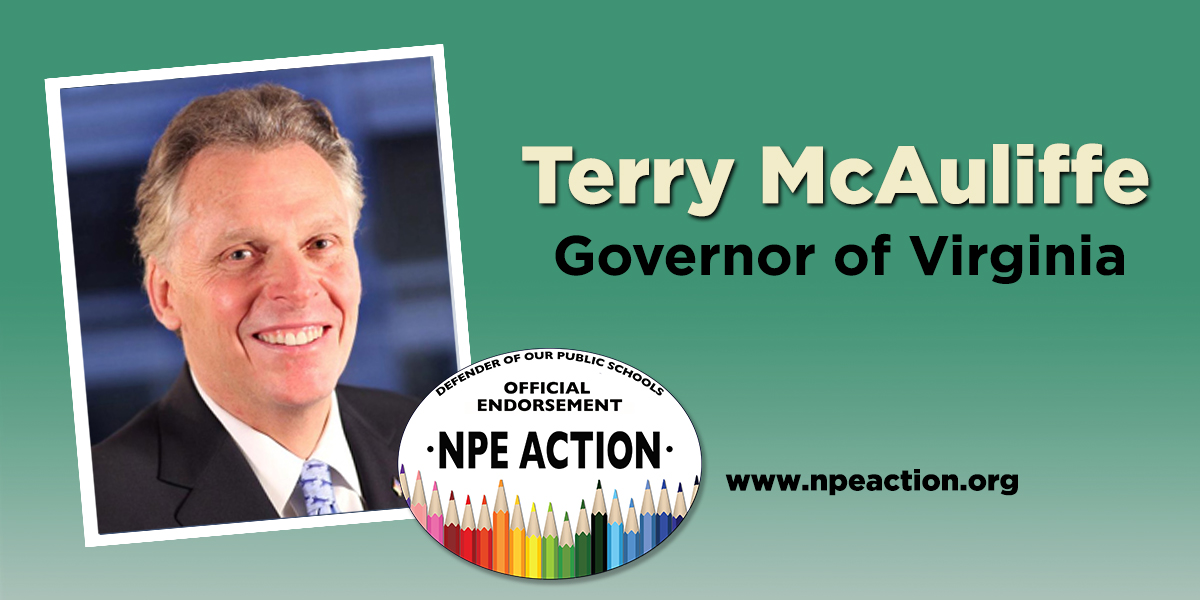
If you live in Virginia and care about your public schools, please vote for Terry McAuliffe for Governor!

The Network for Public Education Action has endorsed Terry McAuliffe for a second term as the Governor of Virginia.  

McAuliffe previously held the office from 2014-2018. In 2017, NPE Action named then Governor McAuliffe a Champion of Public Education for vetoing a group of bills that would have advanced privatization in Virginia. The bills he vetoed not only would have expanded charter schools and virtual schools, one would have established Education Savings Accounts (ESA), the worst of the  voucher programs. 


McAuliffe’s 2021 opponent, Republican Glen Youngkin, has proposed spending $100 million to increase the number of charter schools in the state.

McAuliffe’s opposition to school choice measures has remained unchanged.  His plan to improve public education in the state is to increase funding to $2 billion per year. He intends to use that funding to raise teacher pay above the national average for the first time in Virginia’s history and to expand access to pre-K for 3-4 year olds. In stark contrast to his opponent, who is creating unrest in the state by inflaming parents to rail against the supposed teaching of Critical Race Theory (CRT) in schools, McAuliffe has a plan to create an Equity Commission that will be charged with identifying the racial and socioeconomic gaps students face in the state.

We strongly encourage our supporters in Virginia to vote for Terry McAuliffe in the general election on Tuesday, November 2nd.  Please take a moment to share our endorsement in this critical election. https://npeaction.org/terry-mcauliffe-for-virginia-governor/

Mayor Bill De Blasio announced that the city would eliminate the entry test for the city’s “gifted and talented” programs, administered to four-year-olds. The children who make the cut are disproportionately white and Asian. He wants all children to have accelerated programs.

However, the Mayor has only a few months left in office, and his decision may be reversed by the new mayor, who will likely be Eric Adams, the Democratic candidate, a former police officer who has shown little interest in education, and who was funded by charter billionaires..

Instead of having a specific gifted program sorting a small number of children, all kindergarten students attending the city’s 800 elementary schools next September will receive “accelerated” instruction, city officials said Friday. Starting in third grade, all students will be screened to determine if they should continue to receive accelerated instruction in specific subjects.

“The era of judging 4-year-olds based on a single test is over,” Mayor Bill de Blasio said in a statement. “Every New York City child deserves to reach their full potential, and this new, equitable model gives them that chance.”

At least, that’s the mayor’s plan. It is an open question whether the changes will ultimately get implemented.

De Blasio has about three months left in his term and Democratic candidate Eric Adams is widely expected to replace him. Adams has offered a much different vision for the coveted gifted programs, proposing instead to keep the admissions test and add more gifted classrooms in communities across the city…

Currently, about 2,500 kindergartners a year score seats in 80 schools to the highly selective program, with many families — with and without means — spending time and money to prep their preschoolers for the exam. Many advocates and parents have blasted the test, which is administered one-on-one to children when they’re about 4, for resulting in a system that largely excludes Black and Latino students. They fill only 14% of gifted seats, but make up nearly 60% of kindergartners citywide.

Be sure to open the linked article by a teacher who has administered the test to four-year-olds.

Jeannie Kaplan, a former member of Denver’s elected school board, has warned for years about the subversion of Denver’s school election by well-funded, out-of-state “reformers.” Their money makes it difficult for ordinary citizens to run for the school board.

In this post, Jeannie reports that Dark Money is back and is prepared to fund candidates who support charter schools and other elements of the failed “reform” agenda. She has identified the groups that act as pass-throughs for Dark Money, she has tallied the total (to date) of $360,000, but it’s usually impossible to identify the original source of the money.