Archives for category: Education Reform

The following post was written by Jill Barshay and reposted by Larry Cuban on his blog. It is a response to the claim by various economists that teachers don’t improve after three to five years. This claim has been used to promote Teach for America, despite their inexperience and lack of substantive teacher education. It has also been used, as the previous post about North Carolina shows, to claim that teachers should not be paid based on their experience. It’s a pernicious idea, and I thank Larry Cuban for featuring this debunking of the conventional but wrong “wisdom.”

Jill Barshay writes:

The idea that teachers stop getting better after their first few years on the job has become widely accepted by both policymakers and the public. Philanthropist and former Microsoft CEO Bill Gates popularized the notion in a 2009 TED Talk when he said “once somebody has taught for three years, their teaching quality does not change thereafter.” He argued that teacher effectiveness should be measured and good teachers rewarded.

That teachers stop improving after three years was, perhaps, an overly simplistic exaggeration but it was based on sound research at the time. In a 2004 paper, economist Jonah Rockoff, now at Columbia Business School, tracked how teachers improved over their careers and noticed that teachers were getting better at their jobs by leaps and bounds at first, as measured by their ability to raise their students’ achievement test scores. But then, their effectiveness or productivity plateaued after three to 10 years on the job. For example, student achievement in their classrooms might increase by the same 50 points every year. The annual jump in their students’ test scores didn’t grow larger. Other researchers, including Stanford University’s Eric Hanushek, found the same.

But now, a new nonprofit organization that seeks to improve teaching, the Research Partnership for Professional Learning, says the conventional wisdom that veteran teachers stop getting better is one of several myths about teaching. The organization says that several groups of researchers have since found that teachers continue to improve, albeit at a slower rate, well into their mid careers.

“It’s not true that teachers stop improving,” said John Papay, an associate professor of education and economics at Brown University. “The science has evolved.”

Papay cited his own 2015 study with Matt Kraft, along with a 2017 study of middle school teachers in North Carolina and a 2011 study of elementary and middle school teachers. These analyses all found that teachers continue to improve beyond their first five years. Papay and Kraft calculated that teachers increased student performance by about half as much between their 5th and 15th year on the job as they did during the first five years of their career. The data are unclear after year 15.

Using test scores to measure teacher quality can be controversial. Papay also looked atother measures of how well teachers teach, such as ratings of their ability to ask probing questions, generate vibrant classroom discussions and handle students’ mistakes and confusion. Again, Papay found that more seasoned teachers were continuing to improve at their profession beyond the first five years of their career. Old dogs do appear to learn new tricks.

The debate over whether teachers get better with experience has had big implications. It has prompted the public to question union pay schedules. Why pay teachers more who’ve been on the job longer if they’re no better than a third-year teacher? It has encouraged school systems to fire “bad” teachers because ineffective teachers were thought to be unlikely to improve. It has also been a way of justifying high turnover in the field. If there’s no added value to veteran teachers, why bother to hang on to them, or invest more in them? Maybe it’s okay if thousands of teachers leave the profession every year if we can replace them with loads of new ones who learn the job fast.

So, how is it that highly regarded quantitative researchers could be coming to such different conclusions when they add up the numbers?

It turns out that it’s really complicated to calculate how much teachers improve every year. It’s simple enough to look up their students’ test scores and see how much they’ve gone up. But it’s unclear how much of the test score gain we can attribute to a teacher. Imagine a teacher who had a classroom of struggling students one year followed by a classroom of high achievers the next year. The bright, motivated students might learn more no matter who their teacher was; it would be misleading to say this teacher had improved.

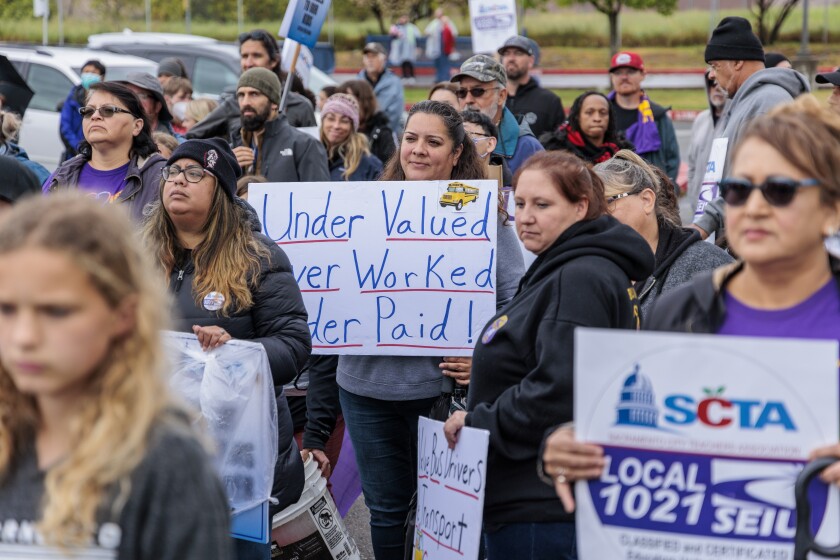
Sacramento City Unified School District teachers, school staff and supporters take part in a rally at Rosemont High School

Sacramento City Unified School District teachers, school staff and supporters take part in a rally at Rosemont High School on March 28 as they have been gone on strike due to the staffing crisis in the district . All SCUSD schools shut down and will remain closed for the duration of the strike.

I have read many articles about the shortage of teachers and school staff. I have read many that were laden with statistics. This is one of the best. It appeared in the Los Angeles Times.

BY ANITA CHABRIA COLUMNIST

A few weeks ago, Sacramento teacher Kacie Go had 56 kids for second period.

That day, there were 109 students at her eighth- through 12th-grade school who were without an instructor because of staff shortages. So she crammed the students into her room and made it work, but “it’s not sustainable,” she said.

No kidding.

Go told me the story standing with hundreds of other teachers and support staff Tuesday morning in the parking lot of an empty high school, as “We’re Not Gonna Take It” blared from speakers and the mostly female workers gathered for day five of a strike that has closed down schools in the Capitol City.

Like Go, these teachers, cafeteria workers, bus drivers and instructional aides are fed up with being asked to do more with less. It’s a problem that goes beyond the Sacramento City Unified School District, with 48,000 students in 81 schools. Frustration among teachers and school workers is rampant across California — pushed to a breaking point by the pandemic and a shortage of more than 11,000 credentialed teachers and thousands of support staff as the state tries to expand pre-kindergarten and bring 10,000 mental health counselors on campuses.

From school closure protests in Oakland to Sacramento’s all-in strike, those who work in our schools are telling us they cannot do this job under the conditions we are imposing. These include mediocre pay, sometimes vicious political blowback from COVID-19 safety measures, a witch-hunt-like scrutiny around hot-button topics, a mental health crisis, the reality of too few people doing the work, and the general disrespect of a society that swears it loves teachers and values education but does little to invest in it. Worrying about school shooters, once an urgent concern of educators and parents, doesn’t even make the top three problems anymore.

It’s the same story playing out in hundreds of other districts not just in California but across the country. Minneapolis teachers just ended a 14-day strike that shared some of the same issues of pay and support, underscored by the same teacher chagrin that we talk a good game about supporting public education but don’t always come through with actions. Minneapolis Federation of Teachers Chapter President Greta Callahan summed it up, sounding like she could be standing in Sacramento.

“We shouldn’t have had to [have] gone on strike to win any of these things, any of these critical supports for our students, but we did,” she said.

Go, who has been a teacher for 20 years and earned a master’s degree along the way — bringing her to the top of the district’s salary scale at just more than $100,000 a year — estimates she’s losing about $500 a day during the walkout.

But she’s more worried about support staff such as Katie Santora, a cafeteria worker who was also on the picket line.

Santora is the lead nutrition services worker at a high school, expected to churn out 1,500 meals a day between breakfast and lunch — with a staff of nine people (though they started the year with only five). Most are part-timers because the district doesn’t want to pay them benefits, and they make about minimum wage.

Santora, with 13 years at the district, makes $18.98 an hour for what is essentially a management role. She’s in charge of ordering, planning, receiving and keeping the joint running.

On the last day before the strike, that included making popcorn chicken bowls for lunch. What does that look like? Five 30-pound cases of chicken, oven-baked, 22 bags of potatoes, boiled and mashed, corn and gravy — all assembled after her staff finished making steak breakfast burritos and scrambled egg bowls. Did I mention every student is required to take a piece of fruit, which means washing somewhere along the lines of 1,700 apples?

Santora says high schoolers are the “most misunderstood” people on the planet, teetering between child and adult. Their well-being, she says, depends on being fed so “their bellies aren’t rumbling in class” and seeing a friendly face when they walk in her cafeteria. She loves delivering both.

“When they come through the line, I like to say, ‘Thank you for having lunch with me,’” she says.

But the money isn’t enough to pay her bills. Four or five nights a week, she gets about an hour at home before she heads to her second job loading grocery bags for delivery drivers at Whole Foods. She’s working two jobs just to pay for the privilege of doing the one she likes.

Go, the teacher, feels the hardships in other ways. One of her twin daughters recently had a “pretty severe concussion,” she said, but Go felt like she couldn’t stay home with her. If she did, one of her co-workers would likely be stuck with a jampacked classroom — and all the other unofficial jobs she has to do on a daily basis, from fill-in parent to police officer to relationship advisor when her teenage students’ hormones go into overdrive. Substitutes are hard to come by, she thinks, because the pay — $224 a day — isn’t competitive compared with other jobs with less stress.

“Subs don’t have an easy life,” Go said. “Why would you want to do that when you could go to In-N-Out and worry about if it’s animal-style or not for the same amount of money?”

The unions involved in the Sacramento strike contend that there are hundreds of open positions in the district in virtually every job. Nikki Milevsky, a school psychologist and vice president of the teachers union, puts it at 250 vacancies for teachers and 400 for classified staff — in a district with 2,069 teachers and 1,656 classified staff. That classified staff and teachers walked out together shows the depth of problems in Sacramento — it’s unusual for both to strike at the same time, and it has forced schools to shut down because there was no one left but administrators to watch kids.

Chris McCarthy, a first grade teacher in the Sacramento Unified School District, joined other teachers, parents, students and supporters, in the rain at a rally in support of their strike against the school district at Rosemont High School in Sacramento.

The teachers union says that 10,000 students lack a permanent instructor, and on some days, up to 3,000 don’t even have a substitute. About 547 kids who signed up for independent study haven’t been given a teacher yet, meaning they are learning nothing.

The district says it’s down 127 certificated staff and 293 classified positions. Take the difference as you will, but the district doesn’t dispute it’s in a staffing crisis.

Sacramento teachers want a pay raise to make the district more competitive in hiring. Right now, some surrounding districts pay more but have lesser benefit packages. (Please don’t make me tell you that healthcare is a right, not a privilege.) The teachers want the district to back off of a proposal to make current and retired teachers pay hundreds more to keep a non-HMO health plan. The district says it has made an offer of a pay increase and recruitment bonus and a one-year stipend to offset the health plan issue.

From there it turns contentious. Teachers reject the district’s offer as lowball and assert there is money available to do better, just not the will to invest it in staff. The district says the teachers need to compromise because it can’t afford all of their asks.

For days, there were no negotiations. State Supt. of Public Instruction Tony Thurmond tried to bring everyone to the table, only to be rebuffed by the district. Back home again instead of in the classroom, my eighth grader, a student in Sacramento schools, ate lots of chocolate chip pancakes and watched “Turning Red” on repeat.

There is no end in sight. Though negotiations with both unions have resumed, the shutdown is another blow to parents and families already anxious and stressed out. The last time my daughter had a normal school year, she was in fifth grade. So I understand the frustration, and even anger, of parents that schools are once again closed — and the resentment of parents across the state who are sick and tired of problems with schools, many of which predate the pandemic.

But I went to the strike line three times and I can tell you this — it’s not about the money for these teachers. You can roll your eyes at the unions all you want, but these teachers and support staff want their schools to work, for their students, for themselves, and for our collective future. Because democracy depends on an educated populace and education is a right. And because they are educators, and they’re invested in our kids.

Go doesn’t want to do anything else but teach, even if it means 56 kids sometimes. Even if it means losing $500 a day and striking. Even if it means making some people mad to make schools better.

“I freakin’ love it,” she said. “I do.”

With so many laws passed forbidding the teaching of “critical race theory,” Kevin Welner has come up with an ingenious solution. Teach the law itself! Kevin is a lawyer who teaches education policy at the University of Colorado in Boulder. He is also director of the National Education Policy Center. He means this as an April Fool’s joke, but like all satires, there is more than a kernel of truth here:

In high-school classrooms throughout Texas, Oklahoma, Idaho, and other states that have passed laws apparently intended to prohibit the teaching of Critical Race Theory (CRT), a new type of elective course is popping up. Students in the classes read the state legislation and explore its meaning and impact.

One such course offered in Houston, Texas is called, “Get to Know SB 3”, which is a reference to that state’s bill passed in late-2021. Courses in other states and school districts have a variety of names, but what holds them together is an attempt to help students gain a deep understanding of their state’s law and what it accomplishes.

Kim Bell, who teaches the SB 3 course at Ladson-Billings High School in Houston, explained that the course was originally proposed by the school’s students. “None of them had heard of CRT until a couple years ago, but then everyone started talking about it and, more recently, about the law we thought would stop us from teaching it. The students turned to us because they wanted to know more, but at first we told them we were afraid to answer their questions about CRT. We thought that maybe the law stops us from even talking with them about it, so instead we told them about the law.”

Not surprisingly, the students then wanted to know even more about SB 3. “The more we told them, the more questions they asked. So we created this course. It’s not specifically about CRT, but we explain the theory because of its relevance to the legislature’s debates and intentions.”

Among the provisions in the Texas law is a prohibition against “inculcat[ing]” in students, “with respect to their relationship to American values, [that] slavery and racism are anything other than deviations from, betrayals of, or failures to live up to the authentic founding principles of the United States, which include liberty and equality.” As Bell’s students learn, this provision is a push-back against the generally accepted view of historians and other scholars, including those who use a CRT lens, who point to the many ways in which racism has been institutionalized in American laws and society.

The students also read the arguments used by proponents of the state laws. Texas Senator Ted Cruz, for example, charged that CRT is “every bit as racist as a Klansmen in white sheets.” Rhode Island State Representative Patricia Morgan complained that she had lost a black friend to CRT – “I am sure I didn’t do anything to her, except be white.”

This teaching hasn’t gone unnoticed by proponents of laws. “Using things we say – that’s just sneaky and divisive!” protested Rep. Leon Alabaster.

The classes, however, are moving forward. “It seems like the legislature wanted SB 3 to stop us from teaching about the reality of structural racism. Fine. Most students reach that conclusion on their own,” said Bell. “If the legislature prohibited our science teachers from telling students that gravity is real, they’d still reach that conclusion after seeing the objective evidence.”

Bell and other teachers we spoke with pointed out that, by the end of the course, their students often observe that the laws designed to stop them from learning about institutionalized racism are themselves institutionalized racism. Also, these laws that are designed to stop students from learning about CRT have instead resulted in their learning about CRT.

Bell’s students even started a CRT club at the school. These students told us that it’s the CRT lens that really helps them understand the institutionalized racism underlying the anti-CRT laws.

“We’re thinking about creating another elective called, Using SB 3 to Explore Irony,” said Bell.

This year, for the first time since the federal Charter Schools program was established in 1994, the U.S. Department of Education is setting forth meaningful regulation of the program. This is a historic development and great news for those of us who have watched the charter industry escape accountability and transparency, while tolerating grift and profiteering.

As the Network for Public Education showed in two major reports (Asleep at the Wheel and Still Asleep at the Wheel), the federal charter program is riddled with waste, fraud, and abuse. Nearly 40% of the charter schools funded by this program either never opened or closed soon after opening. About $1 billion was wasted.

The Department has made a good faith effort to repair the negative aspects of the Charter School Program and to create regulations that would put guardrails in place for charter schools.

There are three key features to these regulations:

First, to qualify for federal funding, charters must develop an impact statement, describing the demographics that they will serve, whether there is a need for their proposed charter, whether the charter would intensify racial segregation in district schools, and how the charter would impact the local district schools.

Second, charters would have to demonstrate how they will serve the local community.

Third, charters operated by for-profit organizations would not be eligible for funding.

These are all significant reforms that have the potential to turn charters into good neighbors of public schools.

I urge you to write your own comment to support the Department’s bold effort to regulate the recipients of federal money for charters ($440 million). You can write 50 words in the comment or write a letter and attach it.

Please open this link to make a comment or send a letter:

https://www.federalregister.gov/documents/2022/03/14/2022-05463/proposed-priorities-requirements-definitions-and-selection-criteria-expanding-opportunity-through#open-comment

Please read the letter that Carol Burris wrote on behalf of the Network for Public Education, posted here.

Comments from The Network for Public Education Regarding Proposed Priorities, Requirements, Definitions, and Selection Criteria-Expanding Opportunity Through Quality Charter Schools Program (CSP)-Grants

Docket ID Number: ED-2022-OESE-0006

April 1, 2022

The Network for Public Education (NPE) writes in response to the invitation to submit comments regarding “Proposed Priorities, Requirements, Definitions, and Selection Criteria-Expanding Opportunity Through Quality Charter Schools Program (CSP)-Grants to State Entities (SE Grants); Grants to Charter Management Organizations for the Replication and Expansion of High-Quality Charter Schools (CMO Grants); and Grants to Charter School Developers for the Opening of New Charter Schools and for the Replication and Expansion of High-Quality Charter Schools (Developer Grants).

NPE is a national non-profit organization with 350,000 subscribers. We network with nearly 200 national, state, and local organizations all committed to the same mission—to preserve, strengthen and support our democratically governed public school system. For the past several years, we have been deeply concerned by what we view as endemic corruption and waste in the Federal Charter Schools Program.

The U.S. Department of Education (USED) must update its priorities and its requirements to address loopholes and flaws in the program that have resulted in for-profit run schools receiving grants, 12% of all CSP grants going to charter schools that never open, grants received by schools and charter management organizations that provide false and misleading information, and sub-grants issued to charter schools with a history of exacerbating racial segregation and that exclude, by policy or practice, students with disabilities and students who are English Language Learners.

The Award of CSP Grants Charter Schools Operated by For-Profit Organizations

We strongly support the Department’s attempt to ensure that charter schools operated by for-profit management corporations do not receive CSP grants, specifically this language:

(a) Each charter school receiving CSP funding must provide an assurance that it has not and will not enter into a contract with a for-profit management organization, including a non-profit management organization operated by or on behalf of a for-profit entity, under which the management organization exercises full or substantial administrative control over the charter school and, thereby, the CSP project.

The federal definition of a public school under IDEA and ESEA is “a nonprofit institutional day or residential school, including a public elementary charter school, that provides elementary education, as determined under State law.” 20 U. S.C. §§ 1401(6) (IDEA), 7801(18) (ESEA) Similarly, the statutes define a “secondary school” as “a nonprofit institutional day or residential school, including a public secondary charter school, that provides secondary education, as determined under State law․” 20 U.S.C. §§ 1401(27) (IDEA), 7801(38) (ESEA).

Former for-profit entities have created non-profit facades that allow the for-profit and its related organizations to run and profit from the charter school, following the judgment of the Ninth Circuit Court of Appeals in Arizona State Bd. For Charter Schools v. U.S. Dept. of Educ. in 2006 (464 F.3d 1003).

Ineffective provisions undermine the present regulations against the disbursement of funds from the federal Charter Schools Program (CSP) to charter schools operated by for-profit entities. We identified over 440 charter schools operated for profit that received grants totaling approximately $158 million between 2006 and 2017, including CSP grants to schools managed with for-profit sweeps contracts.

We offer as examples the recent CSP grants awarded to Torchlight Academy Charter School of North Carolina and Capital Collegiate Preparatory Academy of Ohio. We also bring your attention to the audit of a charter school run by National Heritage Academies in New York. The State Comptroller specifically chides the charter board for the fees taken by a for-profit that played the role of applying for and managing grants. National Heritage Academies schools have frequently received CSP grants and operate under sweeps contracts.

The relationship between a for-profit management organization is quite different from the relationship between a vendor who provides a single service. A school can sever a bus contract and still have a building, desks, curriculum, and teachers. However, in cases where charter schools have attempted to fire the for-profit operator, they find it impossible to do without destroying the schools in the process.

Recommendations:

Many for-profit organizations operate by steering business to their for-profit-related entities. They are often located at the same address, and the owner of the management company or a member of the immediate family is the owner of the related entity. Therefore, it is recommended that wherever references to for-profit organizations appear, the phrase “and its related entities” is added.

(a) Each charter school receiving CSP funding must provide an assurance that it has not and will not enter into a contract with a for-profit management organization, including a non-profit management organization operated by or on behalf of a for-profit entity, under which the management organization and its related entitiesexercise(s) full or substantial administrative control over the charter school and, thereby, the CSP project.

Quality Control of Awards and the Importance of Impact Analysis

We strongly support the proposed regulations that seek to bring greater transparency and better judgment to the process of awarding CSP grants. We especially support the inclusion of a community impact analysis.

We are pleased that “the community impact analysis must describe how the plan for the proposed charter school take into account the student demographics of the schools from which students are, or would be, drawn to attend the charter school,” and provide “evidence that demonstrates that the number of charter schools proposed to be opened, replicated, or expanded under the grant does not exceed the number of public schools needed to accommodate the demand in the community.”

More than one in four charter schools close by the end of year five. A foremost reason for both public school and charter closure and the disruption such closures bring to the lives of children is low enrollment, as seen this past month in Oakland. In New Orleans, school closures have resulted in children being forced to attend multiple schools during their elementary school years, often traveling long distances. Between 1999 and 2017, nearly one million children were displaced due to the closure of their schools, yet only nine states have significant caps to regulate charter growth.

We applaud language that states, “The community impact analysis must also describe the steps the charter school has taken or will take to ensure that the proposed charter school would not hamper, delay, or in any manner negatively affect any desegregation efforts in the public school districts from which students are, or would be, drawn or in which the charter school is or would be located, including efforts to comply with a court order, statutory obligation, or voluntary efforts to create and maintain desegregated public schools…”

In some states, charter schools have been magnets for white flight from integrated schools. Other charter schools have attracted high achieving students while discouraging students with special needs from attending. And, as you know from the letter you received in June of 2021 from 67 public education advocacy and civil rights groups, the North Carolina SE CSP sub-grants were awarded to charter schools that actively exacerbated segregation, serving in some cases, as white flight academies The information requested by the Department is reasonable and will help reviewers make sound decisions.

In addition to our support for the proposed regulations, we have two additional recommendations to strengthen the impact analysis proposal.

Recommendations: (1) That impact analysis requirements include a profile of the students with disabilities and English Language Learners in the community along with an assurance that the applicant will provide the full range of services that meet the needs of students with disabilities and English Language Learners. (2) That applicants include a signed affidavit provided by district or state education department officials attesting to the accuracy of the information provided.

Regarding proposed rules regarding transparency, we note that in the past, schools were awarded grants without providing even one letter of support, or provided false information indicating support that did not exist.

We also strongly support the requirement state entities provide additional supervision of grants. Some will argue that they do not receive sufficient funding to provide supervision. We believe that funding is more than sufficient and we offer the following example as evidence.

In 2020, the Pennsylvania Coalition of Public Charter Schools(PCPCS) received a SE grant of $30 million to open 18 new or expanded charters in the Commonwealth within five years. ESSA allows state entities to retain 10% of all grant funding with 3% dedicated for grant administration. That means that this small state entity would have access to $1 million dollars to supervise the CSP grant spending of eighteen schools. Given that it is a five-year grant, PCPCS would therefore be allowed to spend from CSP funding $200,000 a year to review applications and keep track of grant spending.

To date, three schools have been awarded grants according to the two co-directors hired to administer the program.

We strongly support all SE sub-grant review requirements. These include: (a) how peer reviewers will be recruited and selected, and (b) efforts the applicant must make to recruit peer reviewers from diverse backgrounds and underrepresented groups. We applaud the requirement for a review team. In some states, including New York, CSP sub-grants are routinely distributed as part of the charter authorization process.

To those proposals we suggest adding the following:

Recommendations: (1) That review teams must include at least one reviewer representative of the district public school community. (2) that a minimum point threshold be established for an award, (3) that applications be checked for factual accuracy, and (4) that applications be posted for public review and comment for a period of no less than 45 days before award decisions.

We also recommend that the Department retain funds from the Charter Schools Program to conduct audits of all Developer, CMO and SE subgrants to ensure the funds are being properly spent and that the conditions and aspirations as described in the applications are being met. Annual audits of 5% of all active awardees in each of the programs, randomly chosen by the Department should be conducted each year.

Priorities One and Two

We strongly support the proposed priorities, which we believe will help return the charter school movement back to its original purpose and benefit the children who attend charter schools. Priority one builds off the successful community schools’ movement. Priority two encourages cooperative activities between district and charter schools. We believe that these priorities should be absolute priorities.

Unfortunately, in many cases charter schools’ employee handbooks commonly require teachers to sign nondisclosure agreements that threaten legal action if they reveal the schools “trade secrets” including such things as “curriculum systems, instructional programs, curriculum solutions … new materials research, pending projects and proposals, proprietary production processes, research and development strategies, technological data, and technological prototypes.”

Recommendation

That the Department disallows grants or sub-grants to any schools that apply under priority two if the school or the CMO considers educational material confidential and proprietary and/or does not make publicly available financial, personal or contracting information.

Planning Grants to Unauthorized Charter Schools

According to a 2019 response to Representative Raul Grijalva by then-Secretary of Education Betsy DeVos, 12% of all CSP grants between 2001 and 2019 were awarded to schools that never opened and were not expected to open. In most cases, these schools had never achieved authorization. Whether unauthorized schools can receive funding for planning purposes and how much can be awarded has been left up to the states. This has resulted in large amounts of federal CSP money in the pockets of people who provided no service to the public.

It has also resulted in egregious abuse, especially in Michigan, where charter schools have received more than $100,000 in awards before their authorization was approved. An in-depth review of such planning grants by Michigan State Board of Education President Cassandra Ulbrich revealed questionable submissions, including invoices that would-be charter operators paid themselves and excessive technology purchases.

Recommendation: A school’s planning amount before an authorization is limited to $10,000. If justifiable expenses exceed that amount, they should only be compensated following authorization.

Proposed Selection Criterion for CMO Grants

ESSA places the following restriction on grants awarded to State Entities: No State entity may receive a grant under this section for use in a State in which a State entity is currently using a grant received under this section. However, ESSA is silent regarding the awarding of grants to CMOs. This has resulted in CMOs having several active grants at the same time, with new grants being issued without proper inspection of the efficacy of former grants. For example, it has resulted in the IDEA charter CMOreceiving six grants in a ten-year period totaling nearly $300 million. These grants occurred under a leadership structure that engaged in questionable practices, including the attempted yearly lease of a private jet, related-party transactions, and the rental of a luxury box at San Antonio Spurs games.

IDEA received two awards, in 2019 and 2020, totaling more than $188 million even as the 2019 audit of the Inspector General found that IDEA submitted incomplete and inaccurate reports on three prior grants. The IG report also looked at a randomly selected sample of expenses and found that IDEA’s charges to the grants did not always include only allowable and adequately documented non-personnel expenses.

Recommendations:

That department regulations disallow the awarding of grants to any CMO currently using a grant received under the CMO program and that for any grant exceeding $25 million, the Department’s OIG conducts an audit before an additional grant is awarded.

I don’t often ask the readers of this blog to do anything other than vote. I urge you to write the Department on behalf of these urgently needed reforms.

The deadline for comments is April 13, 2022.
Craig Harris of USA Today wrote a blockbuster three-part series about the charter schools that grabbed at least $1 billion in federal funds from the COVID Payroll Protection Program, passed in 2020 to help struggling small businesses stay alive and retain their employees. Today the second part was posted. Because charter schools are “technically small businesses,” about 1,000 of them applied for the forgivable loans. None of the charter schools lost revenue or laid off employees but they asked for the money anyway. Even the charter school lobbyist—the National Alliance for Public charter Schools—asked for a $680,000 loan, which was forgiven.

Harris writes in this second part about charters that knew it was wrong to ask for PPP funding when they had no need, and others did. (I can’t find the link: if any reader can, please add.)

He starts:

‘The ethical thing to do’: Why this small San Diego charter school passed on COVID PPP loans

Albert Einstein Academies, a small San Diego charter school chain, turned down a forgivable $3 million Paycheck Protection Program loan.

Story Highlights

  • Learn4Life, a charter chain, got a combined $32.7 million in PPP loans through 12 related firms.
  • California charter schools had six of the eight largest PPP loans in the U.S. among charters.
  • In Arizona, two prominent charter chains also turned down the money, saying they didn’t meet the requirements.

SAN DIEGO – The Albert Einstein Academies, which educate 1,450 students from kindergarten through eighth grade at two inner-city campuses here, could have used a forgivable loan from the federal Paycheck Protection Program.

Half of the middle school students and close to one-third of the elementary kids come from low-income homes and qualify for free or reduced-price lunches at the charter schools, its superintendent said.

But while the academies were eligible for up to $3 million in forgivable loans based on revenuesthat largely came from taxes, Superintendent David Sciarretta didn’t feel right about taking the money.

He said the loan program, started by Congress in March 2020 at the beginning of the pandemic, was intended to help financially struggling small businesses stay open and avoid laying off employees.

Charters are privately operated schools that are publicly funded.

We could have always used the money. But, growing up, my mom told me: ‘If there’s food on the table and there are other folks who are hungrier than you, then you need to let them eat because they have a greater need than you do.’

Sciarretta said Einstein, whose charter school campuses are minutes from downtown, didn’t suffer financially because California continued its pre-pandemic level of public school funding during the health crisis even if enrollment declined, giving some schools additional money.He said refraining from taking the loans was “the ethical thing to do.”

“We could have always used the money,” said Sciarretta, recently awarded the 2022 Hart Vision Award Winner for California Charter Leader of the Year. “But, growing up, my mom told me: ‘If there’s food on the table and there are other folks who are hungrier than you, then you need to let them eat because they have a greater need than you do.'”

Other schools took PPP loans

That wasn’t the view of at least 268 other California charter operators, who run some of the state’s largest and wealthiest publicly funded charter chains.

Those operators had at least $335 million forgiven, a USA TODAY investigation hasfound, the most of any state with charter schools. That’s about one-third of the $1 billion in loans obtained by more than 1,100 U.S. charter schools, which educate a fraction of the nation’s children and had the loans forgiven — even though most lost no money during the pandemic.

Several of those schools also employed more than 500 workers, the limit to qualify under the program, USA TODAY found.

Kathleen Hermsmeyer, superintendent of Springs Charter Schools in Temecula, said while California didn’t cut funding, it also did not increase it for charter schools like hers that specialize in at-home, remote or hybrid learning.

Those types of charter schools,which aren’t based in classrooms, experienced significant enrollment increases because of the need for distance learning during COVID,

She said her network added 1,000 students during the pandemic and needed its nearly $9.9 million loan —the largest of any charter operator in the country. The Small Business Administration, which is in charge of the PPP program that ended last May, forgave that loan on Dec. 1.

“It was exactly what PPP was designed for — to help us provide a great quality education for our children through the most difficult years ever,” Hermsmeyer said. “We kept our programs and services, and we did not cut salaries.”

The federal government promised to forgive the loans if the money was used to keep workers on the job and to pay for pandemic-related issues.

Researchers have found the SBA has forgiven most of the loans for all industries with little auditing done to see if the money was properly used. Meanwhile, up to three-fourths of the money went into the pockets of business owners, according to a recent study.

Which charter schools near you took federal PPP money?

Search USA TODAY’s database of more than 1,100 charter schools that had Paycheck Protection Program loans totalling more than $1 billion forgiven.

California, which in 1992 became the second state to allow charter schools, had more than 1,300 of the schools and seven all-charter districts at the beginning of this school year, according to the state’s department of education. That’s roughly 11.5% of the entire public school student population in California.

The state had six of the top eight forgiven loans for charter schools in America, all in excess of $5.5 million, records show.

California Congressman Judy Chu has been highly critical of the federal oversight, saying the agency and Treasury Department prioritized speed in getting money to businesses instead of scrutiny over who needed the cash.

Learn4Life gets most PPP loans

The largest block of forgiven loans, a combined $32.7 million, went to the same address in Lancaster, California, for 12 related nonprofit companiesthat are part of Learn4Life, a charter chain whose firms reported to the IRS that they employed a combined 4,567 workers during 2019.

The loans were obtained in April and May 2020, and forgiven throughout last year, federal records show.

The combined employment would be more than nine times the threshold for obtaining a PPP loan.

Learn4Life spokeswoman Ann Abajian said the organization had 1,685 employees among its companies.

She said the discrepancy occurred because the companies had previously counted seasonal and part-time employees in their staff totals and that information was disclosed to the federal government to have the loans forgiven.

Federal tax returns for the 2019-2020 fiscal year from those 12 nonprofits, which were signed by company executives, showed the higher staffing numbers.

For example, Learn4Life’s Antelope Valley Learning Academy Inc. reported employing1,302 staff, while Western Educational Corporation and Vista Real Public Charter employed 527 and 668 people, respectively.

“Each entity — as a separate charter nonprofit, with less than 500 employees and its own independent governing board — applied with accuracy and transparency, met the criteria, and was awarded the loans and later forgiven. Proper documentation with supplemental justification and backup was presented to SBA,” Abajian said.

The chain said it used the loans to purchase and distribute 20,000 laptops and 15,000 hotspots, baby supplies for hundreds of parenting students as well as an online curriculum. In addition, the organization said its technology support desk hired more staff.

Eric Cross (middle) teaches seventh-grade science at Einstein Middle School in San Diego. The school was eligible for a federal Paycheck Protection Program loan, but school officials turned it down because the state of California did not cut any funding to public schools.CRAIG HARRIS

Other businesses, such as Shake Shack, also counted separate locations to qualify for a PPP loan. That publicly traded company with more than 7,000 employees and 205 restaurants in the U.S., was one of the first to get a PPP loan. However, Shake Shack returned its $10 million loan following public scrutiny.

In Arizona, prominent, successful chains Basis Charter Schools Inc. and Great Hearts Academies said they didn’t seek the loans even though their individual campuses employed fewer than 500 workers. Basis and Great Heart officials said they read the SBA rules as requiring all employees within an organization to be counted and both were too big.

Meanwhile, other California schools that had jumbo loans forgiven included Granada Hills Charter in Granada Hills ($8.5 million), Antelope Valley Learning Academy in Lancaster ($7.9 million), Summit Public Schools in Redwood City ($6.9 million), Western Educational Corporation in Lancaster ($6.2 million) and Magnolia Educational & Research Foundation in Los Angeles ($5.5 million).

John Thompson, historian and retired teacher in Oklahoma, writes about the legislators who are offering bills to undermine public schools, control their curriculum, even meddle with the school lunch program. Their goal is clear: the demoralization of teachers and the destruction of public schools.

Thompson writes:

Why are some Republican legislators in Oklahoma trying to “strip” school lunch programs from the State Department of Education and move them to the Agriculture Department?

The Tulsa World reports:

“The House author told us that some in the Legislature feel too much focus was put on making sure kids were fed during the pandemic and not on educating kids,” said Carolyn Thompson, chief of government affairs and deputy chief of staff at the Oklahoma State Department of Education (SDE).

The author of HB 3432, Rep. Dell Kerbs, claims he wants “to take something off of education’s plate and hopefully move more schools away from ‘heat and serve’ meal options.” But education leaders have said that that is “ridiculous,” and “a solution in search of a problem.” In fact:

The legislation would create duplication within the state’s overall bureaucracy, because their department must still obtain child nutrition data for a host of purposes including calculating state aid funding, school accountability and accreditation, and the federal E-Rate Program that provides schools with discounted telecommunications services.

This new bill should be considered in the light of numerous other anti-education bills filed this session. As The Frontier explained, they are often pushed by national conservative organizations, sometimes using “word-for-word language copied from model legislation.”

For instance, SB 1508, “would require school districts to submit to the State Department of Education detailed expenditure reports on diversity, inclusion and social justice training for teachers and administrators.” HB 3432 also brings to mind bills by Sen. Shane Jett that “would outlaw teaching of social-emotional learning in schools;” “require higher education institutions to post their budget for student and teacher diversity curriculum online;” and “ban voluntary surveys in schools from asking questions about sexuality or gender and would ban school libraries and curriculum from including books that deal with sexuality or gender.”

To understand the purpose of these restrictions, they must also be considered in the context of bills filed by Standridge that “would require teaching ‘patriotic education’” about Oklahoma history; or “impose civil penalties of at least $10,000 on school personnel who teach lessons related to critical race theory [and] require the employee to be fired and blacklisted from educational employment for at least five years.”

Similarly, these bills’ common purpose must also be understood within the context of Sen. Nathan Dahm’s attempt to “require social studies classes to teach at least 45 minutes every Nov. 7 on “Victims of Communism Day;” to “require schools to distribute historical Thanksgiving day proclamations, all of which list the importance and role of Christian faith;” to “add reading requirements for high schoolers that contain some theological themes;” and “require the Oklahoma State Department of Education to contract for curriculum for a four-year pilot project for 11th graders on U.S. history that “narrowly tailors the subject areas to align with free high school curriculum courses from Hillsdale College.”

And, of course these mandates must be seen within the context of successful and unsuccessful bills prohibiting school boards from issuing mask mandates; requiring an “opt in” system for teachers union membership, even though that is already the law; and at a “cost over $116 million” providing “state dollars to students to spend on private school tuition and other education expenses instead of attending a public school.”

To fully understand these vituperative assaults on schools, we must also consider the New York Times’ coverage of the Enid, Ok. school board battles, which concluded: From lockdowns to masks to vaccines to school curriculums, the conflicts in America keep growing and morphing, even without Donald Trump, the leader who thrived on encouraging them, in the White House.

But the fights are not simply about masks or schools or vaccines. They are, in many ways, all connected as part of a deeper rupture — one that is now about the most fundamental questions a society can ask itself: What does it mean to be an American? Who is in charge? And whose version of the country will prevail?

The Times also explained that Enid is in a county which “experienced one of the largest increases in racial diversity in the country over the past decade.” Since 1980, it dropped from 94 percent white to about 68 percent.

And this brings us back to the two, somewhat separate but intertwined agendas that drive these education bills. The corporate establishment and the leaders of the Trump wing of the Republican Party see both political threats and opportunities in demographic change. In the short-run, in order to keep their majority, they must use gerrymandering (such as moving one of the most progressive areas in Oklahoma City into the Panhandle’s congressional seat hundreds of miles away) and reverse trends that expanded the opportunities to vote. But these demographic changes give them better chances for winning in 2022 and 2024 by stoking the fears of Oklahomans who see themselves as being replaced by immigrants, other people of color, and new generations of progressives.

All of these education bills, primarily, are fact-free, fear-based campaigns to win elections at any costs. Being a Baby Boomer who saw the damage done to schools by McCarthyism, and how it persisted into my K-12 education and even into my teaching career, I worry about the long-term effects of these scorched earth campaign tactics.

The second, overarching theme is privatization. Whether it is Gov. Stitt’s undermining of public health institutions as we entered the Covid crisis, privatizing Medicaid, or disempowering the Pardon and Parole Board by preventing them from considering evidence of innocence in their deliberations, or wrecking public education, they want to dismantle governmental institutions.

Whether all of the legislators who support these bills understand it or not, the real goal is kicking vulnerable school systems that are exhausted by the Covid crisis while they are down. Then, rightwingers can ramp up their efforts to fund their cronies, while claiming that the Free Market will find replacements for what they call a rotten, socialist system that doesn’t respect their political base.

Finally, as I was about to submit this post, the New Yorker arrived, featuring Jill Lepore’s The Parent Trap. Lepore also describes the efforts of many Republicans as “whipping up a frenzy about parents’ rights” to win the mid-term and, perhaps the presidential elections. But she then goes back a century to the Scopes Trial, which also followed a global pandemic; explains the racist roots of the anti-evolution campaigns; and the Scopes aftermath, with “’purging’” libraries and “’hounding’” teachers.

Now, the campaign includes the “highhandedness, moral crusading, and snobbery” of today’s corporate reformers’ school choice movement. Lepore concludes, “It’s still going on today.” Some activist parents seem to “want to destroy public education.” So, everyone should read how this isn’t just a brutal fight in Oklahoma Red State politics, but “another long game, a hundred years war: the campaign against public education.”

Jill Lepore is a historian at Harvard University and a writer for The New Yorker. In this recent article, she reviews a history of attacks on one of our nation’s most important democratic institutions: our public schools. To read the complete article, subscribe to The New Yorker. It is a wonderful magazine.

She begins:

In 1925, Lela V. Scopes, twenty-eight, was turned down for a job teaching mathematics at a high school in Paducah, Kentucky, her home town. She had taught in the Paducah schools before going to Lexington to finish college at the University of Kentucky. But that summer her younger brother, John T. Scopes, was set to be tried for the crime of teaching evolution in a high-school biology class in Dayton, Tennessee, in violation of state law, and Lela Scopes had refused to denounce either her kin or Charles Darwin. It didn’t matter that evolution doesn’t ordinarily come up in an algebra class. And it didn’t matter that Kentucky’s own anti-evolution law had been defeated. “Miss Scopes loses her post because she is in sympathy with her brother’s stand,” the Times reported.

In the nineteen-twenties, legislatures in twenty states, most of them in the South, considered thirty-seven anti-evolution measures. Kentucky’s bill, proposed in 1922, had been the first. It banned teaching, or countenancing the teaching of, “Darwinism, atheism, agnosticism, or the theory of evolution in so far as it pertains to the origin of man.” The bill failed to pass the House by a single vote. Tennessee’s law, passed in 1925, made it a crime for teachers in publicly funded schools “to teach any theory that denies the story of the Divine Creation of man as taught in the Bible, and to teach instead that man has descended from a lower order of animals.” Scopes challenged the law deliberately, as part of an effort by the A.C.L.U. to bring a test case to court. His trial, billed as the trial of the century, was the first to be broadcast live on the radio. It went out across the country, to a nation, rapt.

A century later, the battle over public education that afflicted the nineteen-twenties has started up again, this time over the teaching of American history. Since 2020, with the murder of George Floyd and the advance of the Black Lives Matter movement, seventeen states have made efforts to expand the teaching of one sort of history, sometimes called anti-racist history, while thirty-six states have made efforts to restrict that very same kind of instruction. In 2020, Connecticut became the first state to require African American and Latino American history. Last year, Maine passed “An Act to Integrate African American Studies into American History Education,” and Illinois added a requirement mandating a unit on Asian American history.

On the blackboard on the other side of the classroom are scrawled what might be called anti-anti-racism measures. Some ban the Times’ 1619 Project, or ethnic studies, or training in diversity, inclusion, and belonging, or the bugbear known as critical race theory. Most, like a bill recently introduced in West Virginia, prohibit “race or sex stereotyping,” “race or sex scapegoating,” and the teaching of “divisive concepts”—for instance, the idea that “the United States is fundamentally racist or sexist,” or that “an individual, by virtue of his or her race or sex, is inherently racist, sexist or oppressive, whether consciously or unconsciously.”

While all this has been happening, I’ve been working on a U.S.-history textbook, so it’s been weird to watch lawmakers try their hands at writing American history, and horrible to see what the ferment is doing to public-school teachers. In Virginia, Governor Glenn Youngkin set up an e-mail tip line “for parents to send us any instances where they feel that their fundamental rights are being violated . . . or where there are inherently divisive practices in their schools.” There and elsewhere, parents are harassing school boards and reporting on teachers, at a time when teachers, who earn too little and are asked to do too much, are already exhausted by battles over remote instruction and mask and vaccine mandates and, not least, by witnessing, without being able to repair, the damage the pandemic has inflicted on their students. Kids carry the burdens of loss, uncertainty, and shaken faith on their narrow shoulders, tucked inside their backpacks. Now, with schools open and masks coming off, teachers are left trying to figure out not only how to care for them but also what to teach, and how to teach it, without losing their jobs owing to complaints filed by parents.

There’s a rock, and a hard place, and then there’s a classroom. Consider the dilemma of teachers in New Mexico. In January, the month before the state’s Public Education Department finalized a new social-studies curriculum that includes a unit on inequality and justice in which students are asked to “explore inequity throughout the history of the United States and its connection to conflict that arises today,” Republican lawmakers proposed a ban on teaching “the idea that social problems are created by racist or patriarchal societal structures and systems.” The law, if passed, would make the state’s own curriculum a crime.

Evolution is a theory of change. But in February—a hundred years, nearly to the day, after the Kentucky legislature debated the nation’s first anti-evolution bill—Republicans in Kentucky introduced a bill that mandates the teaching of twenty-four historical documents, beginning with the 1620 Mayflower Compact and ending with Ronald Reagan’s 1964 speech “A Time for Choosing.” My own account of American history ends with the 2020 insurrection at the Capitol, and “The Hill We Climb,” the poem that Amanda Gorman recited at the 2021 Inauguration. “Let the globe, if nothing else, say this is true: / That even as we grieved, we grew.”

Did we, though? In the nineteen-twenties, the curriculum in question was biology; in the twenty-twenties, it’s history. Both conflicts followed a global pandemic and fights over public education that pitted the rights of parents against the power of the state. It’s not clear who’ll win this time. It’s not even clear who won last time. But the distinction between these two moments is less than it seems: what was once contested as a matter of biology—can people change?—has come to be contested as a matter of history. Still, this fight isn’t really about history. It’s about political power. Conservatives believe they can win midterm elections, and maybe even the Presidency, by whipping up a frenzy about “parents’ rights,” and many are also in it for another long game, a hundred years’ war: the campaign against public education.

Please subscribe and finish reading.

Rodney Pierce is a seventh-grade teacher in North Carolina. He writes here on the Public Voices, Public Schools site sponsored by the Network for Public Education.

He writes:

“These are all our children. We will profit by, or pay for, whatever they become.”

Though made over 30 years ago by African American writer and social critic James Baldwin, this statement still emphasizes the choice that sits before us as a nation.

The choice of whether or not we make the investment in our public schools to the benefit of our students.

While that investment can be presented as one of physical capital, i.e., real estate, equipment, inventory, etc., the more significant expenditure is that of human capital, which is namely teachers.

From student performance and achievement, their social and emotional well-being, or the development of non-cognitive skills, a wealth of research shows the impact of teachers on student outcomes.

And if, like Baldwin, we believe these are “all our children,” we should be deeply concerned about the status of Black boys.

Looking at my state of North Carolina, Black male students in 2019 ranked last or near the bottom in Reading and Mathematics scores among 4th, 8th and 12th graders (NAEP). They made up the lowest percentage of students identified as Academically and Intellectually Gifted (AIG) despite making up a higher percentage of male students overall (13 percent) than American Indian, Hispanic and Asian males combined. Black males had the highest rate of short-term and long-term suspensions, the fourth highest dropout rate and were placed more frequently in ALP (Alternative Learning Programs) than any other student groups. Black students as a whole are much more likely than their White counterparts to be arrested as they made up 49 percent of juvenile complaints at school.

These dismal educational scenarios lead to even more somber results in their lives, as Black males in North Carolina have one of the highest unemployment rates, one of the lowest life expectancies and the highest incarceration rate (49 percent of all state inmates as of December 2021).

Despite these grim statistics, the plight of Black male P-12 students can be alleviated by making the aforementioned investment in the recruitment AND retention of Black male teachers.

Research indicates Black male students having Black male teachers leads to lower dropout rates, fewer disciplinary issues, more positive views of schooling, better test scores and increased college aspirations. Our very presence undermines Black male stereotypes and we are more likely to be familiar with the cultural needs of our Black male students, as we were once these students ourselves. These students identify with us, and are able to see themselves working later in life as educated professionals. Black students taught by Black teachers are three times more likely to be assigned to AIG services than those taught by non-Black teachers and are more likely to take AP (Advanced Placement) courses taught by Black teachers.

Students of all races benefit in that they not only have lower likelihoods of discipline when taught by a Black male teacher, but the social and emotional impact of our presence lessens the possibility of those students developing implicit bias as adults. Simply put, seeing Black men in positions of authority helps all students develop dispositions for not only civic life but the  workforce. In several models controlling for student, teacher and school conditions, researchers have continuously found students expressed more favorable perceptions of Black male teachers than non-Black ones.

But there’s an impediment to these benefits of having Black men in P-12 classrooms.

In North Carolina, Black male teachers made up only 3% of teachers in 2017-18. We make up only 2% nationwide.

How do we solve this?

By making that investment.

The model is already available from groups and organizations like Call Me MISTER (South Carolina), the He Is Me Institute, Profound Gentlemen (Charlotte, NC), the BOND Project, the Center for Black Educator Development, the Boston Public Schools Male Educators of Color Program, etc.

If you want to recruit, develop, retain and ultimately, empower Black male teachers, you need to listen to the Black men who run these entities. Unfortunately, our country doesn’t have the best track record when it comes to that.

But if we don’t make the investment now, we will be making the investment later when it comes to Black male outlooks in unemployment, incarceration and health (life expectancies).

“These are all our children. We will profit by, or pay for, whatever they become.” Let’s ensure that we profit.


Rodney D. Pierce is a seventh-year middle school Social Studies teacher in eastern North Carolina. He was the 2019 North Carolina Council for the Social Studies Teacher of the Year and the inaugural Teacher Fellow for the NC Equity Fellowship through the Center for Racial Equity in Education (CREED). He is a Fellow of Carolina Public Humanities, the UNC-Chapel Hill Southern Oral History Program, and the NC Public School Forum’s Education Policy Fellowship.

Pierce has appeared on MSNBC’s The Reidout and the Tamron Hall Show on ABC to speak about the teaching of American history in public schools. An avid historian, his research on re-segregation in his native Halifax County was featured in the Washington Post. 

He serves on the Governor’s Teacher Advisory Committee. 

Jan Resseger reviewed the federal education budget for next year and found it disappointing. Although schools received large grants to get them through the COVID crisis, the other big budget promises evaporated. With private school choice programs draining money away from the public schools that educate the vast majority of our children, this is bad news indeed. The scandal-scarred federal Charter Schools Program was once again funded at $440 million, after being heavily lobbied by the charter school lobby. This means that the federal Department of Education is the biggest funder in the nation of charter schools, which also are supported by a plethora of billionaires like Gates, Waltons, DeVos, Koch, Bloomberg, and more. The Network for Public Education published two in-depth studies of the federal Charter Schools Program (see here and here), which showed that nearly 40% of the schools funded by the program either closed soon after opening or never opened at all, wasting more than $1 billion. But charter school friends like Senator Booker of New Jersey and Senator Bennett of Colorado fought to keep the money flowing. The Senate also removed a provision banning the funding of for-profit charter corporations. So, despite President Biden’s promise to get rid of for-profit charters, they will continue to feed at the public trough.

Last spring, in his first proposed federal budget for the Department of Education, President Biden tried to begin fulfilling campaign promises that defined his commitment to alleviating educational inequity.  He proposed an astounding $443 million investment in full-service, wraparound Community Schools, far above the previous year’s investment of $30 million; $36.5 billion for Title I, the Education Department’s largest program for schools serving concentrations of children in poverty; $15.5 billion for the Individuals with Disabilities Education Act; $1 billion to help schools hire counselors, nurses, and mental health professionals; and a new $100 million grant program to support diversity in public schools.

But last Thursday night, in order to prevent a federal government shutdown, Biden signeda federal budget whose whose investments in primary and secondary public education are far below what he had hoped for.

Chalkbeat’s Matt Barnum reports: “Biden hoped to reshape school funding. A new budget deal shows that’s not likely anytime soon…  While campaigning for president, Joe Biden vowed to triple funding for Title I.  Last year, Biden aimed to get much of the way there by proposing to more than double the program, which sends extra money to high-poverty schools. Now, it looks like schools will have to settle for far less… A bipartisan budget package… increases Title I by just… $1 billion, and includes a smaller-than-requested boost for funding to support students with disabilities…. In total, the K-12 portion of Department of Education spending would increase by about 5%.”

On the positive side, Biden and Congress have been able to increase the Department of Education’s largest and key programs, while under President Trump, Congress only increased funding slightly for K-12 education while fighting to prevent cuts proposed by Trump and his education secretary, Betsy DeVos.

Writing for FutureEd, Phyllis W. Jordan itemizes the education budget allocations Congress passed last week:

  • Title I — $17.5 billion
  • IDEA Grants — $13.3 billion
  • Educator Professional Development and Support — $2.2 billion
  • School Safety and Student Health — $1.2 billion
  • Mental Health Professionals in Schools — $111 million
  • School-Based Mental Health Services Grants — $56 million
  • Demonstration Grants — $55 million
  • Social-Emotional Learning — $82 million
  • Full Service Community Schools — $75 million

One of the biggest disappointments for educators and many families is Congressional failure to fulfill the President’s attempt significantly to expand the federal investment in Full-Service Community Schools.  These are the schools with wraparound medical and social services located right at school for students and families. Community Schools also often provide enriched after school and summer programs.  President Biden had proposed to expand the federal investment in these programs from the Trump era amount of $30 million to $430 million annually.  In the end, Congress budgeted $75 million for this program, an increase but not what advocates had hoped would expand this proven strategy for assisting struggling families and children in an era when over 10 percent of New York City’s public school students are homeless.

Please open the link and keep reading.

Kathryn Joyce, an investigative reporter for Salon, has written a three-part series for Salon about Hillsdale College, the ultra-conservative Christian college that has entered the charter industry. This is first in the series. Hillsdale was originally founded to preserve the classical tradition in education, but it evolved into a far-right incubator of ideas and officials for the Trump administration.

Governor Bill Lee of Tennessee has already made a deal with Hillsdale to launch 50 Christian-themed charter schools in his state. The fact that this usurps local control of schools in Tennessee doesn’t bother the governor because the state will supply a politically sanitized, Christian school at public expense.

Hillsdale leaders, Joyce explains, were deeply involved in Trump’s so-called “1776 Commission,” which was supposed to be a call for “patriotic education” as a counter to “The 1619 Project.” The college “has quietly become one of the most influential entities in conservative politics.”

Joyce describes in detail a Hillsdale charter school in Orange County led by a powerful ultra-conservative couple: the wife is president of the Orange County Board of Education and the husband is a physician who opposes COVID vaccines and any effort to combat climate change.

Joyce writes:

In an era of book bans, crusades against teaching about racism, and ever-widening proposals to punish teachers and librarians, Hillsdale is not just a central player, but a ready-made solution for conservatives who seek to reclaim an educational system they believe was ceded decades ago to liberal interests. The college has become a leading force in promoting a conservative and overtly Christian reading of American history and the U.S. Constitution. It opposes progressive education reforms in general and contemporary scholarship on inequality in particular. It has featured lectures describing the Jan. 6 insurrection as a hoax and Vladimir Putin as a “hero to populist conservatives around the world.” [Diane’s note: They got that right!]

If you thought that Donald Trump’s 1776 Commission — a jingoistic alternative to the New York Times’ “1619 Project” that was roundly panned by historians — died with his presidency, that effort is now being amplified and exported, on a massive scale, around the country. If you wonder what conservatives hope to install in place of the books they’re trying to ban, the answer often lies in Hillsdale’s freely-licensed curricula.

And as Republicans move into a new phase of their long-game efforts to privatize public education, Hillsdale has become a key resource. Across the nation, conservative officials from state leaders to insurgent school board members are clamoring to implement Hillsdale’s proudly anti-woke lesson plans, including the “patriotic education” premises of its recently released 1776 Curriculum, or add to its growing network of affiliated classical charter schools. 

Please finish reading this excellent and alarming article by opening the link.