Archives for category: Education Reform

As the ultra-conservative Supreme Court nears a decision that may erode or reverse Roe v. Wade, the landmark 1973 decision that allowed abortion until fetal viability (23 weeks), Red states are moving swiftly to enact ever more punitive laws to punish women who get an abortion, as well as doctors or nurses who provide them.

Some thought that abortion pills that are easily available on the Internet would provide access to abortion for women in Red states that had banned it. But according to a recent article in the New York Times, 19 states have adopted new laws barring the use of abortion pills obtained by mail, and another 9 are considering similar legislation.

States such as Missouri are attempting to reach beyond their borders to stop their residents from going elsewhere to get an abortion, by pill or by surgery. Connecticut and California, meanwhile, are rushing to protect their citizens who might be penalized for helping women in restrictive states obtain the medication. One pill manufacturer has sued to stop a Mississippi law that requires the pills to be picked up and swallowed in a doctor’s office.

In Texas, S.B. 8, which bans abortion after about six weeks, requires civilian enforcement, incentivizing citizens with bounties of at least $10,000 to sue anyone who helps a woman get an abortion. S.B. 4, the subsequent law against medication abortion, establishes a criminal violation for delivering the pills, making it a state felony punishable by $10,000 and up to two years in prison. A bill in Iowa would ban the distribution of the pills entirely, with punishments of $10,000 and up to 10 years in prison.

The Lancet, a medical publication that is considered reliable and reputable, recently reported that abortions done by mail-order pills are safe and effective.

Only days ago, Oklahoma enacted an almost total ban on abortions, with the sole exception of saving the pregnant woman’s life. A rapist faces a possible prison term of up to five years, but if the woman he raped tries to get an abortion, she may be jailed for up to ten years. What is the logic behind the disparate treatment?

The bill, Senate Bill 612, would make performing an abortion or attempting to perform the procedure a felony punishable by a maximum fine of $100,000 or maximum 10 years in state prison, or both. 

The legislation, which first passed the state Senate last year, passed the state Republican-led House on Tuesday by 70-14, without debate or questions on the floor. The legislation now heads to Republican Gov. Kevin Stitt, who previously promised to sign every bill limiting abortion that came across his desk.

Such a law would have been unthinkable before Donald Trump appointed three ultraconservative justices and Senator Mitch McConnell rushed through their confirmations.

Women in Red states who are affluent will find a way to get an abortion, by traveling to another state where it is legal (although some states are trying to criminalize that too). Women who are poor, most of whom are people of color, will have more babies. Ironically, this will hasten the changing demographics in Red states.

My personal view of abortion is that it is a decision to be made between a woman and her doctor. My views should not compel anyone else to do what I believe. Women who are opposed to abortion should not have one. Women who, for whatever reason, want an abortion should have access to abortion services that are safe and legal.

Javier Montańez has been acting superintendent of the Providence public schools all year, while State Superintendent Angelica Infante-Green searched and searched and finally decided to make him the real superintendent of the troubled school district.

Providence finally has a chance to have genuine experienced leadership at the helm, if Infante-Green allows him to run the district, writes Boston Globe columnist Dan MacGowan.

Providence has been under state control for two years, with nothing happening, in part due to the COVID.

But let’s face it, the maximum leader Infante-Green has less experience than the new superintendent. She was a TFA teacher for two years, then moved into the New York State Education Department bureaucracy. She has never been a principal or a superintendent. Montańez has been both.

Kids don’t look up to superintendents the way they do to sports stars like LeBron James or Steph Curry, but Montañez is a true role model. As a teenager, Montañez was homeless and sleeping under a tree in Roger Williams Park, and now he’s running a district filled with thousands of students facing similar obstacles to those he overcame in his life.

Teachers don’t usually look up to superintendents, either. But in Montañez, they’ve got someone who truly understands what they’re going through. He has both taught and been a principal in Providence, so he has the ability to connect with the city’s 2,000 educators in a way no school chief has in many years.

Now comes the hard part.

Montañez has a life’s worth of credibility and a career’s worth of goodwill to be the transformational figure that Providence schools desperately need, especially when we’re more than two years into a state takeover that hasn’t produced any significant results up to this point...

For the past year, he’s been the ideal cheerleader for the district while also proving that he can run the operations of a large school system. He has excelled at both. He’s in his element when he’s talking to students about their future or joking around with them in the hallways, and he’s proven that he can make sure the buses run fine, the buildings aren’t in complete disarray, and the students are safe.

His challenge now is to begin articulating and then executing a vision for getting Providence schools to a place where the majority of kids are proficient in math and English. It’s a tall task. As it stands now, only 6.8 percent of students in Grades 3 through 8 were proficient in math and 14.1 percent were proficient in reading.

Is it worth mentioning at this point that “proficient” is not the right benchmark? “Proficient” does not mean “grade level” or “above grade level” or “passing.” It means “excelling.” I am not sure what percent of Providence students should be excellent, but editorialists should use “basic” as “grade level,” not “proficient.”

The biggest problem the new superintendent will have is that the Governor and the State Superintendent are used to micromanaging the district, and neither of them has the experience that the superintendent has. Also, they are both big fans of privatization, and he will have to protect the public schools.

He will have to use his credibility to insist on his leadership.

The nonprofit, nonpartisan group “In the Public Interest” explains the need to regulate the $440 million federal Charter Schools Program, which is awash in waste, fraud, and abuse.

Did you know that the federal government spends $440 million every year to help start privately run charter schools?

Did you know that some of that money ends up in the hands of people who never actually open schools or open them and quickly close them? And that some goes to charter schools run by for-profit organizations in communities that do not want them.

Some even goes to charter schools with a history of worsening racial segregation and others that exclude, by policy or practice, students with disabilities and students who are English Language Learners.

That’s why it’s a big deal that Department of Education just proposed new rules to reform its funding program.

And why YOU, as an individual and/or an organization, need to send a comment in support of the department’s proposed changes.

Please open this link and comment or attach a letter (the deadline is April 13).

Make sure you write that you support the proposed changes. Try to personalize it as much as you can. Talk about how charter schools are impacting your school district or how they might if they started opening and taking away public school dollars. (Here’s a post from education historian Diane Ravitch with more on what to write.)

If you’re short on time, just say who you are and that you support the changes.

Here are the most important proposed reforms:

  • A proposed charter school would need to divulge how it will impact the local school district, including finances, demographics, and educational needs.
  • A proposed charter school would need to demonstrate how it would serve the local community.
  • Charter schools operated by for-profit organizations would no longer be eligible for funding.

The charter school industry is fighting the new regulations with all they’ve got. Opinion pieces are echoing across right-wing media.

Let the Department of Education know they are supported. Comment before April 13. It will only take a few minutes.

If you need help writing a comment, don’t hesitate to email us.

Keep in touch,

Jeremy Mohler
Communications Director
In the Public Interest

P.S. We have a new website!!!

Tom Ultican, chronicler of the Destroy Public Education movement and retired teacher of physics and advanced mathematics, investigated a strange occurrence in the District of Columbia: Two respected, experienced black educators were fired for refusing to adopt the practices of the so-called Relay “Graduate School” of Education. Relay is not a real graduate school. It has no campus, no research, no graduate programs. It was created by charter schools and recognized by their allies so that charter teachers could teach the tricks of raising test scores to other charter teachers and enable them to get a “master’s degree” from people who had never earned doctorate degrees. Relay’s textbook is Doug Lemov’s “Teach Like a Champion.” Relay does not offer the wide range of courses offered in real graduate schools.

He begins:

School leaders and teachers in Washington DC’s wards 7 and 8 are being forced into training given by Relay Graduate School of Education (RSGE). West of the Anacostia River in the wealthier whiter communities public school leader are not forced. When ward 7 and 8 administrators spoke out against the policy, they were fired. Two of them Dr. Carolyn Jackson-King and Marlon Ray, formerly of Boone Elementary School are suing DC Public Schools (DCPS) for violating the Whistleblower Protection Act and the DC Human Rights Act.

Jackson-King and Ray are emblematic of the talented black educators with deep experience that are being driven out of the Washington DC public school system. They are respected leaders in the schools and the community. When it was learned Jackson-King was let go the community protested loudly and created a web site publishing her accomplishments.

In 2014, Jackson-King arrived at the Lawrence E. Boone Elementary school when it was still named Orr Elementary. The school had been plagued by violence and gone through two principals the previous year. Teacher Diane Johnson recalled carrying a bleeding student who had been punched to the nurse’s office. She remembered fighting being a daily occurrence before Jackson-King took over.

In 2018, Orr Elementary went through a $46 million dollar renovation. The community and school board agreed that the name should be changed before the building reopened. Orr was originally named in honor of Benjamin Grayson Orr, a D.C. mayor in the 19th century and slave owner. The new name honors Lawrence Boone a Black educator who was Orr Elementary’s principal from 1973 to 1996.

Jackson-King successfully navigated the campus violence and new construction. By 2019, Boon Elementary was demonstrating solid education progress as monitored by the district’s star ratings. Boone Elementary is in a poor minority neighborhood. It went from a 1-star out of 5 rating when Jackson-King arrived to a 3-star rating her last year there….

Marlon Ray was Boone’s director of strategy and logistics. He worked there for 13-years including the last six under Principal Jackson-King. Despite his long history in the district, Ray was apparently targeted after filing a whistleblower complaint over Relay Graduate School. Ray questioned RGSE’s relationship with DCPS, the Executive Office of the Mayor and the Office of the State Superintendent of Education. He implicated Mary Ann Stinson, the DCPS Cluster II instructional superintendent who wrote Jackson-King’s district Impact review that paved the way for her termination. In the lawsuit, Ray alleges that DCPS leadership responded by requiring him to work in person five days a week in the early months of the pandemic while most of his colleagues, including Jackson-King’s replacement Kimberly Douglas, worked remotely. This continued well into the spring of 2021.

In October of 2020, Ray joined with about 30 Washington Teacher’s Union members, parents and students to rally against opening school before it was safe. Ray reported that he received a tongue lashing from a DCPS administrator for being there and then 2-hours later receive a telephoned death threat. He reports the caller saying, “This is Marcus from DCPS; you’re done, you’re through, you’re finished, you’re dead.”

Ray’s position was eliminated in June, 2021…

In Washington DC, the mayor has almost dictatorial power over public education. Therefore, when the mayor becomes convinced of the illusion that public schools are failing, there are few safeguards available to stop the policy led destruction.

In the chart above, notice that all of the key employees she chose to lead DC K-12 education have a strong connection to organizations practicing what Cornell Professor Noliwe Rooks labeled “segrenomics.” In her book Cutting School (Page 2), she describes it as the businesses of taking advantage of separate, segregated, and unequal forms of education to make a profit selling school. Bowser’s first Deputy Mayor for Education, Jennifer Niles, was a charter school founder. Her second Deputy Mayor, Paul Kihn, attended the infamous school privatization centric Broad Academy. She inherited Kaya Henderson as DCPS Chancellor and kept her for five years. Kaya Henderson, a Teach For America alum, was the infamous Michelle Rhee’s heir apparent. The other two Chancellors that Bowser chose, Antwan Wilson and Lewis Ferebee, also attended the Broad Academy and both are members of Jeb Bush’s Chiefs for Change….

The State Superintendent of Education who awarded $7.5 million in public education dollars to five private companies was Hanseul Kang. Before Bowser appointed her to the position Kang was a member of the Broad Residency class of 2012-2014. At that time, she was serving as Chief of Staff for the Tennessee Department of Education while her fellow Broadie, Chris Barbic, was setting up the doomed to fail Tennessee Achievement School District. In 2021, Bowser had to replace Kang because she became the inaugural Executive Director of the new Broad Center at Yale. Bowser chose Christina Grant yet another Broad trained education privatization enthusiast to replace Kang.

For background information on the Broad Academy see Broad’s Academy and Residencies Fuel the Destroy Public Education Agenda.)

Bowser and her team are in many ways impressive, high achieving and admirable people. However, their deluded view of public education and its value is dangerous; dangerous for K-12 education and dangerous for democracy.

“Teach like it is 1885”

The root of the push back against Relay training by ward 7 and 8 educators is found in the authoritarian approach being propagated. NPR listed feedback from dismayed teachers bothered by instructions such as:

  • “Students must pick up their pens within three seconds of starting a writing assignment.
  • “Students must walk silently, in a straight line, hands behind their backs, when they are outside the classroom.
  • “Teachers must stand still, speak in a ‘formal register’ and square their shoulders toward students when they give directions.”

Dr. Jackson-King noted“Kids have to sit a certain way, they have to look a certain way. They cannot be who they are. Those are all the ways they teach you in prison — you have to walk in a straight line, hands behind your back, eyes forward.”

RSGE does not focus on education philosophy or guidance from the world’s foremost educators. Rather its fundamental text is Teach Like a Champion which is a guidebook for no excuses charter schools.

In her book Scripting the Moves Professor Joanne Golann wrote:

No excuses charter school founders established RGSE. In the post “Teach Like its 1885.” published by Jenifer Berkshire, Layla Treuhaft-Ali wrote, “Placed in their proper racial context, the Teach Like A Champion techniques can read like a modern-day version of the *Hampton Idea,* where children of color are taught not to challenge authority under the supervision of a wealthy, white elite….”

‘“Ultimately no-excuses charters schools are a failed solution to a much larger social problem,’ education scholar Maury Nation has argued. ‘How does a society address systemic marginalization and related economic inequalities? How do schools mitigate the effects of a system of White supremacy within which schools themselves are embedded?’ Without attending to these problems, we will not solve the problems of educational inequality. ‘As with so many school reforms,’ Nation argues, ‘no-excuses discipline is an attempt to address the complexities of these problems, with a cheap, simplistic, mass-producible, ‘market-based’ solution.’” (Page 174)

Legitimate education professionals routinely heap scorn on RSGE. Relay practices the pedagogy of poverty and as Martin Haberman says,

“In reality, the pedagogy of poverty is not a professional methodology at all. It is not supported by research, by theory, or by the best practice of superior urban teachers. It is actually certain ritualistic acts that, much like the ceremonies performed by religious functionaries, have come to be conducted for their intrinsic value rather than to foster learning.”

So these two courageous black professionals were fired for refusing to accept the harsh “no excuses” pedagogy designed for black children, designed to make them servile and obedient.

Their jobs should be promptly restored. Mayor Bowser has been captured by the forces of privatization and conformity. She should wake up. Some of the “no excuses” charter schools have recognized the harm they do to black children by treating them as clay to be molded, instead of human beings with vitality and interests who need to discover their talents and the joy of learning.

The following post was written by Jill Barshay and reposted by Larry Cuban on his blog. It is a response to the claim by various economists that teachers don’t improve after three to five years. This claim has been used to promote Teach for America, despite their inexperience and lack of substantive teacher education. It has also been used, as the previous post about North Carolina shows, to claim that teachers should not be paid based on their experience. It’s a pernicious idea, and I thank Larry Cuban for featuring this debunking of the conventional but wrong “wisdom.”

Jill Barshay writes:

The idea that teachers stop getting better after their first few years on the job has become widely accepted by both policymakers and the public. Philanthropist and former Microsoft CEO Bill Gates popularized the notion in a 2009 TED Talk when he said “once somebody has taught for three years, their teaching quality does not change thereafter.” He argued that teacher effectiveness should be measured and good teachers rewarded.

That teachers stop improving after three years was, perhaps, an overly simplistic exaggeration but it was based on sound research at the time. In a 2004 paper, economist Jonah Rockoff, now at Columbia Business School, tracked how teachers improved over their careers and noticed that teachers were getting better at their jobs by leaps and bounds at first, as measured by their ability to raise their students’ achievement test scores. But then, their effectiveness or productivity plateaued after three to 10 years on the job. For example, student achievement in their classrooms might increase by the same 50 points every year. The annual jump in their students’ test scores didn’t grow larger. Other researchers, including Stanford University’s Eric Hanushek, found the same.

But now, a new nonprofit organization that seeks to improve teaching, the Research Partnership for Professional Learning, says the conventional wisdom that veteran teachers stop getting better is one of several myths about teaching. The organization says that several groups of researchers have since found that teachers continue to improve, albeit at a slower rate, well into their mid careers.

“It’s not true that teachers stop improving,” said John Papay, an associate professor of education and economics at Brown University. “The science has evolved.”

Papay cited his own 2015 study with Matt Kraft, along with a 2017 study of middle school teachers in North Carolina and a 2011 study of elementary and middle school teachers. These analyses all found that teachers continue to improve beyond their first five years. Papay and Kraft calculated that teachers increased student performance by about half as much between their 5th and 15th year on the job as they did during the first five years of their career. The data are unclear after year 15.

Using test scores to measure teacher quality can be controversial. Papay also looked atother measures of how well teachers teach, such as ratings of their ability to ask probing questions, generate vibrant classroom discussions and handle students’ mistakes and confusion. Again, Papay found that more seasoned teachers were continuing to improve at their profession beyond the first five years of their career. Old dogs do appear to learn new tricks.

The debate over whether teachers get better with experience has had big implications. It has prompted the public to question union pay schedules. Why pay teachers more who’ve been on the job longer if they’re no better than a third-year teacher? It has encouraged school systems to fire “bad” teachers because ineffective teachers were thought to be unlikely to improve. It has also been a way of justifying high turnover in the field. If there’s no added value to veteran teachers, why bother to hang on to them, or invest more in them? Maybe it’s okay if thousands of teachers leave the profession every year if we can replace them with loads of new ones who learn the job fast.

So, how is it that highly regarded quantitative researchers could be coming to such different conclusions when they add up the numbers?

It turns out that it’s really complicated to calculate how much teachers improve every year. It’s simple enough to look up their students’ test scores and see how much they’ve gone up. But it’s unclear how much of the test score gain we can attribute to a teacher. Imagine a teacher who had a classroom of struggling students one year followed by a classroom of high achievers the next year. The bright, motivated students might learn more no matter who their teacher was; it would be misleading to say this teacher had improved.

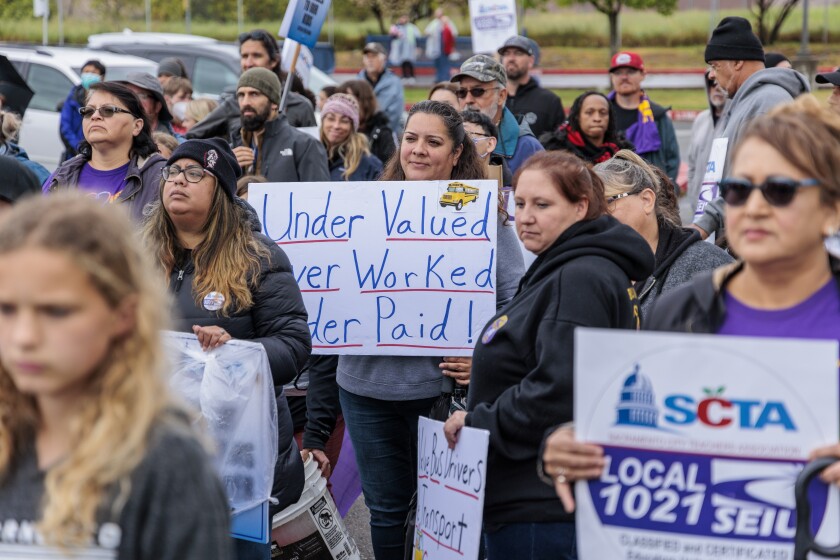
Sacramento City Unified School District teachers, school staff and supporters take part in a rally at Rosemont High School

Sacramento City Unified School District teachers, school staff and supporters take part in a rally at Rosemont High School on March 28 as they have been gone on strike due to the staffing crisis in the district . All SCUSD schools shut down and will remain closed for the duration of the strike.

I have read many articles about the shortage of teachers and school staff. I have read many that were laden with statistics. This is one of the best. It appeared in the Los Angeles Times.

BY ANITA CHABRIA COLUMNIST

A few weeks ago, Sacramento teacher Kacie Go had 56 kids for second period.

That day, there were 109 students at her eighth- through 12th-grade school who were without an instructor because of staff shortages. So she crammed the students into her room and made it work, but “it’s not sustainable,” she said.

No kidding.

Go told me the story standing with hundreds of other teachers and support staff Tuesday morning in the parking lot of an empty high school, as “We’re Not Gonna Take It” blared from speakers and the mostly female workers gathered for day five of a strike that has closed down schools in the Capitol City.

Like Go, these teachers, cafeteria workers, bus drivers and instructional aides are fed up with being asked to do more with less. It’s a problem that goes beyond the Sacramento City Unified School District, with 48,000 students in 81 schools. Frustration among teachers and school workers is rampant across California — pushed to a breaking point by the pandemic and a shortage of more than 11,000 credentialed teachers and thousands of support staff as the state tries to expand pre-kindergarten and bring 10,000 mental health counselors on campuses.

From school closure protests in Oakland to Sacramento’s all-in strike, those who work in our schools are telling us they cannot do this job under the conditions we are imposing. These include mediocre pay, sometimes vicious political blowback from COVID-19 safety measures, a witch-hunt-like scrutiny around hot-button topics, a mental health crisis, the reality of too few people doing the work, and the general disrespect of a society that swears it loves teachers and values education but does little to invest in it. Worrying about school shooters, once an urgent concern of educators and parents, doesn’t even make the top three problems anymore.

It’s the same story playing out in hundreds of other districts not just in California but across the country. Minneapolis teachers just ended a 14-day strike that shared some of the same issues of pay and support, underscored by the same teacher chagrin that we talk a good game about supporting public education but don’t always come through with actions. Minneapolis Federation of Teachers Chapter President Greta Callahan summed it up, sounding like she could be standing in Sacramento.

“We shouldn’t have had to [have] gone on strike to win any of these things, any of these critical supports for our students, but we did,” she said.

Go, who has been a teacher for 20 years and earned a master’s degree along the way — bringing her to the top of the district’s salary scale at just more than $100,000 a year — estimates she’s losing about $500 a day during the walkout.

But she’s more worried about support staff such as Katie Santora, a cafeteria worker who was also on the picket line.

Santora is the lead nutrition services worker at a high school, expected to churn out 1,500 meals a day between breakfast and lunch — with a staff of nine people (though they started the year with only five). Most are part-timers because the district doesn’t want to pay them benefits, and they make about minimum wage.

Santora, with 13 years at the district, makes $18.98 an hour for what is essentially a management role. She’s in charge of ordering, planning, receiving and keeping the joint running.

On the last day before the strike, that included making popcorn chicken bowls for lunch. What does that look like? Five 30-pound cases of chicken, oven-baked, 22 bags of potatoes, boiled and mashed, corn and gravy — all assembled after her staff finished making steak breakfast burritos and scrambled egg bowls. Did I mention every student is required to take a piece of fruit, which means washing somewhere along the lines of 1,700 apples?

Santora says high schoolers are the “most misunderstood” people on the planet, teetering between child and adult. Their well-being, she says, depends on being fed so “their bellies aren’t rumbling in class” and seeing a friendly face when they walk in her cafeteria. She loves delivering both.

“When they come through the line, I like to say, ‘Thank you for having lunch with me,’” she says.

But the money isn’t enough to pay her bills. Four or five nights a week, she gets about an hour at home before she heads to her second job loading grocery bags for delivery drivers at Whole Foods. She’s working two jobs just to pay for the privilege of doing the one she likes.

Go, the teacher, feels the hardships in other ways. One of her twin daughters recently had a “pretty severe concussion,” she said, but Go felt like she couldn’t stay home with her. If she did, one of her co-workers would likely be stuck with a jampacked classroom — and all the other unofficial jobs she has to do on a daily basis, from fill-in parent to police officer to relationship advisor when her teenage students’ hormones go into overdrive. Substitutes are hard to come by, she thinks, because the pay — $224 a day — isn’t competitive compared with other jobs with less stress.

“Subs don’t have an easy life,” Go said. “Why would you want to do that when you could go to In-N-Out and worry about if it’s animal-style or not for the same amount of money?”

The unions involved in the Sacramento strike contend that there are hundreds of open positions in the district in virtually every job. Nikki Milevsky, a school psychologist and vice president of the teachers union, puts it at 250 vacancies for teachers and 400 for classified staff — in a district with 2,069 teachers and 1,656 classified staff. That classified staff and teachers walked out together shows the depth of problems in Sacramento — it’s unusual for both to strike at the same time, and it has forced schools to shut down because there was no one left but administrators to watch kids.

Chris McCarthy, a first grade teacher in the Sacramento Unified School District, joined other teachers, parents, students and supporters, in the rain at a rally in support of their strike against the school district at Rosemont High School in Sacramento.

The teachers union says that 10,000 students lack a permanent instructor, and on some days, up to 3,000 don’t even have a substitute. About 547 kids who signed up for independent study haven’t been given a teacher yet, meaning they are learning nothing.

The district says it’s down 127 certificated staff and 293 classified positions. Take the difference as you will, but the district doesn’t dispute it’s in a staffing crisis.

Sacramento teachers want a pay raise to make the district more competitive in hiring. Right now, some surrounding districts pay more but have lesser benefit packages. (Please don’t make me tell you that healthcare is a right, not a privilege.) The teachers want the district to back off of a proposal to make current and retired teachers pay hundreds more to keep a non-HMO health plan. The district says it has made an offer of a pay increase and recruitment bonus and a one-year stipend to offset the health plan issue.

From there it turns contentious. Teachers reject the district’s offer as lowball and assert there is money available to do better, just not the will to invest it in staff. The district says the teachers need to compromise because it can’t afford all of their asks.

For days, there were no negotiations. State Supt. of Public Instruction Tony Thurmond tried to bring everyone to the table, only to be rebuffed by the district. Back home again instead of in the classroom, my eighth grader, a student in Sacramento schools, ate lots of chocolate chip pancakes and watched “Turning Red” on repeat.

There is no end in sight. Though negotiations with both unions have resumed, the shutdown is another blow to parents and families already anxious and stressed out. The last time my daughter had a normal school year, she was in fifth grade. So I understand the frustration, and even anger, of parents that schools are once again closed — and the resentment of parents across the state who are sick and tired of problems with schools, many of which predate the pandemic.

But I went to the strike line three times and I can tell you this — it’s not about the money for these teachers. You can roll your eyes at the unions all you want, but these teachers and support staff want their schools to work, for their students, for themselves, and for our collective future. Because democracy depends on an educated populace and education is a right. And because they are educators, and they’re invested in our kids.

Go doesn’t want to do anything else but teach, even if it means 56 kids sometimes. Even if it means losing $500 a day and striking. Even if it means making some people mad to make schools better.

“I freakin’ love it,” she said. “I do.”

With so many laws passed forbidding the teaching of “critical race theory,” Kevin Welner has come up with an ingenious solution. Teach the law itself! Kevin is a lawyer who teaches education policy at the University of Colorado in Boulder. He is also director of the National Education Policy Center. He means this as an April Fool’s joke, but like all satires, there is more than a kernel of truth here:

In high-school classrooms throughout Texas, Oklahoma, Idaho, and other states that have passed laws apparently intended to prohibit the teaching of Critical Race Theory (CRT), a new type of elective course is popping up. Students in the classes read the state legislation and explore its meaning and impact.

One such course offered in Houston, Texas is called, “Get to Know SB 3”, which is a reference to that state’s bill passed in late-2021. Courses in other states and school districts have a variety of names, but what holds them together is an attempt to help students gain a deep understanding of their state’s law and what it accomplishes.

Kim Bell, who teaches the SB 3 course at Ladson-Billings High School in Houston, explained that the course was originally proposed by the school’s students. “None of them had heard of CRT until a couple years ago, but then everyone started talking about it and, more recently, about the law we thought would stop us from teaching it. The students turned to us because they wanted to know more, but at first we told them we were afraid to answer their questions about CRT. We thought that maybe the law stops us from even talking with them about it, so instead we told them about the law.”

Not surprisingly, the students then wanted to know even more about SB 3. “The more we told them, the more questions they asked. So we created this course. It’s not specifically about CRT, but we explain the theory because of its relevance to the legislature’s debates and intentions.”

Among the provisions in the Texas law is a prohibition against “inculcat[ing]” in students, “with respect to their relationship to American values, [that] slavery and racism are anything other than deviations from, betrayals of, or failures to live up to the authentic founding principles of the United States, which include liberty and equality.” As Bell’s students learn, this provision is a push-back against the generally accepted view of historians and other scholars, including those who use a CRT lens, who point to the many ways in which racism has been institutionalized in American laws and society.

The students also read the arguments used by proponents of the state laws. Texas Senator Ted Cruz, for example, charged that CRT is “every bit as racist as a Klansmen in white sheets.” Rhode Island State Representative Patricia Morgan complained that she had lost a black friend to CRT – “I am sure I didn’t do anything to her, except be white.”

This teaching hasn’t gone unnoticed by proponents of laws. “Using things we say – that’s just sneaky and divisive!” protested Rep. Leon Alabaster.

The classes, however, are moving forward. “It seems like the legislature wanted SB 3 to stop us from teaching about the reality of structural racism. Fine. Most students reach that conclusion on their own,” said Bell. “If the legislature prohibited our science teachers from telling students that gravity is real, they’d still reach that conclusion after seeing the objective evidence.”

Bell and other teachers we spoke with pointed out that, by the end of the course, their students often observe that the laws designed to stop them from learning about institutionalized racism are themselves institutionalized racism. Also, these laws that are designed to stop students from learning about CRT have instead resulted in their learning about CRT.

Bell’s students even started a CRT club at the school. These students told us that it’s the CRT lens that really helps them understand the institutionalized racism underlying the anti-CRT laws.

“We’re thinking about creating another elective called, Using SB 3 to Explore Irony,” said Bell.

This year, for the first time since the federal Charter Schools program was established in 1994, the U.S. Department of Education is setting forth meaningful regulation of the program. This is a historic development and great news for those of us who have watched the charter industry escape accountability and transparency, while tolerating grift and profiteering.

As the Network for Public Education showed in two major reports (Asleep at the Wheel and Still Asleep at the Wheel), the federal charter program is riddled with waste, fraud, and abuse. Nearly 40% of the charter schools funded by this program either never opened or closed soon after opening. About $1 billion was wasted.

The Department has made a good faith effort to repair the negative aspects of the Charter School Program and to create regulations that would put guardrails in place for charter schools.

There are three key features to these regulations:

First, to qualify for federal funding, charters must develop an impact statement, describing the demographics that they will serve, whether there is a need for their proposed charter, whether the charter would intensify racial segregation in district schools, and how the charter would impact the local district schools.

Second, charters would have to demonstrate how they will serve the local community.

Third, charters operated by for-profit organizations would not be eligible for funding.

These are all significant reforms that have the potential to turn charters into good neighbors of public schools.

I urge you to write your own comment to support the Department’s bold effort to regulate the recipients of federal money for charters ($440 million). You can write 50 words in the comment or write a letter and attach it.

Please open this link to make a comment or send a letter:

https://www.federalregister.gov/documents/2022/03/14/2022-05463/proposed-priorities-requirements-definitions-and-selection-criteria-expanding-opportunity-through#open-comment

Please read the letter that Carol Burris wrote on behalf of the Network for Public Education, posted here.

Comments from The Network for Public Education Regarding Proposed Priorities, Requirements, Definitions, and Selection Criteria-Expanding Opportunity Through Quality Charter Schools Program (CSP)-Grants

Docket ID Number: ED-2022-OESE-0006

April 1, 2022

The Network for Public Education (NPE) writes in response to the invitation to submit comments regarding “Proposed Priorities, Requirements, Definitions, and Selection Criteria-Expanding Opportunity Through Quality Charter Schools Program (CSP)-Grants to State Entities (SE Grants); Grants to Charter Management Organizations for the Replication and Expansion of High-Quality Charter Schools (CMO Grants); and Grants to Charter School Developers for the Opening of New Charter Schools and for the Replication and Expansion of High-Quality Charter Schools (Developer Grants).

NPE is a national non-profit organization with 350,000 subscribers. We network with nearly 200 national, state, and local organizations all committed to the same mission—to preserve, strengthen and support our democratically governed public school system. For the past several years, we have been deeply concerned by what we view as endemic corruption and waste in the Federal Charter Schools Program.

The U.S. Department of Education (USED) must update its priorities and its requirements to address loopholes and flaws in the program that have resulted in for-profit run schools receiving grants, 12% of all CSP grants going to charter schools that never open, grants received by schools and charter management organizations that provide false and misleading information, and sub-grants issued to charter schools with a history of exacerbating racial segregation and that exclude, by policy or practice, students with disabilities and students who are English Language Learners.

The Award of CSP Grants Charter Schools Operated by For-Profit Organizations

We strongly support the Department’s attempt to ensure that charter schools operated by for-profit management corporations do not receive CSP grants, specifically this language:

(a) Each charter school receiving CSP funding must provide an assurance that it has not and will not enter into a contract with a for-profit management organization, including a non-profit management organization operated by or on behalf of a for-profit entity, under which the management organization exercises full or substantial administrative control over the charter school and, thereby, the CSP project.

The federal definition of a public school under IDEA and ESEA is “a nonprofit institutional day or residential school, including a public elementary charter school, that provides elementary education, as determined under State law.” 20 U. S.C. §§ 1401(6) (IDEA), 7801(18) (ESEA) Similarly, the statutes define a “secondary school” as “a nonprofit institutional day or residential school, including a public secondary charter school, that provides secondary education, as determined under State law․” 20 U.S.C. §§ 1401(27) (IDEA), 7801(38) (ESEA).

Former for-profit entities have created non-profit facades that allow the for-profit and its related organizations to run and profit from the charter school, following the judgment of the Ninth Circuit Court of Appeals in Arizona State Bd. For Charter Schools v. U.S. Dept. of Educ. in 2006 (464 F.3d 1003).

Ineffective provisions undermine the present regulations against the disbursement of funds from the federal Charter Schools Program (CSP) to charter schools operated by for-profit entities. We identified over 440 charter schools operated for profit that received grants totaling approximately $158 million between 2006 and 2017, including CSP grants to schools managed with for-profit sweeps contracts.

We offer as examples the recent CSP grants awarded to Torchlight Academy Charter School of North Carolina and Capital Collegiate Preparatory Academy of Ohio. We also bring your attention to the audit of a charter school run by National Heritage Academies in New York. The State Comptroller specifically chides the charter board for the fees taken by a for-profit that played the role of applying for and managing grants. National Heritage Academies schools have frequently received CSP grants and operate under sweeps contracts.

The relationship between a for-profit management organization is quite different from the relationship between a vendor who provides a single service. A school can sever a bus contract and still have a building, desks, curriculum, and teachers. However, in cases where charter schools have attempted to fire the for-profit operator, they find it impossible to do without destroying the schools in the process.

Recommendations:

Many for-profit organizations operate by steering business to their for-profit-related entities. They are often located at the same address, and the owner of the management company or a member of the immediate family is the owner of the related entity. Therefore, it is recommended that wherever references to for-profit organizations appear, the phrase “and its related entities” is added.

(a) Each charter school receiving CSP funding must provide an assurance that it has not and will not enter into a contract with a for-profit management organization, including a non-profit management organization operated by or on behalf of a for-profit entity, under which the management organization and its related entitiesexercise(s) full or substantial administrative control over the charter school and, thereby, the CSP project.

Quality Control of Awards and the Importance of Impact Analysis

We strongly support the proposed regulations that seek to bring greater transparency and better judgment to the process of awarding CSP grants. We especially support the inclusion of a community impact analysis.

We are pleased that “the community impact analysis must describe how the plan for the proposed charter school take into account the student demographics of the schools from which students are, or would be, drawn to attend the charter school,” and provide “evidence that demonstrates that the number of charter schools proposed to be opened, replicated, or expanded under the grant does not exceed the number of public schools needed to accommodate the demand in the community.”

More than one in four charter schools close by the end of year five. A foremost reason for both public school and charter closure and the disruption such closures bring to the lives of children is low enrollment, as seen this past month in Oakland. In New Orleans, school closures have resulted in children being forced to attend multiple schools during their elementary school years, often traveling long distances. Between 1999 and 2017, nearly one million children were displaced due to the closure of their schools, yet only nine states have significant caps to regulate charter growth.

We applaud language that states, “The community impact analysis must also describe the steps the charter school has taken or will take to ensure that the proposed charter school would not hamper, delay, or in any manner negatively affect any desegregation efforts in the public school districts from which students are, or would be, drawn or in which the charter school is or would be located, including efforts to comply with a court order, statutory obligation, or voluntary efforts to create and maintain desegregated public schools…”

In some states, charter schools have been magnets for white flight from integrated schools. Other charter schools have attracted high achieving students while discouraging students with special needs from attending. And, as you know from the letter you received in June of 2021 from 67 public education advocacy and civil rights groups, the North Carolina SE CSP sub-grants were awarded to charter schools that actively exacerbated segregation, serving in some cases, as white flight academies The information requested by the Department is reasonable and will help reviewers make sound decisions.

In addition to our support for the proposed regulations, we have two additional recommendations to strengthen the impact analysis proposal.

Recommendations: (1) That impact analysis requirements include a profile of the students with disabilities and English Language Learners in the community along with an assurance that the applicant will provide the full range of services that meet the needs of students with disabilities and English Language Learners. (2) That applicants include a signed affidavit provided by district or state education department officials attesting to the accuracy of the information provided.

Regarding proposed rules regarding transparency, we note that in the past, schools were awarded grants without providing even one letter of support, or provided false information indicating support that did not exist.

We also strongly support the requirement state entities provide additional supervision of grants. Some will argue that they do not receive sufficient funding to provide supervision. We believe that funding is more than sufficient and we offer the following example as evidence.

In 2020, the Pennsylvania Coalition of Public Charter Schools(PCPCS) received a SE grant of $30 million to open 18 new or expanded charters in the Commonwealth within five years. ESSA allows state entities to retain 10% of all grant funding with 3% dedicated for grant administration. That means that this small state entity would have access to $1 million dollars to supervise the CSP grant spending of eighteen schools. Given that it is a five-year grant, PCPCS would therefore be allowed to spend from CSP funding $200,000 a year to review applications and keep track of grant spending.

To date, three schools have been awarded grants according to the two co-directors hired to administer the program.

We strongly support all SE sub-grant review requirements. These include: (a) how peer reviewers will be recruited and selected, and (b) efforts the applicant must make to recruit peer reviewers from diverse backgrounds and underrepresented groups. We applaud the requirement for a review team. In some states, including New York, CSP sub-grants are routinely distributed as part of the charter authorization process.

To those proposals we suggest adding the following:

Recommendations: (1) That review teams must include at least one reviewer representative of the district public school community. (2) that a minimum point threshold be established for an award, (3) that applications be checked for factual accuracy, and (4) that applications be posted for public review and comment for a period of no less than 45 days before award decisions.

We also recommend that the Department retain funds from the Charter Schools Program to conduct audits of all Developer, CMO and SE subgrants to ensure the funds are being properly spent and that the conditions and aspirations as described in the applications are being met. Annual audits of 5% of all active awardees in each of the programs, randomly chosen by the Department should be conducted each year.

Priorities One and Two

We strongly support the proposed priorities, which we believe will help return the charter school movement back to its original purpose and benefit the children who attend charter schools. Priority one builds off the successful community schools’ movement. Priority two encourages cooperative activities between district and charter schools. We believe that these priorities should be absolute priorities.

Unfortunately, in many cases charter schools’ employee handbooks commonly require teachers to sign nondisclosure agreements that threaten legal action if they reveal the schools “trade secrets” including such things as “curriculum systems, instructional programs, curriculum solutions … new materials research, pending projects and proposals, proprietary production processes, research and development strategies, technological data, and technological prototypes.”

Recommendation

That the Department disallows grants or sub-grants to any schools that apply under priority two if the school or the CMO considers educational material confidential and proprietary and/or does not make publicly available financial, personal or contracting information.

Planning Grants to Unauthorized Charter Schools

According to a 2019 response to Representative Raul Grijalva by then-Secretary of Education Betsy DeVos, 12% of all CSP grants between 2001 and 2019 were awarded to schools that never opened and were not expected to open. In most cases, these schools had never achieved authorization. Whether unauthorized schools can receive funding for planning purposes and how much can be awarded has been left up to the states. This has resulted in large amounts of federal CSP money in the pockets of people who provided no service to the public.

It has also resulted in egregious abuse, especially in Michigan, where charter schools have received more than $100,000 in awards before their authorization was approved. An in-depth review of such planning grants by Michigan State Board of Education President Cassandra Ulbrich revealed questionable submissions, including invoices that would-be charter operators paid themselves and excessive technology purchases.

Recommendation: A school’s planning amount before an authorization is limited to $10,000. If justifiable expenses exceed that amount, they should only be compensated following authorization.

Proposed Selection Criterion for CMO Grants

ESSA places the following restriction on grants awarded to State Entities: No State entity may receive a grant under this section for use in a State in which a State entity is currently using a grant received under this section. However, ESSA is silent regarding the awarding of grants to CMOs. This has resulted in CMOs having several active grants at the same time, with new grants being issued without proper inspection of the efficacy of former grants. For example, it has resulted in the IDEA charter CMOreceiving six grants in a ten-year period totaling nearly $300 million. These grants occurred under a leadership structure that engaged in questionable practices, including the attempted yearly lease of a private jet, related-party transactions, and the rental of a luxury box at San Antonio Spurs games.

IDEA received two awards, in 2019 and 2020, totaling more than $188 million even as the 2019 audit of the Inspector General found that IDEA submitted incomplete and inaccurate reports on three prior grants. The IG report also looked at a randomly selected sample of expenses and found that IDEA’s charges to the grants did not always include only allowable and adequately documented non-personnel expenses.

Recommendations:

That department regulations disallow the awarding of grants to any CMO currently using a grant received under the CMO program and that for any grant exceeding $25 million, the Department’s OIG conducts an audit before an additional grant is awarded.

I don’t often ask the readers of this blog to do anything other than vote. I urge you to write the Department on behalf of these urgently needed reforms.

The deadline for comments is April 13, 2022.
Craig Harris of USA Today wrote a blockbuster three-part series about the charter schools that grabbed at least $1 billion in federal funds from the COVID Payroll Protection Program, passed in 2020 to help struggling small businesses stay alive and retain their employees. Today the second part was posted. Because charter schools are “technically small businesses,” about 1,000 of them applied for the forgivable loans. None of the charter schools lost revenue or laid off employees but they asked for the money anyway. Even the charter school lobbyist—the National Alliance for Public charter Schools—asked for a $680,000 loan, which was forgiven.

Harris writes in this second part about charters that knew it was wrong to ask for PPP funding when they had no need, and others did. (I can’t find the link: if any reader can, please add.)

He starts:

‘The ethical thing to do’: Why this small San Diego charter school passed on COVID PPP loans

Albert Einstein Academies, a small San Diego charter school chain, turned down a forgivable $3 million Paycheck Protection Program loan.

Story Highlights

  • Learn4Life, a charter chain, got a combined $32.7 million in PPP loans through 12 related firms.
  • California charter schools had six of the eight largest PPP loans in the U.S. among charters.
  • In Arizona, two prominent charter chains also turned down the money, saying they didn’t meet the requirements.

SAN DIEGO – The Albert Einstein Academies, which educate 1,450 students from kindergarten through eighth grade at two inner-city campuses here, could have used a forgivable loan from the federal Paycheck Protection Program.

Half of the middle school students and close to one-third of the elementary kids come from low-income homes and qualify for free or reduced-price lunches at the charter schools, its superintendent said.

But while the academies were eligible for up to $3 million in forgivable loans based on revenuesthat largely came from taxes, Superintendent David Sciarretta didn’t feel right about taking the money.

He said the loan program, started by Congress in March 2020 at the beginning of the pandemic, was intended to help financially struggling small businesses stay open and avoid laying off employees.

Charters are privately operated schools that are publicly funded.

We could have always used the money. But, growing up, my mom told me: ‘If there’s food on the table and there are other folks who are hungrier than you, then you need to let them eat because they have a greater need than you do.’

Sciarretta said Einstein, whose charter school campuses are minutes from downtown, didn’t suffer financially because California continued its pre-pandemic level of public school funding during the health crisis even if enrollment declined, giving some schools additional money.He said refraining from taking the loans was “the ethical thing to do.”

“We could have always used the money,” said Sciarretta, recently awarded the 2022 Hart Vision Award Winner for California Charter Leader of the Year. “But, growing up, my mom told me: ‘If there’s food on the table and there are other folks who are hungrier than you, then you need to let them eat because they have a greater need than you do.'”

Other schools took PPP loans

That wasn’t the view of at least 268 other California charter operators, who run some of the state’s largest and wealthiest publicly funded charter chains.

Those operators had at least $335 million forgiven, a USA TODAY investigation hasfound, the most of any state with charter schools. That’s about one-third of the $1 billion in loans obtained by more than 1,100 U.S. charter schools, which educate a fraction of the nation’s children and had the loans forgiven — even though most lost no money during the pandemic.

Several of those schools also employed more than 500 workers, the limit to qualify under the program, USA TODAY found.

Kathleen Hermsmeyer, superintendent of Springs Charter Schools in Temecula, said while California didn’t cut funding, it also did not increase it for charter schools like hers that specialize in at-home, remote or hybrid learning.

Those types of charter schools,which aren’t based in classrooms, experienced significant enrollment increases because of the need for distance learning during COVID,

She said her network added 1,000 students during the pandemic and needed its nearly $9.9 million loan —the largest of any charter operator in the country. The Small Business Administration, which is in charge of the PPP program that ended last May, forgave that loan on Dec. 1.

“It was exactly what PPP was designed for — to help us provide a great quality education for our children through the most difficult years ever,” Hermsmeyer said. “We kept our programs and services, and we did not cut salaries.”

The federal government promised to forgive the loans if the money was used to keep workers on the job and to pay for pandemic-related issues.

Researchers have found the SBA has forgiven most of the loans for all industries with little auditing done to see if the money was properly used. Meanwhile, up to three-fourths of the money went into the pockets of business owners, according to a recent study.

Which charter schools near you took federal PPP money?

Search USA TODAY’s database of more than 1,100 charter schools that had Paycheck Protection Program loans totalling more than $1 billion forgiven.

California, which in 1992 became the second state to allow charter schools, had more than 1,300 of the schools and seven all-charter districts at the beginning of this school year, according to the state’s department of education. That’s roughly 11.5% of the entire public school student population in California.

The state had six of the top eight forgiven loans for charter schools in America, all in excess of $5.5 million, records show.

California Congressman Judy Chu has been highly critical of the federal oversight, saying the agency and Treasury Department prioritized speed in getting money to businesses instead of scrutiny over who needed the cash.

Learn4Life gets most PPP loans

The largest block of forgiven loans, a combined $32.7 million, went to the same address in Lancaster, California, for 12 related nonprofit companiesthat are part of Learn4Life, a charter chain whose firms reported to the IRS that they employed a combined 4,567 workers during 2019.

The loans were obtained in April and May 2020, and forgiven throughout last year, federal records show.

The combined employment would be more than nine times the threshold for obtaining a PPP loan.

Learn4Life spokeswoman Ann Abajian said the organization had 1,685 employees among its companies.

She said the discrepancy occurred because the companies had previously counted seasonal and part-time employees in their staff totals and that information was disclosed to the federal government to have the loans forgiven.

Federal tax returns for the 2019-2020 fiscal year from those 12 nonprofits, which were signed by company executives, showed the higher staffing numbers.

For example, Learn4Life’s Antelope Valley Learning Academy Inc. reported employing1,302 staff, while Western Educational Corporation and Vista Real Public Charter employed 527 and 668 people, respectively.

“Each entity — as a separate charter nonprofit, with less than 500 employees and its own independent governing board — applied with accuracy and transparency, met the criteria, and was awarded the loans and later forgiven. Proper documentation with supplemental justification and backup was presented to SBA,” Abajian said.

The chain said it used the loans to purchase and distribute 20,000 laptops and 15,000 hotspots, baby supplies for hundreds of parenting students as well as an online curriculum. In addition, the organization said its technology support desk hired more staff.

Eric Cross (middle) teaches seventh-grade science at Einstein Middle School in San Diego. The school was eligible for a federal Paycheck Protection Program loan, but school officials turned it down because the state of California did not cut any funding to public schools.CRAIG HARRIS

Other businesses, such as Shake Shack, also counted separate locations to qualify for a PPP loan. That publicly traded company with more than 7,000 employees and 205 restaurants in the U.S., was one of the first to get a PPP loan. However, Shake Shack returned its $10 million loan following public scrutiny.

In Arizona, prominent, successful chains Basis Charter Schools Inc. and Great Hearts Academies said they didn’t seek the loans even though their individual campuses employed fewer than 500 workers. Basis and Great Heart officials said they read the SBA rules as requiring all employees within an organization to be counted and both were too big.

Meanwhile, other California schools that had jumbo loans forgiven included Granada Hills Charter in Granada Hills ($8.5 million), Antelope Valley Learning Academy in Lancaster ($7.9 million), Summit Public Schools in Redwood City ($6.9 million), Western Educational Corporation in Lancaster ($6.2 million) and Magnolia Educational & Research Foundation in Los Angeles ($5.5 million).

John Thompson, historian and retired teacher in Oklahoma, writes about the legislators who are offering bills to undermine public schools, control their curriculum, even meddle with the school lunch program. Their goal is clear: the demoralization of teachers and the destruction of public schools.

Thompson writes:

Why are some Republican legislators in Oklahoma trying to “strip” school lunch programs from the State Department of Education and move them to the Agriculture Department?

The Tulsa World reports:

“The House author told us that some in the Legislature feel too much focus was put on making sure kids were fed during the pandemic and not on educating kids,” said Carolyn Thompson, chief of government affairs and deputy chief of staff at the Oklahoma State Department of Education (SDE).

The author of HB 3432, Rep. Dell Kerbs, claims he wants “to take something off of education’s plate and hopefully move more schools away from ‘heat and serve’ meal options.” But education leaders have said that that is “ridiculous,” and “a solution in search of a problem.” In fact:

The legislation would create duplication within the state’s overall bureaucracy, because their department must still obtain child nutrition data for a host of purposes including calculating state aid funding, school accountability and accreditation, and the federal E-Rate Program that provides schools with discounted telecommunications services.

This new bill should be considered in the light of numerous other anti-education bills filed this session. As The Frontier explained, they are often pushed by national conservative organizations, sometimes using “word-for-word language copied from model legislation.”

For instance, SB 1508, “would require school districts to submit to the State Department of Education detailed expenditure reports on diversity, inclusion and social justice training for teachers and administrators.” HB 3432 also brings to mind bills by Sen. Shane Jett that “would outlaw teaching of social-emotional learning in schools;” “require higher education institutions to post their budget for student and teacher diversity curriculum online;” and “ban voluntary surveys in schools from asking questions about sexuality or gender and would ban school libraries and curriculum from including books that deal with sexuality or gender.”

To understand the purpose of these restrictions, they must also be considered in the context of bills filed by Standridge that “would require teaching ‘patriotic education’” about Oklahoma history; or “impose civil penalties of at least $10,000 on school personnel who teach lessons related to critical race theory [and] require the employee to be fired and blacklisted from educational employment for at least five years.”

Similarly, these bills’ common purpose must also be understood within the context of Sen. Nathan Dahm’s attempt to “require social studies classes to teach at least 45 minutes every Nov. 7 on “Victims of Communism Day;” to “require schools to distribute historical Thanksgiving day proclamations, all of which list the importance and role of Christian faith;” to “add reading requirements for high schoolers that contain some theological themes;” and “require the Oklahoma State Department of Education to contract for curriculum for a four-year pilot project for 11th graders on U.S. history that “narrowly tailors the subject areas to align with free high school curriculum courses from Hillsdale College.”

And, of course these mandates must be seen within the context of successful and unsuccessful bills prohibiting school boards from issuing mask mandates; requiring an “opt in” system for teachers union membership, even though that is already the law; and at a “cost over $116 million” providing “state dollars to students to spend on private school tuition and other education expenses instead of attending a public school.”

To fully understand these vituperative assaults on schools, we must also consider the New York Times’ coverage of the Enid, Ok. school board battles, which concluded: From lockdowns to masks to vaccines to school curriculums, the conflicts in America keep growing and morphing, even without Donald Trump, the leader who thrived on encouraging them, in the White House.

But the fights are not simply about masks or schools or vaccines. They are, in many ways, all connected as part of a deeper rupture — one that is now about the most fundamental questions a society can ask itself: What does it mean to be an American? Who is in charge? And whose version of the country will prevail?

The Times also explained that Enid is in a county which “experienced one of the largest increases in racial diversity in the country over the past decade.” Since 1980, it dropped from 94 percent white to about 68 percent.

And this brings us back to the two, somewhat separate but intertwined agendas that drive these education bills. The corporate establishment and the leaders of the Trump wing of the Republican Party see both political threats and opportunities in demographic change. In the short-run, in order to keep their majority, they must use gerrymandering (such as moving one of the most progressive areas in Oklahoma City into the Panhandle’s congressional seat hundreds of miles away) and reverse trends that expanded the opportunities to vote. But these demographic changes give them better chances for winning in 2022 and 2024 by stoking the fears of Oklahomans who see themselves as being replaced by immigrants, other people of color, and new generations of progressives.

All of these education bills, primarily, are fact-free, fear-based campaigns to win elections at any costs. Being a Baby Boomer who saw the damage done to schools by McCarthyism, and how it persisted into my K-12 education and even into my teaching career, I worry about the long-term effects of these scorched earth campaign tactics.

The second, overarching theme is privatization. Whether it is Gov. Stitt’s undermining of public health institutions as we entered the Covid crisis, privatizing Medicaid, or disempowering the Pardon and Parole Board by preventing them from considering evidence of innocence in their deliberations, or wrecking public education, they want to dismantle governmental institutions.

Whether all of the legislators who support these bills understand it or not, the real goal is kicking vulnerable school systems that are exhausted by the Covid crisis while they are down. Then, rightwingers can ramp up their efforts to fund their cronies, while claiming that the Free Market will find replacements for what they call a rotten, socialist system that doesn’t respect their political base.

Finally, as I was about to submit this post, the New Yorker arrived, featuring Jill Lepore’s The Parent Trap. Lepore also describes the efforts of many Republicans as “whipping up a frenzy about parents’ rights” to win the mid-term and, perhaps the presidential elections. But she then goes back a century to the Scopes Trial, which also followed a global pandemic; explains the racist roots of the anti-evolution campaigns; and the Scopes aftermath, with “’purging’” libraries and “’hounding’” teachers.

Now, the campaign includes the “highhandedness, moral crusading, and snobbery” of today’s corporate reformers’ school choice movement. Lepore concludes, “It’s still going on today.” Some activist parents seem to “want to destroy public education.” So, everyone should read how this isn’t just a brutal fight in Oklahoma Red State politics, but “another long game, a hundred years war: the campaign against public education.”