The story, if you can open the WSJ, features drawings of a beachfront ringed by futuristic high-rise luxury buildings, harbors with yachts, a dreamscape replacing a devastated landscape. It’s reminiscent of the video released by the White House last year that showed Trump and Netanyahu stretched out on beach chairs on the Gaza beach, enjoying their drinks in the “Riviera of the Middle East.”
The curious part of this fantasy is the claim that that this the cost will be $112 billion.
The presentationhas been shared with the leaders of oil-rich Arab nations.
The unsolved problem: what to do with the 2 million homeless Gazans.
Welcome to “Project Sunrise,” the Trump administration’s pitch to foreign governments and investors to turn Gaza’s rubble into a futuristic coastal destination.
A team led by President Trump’s son-in-law Jared Kushner and Middle East envoy Steve Witkoff, two top White House aides, developed a draft proposal to convert the bombed-out enclave into a gleaming metropolis. In 32 pages of PowerPoint slides, replete with images of coastal high-rises alongside charts and cost tables, the plan outlines steps to take Gaza residents from tents to penthouses and from poverty to prosperity.
The presentation is labeled “sensitive but unclassified,” and doesn’t go into details about which countries or companies would fund Gaza’s rebuilding. Nor does it specify where precisely the 2 million displaced Palestinians would live during reconstruction. The U.S. has shown the slides to prospective donor countries, U.S. officials said, including wealthy Gulf kingdoms, Turkey and Egypt….
The school will be supplied by a giant online corporation called Stride, which used to be K-12 Inc.
K-12 Inc. was known for low-quality instruction, low graduation rates, and scandals. Its executives are paid multi-million dollar salaries.
It’s ironic that the government is paying Stride to provide low-quality online instruction to hapless children whose families are about to be ousted from America.
CoreCivic was founded as Corrections Corporation of America (CCA) in 1983, by Thomas W. Beasley, Robert Crants and T. Don Hutto. Beasley served as the chairman of the Tennessee Republican Party; Crants was the chief financial officer of a real estate company in Nashville; Hutto was the president-elect of the American Correctional Association, and according to a 2018 Time Magazine investigation, ran a Manhattan-sized Tennessee cotton plantation where Black convicts picked cotton for no pay…
One of its first big investors was Michael Milken. That investment came a decade after he pled guilty to six felonies in the “biggest fraud case in the securities industry” ending his reign as the “junk bond king.” In 1996, he had established Knowledge Universe, an organization he created with his brother Lowell and Larry Ellison (Oracle), who both kicked in money for K12. Steve Fink, a trusted Milliken confidant and lead independent director of Stride, is the brother of Larry Fink, chairman and CEO of Blackrock, which has been a longtime investor in Stride.
In 2013 K12 settled a class action lawsuit in Virginia for $6.75 million after stockholders accused the company of misleading them about“the company’s business practices and academic performance.” In 2014, Middlebury College faculty voted to end a partnership with K12 saying the company’s business practices “are at odds with the integrity, reputation and educational mission of the college.”
In 2016 K12 got in yet another round of trouble in California for lying about student enrollment, resulting in a $165 million settlement with then Attorney General Kamala Harris. K12 was repeatedly dropped in some states and cities for poor performance.
Well, who cares? Who cares if Stride-K12 provides high-quality education? So what if it’s a waste of taxpayer money? The “students” are children who are being deported. Their parents are being deported too. Who cares?
Trump’s hand-picked board of the John F. Kennedy Center for the Performing Arts in the nation’s Capitol has voted to rename it. It is now the Trump-Kennedy Center for the Performing Arts.
Early in his term, Trump fired Biden’s appointees to the Kennedy Center board and replaced them with his close allies, including his chief of staff Susie Wiles and Usha Vance, the vice-president’s wife. He named himself chairman of the board. He installed Ric Grennell, former Trump-named Ambassador to Germany, as the new president and executive director, although Grennell had no relevant experience. Trump made decisions about programming, and some groups canceled their appearances to protest his takeover.
Ticket sales and attendance have declined sharply since Trump took over. Many employees have been fired or quit, and were replaced by unqualified friends of Trump. He intends to remodel the center, and patrons of the arts are apprehensive about what he will do. In the decades that he lived in New York City, he never associated himself with venues for the arts, like Lincoln Center and Carnegie Hall.
Republicans have mused about renaming the Kennedy Center and changing it to the Donald J. Trump Center for the Performing Arts. Some speculated about renaming the Opera House of the Kennedy Center for Melania.
Yesterday, the board changed the name to the Trump-Kennedy Center for the Performing Arts. Trump’s press secretary said the vote was unanimous, but the only Democrat on the board, Rep. Joyce Pratt of Ohio, was muted during the vote and not allowed to speak.
This was no surprise. The board was prepared. The new logo was immediately rolled out:
In reality, the board does not have the power to rename the Kennedy Center. Its name was authorized by law and can be changed only by Congress, just as the Department of Defense cannot be renamed the Department of War without Congress.
What else can he rename for himself? Should the Washington Monument be declared the Trump Monument? Can he replace Lincoln in the Lincoln Monument? Instead of a brooding Lincoln, the new statue would be Trump swinging a golf club. Maybe that’s the purpose of the Arc d’Trump that he intends to build.
I have said before that I love Peter Greene. He has turned his four decades of experience as a high school English teacher into a compendium of wisdom. He knows when to listen carefully to new ideas and when to throw them out with the garbage. He usually says what I have been thinking, but writes it up better than I could. This is one of those wonderful pieces that are trademark Peter Greene.
He writes:
Last week I had a bluesky post blow up, a simply referral to Dana Goldstein’s New York Times pieceabout how nobody reads whole books in school any more. It’s a good piece, pretty fairly balanced even as it points out the role of technology, Common Core, and testing in the decline of whole-book reading (and allows some folks to try to defend the not-very-defensible).
The article itself drew well over a thousand comments, most of them supportive of the idea of reading whole books. The responses to my post were a more mixed bag, with responses that included variations on “Students would read more books if they were assigned good stuff like [insert your fave here] and not crap like [insert author who bugs you and/or Shakespeare here].” Also variations on “Aren’t books over, really?” and its cousin “I didn’t read any books and I am just swell.”
Goldstein gives Common Core a few graphs of defense, because the world still includes people who think it’s great. I am not one of those people, and I have filled up a lot of space explaining why. But in the drop in book reading we can see a couple of the long-term ill effects of the Core (including all the versions hiding in states under an assumed name).
One problem is the Core’s focus on reading as a set of discrete skills that exist in some sort of vacuum absent any content, like waves without water or air. The Core imagined reading as a means of building those skills, and imagined in that context that it doesn’t matter what or how much you read. If today’s lesson is on Drawing Inferences, it doesn’t matter whether you read a scene from Hamlet or a page from a description of 12th century pottery techniques. You certainly don’t need to read the entire work that either of those excerpts came from. Read a page, answer some questions about inferences. Quick and efficient.
And that emphasis on speed and efficiency is another problem.
The Big Standardized Test doesn’t just demand that students get the right answer. It demands that they come up with the right answer RIGHT NOW! And that scaffolds its way backwards through the whole classroom process. The test prep emphasizes picking the One Correct Answer to the question about the one page slice o’writing, and it emphasizes picking it quickly. There is no time allotted for mulling over the reading, no time for putting it in the context of a larger work, certainly no time for considering what other folks have thought about the larger work.
To read and grapple with a whole book takes time. It takes reflection, and it can be enhanced by taking in the reactions of other readers (including both fancy pants scholars and your own peers). I reread Hamlet every year for twenty-some years, each time with a different audience, and I was still unpacking layers of ideas and language and understanding at the end. I taught Nickel and Dimed for years, and the book would lend itself very easily to being excerpted so that one only taught a single chapter from it; but the many chapters taken together add up to more than the sum of their parts. And it takes a while to get through all of it.
If you think there is more value in reading complete works than simply test prep for reading “skills,” then you have to take the time to pursue it.
It is easy as a teacher to get caught up on the treadmill. There is so much you need to cover, and only so much time. There were many times in my career when I had to take a deep breath and walk myself back from hammering forward at breakneck speed. And education leaders tend only to add to the problem and pressure (the people who want you to put something else on your classroom plate rarely offer any ideas about taking something off to make room).
And look– I don’t want to fetshize books here. We English teachers love our novels, but it’s worth remembering that the novel as we understand is a relatively recent development in human history. Some works that we think of as novels weren’t even first published as books; Dickens published his works as magazine serials. And reading novels was, at times, considered bad for Young People These Days. For that matter, complaints about how Kids These Days don’t read full works takes me back to a college class where we learned that pre-literate cultures would sometimes bemoan the rise of literacy– “Kids These Days don’t remember the old songs and stories any more.”
Reading entire works is not automatically magical or transformative. But there is a problem that comes with approaches to comprehending the world that emphasize speed rather than understanding, superficial “skills” over grappling with the ponderable complexities of life. The most rewarding relationships of your life will probably not be the ones that are fast and superficial. And I am reflexively suspicious of anyone who does not themselves want to be seen, heard, or understood on anything beyond a swift and shallow read.
If education is about helping young humans grasp the better version of themselves while understanding what it means to be fully human in the world (and I think it is) then students need the opportunity to grapple with works that mimic the depth and size and complexity of real humans in the real world.
The case has been made for slow school, analogous to the slow food movement, and it can have its problems, like fetishizing a selective view of tradition. But I like the basic idea, the concept of slowing down enough to be able to take in and digest large slices of the world. That should certainly take the form of engaging students with complete works, but I expect that it can take other forms as well.
Test-centric schooling has narrowed and shallowed our concept of education in this country, and while there has never been a reason to stop discussing this issue over the last twenty years, much of the conversation has moved on to other issues, like the current emphasis on culture panic and dismantling the system. But we can do better, dig deeper, tap richer educational veins, if we are just honest about our goals and our obstacles. I hope we’ll get there before my children and grandchildren get too much older.
Scott Maxwell of the Sun-Sentinel in Orlando calls out state education officials for their double standards. Public schools give state tests and are held accountable for student performance. Private voucher schools are not required to give the tests, and few do. Public schools are required to hire teachers who are detified to teach. Voucher schools can hire anyone, even “teachers” without a college degree. Public schools are not allowed to discriminate against students with disabilities or students who are gay. Voucher schools discriminate against any students they don’t want.
Florida’s new top education official is pretty unpopular these days.
Last week, Education Commissioner Anastasios Kamoutsas was booed by local school officials from around the state.
Keep in mind: This wasn’t a room full of lefty liberals. It was a gathering of school board members from across the state — the majority of whom represent rural, Republican counties.
But even conservative leaders have quickly tired of an education official whose top priority seems to be trashing public education.
In fact, that seems to be why Gov. Ron DeSantis picked his 37-year-old former deputy chief of staff for the post — to trash teachers, threaten schools and generally troll public education. It’s like putting a guy who hates puppies in charge of an animal shelter.
Still, big talkers often clam up when pushed to address the facts beyond their cheap shots. And that has been the case here. Kamoutsas loves to claim that public schools are “failing,” but seems thoroughly uninterested in talking about how many voucher and charter schools have been proven disasters.
After all, it has become abundantly clear that Florida’s multi-billion-dollar experiment in school choice has failed a lot of kids. The Orlando Sentinel has documented many examples in its “Schools Without Rules” investigation into voucher (or “scholarship”) schools.
All of it funded by taxpayers. All of it documented in print. Yet most of those school operators didn’t get threats from state officials. They just got more public money.
Some schools were such financial disasters, they shut down in the middle of the year, leaving families stranded. (We found one in Orlando that was evicted from a commercial complex where the neighboring tenants included a place called “Drug Tests R Us.” More recently, a South Florida TV station reported that a voucher school in Fort Pierce closed its doors one weekend in September, “leaving parents scrambling for alternatives.”)
We also found schools that employed “teachers” without teaching credentials or college degrees.
Hundreds also had written policies of discrimination, saying they refused to serve students with autism, in wheelchairs, who are gay or who have LGBTQ parents.
So after Kamoutsas threatened to shut down public schools in the name of “accountability,” I asked him why he hadn’t pushed for accountability for all voucher schools as well.
Perhaps not surprisingly, Kamoutsas didn’t respond to that question. Neither did his press office. Suddenly, all the tough talk stopped.
And those messes at taxpayer-funded voucher schools are just the tip of Florida’s increasingly messy school-choice iceberg. Florida’s network of voucher and charter schools keep making national headlines for new problems.
Just last week, the state’s own auditors concluded that Florida’s publicly funded voucher program was such a financial mess that the state couldn’t account for hundreds of millions of tax dollars.
Then there was a report from CBS News that said a startup charter school connected to Erika Donalds, the wife of GOP gubernatorial candidate Byron Donalds, had enrolled students, only to never open its doors.
Where’s the accountability for that?
A handful of GOP leaders have spoken up. Veteran Republican State Sen. Don Gaetz called for more accountability for voucher money after declaring: “Whatever can go wrong with this system has gone wrong.” And Lt. Gov. Jay Collins tweeted that law enforcement should perhaps probe the “financial irregularities” at the Donalds-connected school.
But Gaetz received pushback. And Erika Donalds said that Collins was only spotlighting problems at her schools because Collins is contemplating an uphill gubernatorial battle against her husband. The reality is that Republican leaders in this state have never pushed for serious accountability for taxpayer-funded schools of choice.
Even after Florida journalists exposed schools that shut down mid-year, hired teachers without degrees or discriminated against students with disabilities, nothing was done. All we heard was more trash talk about public schools and teachers.
Some choice schools do stellar jobs. I’ve been a big advocate for charter schools like UCP of Central Florida that specialize in teaching kids with special needs and do so in caring, effective fashion. And some private schools that accept vouchers are among the best in the state.
But there are also some total dumpster fires. That’s why people who truly believe in accountability believe it should apply to all schools that get public money.
I do. So does the Orlando Sentinel at large. Over the years, this newspaper exposed many problems at public schools — everything from safety violations and poor test scores to unfit teachers and absentee school board members. Usually, public officials agreed that reform and accountability was needed.
Yet most every time we’ve exposed problems in taxpayer-funded voucher schools over the past decade, state lawmakers and education leaders looked the other way.
There are some basic measures that should be in place to protect both students and taxpayers.
Voucher schools, for instance, should be required to publish graduation rates and nationally accepted test scores, hire teachers who are certified or at least have a college degree, disclose all their curriculum, end their discrimination policies and prove that they have their finances in sound enough order to remain open for an entire school year. This is all really basic stuff.
The bottom line: If Kamoutsas and other state officials truly believe in accountability, they’d demand it for all taxpayer-funded schools. And for all the students who attend them.
Andy Spears is a veteran education journalist who tracks policy and finances across the South, but most often in Tennessee, where he lives. He has recently been following waste, fraud, and abuse in voucher programs in Arizona and Florida, learning lessons that Tennessee could learn from.
Spears wrote on his Substack blog The Education Report that Arizona passed the $1 Billion mark in annual spending on vouchers, most of which pays tuition for students already enrolled in nonpublic schools, and some of which is collected by very rich kids. Voucher money is spent on all sorts of things, not just tuition, including vacations, diamonds, lingerie, home appliances, television sets, vacations, and gift cards.
Arizona State Attorney General Kris Mayes announced that she is opening a review of voucher spending, especially the State Department of Education’s policy of rubber-stamping expenses under $2,000.
Spears also reported on Florida’s slipshod accounting of voucher students:
Where are Florida kids in school? Are they being counted as voucher students on a private school’s roster while actually attending a public school? Is the money following the student, or is it making a stop in the bank account of a private operator with little accountability? In this story about a private school that accepted voucher funds for 80 students it never saw or educated, there’s an even bigger revelation.
In this story about a private school that accepted voucher funds for 80 students it never saw or educated, there’s an even bigger revelation.
Sen. Don Gaetz, R-Crestview, said that at any given moment the state does not know where 30,000 students are in terms of school categories — traditional public or voucher-supported private or home schools — together worth $270 million in education support.
30,000 kids. $270 million. And a state audit says the Florida Department of Education doesn’t seem to know what’s going on.
State legislators last week reviewed a state audit that found the school choice scholarship program in Florida exhibited “a myriad of accountability problems.”
Oh, and that original story – also pretty alarming. Apparently, a school claimed 80 students who lived 130 miles away – students they’d never seen or educated.
According to the decision, during the 2023-2024 school year, Little Wings submitted invoices to Step Up for Students, an organization administering state vouchers, for students previously enrolled at Touched by an Angel school, 130 miles away in Lake City.
The owner of the school that took voucher funds while not providing education to kids said she was not aware that is illegal.
Harris testified that during the 2023-2024 school year, her school received state scholarship funds for students that did not physically attend the school and that she did not know it was illegal to do so.
Florida’s school voucher scheme has private school operators billing for students who do not attend their school. It can’t keep track of as many as 30,000 students at a time. Hundreds of millions of taxpayer dollars are not properly tracked or accounted for
This is what proponents of “school choice” want – unlimited “choice” options, which means unlimited ways for unaccountable private operators to get their hands on loads of taxpayer cash.
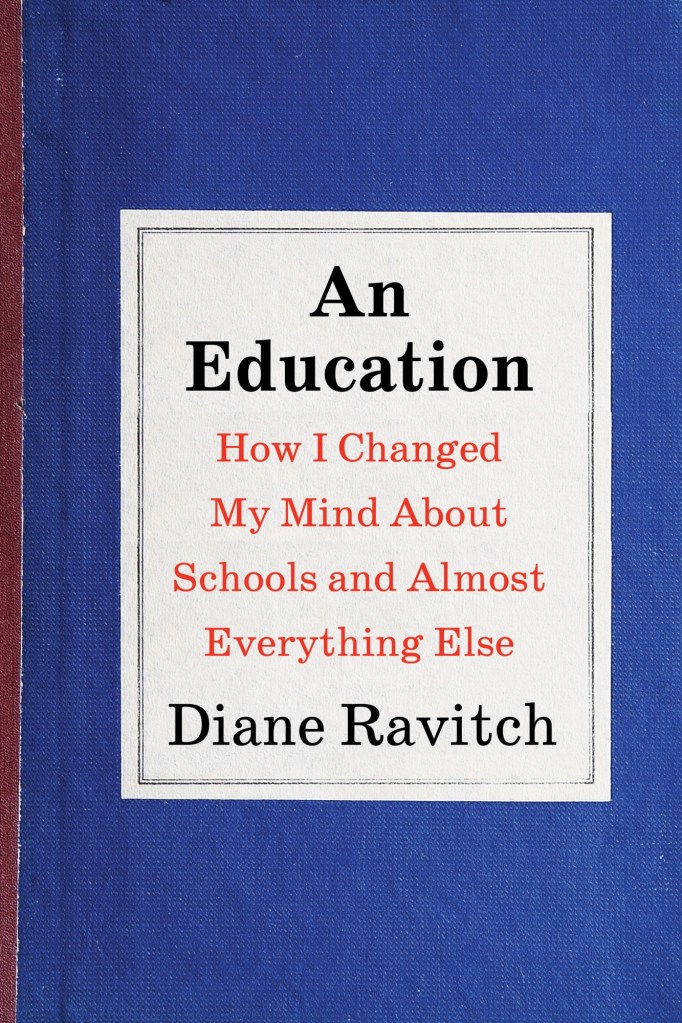
The Network for Public Education sponsored a conversation between me and Carol Burris about my new book: AN EDUCATION: HOW I CHANGED MY MIND ABOUT SCHOOLS AND ALMOST EVERYTHING ELSE.
The Secretary of Defense Pete Hegseth invited certain members of Congress to view the video in which U.S. military fired a missile at a boat with 11 men on board, allegedly carrying illegal drugs in international waters. After the first strike, surveillance showed that there were two survivors holding on to the remains of disabled boat and trying to climb on to it. Some of those who saw the video said the two survivors waved at the U.S. aircraft. A second strike killed the two men.
Democrats who saw the video said the two men were unarmed, had no communications devices, and were likely seeking to surrender or asking for help.
Republicans who saw the video said the two men were seeking to flip the boat and continue their mission. Hegseth says the second strike was justified because the men still posed a threat.
Was the second strike necessary or was it a war crime or murder?
George Stephanopoulos interviewed Rep. Adam Smith, ranking Democrat on the House Armed Services Committee.
The American public should have the opportunity to view the video that members of Congress saw.
If Congressman Smith is right, whoever gave the order to kill the survivors is guilty of a war crime or murder.
If Hegseth and Republicans who saw the video are right, it was necessary to kill the two survivors to prevent them from summoning another boat to rescue them.
Release the video!
If they refuse to show it to the public, they are purposely keeping us in the dark. None of has an informed opinion unless we see the video that was showed to some members of Congress.
I assume that the boat was no longer navigable after sustaining a missile hit. But I may be wrong.
Release the video and let us have an informed discussion.
I was interviewed by Brian Lehrer of WNYC, public radio about my latest book, probably my last. He is a great interviewer. He asks good questions, followed by people who called in to disagree with me.
It’s an excellent interview.
I apologize if I’m browbeating you with stuff about my book, but the book is really good; I worked on it for two years; the mainstream media has ignored it; and I think you will enjoy reading it.
In case you haven’t noticed, the title is:
An Education: How I Changed My Mind About Schools And Almost Everything Else (Columbia University Press). You can buy it from Columbia University Press, your local independent bookstore, or Amazon.
Gary Rubinstein is a teacher of mathematics at Stuyvesant High School in NYC and a prominent critic of corporate reform. He started his career as one of the first corps members of Teach for America. After many years inside the reform world, he saw its flaws and became an apostate. Like me. With his superb mathematical skills, he has debunked charter school “miracles,” TFA data, the Tennessee Achievement School District, which did a lot of boasting but failed.
His review is a delight to read.
He writes:
Fifty years after the publication of her first book, ‘The Great School Wars’, author and historian Diane Ravitch has released her long awaited memoirs. In ‘An Education: How I Changed My Mind About Schools and Almost Everything Else’ Ravitch takes us through her life from her childhood in Houston through the ups and downs of a long and productive life driven by truth and integrity.
What makes this book a ‘must read’ is that it has the three elements that a great autobiography should. First, her life story is interesting on an objective level. Anyone picking up the book and reading over the book jacket will know that Ravtich is someone who achieved fame and notoriety through the unlikely passion of the history of Education in America. But in this book we learn about the sorrow she had to endure between her great triumphs. So her story, even if it weren’t so well written, would make a very good book. A second component of a great autobiography is the author’s ability to reflect on 80 plus years of life and find the pivotal moments that changed the course of her life. But for an autobiography to be ‘great’ it must be infused and brought to life with excellent precise writing. As ‘An Education’ has all three aspects, this is a book you are going to want to read and then keep to re-read over the years when you are in need of inspiration.
If you have read any of Ravitch’s education books, you know that she is a master of absorbing decades of events and processing them and creating an insightful, and incredibly efficient, thesis which she develops over the course of a book. As she explains in this book, she learned her craft while writing as a journalist for The Wellesley News and then for The New Leader magazine. In all her books she exhibits this efficient technique that would make Strunk and White beam. But, by design, Ravtich’s books on Education are stripped of emotional language. Those books educate you through a series of well chosen facts that lead you to understand the implications and big moments without having to spell out every detail. The big question, which this new book answers with an emphatic ‘Yes’ is whether or not her kind of writing can be used to evoke the joy and the sorrow she experienced through her full 87 years of living.
When I started reading this book, I would bookmark interesting passages that show her talent for memoir. Eventually I realized that I was bookmarking almost every page. So after the first 50 of so pages, I had to slow down on the bookmarking. Here are some of my favorite moments (I will try not to give away too much).
Since Ravitch can write a full tale in the span of five or six lines, there are so many interesting stories in this book. As a writer she reminds me of one of those painters, I don’t know so much about painting to know what this is called – maybe impressionistic? – who, rather than producing a full photographic quality image, instead just does the minimal with the paint and brush to convey the emotion and ideas. This is something that is very difficult to do yet she makes it look easy.
A few pages later, Ravitch relays an amusing story about how as a teen she found a pearl in an oyster and ended up in the newspaper for it and also got food poisoning from eating the oyster: “The next day, after the newspaper appeared with a photograph of me in short shorts, identified by name, strange men began calling the house, asking for me and saying impudent things. That went on for days, along with the vomiting. My mother was not amused.” This is so efficient, not a word wasted and it does convey the absurdity and the humor with a minimal delivery reminiscent of maybe Bob Newhart.
Here’s one I liked: “The only Sunday school teacher I remember was a strapping guy who discussed Bible stories and the Jewish religion with us. He told us that when he was our age he had run away with the circus.” Ah, see how great this is? In the first sentence she sets up the scene. And then in just a few words tells us the perfect thing to understand this guy. No more is needed and no more is said.
Throughout the book, Ravitch takes stories and moments that could easily fill several pages and finds a way to convey them in a few words. For the reader, this has the effect of injecting all the humor and sometimes the sorrow of these moments directly into our brains without it having to be processed and translated in our minds.
Though these two examples are fun and convey the innocence of childhood, Ravitch is similarly terse in her telling of some of the deepest tragic moments of her life. When these happen in the book, the descriptions are so efficiently written that, like sometimes when bad things happen in life unexpectedly, we find ourselves pausing and wondering if that really just happened. The matter of fact telling of memorable moments of life, both big and small, happy and tragic, has a powerful effect on the reader.
The book really gets rolling when Ravitch enters college in 1956 at Wellesley. In one sense she is a fish out of water and then she eventually completely at home with the lifelong friends she made there. This was a really fun chapter to read as Ravitch has the first of her many brushes with fame, like her friend Maddy – eventually Madeleine Albright. Just as always, Ravitch perfectly sets up the matter of fact description of her friend’s background and then, in an instant it is revealed who she became known as. The Madeleine Albright story was less than one page long.
One of my favorite parts was the description about a satirical musical Ravitch and her friends wrote for the Wellesley Junior Show. It was hilarious. I kind of want to see the full script but her description of it, as all her descriptions, gave us just enough that we feel like we saw the whole show but forgot some of the missing details.
After college, Ravitch starts domestic life but isn’t quite content. She then goes on a lifelong quest for love and for purpose. As she goes through different eras in her life, she meets a new cast of colorful characters, some famous, some not, but always relevant to her story.
In this book we learn how she went from being the wife of an influential New York City figure to the influential Dr. Ravitch the Education guru of this country. As she rises in the ranks, she finds herself in the company of so many famous people — even several presidents, yet she conveys in her telling of these encounters that, to her, it wasn’t such a big deal. They are all just people. Anyone who has gotten the chance to meet her in person and see her interact with so many people who are not famous will see that she treats non famous people like they are special and is always asking them questions rather than talking about herself.
One of the funniest anecdotes in the book is when she inadvertently got Isaac Asimov angry with her over small talk related to word processors. Again, this is only a few lines, but another interesting adventure in Ravitch’s full life that put her often in the room with all kinds of famous people.
While married to her husband, Diane unexpectedly meets her soulmate who happens to be a woman. In the chapter about the genesis and growth of her relationship, they have now been together for almost 40 years, she is able to convey what it means to finally experience the joy of true love.
In the last chapters of the book we learn about the Washington years in the Department of Education and how that came about and what she tried to accomplish there. We also learn about what it took to renounce much of her work and to follow the evidence into a more evolved system of beliefs about what can improve education in this country. She lost a lot of friends and titles in the process but she kept her personal integrity and commitment to the truth.
Throughout the book, the theme is that Ravitch is never just one thing or the other. Is she a education conservative or an education liberal? Is she straight or gay? Is she a southerner or a north easterner? Is she an introvert or an extrovert? Is she a socialite or a homebody? And throughout her life she is sometimes one and sometimes the other. She is someone who defies categorization. And though in the subtitle she says she ‘changed her mind about schools and almost everything else’ she never changed her core belief that you don’t just stay in the same place just because you are comfortable there.
And like with her, this book is a lot of different things. On one level it is an amusing and interesting read about someone whose choices led her on an unlikely adventure ending with her being, in some circles, a huge celebrity. But it is also an inspirational tale of how having values and staying true to them can help you overcome some of the unfortunate obstacles you have to deal with in life. And though I doubt it was intended to accomplish something else, I think that for many readers they will want to write down their own memoirs after reading this. Ravitch makes it look so easy to analyze your life, find the key moments in it and write some succinct prose – though of course it isn’t so easy but still a worthwhile task.
After finishing this book, I had an experience that only a few people were also able to have. In the acknowledgements in the ‘friends’ section, among sixteen other names, there was my own. I got a chill seeing this, never expecting it. But this made me think something else, also a lesson, though maybe unintended from this great book. This book reminds us of the importance of relationships. Everyone you know has a story to tell. Some people’s lives may not have the highs and lows of Diane Ravitch’s but for each person, their joys and sorrows are meaningful to them. And even if they don’t have the capability to write the way Ravitch can, if they could, you might find yourselves in the acknowledgement page for that friend or family member. So enjoy the relationships you have while you can and remember that you are an important person in many people’s lives.
So pick up a copy today and take a ride through the ups and downs of a well lived life. Though she has made a career of writing about education and teaching, through this book she educates and teaches us that if you keep an open mind and are committed to learning and following the facts, you might end up in a comfortable home a long way from where you started.







 Diane Ravitch's blog