Archives for category: Education Reform

Phyllis Bush reports on the latest turn of events in her battle with cancer.

She’s still winning but it’s not easy and sometimes, in Phyllis’s telling, it has comic moments.

Phyllis is a founder of the Northeast Indiana Friends of Public Education and a member of the board of the Network for Public Education.

Angie Sullivan teaches in a Title 1 school in Clark County, Nevada. Her emails go to every legislator in the state.

She wrote:

So I was wrong.

Nevada Charters are NOT only about white flight.

My bad.

They are also about getting away from language learners.

And special education students.

But it seems they are primarily about serving rich folks.

Nevada Charters so white.

Nevada Charters so rich.

In a class, a charter leader once told me – we want to get away from riff-raff. Wonder what he meant by riff-raff? I left that class and did not return – I was offended so badly.
___________________

What top-rated charter schools have in common: fewer poor kids

_______________

Nevada Charters do not take their share of poor students, ELL students, or IEP students.

Bragging about their stars seems kind of lame if they get there by excluding kids who traditionally do not score well.

Is that fair?

Is “choice” about leaving some kids behind so a for-profit corporation can brag about stars – what the Nevada tax payer wants?

Five star choice in a five star public school neighborhood seems redundant. It is also profitable to siphon money and obtain high value real estate. Both have been investigated in other states – when Academica is involved.

Who is making cash serving students who already have greater access and “choice” than others?

Who is harmed when money lines a corporations’ pocket?

This is privatization.

Making money doing the least amount of heavy lift.

And it is lazy too.

Nevada Charters so lazy.

Keep on bragging Nevada Charters. And I will be on the look out for someone to tell me the real story about “testing” too.

Probably why Nevada Charters did not have data for thirty years. Now we can see what is really happening.

Plus the charter receiverships and bankruptcies – bleeding us dry.

Legislators who own, sit on boards, manage, or work in charters have some serious explaining to do. Their votes during sessions are unethical if they work for a for-profit corporation.

And I’m looking at the Attorney General too.

What is going on?

This is a mess.

They are not going to clean it up unless forced.

The Teacher,

Angie

https://www.facebook.com/events/667620866944820/?ti=icl

This is the portrait of “choice” in Detroit.

It is a disaster for children. They constantly change schools.

There are 31 students in class 8B in Bethune Middle School. Collectively, these students have attended 128 schools.

Their parents choose and choose and choose.

Most students have attended four or five different schools by the time they are in eighth grade.

Does anyone believe this instability, disruption, and churn are good for children?

Here is Jan Resseger’s commentary: She says that choice “accelerates student mobility, stresses educators, and undermines education.” As the embedded article shows, the more frequently students change schools by eighth grade, the lower their scores on the state’s annual tests.

Is it helpful to have no long-term, reliable relationships with friends or teachers?

Would Betsy DeVos do this to her children?

What do you think?

Wendy Lecker, a civil rights attorney with the Education Law Center, writes about a major legal defeat for the charter industry in Connecticut, where they sought a “constitutional right” for students to attend a privately managed charter school. Charter lobbyists tried the same maneuver in Massachusetts and were rebuffed by state courts.

CHARTER BACKERS LOSE IN CONNECTICUT FEDERAL COURT

By Wendy Lecker

A pro-charter group has lost its Connecticut lawsuit seeking a federal constitutional right to attend a charter school. California-based Students Matter filed the case, Martinez v. Malloy, in 2016. The case was dismissed on September 28 by Judge Alvin W. Thompson of the United States District Court in Hartford.

Students Matter, founded by Silicon Valley entrepreneur David Welch, is a major proponent of charter school expansion. The organization initiated, and lost, the Vergara case in California, which unsuccessfully challenged that state’s laws governing teacher tenure.

In Martinez, Students Matter challenged in federal court Connecticut laws governing public school “choice” programs, specifically charter and magnet schools. Those laws determine funding levels and set limits on the expansion of charters and magnets. The Martinez complaint asserted that these laws violate the Equal Protection and Due Process clauses of the United States Constitution.

Education as a Right Under the U.S. Constitution

In bringing this case, the Martinez plaintiffs faced two hurdles: establishing education as a fundamental right under the United States Constitution, and then securing a court ruling that public school “choice” is an element of the federal right.

The State moved to dismiss the case, contending that while there is a right to education under Connecticut’s constitution, there is no federal constitutional right to education based on the United States Supreme Court’s 1973 ruling in San Antonio v. Rodriguez. Further, the State contended that it is rational for Connecticut to decide to fulfill its obligations under the state constitution’s education guarantee by funding a system of public schools governed by local school districts. Any alternatively-governed schools, such as charter schools, are not constitutionally required, but rather are a policy choice left to the State, and which the State can discontinue or restrict at any time.

The District Court concluded that there is no federal constitutional right to education. The Court further agreed with the State that Connecticut’s policy toward providing school governance options is rational. As the Court correctly noted, “the legislature could rationally believe that the best and most effective way to address [any shortcomings in some district public schools] is to take steps to improve the education opportunities provided in those schools, as opposed to creating and funding an entirely new and more expensive system of charter and magnet schools.” [Emphasis added.]

Charters as a Constitutional Right?

In other states, charter advocates have unsuccessfully attempted to incorporate charter schools as an element of the right to public education guaranteed by state constitutions. In Massachusetts, New York, Arizona, and New Jersey, courts have consistently ruled that while states are obligated to provide an adequate education, “this obligation does not mean that Plaintiffs have the constitutional right to choose a particular flavor of education,” as a Massachusetts court held. In fact, a New York appellate court opined that choice may undermine that state’s right to education and that diverting “public education funds away from the traditional public schools and towards charter schools would benefit a select few at the expense of the ‘common schools, wherein all the children of this State may be educated.’”

Charters in Connecticut

The Connecticut charter school program has been cited for undermining education equity for all public school children. A 2014 Connecticut Voices for Children report found that these schools underserve English Language Learners, students with disabilities and economically disadvantaged students. The report further found that the majority of Connecticut charter schools are hyper-segregated. In Hartford, segregation in charter schools has hampered achieving integration targets established by the settlement in the landmark Sheff v. O’Neill school desegregation case. Connecticut charter schools have also been cited for civil rights violations against students with disabilities, and for suspending children as young as five years old at alarming rates.

As in other states, Connecticut concentrates charter schools in the state’s highest poverty districts, posing a fiscal threat to district school systems. Credit agencies have determined that charter expansion lowers district bond ratings. Staunch opposition by Bridgeport district officials to charter expansion has been repeatedly ignored by the State education agency. State-approved charter expansion has resulted in an increasing diversion of Bridgeport funding to charters, leaving the district unable to provide essential educational resources, such as guidance counselors, bilingual education, and interventions for the district’s high need student population.

As in other states, Connecticut concentrates charter schools in the state’s highest poverty districts, posing a fiscal threat to district school systems. Credit agencies have determined that charter expansion lowers district bond ratings. Staunch opposition by Bridgeport district officials to charter expansion has been repeatedly ignored by the State education agency. State-approved charter expansion has resulted in an increasing diversion of Bridgeport funding to charters, leaving the district unable to provide essential educational resources, such as guidance counselors, bilingual education, and interventions for the district’s high need student population.

The Real Fight for Educational Justice in Connecticut

Advocates for education equity in Connecticut waged a decade-long legal fight to increase funding and resources in high poverty districts in the CCJEF v. Rell litigation. Unfortunately, in a January 2018 ruling, the Connecticut Supreme Court rejected the CCJEF claim for adequate school funding.

In ruling against the CCJEF plaintiffs, the Court acknowledged that Connecticut’s poorest districts suffered severe deprivations in educational resources, especially resources to help at-risk students. The Court also acknowledged that “the lack of such support services makes it extremely difficult for many students in the state’s neediest school districts to take advantage of the state’s educational offerings.”

Yet Connecticut’s high court ruled that these proven deprivations do not amount to a constitutional violation. Instead, the Court held that the State is only obligated to provide the “bare minimum” of teachers, facilities, curricula and instrumentalities of learning, such as books, computers and desks.

In his dissent, Justice Palmer articulated the central principle that must drive the fight for educational justice in Connecticut. He declared that “[i]t is not enough to seek success in some places, for some children.” Justice Palmer lays bare the stark difference between the strategies in the Martinez and CCJEF cases. Expanding a parallel, selective system of charter schools is a piecemeal approach that results in the exclusion of at-risk students, leaving district school systems with fewer resources to meet their needs. As Justice Palmer made clear, “the educational system must be reasonably designed to achieve results in every district and neighborhood. Our state constitution simply will not allow us to leave our neediest children behind.”

The CCJEF ruling is a major blow to efforts to improve outcomes and opportunities for Connecticut’s most vulnerable school children. With the Connecticut courts now on the sidelines, advancing education equity for all – and not a few – public school children now requires a concerted and sustained effort to hold the Legislature and Governor accountable to provide vulnerable students with more than the “bare minimum.”

Wendy Lecker is a Senior Attorney at Education Law Center.

Rochester NY’s Coalition for Public Education, in collaboration with the University of Rochester, Writers & Books and the Rochester Teachers Association recently began a “community read” project using Daniel Koretz’s book, “The Testing Charade: Pretending to Make Schools Better.” The project involves having as many community members as possible read the book and/or attending a presentation by Dan Koretz, and attending one or more of several discussion/problem-solving/action meetings to generate alternatives to high-stakes standardized testing to education policy-makers.

These are the key points that organizers of the Rochester Coalition for Public Education circulated to readers of the Koretz book:

FIVE CRITICAL POINTS FROM DANIEL KORETZ’S BOOK: “THE TESTING CHARADE: PRETENDING TO MAKE SCHOOLS BETTER”


  1. Education policy makers have created and implemented many non-research-based and harmful practices in the name of accountability, including the following:
  • Basing teacher evaluation scores, to a significant degree, on test scores of students who have significant variables in their lives that negatively impact their growth and development.
  • Holding English as Second Language students, who have little or no English language experience, accountable for passing standardized English exams, after only one year of learning English.
  • Using unreliable, invalid, non-field-tested standardized tests to hold students accountable,
  • Holding all students accountable for meeting grade-level expectations, when some students may not be developmentally ready or may be deprived of the resource help they need.
  • Punishing students, teachers & school communities, by labeling them as failures.


  1. High-stakes standardized test scores are often inflated for some of the following reasons:
    • Teachers focusing on “teaching-to-the-test,” rather than student interests and areas not often tested, like citizenship, music and current social problems,
    • Some students and/or teachers “cheat,”
    • Middle & upper class students may receive “paid” extra tutoring,
    • Some students are taught skills for more accurately guessing correctly.


  1. Standardized tests can have a useful role, if the following criteria were used more often:
    • Used for diagnostic vs. “high-stakes purposes,”
    • Test student sample populations vs. every student,
    • Set realistic, appropriate test score goals for individual students,
    • Use “performance-based” vs. memorize and regurgitate tasks,
    • Piloted for validity and reliability, before implemented,
    • Test what is important, and
    • Use human judgment as part of the process.

Koretz states: “ The problem is not tests. The problem is the misuse of tests. Tests can be a useful tool, but policymakers have demanded far more of them than is reasonable, and this has backfired. Used appropriately, standardized tests are a valuable source of information, sometimes an irreplaceable one. For example, how do we know that the achievement gap between minority and majority students has been slowly narrowing, while the gap between rich and poor students has been growing?”


  1. “Campbell’s Law,” generally states that whenever a socio-economic goal is reduced to a number, corruption and perversion of the process to attain that goal is inevitable. This phenomena is demonstrated in a number of ways, including: cheating, teaching to the test, ignoring student needs and interests, and creating invalid teacher evaluation systems that devalue the role of teacher judgment.


  1. The high-stakes standardized exam-driven, approach to school reform has been a huge failure. Koretz

states: “If you line up the effects of this approach, the answer is clear: It has been a failure. The improvements it has produced have been limited, and these are greatly outweighed by the serious damage it has done. Of course, in many places, improvements appeared to be big, but most often, this was just inflated test scores.”

HIGH-STAKES STANDARDIZED TESTING

DISCUSSION/PROBLEM-SOLVING/ACTION GROUP MEETINGS


  • October 11th, Thursday, 4:00-6:00 pm at Nazareth College, Golisano Academic Complex, Room 211, led by Professor Shawgi Tell
  • October 15th, Monday, 7:00-9:00 pm at St. John Fisher College, Mid-level Gateway Room, Basil Hall, led by Professor Jeffrey Liles
  • October 18th, Thursday, 7:00-9:00 pm at Writers & Books, 740 University Avenue, led by Rochester Coalition for Public Education Coordinator, Dan Drmacich
  • October 29th, Monday, 7:00-9:00 pm, at Pittsford Barnes & Noble, led by Howard Maffucci, former East Rochester Superintendent & current Monroe County Legislator
  • November 8th, Thursday, 3:45-4:45, LaChase Hall, Margaret Warner Graduate School of Education, University of Rochester, led by Professor David Hursh


Please go to our website www.roccoalitionforpubliceducation.com, to register to attend any of these discussion/problem-solving/action meetings. Our objective is to submit well thought-out proposals to our educational policy-makers for meaningful change in our current public school tests. Please get involved and bring your ideas and colleagues. You need not have read Koretz’s book to be involved, but we do encourage reading the first two and the last chapter of his book: The Testing Charade: Pretending to Make Schools Better.

https://www.youtube.com/watch?time_continue=3&v=l6DK0B8PCqE

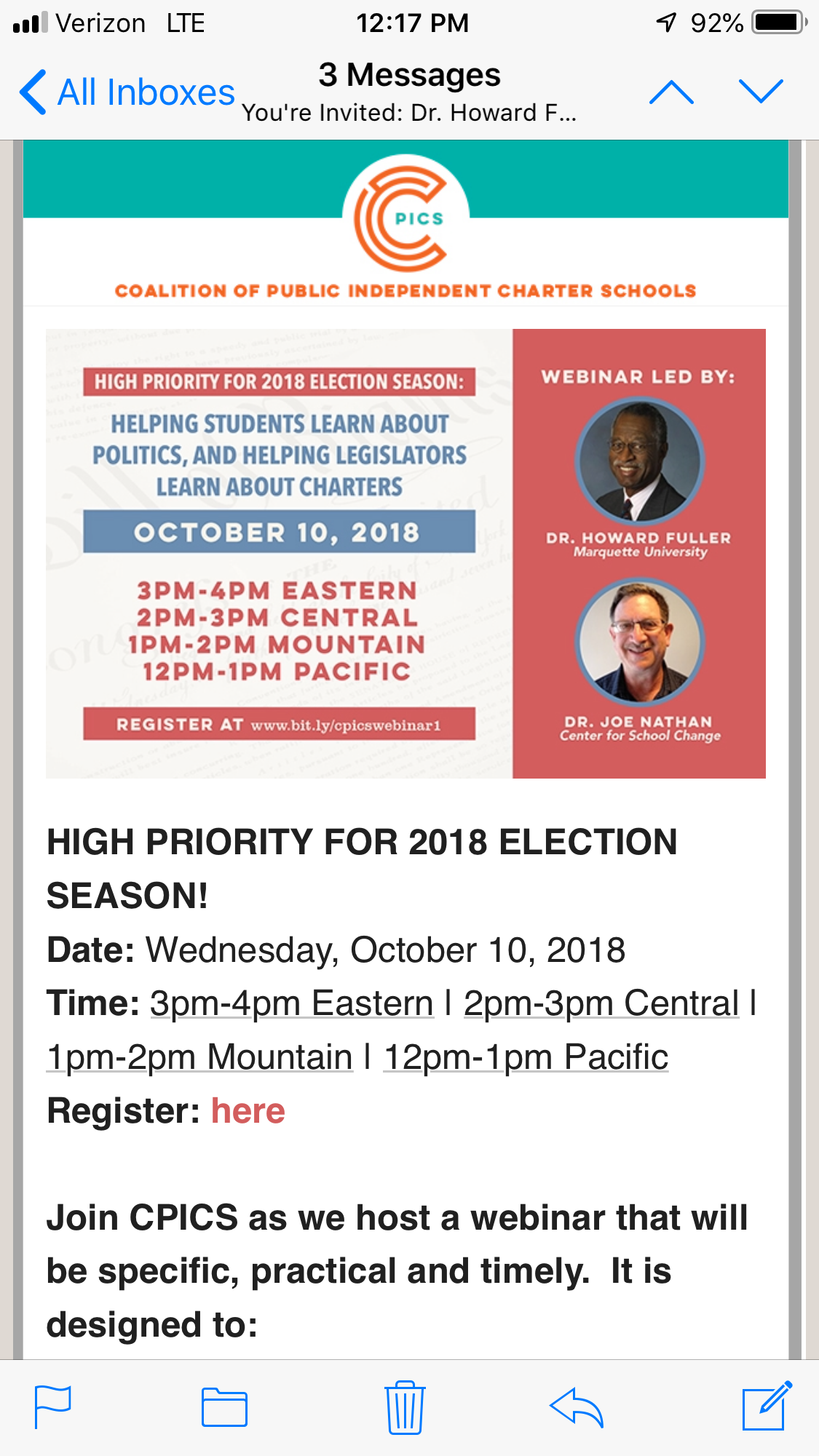
There is still time for you to tune in at 3 pm EST to hear Joe Nathan and Howard Fuller discuss political strategy to promote charter schools and privatization.

Nathan is a week-known Charter advocate.

Fuller is a well-known voucher advocate. His defunct organization, Black Alliance for Educational Options, received millions of dollars annually from pro-voucher, pro-charter groups. In its last year, it had revenues of $8.5 million. Fuller relied on the Rightwing Bradley Foundation to launch him into national activism for vouchers and privatization. Read Mercedes Schneider on BAEO, it’s association with Betsy DeVos’s AMERICAN Federation for Children, and its persistent efforts to privatize public schools.

Nathan and Fuller will share their concern about the “well-funded” efforts to stop charter schools and privatization.

I hope they will let listeners know where to find the funding to stop privatization. I’d like to raise some money for the Network for Public Education, which is not “well funded.”

Do you think they will mention the hundreds of millions of dollars spent every year by the Waltons, Eli Broad, Bill Gates, John Arnold, the Koch brothers, the DeVos family, Reed Hastings, Michael Bloomberg, Paul Singer, Dan Loeb, and other billionaires, as well as the U.S. Department of Education, to fund charter schools?

If ever there was a well-funded industry, it is the charter industry.

If ever there was an underfunded opposition, it is those who fight to protect their public schools against the charter vultures.


Carl Cohn is one of the most respected educators in California. He has been a teacher, principal, and superintendent. He led Long Beach, where he earned a reputation as a calm problem solver. I got to know him when he was superintendent in San Diego, and I was researching the first district to embrace and impose top-down Corporate Reform. After voters booted out the Reformers, Carl was brought in to restore calm and trust. When Carl Cohn speaks, I listen.

In this article, he tells the public what is at stake in the contest for Superintendent of Public Instruction in California. This race is likely to be even more expensive than the governor’s race, where Gavin Newsom has a large lead over his

On one side is Tony Thurmond, social worker and legislator. On the other is Marshall Tuck, the chosen favorite of the charter-loving billionaires. The money is pouting in for Tuck. Just last week, another $4 million arrived from his super-rich allies.

He writes:

Why will so much money be spent on this race? The reason lies with a small group of billionaires who have no education experience but because of their outsized pocketbooks wield huge influence in education politics across the nation. Billionaires like the Waltons (of Walmart fortune), Eli Broad, and President Trump’s Education Secretary Betsy DeVos have made it their priority to fight for the charter school industry, school vouchers, and high-stakes testing.

The billionaires are supporting candidate Marshall Tuck, a former charter schools executive with a mixed record of success and reputation for fighting not fixing – because they know they can count on him to support the charter school industry.

His opponent is Democratic state legislator and public school parent Tony Thurmond. Tony is a social worker by training who has spent 20 years working inside and outside of schools with some of the most high-need children in California.

Tony’s passion for education stems from his own life experience.

Like many California students, Tony Thurmond comes from humble beginnings. Tony’s mother emigrated from Panama to San Jose to become a teacher. His father was a Vietnam veteran who, suffering from PTSD, did not return to the family. When Tony was 6, his mother lost her battle to cancer. He and his brother were sent to live with a distant cousin.

Tony grew up on public assistance and college was never a sure thing – but he succeeded because he was able to attend a great public school where his teachers encouraged him to apply. At Temple University in Philadelphia, Tony became student body president.

After graduation, Tony became a social worker to give back, serving foster youth, children with incarcerated parents, folks with disabilities, immigrants, first-generation college students, and families living in deep poverty. He went on to lead nonprofits and run school-based mental health programs. Tony has taught civics, life skills, and career training courses.

Tony Thurmond believes, as I do, that public education can save lives.

For me, it’s a belief that stems from 50 years working in education, first as a teacher and counselor in the Compton public schools, then as a superintendent in the Long Beach and San Diego school districts. Most recently, as executive director of the California Collaborative for Educational Excellence, it’s been my job to get the right kind of help to schools, districts, charters and county offices of education.

With Trump and DeVos leading the federal education agenda, it is imperative that California elect a strong, effective advocate for public education who will stand up to the billionaires and their charter school industry. Tony Thurmond is that advocate.

While Secretary DeVos was proposing to eliminate the federal Office for English-Language Learners, Tony was passing legislation to expand bilingual education. One in five California students is an English Learner.

While Trump and DeVos were shortchanging STEM (science, technology, engineering and math) education funding on the national level, Tony was fighting for $200 million here in California — an appropriate investment for California, the fifth largest economy in the world and innovation capital of the world.
Tony Thurmond is the only Superintendent of Public Instruction candidate who Californians can trust to fight for our public schools and to fight back against the billionaires and their pro-charter school industry agenda. That’s because Tony believes to his core that we must create a public education system where every child, no matter their circumstances, graduates prepared for success in the 21st century economy.

Do you want to understand the thinking of Gates, Bezos, Zuckerberg, and other billionaires who are disrupting public education? Listen up.

Jennifer Berkshire (once known as the blogger EduShyster) and Jack Schneider (historian of education) create podcasts in a series called “Have You Heard?” in which they interview interesting thinkers.

In this episode, they interview Anand Giridharadas, author of the important book “Winners Take All.” He lived inside the billionaires’ bubble and understood that they want to be seen and applauded as saviors without disrupting the status quo that keeps them on top.

Here is a sampling from the podcast:


“Just because you once got lucky at a hedge fund trade, you shouldn’t get to decide what our schools are like,” says Anand Giridharadas, author of the best-selling new book Winners Take All: The Elite Charade of Changing the World. The book is a scathing indictment of elites who seek to ‘fix’ society, while leaving the inequitable system that has made them so rich untouched. It’s also essential reading for understanding why so many of these billionaire changemakers are intent on ‘disrupting’ public education.

From Bezos to Zuckerberg, the initiatives that these winners champion “mostly aren’t democratic, nor do they reflect problem solving or universal solutions,” argues Giridharadas. “Rather, they favor the use of the private sector and its charitable spoils, the market way of looking at things and the bypassing of government.” Sound familiar?

In the latest episode of the Have You Heard podcast, Jennifer Berkshire and Jack Schneider talk to Giridharadas about education reform in the new gilded age.

Have You Heard: Amazon’s Jeff Bezos recently announced that he’s going to give back by starting up a chain of Montessori-inspired preschools in urban areas. It’s a perfect example of the ‘winner take all’ mentality that your book is about, that someone who has been absolutely central to our age of inequality is now stepping in to offer a fix—on his terms.

Anand Giridharadas: Jeff Bezos becomes the latest entrant to a whole world of billionaire givers, and what’s interesting is that he arrives at a moment of reckoning within both the the tech world where he made his money and the philanthropy world where he’s now alighting. I think five years ago the general attitude to big tech was, ‘thanks so much for this app uncle,’ and you know, in the general attitude to people giving money away was like, gosh, thanks so much. Thanks for giving back. And our culture is changing on both those scores. People are starting to recognize that a lot of the money that is being given away, a lot of how it’s made, a lot of how it’s kept, are themselves the causes of the problems that these rich people turn around and solve. And that we may be better off as a society with people just not causing problems in the first place and then turning around and solving them.

Have You Heard: There’s a common assumption in the education world that elite changemakers, as you describe them, are motivated primarily by the desire for financial gain. But part of what makes Winners Take All such a compelling read is that you really let us see the world through their eyes and the picture we get is much more complex than just ‘I want to cash in on the schools.’

Giridharadas: One of the things I’ll say just overall is that, you know, for Winners Take All I spent about two plus years in the world of elite so-called world changers, trying to understand how they see the world, understand how they try to make change. What I found is much more nuanced story about what motivates the winners of our age and among the things I found was that many, many elites who try to give, who try to donate to a charter school, who try to get on the board of a charter school, who try to, you know, help the Harlem Children’s Zone, who try to do any number of things in any number of other areas—there’s a general sincerity to these people in general. They are not trying to do this to make more money, they’re trying to do this to make the world better.

The problem is that they’re not. The problem is that the good they do, which is real but limited, is often an accomplice to the preservation of a system that keeps generating more harm. The charter school that they donate to, their donation to it as part of a system that allows them to protect the underfunding and unequal funding of public schools across this country. They’re not willing to have an education system that funds public schools equally and adequately because that would cost rich people a lot of money.

Have You Heard: Market thinking has really taken over the education world, and one of the concepts imported from business that you talk about is the “win/win.” It sounds great, but as you argue, it’s key to keeping intact. the structures that make our society so unequal

Giridharadas: The win/win idea originated in business and it’s basically trade and exchange. You have money, I have ice cream, you want ice cream, I’ll get your money. Good—win/win. But what has happened in recent years is that the idea of the win/win has kind of insidiously infiltrated the world of social change, of education, of health, of fighting inequality and poverty. There is now this feeling that both parties—the powerful and the powerless, the haves and the have nots, the rich and the poor—must benefit from a social change for it to be worth doing.

Now, the cleverness of this is it still called a win/win, so it still sounds great. But hold on a second. Are we saying that the powerful must always benefit from helping the powerless? Are we saying that social change must always kick something upstairs to the people benefiting from the status quo? Are we saying the only way to empower women is in ways that give a little something to the men? Are we saying that the only way to help poor kids that are screwed by our education system are in ways that also kicked something up to the affluent? Are we saying that the only way to, you know, improve our healthcare system is in ways that take nothing from billionaires and corporations? Yeah, that’s what we’re saying when we increasingly talk about social change as being a win/win.

Have You Heard: One of the arguments you make in the book is that inequality isn’t just about economics but about ideas, and that the more resources a small group of people commands, the more they effectively control the terms of the debate. But there’s obviously a cultural element at work too, that we’ve given, for example, Mark Zuckerberg an incredible amount of authority, including now anointing him as the savior who’s going to fix our public schools.

Giridharadas: In Europe, no one thinks of Mark Zuckerberg as someone who’s changing the world. Now ‘no one’ may not be literally correct, but in European cultures, that’s just not how they see someone like that. Therefore in Europe they’re not as vulnerable to the Mark Zuckerbergs because they know how to regulate them and they fine him and they stand up for themselves. They create data protection laws that are much tougher than ours. They create antitrust scrutiny that’s much tougher than ours, and I think a big reason they do that is they have a culture that’s free of these myths.

We are participating in a culture that valorizes the win/win, that valorizes the billionaire savior, that is grateful when people who have money they probably shouldn’t have give it away. And we can actually participate in not believing those things anymore. We can just stop believing those things. We can actually, the next time someone gives money away and is, you know, at a conference that you’re attending, ask them a question about how they made the money, not how they’re giving it away.

We uphold through what we passively assent to in this world, and schools uphold it by who they put on the board and, you know, and who they raise money from and who they allow to be their advisors. We are all in on a world that has entrusted the super rich to become our saviors and and the replacements of government in many areas of our life, and that’s an empowering message because we can stop participating in that culture today.

Have You Heard: You write about the winners’ disdain for democracy and preference for private-sector solutions that bypass government. I’m guessing this will strike a chord with anyone who is, say, trying to figure out exactly where Mark Zuckerberg’s enormous stake in expanding personalized learning, for example, is going and is being told ‘it’s none of your business.’

Giridharadas: For a long time, we’ve all been on the receiving end of this culture that tells us to solve things privately, you know, either have a billionaire give back or buy a tote bag that’s going to change the world or a red iPhone case that’s going to change the world or, you know, go to a plutocratic conference that’s going to change the world. I want to urge people to, the next time you are walking around your society and you see a problem that disturbs you, you see problem with education or any other area of your life that disturbs you, think of a solution that has the following four qualities: it’s public, it’s democratic, it’s universal and it’s institutional. Think of a solution that actually would solve the problem at the root, not in the branches and for everybody, not just the people that you would want to save that day, and get out of that relationship of saving to begin with.

When we act privately, when you have these foundations or companies picking and choosing people they want to save, again, that’s a feudal relationship. That’s a relationship of master and servant. The servant is having a little difficulty in their life, the master is throwing some gold coins at them, but it’s not changing the relationship of master and servant. When we act democratically through our shared institutions to solve a problem for everybody, in education, in health, whatever else, we are expressing the value of the whole. We are acting together to protect each other and it has a fundamentally different meaning. We are both the object and the subject of the help, and I think we have to, in education and every other sphere, get out of this world in which we think that because you once got lucky at a hedge fund trade, you should decide what our schools are like.

Have You Heard: Winners Take All is an infuriating read—people should probably avoid reading it in the presence of pitchforks—but it’s also kind of liberating, What do you hope readers will take away from the book?

Giridharadas: I think of this book as very much trying to dismantle a culture and it does so through stories of people living in this culture, struggling with these ideas, trying to do better, but being limited inhibited by a bunch of mythology that encircles them, and my book is trying to kind of get rid of that mythology. It’s trying to dismantle it and make you never use the word win/ win or thought leader or innovation non ironically again. I think this kind of this false sense that you can change the world in ways that protect the status quo for the winners of our age is at the heart of why we live in an age that has been so good for winners and so, so you know, mediocre at best or punishing for everybody else.
This is an outrageous story.

The state of Ohio Plans to take over the East Cleveland school district despite the fact that the state’s data are wildly inaccurate.

CLEVELAND – After digging into the state Department of Education’s report cards for current and planned state takeovers, News 5 found there are some issues within the report cards of at least one district — East Cleveland.

“We found some inaccuracies within the report card,” said Tom Domzalski, East Cleveland School District’s director of research, data and assessments.

Domzalski said “without a doubt,” the district and students are performing better than the state’s report card reflects.

An example of one of the errors in the state report card was that it showed that only 90.9 percent of principals in East Cleveland have a college degree, but state law requires principals to have a bachelor’s and master’s degree. According to East Cleveland officials, all of their principals do.

So where did the state come up with the 90.9 percent? That’s unclear, but it’s not the only problem.

There are errors, inconsistencies and numbers from last year within the document reflecting East Cleveland School District’s 2018 failing grade.

“One times .15 percent is not .075 percent,” Domzalski said, pointing out errors in the math published on the first page. “…the math just isn’t correct.”

According to Domzalski, the inconsistencies don’t stop there.

“In terms of our prepared for success measure, we are showing that students are not taking college credit courses. That’s not true,” he said.

When the state was informed about multiple errors in the East Cleveland report card, the officials said it was too late, nothing could be done.

Is it political meanness or bureaucratic inertia that prevents the state from acknowledging and rectifying its errors?

The test results are in from last March-April in New York. 85% of all 718 school districts in the state did not meet the federally mandated 95% participation rate in the state tests.

18% of the 950,000 eligible students did not take the tests at all. That’s 210,000 students who said no.

Newsday, the main newspaper on Long Island, reports:

Long Island is opt-out central for New York, laying claim to 19 of the 20 school systems statewide with the highest numbers of students boycotting standardized tests, a Newsday analysis shows.

Upstate, the movement has gained a foothold, too, but still isn’t as popular as it is in Nassau and Suffolk counties, the review found.

The biggest boycotts draw students mostly from middle class communities in Suffolk. Comsewogue and Rocky Point, for example, had opt-out rates higher than 80 percent. Commack, Eastport-South Manor and Middle Country had rates of more than 65 percent.

Of 100 districts statewide with the highest numbers of test refusals, 70 are on the Island. All have opt-out rates of 45 percent or higher, according to the analysis. Statewide, opt-out rates averaged 18 percent. The average for the Nassau-Suffolk region stood about 50 percent.

Newsday reviewed the test results in English Language Arts and mathematics, released in late September by the state Education Department. More than 950,000 students in grades three though eight took the exams, while more than 210,000 opted out. Of those who boycotted the tests, more than 90,000 live on the Island.

The opt-out movement, now in its sixth year, appears most successful in middle class communities, which political experts attribute largely to close contacts there between parents and teachers. Many live in the communities; they have children in school and they carry weight with parents when they express doubt about the benefit of state exams. And educators belong to strong unions, which have pushed hard to keep student scores from being tied to mandatory teacher evaluations, the experts said.

The state offered threats and bribes, but to no avail.

Opt out is alive and well on Long Island and parts of upstate New York, driven by parents, not teachers.

Every year the eighth grade ages out. Every year, a new group of third graders is eligible. The fact that the movement has persisted and drawn roughly one-Fifth is a testament to parent power.

Why do parents opt out? They understand that the tests are not diagnostic and serve no purpose other than to compare their children to other children, a function of no value to the children.

Hats off to NYSAPE, New York State Allies for Public Education, which has led the opt out movement.