This is an interesting and plausible analysis of our national drama.
Why is Trump deferential to Putin? What’s the connection?
This is an interesting and plausible analysis of our national drama.
Why is Trump deferential to Putin? What’s the connection?
Is your school district losing funds to charter schools that it did not authorize? If so, you might find this information useful.
A few months ago, the Southern Poverty Law Center filed a lawsuit in Mississippi to block the state from removing tax revenues from local school districts to pay for charter schools. The district in question is Jackson, Mississippi. SPLC argued that the state constitution requires that the funds of each district are to be spent solely for its own public schools, under local control.
The SPLC brief is linked in the original post.
SPLC shared with me the amicus briefs, which are excellent. If your state or district is being drained by charters, you may find these legal briefs to be useful.
ProPublica has created a valuable database identifying the individuals appointed by the Trump administration, with their history and ties to conservative groups.
Go to the Education section and you can view the bios and financial history of every important appointee.
I learned about this an hour after Trump named Patrick Shanahan to become Secretary of Defense. I put in his name and learned that he was a Senior Vice President of Boeing, a major contractor for the Defense Department. Apparently he never served in the military. Will he award contracts to Boeing? Stay tuned.
Linda Lyon writes a blog called “Restore Reason.” She lives in Arizona, after a successful career in the military, and she just stepped down as President of the Arizona School Boards Association.
In this post, she describes legislators prefer revenge to reason. They are furious about the success of the RedForEs movement, and they are lashing out at teachers.
“I don’t believe Arizona’s teachers walked out because they were tired of being paid at a rate ranked 48th in the nation. I believe they walked out because we had some 2,000 classrooms without a certified teacher and class sizes that are 5th highest in the U.S. They walked out, because they know that the number one in-school factor to student achievement is a highly qualified teacher. They walked out because it was way beyond time for someone to take a significant stand. It took 75,000 of them, but their stand significantly moved the needle for Arizona’s one million public school students. To be clear though, even with the additional funding garnered this year, our public schools are still short over $600 million from 2008 levels (yes, a decade ago.)
“Progress though, evidently scares lawmakers like Finchem and Townsend (or gives them a tool with which to scare others) and they are out for revenge. They don’t want teachers who stand up for their students, they want teachers who do what they are told. Unfortunately for them, teachers are citizens first and still do enjoy certain Constitutional protections for protected speech.”
A great post.
Teachers who stand up for their students terrify small-minded legislators.
Steven Singer writes his summary of 2018 here. He concludes with a list of his best posts, along with links.
He wrote:
I’m not going to mince words.
This year, 2018, has been a monster.
We’ve been fighting the dumbest and most corrupt President of our lives – Donald Trump. And we’ve been making progress.
Thanks to the midterm election blue wave in the U.S. House, Trump will finally have a check on his power.
We have more black and brown representatives, more women, more nationalities, ethnicities and faiths in the halls of power than ever before.
Charter schools and vouchers are more unpopular today than at any other point in history. High stakes testing is on the decline. And everywhere you look educators and education activists are being heard and making a difference.
But it’s taken an incredible toll on the activist community.
We have had to be out there fighting this ridiculous crap day-in-day-out 365 days a year.
And even then, we’ve suffered devastating losses – family separations at the border, children dying in detention, an increase in hate crimes and gun deaths, all while climate change runs rapidly out of control.
I wish I felt more hopeful. But as I cast my eyes back on the year that was, I’m struck with a sense of bone-deep despair.
I am confident Trump will go down and he will take so many with him.
But the forces of regression, prejudice and stupidity that forced him upon us don’t appear to be going anywhere.
Behind Donald is another Trump waiting to take his place. And behind him another one – like an infinite set of Russian Matryoshka dolls.
Oh, many of them look more appealing than Donald. They dress better, are more articulate and can remember all the words to the National Anthem. But they are just as committed to serving themselves at our expense.
So with that in mind, I invite you to join me on a brief look back at the year that was.
First, let me thank everyone who bought my book, “Gadfly on the Wall: A Public School Teacher Speaks Out on Racism and Reform” from Garn Press. It was amazing to have finally achieved the dream of being published (in paper with a binding and everything)! I never made anyone’s best seller list, but it was gratifying to have hundreds of copies make it into readers’ hands. I hope people found it helpful (and still do because it’s still out there where better books are sold).
Also, I got to check another item off my bucket list with the invitation to film a TED Talk at Central Connecticut State University. My topic was “The Plot to Destroy Public Education.” It’s been viewed almost 1,000 times. I invite you to watch it here.
As to the blog, itself, I’ve been writing now for four and a half years. This year, I’ve had more than 211,000 hits. To be honest, that’s quite a drop. In 2017, I had 366,000 hits. But I’m hearing about similar dips all over the blogosphere. Facebook changed its algorithm this year making it much harder for people to see the work of amateurs like me. Zuckerberg’s multi-billion dollar corporation doesn’t refuse to spread the written word – it just charges a fee that I can’t afford. Moreover, the Federal Communications Commission (FCC) repealed Net Neutrality at about this time last year making things even more dodgy.
However, on the plus side, the blog is up to more than 1,429,000 hits total! That’s pretty good for a publication that’s only been around since July 2014. And it doesn’t count all the readers I get from articles reposted on the Badass Teachers Association Blog, Huffington Post, Commondreams.org, the LA Progressive, Alternet, BillMoyers.com or other sites.
In addition, about 500 more people followed me this year for a total of 13,361.
That should do it for an overview.
One final item before I get to the look back. I’m making a slight change this year to how I do things. Instead of publishing two separate articles – a Top 10 list and a List of Honorable Mentions – I’m combing the two into this one.
I’ll begin with three pieces that didn’t necessarily get the number of hits I thought they were worth. Then I’ll count down my 10 most popular pieces of 2018.
And then you will find some truly wonderful posts, which I urge you to open and read.
Studies like those by Gordon Lafer have demonstrated the high cost that charters impose on public schools, which are left with stranded costs when students leave. The history of school segregation in the South has demonstrated the wastefulness of maintains a dual school system with both receiving public funds. Now charters are an issue in Los Angeles, where the funders use them to eliminate the teachers’ union.
Howard Blume writes in the Los Angeles Times:
In its 69 pages of demands to the school district, the union representing Los Angeles teachers barely touches on charter schools. But as they prepare for an announced strike on Jan. 10, union leaders are making the growth of these schools a focus to rally members and raise public awareness of what they see as an existential threat.
On Friday union President Alex Caputo-Pearl called for a halt to new charter schools in the district. It’s the latest escalation in the union’s anti-charter rhetoric.
“It’s time to invest in our existing schools,” said Caputo-Pearl, who heads United Teachers Los Angeles. “This unregulated growth is something that affects the long-term sustainability of the district. … This is about protecting the civic institution of public education.”
Charter supporters take issue with the union’s targeting. They say charters have provided valuable educational choices and have proved popular with parents.
L.A. schools Supt. Austin Beutner on Friday said it was wrong to characterize the dispute “as a referendum on charter schools.”
In an interview on Spectrum News, a cable channel, Beutner said “all schools should be looked at with the same tough set of standards.” For the teachers union, he said, “the difference is charter schools don’t have UTLA members, traditional public schools do.”
About 1 in 5 Los Angeles public school students now attends a charter. L.A. has more charters and more charter students than any other school system in the country. This growth has been substantially fueled by federal grants and donors, who include conservative and anti-union forces as well as some independents and Democrats.
Charters are privately managed and while most are nonunion, Caputo-Pearl said that his union represents about 1,000 charter-school teachers and that existing charters that are struggling with enrollment also are being hurt by the “grow at any cost” strategy of some charter advocates.
UTLA President Alex Caputo-Pearl calls for a cap on charter schools.
He also noted that because funding follows the student, charter expansion has drained funds from L.A. Unified, which also is losing enrollment based on unrelated demographic trends.
Fewer students means fewer teachers. And while a drop in enrollment should lower district expenses, the district has had a hard time shrinking and also is burdened with fixed costs for such things as school maintenance and retiree health benefits.
Union leaders “reason that the dramatic expansion of charter schools in Los Angeles over the last decade — an expansion fueled by funding from [Eli] Broad, the Walton Family Foundation and the Gates Foundation — has heightened instability and undermined the capacity of the system as a whole,” said UCLA education professor John Rogers. “UTLA leadership envisions creating a new reality on the ground that will change the dynamics of education in Los Angeles.”
The district also has a new reality in mind — a still mostly confidential plan to divide the nation’s second-largest school system into about 32 networks. The limited disclosure has exacerbated union fears about the goals of Beutner, a successful businessman without a background in working for or managing a school district.
While Beutner has called for a coming together with teachers, he’s also made comments that increase their anxiety.
“So [if] it’s the flexibility of charter schools that’s allowing them to excel, let’s bring that flexibility into the traditional school classroom,” he said in the TV interview on Friday.
But charter school growth and reorganization plans are not part of contract talks.
In its proposal to the district, the union devotes one page to charters — specifically to what happens when a charter shares a campus with a district-operated school.
These sharing arrangements, called colocations, are required by state law. But they frequently led to disputes over space as well as to protests against a charter’s presence.
The union proposal calls for notice by Nov. 15 of the preceding school year when a charter applies for space. UTLA also wants to establish a colocation coordinator who would get a $2,000 stipend and be involved in all discussions regarding logistics. In addition, the union wants an advisory panel at each affected campus that includes teachers, parents, the plant manager and the principal of the traditional school.
They are the union’s response to complaints from staff at traditional schools, which have had to surrender space set aside for computer rooms, tutoring and extracurricular programs.
L.A. Unified has opposed the union’s colocation proposals without much explanation. But there could be concerns about creating a new, potentially cumbersome bureaucratic layer or about letting the union interfere in district administrative decisions. That’s an issue the district has raised about many of the union demands.
Some district officials, notably school board member Nick Melvoin, have sought to ease tensions over campus sharing by sponsoring something very close to group therapy. Using donated funds, Melvoin organized a summer retreat at a local resort hotel that brought leaders of charters and district-operated schools together to get to know each other and talk.
To be sure, many union activists don’t particularly want to get along with charters. They see the charter incursion as too much of a threat.
A strike, if it happens, won’t be over a charter moratorium. But by bringing up the issue now, the union is taking advantage of the sudden spotlight turned on by the strike threat.
The strike “won’t directly settle any of the underlying issues,” said Charles Kerchner, a scholar on labor relations and a professor emeritus and the Claremont Graduate University. “Hence, the charter school wars will continue.”
The headline is right. Tom Ultican, scourge of the Destroy Public Education Movement, loved Andrea Gabor’s new book After the Education Wars.
We often speak of the misguided, arrogant Corporate Reform movement as an effort to impose market thinking on public schools. It’s allegedly “all about the kids,” but its premise is that experienced teachers stink and public schools are failing and must be replaced by private management, no matter how mean they are to the kids and no matter how harsh they are to teachers, who come and go with frequency.
But Andrea Gabor is a professor of business journalism, and she says that this approach is wrong!
He writes:
Andrea Gabor has written another outstanding book. This latest is titled ‘After the Education Wars’. In it, she makes a radical departure from the top-down models of education reform that have dominated the last two decades. Gabor, a Bloomberg chair of business journalism, has applied her expertise toward analyzing modern education policy. Through five case studies she convincingly argues that business leaders brought the wrong lessons to education when they imposed Fredrick Winslow Taylor’s scientific management and shunned William Edwards Deming’s continuous improvement.
Bottom line: the people imposing ideas from corporate America have learned all the wrong lessons.
As I have written before, I think Gabor’s chapter on New Orleans is the best narrative I have read about that sad district, where the Reformers finally wiped out the last public school.
On December 23, I posted an email exchange I had with Mike Petrilli of the Thomas B. Fordham Institute, in which we disagreed about who was the Goliath and who was the David in the field of education.
Mike objected to my characterization of the billionaire-supported “Reform” movement as the Goliaths of American education, the behemoths making war on public schools. He insisted that his side–those supporting charter schools and vouchers–are the true Davids, and those who oppose them are the true Goliaths because we have the AFT and the NEA on our side.
I pointed out to him that the assets of the two big unions are not in the same league as the supporters of school choice, like the Waltons (at least $160 billion) and a long list of other multibillionaires, who avidly fund school choice, along with the U.S. Department of Education, which has shoveled billions into charter schools since 1994 (and will spend nearly $500 million on charters this year alone). You can’t be supported by billionaires, multiple foundations, the U.S. Department of Education, and call yourself the “David” of education.
My clincher, I thought, was to point out the Reformers’ absence from a Twitter campaign on #GivingTuesday sponsored by a website called #Benevity, which offered $10 for every retweet of its message (#BeTheGood) to the charity of your choice. Look at which groups were asking for $10 retweets. The Network for Public Education urged its followers to retweet the message so that we could be designated to receive $10 per tweet. We figured if we got 100 retweets, we could pull in $1,000. That amount of money means a lot to NPE. It means nothing, zero, nada, zilch to the well-funded “Reform” organizations. It means nothing to organization supported by the Waltons, Bill Gates, Eli Broad, etc.
I wrote:
On #GivingTuesday, I didn’t see a single Reformer group putting out a request for $10. Not one. Not TFA. Not Educators4Excellence. Not Stand for Children. Certainly not the Thomas B. Fordham Institute, which is sitting on tens of millions of dollars and gets huge grants from a long list of foundations.
No, they get gifts of hundreds of thousands and millions from foundations like Walton, Gates, Arnold, Broad, and about 50 other foundations who like to do whatever the big boys and girls do.
Ahem. We proudly claim the title of David to your Goliath. We know how that turned out.
I was surprised to get a response from Mike Petrilli.
He wrote a series of emails to demonstrate that several Reform organizations asked for money on #GivingTuesday. He must have skipped over what I wrote, because not a single one of them asked their followers to retweet #Benevity’s message and get $10 for each retweet. As I wrote, “Not one.” Not one of them cares about a gift of $10. That is not even a rounding error in their budgets.
So here are the Reformer groups that Petrilli sent me to prove that they asked for donations on #GivingTuesday and their annual revenues as of 2016, the last date the figures are available on their public tax reports (thanks to Darcie Cimarusti of the NPE staff for collecting the 990 information).
National Alliance for Public Charter Schools
Annual revenues: $9,582,733
Education Reform Now (nonprofit arm of Democrats for Education Reform, the hedge fund managers’ group)
Annual revenues: $12,379,392
GreatSchools.Org
Annual revenues: $10,774,696
Center for Education Reform (loves all choices, except for public schools)
Annual Revenues: $4,090,687
Rocketship Education:
Total annual revenues: $82,957,671
Net income: $6,761,892
(There are separate reports for local and state Rocketships, like Rocketship DC and Rocketship Wisconsin)
Expect More Arizona
Annual revenues: $3,729,325
Bricolage (the new charter school that will replace the last public school in New Orleans)
Since the school has not opened yet, there are no tax forms, but it is supported by the Walton Family Foundation, NewSchools Venture Fund, New Schools for New Orleans, and the Arnold Foundation.
Washington State Charter Schools. No 990 forms yet, but the charter schools in Washington State were funded entirely by Bill Gates and a small group of billionaires, including Alice Walton, Nick Hanauer, Alice Walton, the parents of Jeff Bezos, and a few others with very deep pockets.
Why in the world would any of these organizations ask you to retweet a message that would win $10 for them?
Ahem. The Reform and privatization industry is a hobby of the billionaires. It is not a “movement.” Its purpose is to destroy public education and eliminate unions. It is a substitute for funding public schools, which 85% of American children choose.
If the money dried up, the entire edifice of privatization would shrivel and blow away.
Meanwhile, the Network for Public Education, whose annual revenues are not in the same league with the Reformers, would be delighted to receive your gift of $5, $10, $20, $50, $100. If 100 people give $10 each, that’s $1,000. That means a lot to us. Unlike the Reformer groups mentioned above, we don’t have office space. We have a Post Office Box. Not a penny of your donation will be wasted on exorbitant salaries or lavish facilities. We have no facilities! We have 1.5 staff members, and none of them is paid a six-figure salary. We are a lean, keen organization. Every dollar you give will support our work to protect, support, and improve public schools.
Make the Network for Public Education your charity of choice this year. We need the money. Don’t be fooled. We are the Davids of education. And you know how that turned out!
The big story this Christmas was, as usual, about Donald Trump. Not that the market crashed, the one he used to brag about (he takes credit when it goes up, blames someone else when it goes down); not that he fired another cabinet member or two or three; not that he attacked another ally. But that he asked a 7-year-old child on a public broadcast whether she still believes in Santa and indicated that at her age, belief in Santa is “marginal.” The video of this conversation went viral on Twitter.
The little girl reached him by calling NORAD ; she is Collman Lloyd in Lexington, South Carolina.
She contacted the North American Aerospace Defense Command (NORAD), which has tracked Santa’s whereabouts for 63 years. A scientist answered the phone and asked Lloyd if she would like to speak with President Donald Trump. She was put on hold for six minutes and then he picked up the phone.
Here is the Donald in conversation with little Collman.
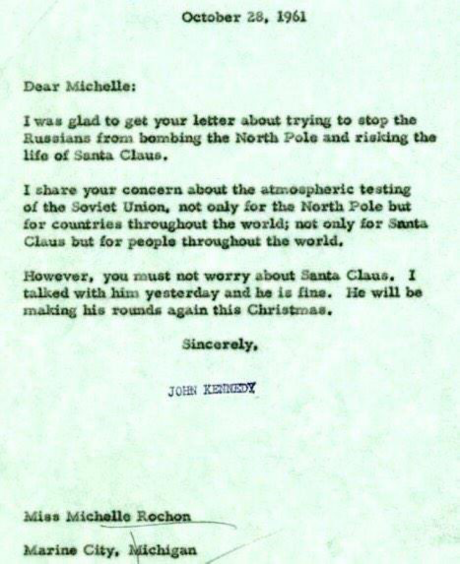
Presidential historian Michael Beschloss tweeted something he discovered in the papers of President John F. Kennedy. A little girl wrote to ask him whether Santa and the North Pole might be endangered by nuclear testing, and he answered her (given that the signature was printed, probably someone answered for him):
The classic response to the question about whether there really is a Santa Claus was printed in the New York Sun in 1897. Wikipedia tells the full story here.
It begins: “In 1897, Dr. Philip O’Hanlon, a coroner’s assistant on Manhattan’s Upper West Side, was asked by his then eight-year-old daughter, Virginia O’Hanlon (1889–1971), whether Santa Claus really existed. O’Hanlon suggested she write to The Sun, a prominent New York City newspaper at the time, assuring her that “If you see it in The Sun, it’s so.”[3] In so doing, Dr. O’Hanlon had unwittingly given one of the paper’s editors, Francis Pharcellus Church, an opportunity to rise above the simple question and address the philosophical issues behind it.” The full text of the editorial appears on the Wikipedia page, along with Virginia’s letter.

When Collman spoke to the President of the United States, she didn’t know what “marginal” meant.
According to the local paper, she still believes in Santa Claus.
Lloyd had never heard that word before, “marginal.”
“Yes, sir,” she said.
She didn’t know it, but his comment about her age being marginal — and her response — would spark national news stories that night and the following morning.
Lloyd never did learn Santa’s whereabouts, but she was glad to be able to talk with her nation’s leader.
“I was like, ‘wow.’ I was shocked,” she said. “It wasn’t really (nerve-wracking), I just had to think of what the truth was.”
After the president hung up the phone, Lloyd sat in her kitchen with her parents, her 10-year-old sister, her 5-year-old brother and a friend. She wondered about Trump’s family, and what his Christmas Eve plans were.
If she ever had the chance to talk to the president again, Lloyd said, she’d ask him about his family.
“Most people know this question. I would like to ask if he has any kids,” she said. “I’ve honestly never heard of them or seen any of them so I was wondering.”
That night, Lloyd and her siblings left iced sugar cookies and chocolate milk out for Santa. The next morning, they were gone, and under the tree was a wrapped gift with Lloyd’s name on it: a brand new American Girl doll.
Santa is real after all, Lloyd said.
She doesn’t know that the president has children. She has led a happily sheltered life. That’s okay. After all, she is only 7. Let’s hope she doesn’t call Trump to ask about the Tooth Fairy.
Lots of readers of this blog don’t like to hear what conservatives, Republicans, or pundits like Thomas Friedman have to say. I disagree. The only way that Trump will ever be reined in is by the leaders of the GOP. No matter how many progressives are elected to Congress, the fact remains that Trump has two years left in his term, and Republicans control the Senate. He won’t be impeached unless 19 Republican Senators join with the Senate Democrats and tell him the country can’t afford to keep him in the presidency as Tweeter-in-Chief, listening to no one but him gut, destroying the western alliance and the economy. Are there 19 Republican Senators willing to face the wrath of Trump and his angry base?
Thomas Friedman wrote that the time has come for the leaders of the GOP to step in and stop the damage to our country and the world by telling Trump that he is toast. I don’t agree that Trump voters wanted disruption. I think he was elected by a coalition that included longtime Hillary haters, disgruntled workers hoping for jobs, people who believed Trump’s lies that he alone could fix the problems of the country, and racists who came out from under the rocks where they had been hiding for years.
Up to now I have not favored removing President Trump from office. I felt strongly that it would be best for the country that he leave the way he came in, through the ballot box. But last week was a watershed moment for me, and I think for many Americans, including some Republicans.
It was the moment when you had to ask whether we really can survive two more years of Trump as president, whether this man and his demented behavior — which will get only worse as the Mueller investigation concludes — are going to destabilize our country, our markets, our key institutions and, by extension, the world. And therefore his removal from office now has to be on the table.
I believe that the only responsible choice for the Republican Party today is an intervention with the president that makes clear that if there is not a radical change in how he conducts himself — and I think that is unlikely — the party’s leadership will have no choice but to press for his resignation or join calls for his impeachment.
It has to start with Republicans, given both the numbers needed in the Senate and political reality. Removing this president has to be an act of national unity as much as possible — otherwise it will tear the country apart even more. I know that such an action is very difficult for today’s G.O.P., but the time is long past for it to rise to confront this crisis of American leadership.
Trump’s behavior has become so erratic, his lying so persistent, his willingness to fulfill the basic functions of the presidency — like reading briefing books, consulting government experts before making major changes and appointing a competent staff — so absent, his readiness to accommodate Russia and spurn allies so disturbing and his obsession with himself and his ego over all other considerations so consistent, two more years of him in office could pose a real threat to our nation. Vice President Mike Pence could not possibly be worse.
The damage an out-of-control Trump can do goes well beyond our borders. America is the keystone of global stability. Our world is the way it is today — a place that, despite all its problems, still enjoys more peace and prosperity than at any time in history — because America is the way it is (or at least was). And that is a nation that at its best has always stood up for the universal values of freedom and human rights, has always paid extra to stabilize the global system from which we were the biggest beneficiary and has always nurtured and protected alliances with like-minded nations.
Donald Trump has proved time and again that he knows nothing of the history or importance of this America. That was made starkly clear in Secretary of Defense Jim Mattis’s resignation letter.
Trump is in the grip of a mad notion that the entire web of global institutions and alliances built after World War II — which, with all their imperfections, have provided the connective tissues that have created this unprecedented era of peace and prosperity — threatens American sovereignty and prosperity and that we are better off without them.
So Trump gloats at the troubles facing the European Union, urges Britain to exit and leaks that he’d consider quitting NATO. These are institutions that all need to be improved, but not scrapped. If America becomes a predator on all the treaties, multilateral institutions and alliances holding the world together; if America goes from being the world’s anchor of stability to an engine of instability; if America goes from a democracy built on the twin pillars of truth and trust to a country where it is acceptable for the president to attack truth and trust on a daily basis, watch out: Your kids won’t just grow up in a different America. They will grow up in a different world.
The last time America disengaged from the world remotely in this manner was in the 1930s, and you remember what followed: World War II.
You have no idea how quickly institutions like NATO and the E.U. and the World Trade Organization and just basic global norms — like thou shalt not kill and dismember a journalist in your own consulate — can unravel when America goes AWOL or haywire under a shameless isolated president.
But this is not just about the world, it’s about the minimum decorum and stability we expect from our president. If the C.E.O. of any public company in America behaved like Trump has over the past two years — constantly lying, tossing out aides like they were Kleenex, tweeting endlessly like a teenager, ignoring the advice of experts — he or she would have been fired by the board of directors long ago. Should we expect less for our president?
That’s what the financial markets are now asking. For the first two years of the Trump presidency the markets treated his dishonesty and craziness as background noise to all the soaring corporate profits and stocks. But that is no longer the case. Trump has markets worried.
The instability Trump is generating — including his attacks on the chairman of the Federal Reserve — is causing investors to wonder where the economic and geopolitical management will come from as the economy slows down. What if we’re plunged into an economic crisis and we have a president whose first instinct is always to blame others and who’s already purged from his side the most sober adults willing to tell him that his vaunted “gut instincts” have no grounding in economics or in law or in common sense. Mattis was the last one.
We are now left with the B team — all the people who were ready to take the jobs that Trump’s first team either resigned from — because they could not countenance his lying, chaos and ignorance — or were fired from for the same reasons.
I seriously doubt that any of these B-players would have been hired by any other administration. Not only do they not inspire confidence in a crisis, but they are all walking around knowing that Trump would stab every one of them in the back with his Twitter knife, at any moment, if it served him. This makes them even less effective.
Ah, we are told, but Trump is a different kind of president. “He’s a disrupter.” Well, I respect those who voted for Trump because they thought the system needed “a disrupter.” It did in some areas. I agree with Trump on the need to disrupt the status quo in U.S.-China trade relations, to rethink our presence in places like Syria and Afghanistan and to eliminate some choking regulations on business.
But too often Trump has given us disruption without any plan for what comes next. He has worked to destroy Obamacare with no plan for the morning after. He announced a pullout from Syria and Afghanistan without even consulting the chairman of the Joint Chiefs of Staff, or the State Department’s top expert, let alone our allies.
People wanted disruption, but too often Trump has given us destruction, distraction, debasement and sheer ignorance.
And while, yes, we need disruption in some areas, we also desperately need innovation in others. How do we manage these giant social networks? How do we integrate artificial intelligence into every aspect of our society, as China is doing? How do we make lifelong learning available to every American? At a time when we need to be building bridges to the 21st century, all Trump can talk about is building a wall with Mexico — a political stunt to energize his base rather than the comprehensive immigration reform that we really need.
Indeed, Trump’s biggest disruption has been to undermine the norms and values we associate with a U.S. president and U.S. leadership. And now that Trump has freed himself of all restraints from within his White House staff, his cabinet and his party — so that “Trump can be Trump,” we are told — he is freer than ever to remake America in his image.
And what is that image? According to The Washington Post’s latest tally, Trump has made 7,546 false or misleading claims through Dec. 20, the 700th day of his term in office. And all that was supposedly before “we let Trump be Trump.”
If America starts to behave as a selfish, shameless, lying grifter like Trump, you simply cannot imagine how unstable — how disruptive — world markets and geopolitics may become.
We cannot afford to find out.


