Archives for category: Education Reform


Eric Blanc asks in Jacobin why Elizabeth Warren does not have a plan for K-12 schooling. She has expressed various positions on education but her overall policy about testing, charter schools, and accountability are murky at best. He questions how different they are from the Bush-Obama strategies.

Blanc recently wrote a comprehensive book about the wave of teachers’ strikes of 2018-19 called Red State Revolt: The Teachers’ Strike Wave and Working-Class Politics. During the strikes, he traveled the nation to talk to strike leaders and striking teachers to understand what was at stake.

He writes:

Elizabeth Warren has a commendably progressive platform on most issues. But her past approach to public education has been closer to that of free-market reformers than most people realize.

The Massachusetts senator’s track record on education has received little scrutiny. Not only was Warren until recently a proponent of market-driven education reform and so-called teacher accountability, but her current platform silences, staff appointments, and political equivocations raise questions about her commitment to reversing the billionaire-funded onslaught against public schools…

There are good reasons to doubt that a Warren presidency would reverse the policies of privatization and education reform that have decimated American’s school system since the 1990s. For someone whose campaign motto is “Warren has a plan for that,” it’s noteworthythat she has not yet issued any plan for K-12 schools — in contrast with Bernie Sanders’ ambitious Thurgood Marshall Plan for Public Education.

Much of what we do know about Warren’s past and present education proposals, as well as the composition of her staff, should be a cause for concern for teachers, students, and parents.

If Warren wants the support of public school teachers and parents, she must issue a plan that clarifies her plans on testing and privatization.

She needs to be crystal clear about whether she would eliminate the federal mandate for annual testing in grades 3-8, a leftover from George W. Bush’s No Child Left Behind, which has been an expensive dud. The testing has enriched the testing industry but had no effect on student scores.

Warren needs to take a stand on the federal Charter Schools Program, which is Betsy DeVos’ slush fund for corporate charter chain that are already amply funded by billionaires.


Public Schools First in North Carolina posted an analysis of the grades given to schools by the state, based mostly on test scores. Not surprisingly, the school grades measured income, not school quality, since standardized tests measure income.

School Performance Grades

School Performance Grades

Source: N&O analysis of Public Instruction data

School performance grades started in 2013-14 modeled after a program in Florida started by Gov. Jeb Bush. All North Carolina public schools, including charters, have received A-F performance grades since 2013. 

Critics of a single school measurement believe that grades:

  • Do not reflect the learning in our schools
  • Undervalue student growth and other important measures of school quality
  • Could result in more attention to borderline students while underserving the lowest and highest performing students
  • Are often used by privatization advocates to support school choice measures and state takeovers of schools, removing these schools from local control and community input.
  • Will have negative economic impacts on a community (lower home values/sales)
  • Do not come with resources/financial support to improve grades

How did North Carolina’s Schools do This Year? Results show that these grades continue to be closely correlated with a student’s family income level.

  • Schools with greater poverty earned fewer A/A+NG’s and B’s and earned more C’s, D’s, and F’s than schools with less poverty.
  • Of the 21.7 percent of schools receiving a D or F grade, 95 percent were serving high poverty populations
  • In schools with more than 80 percent low income students, 60 percent received a D or F grade. Less than one percent of schools with less than 20% low income student populations received a D or F grade
  • Of schools with high concentrations (41 percent or more) of students who are economically disadvantaged, 71 percent met or exceeded growth, compared with 79 percent of schools serving fewer students in poverty.
  • For the 2018–19 school year, 73.3 percent of all schools met or exceeded growth expectations, a slight increase from the previous year.

Read more in our fact sheet about A-F grades here!

Remember when David Coleman, architect of Common Core and then president of the College Board, claimed that the adoption of the Common Core would increase equity and raise test scores for all, especially those farthest behind? Remember, after he took control of the College Board, when he redesigned the SAT and said the New SAT would promote equity? None of that happened.

More students are taking the SAT (good for the College Board’s bottom line), which tends to depress test scores as non-traditional students sign on. But, contrary to Coleman’s assurances, the gaps between groups are growing, not shrinking.

Politico reports:

STUDENTS’ SAT SCORES DECLINE: More than 2.2 million students in the class of 2019 took the college readiness exam, but the test also showed a decrease in average scores, the College Board reported today. The percentage of students passing benchmarks that can be indicators of whether they will successfully complete college coursework also decreased.

— The number of students who took the test increased by 4 percent compared with last year’s class, though the average score decreased by 9 points. This year’s average score was 1059 compared with 1068 in 2018. A perfect score is 1600.

— The percent of test takers who met or exceeded both the Evidence-Based Reading and Writing and Math benchmarks also decreased 2 percentage points, from 47 percent in 2018 to 45 percent. Bianca Quilantan has more.”

Behind these numbers was another story: the increase in gaps between different demographic groups of students.

FairTest reports:

FairTest                          

National Center for Fair & Open Testing
for further information:
Bob Schaeffer (239) 395-6773
mobile  (239) 699-0468


SAT SCORE GAPS BETWEEN DEMOGRAPHIC GROUPS GROWS LARGER;
TEST REMAINS A CLEARER MEASURE OF FAMILY BACKGROUND
THAN HIGHER EDUCATION READINESS
1,050+ COLLEGES, UNIVERSITIES NOW DO NOT REQUIRE SAT OR ACT SCORES

SAT score gaps between demographic groups grew even larger for the high school class of 2019, according to an analysis by FairTest, the National Center for Fair & Open Testing. The nonprofit organization compared new exam results for this year’s graduates with those from 2018.

“Whether broken down by test-takers’ race, parental education or household income, average SAT scores of students from historically disenfranchised groups fell further behind their classmates from more privileged families,” explained Robert Schaeffer, FairTest’s Public Education Director. “That means access to colleges and financial aid will be even more skewed at schools that still rely on test scores to make admissions and tuition award decisions.”

Schaeffer continued, “The SAT remains a more accurate measure of a test-taker’s family background than of an applicant’s capacity to do college level work. No wonder nearly 40% of all four-year colleges and universities in the country are now test-optional. They recognize that standardized exam requirements undermine diversity without improving educational quality”

More than 1,050 accredited, bachelor-degree institutions now will evaluate all or many applicants without regard to test scores. FairTest’s test-optional database includes more than half of all “Top 100” liberal arts colleges. Upwards of 360 schools ranked in the top tiers of their categories by U.S. News & World Report no longer require the SAT or ACT.

– – 3 0 – –

–  See 2019 SAT Scores by gender, ethnicity and parental education below

–  Comprehensive free directory of 1,050+ test-optional and test-flexible colleges and universities:
http://fairtest.org/university/optional

–  List of 360+ schools that de-emphasize ACT/SAT scores ranked in U.S News’ top tiers
http://www.fairtest.org/sites/default/files/Optional-Schools-in-U.S.News-Top-Tiers.pdf  

–  Chronology of higher education institutions dropping admissions testing requirements
http://www.fairtest.org/sites/default/files/Optional-Growth-Chronology.pdf

2019 COLLEGE-BOUND SENIORS SCORES ON “REDESIGNED” SAT
with comparisons to 2018 College-Bound Seniors Scores
(2,220,087 Test-Takers in 2019 Graduating Class up 3.9% from Class of 2018)

                                                                                READING/       MATH        TOTAL*
                                                                                WRITING

ALL TEST-TAKERS                                           531 (- 4)        528 (- 3)     1059 (- 9)

Female                                                             534 (  -5)      519 (  -3)    1053 (-  8)
Male                                                                 529 (  -5)      537 (  -5)    1066 (-10)

Amer. Indian or Alaskan Native                   461 (-19)       451  (-18)     912 (-37)
Asian, Asian Amer. or Pacific Islander        586 (-  2)       637  (+  2)   1223 (   0)
Black or African American                            476 (-  7)       457  (-  6)     933 (-13)
Hispanic, Latino or Latin American             495 (-  6)       483  (-  6)     978 (-12)
Two or more races                                         554 (-  4)       540  (-  3)   1095 (-  6)
White                                                               562 (-  4)       553  (-  4)   1114 (-  9)

 2019 COLLEGE-BOUND SENIORS SAT SCORES BY PARENTAL EDUCATION

               READING/        MATH          TOTAL*
                                                                  WRITING

No High School Diploma                                  464 (-  9)       462  (-  9)     926 (-18)
High School Diploma                                        500 (-  7)       490  (-  7)     989 (-16)
Associate Degree                                              519 (-  7)       508  (-  5)   1027 (-12)
Bachelor’s Degree                                            561 (-  5)       560  (-  3)   1121 (-  8)
Graduate Degree                                              596 (-  3)       598  (   0)   1194 (-  3)

2019 COLLEGE-BOUND SENIORS SAT SCORES BY SAT FEE WAIVER STATUS

                                                                                READING/        MATH          TOTAL*
                                                                                WRITING

Used at Any Point                                             499 (-  2)       488 (-  1)      987 (-  3)
Did Not Use                                                       539 (-  6)       537 (-  6)    1076 (-12)

* scores do not add precisely due to College Board rounding

Calculated by FairTest from: College Board, 2019 SAT Suite of Assessments Annual Report: Total Group

I have not endorsed any candidate. I like Senator Bernie Sanders’ education plan better than any other I have seen but I have not endorsed Bernie nor anyone else.

I will support the nominee of the Democratic Party.

If any candidate says anything that I think is important to bring to your attention, I will share it, regardless which candidate proposes it.

This is what Bernie sent out today, and I agree with his plan. I don’t think anyone should be a billionaire. A person should be able to get by on $900 million, even $100 million. Some manage to live well on even less.

Many of our country’s billionaires are using their vast wealth to undermine and privatize public schools. One thinks of the Waltons, Gates, Broad, Hastings, Koch, Adelson, Anschutz, and that just scratches the surface.

Diane –

I want to ask you to clear your mind for a moment and count to 10.

1…
2…
3…
4…
5…
6…
7…
8…
9…
10…

In those 10 seconds, Jeff Bezos, the owner and founder of Amazon, made more money than the median employee of Amazon makes in an entire year. An entire year.

Think about that.

We live in a time when millions of Americans, including many Amazon employees, are working 2 or 3 jobs to feed their families and the three wealthiest people in this country own more wealth than the bottom half of the American people.

It’s absurd.

And in order to reduce the outrageous level of inequality that exists in America today and to rebuild the disappearing middle class, the time has come for the United States to establish an annual tax on the extreme wealth of the top 0.1 percent of U.S. households.

Add your name if you agree:

Sign my petition — add your name as a citizen supporter of my wealth tax on the top 0.1 percent of Americans as a way to reduce the obscene levels of income and wealth inequality in this country.

Our tax on extreme wealth would only apply to the wealthiest households in America and would cut the wealth of billionaires in half over 15 years — which would substantially break up the concentration of wealth and power of this small, privileged class.

This is how much more in taxes some of the richest people in America would owe this year:

The Walton family – $14.8 billion
Jeff Bezos – $8.9 billion
Charles Koch – $3.2 billion
Sheldon Adelson – $2.6 billion
Rupert Murdoch – $1.28 billion

Our plan would raise more than $4 trillion over the next decade and anyone with a net worth of less than $32 million would not see their taxes go up under this plan.

Now, I have never understood how someone could have tens and hundreds of billions of dollars and feel the desperate need for even more. I would think that with the amount of money the 0.1 percent of this country has, they might just be able to get by.

But the truth is, for the past several decades there has been a massive transfer of wealth from those who have too little to those who have too much.

And for the sake of our democracy and for working families all over America who are struggling economically, that has got to change.

But making it happen must start with all of us making our voices heard and being clear — loudly and directly — that the greed of the billionaire class of this country is intolerable, and it must end. And that starts with you:

Sign my petition — add your name as a citizen supporter of my wealth tax on the top 0.1 percent of Americans as a way to reduce the obscene levels of income and wealth inequality in this country.

In my view, a nation cannot survive morally or economically when so few have so much and so many have so little. Millions of people across this country struggle to put bread on the table and are one paycheck away from economic devastation, while the wealthiest people in this country have never had it so good.

It has got to stop.

And when we are in the White House, it will.

In solidarity,

Bernie Sanders

ADD YOUR NAME

Paid for by Bernie 2020

(not the billionaires)

PO BOX 391, Burlington, VT 05402


Parents, grandparents, and educators in Ohio. Contact the governor and legislators and urge them to stop HB 154. Now. State takeover has already failed in Ohio, yet the Senate Education Committee slipped it back into a bill intended to support struggling districts instead of taking away their democracy.

Bill Phillis and Jeanne Melvin of Public Education Partners send this urgent message.

Jeanne Melvin, President of Public Education Partners (PEP), sets the record straight on Substitute HB 154 in a letter to the editor of the Dispatch
The House of Representatives, by an overwhelmingly majority, passed HB 154. As passed by the House, the bill repealed the HB 70 state takeover bill and provided some resources for struggling districts.
The Senate Education Committee has hijacked HB 154 by inserting the Ohio School Transformation Plan into it as a substitute bill. Readers may recall the original HB 70 (131st General Assembly) focused on wraparound services but the Senate Education Committee hijacked that one and amended the state takeover claptrap into it.
To the Editor:
Ohio lawmakers are still working to replace House Bill 70, Ohio’s school takeover law (Dispatch article, Wednesday). Why reinvent the wheel? Earlier in 2019, House Bill 154, a bipartisan policy offering support for lower-performing school districts, was designed to repeal and replace HB 70 and encourage wraparound services for high-poverty schools. HB 154, an evidence-based model created using results from a five-year research study of school turnaround, was passed without amendment in the Ohio House by a vote of 82-12.
Some misguided members of the Senate Education Committee rely on lobbyists who represent for-profit education interests for advice and direction in education policymaking. On Tuesday, the committee adopted Sub HB 154, written by some of the same influence peddlers who helped create HB 70 in the first place, completely changing HB 154 into another school takeover law.
The time has come to listen and heed the considerable input from thousands of parents, educators, school leaders, community members and other school stakeholders who contacted the governor and legislative leaders this summer to request the end of state takeovers of public school districts.
If Sub HB 154 moves forward, it will burden Ohio with a school takeover law that continues to ignore educational expertise, thoughtful research and field-tested results.
Let’s encourage Gov. Mike DeWine to say no to the lobbyists and think tanks that represent education profiteers by demanding the Senate committee reject Sub HB 154 and use the language of the bipartisan HB 154 to repeal and replace Ohio’s failed school takeover agenda.
Jeanne Melvin, Public Education Partners, Columbus
William L. Phillis | Ohio Coalition for Equity & Adequacy of School Funding | 614.228.6540| ohioeanda@sbcglobal.net| www.ohiocoalition.org


Terri Michal is an elected school board member in Birmingham. Betsy DeVos recently gave $25 million to Alabama from the federal Charter Schools Program, which she uses as her personal slush fund.

Federal Grants and Surplus Property: DeVos’s Solution to Help the Students of Birmingham, AL.

By Terri Michal

In Alabama we have a Legislature that appears to be perfectly fine creating legislation that targets our black and brown high poverty students in Birmingham.

We have education organizations and foundations that work against the very schools they are contracted to support.

We have a State Superintendent that is condoning the targeting of our students.

We have a real estate executive that in 2015 actively worked, unbeknownst to Birmingham City Schools (BCS), to get our charter school law passed while at the same time holding a contract to sell surplus properties for the school system. This information was just recently exposed. They are still under contract with BCS.  

Now, thanks to an old organization, the Alabama Coalition for Public Charter Schools, renamed New Schools for Alabama, we can add Betsy DeVos to that dogpile. Like the cherry on top of a sundae, Betsy DeVos is the final piece needed to serve up Birmingham City Public Schools to the power-hungry politicians and the gluttonous corporations they work for.

So, what was it exactly that DeVos did to make their charter school dreams come true? She awarded New Schools for Alabama a $25 million-dollar grant to open 15 charter schools, a majority of which no doubt will be in Birmingham.

However, New Schools wasn’t the only one that got a gift, I did too.  What was it? The Federal grant application that New Schools filed in an effort to receive that CSP Grant. It brought together, in one document, the entire cast of characters that’sworking to undermine public education in Birmingham, Alabama.

When I began reading it, I didn’t really know what I was looking for.

But the first thing that jumped out at me was the fact that they had no problem saying they were targeting Birmingham, along with 3 other districts. Now, finally, for all of those in this city who refuse to believe we are targets for privatization, it’s right there in the application in black and white. I guess we can now put that ‘conspiracy theory’ to rest.

Second, I noticed the people and organizations that wrote letters in support of New Schools for Alabama and the grant that would be undermining our public schools; Alabama Sen. Del Marsh (R), U.S. Sen. Doug Jones (D), State Superintendent Eric Mackey, the Mike and Gillian Goodrich Foundation, the Daniel Foundation, and A+ Education Partnership, just to mention a few.

Third, and possibly the most disturbing, was the fact that the Executive Director of NSFA, Tyler Barnett, used data gathered from our voucher law, the Alabama Accountability Act, to justify targeting our black and brown students for charter schools.  Here’s what he said:

“Of Alabama’s 76 state-designated failing schools—meaning, the bottom 6% of schools in academic achievement—72 had at least a 90% poverty rate.  And of the 38,420 students in those failing schools, 96% are Black or Hispanic.”

Ninety Six percent are Black or Hispanic!! How in the world can Mr. Barnett, or anyone else for that matter, take this data andthen twist it to blame the schools and/or the students for ‘failing’? Especially knowing the same Sen. Del Marsh that wrote the recommendation letter for this grant was also responsible for bringing us the Accountability Act.  Just as they are targeting our students for charter schools, the Accountability Act targets our black and brown students and labels their schools as failing.

This data is garbage, the only purpose it serves is to strengthen the systemic racism that exists in public education in Alabama. If you are thinking to yourself, ‘it’s the poverty’, it’s not.  Approx. half of our public-school students that live in poverty in Alabama are white.

Finally, the most surprising thing I found was this, in reference to what our charter school law says about acquiring real estate:

“Already, this law has been exercised by a charter applicant in Birmingham City Schools, which sold a historic but underutilized school building in the fall of 2018 so that an emerging charter network could restore the building for school use.”

Wait, what?  I am a board member for BCS, I would like to think that I’d know if we sold a building for charter school use.We did attempt to sell one property last fall, but the sale fell through in February, a month after the NSFA Federal Grant Application was submitted.

If we were to believe that the information in this federal application were true, and why wouldn’t we, the reason I didn’t know the surplus property was going to be a charter school is, more than likely, because of three little words that come after the buyer’s name on our real estate sale agreement, ‘and/or assigns’.What these three words do is allow the person buying the property to assign the sale to a third party.  So, if it says John Smith and/or assigns, then maybe John Smith is buying it, and maybe he’s just making a quick buck for his services and passing the sale on to a third party.  As a BCS school board member, I don’t really KNOW who’s buying our property.

One bit of information I left out; New Schools for Alabama is still legally the Alabama Coalition for Public Charter Schools(ACPS). This coalition’s sole purpose was to get the charter school law passed in Alabama.  Once it did that, the organization went dormant.

Now they have rebranded themselves with a new name, a new board and a new purpose.  Part of their new purpose is to help prospective charter schools buy and/or lease property. (Surprise!!)

In light of this very generous offering from our public-school hating Secretary of Education, I decided it was time to revisit the old board of ACPCS, just to refresh my memory.  

Right away I came across the name of J. Michael Carpenter.  I can tell you, I was more than a little surprised to find out that it was the same J. Michael Carpenter that founded Bloc Global,the real estate company that Birmingham City Schools has had under contract to sell surplus properties since 2011. Could this be how NSFA knew that we sold property to be utilized as a charter school?

So, let me explain this again in very simple terms.  As a Birmingham City Schools Board member I discovered that the real estate company that we have under contract to sell  our surplus property was, in part,  founded by and currently still under the direction of, the very same person that sat on the board of the coalition that is  responsible for helping write our charter school law and lobbying for its passage. Legally that coalition (ACPCS) is the same entity doing business as New Schools for Alabama. NSFA wrote the CSP Grant Application that stated the BCS board sold property in the fall of 2018 to someone for charter school use.

 Is your head spinning? Well so is mine. I knew none of this information until recently. I’m very concerned and upset that as an elected member of the BCS board I had to spend days doing research to uncover all of this myself.  

Yet, I know this is how things work in Betsy’s world.  The world of charter schools is one big land grab full of backroom deals and shell games. Now, with this new information and the $25 million dollar grant it appears the final piece of the charter school puzzle is in place in Birmingham.

Land???  Check.


Nancy Bailey calls out Secretary of Education Betsy DeVos for talking about “education freedom” at the same time that she is doing everything within her power to snuff it out.

Betsy DeVos’s Education Freedom: It’s Anything But


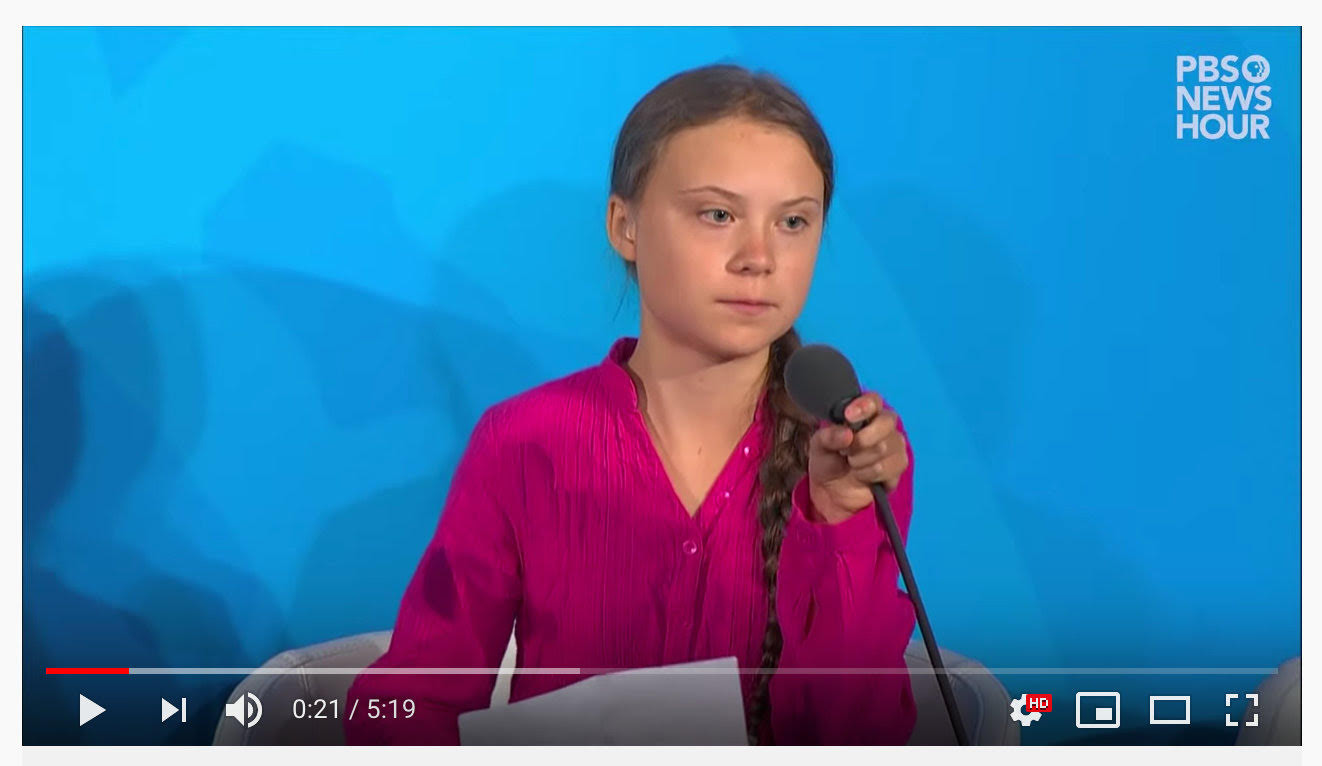
Sixteen-year-old climate activist Greta Thunberg spoke at the UN Climate Conference today. Trump skipped the meeting to attend a discussion of religious freedom. Last Friday, Thunberg inspired millions of students around the world to demonstrate on behalf of action to address the climate crisis.

She said today:

“This is all wrong. I shouldn’t be standing here. I should be back in school on the other side of the ocean.

Yet you all come to me for hope? How dare you.

You have stolen my dreams and my childhood with your empty words. And yet I’m one of the lucky ones. People are suffering. People are dying. Entire ecosystems are collapsing. We are in the beginning of a mass extinction. And all you can talk about is money and fairy tales of eternal economic growth.

How dare you.

For more than 30 years the science has been crystal clear. How dare you continue to look away, and come here saying that you are doing enough, when the politics and solutions needed are still nowhere in sight.

You say you ‘hear’ us and that you understand the urgency. But no matter how sad and angry I am, I don’t want to believe that. Because if you fully understood the situation and still kept on failing to act, then you would be evil. And I refuse to believe that.

To have a 67% chance of staying below a 1.5C global temperature rise – the best odds given by the Intergovernmental Panel on Climate Change – the world had 420 gigatonnes of carbon dioxide left to emit back on January 1st, 2018. Today that figure is already down to less than 350 gigatonnes. How dare you pretend that this can be solved with business-as-usual and some technical solutions. With today’s emissions levels, that remaining CO2 budget will be entirely gone in less than eight and a half years.

There will not be any solutions or plans presented in line with these figures today. Because these numbers are too uncomfortable. And you are still not mature enough to tell it like it is.

You are failing us. But the young people are starting to understand your betrayal. The eyes of all future generations are upon you. And if you choose to fail us I say we will never forgive you. We will not let you get away with this.

Right here, right now is where we draw the line. The world is waking up. And change is coming, whether you like it or not.”


And a little child shall lead them.

All it took to make American education “great again” was two-and-a-half years of Donald Trump and Betsy DeVos.

So saith Betsy DeVos to the Mackinac Republican Leadership Conference in Michigan. 

DeVos vigorously defended charter schools, especially in Detroit, even though most Detroit charters underperform Detroit public schools and are run as profit-making businesses.

DeVos opened Saturday’s program at the Mackinac Republican Leadership Conference by celebrating her mission to spread education freedom across the country. The Michigan native slammed teacher unions and Democratic primary candidates for offering a vision for the education system that will produce worse outcomes for students and cost taxpayers trillions of dollars.

DeVos said she is solely focused on doing what’s best for students, though she has been a frequent target of Democrats running to oppose President Donald Trump in 2020. She said Democrats who criticize the proliferation of charter schools ignores their results and falsely claim they are the “enemy of the people.”

“You’ll hear repeatedly that public charter schools are bad,” DeVos told Republicans Saturday. “The truth is they are the best thing to ever happen to Detroit students.”


Gary Rubenstein enjoyed reading Robert Pondiscio’s book about Eva Moskowitz’s Success Academy. He recommends it. What Pondiscio reveals is that SA does not cherrypick students, as critics charge: It cherrypicks parents.

One premise of the book is that the fundamental secret to Success Academy’s amazing standardized test scores, mentioned throughout the work is the filtering of the right families.  On page 266 he writes “The common criticism leveled at Moskowitz and her schools is that they cherry pick students, attracting bright children and shedding the poorly behaved and hardest to teach  This misses the mark entirely. Success Academy is cherry-picking parents.” Parents must go through a series of tests and hoops to jump through for their children to get into and to stay in a Success Academy school.  First there is, of course, the lottery. But winning the lottery is just the first step. Described in great — and frightening — detail in chapter 20 “The Lottery”, lottery winners have to attend a mandatory informational session where they are told how much work it is to be a parent of a child at the school — how lateness is not tolerated and there is a 7:30 AM start time.  How there is no transportation provided. How every Wednesday is a half day and there is no after school program. How absences require a doctor’s note. Many prospective lottery winners give up after that meeting. Then there are several other steps like extensive paperwork and uniform fittings and a dress rehearsal. Even Pondiscio is shocked to watch how a student who is deep on the waitlist eventually get admitted to the school.  But having families who are this willing and able to comply with the demands made by Success Academy leads, predictably, to high standardized test scores. He doesn’t say this so bluntly, but let’s face it — this is a kind of cheating.

But if you look at the back of the book, you see that it was well reviewed by various reformers including former NYC schools Chancellor Joel Klein.  How can this be? Well even though Pondiscio says the test scores need to be seen in the context of the family selection process, he also argues, several times throughout the book, that it is OK that they do this.  The argument is that wealthy families use their resources to get their child into a school that is a good fit for them so why shouldn’t poor families who have the resource of being highly functional use that to get their child into a school that is a good fit for them too?…

My first response to this would be that only 16 out of the inaugural 73 students even endured to graduate Success Academy.  If a higher percentage were actually served by Success Academy, then this argument of ‘shouldn’t they also get to choose a school that is good for them?’ would be more compelling.  Since for the vast majority, they did not choose a school that was good for them, even after going through all those steps, and they did ultimately choose to leave, so what kind of choice did they really get?  For the small number of families and children that turn out to be a good fit after all, there are at least double that number who regretted that choice and surely feel duped by the false promise that Success Academy actually cares about their children.

Maybe an analogy will make this more clear:  On airplanes, only wealthy people have the choice of flying first class while people who can’t afford that must fly in coach.  So now Success Airlines comes along and they have something they give people the choice of flying in something like first class except the seats are outside the plane on the wings and you have to get to the seats on your own and there’s a 2/3 chance that you’re going to be jettisoned from that seat before the flight is over anyway.  Should we say that having a choice like that is something that poor people deserve to have?

If Pondiscio is making the case here that Success Academy should have the right to exist, I’ve never said that they shouldn’t exist.  But their existence should not be to just benefit the few that are a good fit at the expense of not only the students at the neighboring schools but also the students who left Success Academy before graduating.  To do this, I think that they need more oversight and regulations and transparency about what goes on inside their schools.  And I’m glad that this book does a nice job about showing the sorts of abuse that occur in the school which I’ll get to next.