Archives for category: Education Reform


Josh Moon of the Alabama Political Reporter reports that Montgomery’s first charter school has devolved into a chaotic messonly six weeks after opening. 

LEAD Academy, Montgomery’s first charter school, has been a chaotic mess since it opened less than six weeks ago, with staffing shortages leaving more than 70 students crammed into one class, angry teachers left without necessary supplies, student shortages threatening the school, extensive discipline issues and an ongoing fight between staff and the LEAD board over a strange contract that faculty members are being forced to sign several weeks after school has started, according to numerous LEAD teachers and employees who spoke with APR. 

Most of the issues have remained internal, with few details leaking outside of LEAD’s walls … until Friday, when the school’s first principal, Nicole Ivey, resigned unexpectedly. Almost immediately, rumors began to swirl and worried faculty members started to discuss the multitude of issues at LEAD. 

Two staff members who worked closely with Ivey said she ultimately resigned after a heated argument with LEAD board president Charlotte Meadows, who was pushing Ivey to require the staff to sign an at-will work contract which would allow the board to fire or reduce the pay of any LEAD employee without cause. But those staff members, who spoke on condition of anonymity out of fear that they could be fired by Meadows, said Ivey’s resignation was likely inevitable due to a litany of mismanagement issues and odd decisions by leadership at the school….

For several weeks now, LEAD Academy staff members and their family members have been sending APR information about problems at the school. Prior to Friday, those issues ranged from the mundane to something just short of serious. But following Ivey’s resignation, a flood of information, including details of troubling safety issues and possible fraud allegations, came pouring in from LEAD staffers….

”This is the craziest place I’ve ever worked,” said one employee who has experience working in other school districts in Alabama. “There are no rules. They don’t follow the law. And when you ask Charlotte about it, or say that we can’t do something because it’s illegal, she’ll just tell you that ‘LEAD is a charter school and charter schools don’t follow laws.’”

”Lawless” is the word that teachers use most often to describe the school.

Read the story.

Then ask yourself, why do Alabama state leaders want to inflict this disruption and chaos on children? Why do Republican politicians think that schools like this are just what children in their state need? Do they want to dumb down future generations? Are they preparing children for a jobless economy where robots make decisions? What’s the game?


No previous U.S. Secretary of Education required the protection of U.S. Marshalls.

Betsy DeVos is the first to feel so endangered that she requires a special unit for herself.

Could it be the Grizzly bears?

Her brother Erik Prince owns a mercenary army. Both of them are billionaires. Why doesn’t she ask Erik to pitch in?

Politico Morning Education reports:

DEVOS SECURITY DETAIL COST MORE THAN $6M LAST YEAR:Education Secretary Betsy DeVos’ security detail cost more than $6 million over the past fiscal year and it’s projected to cost more than $7 million over the coming year, a spokesperson for the U.S. Marshals Service confirmed to POLITICO.

— The Marshals Service said the final cost of protecting DeVos in fiscal 2019, which ended Monday, was $6.24 million. That’s down from $6.79 million in fiscal 2018.

— For the current 2020 fiscal year, which extends until next October, the Marshals Services projects that the security costs will increase to $7.87 million. The service did not disclose why the secretary’s protection is expected to cost more this year.

— The U.S. Marshals Service began providing a protective detail for DeVos in February 2017. The service said in a statement that it “regularly conducts threat assessments on Ms. DeVos to determine threats to the secretary’s safety.” Nicole Gaudiano has more.

Sara Stevenson was until recently the librarian at O. Henry Middle School In Austin. She reads the Wall Street Journal daily and writes letters to the editor often to correct their uniformed rants about public schools and school choice. She is singled out for her persistence in my new book SLAYING GOLIATH.

This past week, she explained the Constitution to writers and readers of the Wall Street Journal:

https://www.wsj.com/articles/see-what-you-want-in-the-trump-zelensky-transcript-11569881440
She wrote:

Your editorial “Pelosi Ducks an Impeachment Vote” (Sept. 27) claims: “Impeaching a president means nullifying the results of a presidential election, which is the core act of American democratic legitimacy.” Nothing could be further from the truth. Impeachment is a process the Founding Fathers embedded in our Constitution to hold the executive branch accountable and to prevent it from using its office unlawfully, for instance, to pressure a foreign government to dig up dirt on a political rival.

Furthermore, this is about more than politics. Karl Rove is right that the politics of impeachment may backfire on the Democrats (“Pelosi’s Circular Firing Squad,” op-ed, Sept. 26), and as Kimberley Strassel writes, impeachment may well include the collateral damage of bringing down the Democratic frontrunner, Joe Biden, before this is all over (“Taking Out Joe Biden,” Potomac Watch, Sept. 27). But this is about more than winning elections. It’s about our fundamental freedoms, the integrity of our nation.

If it were only political, why did seven newly-elected, vulnerable Democrats in Trump-popular districts join to write an op-ed in The Washington Post denouncing the scandal?

This impeachment is about national security and making sure that no one, not even the president, is above the law. Some things are more important than politics.

Sara Stevenson


Austin, Texas


William J. Gumbert has been writing a series of articles about charter schools in Texas, which are undermining the state’s underfunded public schools and do not perform any better than public schools.

Texas Charter Schools – Perception May Not Be Reality

IDEA Public Schools: Remove the “Rose-Colored Glasses” and Many RED FLAGS Appear

By: William J. Gumbert

IDEA Public Schools (“IDEA”) is the fastest growing privately-operated charter school in Texas and its rapid expansion in local communities is funded and controlled by “special interests” that desire to “privatize” public education. With promotions of a “100% College Acceptance Rate” and students being “Accepted to the College or University of Their Choice”, a full-time staff is employed to advocate for IDEA in local communities and to aggressively recruit “economically-disadvantaged” parents dreaming of a better life for their children.

Ann Landers said: “Rose-colored glasses are never made in bifocals. Nobody wants to read the small print in dreams”. But with the education of children and millions of taxpayer dollars at stake, the small print is vitally important. Part 4 of this 5-part series removes the “rose-colored glasses” that are inherent in the promotions of IDEA Public Schools to provide parents, taxpayers and communities an opportunity to review the potential RED FLAGS that appear when the light is solely focused on the facts of the rapidly expanding, privately-operated charter school.

Overview, Growth, Taxpayer Funding and Financial Benefits: As a privately-operated charter, IDEA has been approved by the State to separately operate in community-based school districts with taxpayer funding. Since opening with 150 students in 2000, IDEA has been consistently focused on expanding its footprint. In this regard, IDEA strategic growth plan states it will serve 100,000 students by 2022 as new campuses are opened in Austin, El Paso, Houston, Midland/Odessa, Rio Grande Valley, San Antonio, Tarrant County, Louisiana and Florida. At 100,000 students, IDEA would be the 31st largest school system in the United States.

With an appointed board in the Rio Grande Valley, the expansion of IDEA is orchestrated without the involvement of local communities and taxpayers. IDEA’s growth is solely controlled by its appointed board, the State and its private donors. With the legislature supporting the expansion of privately-operated charter schools, the State recently approved IDEA to open 21 additional campuses across Texas.

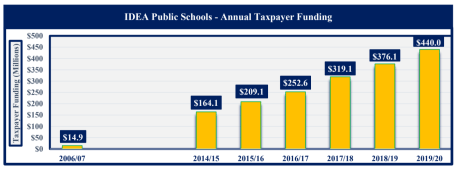
IDEA’s flexibility to expand has resulted in more and more taxpayer funding. Since its first graduating class of 25 students in 2007, IDEA’s taxpayer funding has increased from $14.9 million to approximately $440 million per year. This represents an increase in taxpayer funding of 2,853% in only 13 years.
Screen Shot 2019-09-14 at 10.14.11 PM

IDEA’s growth has also proven to be lucrative for its leadership team. As disclosed on its 2017 IRS Form 990, the Chief Executive Officer and Superintendent collectively received financial benefits totaling $968,208 in year 2017/18. In addition, 8 other IDEA administrators received financial benefits totaling between $219,070 – $466,006. On average, IDEA’s Central Office administrators have a salary of $200,249, while the statewide average salary for Central Office administrators in all Texas public schools is $102,300. 2

Other benefits for IDEA’s leadership team include free travel for family members to IDEA events and the potential use of IDEA’s private airplane secured through a long-term lease. That’s right, a taxpayer-funded “charter” school targeting underserved communities uses a private plane for “charter” flights.

Special Interests are Controlling and Directing IDEA’s Expansion – Not Communities and Taxpayers: As a privately-operated public school, IDEA’s expansion is not subject to the approval of local communities. Rather, IDEA’s expansion is controlled, directed and funded by “special interests” that desire to “privatize” public education. IDEA’s growth strategy proves this: “new regional expansions are the result of community supported education reform groups soliciting and inviting IDEA to open in their region and concurrently offering substantial startup and operational funding…”.

As shown below, IDEA has received financial commitments totaling over $150 million from private donors to expand in various regions of the State. It is important to emphasize that these financial commitments are contingent upon IDEA following the criteria specified by the donor (not parents, communities or taxpayers), which includes the opening of a specified number of new IDEA campuses in each region.

Private Donor

Commitment to IDEA

Expansion Region

Permian Strategic Partners

(Scharbauer and Abell-Hanger Foundations)

$ 55,000,000

Midland/Odessa

Charter School Growth Fund

(Gates and Walton Family Foundations)

$ 23,800,000

Rio Grande Valley

KLE Foundation

$ 23,558,800

Austin

CREEED Foundation (Hunt Family Foundation)

$ 17,000,000

El Paso

Laura and John Arnold Foundation

$ 9,500,000

Houston

Sid W. Richardson Foundation

$ 5,774,000

Tarrant County

Kleinheinz Family Foundation

$ 5,774,000

Tarrant County

Ewing Halsell Foundation

$ 5,500,000

San Antonio

Walton Family Foundation

$ 5,417,800

Tarrant County

Choose to Succeed and City Education Partners

(George W. Brackenridge Foundation)

$ 4,528,351

San Antonio


IDEA Reduces the Funding of Community-Based School Districts by an Estimated $350 Million Per Year: IDEA’s expansions are typically promoted with much publicity and fanfare. But such announcements routinely fail to mention the negative financial impact to local school districts that result from IDEA’s expansion. In this regard, Newton’s Third Law – “for every action, there is an equal and opposite reaction”, applies to education funding. In most cases, there is not any additional funding provided for IDEA to operate in communities as local public education funding is finite. As IDEA enters a community, the available funding must be divided amongst IDEA and the existing community-based school districts. In other words, the funding provided to IDEA will directly reduce the funding and ability of community-based school districts to simultaneously serve students. At this time, it is estimated that IDEA’s expansion in local communities has reduced the funding of community-based school districts by $350 million per year.

IDEA Has Lower Teacher and Principal Experience and Larger Class Sizes: Most parents likely prefer for their child to attend a school that deploys lower “student to teacher” ratios and smaller class sizes. Parents are also likely to prefer teachers and principals with more experience. But IDEA’s “education model” defies these logical preferences. According to Texas Academic Performance Reports (“TAPR”) published by the Texas Education Agency (“TEA”), IDEA’s average class size in the 3rd grade is 28.9 students or 9.9 more students than the statewide average. In addition, while IDEA publicly advertises that it has “Expert Teachers”, the average experience of IDEA’s teachers is only 1.9 years and 90.9% of IDEA’s teachers have 5 years of experience or less. In comparison, the average teacher experience for all Texas public schools is significantly higher at 10.9 years. Teacher turnover has also been historically high at IDEA with 22.1% of teachers leaving each year, which is 33.1% higher than statewide average. 3

Maybe IDEA has figured out how to achieve its promoted results with larger class sizes, lower experienced staff and higher teacher turnover. But if a child was needing to see a doctor, I think most parents would prefer a doctor with 10.9 years of experience, fewer patients and longevity within the community.

COMPARISON OF IDEA PUBLIC SCHOOLS AND STATE AVERAGE – TEXAS PUBLIC SCHOOLS

Teacher and Principal Experience, Class Size and Turnover

State Average – Texas Public Schools

Description

IDEA

Public

Schools

19.0 Students

CLASS SIZE – GRADE 3

28.9 Students

18.7

NUMBER OF STUDENTS PER TEACHER

15.1

10.9 Years

AVERAGE TEACHER EXPERIENCE

1.9 Years

37.3%

TEACHERS WITH 5 YEARS OF EXPERIENCE OR LESS

90.9%

6.3 Years

AVERAGE EXPERIENCE – SCHOOL PRINCIPALS

2.7 Years

16.6%

ANNUAL TEACHER TURNOVER

22.1%


COMPARISON OF IDEA PUBLIC SCHOOLS AND STATE AVERAGE – TEXAS PUBLIC SCHOOLS

Teacher and Principal Experience, Class Size and Turnover

IDEA’s Per Student Expenditures for Instruction and Student Services are Significantly Below Statewide Average: Like a household or a business, the expenditures of a public school can provide insight into the priorities of the school. Once again, IDEA’s unique model defies the norm. In comparison to all Texas public schools, IDEA spends:

  • ▪ 17.3% less per student on instruction;
  • ▪ 91.2% less per student on career and technical training;
  • ▪ 65.5% less per student on extra-curricular activities to supplement the education of students;
  • ▪ 43.6% less per student on students with disabilities; and
  • ▪ Zero dollars to educate students with a discipline history as such students are excluded from enrolling at IDEA.

However, IDEA does spend 99.7% more per student on “School Leadership/General Administration”. It is interesting to note that in comparison to the statewide per student average, the lower dollar amount that IDEA spends of “Instruction” is essentially equal to the higher dollar that IDEA spends on “School Leadership/General Administration”.

COMPARISON OF IDEA PUBLIC SCHOOLS AND STATE AVERAGE

Per Student Expenditures

State Average – Texas Public Schools

Description

IDEA

Public

Schools

$ 5,492

INSTRUCTION

$ 4,543

62.7%

INSTRUCTION EXPENDITURE RATIO

50.9%

$ 299

EXTRA-CURRICULAR ACTIVITIES

$ 103

$ 296

CAREER AND TECHNICAL TRAINING

$ 26

$ 75

ALTERNATIVE EDUCATION

$ 0

$ 908

SCHOOL LEADERSHIP/GENERAL ADMINISTRATION

$ 1,813

$ 174

SOCIAL WORK, HEALTH AND COMMUNITY SERVICES

$ 62

$ 1,157

STUDENTS WITH DISABILITIES

$ 652


IDEA Serves a Lower Percentage of “At Risk”, “Special Education” and “Disciplinary” Students: It is true that IDEA serves primarily “economically-disadvantaged” students. But every “economically-disadvantaged” student is unique; and some students require more attention and resources. These include students that are categorized by the State as “At Risk” of dropping-out, “Special Education” due to a physical or learning disability and those with a “Disciplinary” history.

While IDEA publicly promotes that it is “Open to All Students”, IDEA’s enrollment eligibility criteria states that it may “exclude” students with a “Disciplinary” history. In 2017/18, IDEA enrolled zero “Disciplinary” students and as such, IDEA is not really open to all students. In addition, data published by TEA demonstrates that IDEA serves a significantly lower percentage of “At Risk” and “Special Education” students than the community-based school districts from which they recruit students. While there could be many reasons for this, it may be that IDEA is designed to only appeal to a certain segment of students in the communities they operate within.

Student Description

Austin ISD

Cypress-Fairbanks

ISD

El Paso ISD

Fort Worth ISD

Ector County ISD

Northside ISD – (San Antonio)

IDEA Public Schools

At Risk

51.3%

44.7%

56.3%

77.8%

57.4%

47.0%

45.9%

Special Education

10.9%

8.0%

10.7%

8.3%

8.4%

11.6%

5.2%

Disciplinary Placement

1,140

1,131

1,049

674

555

1,374

0

IDEA Has a Small Number of Graduates and an Alarming High School Student Attrition Rate: While any high school graduate is to be celebrated, the actual number of IDEA graduates remains relatively small for a charter that has been approved by the State to expand to 83,000 students. Based upon information published by TEA, in years 2015-2017 IDEA only averaged 571 graduates, which is comparable to the number of graduates at Coronado High School in El Paso ISD.

Additionally, the high attrition rates of IDEA high school students indicate that its “educational model” may not be fulfilling the needs of all students. As shown below, 24.8% of students enrolled in an IDEA high school during years 2015-2017 did not make it to graduation. In each year, an average of 202 students left IDEA to attend another Texas public high school. In other words, only 3 of every 4 high school students graduate from IDEA as 1 of every 4 students leaves to enroll at a community-based school district or other Texas public high school.

Graduating

Class

Beginning 9th Graders

No. of Students – Transferring to Another Texas Public School

Actual Graduates

Change – 9th Graders Less Actual Graduates

Percentage Change – 9th Graders Less

Actual Graduates

2015

747

224

539

-208

-27.8%

2016

670

181

500

-170

-25.4%

2017

865

200

675

-190

-22.0%

3-Year Average

761

202

571

-189

-24.8%

IDEA Public Schools and Community-Based School Districts Targeted for Expansion

2017/18 Enollment Demographics

IDEA PUBLIC SCHOOLS

Graduation Summary and High School Student Attrition – Classes of 2015-2017

IDEA’S “100% College Acceptance Rate” is a False and Misleading Promotion: IDEA’s promoted legacy is that “100% of (Students/Seniors/Graduates) are Accepted to College” and they have even promoted in formal documents that “100% of Graduates are Accepted to the College or University of Their Choice”. But based upon the facts listed below, these promotions are simply not true and are “materially misleading” to prospective parents, many of which are “economically-disadvantaged”. 5

  • ▪ First, IDEA does not disclose that its college acceptance rate is artificially manipulated by its graduation requirements, which REQUIRES students to be accepted to a 4-year college/university in order to graduate.
  • ▪ Second, IDEA fails to disclose its high student attrition rate as 1 of every 4 students enrolled in an IDEA high school transfers to another Texas public high school prior to graduation.
  • ▪ Third, IDEA does not disclose that its number of graduates is relatively small, ranging from as few as 25 students to 571 students in 2017, and are not comparable to the community-based school districts it operates within. Statewide, over 300,000 students graduate from Texas high schools each year.
  • ▪ Third and most importantly, 125 IDEA graduates applied to a 4-year Texas college/university in years 2012-2016 and were not accepted according to latest data published by “tpeir-Texas Education Reports”,
  • ▪ Fourth, the misleading nature of the statement that “students are accepted to the college or university of their choice” speaks for itself and such a statement raises the question of IDEA’s real motivations.

IDEA Graduates Have a Lower College Graduation Rate: In recent years, IDEA has attempted to broaden its appeal by promoting its unique model and curriculum is preparing students for success in college. For example, IDEA’s Student Handbook and IMPACT Magazine that is prepared for students, parents and supporters includes the following statements:

  • ▪ “IDEA has focused on raising the achievement levels and expectations of students who are underserved so they have the opportunity to attend and succeed in college”;
  • ▪ “Since inception, IDEA has promised countless families that we will get their child to and through college”; and
  • ▪ Vision: To ensure the state of Texas reaches its fullest potential, IDEA will become the region’s largest creator of college graduates.

Despite these statements, the college graduation rate of IDEA students is significantly lower than college bound students graduating from community-based school districts in the geographic areas it serves. According to “tpeir – Texas Education Reports”, only 36.9% of IDEA’s 2012 class of 122 students that enrolled in a 4-year Texas college/university had graduated by 2017. In comparison, the college graduation rate for college-bound students in community-based school districts targeted by IDEA for expansion ranged from a minimum of 50.2% to a high of 84.1%.

Description

Austin ISD

Cypress-Fairbanks

ISD

El Paso ISD

Fort Worth ISD

Ector County ISD

Northside ISD (San Antonio)

IDEA Public Schools

Enrolled

872

1,409

1,129

525

190

1,120

122

Graduated

603

1,185

567

323

145

872

45

Graduation Percentage

69.1%

84.1%

50.2%

61.5%

76.3%

77.8%

36.9%

IDEA Public Schools and Community-Based School Districts Targeted for Expansion

Class of 2012 Enrolling and Graduating From 4-Year Texas College/University by 2017

IDEA Graduates Have Lower Success During Initial Year of Attending a 4-Year Texas College/University: There may be many contributing factors for the lower college graduation rate of IDEA students and unfortunately, poverty may be one. However, information published by the Texas Higher Education Coordinating Board indicates poverty is not the only one.

Of the 467 trackable graduates within IDEA’s class of 2018 that enrolled in a 4-year Texas public college/university, 37% had a GPA below 2.0 and an additional 21% had a GPA below 2.5 in their initial year. In other words, despite IDEA’s promoted focus on preparing students to succeed in college, 58% of IDEA’s 2018 graduates had a GPA below 2.49 in their initial year of attending a 4-year Texas public college/university. 6

Closing: As IDEA Public Schools expands in your community at the direction of privately funded “special interests” and your community relinquishes control of certain schools and taxpayer funding to the privately-operated charter, you deserve to know the facts.

To me, the facts do not support IDEA’s self-proclaimed success as many RED FLAGS appear when the “rose-colored glasses” are removed from IDEA’s promotions. In addition, the facts are very similar to the circumstances of previous attempts to “privatize” public services that failed to fulfill their promises. In this regard, the factual similarities include the promotion by “special interests”, lower expenditures to deliver public services, fewer public services, deployment of less experienced staff, higher administrative costs, employment of full-time promotional staffs and misleading advertisements, targeting of prospective customers, high turnover and the denial of service to certain customers.

But these are only my thoughts and with the future of children and communities at stake, I encourage you to do a little homework and form your own conclusions. Afterall, it’s your students, your schools, your tax dollars and your community.

DISCLOSURES: This material solely reflects the opinion of the author and the author has not been compensated in any manner for the preparation of this material. The author is a voluntary advocate for public education. The material is based upon various sources, including but not limited to, the Texas Education Agency, Texas Academic Performance Reports, tpeir-Texas Education Reports, Texas Higher Education Coordinating Board and other publicly available information. While the author believes these sources to be reliable, the author has not independently verified the information. All readers are encouraged to complete their own review of IDEA Public Schools, the material referenced herein and make their own independent conclusions.


James Hohmann of the Washington Post yesterday  described Trump’s defense when his hand was caught in cookie jar in broad daylight:

The president is running the smashmouth playbook he learned from Roy Cohn, his mentor and Joe McCarthy’s hatchet man. It’s worked repeatedly for Trump, from fighting the Justice Department’s investigation of racial discrimination at his family’s rental properties in the 1970s to overcoming Bob Mueller’s investigation the past two years. Among other things, this strategy involves denying everything and counterattacking critics by accusing them of whatever you’ve been accused of.

The don’t-give-an-inch mentality is what prompts someone like White House policy adviser Stephen Miller to declareon “Fox News Sunday” that “the president of the United States is thewhistleblower, and this individual is a saboteur trying to undermine a democratically elected government.” And it is why Trump allows Rudy Giuliani, his ferocious personal attorney, to keep defending him on television despite the messes he seems to make each time he goes on the air.

Inother words, he did it, it was the right thing to do, who cares, so what, and anyone who says he did it is a liar and a traitor and should resign or be shot.

There was a time when Norh Carolina was widely seen as the most progressive stTe in the South. That time ended abruptly when the Tea Party took control of the state in 2010 and began to decimate public services, especially public education. The Tea Party introduced charters and vouchers, killed the state’s successful NC Teaching Fellows Program for career teachers (giving its funding to Teach for America for temps).

Rob Schofield of NC Policy Watch assesses the war on public education and its ties to the Koch ideology of strangling government.

He writes:


There was a time in the United States not that many years ago in which K-12 public education was taken as a given – something as fundamental to the health and wellbeing of society as drinking water and law enforcement and public roads.

It may not have always lived up to this ideal (particularly in places where the great evil of racial discrimination and segregation held sway), but it’s fair to say that the American public school classroom was widely understood to be the glue that brought our broadly middle class society together and moved it into the future, the unifying institution that inculcated the fundamental civic values of democracy, and the place where society combated ignorance and superstition and prepared members of the next generation to build a better world.

Tragically, this began to change in the latter part of the 20th Century. In her powerful 2017 book, Democracy in Chains: The Deep History of the Radical Right’s Stealth Plan for America, Duke University historian Nancy MacLean makes a compelling argument that the advent of racial integration – and, in particular, the U.S. Supreme Court ruling in Brown v. Board of Education) – helped spur a conservative resistance movement that served to undermine the general consensus about public education.

And when this sad development was combined with two other toxic trends – perhaps most notably the aggressive, corporate-sponsored revival of dog-eat-dog, market fundamentalist economics and the explosive growth in what’s-in-it-for-me? American consumerism – it wasn’t long before prominent leaders of the American Right were referring derisively to “government schools” and treating K-12 education as a commodity in which “winners” and “losers” aggressively bargained and shopped for the best deal.

Now, add to all of this a healthy measure of obliviousness from mostly white male elites that could not and cannot see the amazing advantages they enjoy merely by virtue of their race and gender, and you’ve got a recipe for the situation that confronts North Carolina today – a time in which an entire cohort of children will soon graduate from 12th grade, having experienced nothing but declining public education budgets and a sustained ideologically-driven effort to depopulate public schools.

And while some on the political right continue to insist on paying lip service to the notion that they still support public education, a long litany of ills tells a very different story. Consider the following facts about the education system that students and educators return to this week as they begin the 2019-‘20 school year:

Actual state funding for K-12 education is down 6.7 percent (when one adjusts for enrollment growth and inflation) since the 2008-’09 school year – a time when North Carolina ranked 43rd in the nation in terms of per pupil spending and in spending as a share of Gross State Product.

Most per student funding allotments are actually down more than 6.7%. For instance, the state has 9% fewer “instructional support personnel” (counselors, nurses, librarians, etc.), 8% fewer principals and assistant principals, 36% less funding for teacher assistants, 57% less for textbooks, 56% less for classroom supplies, and 17% less for non-instructional support like custodians and bus drivers.

The state’s mushrooming charter school and voucher programs are contributing to declining public school enrollment, increased racial segregation and a pernicious situation in which children with higher incomes and fewer disabilities are “creamed” away and children with greater challenges disproportionately remain.

Despite recent modest improvements for some, North Carolina teachers still earn far less (5% less) than their college-educated, private sector peers. Only five states fare worse by this measurement.

The state faces a school infrastructure need of at least $8.1 billion.

While most states made use of the post-Great Recession recovery to rebuild their public education investments, North Carolina instead enacted a series of aggressive, multi-billion dollar tax cuts that mostly benefited the top 1% and that lowered the state’s overall funding effort (as a share of Gross State Product) to 48th in the nation. Indeed, it would take billions in additional spending just to match spending levels in South Carolina.


Register today for the Network for Public Education’s National Conference in March 2020 in Philadelphia.

Today is the last day to get early bird discounted rate. 

Great speakers, great panels, and a chance to meet the leaders of the Resistance! Including you!

This is a lovely way to usher in the New Year 5780!

Thanks to my dear friend David Berliner for sharing!

And a happy New Year, L’Shana Tova, to all!


ProPublica documents that Trump has been proclaiming his interest in the Ukraine investigation  on Twitter for months. Why are we surprised when he has told the story out loud for months?

Conspiracy theorists convinced him long ago that Ukraine—not Russia—interfered in the 2016 election, to aid the hated Hillary. He also telegraphed his belief that Ukraine leaked damaging information about Paul Manafort (accurate but that’s beside the point).

Rudy Guiliani’s trips to Ukraine were no secret.

It was all out there.

Why are we surprised?

Trump seems to believe that if you commit a crime, an indiscretion, a betrayal of your oath of office to protect the country, and you do it in plain sight, it’s just fine. If they catch you, your defense of “So what?” is good enough for his fanatical base. This is the base that Trump predicted would not care if he murdered someone in Fifth Avenue in broad daylight.

Will they now tolerate his invitation to Ukraine to smear Joe Biden?


Andrea Gabor wrote this article for Bloomberg News.

Andrea Gabor, a former editor at Business Week and U.S. News & World Report, is the Bloomberg chair of business journalism at Baruch College of the City University of New York and the author of “After the Education Wars: How Smart Schools Upend the Business of Reform.”

The College Board, which administers college entrance exams to high school students, is trying to use its advanced placement courses and tests for high-achieving students to get American schools to take civics seriously again.

That’s a welcome development after years of neglect by both schools and policymakers. Even better, last year’s redesign of its AP U.S. government and politics course — the first since it was introduced in 1986 — goes well beyond requiring basic knowledge of, say, how a bill becomes law, and seeks to get students engaged with civic life. While the academic part of the AP U.S. government course explores the diverse forces that shape everything from legislation to Supreme Court precedents, students also are required to put their knowledge into action by working on a civics project, even one that takes sides in today’s partisan political battles.

The new U.S. government AP is part of a nationwide push — both inside and outside schools — for high-school students to engage in civic debate and action. Last year, Massachusetts became the first state to require schools to coordinate student-led civics projects, though that state’s high school projects must be nonpartisan.

A civics revival is long overdue. As of 2018, only eight states required students to take a yearlong civics and government class, and only 19 required students to take a civics exam to graduate. Even the National Assessment of Educational Progress, which is considered the nation’s report card, dropped its 4th- and 12th-grade civics and American history exam, in 2014. The ostensible reason was to save money, but the NAEP then adopted a new technology and engineering literacy test a year later.

Indeed, civics fell victim to the narrowing of curricula under both Presidents George W. Bush and Barack Obama, and to the standardized testing regimen that focused on math, science and English. Worried about economic competition from China, neither Democrats nor Republicans anticipated the recent populist and authoritarian threat to Western democracies that civics education is meant to forestall.

The reality is, schools need to do both: prepare students for a global economy and to be engaged citizens in a democracy.

Putting action at the core of civics education may seem counterintuitive at a time when basic knowledge of the three branches of the U.S. government is in short supply and especially considering that college students’ activism has often been seen as controversial — think of the sit-ins at segregated lunch counters in the South during the civil rights era and the protests against the Vietnam War.

Yet the benefit of getting high-school students working on civics projects of their own choosing — even partisan ones — goes beyond tapping into the innate desire of teenagers to change the world. Having students work on new legislation or lobby their city council representatives can promote a deep understanding of local, state and federal government and provide the basis for future political engagement.

That’s especially true for immigrants and members of minority groups. Studies conducted nearly 50 years apart — including one by the American Enterprise Institute — show that civics education is especially effective both in teaching poor students and immigrants about government and in increasing their sense of political empowerment.

Students already are demonstrating the power of action civics. In Chicago, high schoolers lobbied Illinois legislators to change harsh disciplinary practices that often pushed minority students out of school and into the criminal justice system, and were instrumental in helping to draft a new school-discipline law in 2016. In New York City, minority student activists are suing the education department for equal access to athletic facilities and school teams. And schools across the country are experimenting with efforts to let students determine school spending priorities on extras such as building a greenhouse or funding a music club.

The Stoneman Douglas High School students in Parkland, Florida, may provide the best argument for a civics approach that encompasses both knowledge and action. Their gun-control advocacy since the 2018 shootings there, which killed 17 students and school staffers, was inspired by research they were already doing for both their AP government class and a district-wide debate program.

Educators also are developing ways to measure the educational value of such projects. In New Hampshire, New York City and Oakland, they have developed assessments that treat the projects like mini dissertations and often require a written report as well as an oral presentation. The AP’s civics projects, however, will count only toward a course grade and not its college-level U.S. government test; that’s in large part because most college government courses do not require projects, according to the College Board.

The biggest challenge may be to scale the efforts at action civics. Only about 281,000 public-school students take the AP U.S. government course — last year, about 30 percent of these students were African-American or Latino and 23 percent were low-income; indeed, the College Board has come under criticism recently for failing to make its tests more accessible to minority students.

States and districts also will need to resist pressures from both the political left and the right that could dilute the push for more robust civics. The movement to require ethnic studies must not be allowed to erode time and attention devoted to civics. And states that require high-school graduates to pass the U.S. citizenship test must resist the lure of a rote multiple-choice approach to civics.

Instead, embracing a meaningful civics project as part of a broader U.S. government and history curriculum may be the best way to help kids make the connection between what they learn about the nation’s political institutions and a future they can affect.

This column does not necessarily reflect the opinion of the editorial board or Bloomberg LP and its owners.

To contact the author of this story:

Andrea Gabor at Andrea.Gabor@baruch.cuny.edu