Archives for category: Education Reform

Laura Chapman is a retired arts educator and a tireless researcher. After she read a post about the disappointing history of education technology and its constant self-promotion, she wrote a post about the current frenzy to buy and build new forms of education technology for the classroom. While most parents and teachers will welcome the return to full-time, face-to-face instruction, many entrepreneurs are betting that the sky is the limit for new technologies. The market is booming!

She writes:

A February 14, 2021 report from EdSurge Biz is all about a deluge of venture capital pouring into the edtech industry and with high hopes of getting a big return on their dollars. In the span of only two days three transactions for US edtech companies totaled over $1 billion. An example of big deals and high hopes is Renaissance’s $650 million acquisition of Nearpod.

Renaissance enables one-click use of ClassLink and Clever. More than 13,000 schools use the Renaissance performance tracking dashboards assembled as “myIGDIs“ (Individual Growth & Development Indicators) for early childhood. The indicators are displayed in colorful dashboards. These displays show at least one “kindergarten readiness score” for early literacy, numeracy, and social-emotional development.

Renaissance also markets “Star” assessments with a claim that these are “highly predictive of performance on state and other high-stakes tests.” There are Star tests for Early Literacy K-3; Literacy growth, K–12; Math for grades 1 to 12; Star elementary school “Curriculum-based tests” in reading and math; Bilingual tests for reading, math, and early literacy for emerging bilingual students… and more (custom tests). https://www.renaissance.com/products/star-assessments.

Renaissance’s acquisition of the Nearpod platform provides a way for teachers to upload and distribute digital lessons in the form of interactive slide decks. The platform also tracks student progress and interactions with the materials.

Nearpod has since expanded this “toolbox” with features that let teachers create quizzes, offer virtual reality content for digital field trips, and embed mini-games into lessons. There is also a library of over 15,000 pre-made lessons from third-party providers including Amplify, Desmos, iCivics and Teaching Tolerance. In 2020, an estimated 19.5 million lessons were taught on Nearpod, marking a six-fold increase from the previous year, according to its CEO Pep Carrera.

“The pandemic really accelerated the need for teachers to find ways to continue doing things that were once easily done in classrooms,” he said in an interview. Today, the platform is used by 75 percent of all U.S. public school districts. Nearpod offers some of its content and tools for free and sells licenses to individual teachers, schools and districts. see  https://www.edsurge.com/news/2021-01-13-a-record-year-amid-a-pandemic-us-edtech-raises-2-2-billion-in-2020

Other deals

HOBSONS SPLIT AND SOLD: Hobsons, a provider of college planning, readiness and enrollment tools since 1974, will be broken up and sold. PowerSchool will be acquiring its college and career-planning tools, Naviance and Intersect; EAB will purchase the student engagement service, Starfish. These two are expected to net Hobson’s owner $410 million.

CODECADEMY COMEBACK: Long before coding boot camps were a thing, there were startups like Codecademy building web-based tools to teach programming. Now, a decade after it launched, the New York-based company continues to grow, selling to colleges and companies and—perhaps most importantly—achieving profitability. That long, steady growth has been rewarded with a $40 million investment led by Owl Ventures”

Kahoot, the Norweigian provider of a game-based learning platform, has acquired Whiteboard.fi, a Finnish developer of digital whiteboard tools for teachers and students, in a deal worth up to $12 million.

Photomath, a San Francisco-based developer of a math problem-solving app, has raised $23 million in a Series B round led by Menlo Ventures, and joined by GSV Ventures, Learn Capital, Cherubic Ventures and Goodwater Capital.

Praxis Labs, a New York-based provider of virtual-reality educational programs for workplaces, has raised $3.2 million in a seed round led by SoftBank’s OB Opportunity Fund, and joined by Norwest Venture Partners, Emerson Collective, Ulu Ventures, Precursor Ventures and Firework VC.”

These ventures dismiss the need for face-to-face deliberations about education and from early childhood to college readiness. Many focus on the required subjects for tests and capitalize on the high stakes attached to test scores. They have contributed to the truncated curriculum in schools. Most substitute “artificial intelligence” and marketing for the work of professionals in education.
Julian Vasquez Heilig, Jameson Brewer, and Frank Adamson have written a peer-reviewed analysis of the politics of school choice. As Heilig wrote in his description of the analysis, “Modern notions of “markets” and “choice” in schooling stem from the libertarian ideas Milton Friedman espoused in the 1950s. Considering the underlying politics of school choice, it is important to examine the ramifications of neoliberal and collective ideology on market-based school choice research. In this chapter we point out that much of the research suggesting positive findings is continually conducted and promoted by neoliberal ideologically-driven organizations.” I would add to their analysis that Milton Friedman was not the sole originator of the ideology of “school choice.” As I wrote in the New York Review of Books, Friedman shares that dubious distinction with white Southern politicians who were adamantly opposed to the Brown decision and desegregation.

Nancy Bailey is a retired teacher and a terrific blogger. She and I co-authored a book called EdSpeak and DoubleTalk: A Glossary to Decipher Hypocrisy and Save Public Schooling. We have never met in person but I asked her to help me revise a similar book that I published a decade earlier; it had become obsolete. Now it is the go-to book to understand education jargon and decipher hoaxes. It was a joy to work with her. Nancy wrote this post for me while I was out of commission having surgery.


Why I Write About Students and Public Schools

Democratic Public Schools

Ensuring that the public has access to good public schools after Covid-19 is more critical than ever. We cannot go back to continuous high-stakes testing and schools that punish teachers and students, especially our youngest learners. Schools should also not be allowed to continue to collect unregulated data through online assessments. Parents need stronger FERPA laws. 

I think we have also learned with this pandemic that parents and students value public schools, that technology is a tool but can never replace the classroom.      

Americans own our schools through a democratically elected school board, or at least we should. We lose that ownership when outsiders with ulterior motives to privatize or change schooling’s nature make schools more like a business. They convert the system to charter schools or change curriculums to serve companies that will make money on the school district’s new plan.

The more involved corporations become with public education, the more changes occur within public schools. Common Core, high-stakes standardized tests, the reliance on AP classes and SAT and ACT testing from the College Board, and many tech programs convert public schooling to a privatized system. 

It is crucial to protect public schools from individuals or corporations who wish to remove the “public” in public schools. Parents should be able to be involved in how their schools function. We need parents, teachers, and the community to be active participants in how public schools serve children bringing Americans together. 

School choice fans believe parents should choose their school, but this is a false argument. Most private school administrators will determine who to accept to the school. Charter schools may choose students by lottery, which is not parent choice either. Even if a student is randomly selected, charter schools can always counsel students out.

Charter schools were initially supposed to be for teachers to run. The charters doing the best jobs are likely run by or highly influenced by real teachers. But many charters are run by Educational Management Operations (EMOs) that set the rules and are prone to scandal. For years, charter schools have primarily served children of color, often with harshly run curriculum and punishing discipline. 

It is hard to see why America needs two systems of education. It further divides people, and charter schools are still substandard to a well-run public school system. Charters that work, run by real teachers, could become alternative schools in a public school system.  

Helping students work together in public schools—students with all kinds of backgrounds and students of color—will bring us together as a nation. The diversity in our country should be cherished, not destroyed by privatization. 

When public schools are valued, when school boards are elected and work with the constituents to better schooling for all children, it is the best that democracy can be. We must afford every child a chance to learn in a well-managed, excellently staffed public school. 

Teaching

I learned to be a special education teacher in the seventies when the All Handicapped Children Act of 1975 became law. It was amazing to see schools open their doors for all children, and universities begin offering specialized classes for different special education areas. I saw it as a shining moment in America.

My undergraduate degree was to teach students with emotional disabilities, with a minor in elementary education. I took challenging coursework. My student teaching took place at one of the best residential treatment centers in the nation, Hawthorn Center, along with an elementary school near Detroit where teachers worked well together, especially in reading. 

Hawthorn Center has struggled with funding since I student taught there, yet many parents desperately search for residential treatment. The elementary school where I student taught closed long ago. I struggle to understand this.  

In the meantime, Teach for America claims that you can teach with five weeks of training, or maybe it is six weeks now. Many from this group go on to lead schools in states and the nation when they never had the kind of preparation necessary to teach children! 

Writing

I write about these issues and more. It is sometimes overwhelming that public schools have so many concerns and how children and teens face such hurdles to get good schooling in America. There is no reason why this country should not have the best public school system in the world for all children!

Please join me and the Network for Public Education in calling for an end to the federal Charter Schools Program. For the past four years, it functional as Betsy DeVos’s personal slush fund. She handed out $440 million a year, mostly to corporate charter chains.

Two studies by the Network for Public Educatuon combed through the records of the CSP and found that nearly 40% of the schools it funded never opened or closed soon after opening. The hundreds of millions the charter industry received were never returned.

Carol Burris wrote:

It is time for a moratorium on the federal Charter Schools Program (CSP). As Congress prepares the next budget, we need to let members know enough is enough. END CSP FUNDING

Right now, there are bills in seven states that would either establish charter schools or greatly expand them. This is in addition to additional bills to expand vouchers.

Right-wing Libertarians, funded by DeVos and the Koch network, are committed to destroying public education. And while they may prefer vouchers, charter schools are certainly part of their plan.

Send your email here

Here is the bottom line. The federal government should not be in the business of funding new charter schools, and as our two reports on the CSP demonstrate, the CSP program is rife with waste and abuse–funding schools that do not open, those that open and shut down, and those with policies designed to exclude disadvantaged students. As our latest report on for-profits shows, the CSP has generously supported the start-up of for-profit-run schools as well.

Send your email and then call your representatives in Congress. You can find your Representative’s phone number here and your Senators’ numbers here.

Below is a script you can use.

My name is [name], and I am calling to ask [Representative] to eliminate funding for the Charter Schools Program in the 2022 budget. The program has wasted approximately one billion dollars on schools the never opened or that have shut down. 

In addition, it lacks quality control and real accountability. It has funded charter schools run by for-profits, schools that do not participate in the federal lunch program, and schools that make special education students unwelcome. The program should be defunded in 2022. Thank you.

Please act today.

You can share our newsletter with this link: https://npeaction.org/cspmoratorium/

Thanks for all you do,

Carol Burris

Network for Public Education Action Executive Director

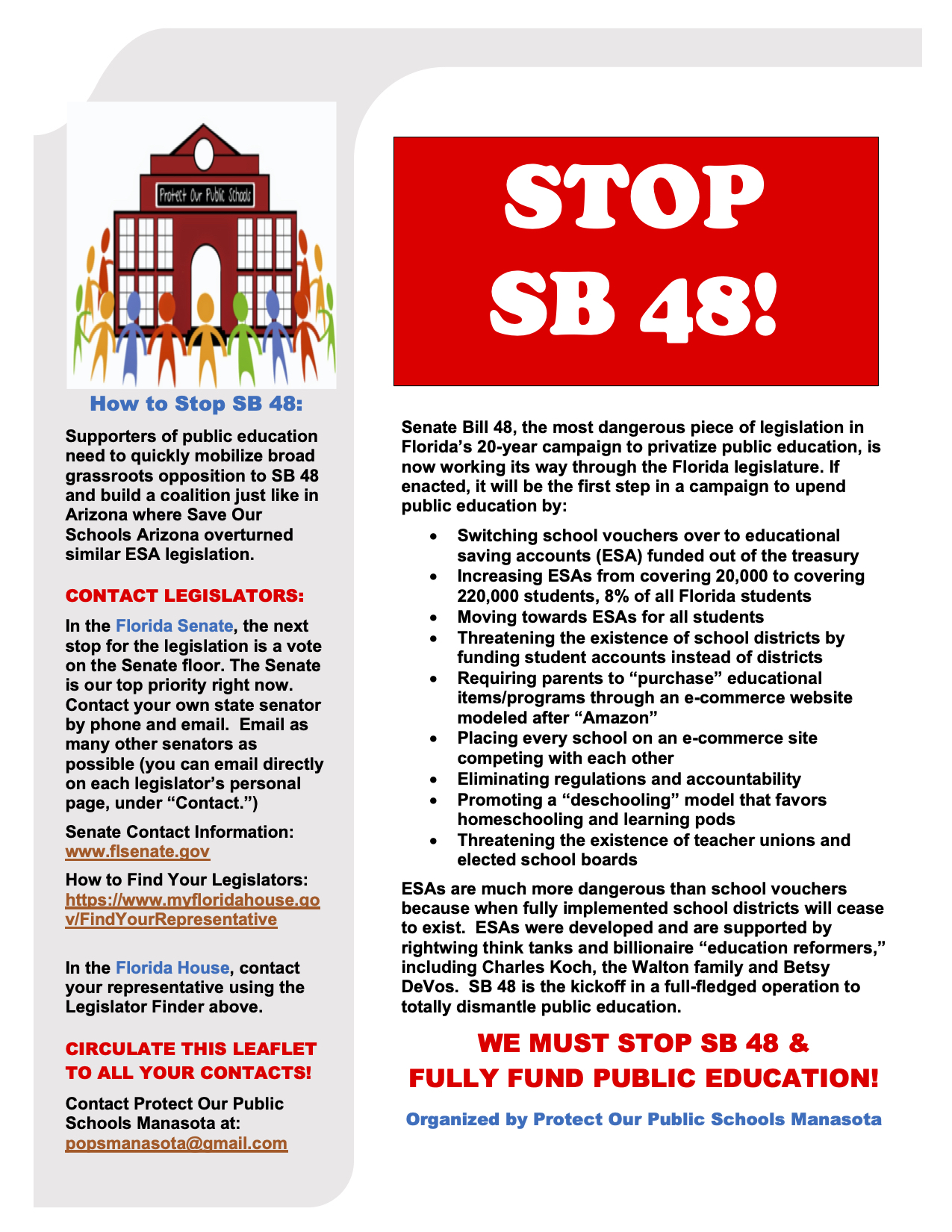
The privatizers are on the move again in Florida. They want to send billions more to unaccountable, low-quality voucher schools. They will take money away from your public schools to pay for vouchers for religious schools where students are not required to take state tests and teachers are not required to be certified. Stop the Steal of public education!

Carol Corbett Burris was a teacher and principal on Long Island, in New York state for many years. After retiring, she became executive director of the Network for Public Education.

She writes:

Last spring, HBO released Bad Education, which tells the story of how a Roslyn, New York Superintendent named Frank Tassone conspired to steal $11.2 million with the help of his business officer, Pamela Gluckin.  Promo materials called the film “the largest public school embezzlement in U.S. history.”

I did not watch it. I am waiting. I am waiting for HBO to release a movie on how a crafty fellow from Australia, Sean McManus, defrauded California taxpayers out of $50 millionvia an elaborate scheme to create phony attendance records to increase revenue to an online charter chain known as A3. 

Or the documentary about the tens of millions that the Electronic Classroom of Tomorrow (ECOT) owes taxpayers for cooking the books on attendance. Or perhaps there will be a mini-series about the fraud and racketeering that charter operator Marcus May engaged in that brought his net worth from $200,000 to $8.5 million in five years and landed him a 20-year sentence in jail. 

The truth is, Frank Tassone and his accomplice are small potatoes compared to the preponderance of charter school scandals that happen every day. What is different is how lawmakers respond. 

When the Tassone case hit the news, I was a principal in a neighboring district. The New York State Legislature came down hard with unfunded mandates on public schools.

We all had to hire external auditors and internal auditors that went over every receipt, no matter how small. Simple things like collecting money for field trips or a club’s T-shirt sale suddenly became a big deal. Although there was no evidence that any other district was engaging in anything like what happened in Roslyn, every district transaction came under scrutiny.

Whether those regulations and their expenses were justified or not is irrelevant. What is relevant is that despite the years and years of scandal in the charter sector, state legislatures never change laws or impose new rules. For-profits run schools doing business with their related companies behind a wall of secrecy, and lawmakers do not worry a bit. 

I am puzzled. Why can’t charter schools be as transparent as public schools?  Why is the ability to easily engage in fraud necessary to promote innovation? 

No one has been able to answer my question yet. 

In New York, several school districts announced an “opt in” policy for state testing, led by the Ossining School District. The deal: If parents want their children to take the tests, they must write a letter asking for them to “opt in.” Other districts followed. Now the entire state of New York will allow districts to have an “opt in” policy. If parents want their child tested, it will be done. If they don’t, they don’t have to “opt out” or do anything. Some districts may prefer to stick with the old way of requiring everyone to take the tests.

This is a remarkable turn of events!

The U.S. Department of Education has denied waivers to states that don’t want to administer the tests. This was an incredibly tone-deaf decision that brought an outcry from educators and parents, who know it is unfair to administer standardized tests in the midst of a pandemic. During the campaign, candidate Joe Biden promised to get rid of the annual standardized tests. But his test-happy minions in the Department of Education issued a decision breaking his promise, even before Secretary Cardona was confirmed. He has had to explain and try to justify an very bad decision.

May New York’s Opt-In strategy travel far and wide!

This is terribly sad news. Last night, Elizabeth Davis, president of the Washington Teachers Union, was killed in a car crash. She was 70 years old.

Cameron Vickrey is associate director of Pastors for Texas Children. In this opinion article published in the San Antonio Express-News, she asks the important question: What’s the end game with the privatization push? Texas has 5 million children in public schools, and about 356,000 in charter schools. The drive for vouchers has been blocked thus far by parents, the Pastors, and a legislative combination of rural Republicans and urban Democrats. But Texas is now ground zero for the charter lobby. Why? Betsy DeVos is one reason: As U.S. Secretary of Education, she poured hundreds of millions of dollars from the federal Charter School Program into corporate chains in Texas, such as IDEA and KIPP. And, Texas has its own home-grown billionaires and libertarians eager to destroy the public schools.

She writes:

Let’s have a serious conversation about the purpose of school choice.

A recent Senate Committee on Education hearing in the Texas Legislature revealed a fundamental divergence in our state’s philosophy of education. One senator admitted proudly the reason Texas has charter schools is to provide “pure choice.”

Pure choice is not the prevailing narrative that we have been told. Many public school supporters have made concessions for charter schools so kids who are “stuck in failing schools” have an affordable alternative. But now we know this is not the end game. The end game is simply choice.

The theory behind pure choice is a commodified system of schools, where each school competes against the others in a marketplace. Expensive “edvertising” is used to convince us our kids will get ahead in life if we choose a certain school. Schools will intentionally attract certain kids — not all kids — to boost their test scores and outcomes, making it look like they are winning in the business of education. We will lose the value of education that our traditional school system provides, as part of a democracy, as a public good.To parents whose kids are happily enrolled in charter schools, good for you. I do not begrudge you that choice, and I wish your child a successful and fulfilling education. Having choices in education is not the problem. The problem is the deregulated free market, resulting in too much choice that ends up diluting all schools— including charters.

Back to the hearing. In the witness chair sat a superintendent of a large suburban school district. He testified against Senate Bill 28, explaining it would allow for a proliferation of charter schools without regard to their impact on his district. He told of his district’s loss of revenue because of students leaving his schools for charter schools.

Some senators on this committee — whose responsibility it is to understand the basic formulas of public school finance — were either incapable or unwilling to comprehend the superintendent’s testimony.

A senator insisted that if tax dollars follow the child to the charter school, then it stands to reason that the district has one less child to educate and therefore requires that much less money. The superintendent politely explained that one less child reduces revenue, but he cannot reduce expenditures to make up for the loss.

If you have trouble following this line of thinking, consider: Five students leave a public school for a charter school. Their tax dollars (let’s say, $1,000 each) follow them to that charter school. So now the public school will receive $5,000 less. But the students were spread out across five grade levels and two schools. So the superintendent cannot reduce overhead costs by $5,000. The superintendent cannot cut back on air conditioning or eliminate a teacher. The budget cuts will come in special services such as libraries, art, music, languages and all the other things that make schools good.

What’s more frustrating is that many charter schools are promising to provide these special services and programs that the neighborhood public school can no longer afford to provide.

So, yes, senators, this is an inconvenient truth. We know you want to create a system of pure choice, where each institution only has to look out for itself, “be the best it can be,” as state Sen. Paul Bettencourt has said. But that only works in a fair competitive market. We are not seeing a fair marketplace. And too many bills this session would like to give charter schools even more of an edge, thereby disadvantaging traditional schools.

We cannot sustain two parallel systems of publicly funded schools with our tax dollars. And I think our senators know this. This is the real end game of their pure choice system.

I would like to tell our senators: Try marriage before divorce. You have not stayed true to your vows to make suitable provisions for our existing public school system. Stop flirting with so many charter schools and the idea of a no-strings-attached marketplace for education, and do the work of tending to your marriage.

Cameron Vickrey is the associate director for Pastors for Texas Children. She also co-founded RootEd, a local parent-led advocacy group for public schools.

Maurice Cunningham is professor of political science at the University of Massachusetts. He specializes in unmasking Dark Money groups.

He writes:

Radical Right Ramps Up War on School Boards, Superintendents, Principals, and Teachers

A new professedly “grassroots” group called Parents Defending Education has joined the right wing assault on public education. It combines white supremacy with a vicious plan to launch personal attacks on elected officials, administrators, and teachers. Just another day in corporate education reform.  

This group says it is fighting to restore “healthy, non-political education for our kids.” What they mean is anything that critically examines America’s racial history or present. 1619 is out, Trump’s 1776 project to promote “patriotic education” is in. Ibram X. Kendi and anti-racism? Definitely out. Wally and the Beav, in. 

Parents Defending Education is a campaign to direct and manage attacks on educators who candidly raise questions of race and the need for work and sacrifice to place America on the road to racial progress. When I first saw Parents DefendingEducation’s website my thoughts immediately turned to an extremist front named Campus Reform. It’s a slime factory funded by Charles Koch and other billionaires that gins up attacks on college professors—especially those who research and write about race. Professor Isaac Kamola of Trinity University has written an essential piece on intimidation campaigns in the Journal of Academic Freedom, Dear University Administrators: to Protect Your Faculty from Right-Wing Attacks, Follow the Money.

Most attacks are leveled against faculty of color, or those whose research and teaching focuses on issues of race. Most start with a handful of organizations explicitly created to monitor and intimidate college faculty (most prominently Campus Reform and the College Fix); from there they travel to sympathetic right-wing websites and news outlets (also created by activist donors committed to undermining public institutions like universities), before arriving at Fox News. Most attacks that gain traction involve college administrations sanctioning faculty and condemning their speech.

University administrators hear from legislators, alumni, local media, parents, etc. The professor attacked gets inundated with hateful email, phone calls, and social media attacks, including physical and death threats. Professors have had to cancel lectures; Trinity College closed down temporarily due to threats. 

Campus Reform pays student “investigators” to inform on professors who raise what they see as controversial topics. (In one case I’ve worked on, a video tape was obviously edited. That failed to move administrators). 

Parents Defending Education is asking parents to inform on their school boards, administrators and teachers. Here’s a sample from its Expose page:

These are not easy topics: the indoctrination of children with divisive ideas, the hijacking of our schools, the politicization and corruption of our educational systems. That’s why it is critical to expose what is going on in our classrooms and school systems. There’s a reason people say sunshine is the best disinfectant.

At Parents Defending Education, we’re dedicated to investigating and exposing what’s happening inside our schools, and one of the best ways is to follow the money.

Let me just pause here and issue the “Parents Defending Education Follow the Money Challenge”: who is funding you, Parents for Education?

From the Engage page:

Why are our schools adopting destructive and radical “woke” curricula

In order to begin reclaiming your school, you and other like-minded parents should also get organized. There many steps that you can take, from asking a question at school up through launching your own local parent organization. Below are some resources we’ve developed to help you get started — from using social media to expose what your school is doing to pitching stories to the media to asking tough, public questions of school officials. Everything you do helps to create accountability and oversight.

Here’s a page for you to report an incident to Parents Defending Education. Why, the group might even include you in their litigation campaign!

Yes, you can not only trigger online intimidation and threats of physical harm on school board members, superintendents, principals, and teachers, but litigation too! Here’s a link to a civil rights complaint Parents for Defending Education filed against the superintendent of the Webster Groves School District of Webster Groves, Missouri. The key language from Parents Defending Education’s president Nicole Neily (Sourcewatch reports that “Nicole Neily has worked for many Koch-affiliated groups”):

Attached to this complaint is supporting evidence in the form of a blog post written by the District’s Superintendent, John Simpson, on June 3, 2020. Simpson’s post asserts that that “inequitable systems and structures” exist “within our school district.” “

Those inequitable systems and structures disadvantage “Black children,” according to Superintendent Simpson, and “[c]learly” require “much” more work to dismantle.

And what was the occasion of Superintendent Simpson’s blog post that so enraged Ms. Niely? His heartfelt response to the police killing of George Floyd. I can’t make this up.

School board members, superintendents, principals, teachers, this is coming your way. I can’t predict the entire course of these attacks but I can tell you this: they’ll be well funded, with dark money.

[Full disclosure: as an educator in the UMass system, I am a union member. I write about dark money (and other things)].