Archives for category: Education Industry

Journalist Nora de la Cour describes the dire situation in Wisconsin, where incumbent Governor Tony Evers is in a close race with an election denier/school privatizer, Tim Michels. There are many other states where education is on the ballot. Wisconsin was once known for its great public schools and public universities. Former Governor Scott Walker declared war on both. Twenty-five years ago, the far-right Bradley Foundation funded the voucher movement in Milwaukee, which has spread to other parts of the state and to other states. The Trumpist base of the Republican Party has declared war on public schools, based on lies and fantasies spun by rightwing think tanks.

She begins:

New research finds that market-style education reforms, like those pioneered in Wisconsin decades ago, have devastating consequences for students. This election, Wisconsin and the rest of the nation must choose whether to plow ahead or reverse course.

Wisconsin’s Democratic governor Tony Evers is neck and neck with his challenger, Trump-endorsed Tim Michels, whose campaign has lauded abortion bans, election denialism, and a beefed up carceralpolicestate. Robert Asen, who studies political discourse at the University of Wisconsin, Madison, told Jacobin that because education has gotten relatively less airtime, it is “a bit of a stealth issue analogous to [labor law in] Scott Walker’s 2010 gubernatorial campaign,” which didn’t prepare voters for Walker’s vicious attacks on workers. But make no mistake: this election will determine the existential future of K-12 schooling in the state.

Following the now-familiar Chris Rufo playbook, Michels plans to sign a restrictive “parents’ rights” bill and move up the timeline on a universal school choice plan that would destroy what’s left of Wisconsin’s once-great public schools. Formerly the state’s superintendent of public instruction, Evers has pledged to increase school funding and prioritize the public system. In reality, though, even if Evers prevails he’ll at best continue to be “the man of a thousand vetoes,” given that Republican opposition will prevent him from pursuing his agenda. So as Marquette University senior fellow and veteran education reporter Alan Borsuk put it when speaking to Jacobin, this governor’s race amounts to a choice between treading water and veering hard right.

In many ways, Wisconsin blazed a trail for the rest of the country with market-style reforms that increase competition by weakening teachers’ unions and privatizing schools. Decades later, researchers have mapped the devastating impact of these reforms on Wisconsin students. So, as voters across the United States face grave education questions up and down the ballot, it makes sense to look back at what’s happened in the Badger State.

Please open the link and read this important article.

Back in 2014, a prominent charter school leader in Connecticut resigned after it was revealed that he had been convicted of felonies many years earlier, and that he did not have a doctorate, although he claimed he did. Michael Sharpe resigned as CEO of Jumoke Academy, which ran charter schools in Connecticut and planned to expand to Louisiana.

Sharpe was part of a management organization called Family Urban Schools of Excellence or FUSE, created in 2012. The state had given millions of dollars to Jumoke to take over low-performing schools and turn them around.

The controversy over Sharpe was embarrassing to Democratic Governor Dannell Malloy, who was a cheerleader for charter schools. Malloy chose Stefan Pryor to be the State Commissioner of Education. Pryor had no experience in the classroom but was a co-founder of the no-excuses charter chain Achievement First. Charter schools in the state were allowed to have only 30% of their staff with state certification. The charter industry was strong in Connecticut due to the financial power of hedge funders and the Sackler Family (of opioid fame), which launched Conn-CAN, a charter advocacy group, which became the national 50CAN.

But the biggest scandal of all came to light in the past week, when the same Michael Sharpe was convicted of breaking into the homes of four women in 1984, kidnapping them, threatening the women with a firearm, sexually assaulting them, then stealing money and valuables.

Sharpe was convicted of kidnapping and faces a sentence of 25-100 years in prison. The statute of limitations had expired on the sexual assault charges. Sharpe’s DNA was found at the four scenes. The case was solved by the state’s cold case unit.

Back in the days of his charter fame, the Center for Education Reform identified him as a national leader.

Dr. Sharpe is president of the Connecticut Charter School Association and founding member of the Legacy Project and Family Urban Schools of Excellence (FUSE). He also sits on the boards of the National Charter School Leadership Council, St. Agnes Home, Inc., the CT Chapter of Lupus Foundation of America and Connecticut Landmarks.

Dr. Sharpe began work at Jumoke Academy in 1998 and was appointed its CEO in 2003. Under his leadership, Jumoke Academy’s middle and elementary schools were cited for three consecutive years as one of the top ten performing urban schools in the State of Connecticut.

Jumoke Academy is committed to developing the whole child, and as such, offers programs that ensure our children become competent in the arts, humanities, civic and social responsibilities, and that they understand the value and importance of good character.

In 2015, after Sharpe had resigned, civil rights attorney Wendy Lecker wrote about the strange trajectory of Jumoke Academy, FUSE, and Michael Sharpe.

Earlier this month, the Connecticut Department of Education quietly distributed a scathing investigative report on the Jumoke/FUSE charter chain, conducted by a law firm the department retained. The report reads like a manual on how to break every rule of running a non-profit organization.

The investigators found that although FUSE and Jumoke were supposed to be two separate, tax-exempt organizations, both were run by Michael Sharpe alone. FUSE, formed in 2012, never held board of directors’ meetings until after the public revelations in the spring of 2014 of Michael Sharpe’s felony record for embezzlement and falsification of his academic credentials. FUSE entered into contracts with the state to run two public schools without approval by its board. In fact, it is unclear that FUSE even had a board of directors then. Jumoke, too, played fast and loose with board meetings. Jumoke’s board gave Sharpe “unfettered control” over every aspect of the organization. Even after he left Jumoke for FUSE, Sharpe still ran Jumoke, leaving day-to-day operations to his nephew, an intern there.

Hiring and background checks were in Sharpe’s sole discretion. He placed ex-convicts in the two public schools run by Jumoke, Hartford’s Milner and Bridgeport’s Dunbar. Dunbar’s principal, brought in by Sharpe, was recently arraigned on charges of stealing more than $10,000 from the school.

Nepotism was “rampant.” Sharpe’s mother founded Jumoke. Sharpe moved from paraprofessional to CEO in 2003, with no additional training. His unqualified daughter and nephew were hired, as well as his sister.

The investigation found extreme comingling of funds and of financial and accounting activities, noting that it “would be difficult to construct a less appropriate financial arrangement between two supposedly separate organizations.”

Jumoke/FUSE used state money to engage in aggressive real estate acquisition, some not even for educational purposes, and some inexplicably purchased above its appraised value. Properties were collateral and/or were mortgaged for one another. Loan rates were excessive. To date, loans are guaranteed by FUSE, which is not operational.

Jumoke leased Sharpe part of a building who, violating the lease, sublet it and collected rent. Sharpe hired Jumoke’s facilities director’s husband to perform costly renovations on the parts of the building, his bedroom and bathroom, paid by Jumoke.

These are just some of the misdeeds that occurred without oversight by the State Board of Education or the State Department of Education. The board approved contracts to run two public schools without verifying that FUSE had no board of directors. It approved millions to be paid to FUSE/Jumoke to buy non-educational buildings, charge excessive consulting fees to public schools and engage in possibly fraudulent activities. Worse still, the board allowed Jumoke/FUSE to run Milner schoolinto the ground, jeopardizing the education of Milner’s vulnerable students.

“Dr. Sharpe’s” Linked-In profile has not been updated. It’s very impressive.

The Walton Family Foundation has poured hundreds of millions, possibly billions, into privatizing America’s schools via charter schools. It recently announced that it would add another $100 million, in alliance with the PNC bank, to enable charters to grow.

The curious aspect of Walton’s devotion to charter schools is its complete indifference to the failures, poor performance, scandals, and frequent closures of charters.

Clearly the foundation has a goal that is unrelated to performance or success. The funders criticize public schools for poor performance, but in many states, the public schools outperform the charter schools. Nonetheless, Walton keeps pouring in more money.

Its goal seems clear: not to provide better opportunities for kids, but to undermine and disrupt public schools.

If they cared about students, the Waltons would pour hundreds of millions into improving public schools, which enroll 85-90% of American students.

Jeanne Kaplan served two terms as an elected board member in Denver. She has watched the board’s frenIed embrace of “reform” with dismay. open the link and read the full article, which appears on her blog. I am not putting the post into italics since she uses italics.

She writes:

Reap what you sow and the chickens come home to roost. The elephant in the room.  Aphorisms appropriate to describe what is happening in public education in Denver. 

After 20 years,  more than 5  superintendents, and 11 different school boards, the results of education reform in Denver have become clear, and they aren’t pretty. After opening 72 charters in the last 20 years, 22 of which have closed, the declining enrollments in neighborhood schools have forced the prospect of school closures.  Who knew opening 26 privately run elementary charter schools in competition with district-run schools would ultimately force the district to make some hard financial decisions?  And who knew that ignoring its own 2007 data showing stagnant population growth would lead to less demand for elementary school seats in the 2020s?  Apparently, not those with the power for the last 20 years.  And, as an ironic aside, many of the same people who were the decision-makers in the past and who were unable to make substantive change then, have now decided they will somehow make these previously unattainable changes from their outside “oversight” committee, EDUCATE Denver. In fact one of the co-chairs, Rosemary Rodriguez, was a DPS board member when on March 16, 2017, a Strengthening Neighborhoods Resolution passed, stating:

NOW, THEREFORE, BE IT RESOLVED, that a citywide committee be formed to review changing demographics and housing patterns in our city and the effect on our schools and to make recommendations on our policies around boundaries, choice, enrollment and academic programs in order to drive greater socio-economic integration in our schools.

BE IT FURTHER RESOLVED, that in the face of the sharp decline in the number of school-aged children in gentrifying neighborhoods, the committee is also charged with how to think about school choice and school consolidation to ensure that our schools are able to offer high-quality, sustainable programs for our kids.

These former school board members and former and current civic leaders have formed a “shadow school board” to evaluate and oversee the current superintendent and school board.  Why?  It appears they don’t like what they are seeing being proposed by the current superintendent. What don’t they like?  It appears they have determined the current superintendent is not committed enough to their reform agenda.  You know – the one that has been in place when they were in power, the one that has produced the biggest gaps in the nation, more segregation, and more resource inequity.

As school closures have risen to the fore this week Chalkbeat disclosed these statistics:

“Over the past 20 years, Denver Public Schools has added a lot of schools. It has added students, too — but at a much slower rate.

  • The number of public schools in Denver grew 55% between the 2001-02 and 2021-22 school years, while the number of students grew just 12%.
  • Denver went from having 132 schools serving about 72,000 students in 2001-02 to 204 schools serving nearly 89,000 students in 2021-22.
  • The number of elementary schools in Denver grew 23% over the past 20 years, while the number of students grew just 4%.”

Through expensive marketing and often false narratives, charter schools have had free reign to prey on susceptible families resulting in DPS losing 7400 elementary school students who would have otherwise most likely attended a neighborhood school. Then add in:

  • a state law that prohibits a district from shutting down low enrollment charters, 
  • a district that has ignored demographic information predicting declining enrollment, 
  • a district that employs “attendance zones” and a secretive CHOICE system to often force place students into heavily marketed, often unwanted CHARTER SCHOOLS, and 
  • a competitive financial model called Student Based Budgeting (SBB – money follows the kid) to fund schools, depending on student needs, the goal of which is to close the achievement and resource gaps.

Preston Green, Ed.D, is the John and Maria Neag Professor of Urban Education at the University of Connecticut. He delivered these remarks as part of the Graduate Schools of Education’s annual Barbara L. Jackson, Ed.D., lecture. Green is a specialist on the subject of education and the law. He warned that charter schools without sufficient oversight may actually threaten students’ civil rights. For the protection of students, charter schools must be regulated by government.

A common refrain from education advocates is that school choice is “the civil rights issue of our time.”

Green began by acknowledging that charter schools, which are not subject to all the rules and regulations of local education departments, but are funded by taxpayer funds, are not only a fundamental part of the landscape, but are expanding.

In the United States, there are 7,500 charter schools in 45 states and the District of Columbia, serving 3.4 million students. Although the rules governing the schools vary widely across the country, there are three general areas where many of them fall short, he said.

They are the loss of civil rights, increased stress to fiscally strapped districts, and predatory contracts.

When it comes to civil rights, Green said, marginalized groups should remember one thing: “They can’t keep you out, and they can’t drum you out,” he said.

Families should know, he said, that they are protected by federal statutes that all schools, be they public, charter, or private, must follow. They include Title VI, which prohibits discrimination against a person based on their race, ethnicity, of national origin; Title IX, which protects against discrimination based on sexual orientation and gender identity; the Equal Educational Opportunities Act, which protects English Language Learners; and the Individuals with Disabilities Act and Section 504, with both protect students with disabilities.

A Key Protection That Needs Attention

To those, Green added the Equal Protection Clause of the U.S. 14th Amendment, and the Due Process Clause, which provides a student who may be suspended or expelled the right to be alerted to the charges and given an opportunity to plead their case. Although charter schools fulfill the first five, Green said it’s an open question whether they fulfill these last two, as public schools do.

As an example, he cited Peltier v. Charter Day School, an ongoing case in North Carolina that has received split rulings in federal court and may be resolved by the U.S. Supreme Court. The school has a strict dress code that says girls must wear skirts and boys must wear pants, a provision that Green said would be a clear violation of the equal protection clause because it discriminates on the basis of sex. The school argued that it is not legally a “state actor,” though, and should be exempted from the clause in the same way that private schools are.

This has major implications for Black students, he said, because some schools have policies forbidding Afrocentric hair. The good news is, he said, is that there are 27 states that prohibit charter schools from violating students’ equal protection rights.

“I would argue that all states need to adopt this type of language to ensure that the civil rights of students are provided for,” he said.

Addressing the Financial Impact of Charters

When it comes to increased stress to fiscally strapped districts, Green made the case that both urban and rural school districts often suffer financially when charter schools are established. In the Chester Upland School District, just outside of Philadelphia, he noted that the district faced a $22 million deficit at the same time that charter schools in the district were being given $40,000 a year for every special education student they admitted.

In Oklahoma, state lawmakers just this past March defeated a bill that would have dedicated $128.5 million to expanding school choice, because they was feared it would have an adverse effect on rural schools. Green applauded this, and suggested taking a page from environmental law, and mandate that districts conduct an “educational impact analysis” report before allowing charters to open.

California, Kentucky and Missouri have provisions like this in place for urban school districts, and Louisiana has one for rural areas, he noted.

“For districts with fewer than 5,000 students, the Louisiana State Department of Education actually engages in an assessment with the school district to determine whether or not a charter school should open in that rural community,” he said.

Finally he cited predatory contracts, which can often surface when charter schools are not properly regulated. In New Jersey, he said, a 2019 investigation found that some operators treated their buildings like investment vehicles instead education spaces, and non-profit educational entities often worked in tandem with for-profit partners.

Idaho, Kentucky, Ohio, Rhode Island in Texas already have laws that stipulate that real estate purchased with charter school funds belong to the state; Green suggested that in addition to that, a model statute for contracts and purchases should also include a rule that leases and related party transactions must be conducted at fair market value.

“We’re having a debate right now where we’re asking, ‘Should we go forward with charter schools or should we go forward with private school choice programs?’ I’m going to say that right now, I think that train has left the station,” he said.

“But if we’re going to go forward with this, we need to provide protections. This is my attempt really to begin to put the meat on the bones as to how we can actually do that.”
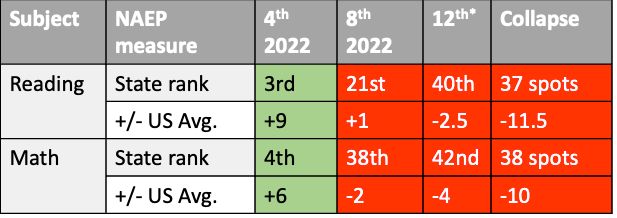
Billy Townsend, Florida blogger, has reported regularly on Florida’s gaming of NAEP scores. He writes here that Governor Ron DeSantis is carrying out Jeb Bush’s old trick to inflate 4th grade NAEP scores. He calls the governor Ron Jebsantis. The trick is third grade retention, which ensures that the lowest scoring third graders never take the fourth grade NAEP test (the kids who take the NAEP test are selected at random).

Thus, DeSantis put out a flashy press release celebrating fourth grade NAEP scores in the test scores recently released. But, as usual, DeSantis neglects to mention the collapse of eighth grade NAEP scores. Somehow the kids who were retained in third grade managed to skip fourth grade and rejoin their classmates by eighth grade.

Here are his numbers, drawn from NAEP reports:

With that in mind, here is a view of Florida’s 2022 NAEP scores peaking in elementary school and dramatically worsening with the older cohorts —- which is ALL of the red numbers after the green baseline.

I personally put no stock in the twelfth grade numbers (which Billy extrapolated) because NAEP stopped testing seniors a decade ago. Seniors know that NAEP doesn’t count and they don’t do their best. Some don’t even try. Their answer sheets had doodles, or some just picked the (A) answer to every question or some were blank.

But the stark drop from fourth grade to eighth grade says something’s fishy in Florida.

Many Twitter users are fearful for the future of the popular social media site since it was purchased by Elon Musk. He is taking the company private and will be the sole proprietor. He has said he is an absolutist on free speech, which raises questions about whether he will tolerate hate speech, lies, propaganda, anti-vaxxers, disinformation, even Donald Trump, who was permanently banned from Twitter for inciting violence.

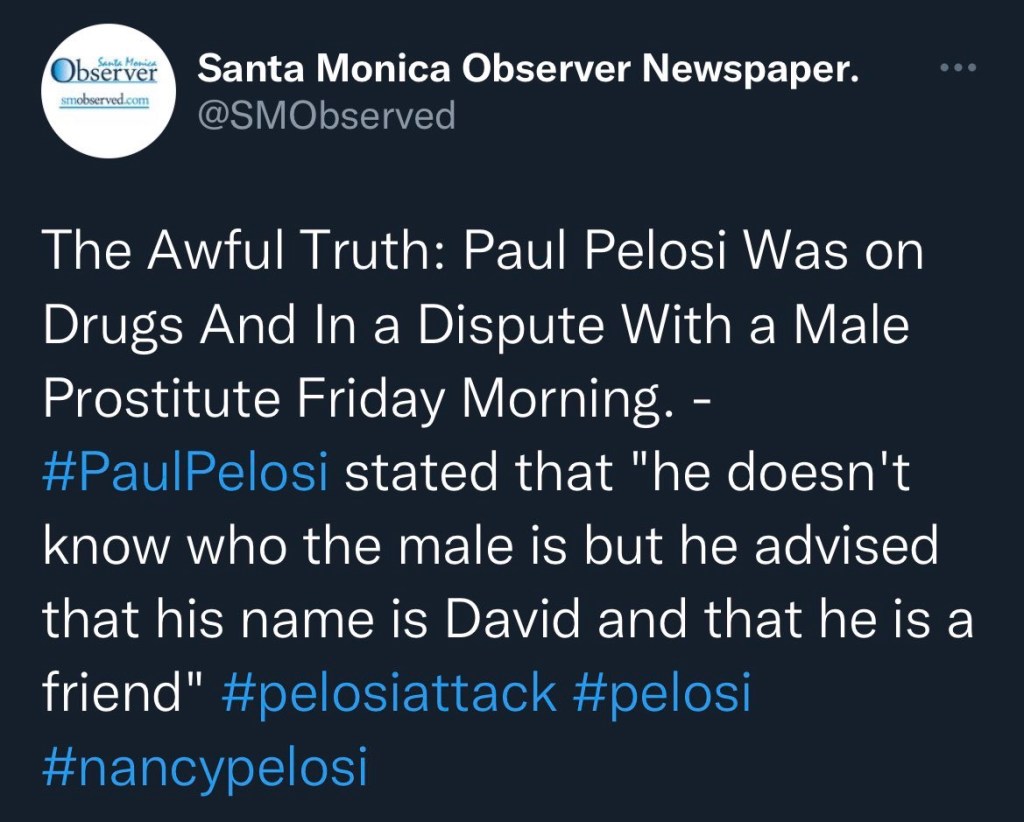
Now, the concern about Musk was stoked when he retweeted gossip from a free weekly (the Santa Monica Observer) that Paul Pelosi was drunk, high on drugs, and got into a fight with a man he picked up at a gay bar.

Musk posted that there was a “tiny possibility” that this was true. As readers began to react with incredulity that the new owner would spread unsubstantiated gossip, Musk deleted his tweet. Musk has 112 million followers on Twitter.

The San Francisco Chronicle wrote:

Musk responded Sunday at 5:15 a.m. Pacific time with a tweet that said, “There is a tiny possibility there might be more to this story than meets the eye,” and posted a link to a baseless, anti-LGBTQ article in the Santa Monica Observer. By 10:30 a.m. Sunday, the message and link had been retweeted more than 30,000 times and liked more than 110,000 times, before being deleted less than an hour later.

Last year, the Los Angeles Times reported that the Santa Monica Observer was “notorious for publishing false news,” and once claimed “that Hillary Clinton had died and that a body double had been sent to debate Donald Trump.”

Axios posted that the Santa Monica Observer is not a trustworthy site.

Why it matters: Musk linked to an article from the Santa Monica Observer, a website known for years for publishing false stories.

  • The site “is anything but trustworthy,” according to an executive at NewsGuard, a company that uses trained journalists to rate news and information sites.
  • The site has a trust score of 44.5 out of 100 points on NewsGuard’s rating scale for trustworthiness, due to repeatedly publishing numerous conspiracy theories and false claims about politics, the pandemic and more.
  • The site gets a red-rating and a warning for readers that says: “Proceed with caution: This website fails to adhere to several basic journalistic standards.”

Responsible people in the media fact-check. Musk didn’t think it was necessary. This does not bode well for the future of Twitter.

We have had our fill of conspiracy theories in the past six years.

It’s awful to think that the sole owner of Twitter will be a dupe for conspiracy theories and gossip and spread them to his millions of readers.

Just for laughs, read this article in The Intercept, which predicts that Elon Musk will regret his purchase of Twitter.

It begins:

ELON MUSK (and his consortium of much smaller investors) now owns Twitter. We need to take seriously the possibility that this will end up being one of the funniest things that’s ever happened.

That’s because as of this moment, it looks like Musk dug a big hole in the forest, carefully filled it with punji sticks and crocodiles, and then jumped in.

Arthur Camins—teacher, scientist, technologist— argues in The Daily Kos that it’s time for Democrats to abandon their support for charter schools. Are you listening, Senator Corey Booker of New Jersey, Senator Michael Bennett of Colorado, Governor Jared Polis of Colorado, Rep. Hakeem Jeffries and other charter allies?

Camins writes:

It is time for Democrats–voters and the politicians who represent them–to abandon charter schools as a strategy for education improvement or to advance equity. Charter schools, whether for- or non-profit, drain funds from public schools that serve all students, increase segregation, and by design only serve the few. Continuation of tax generated funds for charter schools, all of which are privately governed, support the current broader assault on democracy. That should not be the way forward for democracy loving Democrats. In addition, public support for private alternatives to public education suborns the lie that government cannot be the agency for solving problems.

The United States is tilting sharply toward, if not rushing headlong into, a less equitable, less democratic, more authoritarian, more racially divided, and meaner way of governing and living together. Out-for-youselfism is alarmingly rampant. Sadly, continued bipartisan state and federal support for charter schools that pit parents against one another for limited student slots reflects those tendencies.

We have been heading in that direction for decades, led by pro-wealth, anti-regulation billionaires and corporations allied with Christian religious extremists and ideological libertarians. Exacerbating extant racist, xenophobic, and misogynistic resentment is their core strategy. It is represented by a Republican Party whose only moral compass is power and for whom democracy is an expendable inconvenience.

Republican opposition to equity advances for all people, such as the National Labor Relations Act, Unemployment Insurance, Social Security, and Medicare, is nothing new. However, until the emergence of the Republican-light Democratic Leadership Council, there was a strong pro-government, pro-worker, if frequently inconsistent, opposition political party. In the absence of an explicit effort by Democrats to articulate a rationale for a multi-racial, working-class coalition, resentment flourished. Instead, many Democrats embraced deregulation and campaign cash, including contributions from the charter school industry.

This Republican-light Democratic shift could not have come at a worse time, as globalization and automation threatened the livelihood of many Americans, shaking the foundations of post-WWII perception of security, especially for many white working- and middle-class Americans. As scarcity and inequity came to be accepted as the unalterable norm, advances for some–left-out people of color, recent immigrants, and women–came to seen as coming at the expense of others. In that context, charter schools appealed social and economic insecurity.

Nonetheless, Democratic politicians from Bill Clinton to Barrack Obama embraced charter schools. The essential notion was that take-all-comers schools governed by locally elected school boards for the common good were an old-school failure. The supposed evidence was the failure to close the achievement gaps between kids from poor and well-off households. The fact that family socio-economic status explains most of the achievement gaps was ignored in favor of a blame-the-teacher and their unions ethos and test-driven blame. In supporting charter schools Democrats implicitly endorsed a competitive watch–out-for-my-own kid ethos. It is time for a new direction.

Even with substantial evidence of rampant corruption and increased segregation, national Democratic leadership has yet to fully abandon the belief in charter schools as an improvement strategy. In doing so, they abet the ongoing Republican claim that government and democracy are incapable of effective problem solving. Opposition to for-profit charter school and vouchers is insufficient. Increased oversight and rejection of for-profit charter schools is, of course, a positive step. However, the notion of schools as primarily a personal rather than a social benefit and that market-competition as an improvement driver remains intact.

Step away from charter schools, Democrats. Instead, embrace full equitable funding for all schools. Embrace professional salaries, respect, and working conditions for teachers. Embrace union protection. Embrace community schools to meet the needs of children and their families. Embrace small class size so every child can get the academic, social, and emotional supportthey need. Embrace schools to develop socially responsible citizens for a democratic equitable society.

That is the way forward for Democrats and Democracy!

In Tampa, a teacher was fired for teaching false claims to students, but was then hired by a charter school. She was not an exception. Public schools have standards for teachers. Charter schools sometimes do.

Parents said Kimberly Gonzalez was upsetting their children by saying Eve was a man, Adam was gay and God was as real as Santa Claus.

Gonzalez denied making these statements. She kept her job teaching science at Progress Village Middle School in Tampa.

A year later, the concerns escalated. Children said they were told that the Holocaust basically did not happen, that Jewish people wanted World War II, and that the Auschwitz death camp was like a country club with soccer and a cinema. A parent received a link to an antisemitic conspiracy site through Gonzalez’s district messaging server.

Gonzalez told Hillsborough County school officials she wanted her students to think critically about what they learned in school. They opted not to renew her contract. After an argument about sick pay, in which she accused them of “enslaving” her, she left.

She soon found work at Bell Creek Academy, a charter school in Riverview.

Teachers at Florida charter schools, which are publicly funded but independently managed, must hold state credentials in most cases. But when they have a disciplinary history at the organizations they left, it’s unclear how extensively charter schools review them.

The Tampa Bay Times examined 14 such cases in Hillsborough County, often delving deeper into teachers’ backgrounds than the charters did when they hired them.

Peter Greene wants to save time for all organizations that react to the latest NAEP scores. His press release works whether scores are up, down, or flat.

He writes:

It’s time once again to greet the release of another set of data from the NAEP testing machine, which means everyone is warming up their Hot Take generator. But if, like me, you’re getting tired of writing a response to the latest NAEPery, here’s a handy news release that will let you mad lib your way to NAEPy wisdom.


The new scores from the National Assessment of Education Progress (NAEP), known as The Nation’s Report Card, have been released, providing important data about [insert your preferred education policy area]. The recent crisis in [select your favorite policy-adjacent crisis] has clearly created a burgeoning issue of [select whatever Bad Thing you feel will most scare your audience in the direction of your preferred policy].

Says [head of your organization], “The new scores provide important evidence that now is the time for [insert whatever policy action your group always supports]. Clearly the [rise/drop/stagnation] in scores among [whichever subgroup cherry picking best suits your point] proves exactly what we have been arguing for [however long you’ve been at this.]”

[Insert paragraph of data carefully selected and crunched for your purposes. Add a graph if you like. People really dig graphs.]

“This is a clear indication,” says [your favorite go-to education expert], “that it is long past time to [do that thing your organization has been trying to get people to do for years]. Clearly [our preferred solution] is needed.” [Insert further sales pitch here as needed.]

You can expand on this if you wish, but make sure that you definitely do not–

* provide context for the data that you include

* offer perspective from NAEP’s many critics

* absolutely never ever reference the fact that the NAEP folks are extraordinarily clear that folks should not try to suggest a causal relationship between scores and anything else.

As always, the main lesson of NAEP is that contrary to the expectations of so many policy wonks, cold hard data does not actually solve a thing.

The NAEP remains a data-rich Rorschach test that tells us far more about the people interpreting the data than it does about the people from whom the data was collected. Button up your overcoat, prepare for greater-than-usual pearl-clutching and solution-pitching from all the folks who still think the pandemic shutdown is a great opportunity to do [whatever it is they have already been trying to do].