Archives for category: Education Industry

The Bloomberg years have been good for New York City in some ways; for example, smoking has been extinguished in all public and even many private places. The mayor’s dedication to public health is highly commendable.

But other things have been disastrous. The mayor has succeeded in making Manhattan a playground for international tourism and the uber-rich, but the explosion of new residential construction has added apartments that sell for millions of dollars. The New York Times, when it endorsed Bill de Blasio for mayor on October 27, noted in passing that 46% of the populace is New York City lives below the poverty line. In a city as expensive as New York City, nearly half the population is poor. That is a sad record, and it is reflected in the continuing struggles of the schools, which must educate the children of those who are homeless, hungry, and in need of intensive supports of all kinds.

At the outset of his administration, some dozen years ago, Mayor Bloomberg decided that the reform of the education system would be his greatest legacy. He said it again and again in his campaign. He was convinced that the only thing missing was management skills, of which he had plenty. He actually claimed that he could get better “results” with the same amount of money (then $12 billion). The spending has more than doubled, but the better results remain elusive. Unfortunately, the mayor decided that testing and accountability and choice would be the strategies that he would rely on to transform the system. In doing so, he mirrored George W. Bush’s No Child Left Behind. That was the zeitgeist of 2002, when Bush signed NCLB and Bloomberg took office and gained complete control of the school system.

Some observers, especially those who live thousands of miles away, are impressed with the Bloomberg record. Certainly the mayor has expanded the public relations staff devoted to selling the story of his “success.” In the years before Bloomberg, there were three people in the press office, whose job was to get information for reporters. Under Bloomberg, the PR staff ballooned, not only at the Department of Education itself, but grew to include the mayor’s own PR staff, so it is difficult to say exactly how many people were paid to “sell” the mayor’s story of success. Some thought it was a staff of at least 20, but it may have been even more.

Sadly, what was lost was any possibility of getting accurate information from the Department of Education. The PR staff existed to “sell the story” and spin results, not to candidly assess what was happening and how initiatives were working. That work was left to independent groups, which found it very difficult to raise money since the mayor used his considerable influence to affect decisions at the city’s major foundations. Anyone who questioned the administration’s claims had a difficult time finding any funding at all.

In pursuit of his elusive goal of 100% success, the mayor went through several iterations. He had three chancellors: Joel Klein, a lawyer, who lasted eight years and reorganized the schools at least three, perhaps four, times; Cathie Black, a publisher, who lasted 90 days and was a disaster, almost singlehandedly wrecking the mayor’s reputation as a reliable judge of management capability and displaying his disdain for anyone who had any experience in education; then Dennis Walcott, who had once headed the Urban League, but was better known for his long and acquiescent service to Bloomberg as an education advisor.

Over the course of this past dozen years, many schools have closed, many schools have opened. Many new schools also closed after they too posted low scores. The mayor never rethought his strategy of closing schools and opening schools, of using test scores and letter grades as measures of school quality. The graduation rate went up, but the remediation rate at local colleges remained staggeringly high.

What the city needs most today is an administration committed to telling the unvarnished truth about what is happening to the students, the teachers, and the school. If it is possible in our society today, the new administration must be prepared to be honest about successes and failures, and devote the resources necessary to have a high-quality internal department of evaluation and research. Much more is needed, but a good place to start is with a firm commitment to tell the truth without spin or hype.

Here is an analysis of the Bloomberg record, written by an insider at the Department of Education.

Click on the images to enlarge them.

Grading A Dozen Years of Education Policy in the Big Apple: A Report Card

As we come to the end of a dozen years of Michael Bloomberg’s control of New York City’s schools, it is an appropriate time to take stock of the results. Using actual data from New York City schools, what do we learn about results of the specific policies implemented over the past 12 years? [1] Is the education of our students better after many changes and new policies? Has the focus on testing students, using test scores and formulas to grade (and punish) teachers and schools, closing schools, opening schools (and closing those schools too), co-locating and championing charter schools and new schools, and the multiple re-organizations of the bureaucracy helped students?
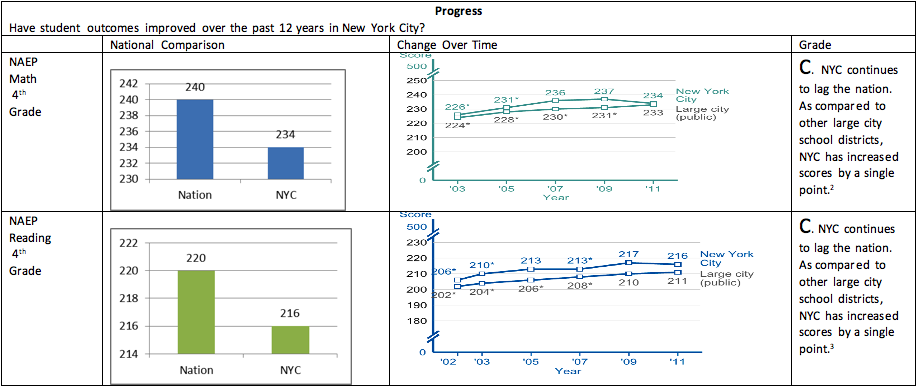
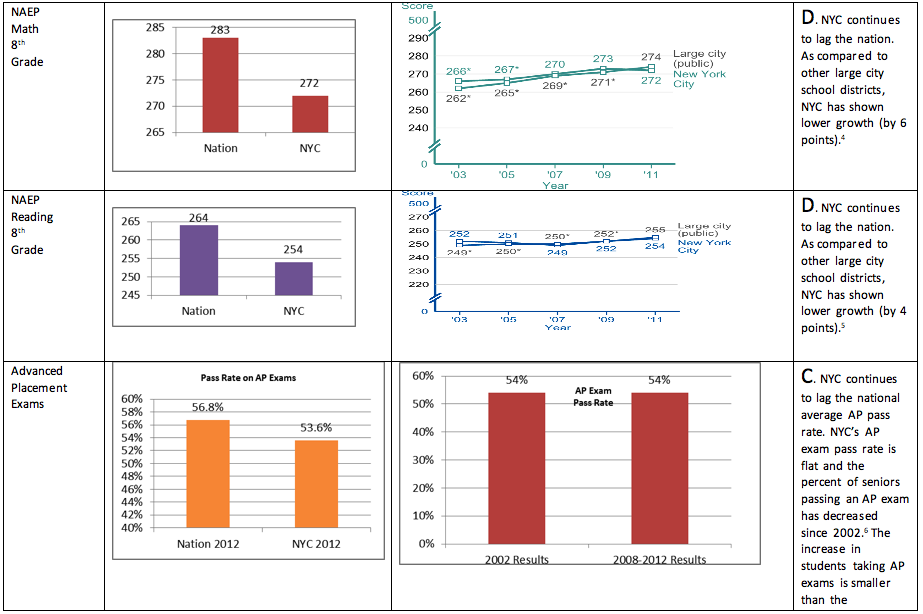
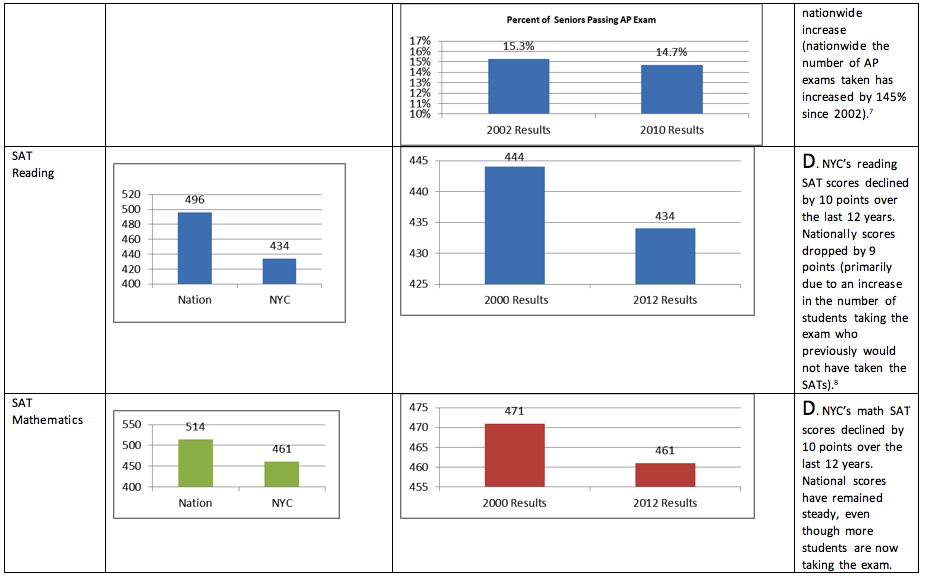
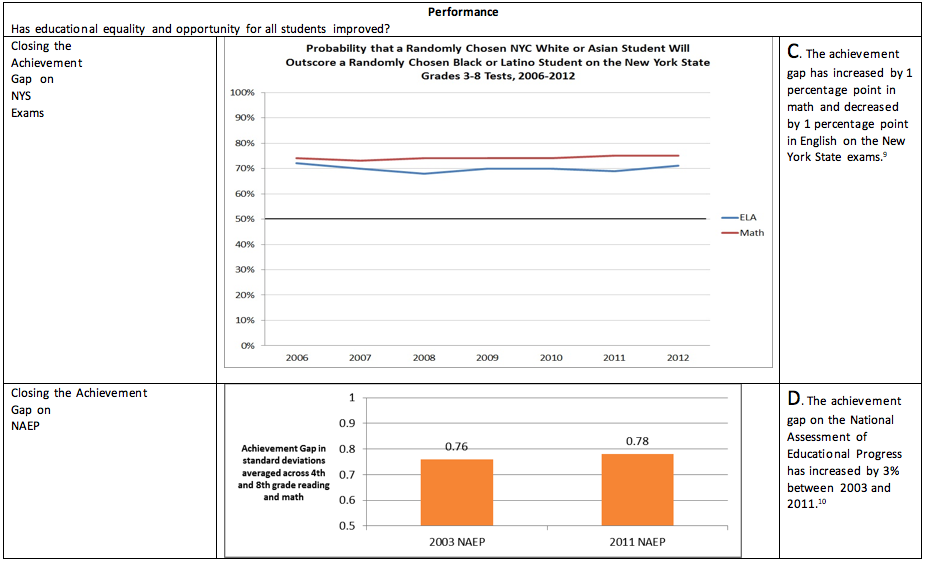
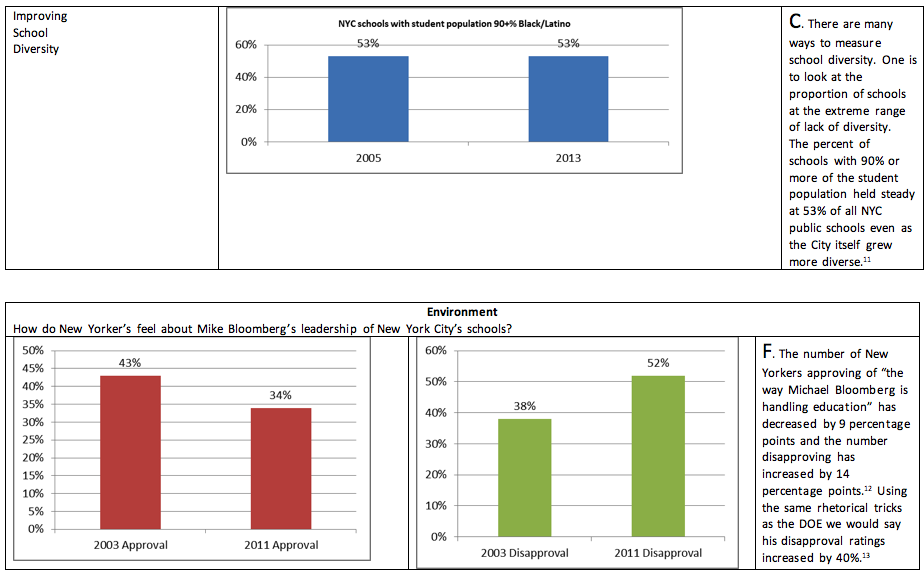
Screen shot 2013-10-23 at 10.43.38 PM Screen shot 2013-10-23 at 10.43.54 PM Screen shot 2013-10-23 at 10.44.11 PM Screen shot 2013-10-23 at 10.44.26 PM Screen shot 2013-10-23 at 10.44.40 PM
FINAL GRADE= D[14].Some readers may have questions or doubts about the data presented above. We do our best to answer them in the section below.

Have you cherry-picked data? These are the real numbers and we have sourced all the data. In fact, some data that were not included show even greater under-performance in New York City schools over the past 12 years. For example, the NAEP results in science show New York City lags behind the national average by 14 points in 4th grade and by 20 points in 8th grade. [15] However, since the most recent data are from 2009 and over 4 years old we did not include them.

Why do some of the metrics have different years of data cited? Because the New York City Department of Education refuses to publicly release complete data sets (and often denies data requests of researchers), we had to use the data we could identify by scouring the web and academic publications. The DOE’s secretive approach to sharing data with researchers, even with all identifying student information removed, is ironic given that they share private student information with corporations. [16]

Is it fair to compare New York City to the national average? The New York City Department of Education uses a similar measure by evaluating individual school in comparison to the performance of all city schools. This means that a school with primarily high needs students is evaluated against screened specialized schools. However, we are fairer than the NYC DOE and do not use the national comparison in the actual scoring. In this context it is worth noting that the formula New York State created and that New York City has implemented to evaluate teachers based on students test scores penalizes teachers who teach significant numbers of disadvantaged students. [17]

Why do you use test scores as your evaluative criteria? Because these are the very criteria that the education policies in New York were based on. As it turns out, even on their own terms, the policies have shown very poor outcomes. Even with the deck stacked in favor of Bloomberg’s policies the data still show that the policies have not been successful. If we were to add other criteria such as quality arts programs things are even worse. Data self-reported by schools shows that since 2006 elementary school students have at least 5% fewer opportunities to take visual arts, dance, theater and music classes taught by arts teachers. This is clearly an underestimate of the loss of arts options for students as an independent audit has demonstrated. [18]

How do you explain the increase in graduation rate in New York City? An independent study based on full access to DOE records and internal emails would help answer this question. A couple of points are in order.

A) The New York State Regents exams were made significantly easier over the past dozen years especially in terms of the grading scale applied to the exams. Math is an illustrative example. The Sequential Math 1 exam required the test taker to earn 65 percent of the available points to receive a passing score. The Math A exam, which replaced Sequential 1 in June 2002, required the test taker to earn 43 percent of the available points to receive a passing score. The Integrated Algebra exam, which replaced the Math A exam in 2009, requires the test taker to earn only 34.5 percent of the available points to receive a passing score. [19] Additionally the Biology exam was replaced by the Living Environment exam in 2001 and the Global Studies exam by the Global History exam in 2000. In each case the newer version was less content driven. [20]An academic study looking at changes in scoring and in difficulty of the Regents exams over the past 15 or so years would fill a gaping hole in our ability to make sense of test trends.

B) Schools were graded on the number of students earning credit. This led to some schools having jumps of 30-55+ percentage points in the number of students passing 10 or more classes. [21]In the space of 4 years the overall level of credit accumulation by students increased by 16 percentage points. [22]This can only be explained as being due to a citywide lowering of the bar on the expectations for earning credit, leading to a higher graduation rate, presumably at the cost of the actual quality of the diploma/college readiness of the student. [23]

C) The demographics of school age children in New York City changed dramatically since 2000, with white and Asian children becoming an increasingly larger proportion of the population. [24]As is well-known those demographic groups have significantly more educational success than Black and Latino children. Closing this achievement gap is one of the core missions of public education.

D) How can the increase in graduation rate reflect true increases in student learning when the grades 3-8 test scores have been mostly flat over the past dozen years? [25]Did students miraculously begin to learn more only when they hit 12th grade? The 8th grade Math/ELA scores on the NAEP increased by less 1.5% between 2003 and 2009, significantly less than the increase of other large urban school districts. How does that translate into an increase in graduation rates 4 years later unless the quality of a high school diploma and the bar for earning one was significantly lowered during that time?

E) The New York City Department of Education likes to compare its numbers to those of the “Big 5” cities (NYC, Buffalo, Rochester, Syracuse and Yonkers) in New York State. This is a deliberately misleading comparison as only 1 of these cities, Yonkers, is demographically similar to New York City. [26] NYC has significantly underperformed when compared to Yonkers. In fact, since 2008 the graduation rate in NYC has barely budged (the percent of students graduating by August after 4 years having gone from 62.7% to 64.7%). Yonkers, on the other hand, has seen its graduation rate increase by over 9 percentage points (from 62.9% to 72.1%). [27] Yonkers has outperformed New York City while serving a similar student population.

Bottom line: The data used here is comparable across years. It is more reliable than graduation rate which is a social construct having no set criteria or meaning. New York City underperforms on graduation rate when compared to comparable districts in New York State.

What does this all mean for the future of education in New York City? It means that we have our work cut out for us, as does the next mayor. With each mistake made over the last dozen years we have learned how we can do better. What have we learned?

  • We need to ensure that every single school has as diverse a student body as possible. Whether G&T programs, screened or specialized high schools, all schools must have a student body that reflects the diversity of New York City. The Office of Enrollment must improve their systems so that diversity is a crucial element of the process.
  • We need to provide schools with expert support and guidance in curriculum. We cannot take a sink or swim approach to teaching and learning, with every school left to their own devices. The Office of Teaching and Learning must be re-opened after having been shuttered under Bloomberg. Truly expert teachers must be identified at each grade level and subject area, their lessons videoed, their materials copied, and all of such resources must be shared with teachers throughout the city.
  • We need to develop rich early intervention and support services for students. This includes vastly increasing the number of speech teachers and math and reading intervention specialists in elementary schools. We cannot pretend that merely increasing the demands we make on students with the Common Core can take the place of our responsibility to support students in the critical early years to ensure they do not fall behind. This will also require developing a citywide early warning system and specialized curriculum to identify and provide quality remedial opportunities to students who are falling behind.
  • We need to provide support to schools that are struggling. It is wrong to continue to close schools just because they serve a high-needs student population. [28]Teams of experts must be formed to work directly with such schools in the areas of programming, data, and instructional cohesion. Each team must be assigned to one school to ensure quality support. This will also require changing Fair Student Funding so that all schools are funded equitably. [29]
  • We need to reform the DOE central office so that they take ownership of, are responsible for, and are held accountable for the success of every school (and student) in New York City. They must do the hard work of helping all schools and students improve. [30]They can no longer be allowed to take the easy way out. [31] The enormous support for a small percentage of charter schools, with no clear improvement in performance, makes no sense. The significant resources and PR devoted to the charter sector must end, while ensuring that the 6% of NYC’s children in charter schools receive a quality education. [32]Instead of destroying existing schools in order to create new schools we must add new and 21st century aligned academic and CTE programs to the schools we already have to ensure their success and that students have genuine choices and opportunities. [33]
  • We need to create an independent research office to evaluate educational initiatives so that the metrics are uniform across schools and can’t be gamed. [34]This office should report to the Panel for Educational Policy whose members should be selected to time- limited terms of office. The panel will then collaborate with the mayor in ensuring that community voice is heard.
  • We need to reorganize the bureaucracy so that schools are evaluated and coached on instructional techniques and youth development approaches by geographically based personnel with knowledge of the school and community. Other functions such as budgeting, HR and the like should be run out of regional offices. Web-based platforms will allow schools to form non-geographic affinity groups so that similar schools can share ideas no matter how far apart they are in the city.
  • We need to think creatively about ways to provide students with the additional quality learning time they need to succeed. The school year should be extended with a shorter summer break in the month of July and the new school year beginning again at the start of August. Summer learning loss is a huge factor in diminished student outcomes and we must address it system-wide.
  • Finally, we need to develop better ways to communicate with parents and communities to present an accurate picture of school performance. The current system penalizes schools and teachers who work with high-needs students. These are the precise parents and families who need the most help. Transparency about these factors must be improved.

[1] There have been some earlier attempts to answer this question https://dianeravitch.net/2012/10/02/after-a-decade-bloomberg-reforms-still-failing/. Our grading policy is as follows: significant improvement (by 10+%) over the past dozen or so years=A, improvement (2-9%) over the past dozen or so years=B, flatlining (-1,0,+1) over the past dozen or so years=C, decline (-2- -9%) over the past dozen or so years=D, significant decline (-10+%) over the past dozen years=F. This is, of course, a rather charitable grading policy as it assumes that no improvement even after a dozen years earns a gentleman’s C and not a F. We will weigh the 3 sections using the same weights as the School Report Cards implemented under Mike Bloomberg for New York City schools. Progress=60% of the final grade, Performance=25% of the final grade and Environment=15% of the final grade.

[2] http://nces.ed.gov/nationsreportcard/pdf/dst2011/2012453XN4.pdf

[3] http://nces.ed.gov/nationsreportcard/pdf/dst2011/2012456XN4.pdf

[4] http://nces.ed.gov/nationsreportcard/pdf/dst2011/2012453XN8.pdf

[5] http://nces.ed.gov/nationsreportcard/pdf/dst2011/2012456XN8.pdf

[6] http://cityroom.blogs.nytimes.com/2011/02/09/15-of-high-school-seniors-passed-an-a-p-test-last-year/ and http://nypost.com/2010/02/11/ny-schoolkids-do-a-ok-on-ap-tests/

[7] http://media.collegeboard.com/digitalServices/pdf/ap/rtn/9th-annual/9th-annual-ap-report-appendix-b.pdf nationwide AP results

[8] http://www.manhattan-institute.org/html/cr_26.htm NYC’s 2000 SAT results. http://nces.ed.gov/fastfacts/display.asp?id=171 nationwide SAT results through 2011. http://professionals.collegeboard.com/testing/sat-reasoning/scores/averages 2012 SAT results.

[9] http://eyeoned.org/content/closing-the-achievement-gap-have-we-flat-lined_379/

[10] http://eyeoned.org/content/the-emperors-new-close_313/

[11] http://schools.nyc.gov/NR/rdonlyres/B54A0720-E4EE-432D-A322-940346CCE61B/0/2013DemographicSnapshotPUBLIC.xlsx and http://www.nytimes.com/interactive/2012/05/11/nyregion/segregation-in-new-york-city-public-schools.html?_r=0 showing that “Black isolation in schools has persisted even as residential segregation has declined.” https://dianeravitch.net/2013/09/08/insider-at-bloomberg-doe-spills-the-beans-about-failed-policies/ has data on the extreme inequities in school outcomes where only a small handful of NYC produce outcomes at the national average. Finally, the Independent Budget Office has shown that from 2002-2011 school integration has remained flat http://www.ibo.nyc.ny.us/iboreports/printnycbtn11.pdf

[12] http://www.nytimes.com/interactive/2011/09/07/nyregion/20110907-nyc-schools-poll.html?ref=education

[13] The DOE, when reporting numbers, often uses percent increase rather than the actual number of percentage points. This makes small gains looks much larger than they otherwise would.

[14] Following the formula outlined in the first footnote the calculation is as follows: Progress x 60% + Performance x 25% + Environment x 15%= Final Grade. Replacing the letter grades with numbers A=1, B=2, C=3, D=4, F=5. The scores of each component were averaged and plugged into the formula as follows: (4.1667 x .6) + (3.3333 x .25) + (5 x .15) = 4.08=D.

[15] http://nces.ed.gov/nationsreportcard/pdf/dst2007/2008471XN8.pdf

[16] http://www.nytimes.com/2013/10/06/business/deciding-who-sees-students-data.html.

[17] http://www.lhcss.org/positionpapers/nysgrowthmodel.pdf

[18] http://schools.nyc.gov/offices/teachlearn/arts/ArtsCount/ArtsReport/2011-12/Final2012ArtsInSchools.pdf

[19] http://nycpublicschoolparents.blogspot.com/2008/01/ny-state-math-regents-exams-soft.html and http://atfss.wordpress.com/nys-regents/. Note that these numbers vary slightly with each exam.

[20] http://www.city-journal.org/2009/eon0731me.html

[21] http://blogs.edweek.org/edweek/eduwonkette/2008/11/the_nyc_high_school_progress_r_1.html

[22] http://www.edwize.org/credit-accumulation-soars-in-nyc-but-students-remain-behind

[23] Note that this may be very good public policy. Lowering the bar for a high school diploma so that more young adults have the opportunities for college education and job training where there is more flexibility around pursuing one’s interests is intuitively smart policy. However, when the bar is lowered policy-makers can’t claim that the graduation rate is comparable to earlier rates.

[24] “The fact is, the number of children in New York decreased by almost 9 percent between 2000 and 2010. According to the Department of City Planning, the black population under 18 decreased especially dramatically during those ten years, by 22.4 percent, while the population of white children decreased by only 3.8 percent. In the city’s richest borough, Manhattan, the number of white kids actually grew—by nearly 23 percent—and in rapidly gentrifying Brooklyn, the number of white kids increased by 7 percent. (The displacement of blacks and Latinos in some neighborhoods is painfully pronounced: In Brooklyn’s District 6, which encompasses Park Slope, the South Slope, Cobble Hill, Carroll Gardens, and Red Hook, the number of white kids grew by 28.5 percent while the number of black and Hispanic kids each dropped by 36 percent.) Asians are the one ethnic group whose number of children increased overall during the decade.” http://nymag.com/news/features/childhood/modern-childhood-2013-4/index3.html

[25] http://gothamschools.org/2010/07/28/test-scores-down-sharply-biggest-decline-for-needy-students/ data showing flat scores after New York State stopped lowering the bar for proficiency on the grades 3-8 exams.

[26] http://assembly.state.ny.us/member_files/044/20090319/report.pdf

[27] http://www.p12.nysed.gov/irs/pressRelease/20130617/GradRateSlides.ppt

[28] http://annenberginstitute.org/sites/default/files/SchoolTransformationReport_0.pdf https://dianeravitch.net/2012/08/25/nycs-schools-for-poorest-faring-poorly/ and https://dianeravitch.net/2012/08/09/after-ten-years-of-reform-in-new-york-city/

[29] https://dianeravitch.net/2012/09/05/how-new-york-city-stiffs-the-neediest-students/ https://dianeravitch.net/2012/08/12/in-nyc-fair-student-funding-is-unfair/ and https://dianeravitch.net/2012/08/30/who-is-putting-children-first/

[30] https://dianeravitch.net/2012/10/17/if-teachers-ran-their-classes-like-nyc-runs-schools-then/

[31] https://dianeravitch.net/2013/10/22/a-report-from-the-sinking-ship-at-nycs-doe-headquarters/

[32] https://dianeravitch.net/2013/10/15/the-charter-school-bubble-in-new-york-city/ on spending for charter schools. https://dianeravitch.net/2013/02/26/an-inside-the-doe-view-of-the-nyc-credo-study/ on the performance of charter schools. https://dianeravitch.net/2012/12/20/inflated-claims-of-charter-success-in-nyc/ and https://dianeravitch.net/2012/12/03/reader-calls-out-ny-daily-news-for-charter-spin-2/ on the exaggerated PR on behalf of charter schools.

[33] https://dianeravitch.net/2013/03/01/why-nyc-closes-high-schools/ on the coddling of new schools at the expense of existing ones.

[34] https://dianeravitch.net/2013/09/19/nyc-whistle-blower-how-the-doe-is-like-enron/


Thanks to Kipp Dawson of Pittsburgh for drawing my attention to this letter written by Melissa Tomlinson, the teacher who confronted Governor Chris Christie, who shouted her down and said contemptuously, “What do you people want?”

This is her answer, which appeared on Mark Naison’s blog:
Dear Governor Christie,

Yesterday I took the opportunity to come hear you speak on your campaign trail. I have never really heard you speak before except for sound bytes that I get on my computer. I don’t have cable, I don’t read newspapers. I don’t have enough time. I am a public school teacher that works an average of 60 hours a week in my building. Yes, you can check with my principal. I run the after-school program along with my my classroom position. I do even more work when I am at home.

For verification of this, just ask my children.

I asked you one simple question yesterday. I wanted to know why you portray NJ Public Schools as failure factories.

Apparently that question struck a nerve. When you swung around at me and raised your voice, asking me what I wanted, my first response “I want more money for my students.”

Notice, I did not ask for more money for me. I did not ask for my health benefits, my pension, a raise, my tenure, or even my contract that I have not had for nearly three years. We got into a small debate about how much money has been spent on education. To me, there is never enough money that is spent on education. To invest in education is to invest in our future. We cannot keep short-changing our children and taking away opportunities for them to explore and learn.

As more money is required for state-mandated curriculum changes and high-stakes standardized testing, it is our children that are losing. Programs are being cut all over the state as budget changes are forcing districts to cut music, art, after-school transportation, and youth-centered clubs.

But let’s put money aside for a moment. What do I want? What do ‘we people’ want? We want to be allowed to teach.

Do you know that the past two months has been spent of our time preparing and completing paperwork for the Student Growth Objectives? Assessments were created and administered to our students on material that we have not even taught yet. Can you imagine how that made us feel? The students felt like they were worthless for not having any clue how to complete the assessments. The teachers felt like horrible monsters for having to make the students endure this. How is that helping the development of a child? How will that help them see the value in their own self-worth?

This futile exercise took time away from planning and preparing meaningful lessons as well as the time spent in class actually completing the assessments. The evaluations have no statistical worth and has even been recognized as such by the NJ Department of Education. I am all for evaluation of a teacher.

I recognize that I should be held accountable for my job. This does not worry me, as long as I am evaluated on my methods of teaching. I can not be held wholly accountable for the learning growth of a student when I am not accountable for all of the factors that influence this growth. Are you aware that poverty is the biggest determination of a child’s educational success. If not, I suggest you read Diane Ravitch’s new book Reign of Error. Take a moment and become enlightened.

Getting back to the issue of money. I am fully aware of our educational budget. Where is all of this money? To me it seems like it is being siphoned right off into the hands of private companies as they reap the benefits of the charter schools and voucher programs that you have put into place. It certainly hasn’t gone to improve school conditions in urban areas such as Jersey City. The conditions that these students and teachers are forced to be in are horrifying. Yet you are not allowing the funds needed to improve these conditions. Are you hoping that these schools get closed down and more students are forced to go to private charter schools while the districts are being forced to pay their tuition? I know for a fact that this is what has happened in Camden and Newark.

Yet these charter schools are not held to the same accountability as our public schools. Why is that? Because deep down you know that you are not really dealing with the issues that influence a child’s education. You are simply putting a temporary band-aid into place.

Unfortunately [for you] that temporary fix is already starting to be exposed as Charter Schools are showing that they actually are not able to do better than public schools. You are setting up teachers to take the blame for all of this. You have portrayed us as greedy, lazy money-draining public servants that do nothing. I invite you to come do my job for one week Governor Christie. I invite you to come see my students, see how little they really have during the school day as they are being forced to keep learning for a single snapshot of their educational worth.

For that one end-all, be-all test, the NJASK. The one that the future of my job and my life is now based upon. Why do you portray schools as failure factories? What benefit do you reap from this? Have you acquired financial promises for your future campaigns as you eye the presidential nomination? Has there been back-room meetings as you agree to divert public funds to private companies that are seeking to take over our public educational system? This is my theory. To accomplish all of this, you are setting up the teachers to take the blame. Unfortunately, you are not the only governor in our country that has this agenda.

What do “we people’ want, Governor Christie? We want our schools back. We want to teach. We want to be allowed to help these children to grow, educationally, socially, and emotionally. We want to be respected as we do this, not bullied.
BadAss Teacher, Melissa Tomlinson
http://withabrooklynaccent.blogspot.com/2013/11/letter-to-governor-christie-from-new.html

A couple of weeks ago, Bill Keller wrote an opinion piece in the New York Times in which he asserted that colleges of education were largely responsible for our national education woes. Leave aside the fact that he knows nothing about the national education issues, but focus instead on his claim that whatever is wrong must be the fault of the ed schools.

Bruce Baker was outraged, as was I.

I have never been a champion of ed schools, but like Baker, I recoiled at Keller’s simplistic thinking. Plenty of smart teachers went to ed schools; are there some bad courses there? Sure. Are there some bad courses in liberal arts colleges? Yes. My own view is that teachers should be solidly grounded in whatever they expect to teach, but they should also learn about how to teach, about child psychology, about how children learn, and about the politics, history, and economics of education. The combination is powerful. But that doesn’t mean that everyone with that combination will be a great teacher.

Baker writes:

But there’s actually a simpler logical fallacy at play here which lies at the root of many reformy arguments regarding causes and consequences – failure to acknowledge that the U.S. has a wide range of elementary and secondary of schools that are both high performing and low performing and that the defining features differentiating higher and lower performing schools are not found primarily in their teachers or the preparation programs they attended – or whether they attended any at all – but rather in the communities they serve, the resources available to them and the backgrounds, health and economic well-being of the children and families they serve.

This is not about the poverty as excuse argument. This is about the simple point that our highest performing public schools also employ teachers from traditional public college and university preparation programs and in many cases, teachers from the same – or substantively overlapping – college and university preparation programs as teachers in our lowest performing schools in the same region.

If that’s the case, then how is it possible that teacher preparation programs are the problem?

It would be wonderful if the New York Times elevated someone to the op-ed page as a columnist who actually knew something about education, like Michael Winerip. Winerip used to have a great weekly column, but was then mysteriously assigned to cover baby-boomers. At present, every columnist on the New York Times opinion pages takes his turn saying absurd things about American education, either because they think they have found a miracle school (which isn’t) or because they have found the ultimate scapegoat (which they haven’t).

Maybe they could hire Bruce Baker and really enlighten the world.

Raymond Gerson of Austin Community College sent this article, which expresses a growing recognition across the nation that federal and state education policies are ruining children’s lives and crushing the love of learning.

Gerson writes:

Scarcity of Humane Values in Educational Policies

By Raymond Gerson

Frequent high stakes testing, hours of test prep drills, large classes and reduction or elimination of art, music and P.E. are taking their toll on both students and teachers. School counselors have reported an increase in A.D.H.D., anxiety, depression and other psychological problems among students. Parents have reported that as early as elementary school their children are starting to hate school and are turning off. Many students are bored and stressed out from the constant pressure to perform on high stakes bubble tests.

Children begin school with a natural curiosity and intrinsic motivation to learn. Learning should be an enjoyable process which stimulates student imagination, creativity, ability to think for oneself and the ability to solve problems that have more than one right answer. This type of learning experience will prepare students to become well-informed and productive members of society and to work in good careers in the future. Many current educational environments are breaking the spirits of students and teachers and are turning off intrinsic motivation to learn and teach.

Many wealthy and powerful individuals (and organizations) with little or no teaching experience are influencing educational policies which are destructive. They are in favor of frequent high stakes testing, large classes, closing public schools and reducing courses in the arts except when it comes to their own children. Their children usually attend private schools with small classes, health support services, plenty of courses in the arts and little or no frequent high stakes standardized tests with hours of test prep drills. This is hypocritical and inhumane.

Children need to be emotionally healthy to live successful and fulfilling lives as adults. Development of their emotional and social intelligence are important if they are to grow into fully functioning adults with humane values. Values such as kindness, caring for others, love, integrity and compassion make us good human beings. Students will learn these values from the example of adults and by the way adults treat them. The way many students are being treated is lowering their sense of self-worth, diminishing their creativity, blocking their potential and teaching them to be less compassionate and empathetic.

Teachers should be allowed to teach and create their own lesson plans based on the curriculum that they are teaching. They need time to teach students to think for themselves instead of spending hours doing test prep. They also need time to collaborate with other teachers.

There are schools which are excellent models of education such as the one in Finland. Instead of modeling our education system after successful ones, the U.S. is following in the footsteps of educational systems like the one in Chile which is a “free market” disaster.

The changes that are needed for a great education system will not come from the top down until there is enough action and pressure from the bottom up. Students, parents, teachers and school administrators will need to protest in large numbers before the PTB will make necessary changes. An example of this occurred recently in Texas. Mothers who were angry about all of the high stakes testing convinced the state politicians to take action. They voted to reduce the amount of yearly standardized tests from fifteen to five.

Let’s reawaken a love of learning in our students, treat them with humane values and give our teachers opportunities to teach students to think for themselves.

Cindi Pastore created this multiple-choice exam for the people of Infiana.

It illustrates the current crazy situation there. Glenda Ritz won a startling upset victory last fall, winning more votes than Governor Pence. Yet Governor Pence has worked unceasingly to dilute Ritz’s authority and render her powerless to carry out her official duties. He and the unelected state board are thwarting her so they can continue to privatize education in the state of Indiana.

Here is the test:

An Eight Question High Stakes Test for Governor Pence, Brian Bosma, David Long, and Members of the State Board of Education

1. Who was elected by an overwhelming majority (roughly 1,300,000) of the voters (many of whom crossed their party lines) of this state to be the Indiana Superintendent of Public Schools?

a. Claire Fiddian-Greene
b. Brian Bosma
c. GLENDA RITZ
d. David Long
e. Mike Pence
f. Any of the appointed Members of the SBOE
g. Daniel Elsener

2. Who campaigned and won on the platform of re-introducing evidenced-based educational methods, policies, and standards including: more teaching and less testing, more local control for implementing standards, safe and respectful schools, high standards for educators, improved vocational education, and reserving public dollars for public schools?

a. Claire Fiddian-Greene
b. Brian Bosma
c. GLENDA RITZ
d. David Long
e. Mike Pence
f. Any of the appointed Members of the SBOE
g. Daniel Elsener

3. Who is a National Board Certified Teacher, holds two masters degrees with licenses to teach elementary, middle and high school in the areas of special education, general education, and library science, and has won both the Teacher of the Year for Washington Township Schools and a Golden Apple Award?

a. Claire Fiddian-Greene
b. Brian Bosma
c. GLENDA RITZ
d. David Long
e. Mike Pence
f. Any of the appointed Members of the SBOE
g. Daniel Elsener

4. Who held a Community Partners School Improvement Summit and started the Hoosier Family of Readers program since beginning her elected job of Indiana’s Superintendent of Public Instruction?

a. Claire Fiddian-Greene
b. Brian Bosma
c. GLENDA RITZ
d. David Long
e. Mike Pence
f. Any of the appointed Members of the SBOE
g. Daniel Elsener

5. Who has been continually thwarted in her attempts to carry out the duties of her office, the elected Superintendent of Public Instruction, by a bombardment of politically motivated and unnecessary requests for ill-conceived action and irrelevant information?

a. Claire Fiddian-Greene
b. Brian Bosma
c. GLENDA RITZ
d. David Long
e. Mike Pence
f. Any of the appointed Members of the SBOE
g. Daniel Elsener

6. Who is being hurt by the Governor, the members of the SBOE, and those legislators who are being obstructionist to Superintendent Ritz’ work?
a. The CHILDREN of this state
b. The CHILDREN of this state
c. The CHILDREN of this state
d. The CHILDREN of this state
e. The CHILDREN of this state

7. Whose money is being wasted by the creation by Governor Pence of an agency with an non-elected head, that is essentially an attempt to be a duplication of the Indiana Department of Education?

a. The TAXPAYERS of Indiana
b. The TAXPAYERS of Indiana
c. The TAXPAYERS of Indiana
d. The TAXPAYERS of Indiana
e. The TAXPAYERS of Indiana

8. Who will respond to the bullying of Superintendent Ritz by the Governor, the SBOE board members, and members of the state legislature?
a. The VOTERS in Indiana
b. The VOTERS in Indiana
c. The VOTERS in Indiana
d. The VOTERS in Indiana
e. The VOTERS in Indiana

Answer Key: For each of questions 1-5, the answer is c. For each of questions 6-8, the answers are a,b,c,d, and e.

Grading Scale: A= 8 correct answers F= 0-7 correct answers

Thanks to Leonie Haimson for posting this information about the New York State Comptroller’s audit of charter schools in Albany. The links are a must-read. When you read the links, you will understand why the New York Charter Association fought all efforts to permit the State Comptroller to audit the charters; the charters won in court, but the legislature revised the law, allowing the audits to proceed.

Leonie Haimson writes:

Albany Community Charter School – Financial Operations (Albany County)
The board failed to fully evaluate the choice of its school building for the site selection of the elementary school or middle school. Auditors found the school could have saved from $200,000 to $2.3 million if it purchased the elementary school by issuing debt instead of continuing to lease the building.

The building was being leased from the Brighter Choice Foundation,

http://www.osc.state.ny.us/localgov/audits/schools/2013/albanycharter.pdf

The Brighter Choice Foundation, founded by Tom Carroll, who is one of Albany’s top lobbyists for privatization. More on him and the Foundation here:

http://nepc.colorado.edu/blog/charters-get-even-more-brazen

http://www.nydailynews.com/new-york/education/albany-charter-cash-big-banks-making-bundle-new-construction-schools-bear-cost-article-1.448008

http://www.edwize.org/thomas-carroll-wal-mart-and-the-effort-to-defeat-the-albany-school-budget

http://www.albanycharterschoolnetwork.org/community/brighter-choice-foundation/history/

In response to the crises faced by the Albany public schools, a group of concerned civic and business leaders founded the Brighter Choice Foundation (BCF) in 2000. At the time, the mission of BCF was to undertake a variety of educational initiatives aimed at addressing the dire educational situation in Albany. These educational initiatives included:

  • Providing technical assistance and other support to public charter schools, public schools, and private schools pursuing innovative educational practices, with a focus on schools serving urban and economically disadvantaged children.
  • Supporting innovative educational approaches, including longer school day and longer school year models; single-sex instruction; subject-based elementary-level instruction; looping and integration of social and educational programs.
  • Conducting and commissioning research on the effectiveness of different educational approaches.
  • Supporting educational scholarships, with a focus on programs that serve economically disadvantaged students.
  • Serving as a clearinghouse for information on educational best practices.

Thirteen years after the start of its mission and with nine charter schools up and running in Albany, BCF has become an organization dedicated to the support and success of those schools. Today, those nine charter schools supported by BCF collectively represent the Albany Charter School Network (ACSN).

A reader in North Carolina updates us on the great tablet fiasco, the recriminations, and the eternal question: who is making a lot of money? Hint: not the teachers.

The reader writes:

Add to this fiasco ANOTHER one from North Carolina. (Greensboro’s NEWS AND RECORD has created a page for the great Tablet Deal Gone Wrong):

http://www.news-record.com/news/schools/collection_9555d386-2551-11e3-a120-0019bb30f31a.html

Scroll to bottom article discussing current Guilford County Schools Sperintendent Maurice Green’s connection to Peter Gorman, current senior vice-president for AMPLIFY and former superintendent of Charlotte-Mecklenburg Schools ( i.e. Green’s former boss). Green kept mum about the connection.

Key excerpt below from:
http://www.news-record.com/news/schools/article_9c78ebb8-bd9a-11e2-9fc2-0019bb30f31a.html

Gorman joined Amplify after serving as superintendent of Charlotte-Mecklenburg Schools from 2006 to 2011. Green was his deputy superintendent before leaving in 2008 to lead Guilford County Schools.

“It raises an eyebrow,” said Linda Welborn, school board member. “I could see the concern and possibly the perception from other people that are aware of the connection.
“Had I known, I probably would have asked more questions.”

Welborn and board members Ed Price and Darlene Garrett said staff should have mentioned that history when they recommended Amplify for the four-year contract.
But Price and Welborn said Amplify seemed worthy of the contract because it had the lowest bid and met the district’s criteria.

“The fact that (Gorman) worked there, that in and of itself would not have stopped me from voting for them if they had the best deal,” Price said.

“I do not question Mo Green’s integrity, and I don’t think he would have done something just because of his past relationship with Peter Gorman.”

Nora Carr, the district’s chief of staff, said Green purposely excluded himself from the review process so as not to influence the staff’s decision.

“He certainly made every effort to remove himself from the process so that the team could make decisions that were based on facts and the individual strengths of the proposals,” said Carr, who also worked for Charlotte-Mecklenburg Schools before coming to the district in 2008.

Carr said business connections in the education sector are common. Green had a previous work history with an employee of another company that bid on the PACE project, she said.

And he developed relationships with executives at Apple, which provided iPads to Montlieu Academy of Technology.

Green and school board Chairman Alan Duncan also used to work for the same law firm.
“Education is a small world,” Carr said. “If we ruled out every company that had a connection with us, we would have a very small pool to draw from.”
Still, some board members were not satisfied with the review process — either because the project team did not include teachers or because details weren’t provided on the other vendors.

Garrett, who voted against the Amplify contract, said she wanted to hear presentations from other companies.

“We should have had more information,” Garrett said. “We should have asked for it, but I think we were in a rush to approve it.”

The school district won a $30 million federal Race to the Top grant in December and is on a tight schedule to put digital devices in the hands of most middle school students this fall. The initiative is part of national efforts to improve student learning through digital technology.

But some people wonder who stands to benefit more from the trend — the students or the companies selling the technology.

“There is the concern that once you’re locked in there, what happens after the four years?” Welborn said about the devices. “This new age of electronic teaching is going to be huge money.”

So Los Angeles spent $1 billion on iPads, promising grand outcomes, closing the digital divide between rich and poor, the “civil rights issue of our time,” yada, yada, yada.

But as this blogger points out, this move was made without the most elementary planning or forethought.

Should anyone have been consulted before spending 25-year school construction bond money on iPads? Will voters ever again approve such a bond knowing that it may be diverted to an administrator’s pet project?

She asks questions that apparently never occurred to the administrators who bought the iPads:

“If the ipads stay in the classroom, how is their distribution to be managed in any way efficiently?

If in the classroom, is the physical integrity of the building sufficient to ensure everyone’s and everything’s safety?

If staying in the classroom, does that forfeit the device’s biggest potential, as substitutes for heavy, expensive, resource-intensive textbooks?

If not to stay in the classroom, how will internet access be managed among “not-wired”, very poor or chaotic homes?

How are electronics to be harnessed for education alone and not hijacked by its social, interactive component?

If not in the classroom, how to reconcile bond construction monies targeted to long-term infrastructure support, with transient instruction delivery tied to non-durable goods?

If not in the classroom, how to manage the high turnover (purportedly up to one-third) among students of some high-poverty communities? What is the implication for device-specific instruction? For physical disappearance of the devices?

When was the imperative of Common Core testing agreed upon, as it underlies the drive behind implementing the
ipad program precipitously?

When were teachers presented an honest cost:benefit analysis toward soliciting professional input regarding utility and efficacy in educating their students???

And:

“When were parents presented an honest cost:benefit analysis toward soliciting parental input regarding utility and efficacy in educating their child???

“The bottom line is: the people such massive programs with gargantuan implications affect, need to be asked first. A program of such eclipsing size and existential implications needs at the least to be tested, to be piloted and then: to be evaluated before approving or denying subsequent phases.”

“It is an incredibly uncomfortable position to feel patronized and exploited by in-house imperialists. How do these detached, possibly ulteriorly-motivated administrators know what is best in the classroom, without going into the classroom? Ask the denizens there what they need, and for some sense of the fallout.”

From California to New York, the same questions arise: why don’t the people making decisions about children and education listen to parents and educators?

In a democracy, consultation is necessary and wise. Great leaders know how to listen and are wiling to learn from their errors.

Charter schools were supposed to be creative sources of innovation. They were supposed to show what could be accomplished when government got out of the way. The newcomers would give lessons to the professionals, who couldn’t be trusted.

But it hasn’t worked out that way. In Ohio, charter schools are some of the worst schools in the state. 83 of the lowest performing 84 schools in the state are charters.

Guido H. Stempel III, a distinguished professor emeritus in the E.W. Scripps School of Journalism at Ohio University, says that the people of Ohio have been cheated.

Stempl says the driving force behind charters is greed.

He writes:

“There are 27 organizations, and 25 of those are for-profit. One of those, with 17 schools, is run by an Islamic minister.
We have a double standard. There are 200 state laws that apply to public schools and not to charter schools Qualifications of teachers are not checked as they are for public school teachers. Auditing of finances does not occur as often.
The names of public school board members are public and listed in a state directory. There is no record of who the members of school boards for charter schools are or how they are chosen. Public school boards must have a regular meeting schedule, and if they schedule additional meetings they must notify local media. The public does not know when charter school boards meet.
There is, in short, a lack of oversight.”

When the state ordered the state’s largest charter operator, David Brennan, to close two of his low-performing schools, “One reopened in the same place with a new name and the same staff. The other was the same story except that they replaced 30 percent of the staff.

“The charter schools are getting almost a billion dollars from the state. This year charter schools got bigger increases in state funding that the public schools did. Money was taken from appropriations for districts. More that a million dollars was taken from the five districts in Athens County.

Why do the legislature and governor protect charters from accountability?

Simple.

Charter school owners contribute generously to political candidates.

Sue Peters, parent activist, is running for the school board in Seattle.

She has raised $28,289.

Her opponent, Suzanne Dale Estey, has raised over $100,000, plus an independent PAC has raised more than another $100,000 for Estey.

That means that Sue Peters is outspent about 7-1.

Estey has raised more money for her contest than any school board race in the state’s history.

Read the list of Estey’s contributors: it is the same handful of wealthy entrepreneurs who have been pouring big money into election after election in Seattle and in the state of Washington, to promote charters, test-based evaluation, Teach for America, and other failed policies.

Few, if any, of Estey’s donors have children in the Seattle public schools.

Why are the rich buying up school board seats?

In Seattle, is democracy for sale to the highest bidder?