Archives for category: Education Industry

From a reader:

Journalists do not really seem to understand the gravity of what is happening to education in the United States. There is a reason that highly educated parents are opting their children out of standardized tests. It is a scary time to be a teacher and an even scarier time to raise a child.

Since 1997, the testing market in the United States has grown 835%, or roughly 14% annually, from $263 million to over $2.46 billion. That’s nearly double the annual rate of return of the S&P 500. A lot of people have made a lot of money off of the test-based accountability movement and a lot of corporations now have a lot to lose. Corporations and politicians promised us a lot when they seized control of the nation’s education policy and enacted No Child Left Behind in 2002.

Since then, the rate of growth in NAEP scores has declined, SAT scores have declined, ACT scores have remained flat, and PISA scores have declined.

As if that wasn’t enough, politicians and their corporate backers doubled down on the dismantling of public education by withholding funding, taking over school districts, and threatening to close down schools. In Washington D.C., after linking 50% of teacher evaluations to standardized test scores, teacher turnover increased to 82%, schools in communities with high poverty rates showed large or moderate declines in student learning outcomes, and the combined poverty gap expanded by 44 scale-score points causing poor students to fall even further behind their more affluent peers.

Realizing the calamity of these reform efforts, the American Statistical Association, the National Academy of Education, the American Educational Research Association, the Economic Policy Institute, and educators throughout the country issued statements urging policymakers to reconsider the use of high-stakes tests which have robbed teachers of their autonomy and forced hundreds of hours of test prep on our students.

While some states have responded to limit the stakes until more is known about the validity and reliability of the assessments, officials in New York State continue to press forward.

It is long past time to acknowledge that the high-stakes accountability movement has failed our children. We must hold politicians responsible for withholding funding from our public schools and allowing poverty to wreak havoc on our education system. The United States now has its highest level of income inequality since 1928. Yet when you control for poverty, we have the best PISA scores in the world.

Our schools are not failing our children, our politicians are. It takes a real hero to ignore the impact of poverty and threaten to punch teachers in the face. But parents can see right through the lies, the decept, and the corruption. In 2016, opt out rates will double and this grass-roots parent movement will ensure that the American Dream is not permitted to skip a generation.

The U.S. Department of Education says that the correct number of standardized tests is 2% of instructional time.

In most districts, that would be about 20-24 hours of taking tests. Not prepping for them, just taking them.

That would be an increase in the amount of time now allocated in most places to standardized tests. Should children in grades 3-8 really sit for 20 hours of tests? Sounds nutty.

Peter Greene has a different idea. He says the correct number of standardized test is zero.

He writes:

Students need standardized tests like a fish needs a bicycle. Standardized tests are as essential to education as a mugging is essential to better financial health.

Is there a benefit to the child to be compared and ranked against the rest of the children in the country, to be part of the Great Sorting of children into winners and losers? No. Having such rankings and ratings may advance the agenda of other folks when it comes to writing policy and distributing money, but those benefits are for those folks– not the children. The mugger may benefit from mugging me, but it does not follow that I enjoy a benefit.

Are there standardized tests from which a classroom teacher can glean useful information? Sure– but those tests are best chosen to fit the needs and concerns of one particular teacher and one particular collection of students. A diagnostic test might help me with Chris, but there’s no reason to believe it would help me better understand Chris if it were given to every other student at the same time.

Read on.

Mitchell Robinson, professor of music education and blogger, ponders whether the education wars are winding down. He thinks not. The contention over policy issues remains profound.

To help explicate the issues, he has compiled a brief guide to the different “sides.” In a recent post by Sam Chaltain, who does think the battles are subsiding and a new convergence is on the horizon, one side is the “practitioners, and the other is the “policymakers.” Robinson says the labels illustrate a clash of views.

Robinson writes:

“Mr. Chaltain’s descriptors for the two sides in the war on education are revealing, in that he sees a clear distinction between those who actually teach (the “practitioners”), and those who establish and enforce the rules and policies that govern that practice (the “policy makers”). Perhaps unintentionally, his labels also highlight a major flaw in our current education enterprise: public education policy is being written and administrated largely by persons who have not themselves attended public schools, have no degrees or certification in education, have never taught, and have spent little time in public schools. Whatever meager educational background that the members of what I term the Deformer “edu-tribe” may have is often accrued through alternative routes to the classroom (i.e., Teach for America, The New Teacher Project, the Michigan Teacher Corps), and their educational credentials are often received via online programs that require little or no actual teaching experience, residencies or interactions with other teachers or professors with actual teaching experience.

“Many of the “foot soldiers” in the Deformer army wind up in high-level positions in state departments of education, policy think-tanks, on school boards and as leaders of high-profile charter school networks. They reach these positions of power and authority with shockingly little experience in classrooms, or working with children, but exert out-sized influence on the shape and nature of public education. These members of the Deformer “advance force” parrot a regressive agenda of union-busting, tenure-smashing, and teacher-demonizing, paired with an obsessive devotion to standardized testing, “data driven decision making”, charter school expansion, and privatization as the “answers” to the “crisis in public education”–while remaining seemingly oblivious to the fact that it was their policies that manufactured the crisis they claim to be addressing, and which are paying off so handsomely for the investors who fund their charter schools and pay their generous salaries.”

On the other side are what Robinson calls “the Guardians of Oublic Education.”

“The members of this army largely consist of teachers, retired teachers, and teacher educators, most of whom have significant experience as classroom teachers, multiple degrees in education, and a career commitment to children, schools and education. Few Guardians entered the profession by alternative routes, instead earning their credentials in traditional colleges and universities, under the tutelage of professors who had themselves been classroom teachers before moving to higher education. Many of these activists earn graduate degrees in their chosen field–even as states now refuse to pay for additional degrees–and seek out weekend and summer professional development opportunities at their own expense in order to remain certified.

“The activism practiced by these Guardians is not their sole focus as professionals–rather, these teachers blog at night after lessons have been planned, and kids put to bed, or on rare quiet weekend mornings and afternoons when a few minutes can be stolen from other tasks and responsibilities. And the conflict in which they are engaged is a non-linear war–they are fighting not just the Deformers, but also their support staff in their underground bunkers, typing away on banks of sleek laptops as they push back against kindergarten teachers furiously hammering out their frustrated rants on the ridiculousness of testing 6 year olds, or 3rd grade teachers pointing out the illogic of retaining 8 year olds who struggle with reading.”

The “Deformers” are well-paid. But the Guardians work not for money but for conviction.

“These writers and activists don’t receive a penny for their efforts, in stark opposition to the Deformers’ forces, who are stunningly well-compensated for their work. Instead, these bloggers often toil away in anonymity, providing a voice for the thousands of teachers that have been silenced for speaking out against the reform agenda.”

He provides a list for each side. My lists would be longer. Make your own lists or additions. I would certainly place ALEC, Jeb Bush, Scott Walker, John Kasich, Rick Scott, Rick Snyder, and a number of academics and philanthropists on the Deformer list.

Blogger Educational Alchemy sees behind the Department of Education smokescreen. The goal of the Obama administration’s “Testing Action Plan” is not what it appears.

Now that almost every school is testing online, it is time to move on to the next stage of the education revolution. Outsourcing online testing to vendors.

The wave of the future: Competency-based assessments.

Here is an excerpt:

This is what the “Testing Action Plan” (TAP) says:

The new plan will “include competency-based assessments, innovative item types.” It states also “The Department will also share tools already available to do this work, including The Council of Chief State School Officers’ (CCSSO) Comprehensive Statewide Assessment Systems: A Framework for the Role of the State Education Agency in Improving Quality and Reducing Burden and Achieve’s Student Assessment Inventory for School Districts.”

This is what it means:

Remember CCSSO? They are the ones who crafted the Common Core State Standards. The standards were developed to create a “standardized” system that allows third-party companies to develop systems for outsourcing education. Now with a set of “national” standards as benchmarks, instruction can be metered out by online edu-tech companies who provide new “competency” based instruction and assessment. No teacher required.

In 2010, the Foundation for Excellence in Education (who supported Common Core) convened the Digital Learning Council, a diverse group of more than 100 leaders in education, government, philanthropy, business, technology and members of policy think tanks led by Co-Chairmen Jeb Bush, and Bob Wise (both integral in the creation and promotion of Common Core). It’s an ALEC model-endorsed comprehensive framework of state-level policies and actions “designed to advance the meaningful and thoughtful integration of technology into K12 public education.”

This idea is stated again toward the end of the Testing Action Plan (TAP): “Congress should continue to require the Department to work with external assessment experts to ensure states are using high-quality assessments that are aligned with state-developed standards and valid for the purposes for which they are used.”

TAP Says:

“…the Department granted a temporary waiver to New Hampshire to pilot a competency-based assessment system in four districts ….” as a way to set a national example. (and), “The Department will work with external assessment experts…”

What this means:

The department will outsource education curriculum and assessment to corporations just like it did in NH where they “…have adopted unique and innovative learning approaches, such as digital learning, that create a more flexible learning schedule that extends beyond the school day.”

The Alliance for Excellent Education (Bob Wise serves as president) in 2013 stated: “Competency-based advancement is an important part of New Hampshire’s strategy for implementing the Common Core State Standards.”

Read the post with care. Every element is there for a transition to the next stage of relinquishing control of curriculum and assessment to the vendors.

The Obama administration acknowledged that students are spending too much time on testing and recommended that no more than 2% of classroom instructional time be devoted to testing.

Apparently the administration is reacting to bipartisan opposition and widespread parent protests against the diversion of time and billions of dollars to high-stakes testing. Public sentiment, as recorded in recent polls, opposes the overuse of standardized testing.

In addition, the Times reports, the administration was reacting to a new report from the Council of Great City Schools, which found that the current regime of testing has not improved achievement.

You might say that the Obama administration is lamenting the past 13 years of federal policy, which mandated annual testing, and made test scores the determinative factor in the evaluation of teachers, principals and schools.

In short, the Bush-Obama policies have been a disaster.

This is a classic case of too little, too late. Think of the thousands of teachers and principals who were unjustly fired and the thousands of pubic schools wrongly closed when they should have gotten help. This administration and the George W. Bush cannot be absolved for the damage they have done to American education by issuing a press release.

The story says:

“Faced with mounting and bipartisan opposition to increased and often high-stakes testing in the nation’s public schools, the Obama administration declared Saturday that the push had gone too far, acknowledged its own role in the proliferation of tests, and urged schools to step back and make exams less onerous and more purposeful.

“Specifically, the administration called for a cap on assessment so that no child would spend more than 2 percent of classroom instruction time taking tests. It called on Congress to “reduce over-testing” as it reauthorizes the federal legislation governing the nation’s public elementary and secondary schools.

“I still have no question that we need to check at least once a year to make sure our kids are on track or identify areas where they need support,” said Arne Duncan, the secretary of education, who has announced that he will leave office in December. “But I can’t tell you how many conversations I’m in with educators who are understandably stressed and concerned about an overemphasis on testing in some places and how much time testing and test prep are taking…”

“And even some proponents of newer, tougher tests said they appreciated the administration’s acknowledgment that it had helped create the problem, saying it did particular damage by encouraging states to evaluate teachers in part on test scores.

“But the administration’s so-called “testing action plan” — which guides school districts but does not have the force of law — also risks creating new uncertainty on the role of tests in America’s schools. Many teachers have felt whiplash as they rushed to rewrite curriculum based on new standards and new assessments, only to have politicians in many states pull back because of political pressure.

“Some who agreed that testing has run rampant also urged the administration not to throw out the No. 2 pencils with the bath water, saying tests can be a powerful tool for schools to identify weaknesses and direct resources…

“What happens if somebody puts a cap on testing, and to meet the cap ends up eliminating tests that could actually be helpful, or leaves the redundancy in the test and gets rid of a test that teachers can use to inform their instruction?” asked Michael Casserly, the executive director of the Council of the Great City Schools, an organization that represents about 70 large urban school districts.

“The administration’s move seemed a reckoning on a two-decade push that began during the Bush administration and intensified under President Obama. Programs with aspirational names — No Child Left Behind, Race to the Top — were responding to swelling agreement among Democrats and Republicans that higher expectations and accountability could lift the performance of American students, who chronically lag their peers in other countries on international measures, and could help close a chronic achievement gap between black and white students….

“But as the Obama administration pushed testing as an incentive for states to win more federal money in the Race for the Top program, it was bedeviled by an unlikely left-right alliance. Conservatives argued that the standards and tests were federal overreach — some called them a federal takeover — and called on parents and local school committees to resist what they called a “one size fits all” approach to teaching.

“On the left, parents and unions objected to tying tests to teacher evaluations and said tests hamstrung educators’ creativity. They accused the companies writing the assessments of commercializing the fiercely local tradition of American schooling.

“As a new generation of tests tied to the Common Core was rolled out last spring, several states abandoned plans to use the tests, while others renounced the Common Core, or rebranded it as a new set of local standards. And some parents, mostly in suburban areas, had their children opt out of the tests.

“Mr. Duncan’s announcement — which was backed by his designated successor, John B. King Jr. — was prompted in part by the anticipation of a new survey from the Council of the Great City Schools, which set out to determine exactly how much testing is happening among its members.

“That survey, also released Saturday, found that students in the nation’s big-city schools will take, on average, about 112 mandatory standardized tests between prekindergarten and high school graduation — eight tests a year. In eighth grade, when tests fall most heavily, they consume an average of 20 to 25 hours, or 2.3 percent of school time. The totals did not include tests like Advanced Placement exams or the ACT.

“There was no evidence, the study found, that more time spent on tests improved academic performance, at least as measured by the National Assessment of Educational Progress, a longstanding test sometimes referred to as the nation’s report card.”

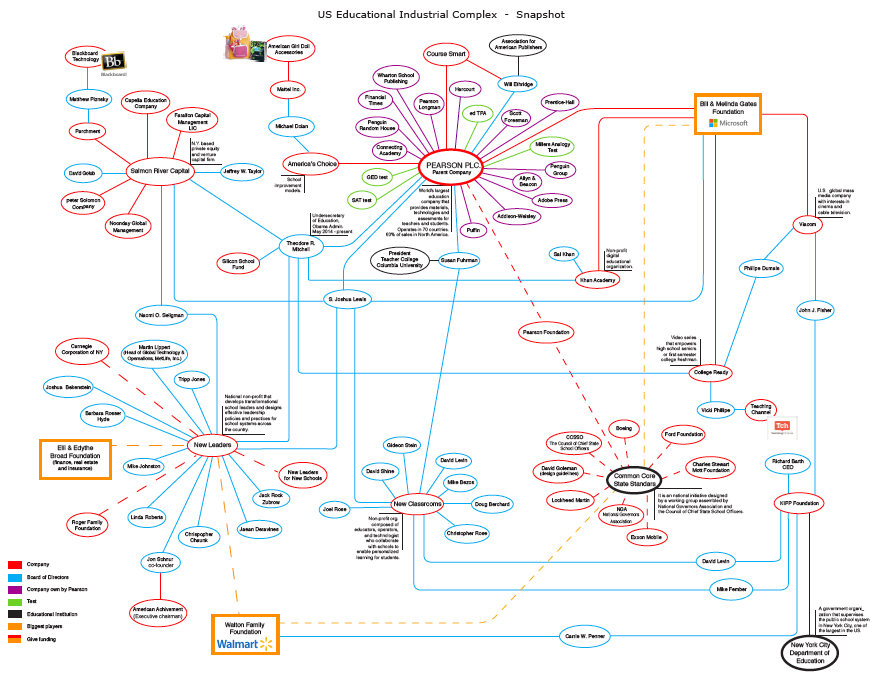
Dipti Desai is a professor of the arts and art education at New York University. She teaches both pre-service and in-service art teachers. As she watched what was happening in the world of education, she decided to create a graphic to illustrate the “Educational Industrial Complex.” Readers may know that when President Dwight D. Eisenhower was leaving office after his second term, he warned voters to be wary of the “Military Industrial Complex.” Who knew that in 2015 we would have to keep our eyes on the “educational industrial complex,” a combination of corporations, philanthropies, government agencies, and the organizations that promote privatization and high-stakes testing?

edcomplex


The report can be downloaded here.

This is a very interesting interview with Bobby Turner, who is the partner of Andre Agassi in opening new charter schools for profit across the country. He seems to think that destroying public education is a way to perform good works.

Charity is laudable, Bobby Turner says, but if you really want to raise enough money to improve a thorny social problem you have to introduce the profit motive.

An associate of 1980s junk bond king Michael Milken who made a fortune in real estate, Turner is now turning that personal philosophy into action.

He set up a company last year called Turner Impact Capital that seeks investors to pay for blue-collar housing, promising returns more typical of ­conventional moneymaking businesses.

And already some big names are risking capital to invest with Turner, a deeply connected Los Angeles financier who already has a similar fund with former tennis star Andre Agassi to build inner-city charter schools.

The Turner Multifamily Impact Fund launched in June so far has drawn investments from high-profile hedge fund manager Bill Ackman; Citi Community Capital, a division of Citibank that invests in affordable housing; the University of Michigan endowment; and Rockefeller Brothers Fund, a philanthropic organization operated by the Rockefeller family.

This is the reasoning of the hedge fund managers and equity investors who are privatizing public schools. If they can generate a profit, taking public money that should be paying for the arts, for raising teachers’ salaries, and for reducing class sizes, they think they are doing good works. Please, someone, tell them they should stick to selling stuff and leave the taxpayer money for the kids, not for investors and profits. They are getting rich, and they are not doing good. They are hurting children.

Center for Media and Democracy federal charter grant report RELEASED TODAY

http://www.prwatch.org/charter-school-black-hole

“Charter School Black Hole” – CMD Special Investigation Reveals Huge Info Gap on Charter Spending

Madison, WI (CMD) – Today the Center for Media and Democracy (CMD) is releasing a special report on its year-long investigation into charter schools spending in the United States. You can access the full report “Charter School Black Hole” here.

CMD, a national investigative group that conducts in-depth investigations into the influence of corporations, trade groups, and PR firms on media and democracy, found that the public does not have ready access to key information about how their federal and state taxes are being spent to fuel the charter school industry since charters began almost 25 years ago.

Indeed, no one even knew how much the federal government had spent on its program designed to boost the charter sector. So CMD reviewed more than two decades of federal authorizations and appropriations to calculate the sum, which is now more than $3.7 billion—as noted in this new report. CMD also found that the federal government was not providing the public with a list of all the charter schools that received federal tax monies and how much.

CMD also found that many states have not provided the public with ready information about the amounts of federal funding each charter has received under the federal “Charter School Program” (CSP) for state education agencies (SEAs), and that most states have not provided the public with information about the amounts in state and federal tax dollars that have been diverted to charters rather than spent strengthening traditional public schools.

What is even more troubling is how difficult it is to find essential information on how some charters have spent federal and state tax dollars, even as governments continue to increase funding for charters while slashing funds for traditional public schools. Unlike truly public schools that have to account for prospective and past spending in public budgets provided to democratically elected school boards, charter spending of tax monies is too often a black hole.

This is the largely due to the way the charter industry has been built by proponents, favoring “flexibility” over rules. That flexibility has allowed an epidemic of fraud, waste, and mismanagement that would not be tolerated in public schools. Charters are often policed—if they are really policed at all—by charter proponents, both within government agencies and within private entities tasked with oversight as “authorizers” of charters.

In this investigation, CMD pursued numerous open records requests under federal or state law about how much federal CSP money had been given to charters and how that money was spent in 12 states. As a result, CMD found that public information about funds received and spent by charters is severely lacking. It also documented how little is known about spending by closed charters, and identified “ghost” schools, where federal grants were awarded to charters that never opened.

“The bottom-line is taxpayers know far too little about how much their federal tax dollars are being used to fund charters and there is far too little information provided by states about how tax monies are being spent by charters or by for-profit firms they are tied to,” said Lisa Graves, Executive Director of CMD. “Neither the federal government nor the states require charters to publish that information on their websites and neither the federal or state governments we examined publish that information themselves. Even aside from serious questions about academic performance by charters—especially online charters—the lack of real accountability remains a real problem for kids and families, as more and more people and corporations have sought to get a piece of pie, a revenue stream from taxpayer money, to operate or assist charters.”

Below are a few key findings from the report:

Michigan: In 2011 and 2012, $3.7 million in federal taxpayer money was awarded to 25 Michigan “ghost” schools that never even opened to students. The organizations behind these schools received at least $1.7 million, according to the state expenditure database. WestEd—a private company that contracts with the U.S. Department of Education to monitor how states comply with federal regulations—flagged this as a potential problem, but the agency did little to address the problem. After verbal assurances that this would not happen again, the federal agency assured the Michigan Department of Education “that there will not be any additional follow-up.”

Ohio: Out of the 88 schools created by planning and implementation grants under CSP between 2008 and 2013, at least 15 closed within a few years; a further seven schools never even opened. These charters received more than $4 million in federal taxpayer money. Despite this track record, Ohio landed the biggest one-year grant by far in the 2015 competition for federal funding: $32.6 million. CMD can reveal that part of the reason Ohio won the grant was a glowing endorsement from the National Association of Charter School Authorizers (NACSA)—an organization that had previously referred to the charter system in Ohio as “broken.” But NACSA was more than willing to take that back as long as the Ohio Department of Education signed a $40,000-a-year deal. The deal was brokered by former NACSA senior executive and lobbyist David Hansen only days before he resigned as head of the Ohio Office of Quality School Choice amid accusations of having manipulated charter school performance data.

California: More than $4.7 million in federal taxpayer money was handed out to create charter schools that subsequently closed within a few years. CMD’s investigation found that California’s record on charters is marked by continued failures, including squandering of taxpayer money, along with deference to unaccountable authorizers and resistance to federal efforts to mandate better state oversight.

Wisconsin: More than $2.5 million in CSP money was used to create charter schools that shuttered shortly thereafter. In addition to the school closings, at least one of the schools created by federal charter school money was a former religious school that has since “converted” to charter status so as to be eligible for funding, an audit obtained by CMD shows. There appears to have been no regular evaluations about whether such conversions in Wisconsin–and also Texas–affect the content of the instruction or not.

Indiana: At least $2.2 million was awarded to charters that either closed or never opened. In addition, emails obtained by CMD through a public records request to Gov. Pence’s office found troubling examples of how the private charter sector, notably for-profit chain Charter Schools USA, influences on policy-making.

New York State: CMD discovered that almost every single application for the New York subgrants was written by the same multi-million-dollar charter consultancy firm: Charter School Business Management. The nature of CSP funding competition means that charter schools relying on private contractors for services, such as grant-writing and budgeting, can gain a competitive edge.

Colorado: State leadership responsible for managing the federal charter school grants fought legislation that would have advanced charter school oversight and accountability, emails obtained by CMD show.

The report also reviews federal charter spending in Arizona, District of Columbia, Florida, Texas and Utah. Read the full report here. http://www.prwatch.org/files/new_charter_school_black_hole_report_oct_21_2015.pdf

Open the full report for a complete state-by-state list of charter schools that were created by CSP SEA seed money in the 2010-2015 grant cycle. Dozens of these “schools” never opened to students in the first place, and many of the schools that did open have since closed. For an updated tally of the $3.7 billion disbursed under the CSP umbrella since the inception of the program, click here. Click here for emails from Ohio’s Office of Quality School Choice, detailing the role NACSA and David Hansen, who resigned in July amid accusations of having manipulated data on charter school “success,” played in securing the biggest federal charter grant in 2015. –

See more at: http://www.prwatch.org/charter-school-black-hole#sthash.BG877tYw.dpuf
I get the impression, reading Peter Greene’s latest post, that he doesn’t think Eva Moskowitz deserves an apology from John Merrow or PBS.

He says she has created an empire of her own, and she can’t brook any criticism.

Success Academy works for some kids, but not for all kids. That is, if you think that the ultimate measure of a school is test scores, she has them. Public schools are supposed to work for all kids. Granted, there are magnet schools and special schools, but there are supposed to be public schools where no one is turned away, no one is counseled out.

Eva says that the little boy–age 5 or 6–was a very bad behavior problem. Peter–and many readers of this blog–think that he couldn’t handle the pressure.

Peter finds documentation for everything John Merrow said about attrition rates.

Moskowitz also demands a retraction for the reporting of a high attrition rate, claiming, “Our attrition rate is actually lower than the average for either district or charter schools.” This is an exceptionally ballsy claim. You can look at these charts from Democracy Builders, a pro-charter group in NYC, showing that for eighty-eight students starting in third grade, Success ends up with thirty-one in eighth grade. In 2014, the Daily News reported that the first graduating class at Harlem Success was just thirty-two of the original seventy-three– and despite their awesome test scores, none of them qualified on the entrance exam for the top high schools in the city.

Maybe those kids were just a bad fit for Eva’s academy.

A reader named mrobmsu left a comment on the last post, the one saying that Eva Moskowitz demands an apology from PBS and John Merrow. It made me laugh out loud. (LOL). Here it is:

Nation’s Children, Parents and Teachers Demand Apology by Eva Moskowitz and Success Network, Campbell Brown, Michelle Rhee, Teach for America, StudentsFirst, the New Teacher Project, Democrats for Education reform, Arne Duncan, John King, Bill Gates, The Walton Family Foundation, The Heritage Foundation, KIPP, Wendy Kopp, David Coleman, the Relay Graduate School, Education Post and Peter Cunningham, Chris Stewart and Every Hedge Fund Manager and Investment Banker Who Has Profited from Corporate Education Reform

Not to be picky, but I think Eli Broad would demand an apology for being omitted from the list.