Archives for category: Education Industry

Carol Burris, executive director of the Network for Public Education, wrote the following:

As you know, the House is trying to block federal funding to charters controlled by for-profits. But it will be an uphill battle. I recently did an investigation into the private sale of 69 charters by for-profit NHA. It is jaw-dropping. Please read about it and share. This is a critical time to get the word out. Thanks, Carol

https://www.washingtonpost.com/education/2021/09/14/charter-school-scams/

Texas has gone overboard for charter schools, even though they consistently post worse results than public schools. In the state’s new plans, charter schools will not be held accountable for the performance of English-language learners or students with disabilities. That is grossly unfair to public schools but it should raise the ratings of charter schools.

A trusted friend who works for the Texas Education Agency sent this information:

The proposed Texas Charter School Performance Framework for 2020 has been posted for public comment. On page 19, in the Operations standards, “Program requirements: Special populations” and “Program requirements: Bilingual education/English as a second language populations” are marked as “N/A for 2020” instead of each counting for one point. These indicators, 3b and 3c, are struck out on page 20. There does not appear to be an explanation for these changes.
Appropriate handling of assessments is another deletion from the Operations standards on pages 23-24.
Due to the lack of academic accountability, the manual will reflect fiscal and operational indicators only, not academic indicators.

https://texreg.sos.state.tx.us/fidsreg/202103289-1.pdf

There are no academic indicators, which makes sense because there were no tests in 2020. But the state officials removed the program indicators for bilingual and special education populations from the Operations standards on which charter schools will still be rated. These indicators measure if charters meet program requirements such as employing certified teachers in these areas.

This is not the only exception made for charter schools. Those that get a D or F rating three years in a row are supposed to be closed by the state, but that accountability is seldom enforced. Indeed, the state allows failing charters to expand.

NPE ACTION’S NEW PROJECT TO BRING TALES FROM THE FRONTLINES OF PUBLIC SCHOOL ADVOCACY

Public schools remain incredibly popular among Americans across the political spectrum, even under the strains of a global pandemic and a divisive political culture being inflamed by opportunists seeking to push radical, unpopular agendas. Parents, students, volunteers, and communities who rely on and cherish their public schools deserve to be heard now more than ever. Public Voices for Public Schools, a community project of the Network for Public Education Action, launches today with tales from the frontlines of public school advocacy.

Unfortunately, public education in America has been under systematic attack for decades by an axis of right-wing political radicals, self-appointed reformers, opportunists, segregationists, and wealthy special interests, all working together to dismantle and privatize our treasured public schools. Their efforts have done lasting harm to students and their communities, and it is time those communities have a platform where their stories can be shared.

“After my two sons enrolled in a private school thanks to vouchers, I began to understand that school is about more than academics,” said Dountonia Batts, a former voucher parent. “As charter schools and vouchers expanded, the school system in Indianapolis was falling apart. All of the high schools in our neighborhood had been shut down, even as charter high schools were popping up. I realized I could no longer accept school vouchers for my children because it was unethical.”

People like Batts rarely get a chance to be heard, especially by policymakers who are often targeted for pressure by pro-privatization groups with access to campaign donations and full-time public relations machinery. That’s why Public Voices for Public Schools is so important, as it is a place to elevate the regular people in our community and help them have access to the tools to engage their elected representatives directly.

“Once I understood that our funders wanted us to help them burn down the entire public school system, I realized I had very different intentions than the school reform movement,” said Gloria Evans Nolan, a former Missouri education reformer. “I could see for myself the toll that education “reform” was having on my city. The result was that our sense of community was dropping away. We were also losing our history. Every school I attended is now closed.”

Public Voices for Public Schools will regularly bring you stories from parents like Batts and Nolan, students, academics researching the effects of privatization, along with many others. Visit us at pv4ps.org where you can join our shared community and always be kept up to date. You will learn what you can do to preserve a pillar of our democracy, our neighborhood public schools.
*************

The board of the Los Angeles Unified School District will vote Tuesday on a funding scheme promoted by conservatives and neoliberals. Its promoters call it “student-centered funding,” but that’s a euphemism for the “backpack full of cash” idea, which encourages school choice. Critics of SCF say it introduces free-market principles into school funding and will benefit charter schools while harming public schools.

Jack Ross of the California-based journal “Capitol & Main” writes about the debate over student-centered funding.

Even though it is flush with cash from several federal relief packages, the Los Angeles Unified School District (LAUSD) wants to switch funding models next year, instituting a controversial structure called Student Centered Funding (SCF) that ties a school’s funding to its student enrollment. Under SCF, schools are awarded a base rate for each child and receive additional funds if the student is considered needier — if they are learning English, for instance, or if they’re in foster care or qualify for free lunch.

If the student leaves the school, the funding goes with them as if they carried a “backpack full of cash.” This could pit schools against each other in a competition for students and the dollars they guarantee, critics say. The funding switch has its origins with Betsy DeVos, Donald Trump’s secretary of education, who instituted grants for school districts to explore Student Centered Funding. Los Angeles received one last year

LAUSD board member Jackie Goldberg says Student Centered Funding will fuel downward enrollment spirals that will shutter underfunded schools in poor neighborhoods. The more students leave, the less money a school has, and parents and children begin jumping ship at an increasing rate. Proponents of the model say SCF gives schools more flexibility to spend their money on what they need rather than locking them into certain programs designed by remote authorities, like the school board or the state or federal government.

Goldberg disagrees. “[SCF] says districts don’t need to spend the money, individual schools do, by trying to assemble the right combination of kids with the right combination of money,” she says. “A child that’s learning [English as] a second language and has a disability, you might get a lot of money for that student. What do you do if you’re a principal? You start recruiting those students — because they bring their money with them.”

LAUSD insists Student Centered Funding furthers equity by placing schools in better control of how they use their money, and by more directly targeting money at the neediest students. “It really is that iterative process of contending with, what do we do now to better serve our students?” Deputy Superintendent Pedro Salcido told the board. “Student Centered Funding really is that next iteration: How do we deepen the work, how do we deepen progress in our schools?”

In LAUSD’s own calculations of how SCF would affect its school budgets under a “fully loaded” funding formula, 348 schools were found to lose money under SCF, while 367 schools would gain

Sorting the data by percentage of students qualifying for free or reduced lunch reveals further inequities. Ann Street Elementary in Downtown Los Angeles, which tops the list with 100% of its students receiving free or reduced lunch, will lose $3,197 per student and $268,568 in total. It’s not alone: Of the schools with 95% to 100% of students qualifying for free lunch, 29 will lose money under Student Centered Funding, the district found. Between the 85th and 94th percentiles, 141 schools face cuts.

Under a similar student-centered funding policy (lower-cased when we refer to the broader policy; capitalized when we refer to the LAUSD model), Chicago public schools went from 460 librarians in 2012 to 123 in 2020, according to the Chicago Teachers Union. More research on the implementation of student-centered funding in Chicago found teachers felt pressured to take on extra classes because of tightening budgets, while some teachers were just laid off.

“As we lose students, we have less and less resources for the things we need,” one participant says. “The librarian got pulled from being a librarian to be a special education teacher because it was cheaper and because she was certified in that area. So, staff don’t teach what they love, and arts education has to be sacrificed because they are deemed as less important….”

Jill Wynn saw student-centered funding up close. The former San Francisco school board member says the system can flourish — as long as it includes strong protections for low-enrollment schools.

A self-proclaimed charter skeptic, Wynn is a “big fan” of student-centered funding models, which she believes can guarantee extra funding for schools with the neediest children while freeing them from restrictive requirements on how that money must be spent.

But the system works only if it sets in place rules the schools must follow with their money, she explains. When it switched to its own student-centered funding model, the San Francisco School Board mandated that all schools had to use their allotted funds for library services and some music and arts programs, and schools were guaranteed a minimum amount of funding to protect small schools from closure.

What advice would she give to LAUSD if it adopts the model? “Put the guardrails in and make them high,” she says

A 4-3 pro-charter majority on the school board means opposition to SCF is, for now, probably futile. But with a year until implementation of the new model, and an outraged and organized teachers’ union, the fight over Student Centered Funding is likely just beginning.
Jan Resseger, a prominent social justice advocate in Ohio, recently wrote about Jeb Bush’s cliche-ridden defense of for-profit charter schools. The House of Representatives passed a budget proposal to prohibit federal funding of them. Jeb Bush is a relentless proponent of privatization:

Her commentary was published by the National Education Policy Center. She begins:

It’s clear that the charter school lobby is upset about the House of Representatives’ effort in its proposed budget resolution to curtail abuses in the federal Charter Schools Program and to reduce the program’s appropriation by $40 million in the upcoming fiscal year.

Jeff Bryant explained last week: “The top lobbying group for the charter school industry is rushing to preserve millions in funds from the federal government that flow to charter operators that have turned their K-12 schools into profit-making enterprises, often in low-income communities of color. The group, the National Alliance for Public Charter Schools (NAPCS), objects to a provision in the House Appropriations Committee’s proposed 2022 education budget that closes loopholes that have long been exploited by charter school operators that profit from their schools through management contracts, real estate deals, and other business arrangements.”

The executive director of National Alliance for Public Charter Schools, Nina Rees went on C-Span to try to defend the program, and now it’s clear that the organization is calling on old allies to push Congress to cancel the House Appropriations Committee’s proposed elimination of all federal funding for charters operated for-profit by Charter Management Organizations. Bryant reminds us that Nina Rees was the deputy assistant for domestic policy for former Vice President Dick Cheney.

This week Jeb Bush, the ultimate old advocate for school privatization, came out of the woodwork with an op-ed circulated all over the country by the Tribune News Service. Bush’s piece appeared in our Sunday Cleveland Plain Dealer. Toward the end of his article, Bush gets to the point and protests the proposed House Budget Resolution: “Not only does it specifically cut $40 million in education funding (from the Charter Schools Program), but the House budget bill also includes alarming language that would prevent any federal funds from reaching any charter school ‘that contracts with a for-profit entity to operate, oversee or manage the activities of the school.’”

Bush thinks that the U.S. Department of Education ought to be allowed to make grants to charter schools whose operators are, in many cases, collecting huge profits at the expense of our tax dollars and at the expense of children whose education programming is reduced to ensure operators can make a profit. I guess he isn’t bothered by the charter management companies that have managed to negotiate sweeps contracts that gobble up more than 90 percent of the state and federal operating dollars and manage the school without transparency.

Open the link and read the rest.

Nancy Flanagan is a retired teacher with decades of experience. In this post, she remembers when she used to take standardized test scores seriously. Then she went to a state board meeting in Michigan, where the topic of discussion was setting cut scores. Cut scores are the lines that determine whether students scored “advanced,” “proficient,” “basic,” or “below basic.”

What she learned was that the cut scores are arbitrary. There is no science involved in setting the cut scores. It’s guesswork. The cut scores can be moved up or down to produce good news or bad news.

She writes:

Here’s the (incendiary) headline: Test Scores Show Dramatic Declines!

Here’s the truth: this set of test scores tells us nothing for certain. The data are apples-to-oranges-to bowling balls muddled. If anything, if you still believe test scores give us valuable information, the data might be mildly encouraging, considering what students have encountered over the past 18 months…

The problem is this: You can’t talk about good schools or good teachers or even “lost learning”any more, without a mountain of numbers. Which can be inscrutable to nearly everyone, including those making policies impacting millions of children. When it comes to standardized test score analysis, we are collectively illiterate. And this year’s data? It’s meaningless.

Bridge Magazine (headline: Test Scores Slump) provides up/down testing data for every school district in Michigan. The accompanying article includes plenty of expert opinion on how suspect and incomplete the numbers are, but starts out with sky-is-falling paragraphs: In English, the share of third-graders considered “proficient” or higher dropped from 45.1 percent to 42.8 percent; in sixth-grade math, from 35.1 percent to 28.6 percent; in eighth-grade social studies, from 28 percent to 25.9 percent.

These are, of course, aggregated statewide numbers. Down a few percent, pretty much across the board. Unsurprising, given the conditions under which most elementary and middle school students were learning. Down the most for students of color and those in poverty—again, unsurprising. Still, there’s also immense score variance, school to school, even grade to grade. The aggregate numbers don’t tell the whole story–or even the right story.

The media seemed to prefer a bad-news advertising campaign for the alarming idea that our kids are falling further behind. Behind whom, is what I want to know? Aren’t we all in this together? Is a two-point-something score drop while a virus rages reason to clutch your academic pearls?

It’s time to end our national love affair with testing, to make all Americans understand that educational testing is a sham that’s harmed many children. Testing hasn’t ever worked to improve public education outcomes, and it’s especially wasteful and subject to misinterpretation right now.

Ethan DeWitt of the New Hampshire Bulletin and NPR reported on the partisan divide surrounding vouchers. Republicans budgeted for 28 students but expect between 1,000-5,000 to enroll. Democrats worry that the cost of vouchers will spin out of control.

Both should worry that the evidence base for the efficacy of vouchers shows high attrition rates and meager or negative academic results. Furthermore, the voucher advocates repeat the big lie that a state grant of $5,000 will give poor kids the same opportunities as rich kids, whose families pay far more for private schools.

During a two-hour event sponsored by the conservative advocacy organization Club for Growth, DeVos and Pompeo applauded New Hampshire’s initiative. And they framed the effort to allow public money to help students attend private schools as essential to closing the country’s achievement gap when compared to other developed countries.

Here is a link to Pompeo’s speech.

“The same chance”? Not so. Saying it doesn’t make it so.

Representative Mel Myers, Democrat and ranking member of the NH House Education Committee, sent me the following comment:

You have to remember that this voucher policy was slipped into the budget with no public hearing on this bill version. Our House Education Committee heard a similar bill which was tabled after a rigorous challenge on the part of the Democratic members of the committee. During the remote hearing, over 1000 signed up and over 800 were in opposition. Our Governor Chris Sununu and Commissioner of Education Frank Edelblut continue their agenda to dismantle NH education which has always ranked in the top five in the nation.


Rep. Mel Myler

Ranking Dem

House Education Committee

Jeanne Diestch, a former Democratic state senator in New Hampshire, recently wrote about the attention showered on the state’s new voucher program by Republican conservatives like Mike Pompeo, a likely Presidential candidate, and Betsy DeVos. Republicans took control of the New Hampshire legislature until 2020; its Governor, Chris Sununu, is a Republican, and he appointed the state’s commissioner of education, Frank Edelblut, who homeschooled his children. Republicans wasted no time in passing a sweeping voucher bill.

US Conservatives Eyeing NH Vouchers

Diestch wrote in her newsletter:


Why the GOP hates the world’s top education models

When a former Secretary of Education and a future Presidential candidate come to New Hampshire for the rollout of a new state educational policy, you know something important is afoot. The candidate, Mike Pompeo, stated at the event that US schools are falling behind because we have a “public-school monopoly”; adopting NH’s “Education Freedom Accounts” [EFAs] would allow the “free market” to correct this problem. This change is so important to conservatives that the Koch-founded Americans for Prosperity is handing out supportive pamphlets door-to-door in Bedford. So let’s look at three questions:

  1. Why do conservatives want the free market to control education rather than local public-school districts?
  2. Why are so many outside the state so interested in a change inside New Hampshire?
  3. How will all this impact us, the people of the state?

WHY DO CONSERVATIVES WANT FREE-MARKET EDUCATION?
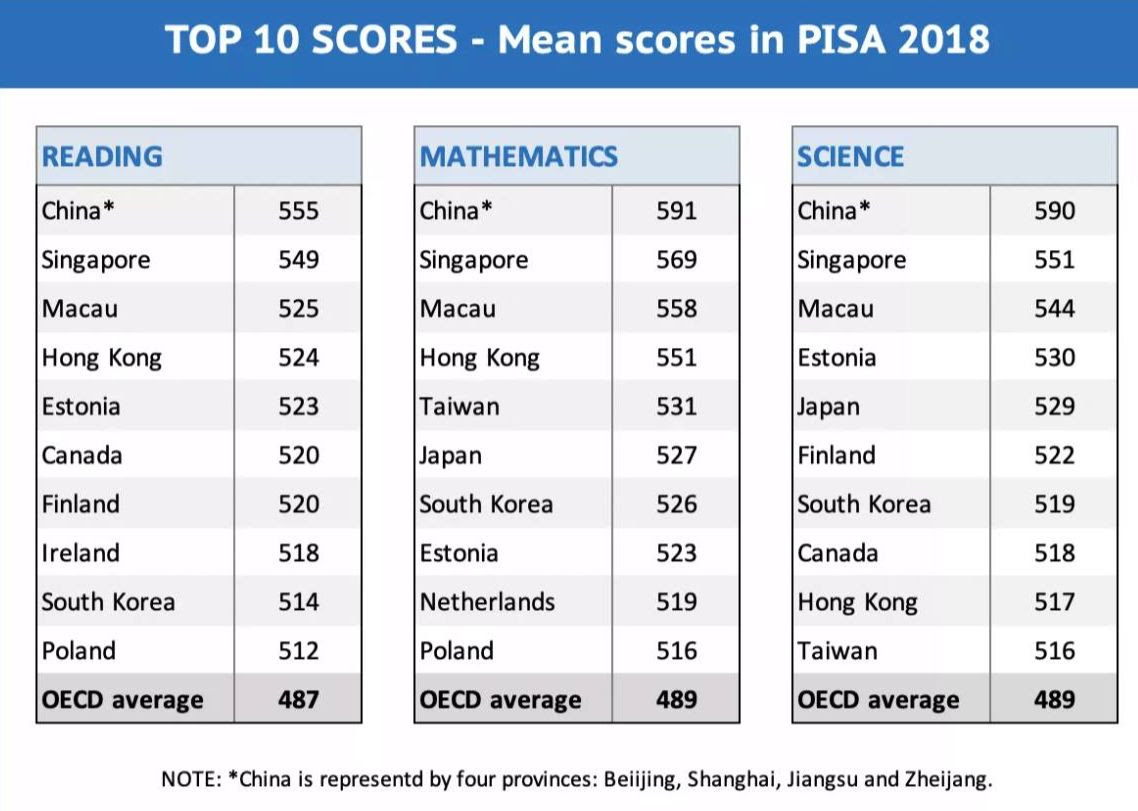
Nations with top education scores all rely on public schools. If the US followed their examples:

  • Teachers would be highly educated, well-paid and respected. In Finland, for example, acceptance for an education degree can be more competitive than medical school.
  • Schools would have shorter vacations, but also shorter school days. In China, elementary students take 90-minute lunch breaks. In Singapore, teachers use the additional time for planning lessons and collaborating on how to improve students’ performance.
  • After the regular school day, learning would continue at home or in tutoring sessions, especially for secondary students. Parents’ role in most successful nations is to ensure children do their three hours or so of assigned homework.

All these top-scoring countries rely on
public-education systems.

(Note that China is not really first; it only submits scores from 4 wealthy provinces.)Why don’t conservatives want to follow these successful models? More school days with highly qualified educators cost more. Companies want to sell high-margin educational software, supported by low-paid trainees, rather than pay education professionals’ salaries. New Hampshire’s EFAs potentially shift millions from public-school teachers and administrators to corporations seeking shareholder profits. In addition, church-based schools are seeking their share of EFAs. Then there is the fact that more-educated people tend to vote Democratic.

WHY SO MANY EYES ARE WATCHING NH EFAS
That is why so many outside New Hampshire are focused on EFAs here. National and international commercial and religious interests will be contributing to Mr. Pompeo and other conservative candidates. Donors hope that if a highly ranked state like New Hampshire can be convinced to hand their taxpayer dollars to unsupervised scholarship funds (see inset below), the rest of the nation will follow.EFAs hide spending detail from taxpayers

EFAs move millions in taxpayer funds from local school board oversight to an independent contractor. The contractor only has to report three things to the Department of Revenue
Administration: amount spent on administration, total number of scholarships, and average scholarship size. The state has no knowledge of who receives how much.
— NH RSA 77 G:5(g)HOW EFAS WILL CHANGE NH
EFAs impact far more than students. When EFAs substitute a $4600 payment for a year of public-school education, someone has to make up the difference. A religious school might charge only $2000 more per year in tuition, but how many low-income households can afford $2000 per child? The upshot is that poor neighborhoods will still need to rely on public schools, but those schools will have fewer per-student dollars to support them. Property taxpayers will have to make up the difference or close schools. The hit will be especially severe in Coos County, where thousands of educators comprise a significant segment of employees. When those schools are forced to close, most educators will move out, worsening Coos towns already dwindling populations and decreasing property values. Our most diverse populations in Manchester and Nashua are also more likely to suffer from the shift in funding caused by EFAs because they have lower incomes. In southern New Hampshire, the census showed that population did increase due to in-state migration. But what families will want to move into a state whose public schools are foundering? The answer is, those families for whom $4600 is enough to send their children to low-tuition religious schools, those families who can already afford expensive private school but would like taxpayers to subsidize them, and those families who want taxpayer funding for parent-guided home education programs. These differ from the workers attracted over the last decade to New Hampshire for its highly rated public schools. How will this affect companies struggling to find employees? No one knows, but the answer will certainly impact our economy.
EFAs will also impact New Hampshire society. Communities forced to close their schools will become less cohesive. Children educated only alongside others with similar backgrounds will have less understanding of the world and their place in it. They will be less able to succeed in the diverse demographics that will make up our nation’s future.
Perhaps conservatives have decided not to follow successful models for improving public education because they do not want the public to be educated. They would prefer people who let corporations and the wealthy take advantage of them, who have been taught to villainize a government that protects public interests.

Carol Burris, executive director of the Network for Public Education, reports the heartening news that support for school choice has declined in the latest poll by EdNext. EdNext is a pro-choice journal funded by the Hoover Institution and of there pro-choice organizations and individuals.

Support for Charters and Vouchers Has Dropped

Despite the myth that the pandemic resulted in an increased appetite for privatized alternatives to public schools, the opposite is true, according to a new poll just published by EdNext. Support for both charter schools and vouchers is down by substantial amounts. Only 33% of all Democrats now support charter schools–that’s an all-time low.  Less than half of all Americans (41%) now support them. Your constant advocacy for public schools and against privatized alternatives is paying off.

Democrats are beginning to see the pattern in the rug: Whatever is being pushed by Betsy DeVos, Charles Koch, the Walton family, and every rightwing foundation is not in the public interest.

Online charters have a history of poor performance: high attrition rates, low graduation rates, low test scores.

Will Huntsberry of the Voice of San Diego reports here that online charters were once again among the lowest performing schools in that city.

Huntsberry writes:

Virtual charter schools – as well as other charters that don’t use traditional brick-and-mortar classrooms – performed among the worst in San Diego County in a new analysis of test scores that took each school’s poverty level into account.

The analysis compared 632 schools across San Diego County. Out of 14 non-classroom-based charter schools, as they are called in education jargon, five scored among the 20 lowest-performing schools. Nine out of 14 schools scored among the bottom 15 percent.

California’s non-classroom-based schools have lived under a magnifying glass in recent years. State legislators placed a moratorium on new non-classroom schools, after executives from one online charter siphoned more than $80 million into their own private companies. Legislators also temporarily blocked the schools from receiving new funds.

The new analysis, performed by Voice of San Diego and the Center for Research and Evaluation at UC San Diego Extension, did not just look at a school’s test scores. It compared a school’s performance on standardized tests to other schools with similar poverty levels.

Brick-and-mortar charters performed in line with traditional public schools in the analysis. But non-classroom-based charters scored significantly worse.

These findings reenforce the statewide study of online charter schools in California, prepared by “In the Public Interest.” They have a long track record of failure nationally.