Archives for category: Education Industry

Veteran journalist Jennifer Berkshire speculated on Twitter about why Democrats failed to defend public schools against extremists. The answer is that they swerved into the politics of neoliberalism 25 years ago and promoted privately-run charter schools. They allied with reactionary forces like the Waltons in their fruitless quest for “innovative” schools. Her handle is @@BisforBerkshire.

She wrote with crystal clarity:

Lots of takes on the Dem’s public education problem. But party’s utter inability to articulate why public education matters may be the biggest.

The Democrats’ favorite policy shop in D.C. is the Center for American Progress, which has been the party’s leading advocate of charter schools. The question that CAP can’t answer is: Why does public education matter?

Nancy Bailey addressed the same problem on her blog. She said bluntly that Democrats are not the education party, as they want the public to believe. They abandoned public schools and teachers by their promotion of school choice and evaluating teachers by their students’ test scores.

The eight years of Obama’s Race to the Too was a nightmare for teachers, who were constantly scapegoated. Arne Duncan fell in love with Common Core and Teach for America and used every opportunities to bash teachers and real public schools.

Democrats cannot be the education party when they support charter schools, Common Core, and fast-track teachers like Teach for America. They haven’t stood up for public education despite all the teacher union hoopla.

Where have they been on the discussion of special education? They’ve worked along with Republicans to deny children individualization, smaller class sizes.

Democrats can become the “education party” again when they walk away from the billionaires like Bill Gates, who likes to play with other people’s lives.

Bill Phillis is a retired state deputy commissioner of education who is dedicated to the preservation and improvement of public schools in Ohio. He has dedicated his retirement years to publicizing the harm that vouchers and charters do to public schools. He founded the Ohio Coalition for Equity and Adequacy. The Ohio State Constitution guarantees a uniform system of public schools, a commitment that the Republicans who control the state have repeatedly violated with impunity.

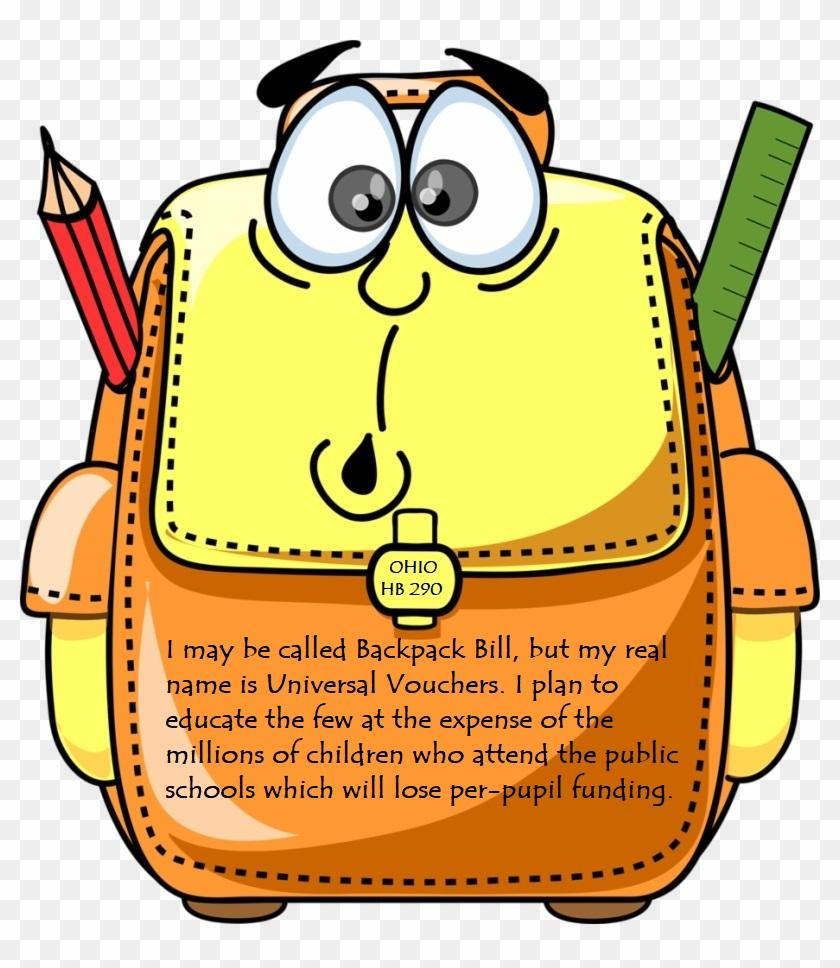
The latest gambit from the Republican privatizers called “the backpack bill,” symbolizing the idea that each child has a “backpack full of cash” to spend in any way their family chooses. They really need to see the wonderful documentary “Backpack Full of Cash.” You can rent the documentary and show it in your community.

Phillis writes:

THE OHIO UNIVERSAL VOUCHER CAMPAIGNERS USE CRITICAL RACE THEORY TO ENTICE FOLKS TO SUPPORT HB290 (UNIVERSAL VOUCHERS) IN A SLICK MAILER


The HB290 crusaders have produced and sent a fundraising mailer signed by one Aaron Baer to an undisclosed list of folks. The seven-page letter warns recipients that public schools are indoctrinating our children into radical anti-Christian ideology, “Critical Race Theory, and trans advocacy”. “They are being trained to hate America”, the letter says. They evidently combed through the classrooms of Ohio and found 4 students whose teachers were doing something that hinted at support for CRT or other controversial issues. They didn’t mention the 100,000 plus public school educators that are working selflessly to grow upstanding citizens.
The author of the letter makes such revealing statements as:

  • “…many of Ohio’s public schools have been failing our students for more than a generation.”
  • “…I initiated the Backpack Bill (HB290)…” (A couple legislators who sponsored the bill indicate they initiated the bill.)
  • “…The Backpack Bill ensures every Ohio student can have access to high quality education…”
  • The P.S. to the letter includes the statement, “Ohio students are trapped in failing public schools…”

The Backpack voucher campaigners are perpetuating the myth of the “failing public school monopoly” as a key plank in their campaign platform.

Public school advocates, who believe HB290 is too extreme to pass, need to wake up.

Follow the link to read the 8 Lies About Private School Vouchershttps://vouchershurtohio.com/8-lies-about-private-school-vouchers/

Like us on Facebook: https://www.facebook.com/OhioEandA


Photo Credit: Jeanne Melvin


The No Child Left Behind Act Has Put The Nation At RiskVouchers Hurt Ohio

William L. Phillis | Ohio Coalition for Equity & Adequacy of School Funding | 614.228.6540 |ohioeanda@sbcglobal.net| http://ohiocoalition.orgSign up for our newsletter!

A regular commenter on the blog, known as Chiara, reports the composition of West Virginia’s new board for authorizing charter schools. The legislature endorsed new charter schools in a state that has never had them. Several of them will be for-profits. Two will be virtual charters. There are three other entities that can authorize the privately run schools that are publicly funded.

Chiara wrote:

Here’s the oversight of West Virginia’s new charter sector: “Appointees are: former Greater Beckley Christian School head boys basketball coach Brian Helton; John Waltz, the vice president for enrollment management at West Virginia Wesleyan College Upshur County; Dewayne Duncan, a real estate developer in Kanawha County and former Republican candidate for Kanawha County Commission; Karen Bailey-Chapman, owner of public relations firm KB Advocacy in Jefferson County and a board member of the libertarian Cardinal Institute for West Virginia Policy; and Adam Kissel, a senior fellow at the Cardinal Institute. Kissel, a former deputy assistant secretary for higher education programs at the U.S. Department of Education for 16 months under former president Donald Trump, said he was excited to get to work on the new board.” Not a single person from a public school, nor anyone who supports public schools. Rigorously screened – only true believer ideological ed reformers are hired. These are the governance systems national ed reformers design and lobby for, so this must be how they envision the privatized systems they’re creating. Packed with fellow ed reform echo chambers, no dissent or different views permitted, and deliberate exclusion of anyone who comes out of a public school.

The Wall Street Journal, owned by billionaire RupertMurdoch (who also owns Fox News), runs a steady diet of anti-public school editorials. Sometimes they bash public schools. Sometimes they praise charter schools and vouchers. Sometimes they do all of this in the same editorial. While an opinion piece that expresses a dissenting opinion occasionally gets published, it’s fair to say that the WSJ does not like public schools. In my last book, Slaying Goliath, I praised retired Austin librarian Sara Stevenson for responding to every WSJ vilification of public schools.

Peter Greene responded to the opinion piece by law professor Philip Hamburger, who claimed that public schools are not “constitutional” because they suppress parents’ freedom of speech, that is, their ability to ensure that their children hear, read, and learn only what their parents want them to learn.

Greene begins:

Last Friday, the Wall Street Journal (Fox News’ upscale sibling) published an op-ed from Philip Hamburger, a Columbia law professor and head of the New Civil Liberties Alliance, a Koch-funded pro bono firm that takes cases primarily to defend against the “administrative state.” It’s a hit job on public education with some pretty bold arguments, some of which are pretty insulting. But he sure says a lot of the quiet part out loud, and that makes this worth a look. Let me walk you through this. (Warning–it’s a little rambly, and you can skip to the last section if you want to get the basic layout)

Hamburger signals where he’s headed with the very first paragraph: The public school system weighs on parents. It burdens them not simply with poor teaching and discipline, but with political bias, hostility toward religion, and now even sexual and racial indoctrination. Schools often seek openly to shape the very identity of children. What can parents do about it?

Hamburger offers no particular evidence for any of this catalog of arguable points. Various surveys repeatedly show that the majority of parents approve of their child’s public school. The rest is a litany of conservative complaints with no particular evidence, but Hamburger needs the premise to power the rest of his argument.

So here comes Hamburger’s bold assertion:

Education is mostly speech, and parents have a constitutional right to choose the speech with which their children will be educated. They therefore cannot constitutionally be compelled, or even pressured, to make their children a captive audience for government indoctrination. Conservative talking points about public education routinely assert and assume that public education is a service provided to parents, rather than to the students or society at large. It’s case I’ve never seen them successfully make. At the same time, society’s stake in educated members is clear and the entire rationale behind having non-parent taxpayers help pay the cost of public education. In any other instance where the taxpayers subsidize a private individual’s purchase of goods or service (e.g. food stamps, housing), some conservatives say the social safety net is a Bad Thing, so it’s uncharacteristic for them to champion public education as, basically, a welfare program for parents when they want to dramatically reduce all other such programs to bathtub-drowning size (spoiler alert: they’d like to do that with public education, too).

But Hamburger has taken another step here, arguing that speech to children somehow belongs to their parents. It’s a bold notion–do parents somehow have a First Amendment right to control every sound that enters their children’s ears? Where are the children’s rights in this? Or does Hamburger’s argument (as some angry Twitter respondents claim) reduce children to chattel?

Hamburger follows his assertion with some arguments that don’t help. He argues that public education has always attempted to “homogenize and mold the identity of children,” which is a huge claim and, like much of his argument, assumes that schools somehow have the power to overwrite or erase everything that parents have inculcated at home. But then, for the whole argument currently raging, it’s necessary to paint public schools as huge threat in order to justify taking dramatic major action against them….

But “education is speech” is not the really bold part of his argument. That really bold part is where he goes on to say “therefor, parents should have total control over it.” I have so many questions. Should parents have total control over all speech directed at or in the vicinity of their children, including books, and so would I be violating a parent’s First Amendment rights if I gave their child an book for Christmas? And where are the child’s rights in this? Would this mean that a parent is allowed to lock their child in the basement in order to protect that parent’s First Amendment right to control what the child is exposed to?

Hamburger’s argument has implications that he doesn’t get into in his rush to get to “do away with them and give everyone vouchers.” The biggest perhaps is that he has made an argument that non-parent taxpayers should not have to subsidize an education system. I’m betting he’s not unaware of that.

Please open the link and read the rest of the article.

In this opinion piece in the Baltimore Sun, Kalman R. Hettleman describes the creation in Maryland of a new state agency that has the same functions as the Maryland State Department of Education and the power to override local control. This agency is supposed to guarantee “accountability,” but it’s limitless power leaves many unanswered questions.

A bombshell, with uncertain force, is about to land on school reform in Maryland. It’s the startup in the next several weeks of the Accountability and Implementation Board (AIB) created under the Blueprint for Maryland’s Future. More than any other part of the blueprint, the AIB is a radical experiment in school governance — untested anywhere in the U.S. — with virtually limitless authority to make or break school reform for generations to come.

The AIB’s super-muscle comes from its unambiguous power to fully govern public schools. This means it can usurp the functions of the Maryland State Department of Education (MSDE) and control local school policies.

As a member of the Commission on Innovation and Excellence in Education (known as the Kirwan Commission) that drafted the blueprint, I favored the concept of the AIB. I still do. But I recognized that opponents, though some were overwrought, had a point. The seven-member board, to be appointed by the governor from a list of nine persons just selected by the AIB nominating committee, could actually cause more bureaucracy and less accountability, unless it acts wisely.

Predictably, formidable political groups opposed such a drastic departure from current law and practice. The MSDE board, state superintendent and local school district boards and superintendents argued that they would be micromanaged; in the process, they said, local control — so sacrosanct for so long — would be emasculated.

In addition, Maryland just appointed a State Superintendent with impeccable reform credentials.

Read the article. If you understand why the state is creating a powerful new agency to run its schools, please let me know.

The House of Representatives recently passed a budget that excluded for-profit charter schools from receiving federal funds. The federal Charter Schools Program has doled out many millions to for-profits over the years, despite the fact that their need for profit reduces their funding for instruction, small classes, and experienced teachers. The Senate has not yet taken action on the budget but the charter lobbyists are pushing hard to protect their for-profit friends. In the past, the charter industry shunned the profiteers, but they stand with them in solidarity to hang on to their access to federal funds.

Does it matter whether a charter operates for-profit or not? Jeff Bryant explains how the introduction of profiteering has harmed not only the schools but other sectors as well. Bryant is an independent journalist who has written frequently about school privatization.

He begins:

Charter school industry lobbyists, who appear to have lost a fight in the U.S. House of Representatives over an appropriations bill that cuts federal funding to charter schools operated by for-profit businesses, are rolling out a campaign to defend their taxpayer revenues in the U.S. Senate, but federal lawmakers may wish to consider new evidence of how for-profit charter enterprises introduce potential harms into public education.

One such potential harm, according to an in-depth examination conducted by Our Schools, stems from for-profit charter school operators partnering with private investors intent on turning quick profits from public dollars meant for educating children.

Our Schools examined the relationship between Pansophic Learning, owner of the Accel Schools chain of for-profit charter schools, and Safanad Limited, a private equity firm, originating in the Middle East, with extensive investment holdings in K-12 education, senior living, and other public sector-related enterprises.

What Our Schools found was that for-profit businesses like Pansophic Learning are providing entryways for wealthy investors from abroad to flood the U.S. with money to buy up struggling taxpayer-funded enterprises and put into place elaborate business schemes and networks of interrelated companies that hide their profiteering while doing little to improve the quality of services to the public.

A request for comment regarding Pansophic’s relationship with Safanad and the partnership’s potential for conflicts of interest that was left as a press inquiry at the Pansophic website did not receive a reply.

The combination of for-profit operators backed by private equity has become prevalent in other publicly funded sectors that have traditionally been operated by federal and/or state governments or nonprofit organizations. And the results have not been beneficial to the public or the individuals the publicly funded system was intended to serve.

For example, in the government-funded prison system, “The involvement of private equity firms, which manage large investment portfolios, presents a conflict between the financial and social goals of some investors,” reported Prison Legal News in 2019, citing two studies—one from the nonprofit Worth Rises, which advocates for “dismantling the prison industry,” and the other from the American Federation of Teachers, a national teachers’ union.

Another analysis, by the ACLU, found that for-profit prison operators backed by private investors are more apt to create profit for their investors by maintaining high rates of incarceration, which results in significantly higher social and fiscal costs to the public.

Our Schools found that this combination of for-profit entrepreneurs backed by private investors is having a similarly corrosive impact in the charter school industry.

Ron Packard and K12 Inc.

The genesis of Accel Schools goes back to 2014, when Education Week reported that Ron Packard, the former CEO of K12 Inc., had formed a new education enterprise called Pansophic Learning. K12 Inc., which changed its name to Stride Inc. in 2020, was then, and still is, the largest for-profit charter school operator in the U.S.

Packard, a former Goldman Sachs executive who specialized in mergers and acquisitions, departed K12 Inc., which he founded, at a time when the company was besieged with negative publicity.

In 2011, K12 Inc. was the subject of a scathing story in the New York Times revealing that “only a third” of the students enrolled in its online charter schools “achieved adequate yearly progress, the measurement mandated by federal No Child Left Behind legislation,” while the company employed multiple ways to “squeeze profits from public school dollars by raising enrollment, increasing teacher workload, and lowering standards.”

The withering critique, which ran on the newspaper’s front page, “caused” the publicly traded company’s stock price “to drop precipitously,” Education Week reported in 2012, and prompted a shareholder to file a federal lawsuit accusing K12 Inc. executives, including Packard, of “misleading investors with false student-performance claims.”

More negative publicity came in 2013 when Politico reported K12 Inc. was one among many online charter schools that “posts dismal scores on math, writing, and science tests and mediocre scores on reading.” Another blow came that year when influential hedge fund manager and charter school proponent Whitney Tilsonannounced he was shorting K12 Inc. stock, betting the company would fail.

In 2014, K12 Inc. became the target of yet another lawsuit accusing the company of “misleading investors by putting forward overly positive public statements… only later to reveal that it had missed key operational and financial targets,” Education Week reported. The lawsuit also charged Packard, whose relationship to the company had become unclear, of selling off his own stock before revealing the negative financials, and, thus, earning a windfall of $6.4 million before the stock price plunged.

But as Packard disengaged from one troubled education enterprise, he started another with a financial partner that would provide the capital to quickly scale up.

As Education Week reported in 2014, Packard’s new company, Pansophic Learning, included a partnership with a holding company, Safanad Education, a subsidiary of Safanad Limited, a New York- and Dubai-based real estate and investment firm. Packard and Safanad spent an unknown sum to purchase part of K12 Inc.’s assets, mostly in higher education, and acquire an international brick-and-mortar private school. The two entrepreneurs were “on the hunt for acquisitions,” according to Education Week.

A Charter School Shopping Spree

Initially, Packard and Pansophic Learning kept a low profile until, in 2016, a visit by then-Republican presidential nominee Donald Trump drew attention to a Cleveland, Ohio, brick-and-mortar charter school “that usually escapes notice,” reported the Plain Dealer, a Cleveland newspaper.

According to the Plain Dealer, the school, the Cleveland Arts and Social Sciences Academy, was one of 27 schools in Colorado, Illinois, Michigan, Minnesota, and Ohio that had been recently acquired by Accel Schools, a new for-profit network of charter schools owned and operated by Pansophic Learning.

Packard is listed as the CEO of both Pansophic Learning and Accel Schools. Two other C-suite executives of both Pansophic Learning and Accel Schools are COO Maria Szalay and CTO Eric Waller. Pansophic Learning and Accel Schools also have an identical street address in McLean, Virginia.

Prior to the news about Trump visiting its school, Accel Schools had been “amassing an education empire” in Ohio, the Akron Beacon Journal reported.

Among its acquisitions were, in 2014, the “troubled K-8 schools” of White Hat Management, which had previously been, according to the Akron Beacon Journal, Ohio’s largest charter school chain. In 2019, Accel Schools purchased White Hat’s last remaining online charter school as well.

In 2015, Accel Schools also acquired the assets of another financially struggling charter management firm, Mosaica Education, and bought Cleveland-based I Can Schools, which, Packard told the Plain Dealer, were also “struggling financially.”

The charter school shopping spree Accel Schools went on undoubtedly benefited from the financial support of Safanad.

“We are fortunate to partner with Safanad,” Packard is quoted saying in Safanad’s official announcement of its partnership with Pansophic Learning in 2014. “Safanad’s extensive resources will allow us to pursue opportunities of all sizes,” he said.

The Bahamdan Connection

According to the firm’s website, Safanad’s founder and CEO is Kamal Bahamdan, a Saudi national. “Mr. Bahamdan has also been the CEO of the Bahamdan [investment] Group,” according to his profile.

Kamal Bahamdan’s current relationship with the Bahamdan Investment Group is unclear, but the Bahamdan firm maintains a controlling interest in Safanad. According to its SEC filings brochure, Safanad is “controlled by Bahamdan Investment Group and KB Group Holdings Ltd.” KB Group Holdings Ltd., according to Safanad’s SEC filing form, is owned by the Bahamdan Investment Group.

The Bahamdan Investment Group is a Saudi-based investment firm founded by Sheikh Abdullah Salem Bahamdan, Kamal Bahamdan’s father, according to Rocket Reach, a corporate sales, recruiting, and marketing website that published a Bahamdan company history calling Kamal Bahamdan the “third generation” of financial leadership of the Bahamdan Investment Group and “[Abdullah] Bahamdan’s son.”

In numerous online profiles, Abdullah Salem Bahamdan (also Abdullah S. Bahamdan, Abdullah Salim Bahamdan, and Abdullah Bahamdan) is described as a “seasoned banker” and one of “the Middle East’s most prominent and influential financiers.”

Abdullah Bahamdan also spent more than 50 years as the chairman of “Saudi Arabia’s National Commercial Bank, the largest lender in the Arab world,” according to Institutional Investor. National Commercial Bank (NCB), which merged with Samba Financial Group in 2021 to form Saudi National Bank (SNB), was established in 1953 by royal decree, according to the SNB website, with the Saudi government as its major shareholder.

Despite its close relationship to the Saudi government, NCB was one among 16 financial institutions that were fined by the Saudi Monetary Authority in 2019 “for violating principles of responsible finance,” according to Reuters. “[T]he violations were related to exceeding debt burdens imposed on people in proportion to their monthly income.”

In 2020, the U.S. Treasury Department settled a lawsuit with NCB accusing the bank of violating U.S. sanctions against Syria and Sudan between November 2011 to August 2014.

The bank and Abdullah Bahamdan have been the subjects of at least two lawsuits accusing them of financing terrorist groups, which may have been part of what prompted the Saudi government to, in 2017, “crack down on corruption” in its banking industry, Reuters reported.

Perhaps as a result of the crackdown, SNB claims on its website that it “has developed a Bank-wide Anti-Money Laundering and Combating Terrorist Financing Policy.”

Mixing Charter School Investments With Subpar Senior Care

Aside from its investments in Pansophic Learning, Safanad has made some of its biggest commercial real estate deals in the health care sector, principally in senior care facilities, including assisted living, independent living, memory care, and nursing homes, frequently called skilled nursing facilities.

Senior Housing News reported that Safanad teamed up with investment firm Formation Capital, an Atlanta-based health-care-focused private investment company, to purchase 36 senior care facilities in 2011, and, in 2012, the partners spent $750 million to acquire 68 more nursing homes located in East Coast states. The acquisitions made the two investment firms “one of the United States’ largest standalone skilled nursing portfolios,” according to Senior Housing News, with “more than $1 billion worth of senior care assets in the U.S.”

In 2013, the same two investment firms purchased a “36-property senior housing portfolio for approximately $400 million,” reported Senior Housing News, and in 2014, the two firms struck another deal to buy “14 skilled nursing facilities in the mid-Atlantic for about $150 million,” according to Senior Housing News.

The deals Safanad and Formation Capital struck to acquire senior care facilities are strikingly similar to the business transactions Safanad conducted with Pansophic Learning in the charter school sector, principally, buying up financially struggling service businesses that receive large amounts of public funding—in the case of the senior care sector, from Medicare and Medicaid—and that also happen to include significant holdings of real estate.

The nursing home and senior living facilities industry was struggling financially before the pandemic, according to a report by the Pew Charitable Trust. Facilities had been cutting corners for years, skating by with too few staff, due to stagnating wages, and sometimes hiring unskilled workers instead of highly trained personnel.

COVID-19 simply revealed an industry that was already “broken,” reported NBC News, citing “low pay, high turnover, and tough working conditions” as chronic problems in the senior care facilities industry.

Yet the growing presence of private equity investors in the senior care industry has done little to help the industry and appears to have done mostly harm.

2020 study found that private equity ownership of nursing homes and other kinds of senior living facilities increased costs to the public by 19 percent while shortening the lifespans of patients.

Patients in facilities with substantial private equity backing tended to have less access to nurses, declining mobility, and greater use of antipsychotic medications, the study found. Consequently, “private equity ownership increases short-term mortality by 10 percent,” the authors claimed, “which implies about 21,000 lives lost due to private equity ownership over our sample period.”

As with the for-profit prison industry, many of the problems posed by private investment firms in the senior care industry, according to the study, can be sourced to “high-powered for-profit incentives… [being] misaligned with the social goals of quality care at a reasonable cost.”

The study distinguished private equity for-profit ownership from “generic” for-profit ownership because “private equity ownership confers distinct incentives to quickly and substantially increase the value of their portfolio firms.” It is this form of intense, high-powered profit-maximizing incentives, the authors asserted, “that characterize[s] private equity… [and could lead to] detrimental implications for consumer welfare.”

Investor-driven senior care facilities were especially hard hit by the COVID-19 pandemic, a 2020 article in the New York Times reported.

“Decades of ownership by private equity and other private investment firms left many nursing homes with staggering bills and razor-thin margins,” according to the article.

“The toll of putting profits first started to show when the outbreak began,” the article continued. “[S]ome for-profit homes were particularly ill equipped and understaffed, which undercut their ability to contain the spread of the coronavirus.”

Among the for-profit operators that appear to have fared poorly in the pandemic is Consulate Health Care, one of the providers that were snapped up by Safanad and Formation Capital in 2014, according to Senior Housing News. In a 2021 report, the Private Equity Stakeholder Project lists Formation Capital as the owner of Consulate Health Care.

Nursing homes operated by Consulate Health Care and Formation Capital have been hotspots for COVID-19 outbreaks, according to numerous news reports from Florida and Virginia. The high incidence of outbreaks has, in part, prompted a U.S. House committee to launch an investigation into the country’s five largest for-profit nursing home companies, including Consulate Health Care, Politico reported in 2020.

Creative Ways to Wring Profits

As the New York Times reported in 2020, while senior care facilities often struggle financially, their private equity-backed owners have “found creative ways to wring profits out of them.”

Some of these creative ways include charging their operators “hefty management and consulting fees”; buying the real estate from the operators and then leasing the buildings back to the operators, while upping the rents; and pushing their operators to buy products and services from companies that are controlled by the investors.

The real estate plays these firms pull off are particularly lucrative, the New York Times noted, because the buildings are often “more valuable than the businesses themselves.”

A 2018 article in the Naples Daily News described how these arrangements work in Consulate Health Care facilities owned by Formation Capital, the state’s largest provider.

Consulate Health Care and Formation Capital both operate a network of other related businesses—including “real estate, management, rehabilitation and other companies”—that they use as subcontractors for the nursing homes they own.

So when “[t]axpayer money flows to Consulate nursing homes,” the article explained, some of the money also goes to subcontractors that are related to the owners, Consulate Health Care and its controlling company, Formation Capital. “[A]nd profits earned go to the chain’s owner, the Atlanta-based private equity firm Formation Capital,” the article stated.

One of the Consulate Health Care nursing homes highlighted in the article pays its owner and management fees to two Consulate companies and also pays its lease payments and rehabilitation service fees to providers that are both related to Formation Capital.

“In each case,” the article said, “the money flows back to Formation Capital and its wealthy investors,” which include Safanad.

Pansophic Learning and Accel Schools operate similar business arrangements that help their organizations maximize their profits, according to a 2021 report by the Network for Public Education (NPE).

Much in the same way Consulate Health Care facilities and Formation Capital push their nursing homes into contracts with their other related businesses, Accel and Pansophic use “a complex web of corporations,” according to NPE, to “control the operations of the school and in doing so, steer business to their related services.”

The report highlighted Accel-managed Broadway Academy, in Cleveland, a charter school previously owned by White Hat Management, according to the Accel Schools contract with the school.

Under the “fees” section in the terms of that contract—originally with for-profit management company Chippewa Community School, LLC, which is now a subsidiary of Accel Schools Ohio LLC—the school, referred to in the contract as the corporation, pays the operator (Accel, by way of its subsidiary Chippewa Community School, LLC) 96 percent of the school’s monthly qualified gross revenue, which is the per-pupil revenue the school receives from the state. In return, Accel is the sole source to provide the school with school staffing and professional development, school management and consulting, textbooks, equipment, technology, student recruitment, building payments, maintenance, custodial service, security, and capital improvements.

In other words, there’s nothing that stops Accel or Pansophic from creating yet more subsidiaries and other related companies that can do business with Broadway Academy. According to the contract, Accel can subcontract services “without the [Broadway Academy] Board’s approval,” and property purchased by Accel “shall remain… [Accel’s] sole property.”

According to NPE, these kinds of contracts, known as “sweeps,” are commonplace in the for-profit charter school industry.

“Sweeps contracts give for-profits the authority to run all school services in exchange for all or nearly all of the school’s revenue,” said the NPE report.

Taxpayer funding for the Broadway Academy that isn’t swept up by Accel’s continuing fee must be depositedinto a “Student Enrichment Fund” for “educational services in the areas of student cultural activities[,] … supplemental tutoring services, and other programs.” Accel has sole authority to “propose uses for such funds,” and “85 percent of all Student Enrichment Funds not spent during the fiscal year in which they are received shall be paid over to [Accel].”

While Accel’s contract with Broadway Academy doesn’t include real estate, the authors of the NPE report searched the database of Ohio charter school contracts, called “community schools documents,” and found that “Global School Properties Ohio, LLC holds the leases for many Accel charter schools. The… [landlord] is at the same 1650 Tysons Blvd. address in McLean, Virginia, as Pansophic [Learning].”

Profiting From D- and F-Rated Schools

School choice and charter school advocates are often quick to defend for-profit charter companies and their private investors, arguing that they are “sector agnostic” about who owns and operates a school and care only about the school’s “results.”

But what constitutes good results in education is a much-debated topic, and studies about the results of for-profit charter schools have found mixed results at best.

A 2017 report from Stanford University’s Center for Research on Education Outcomes (CREDO) found that students who attend for-profit charter schools have weaker growth in math than they would have in a district public school and similar growth in reading. Students in nonprofit charter schools experienced stronger academic growth in both subjects than their peers enrolled in for-profit charters. The differences were “significant,” according to the study.

Also in 2017, Chalkbeat reported, “studies comparing for-profit schools to nonprofits and traditional public schools in the same area don’t find consistent differences in performance, as measured by test scores.”

None of these studies examined the performance of Accel Schools or the impact of private equity in the for-profit charter industry.

But based on Ohio’s A-F grading system, Accel Schools in the Cleveland area, where the management company has its highest density of schools, has no schools with A or B ratings from the 2018-2019 school year, the last one measured due to the pandemic. There are three C-rated schools, including Broadway Academy. Eleven others are D- and F-rated schools. Among the F-rated schools is the school Trump visited in 2016, the Cleveland Arts and Social Sciences Academy.

The problems posed by the charter school industry and its for-profit sector have not gone unnoticed by Democratic Party elected officials and their voters.

A 2021 survey found that public support for charter schools is waning, especially in the Democratic Party where favorability has fallen to an all-time low of only 33 percent. Our Schools has previously noted that Democratic Party politicians are steadily drifting away from their once-avid support of the industry, especially the ones operated for profit.

Nevertheless, out of seven charter schools that have applied to open in West Virginia, where charter schools had not been allowed to open until 2021, five of the proposed schools would be operated as for-profit entities, and of those five, three would be operated by Accel.

By Jeff Bryant, a writing fellow and chief correspondent for Our Schools. He is a communications consultant, freelance writer, advocacy journalist, and director of the Education Opportunity Network, a strategy and messaging center for progressive education policy. His award-winning commentary and reporting routinely appear in prominent online news outlets, and he speaks frequently at national events about public education policy. Follow him on Twitter @jeffbcdm. Produced by Our Schools.
In the race for governor of Virginia, Republicans have focused their campaign on hot-button issues like banning “critical race theory” from the schools, opposing mask mandates, and taking a stand against tiny numbers of transgender students. Republicans have also argued that parents should be able to determine what teachers are allowed to teach and to ban books that they don’t like. And of course, they support school choice. In short, the Republican candidate has decided to base his campaign on “culture war” issues, offering no proposals to improve the schools.

In contrast, the Democratic candidate Terry McAuliffe has promised to raise teachers’ salaries, expand pre-K, and protect students from the virus. He has also taken a stand against parents dictating what should be taught, instead leaving those decisions to teachers. In these times, he has shown that principle and courage are possible when running for high political office, which is why he was endorsed by the Network for Public Education Action. We will learn on November 2 whether principle and courage can beat rank opportunism.

Lisa Lerer wrote in the New York Times about how unusual it is to have a statewide race centered on education. .

WINCHESTER, Va. — …From fights over evolution to desegregation to prayer, education battles have been a staple of the country’s divisive cultural issues for decades. But not quite like this.

After months of closed classrooms and lost learning time, Republicans in Virginia are making the schools the focus of their final push to capture the governor’s office, hoping to rally conservatives around both their frustrations over mask mandates and mandatory vaccinations and their fears of what their children are being taught.

Vocal groups of parents, some led by Republican activists, are organizing against school curriculums, opposing public-health measures and calling for recalls of school board members. And Mr. Youngkin, a former private equity executive, has capitalized, seizing on conservatives’ concerns about instruction on race and the rights of transgender children to argue that Democrats want to come between parents and their children’s education.

Mr. Youngkin’s attacks have forced Terry McAuliffe, the Democratic former governor trying to win back his old job, onto the defensive, and have thrust the ordinarily local issues surrounding schools into the middle of a rancorous nationwide shouting match.

The Virginia race offers an early electoral test of that conservative energy.

A victory by Mr. Youngkin would mark the first statewide win for Republicans in a dozen years and likely trigger a political panic within the Democratic Party about its prospects in next year’s midterm elections. Some Republican officials and strategists liken the surge of activism to the Tea Party, the anti-government movement that helped them win control of the House in 2010 and unleashed a revival of outrage politics that would define their party for the next decade.

“There’s just so much focus on the schools, and it’s visceral,” said John Whitbeck, a former chairman of the Republican Party of Virginia from Loudoun County, where acrimonious school board meetings have led to arrests, death threats and constant airtime on conservative media. “It’s not like, ‘Oh, I’m against the debt ceiling.’ This is like, ‘You’re destroying our children’s education.’ And, look, angry people vote.”

Polling in recent weeks has shown a tight race, with Democrats less enthusiastic than Republicans about voting. Mr. McAuliffe, who was barred from seeking re-election in 2017 by Virginia law, is faring worse in the fast-growing, voter-rich Northern Virginia suburbs than Gov. Ralph Northam, a Democrat, did when he won four years ago, according to some surveys.

Mr. Youngkin’s focus on schools may not resonate as strongly with the broader electorate.

Measures such as mask and vaccine mandates are cutting differently in the governor’s race in more liberal New Jersey and are overwhelmingly popular among Virginia’s independents and Democrats. Critical race theory — an advanced academic concept generally not introduced until college — is not part of classroom teaching in Virginia and many voters say they do not know enough about it to have an opinion.

And turning schools into a cultural war zone by railing against equity initiatives, books with sexual content and public health measures avoids tackling issues like budget cuts and the other thornier problems facing American education.

But in an off-year election, when both sides anticipate a sharp falloff in voting, victory may hinge on which candidate can best motivate their base. Mr. Youngkin and his strategists believe that in the fights roiling schools they have discovered the rare issue that can galvanize their voters, even in places that are shifting the state to the left.

Frustration with education is an issue that unites Republicans, energizing moderates eager to ensure their children remain in school as well as conservatives who see a liberal plot to indoctrinate their children with the belief that white people are inherently racist.

“The former governor is saying, ‘Hey I’ll decide how to teach your kids, not you’ — that’s really the issue driving this,” said John Fredericks, who led Donald Trump’s Virginia campaign last year. “Glenn Youngkin is the candidate that’s been able to straddle both sides of the party. And so far he’s given us just enough where we can enthusiastically vote for the guy.”

Republicans have centered much of their closing argument around a statement by Mr. McAuliffe in last month’s debate.

The comment came after Mr. Youngkin attacked Mr. McAuliffe over his 2017 veto of a bill permitting parents to opt out of allowing their children to study material deemed sexually explicit. The dispute was prompted by a mother who objected to her son, a high school senior, reading literary classics including Toni Morrison’s “Beloved.”

Mr. McAuliffe shot back that he did not believe “parents should be telling schools what they should teach.” In the weeks since, he’s stood by those remarks, saying that the state Board of Education and local school boards should determine what is taught in the classroom.

But Mr. Youngkin and Republicans, stripping the quotation from its context, have turned the footage into the core of their argument that Mr. McAuliffe would side with government over parents.

Video of the remark was featured in a flurry of digital ads and a statewide television commercial accusing Mr. McAuliffe of going “on the attack against parents.” Mr. Youngkin’s team began scheduling “Parents Matter” rallies in exurban counties, as they actively courted parent activist groups.

And Mr. Youngkin has also voiced support for Byron Tanner Cross, a physical education teacher in Loudoun County. Mr. Cross was suspended after announcing at a school board meeting that he would not address transgender students by their preferred pronouns because of his Christian faith.

At a campaign rally last week in Winchester, a small town in the Shenandoah Valley in one of the fast-growing exurb counties around Washington, Mr. Youngkin made little mention of Mr. Trump, vaccines or the coronavirus. Instead, he repeatedly invoked issues around schools as top priorities.

He drew some of the loudest applause from the overwhelmingly white audience when he promised to ban critical race theory on his first day in office and vowed that schools would never be closed again.

“This is what big government means for Terry McAuliffe. He not only wants to stand between you and your children. He wants to make government a tool to silence us,” Mr. Youngkin told the crowd of nearly 200 people at a farm stand. “This is no longer a campaign. This is a movement. It’s a movement led by parents.”

Mr. McAuliffe has dismissed the outrage surrounding critical race theory as “racist” and “a dog whistle.” He supports mask and vaccine mandates for students, teachers and school staff. (Mr. Youngkin says he encourages Virginians to get vaccinated against the coronavirus but does not support mandates.)

But there are signs that Democrats sense danger.

Mr. McAuliffe’s campaign has returned to highlighting his education proposals to undercut any argument that Mr. Youngkin could be stronger on the issue, promising to invest $2 billion in education, raise teacher pay, expand pre-K programs and invest in broadband access for students. On Friday, Mr. McAuliffe released an ad saying that Mr. Youngkin would cut billions of dollars in education funding and bring “Donald Trump and Betsy DeVos’s education policies to Virginia.”

The parent organizations in Virginia say they are nonpartisan and more focused on school board elections than national politics. But many are led by Republican activists, raise funds from Republican Party donors and are helped by conservative think tanks such as the Heritage Foundation, which has held briefings to discuss model legislation to block critical race theory. Last month, the Republican National Committee ran ads attacking “fascist mask mandates” and highlighting video clips of angry parents yelling at school board members.

On September 22, the National Alliance for Public Charter Schools put out a press release boasting of unprecedented enrollment growth during the pandemic. The report asserted that charter school enrollment increased during the pandemic in at least 39 states, with a 7 percent overall increase. The charter lobby said that this growth “is likely” to be “the largest rate of increase in student enrollment increase in half a decade,” as charter schools added nearly a quarter million students.

Carol Burris, executive director of the Network for Public Education, conducted a state-by-state analysis of their claim and discovered that it was a half-truth at best. Maybe a quarter truth. Maybe less.

What she discovered was that most of the enrollment gains occurred at the worst-performing segment of the charter industry: virtual charter schools. Many brick-and-mortar charter schools actually lost enrollment.

Writing on Valerie Strauss’s “Answer Sheet” blog at the Washington Post, Burris documented the hollowness of the charter lobby claim.

She began:

The National Alliance for Public Charter Schools (NAPCS) has been broadcasting a 7 percent surge in charter school enrollment during the 2020-2021 pandemic school year. Parents are “voting with their feet,” according to its new report, preferring charters to their local public schools. What the authors of the report avoid telling readers is that much of the increase — and likely most of it — was in virtual charter schools, the worst-performing in the charter sector. This occurred even at the expense of brick-and-mortar charters.

The report says this:

“Although a school-level analysis was not conducted as a part of this paper, in some states (e.g., Oklahoma, Pennsylvania, and Utah), charter school enrollment increases were primarily driven by enrollment in virtual charter schools. This explains some but not all of the enrollment increases experienced by the charter school sector nationwide last year.

What exactly does “primarily” mean? How bad is the problem? To find out, the Network for Public Education did a school-by-school analysis of virtual charter growth in the states with the largest proportional enrollment increases.

We began with the three mentioned states. In Oklahoma, the virtual charter-school sector more than doubled enrollment. Ninety-seven percent of the more than 35,000 new students in charters enrolled in virtual schools — most in the for-profit EPIC, which has been repeatedly under investigation for misreporting costs to state officials, improper financial transfers and more.

In Pennsylvania, 99.7 percent of the charter enrollment growth occurred in virtual charter schools. Enrollment in the Commonwealth’s traditional brick-and-mortar charter schools increased by a mere 78 students.

Cyber charters accounted for over 131 percent of the growth in Utah, with enrollment in traditional charters declining.

We expanded our analysis to see if this trend occurred in other states. We began with Michigan, a state whose auditor general had recently released an audit finding that cyber charters could not document participation in at least a single course in more than half of the inspected student records.
The enrollment surge in that state’s cyber charters accounted for 237 percent of the increase. Cyber charters enrollment increased by 5,071 students, while traditional charter enrollment dropped by nearly 3,000.

We then looked at Arizona, a state where families have been bombarded with cyber charter ads and billboards. Over 94 percent of the charter enrollment growth in that state was in the cyber charter sector.

Burris then includes a graph of every state that experienced at least a 10% increase in charter enrollments; there were 13. The graph shows how many students switched to online charters and how many to brick-and-mortar charters. In sum, 95.5% of the enrollment growth was virtual charters. Some brick-and-mortar charters lost enrollments.

Why does this matter? The virtual charter schools have a record of low academic achievement, high attrition, and low graduation rates. In addition, the sector has experienced massive scandals, like the A3 chain in California, whose founders pleaded guilty to phantom enrollments and are repaying the state hundreds of millions of dollars. Like ECOT (Electronic Classroom of Tomorrow) in Ohio, which collected $1 billion over 20 years, gave generously to politicians, then declared bankruptcy rather than comply with a court order to repay $67 million to the state for padded enrollments.

Seeing this increase in schools with abysmal performance is cause for alarm. A study of virtual schools by CREDO in 2015 concluded that students who attend these schools lose ground. While findings vary for each student, the results in CREDO’s report show that the majority of online charter students had far weaker academic growth in both math and reading compared to their traditional public school peers. To conceptualize this shortfall, it would equate to a student losing 72 days of learning in reading and 180 days of learning in math, based on a 180-day school year. This pattern of weaker growth remained consistent across racial-ethnic subpopulations and students in poverty.

Students may have”voted with their feet” to enroll in virtual schools during the pandemic, but we have to wait for the evidence to find out if they stayed or returned to public schools. If they decide to stay in virtual schools, we should be alarmed.

Billy Townsend of Florida writes here about an emerging development: the end of high-stakes testing. As a candidate, Biden promised to end it, but didn’t. Now Florida’s Governor Ron DeSantis says its day is done. Even his state commissioner loves testing but turned on a dime to support the Governor. The vaunted “Florida model” of test-punish-choice is dead, writes Townsend.

No state has been more devoted to standardized testing than Florida, so the fact that its leaders are adopting anti-testing rhetoric suggests that the wind is shifting.

Townsend begins:

Last month, Ron DeSantis turned heretic. Without any warning, the 2024 GOP presidential hopeful publicly trashed the Republican education policy scripture Jeb Bush wrote 25 years ago.

He joined U.S. president Joe Biden in publicly rejecting the cornerstone of America’s dying “education reform” movement: the big money, high-stakes, end-of-year, badly designed, standardized test.

Bipartisan/institutional American power has used these tests to label and punish American children, teachers, parents, schools, and communities for a generation, with no measurable or perceivable life benefit.

In Florida, we call this test the Florida Standards Assessment (FSA).

Ironically, in killing the FSA, DeSantis and his pro-test Education Commissioner Richard Corcoran used the language teacher unions and Opt-Out activists and public school advocates have used for years and years. – “I want more learning and less test prep,” DeSantis said.

“From April to May, we basically shut down schools for testing,” said Corcoran, who also called the Florida test he championed for years “archaic.” For Corcoran particularly, this is the equivalent of a Wall Street investment banker publicly repudiating capital as “archaic.”

In theory, the massive testing period near the end of the year will be replaced by three “progress monitoring” windows during the school year. Everyone in the state will use an as-yet unbuilt state-owned, state-run assessment platform.

But the policy detail is actually much less important than the political rhetoric this time.

With Joe Biden rejecting the current use of high stakes testing during his campaign; and DeSantis rejecting “test prep” and the experience of testing in Florida, the autopilot awfulness of American test-based “reform education” has lost all organized political support. It has enormous unelected money to sustain the inertia for a while. But, I believe, it is doomed.

“Absolutely central”

To understand what an earthquake this announcement was for the Florida Model of education, which has set the toxic American “education reform” template for a generation, you shouldn’t look to me.

Listen to a smart champion of “reform” and the Florida Model instead.

Travis Pillow long worked as a top editor — and by far the smartest voice — for ReDefined, the Florida-based “choice” PR/media shop. ReDefined is funded by Step Up for Students, the massive “charity” that doles out Florida’s various vouchers. Now he writes for an “education reform” site called the “Center on Reinventing Public Education.” Here’s what Travis tweeted after the DeSantis announcement. It’s completely accurate:

“The biggest piece I think non-Floridians (and some Floridians) are missing in this news is how absolutely central A-F school grades are to so many facets of our state’s education policy and how critical it will be to make sure test data can still be relied upon for them.”

As Travis understands, wiping out the FSA wipes out the functional totality of the elementary school grade formula. And it wipes out huge chunks of the middle, high school, and overall district grades. It requires Florida to completely rebuild the grade system, almost from scratch. This includes the basic legal definition of words like “growth” and “achievement” in a way that the “data” from an as-yet unbuilt state progress monitoring platform can feed.

The FSA is also the basis of Florida’s cruel and educationally unsound 3rd grade retention policies, for which there is no supportive research, and which exists only to pump student scores on another big national test, the 4th grade NAEP.

Indeed, Florida’s school grades have been entirely political tools and destructive fraudssince the day they were introduced after Jeb’s election in 1998. They have been used to advance the privatization agenda by driving public school children into un-FSA-tested, ungraded voucher schools.

Please keep reading. Open the link.

Katherine Kozioziemski tells the sad story of her bad experience with a charter school that promised the moon, but turned into a grand financial scam. Her post appears on a new site sponsored by the Network for Public Education called “Public Voices for Public Schools.”

She begins:

I knew something was seriously wrong as soon as I saw the budget of the charter school my kids attended. As a member of the school site council, I was on the budget committee. Now, as I looked at the numbers, I could see for myself how dire the situation was. The school was paying five times fair market value to lease a property from a shell company created by the former CEO of the charter management company. We were on a fast track to bankruptcy.

How did a charter school created by parents and teachers morph into a series of shell corporations and a money-making scheme so complex that the Securities and Exchange Commission would ultimately step in? The story begins nearly two decades ago with budget cuts. Like districts all over California, the Livermore schools had been forced to make deep cuts, including shuttering two beloved magnet schools. The Livermore Valley Charter School, which opened in 2005, emerged from a grassroots desire to provide art, music and science—all of the things our district schools were being forced to eliminate.

To me it sounded like the promise of Disneyland: a private school education at a public school price. While classes in the public schools had 25+ kids in a class, the charter would cap its class sizes at 20. I bought into it–hook, line and sinker.

Within a few years after opening, the K-8 school was in financial freefall. That’s when the CEO proposed an ambitious plan that would not just save the school but create a high school as well as acquire two additional schools in Stockton. By the time my son started at Livermore Valley Charter in 2012, I was already hearing whispers about the company that now ran the school: Tri Valley Learning Corporation. By 2015, when my kids were in kindergarten and third grade, signs that something was seriously awry were impossible to ignore.

Open the link to read the rest of this shocking story.