Archives for category: DeSantis

The Miami Herald reported that Trump lashed out at his rival, Ron DeSantis:

Former President Donald Trump blasted Gov. Ron DeSantis on Thursday, issuing a lengthy statement that called the Florida GOP leader an “average Republican governor with great public relations” and accused him of “playing games” over a potential future presidential bid. Trump, who reiterated his previous “Ron DeSanctimonious” nickname in the press release, said DeSantis owes his entire political career to the former president’s past support of his campaign — something the former president says the governor now takes for granted. “The Fake News asks him if he’s going to run if President Trump runs, and he says, ‘I’m only focused on the Governor’s race, I’m not looking into the future,’” Trump said. “Well, in terms of loyalty and class, that’s really not the right answer.”

Read more at: https://www.miamiherald.com/news/politics-government/article268604697.html#storylink=cpy

Ron DeSantis is a bully and a braggart. Under his autocratic rule, the people of Florida are “free” to do what he tells them to do. The Miami Herald endorsed his opponent Charlie Crist.

Gov. Ron DeSantis’ Florida is a place of meanness. It’s a place where dissent is muzzled, where personal rights triumph over the greater good, where winning is more important than unity — especially if that victory moves him closer to a White House run.

That’s not the Florida we had four years ago. And it’s not a Florida that voters should tolerate for the next four years. There’s a far better choice in the Nov. 8 election: Democrat Charlie Crist.

DeSantis’ first term in office has been defined by stunt after stunt and made-for-Fox-News grandstanding as he claims successive wins in the culture wars created by the politics of division that he exploits for his own gain. Meanwhile, real crises such as the lack of affordable housing and property insurance are barely addressed.

There was the recent taxpayer-funded flight of Venezuelan asylum seekers from Texas to Martha’s Vineyard. The migrants reportedly were duped into believing they would get jobs, but instead ended up on the Massachusetts vacation island, pawns in DeSantis’ thirst for attention. His willingness to upend the lives of vulnerable people for self-aggrandizing publicity appears to have also been behind his boastful announcement in August of the arrest of 20 people, ex-offenders he said voted illegally. However, those arrested have told the Herald that their county election supervisor’s office said they could cast ballots after Floridians approved the restoration of voting rights for some ex-felons.

DeSantis’ own administration was responsible for flagging ineligible voters, but didn’t. Friday, a Miami circuit court judge threw out a criminal case against one of the people DeSantis accused of committing election fraud in the 2020 election.

There’s DeSantis’ crusade to protect white Floridians from alleged reverse racism at the hands of so-called “woke” teachers and workplace diversity trainers. His targeting of drag queens and a Miami bar because a parent brought their child to a popular drag brunch. His use of “parental rights” to create a new culture war surrounding the teaching of LGBTQ+ issues at schools. His exploitation of the COVID pandemic and masking of children as political tools to proclaim Florida as the “free” state — as long as your version of freedom agrees with his.

LOYAL SUPPORTERS

Still, we can’t deny that DeSantis is a highly popular governor within the state and beyond, depending on one’s political leaning. He has loyal supporters; and he is a Trump-like figure without the buffoonery; and he can deftly play both sides against the middle.

While denigrating teachers at traditional public schools, for instance, the governor guaranteed $500 million to raise the minimum teacher salary and provide raises for veteran teachers and other instructional personnel; secured the highest-ever per-pupil spending totals at $7,793 per student; replaced standardized tests in schools; invested more than $124 million for Florida’s Historically Black Colleges and Universities; and gave parents an outsize voice in their children’s education — just one skirmish in his culture wars.

Similarly, he pushed to reopen the state during the COVID-19 pandemic sooner than many others and less safely. His reelection ads tie Florida’s fast economic rebound to his actions to reopen the state early. But, again, he used the pandemic as a political opportunity, pushing unproven treatment, instead of vaccines, to counter the omicron variant; initially refusing to release the names of facilities where long-term-care residents and staff have been exposed; overseeing a health department accused of undercounting the number of dead; downplaying vaccines while areas with his supporters got theirs first; handcuffing local officials from imposing stringent measures to fight the pandemic. And let’s not get into his threats against school districts that wanted to order mask mandates.

More than 80,000 Floridians have died of COVID, something DeSantis has rarely, if ever, acknowledged.

DeSantis, 44, is governor, yes, but with a broad streak of autocrat. He flaunts Florida’s “freedom,” but it’s granted only to a special few. He wants to control every aspect of how Florida functions. He targets people and communities who disagree with him. He pits Floridians against each other to reap political power. There’s no place for dissent — or even normal discussion — in the DeSantis administration, as demonstrated by his attacks against media to deflect potential governmental blame — even as Hurricane Ian’s victims were still being counted. He is an avenging governor, punishing Disney for supporting LGBTQ+ rights. The compliant Republican Legislature aids and abets him, cowed into compliance by his brutal style of politics.

HAS THE KNOW-HOW

Crist, 66, is seasoned, smart and reasonable. He treats people with courtesy, in contrast to DeSantis, who publicly snapped at high school students for wearing masks and accuse them of engaging in “COVID theater.”

Crist has detailed plans on how to tackle the affordable-housing crisis, one of the most important quality-of-life issues in the state. He’s a consensus builder, something we have missed since DeSantis took office, and he knows intimately how government works. There certainly are knocks against Crist. He’s been criticized as a career politician and political chameleon. And it’s true that he’s a former Republican governor-turned-independent-turned-Democratic congressman who is now running for governor again.

But he says the Republican Party left him, not the other way around, a realization shared by many traditional Republicans. But more than anything, Crist is what we need to return Florida to normalcy and common decency. He would stop the culture wars over made-up issues that have no bearing on Floridians’ everyday lives and get on with the business of governing.

And no matter how much Republicans try to paint Crist as a leftist or socialist, he’s not. Instead, he’s that rarely seen breed in the Florida politics of today: a moderate. As a Republican governor, he displayed independence when he vetoed a bill that would have forced women to undergo an ultrasound before having an abortion. And though he came under attack earlier this year from his Democratic primary opponent, Nikki Fried for his word-parsing when it comes to abortion rights, he has made it clear he will protect a woman’s right to choose by signing an executive order on his first day in office.

ABORTION RESTRICTIONS

DeSantis, on the other hand, has vowed to “expand pro-life protections” after the U.S. Supreme Court overturned Roe v. Wade. Republicans control the Legislature, and it’s very likely they will further restrict the 15-week abortion ban they passed this year. Make no mistake: Reproductive rights are at stake in this year’s gubernatorial election.

DeSantis has done little, if anything, to address the exorbitant costs of buying and renting a home. Imagine if the governor dedicated only a fraction of the attention he’s devoted to bashing “critical race theory” to affordable housing. He has recommended lawmakers fully fund the state’s affordable-housing trust fund over the years. But he has never pushed his Republican allies in the Legislature to come up with comprehensive solutions to the issue — and actually signed a bill that enshrines into law lawmakers’ habit of raiding that trust fund for other purposes. Crist would expand down-payment assistance programs and appoint a “housing czar” to help local governments meet housing-affordability goals. In July, he told the Editorial Board that he wants a “Wall Street crackdown” on companies that “are buying huge tracts of land to flip and make a quick profit,” raising costs for working and middle-class families. Taking on those big companies will be a challenge with a GOP-controlled Legislature. As governor, Crist approved cuts to the Sadowski housing trust fund, but said that was necessary during the Great Recession. He now says he wants to fully fund it and would work to repeal the bill DeSantis signed.

We give DeSantis credit for spearheading the recovery in Southwest Florida from the ravages of Hurricane Ian with a billion-dollar price tag. He’s put on his boots — yes, those white ones — and launched a fast-moving recovery plan. For example, it only took the state a few weeks to repair a crucial bridge into Sanibel, not the months predicted. That’s what we would expect from any state’s executive leader. However, Crist has rightly criticized DeSantis for allowing the state’s other crisis, property insurance, to balloon. Hurricane Ian threatens to turn that crisis into a catastrophe. Under DeSantis’ leadership, the Legislature passed Band-Aid reforms during a hasty, three-day special legislative session. Since then, you hardly hear the governor talk about the issue, despite homeowners losing coverage or facing jaw-dropping premium hikes.

But there’s plenty of talk about those deviant drag queens. Crist has a seven-point plan to fix the state’s property insurance system. He would require, for example, that large companies that provide car insurance also provide homeowners. That would address the cherry-picking that insurers do — leaving many Floridians out in the cold. It’s a start, and we’d like to learn more.

WINS AND LOSSES

Crist’s political resume is hard to beat. He served in the Florida Senate, then as the state’s education commissioner, attorney general and Republican governor for one term — before winning the St. Petersburg congressional seat he has held since 2017. He has also lost elections: in 2010, to U.S. Sen. Marco Rubio and, in 2014, when he came within one point of ousting then-Gov. Rick Scott. All of that experience gives him a deep understanding of Florida and how the Legislature works.

▪ On issues of law and order, Crist wants the state to allow felons who have completed their sentences to vote — even while continuing to pay fines or restitution — as Florida’s Amendment 4 was supposed to do, before Republican lawmakers undercut it. Floridians voted to restore the voting rights of former felons, and they deserve a governor who will honor that intent. Though Crist was nicknamed “Chain Gang Charlie” in the 1990s for championing roadside prison work crews in Florida, when he became governor, he restored voting rights to 155,000 convicted felons, streamlining the clemency process and rejecting a policy rooted in the Jim Crow era — a stand-out accomplishment for civil rights, despite former Gov. Rick Scott’s subsequent decision to revoke the measure.

Crist would also seek to expunge marijuana possession charges and sentences, a measure that would fall in line with President Biden’s pardon this month of people convicted of marijuana possession charges under federal law. He supports legalizing recreational marijuana, saying any taxes on it could go toward raises for veteran teachers. ▪ On gun control, Crist said he supports a supports a ban on military-style rifles, saying they “shouldn’t be on the streets of America.” South Florida suffered through the Parkland school shooting. There is no question that we agree.

▪ Climate change and environmental issues are becoming an increasingly urgent in Florida, with Hurricane Ian as just the most recent example. Crist is the right choice to fight for environmental causes, even when facing pressure from business interests — and that’s based on his record. As governor, he hosted a climate change summit in Miami all the way back in 2007 — early days for that topic. He also clashed with Florida Power & Light on rate increases. He wants utility companies to have less control over the state agency that oversees them by allowing voters to decide whether to retain members of the the Public Service Commission, which has been notorious for going along with FPL’s requests. Crist came close to finalizing a historic $1.75 billion Everglades land deal to help restore the flow of water from Lake Okeechobee to the Everglades. Though most of the purchase fell through when the Great Recession hit, Crist understands that preserving Florida’s environment is critical, ultimately, a pro-business stance. Crist said he will work to attract technology and other clean industries to Florida, which would help reduce the state’s economic reliance on tourism. Crist is all-in on solar power, saying the state should lead the way. DeSantis, too, has been an ally of the Everglades and supports building a reservoir to clean and send more water south. Soon after taking office, he created an algae-bloom task force and appointed a chief resilience officer. He spearheaded the creation of a state program that helps communities pay for projects that mitigate the impacts of sea-level rise. He signed the “Clean Waterways Act” to minimize the impact of known sources of nutrient pollution. And for Miami-Dade, he announced a $20 million investment into the protection and preservation of Biscayne Bay, a joint funding initiative between the state for important infrastructure updates and new technology to help predict and prevent sanitary sewer overflows into the bay. But climate change and the state’s reliance on fossil fuels aren’t topics you hear the governor discuss, or even acknowledge.

▪ On voting rights, Crist would push to reverse the limits on mail-in ballots imposed by the Legislature under DeSantis. He also wants to declare Election Day a state holiday, to allow more people to vote, and he would push the Legislature to move primaries from the slow middle of the summer — August — to the spring, when more voters are in the state. Those are common-sense changes that would encourage people to vote. Except for some high spots, DeSantis has deeply damaged our state in four years. Instead of bringing us together so that, united, we can confront and solve our biggest challenges, he has pushed us apart. Instead of working for the betterment of everyone, he has worked only for the betterment of himself and his drive for higher office. Instead of encouraging us to reach for our better selves, he has sown suspicion and scorn. He has marginalized, penalized and ostracized entire groups of people — his constituents — though he spurns them relentlessly. Four more years of this, and what will be left of civil society in Florida? We’ll become unrecognizable. Charlie Crist is the best choice. He’ll work to unite us — Democrats, Republicans and independents alike. He’s what Florida needs — now.

The Miami Herald Editorial Board recommends CHARLIE CRIST for Florida governor.

Read more at: https://www.miamiherald.com/opinion/editorials/article267265987.html#storylink=cpy
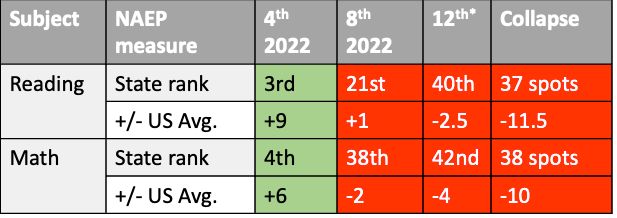
Billy Townsend, Florida blogger, has reported regularly on Florida’s gaming of NAEP scores. He writes here that Governor Ron DeSantis is carrying out Jeb Bush’s old trick to inflate 4th grade NAEP scores. He calls the governor Ron Jebsantis. The trick is third grade retention, which ensures that the lowest scoring third graders never take the fourth grade NAEP test (the kids who take the NAEP test are selected at random).

Thus, DeSantis put out a flashy press release celebrating fourth grade NAEP scores in the test scores recently released. But, as usual, DeSantis neglects to mention the collapse of eighth grade NAEP scores. Somehow the kids who were retained in third grade managed to skip fourth grade and rejoin their classmates by eighth grade.

Here are his numbers, drawn from NAEP reports:

With that in mind, here is a view of Florida’s 2022 NAEP scores peaking in elementary school and dramatically worsening with the older cohorts —- which is ALL of the red numbers after the green baseline.

I personally put no stock in the twelfth grade numbers (which Billy extrapolated) because NAEP stopped testing seniors a decade ago. Seniors know that NAEP doesn’t count and they don’t do their best. Some don’t even try. Their answer sheets had doodles, or some just picked the (A) answer to every question or some were blank.

But the stark drop from fourth grade to eighth grade says something’s fishy in Florida.

Florida Governor Ron DeSantis is a master of political stunts that target the weak, like flying Venezuelan immigrants from Texas to Martha’s Vinyard. Another stunt is his crackdown on voter fraud. (Florida went for Trump.) voters in the state passed a law allowing ex-felons to vote after they served their time. The law excluded those convicted of murder or sex crimes. Nonetheless, his voting police grabbed some ex-convicts who thought their voting rights had been restored.

The people of Florida can sleep easier now that these 19 dangerous voters have been arrested. DeSantis doesn’t care. He got the publicity he wanted.

The Miami Herald reported:

Tallahassee — When police went to arrest Tony Patterson outside his Tampa home in August, he couldn’t believe the reason.

“What is wrong with this state, man?” Patterson protested as he was being escorted to a police car in handcuffs. “Voter fraud? Y’all said anybody with a felony could vote, man.”

Body-worn camera footage recorded by local police captured the confusion and outrage of Hillsborough County residents who found themselves in handcuffs for casting a ballot following investigations by Gov. Ron DeSantis’ new Office of Election Crimes and Security.

The Aug. 18 arrests — conducted hours before DeSantis called a news conference to tout his crackdown on alleged voter fraud — were carried out by state police officers accompanied by local law enforcement.

The never-before-seen footage, obtained by the Herald/Times through public records requests, offers a personal glimpse of the effects of DeSantis’ efforts to root out perceived voter fraud.

“They’re going to pay the price,” DeSantis said during the news conference announcing the arrests.

Of the 19 people arrested, 12 were registered as Democrats and at least 13 are Black, the Herald/Times found.

Romona Oliver, 55, was about to leave for work when police walked up her driveway at 6:52 a.m. and told her they had a warrant for her arrest.

“Oh my God,” she said.

An officer told her she was being arrested for fraud, a third-degree felony, for voting illegally in 2020.

“Voter fraud?” she said. “I voted, but I ain’t commit no fraud.”

Oliver and 19 others are facing up to five years in prison after being accused by DeSantis and state police of both registering, and voting, illegally.

They are accused of violating a state law that doesn’t allow people convicted of murder or felony sex offenses to automatically be able to vote after they complete their sentence. A 2018 state constitutional amendment that restored the right to vote to many felons excluded this group.

But, as the videos further support, the amendment and subsequent actions by state lawmakers caused mass confusion about who was eligible, and the state’s voter registration forms offer no clarity. They only require a potential voter to swear, under penalty of perjury, that they’re not a felon, or if they are, that their rights have been restored. The forms do not clarify that those with murder convictions don’t get automatic restoration of their rights.

Oliver, who served 18 years in prison on a second-degree murder charge, registered to vote at the Department of Highway Safety and Motor Vehicles on Feb. 14, 2020. Six months later, she updated her address and completed another registration form.

After brief eligibility checks by the Department of State — which reports to DeSantis and is responsible for cleaning the rolls of ineligible voters — she was given a voter ID card both times.

Oliver wasn’t removed from the rolls until March 30 this year, more than two years later.

The recordings by Tampa police and Hillsborough County sheriff’s deputies reveal officers who were patient, understanding — almost apologetic.

A handcuffed Nathan Hart, 49, found a sympathetic ear when he explained how he ended up registering and voting illegally, according to the sheriff’s office recording.

As he stood handcuffed, he told officers that he signed up to vote at the encouragement of somebody at “the driver’s license place.” Records show it was in March 2020.

“I said, ‘I’m a convicted felon, I’m pretty sure I can’t,’” Hart, a registered sex offender, told officers. “He goes, ‘Well, are you still on probation?’”

Hart’s probation had ended a month earlier, Hart recalled. The person told him to sign up anyway.

“He said, ‘Well, just fill out this form, and if they let you vote, then you can,’” Hart said. “‘If they don’t, then you can’t.’”

“Then there’s your defense,” one of the officers replied. “You know what I’m saying? That sounds like a loophole to me.”

“Well, we can hope,” Hart said.

The officer was correct in one way: State law says that a voter has to “willfully” commit the crime — a hurdle that has forced some prosecutors not to charge ineligible voters.

In Lake County this year, for example, prosecutors declined to bring charges against six convicted sex offenders who voted in 2020.

“In all of the instances where sex offenders voted, each appear to have been encouraged to vote by various mailings and misinformation,” prosecutor Jonathan Olson wrote. “Each were given voter registration cards which would lead one to believe they could legally vote in the election. The evidence fails to show willful actions on a part of these individuals.”

ProPublica, the journalistic voice of integrity, suggests that Florida Governor Ron DeSantis may have broken the law when he took personal control of redistricting the state’s Congressional seats. The Miami Herald reported the story.

“May have broken the law” is an understatement.

Florida Gov. Ron DeSantis was incensed. Late last year, the state’s Republican Legislature had drawn congressional maps that largely kept districts intact, leaving the GOP with only a modest electoral advantage. DeSantis threw out the Legislature’s work and redrew Florida’s congressional districts, making them far more favorable to Republicans. The plan was so aggressive that the Republican-controlled Legislature balked and fought DeSantis for months. The governor overruled lawmakers and pushed his map through.

DeSantis’ office has publicly stressed that partisan considerations played no role and that partisan operatives were not involved in the new map. A ProPublica examination of how that map was drawn — and who helped decide its new boundaries — reveals a much different origin story. The new details show that the governor’s office appears to have misled the public and the state Legislature and may also have violated Florida law. DeSantis aides worked behind the scenes with an attorney who serves as the national GOP’s top redistricting lawyer and other consultants tied to the national party apparatus, according to records and interviews.

Florida’s Constitution was amended in 2010 to prohibit partisan-driven redistricting, a landmark effort in the growing movement to end gerrymandering as an inescapable feature of American politics. Barbara Pariente, a former chief justice of the state Supreme Court who retired in 2019, told ProPublica that DeSantis’ collaboration with people connected to the national GOP would constitute “significant evidence of a violation of the constitutional amendment.” “If that evidence was offered in a trial, the fact that DeSantis was getting input from someone working with the Republican Party and who’s also working in other states — that would be very powerful,” said Pariente, who was appointed to the Supreme Court by Democrat Lawton Chiles.

A meeting invite obtained by ProPublica shows that on Jan. 5, top DeSantis aides had a “Florida Redistricting Kick-off Call” with out-of-state operatives. Those outsiders had also been working with states across the country to help the Republican Party create a favorable election map. In the days after the call, the key GOP law firm working for DeSantis logged dozens of hours on the effort, invoices show. The firm has since billed the state more than $450,000 for its work on redistricting. A week and a half after the call, DeSantis unveiled his new map.

No Florida governor had ever pushed their own district lines before. His plan wiped away half of the state’s Black-dominated congressional districts, dramatically curtailing Black voting power in America’s largest swing state.

One of the districts, held by Democrat Al Lawson, had been created by the Florida Supreme Court just seven years before. Stretching along a swath of North Florida once dominated by tobacco and cotton plantations, it had drawn together Black communities largely populated by the descendants of sharecroppers and slaves. DeSantis shattered it, breaking the district into four pieces. He then tucked each fragment away in a majority-white, heavily Republican district….

Analysts predict that DeSantis’ map will give the GOP four more members of Congress from Florida, the largest gain by either party in any state. If the forecasts hold, Republicans will win 20 of Florida’s 28 seats in the upcoming midterms — meaning that Republicans would control more than 70% of the House delegation in a state where Trump won just over half of the vote.

The reverberations of DeSantis’ effort could go beyond Florida in another way. His erasure of Lawson’s seat broke long-held norms and invited racial discrimination lawsuits, experts said. Six political scientists and law professors who study voting rights told ProPublica it’s the first instance they’re aware of where a state so thoroughly dismantled a Black-dominated district.

If the governor prevails against suits challenging his map, he will have forged a path for Republicans all over the country to take aim at Black-held districts. “To the extent that this is successful, it’s going to be replicated in other states. There’s no question,” said Michael Latner, a political science professor at California Polytechnic State University who studies redistricting. “The repercussions are so broad that it’s kind of terrifying.” Al Lawson’s district, now wiped away by DeSantis, had been created in response to an earlier episode of surreptitious gerrymandering in Florida.

Read more at: https://www.miamiherald.com/news/politics-government/article267118181.html#storylink=cpy

When Ron DeSantis entered Congress, he joined the Freedom Caucus, the far-right members of the House. His very first vote was in opposition to aid for the victims of Hurricane Sandy, which pummeled New York City and the New Jersey coast.

The New York Times noted:

As a freshman congressman in 2013, Ron DeSantis was unambiguous: A federal bailout for the New York region after Hurricane Sandy was an irresponsible boondoggle, a symbol of the “put it on the credit card mentality” he had come to Washington to oppose.

But any hurricane that harmed a Red state got his vote. Four years after opposing federal aid for Sandy relief, he supported aid for victims of Hurricane Irma, which affected his own state.

The Washington Post wrote about GOP hypocrisy on hurricane relief. When a hurricane hits a Red state, they are for it. In the rare instance when the disaster is in a Blue state, not so much.

The GOP movement to question spending on disaster relief began to pick up amid the debate over Hurricane Katrina aid in 2005. Only 11 House Republicans voted against the $50 billion-plus package, but others cautioned that they’d be drawing a harder line moving forward, particularly if the spending wasn’t offset with cuts elsewhere.

“Congress must ensure that a catastrophe of nature does not become a catastrophe of debt for our children and grandchildren,” said future vice president Mike Pence, then a congressman from Indiana.

After the tea party movement took hold around 2010, members began to hold that line. A $9.7 billion flood relief bill for Hurricane Sandy was considered noncontroversial, even passing by voice vote in the Senate. But 67 House Republicans voted against it, including DeSantis.

Then came a larger, $50 billion Sandy bill. Fully 36 Senate Republicans voted against it, as did 179 House Republicans — the vast majority of GOP contingents in both chambers (again including DeSantis). They objected not just because the spending wasn’t offset, but because they viewed it as too large and not sufficiently targeted in scope or timing to truly constitute hurricane relief.

By the time 2017 rolled around, though, DeSantis wasn’t the only one who didn’t seem to be holding as hard a line. Despite the bill lacking such spending offsets, the GOP “no” votes on a $36.5 billion aid bill for Hurricanes Harvey, Irma and Maria numbered only 17 in the Senate and 69 in the House.

Such votes show how malleable such principled stands can be, depending on where disaster strikes.

For instance, only three of 18 House Republicans from Florida voted for the larger Sandy bill, but every one of them voted for the 2017 bill that included aid for their home state.

Likewise, of the 49 House GOP “yes” votes on the larger Sandy bill, nearly half came from states that were directly affected, including every Republican from New York and New Jersey.

One of those New Jersey Republicans was Rep. Scott Garrett, who actually introduced the smaller Sandy bill. Just eight years before, he had been one of those 11 Republicans who voted against the Katrina package.

If you comb through all of these votes, you’ll notice that, the larger Sandy bill aside, lawmakers who come from states that are particularly vulnerable to hurricanes (i.e. along the Gulf Coast) are generally less likely to be among the hard-liners — perhaps owing to the fact that they know their states could be next in line.

That’s where DeSantis’s votes do stand out. On the first Sandy bill, he was one of just two Florida Republicans to vote no, and very few members from the Gulf Coast joined them.

It’s a stand that served notice of his intent to legislate as a tea party conservative; he cast the vote just a day after being sworn in to Congress.

Democrats don’t seem to have the same problem. They typically support disaster aid, even in Red states.

It’s also noteworthy that DeSantis has switched gears in addressing President Biden, whom he usually refers to as “Brandon” (a rightwing synonym for “F… you, Biden”). Now, for the moment, he calls him “Mr.President.” And he can be sure that Democratic President Biden will respond with federal aid for the victims of Hurricane Ian in Florida.

Politifact reports how DeSantis and Rubio voted on hurricane relief.

Kathryn Joyce of Salon has written one dynamite article after another about the movement to destroy public education. In this post, she writes that Florida was ranked # 1 in “educational freedom” by the far-right Heritage Foundation, which wants to privatize all schools. This is a brilliant, must-read article!

Arizona, which has pushed hard to expand charters and vouchers, came in a close second.

That claim, along with the fact that the list’s top 20 states are mostly deep “red” and its bottom 10 are almost all dark “blue,” might come as a surprise to education watchers who are familiar with more traditional assessments of education performance. But in the Heritage Foundation’s inaugural “Education Freedom Report Card,” the think tank is grading according to a different metric entirely: not things like average student funding, teacher salary or classroom size, but how easily state legislatures enable students to leave public schools; how lightly private schools and homeschooling are regulated; how active and welcome conservative parent-advocacy groups are; and how frequently or loudly those groups claim that schools are indoctrinating students….

In the category of education choice, Heritage’s primary focus is on education savings accounts(ESAs), a form of school voucher that allows parents to opt out of public schools and use a set amount of state funding (sometimes delivered via debit card) on almost any educational expenses they see fit. ESAs can be used towards charter schools, private schools, parochial schools and low-cost (and typically low-quality) “voucher schools,” as well as online schools, homeschooling expenses, unregulated “microschools” (where a group of parents pool resources to hire a private teacher) or tutoring. The report’s methodology also notes that the percentage of children in a state who attend these alternatives to public schools figures into its rankings, implying that families who choose traditional public schools are not considered examples of educational “freedom.” The “choice” category also awards points based on how non-public schools are regulated, docking states that require accreditation or the same level of testing mandated for public schools.

States can lose points if they have credentialed teachers and gain points if they let anyone without any credentials teach. They also lose points if they have good pension plans and unions. They gain points by having strong bans on “critical race theory” and gain points for teaching patriotic history.

What’s especially noteworthy about this report — which Heritage says it will release on an annual basis — is how closely most of its ranking criteria track with the right’s broader education agenda. Over the last few months, almost all the issues addressed in this report have been highlighted as key action items for conservative education reformers, from the promotion of ESAs, as a preferred pathway to universal school vouchers, to alternative teacher credentialing to the expansion of the anti-CRT movement, which now encompasses anything related to “diversity, equity and inclusion…”

Framing the report by invoking the libertarian economist [Milton] Friedman — who, over the course of his controversial career, proposed eliminating Social Security, the Food and Drug Administration, the licensing of doctors and more — is a telling choice. In a foundational 1955 essay, as Heritage notes, Friedman famously argued that “government-administered schooling” was incompatible with a freedom-loving society, and that public funding of education should be severed from public administration of it — which would end public education as the country had known it for generations…

“Friedman may have been an accomplished number-cruncher, but when it came to social issues, he was a crackpot,” said Carol Corbett Burris, executive director of the Network for Public Education. He claimed that “vouchers ‘would solve all of the critical problems’ faced by schools,” from discipline, to busing to segregation, Burris continued. “He presented no evidence, just claims based on his disdain for any government regulation….”

By 1980, Friedman was declaring that vouchers were merely a useful waypoint on the road to true education freedom, which would include revoking compulsory education laws. In 2006, shortly before his death, Friedman told an ALEC audience that it would be “ideal” to “abolish the public school system and eliminate all the taxes that pay for it.”

For Heritage to use Friedman as its ideological lodestar, public education advocates observe, makes clear what the report values most in the state education systems it’s ranking….

“The fact that the Heritage Foundation ranks Arizona second in the country, when our schools are funded nearly last in the nation, only underscores the depraved lens with which they view the world,” said Beth Lewis, director of the advocacy group Save Our Schools Arizona, which is currently leading a citizen ballot referendumagainst the state’s new universal ESA law. “Heritage boasting about realizing Milton Friedman’s dream reveals the agenda — to abolish public schools and put every child on a voucher in segregated schools….”

“With this report,” added Burris, “the Heritage Foundation puts its values front and forward — that schooling should be a free-for-all marketplace where states spend the least possible on educating the future generation of Americans, with no regulations to preserve quality.” It’s no accident, Burris added, that Heritage’s top two states, Florida and Arizona, were ranked as the worst on the Network for Public Education’s own report card this year.

Polymath Bob Shepherd, a frequent contributor to this blog, lives in Florida. He recently received a survey from his member of Congress. He shows how deeply deceptive such a survey can be.

He writes:

I received in my email yesterday yet another transparently biased “survey” from my Flor-uh-duh Congressman Scott Franklin. It read as follows:

Do you support a Parents’ Bill of Rights to increase transparency on what children are being taught in school and how tax dollars are being spent? (yes/no)

Note that the survey DOES NOT ask,

Do you support allowing a handful of backward, provincial, undemocratic, authoritarian, homophobic, transphobic, sexist, white supremacist, Christian nationalist, fundamentalist wackjobs from among the parents in your community to decide what will be taught in your kids’ schools, what books can be in their library, who can teach, and what teachers can and cannot say? (yes/no)

These two questions are in fact equivalent.

Governor Ron DeSantis has terrorized school boards across Florida, who are afraid to endorse anything to do with racism or gender identity.

In the latest fiasco, the Miami-Dade school board censored a Pulitzer-prize winning play by a Miami author.

DeSantis is a bully and a wannabe fascist.

The story was written by Fabiola Santiago:

I told you, my fellow Cuban Americans, that the censors would get around to us, too.

And they have.

The same afternoon after the Miami-Dade School Board voted to suspend the district’s recognition of national LGBTQ History Month in October, school officials also quietly rejected — via email — the work of one of the most prominent Cuban Americans in U.S. cultural life.

Miami-Dade County Public School’s Division of Academics is refusing to allow high school students to attend — as they have in the past — Miami New Drama’s staging of Nilo Cruz’s Pulitzer Prize-winning work “Anna in the Tropics.” This year’s is the 20th-anniversary presentation of the play.

Why the rejection?

The school district’s not saying.

Is it because Cruz is gay? The district would never say that outright. But after the spectacle of last week’s School Board meeting, at which members were cowed into voting down recognizing LGBTQ History Month by hostile parents and un-Christian-like religious leaders — even the Proud Boys showed up — it’s not too far a leap in logic these days.

MDCPS students have been bused to see this stellar play before. The district should tell them — and the rest of us — what’s changed.

“My work has been staged around the world — and the only place where it has been censored is in Iran,” Cruz, 62, told me in an interview from his Miami home.

Until now — when the first Hispanic to win the Pulitzer Prize in drama, a distinction that, in 2003, also brought prestige to his hometown’s booming literary and theater scenes, appears to have become the latest victim of Florida Gov. Ron DeSantis’ culture wars.

Governor Ron DeSantis wants to make sure that students are never exposed to anything in school that acknowledges the existence of people who are gay. Maybe he thinks that if their existence is never mentioned, they will disappear or go back into the closet.

The Miami-Dade School Board got his message. Last year the board approved a measure to recognize LGBTQ History Month. It was not controversial. Recently the board voted overwhelmingly to cancel that decision, in deference to state law proclaiming that gay people should not be acknowledged.

Last year, when the Miami-Dade School Board overwhelmingly supported a measure to recognize October as Lesbian, Gay, Bisexual, Transgender and Queer (LGBTQ) History Month, some board members said their decision was rooted in another step toward civil rights for all people.

At the time, Vice Chair Steve Gallon III said he was “obligated to support the item because my DNA compels me to support inclusion. It compels me to support equity, it compels me to support equality.” 

The nine-member board passed the proposal in a 7-1 vote, with Board Member Christa Fraga dissenting and Board Member Lubby Navarro absent.

This year, though, during a marathon and contentious meeting Wednesday, the board voted 8-1 to reject recognizing October as LGBTQ month. Only Board Member Lucia Baez-Geller supported the observance; she put forth the proposal, both last year and this year.

This time, Gallon said, his personal beliefs must be divorced from his obligation to follow the law, despite his “love for all humanity, my commitment to inclusivity and access to representation.”

He expressed concern Baez-Geller’s measure “did not fully comport with the law,” referencing Florida’s new Parental Rights in Education law, dubbed by critics as Florida’s “Don’t say gay” bill. In March, Gov. DeSantis signed the bill into law, prohibiting instruction related to gender identity or sexual orientation in kindergarten through third grade and could potentially restrict such instruction for older kids.

Gallon and seven other board members voted no on the October observance and no on allowing the district to explore teaching two landmark Supreme Court decisions impacting the LGBTQ community to 12th-grade students. To some, the board’s vote on Wednesday underscores the chilling effect the law is having on school boards in Florida.

“Nearly every board member opposing the resolution voiced their belief that the proclamation violated the Don’t Say LGBTQ Law, further evidence of the sweeping censorship of this law,” said a news release sent by Equality Florida, a civil rights organization that works with Florida’s LGBTQ community.

School board attorney Walter Harvey told the board Wednesday that he believed the measure was in compliance with the state law because it did not have changes to curriculum or instruction.

Board members, however, believed otherwise. 

Law’s potential chilling effect

Throughout the hours-long meeting Wednesday, Baez-Geller tried to debunk what she called “disinformation” being promulgated by people at the podium.

For one, she said, the item included an opt-out for students on the Supreme Court lessons in addition to language that required any recognition be pursuant to state law.

Nevertheless, speaker after speaker opposed to the measure said the recognition would indoctrinate students; in some cases, speakers likened the resolution to child abuse. 

“What I think is happening, (following) the removal of members of Broward County and the language and rhetoric from the right, it’s a scary time for allies … and people who would have voted in favor of this in the past may now be thinking twice,” she told the Herald Thursday. “The law is vague on purpose and as we saw, the law is meant to have a chilling effect, and I believe the law has been successful in scaring people away from topics that are potentially controversial or that could bring a lawsuit.”

Last month, DeSantis removed four elected Broward County School Board members following a grand jury report that cited the members for “incompetent management” and “neglect of duty.” He replaced the four members with four men — the four he suspended were all women — who had ties to him or to the Republican Party.

At the end of July, opponents to the law sued DeSantis, the Florida Board of Education and Education Commissioner Manny Diaz Jr. in federal court in Tallahassee, challenging the law’s constitutionality. The case is pending.

A packed house, polarized crowd

Most of the speakers Wednesday spoke against the measure. 

Patricia Moore was greeted with cheers from the packed auditorium after she said schools “are not here to indoctrinate with the LGBTQ agenda. We should not expose our children to this in school.”

Michael Rajner, however, was among those who spoke in favor of the measure, telling the board he knows what it’s like to have parents who told him not to tell others he was gay, including his siblings. 

“Our struggle is real. Our struggle is history,” Rajner told the board members.

Now, if DeSantis should be elected President in 2024, he could tell cable and network stations not to broadcast any programs with gay characters, and he could censor the Internet.

He is a bigot and a bully.