Archives for category: DeSantis

One of the most bizarre aspects of the 2020 election-denial drama is the search for voter fraud in states that voted for Trump. Florida is Exhibit Number One, as demonstrated in this excellent article in the New York Times by Alexandra Bersin and Sharon LaFraniere. Trump won Florida handily, yet Governor Ron DeSantis felt he had to mollify Trump’s rabid base by insisting that he would root out election fraud. Did he want to increase Trump’s numbers or what? Maybe Biden really won Florida? It made no sense. Or was DeSantis grandstanding for the nutty rightwing base?

The story begins:

It resembled a political rally more than a news conference. In November 2021, exactly one year after Donald J. Trump lost the presidential election to Joseph R. Biden Jr., Gov. Ron DeSantis of Florida spoke to a raucous crowd in a hotel conference room just a few miles from Mr. Trump’s home base of Mar-a-Lago.

Their suspicions about vast election malfeasance would be heard, Mr. DeSantis promised. He was setting up an election police unit and he invited the crowd to send in tips about illegal “ballot harvesting,” nodding to an unfounded theory about Democrats collecting ballots in bulk.

The crowd whooped and waved furiously. “He gets it!” posted a commenter watching on Rumble.

But in his seven-minute, tough-on-election-crimes sermon, Mr. DeSantis, a Republican, never explicitly endorsed that theory or the many others spread by the defeated president and embraced by much of their party.

In this way, for nearly three years, Mr. DeSantis played both sides of Republicans’ rift over the 2020 election. As his state became a buzzing hub of the election denial movement, he repeatedly took actions that placated those who believed Mr. Trump had won.

Most prominent was the creation of an election crimes unit that surfaced scores of “zany-burger” tips, according to its former leader, disrupted the lives of a few dozen Floridians, and, one year in, has not yet led to any charges of ballot harvesting or uncovered other mass fraud.

Yet Mr. DeSantis kept his own views vague. Only last month — two years, six months and 18 days after Mr. Biden was sworn into office — did Mr. DeSantis, now running for president, acknowledge that Mr. Biden had defeated Mr. Trump.

DeSantis never spoke honestly to the election deniers. Instead he appeased them. His “election crimes unit” managed to find a grand total of 32 ex-felons who voted illegally. They didn’t know they were voting illegally because they received letters from the state urging them to vote and were issued voter registration cards.

Nathan Hart, a 50-year-old ex-felon from near Tampa, is among 32 people who have been arrested or faced warrants under the new initiative. Mr. Hart, who plans to appeal his conviction, said he lost his job as a warehouse worker because he had to show up in court. When he cast his ballot for Mr. Trump he had no idea he was ineligible to vote, he said.

He and others suffered so that the governor “could have a really good photo op and make himself look tough,” he said.

In the 2020 election, 11 million Floridians voted, and Trump won the state by 371,686 votes. Yet the leaders of the election fraud crusade descended on Florida, including Trump lawyer Cleta Mitchell, Michael Flynn, and Patrick Byrne, founder of Overstock.com. Local activists organized to find evidence of voter fraud. One group even delivered a box of claims to DeSantis’s mother, who sent it on to her son. None of the “evidence” or tips panned out. The search for voter fraud was a wild goose chase.

DeSantis’ much-ballyhooed election crimes unit turned over 1,500 names of potential fraudsters to local officials, which resulted in 32 arrests. A big nothing-burger.

DeSantis boasted about his crackdown on voter fraud, but never admitted that it produced no evidence of voter fraud. The only genuine fraud was the insistence by conspiracy theorists that the 2020 election was riddled with fraud.

And my initial question remains unanswered: what was the point of searching for voter fraud in a state that Trump won handily?
The Orlando Sentinel reported that the DeSantis administration used federal funds to create a new office to network with rightwing school boards, headed by Terry Stoops. DeSantis wants to stamp out anything he thinks is “woke,” that is, any instruction about racism, sexism, homophobia, or any other form of injustice or bigotry.

Leslie Postal writes:

A new Florida Department of Education employee who’s reaching out to conservative school board members makes $126,000 a year, a salary funded by a federal grant designed to boost “well-rounded educational opportunities,” health and safety and effective use of technology.

Terry Stoops was tapped in April to head the department’s new office of Academically Successful and Resilient Districts. Most of his contacts during his first months on the job were to school board members who’d been endorsed by Gov. Ron DeSantis and representatives of conservative groups, his emails and calendar show.

In April, for example, he met several school board members at a “Learn Right” summit in Sarasota spearheaded by a founder of Moms for Liberty, the conservative group launched in Florida and focused on schools.

He emailed more than a dozen school board members endorsed by the governor in the 2022 election cycle and others who had the backing of Moms for Liberty, including Alicia Farrant, elected to the Orange County School Board in November.

And in May, Stoops met with the Herzog Foundation; its goal is “Advancing Christian Education.”

Apolitical school boards have not been contacted.

DeSantis, who is running for president, told Fox News in June that if elected he would try to abolish the federal education department and other agencies. If Congress would not approve doing that, “I’m going to use those agencies to push back against woke ideology and against the leftism we see creeping into all institutions of American life,” he said in that interview on June 28…

Stoops also met with people who were not school board members but seemed to share his political views. For example, he attended a virtual meeting about American Birthright, a blueprint for how to teach students social studies that embraces “the ideals of conservative Americans.”

Stoops, who spent nearly two decades in North Carolina mostly working on education policy for the conservative John Locke Foundation, was on the executive committee that helped devise American Birthright, which was released last year.

A reader who identifies as “Democracy” left a comment here about DeSantis’ war against the College Board’s Advanced Placement (AP) courses. DeSantis manufactured a culture war issue, a familiar tactic for him, but don’t defend the AP exams: They are worthless, says he or she.

Democracy wrote:

While I certainly do not agree with — and am appalled by — the Florida dictate, I hate to see the College Board’s Advanced Placement (AP) program in the bannerhead of this issue because it makes it appear that the AP program is somehow being victimized, and it helps to propagate the AP brand.

It’s important to separate the wheat from the chaff here. The Florida requirement – state law – is part of a larger effort by conservatives (Republicans) across the country to, as USA Today put it, “restrict learning and materials about controversial topics.” Or, in other words, topics that conservatives hate to talk about: racism, misogyny, equality, sedition, tolerance, democracy, reproductive rights, climate change, sex…..

The original law required a cataloging of all books in “a school library media center.” The DeSantis-controlled Florida DOE interpreted that broadly to include classrooms. The Republican legislature amended the law to say that a school library media center is

“any collection of books, ebooks, periodicals, or videos maintained and accessible on the site of a school, including in classrooms.”

As The Sarasota Herald Tribune reported in April of this year,

“The law, governing instructional materials for classes from kindergarten to 12th grade, passed last year and holds school districts responsible for the content of all materials used in a classroom, made available in a school library or included on a reading list. It requires each book in a school library to be certified by a media specialist and for a list of these materials to be available on school websites. The law took effect in January.”

This is incredibly cumbersome, especially for elementary school teachers who have large troves of books for their students. And if it reeks of conservative religious state-imposed censorship, that’s probably because it is. As ABC News (and other media) reported, “Books targeted by conservative groups were overwhelmingly written by or about people of color and LGBTQ people, according to anti-censorship researchers.”

All of this is worrisome. It’s dangerous territory.

But that does not mean that AP is the victim. Nor should it imply that AP is actually educationally beneficial for most students. As I’ve noted here previously, more colleges and universities are either refusing to accept AP test scores for credit, or they are limiting credit awarded only for a score of 5 on an AP test. The reason is that they find most students awarded credit for AP courses are just generally not well-prepared.

Dartmouth no longer gives credit for AP test scores. It found that 90 percent of those who scored a 5 on the AP psychology test failed a Dartmouth Intro to Psych exam. A 2006 MIT faculty report noted “there is ‘a growing body of research’ that students who earn top AP scores and place out of institute introductory courses end up having ‘difficulty’ when taking the next course.” Two years prior, Harvard “conducted a study that found students who are allowed to skip introductory courses because they have passed a supposedly equivalent AP course do worse in subsequent courses than students who took the introductory courses at Harvard.”

In The ToolBox Revisited (2006) Clifford Adelman scolded those who had misrepresented his original ToolBox research by citing the importance of AP “in explaining bachelor’s degree completion. Adelman said, “To put it gently, this is a misreading.” Moreover, in statistically analyzing the factors contributing to the earning of a bachelor’s degree, Adelman found that Advanced Placement did not reach the “threshold level of significance.”

College Board executives often say that if high schools implement AP courses and encourage more students to take them, then (1) more students will be motivated to go to college and (2) high school graduation rates will increase. There are educators who parrot the College Board line. Researchers Kristin Klopfenstein and Kathleen Thomas “conclude that there is no evidence to back up these claims.”

Why do students take AP? Because they’ve been told to. Because they’re “trying to look good” to colleges in the “increasingly high-stakes college admission process,” and because, increasingly, “high schools give extra weight to AP courses when calculating grade-point averages, so it can boost a student’s class rank.” It’s a depraved stupid circle that has swept up parents, guidance counselors, administrators and school boards, teachers, and the general public – not to mention public education reporters – into the misbelief that “AP is better.” It isn’t.

One student who got caught up in the AP hype cycle –– taking 3 AP courses as a junior and 5 as a senior –– and only got credit for one AP course in college, reflected on his AP experience. He said nothing about “rigor” or “trying to be educated” or the quality of instruction, but remarked “if i didn’t take AP classes, it’s likely I wouldn’t have gotten accepted into the college I’m attending next year…If your high school offers them, you pretty much need to take them if you want to get into a competitive school.”

What do students actually learn from taking these “rigorous” AP courses and tests? For many, not much. One student remarked, after taking the World History AP test, “dear jesus… I had hoped to never see ‘DBQ’ ever again, after AP world history… so much hate… so much hate.”

And another added, “I was pretty fond of the DBQ’s, actually, because you didn’t really have to know anything about the subject, you could just make it all up after reading the documents.”

Another AP student related how the “high achievers” in his school approached AP tests: “The majority of high-achieving kids in my buddies' and my AP classes couldn’t have given less of a crap. They showed up for most of the classes, sure, and they did their best to keep up with the grades because they didn’t want their GPAs to drop, but when it came time to take the tests, they drew pictures on the AP Calc, answered just ‘C’ on the AP World History, and would finish sections of the AP Chem in, like, 5 minutes. I had one buddy who took an hour-and-a-half bathroom break during World History. The cops were almost called. They thought he was missing.”

And an AP reader (grader), related this about the types of essays he saw:

“I read AP exams in the past. Most memorable was an exam book with $5 taped to the page inside and the essay just said ‘please, have mercy.’ But I also got an angry breakup letter, a drawing of some astronauts, all kinds of random stuff. I can’t really remember it all… I read so many essays in such compressed time periods that it all blurs together when I try to remember.”

The Florida law is clearly not in the interests of kids and learning. But AP ain’t necessarily all that either.

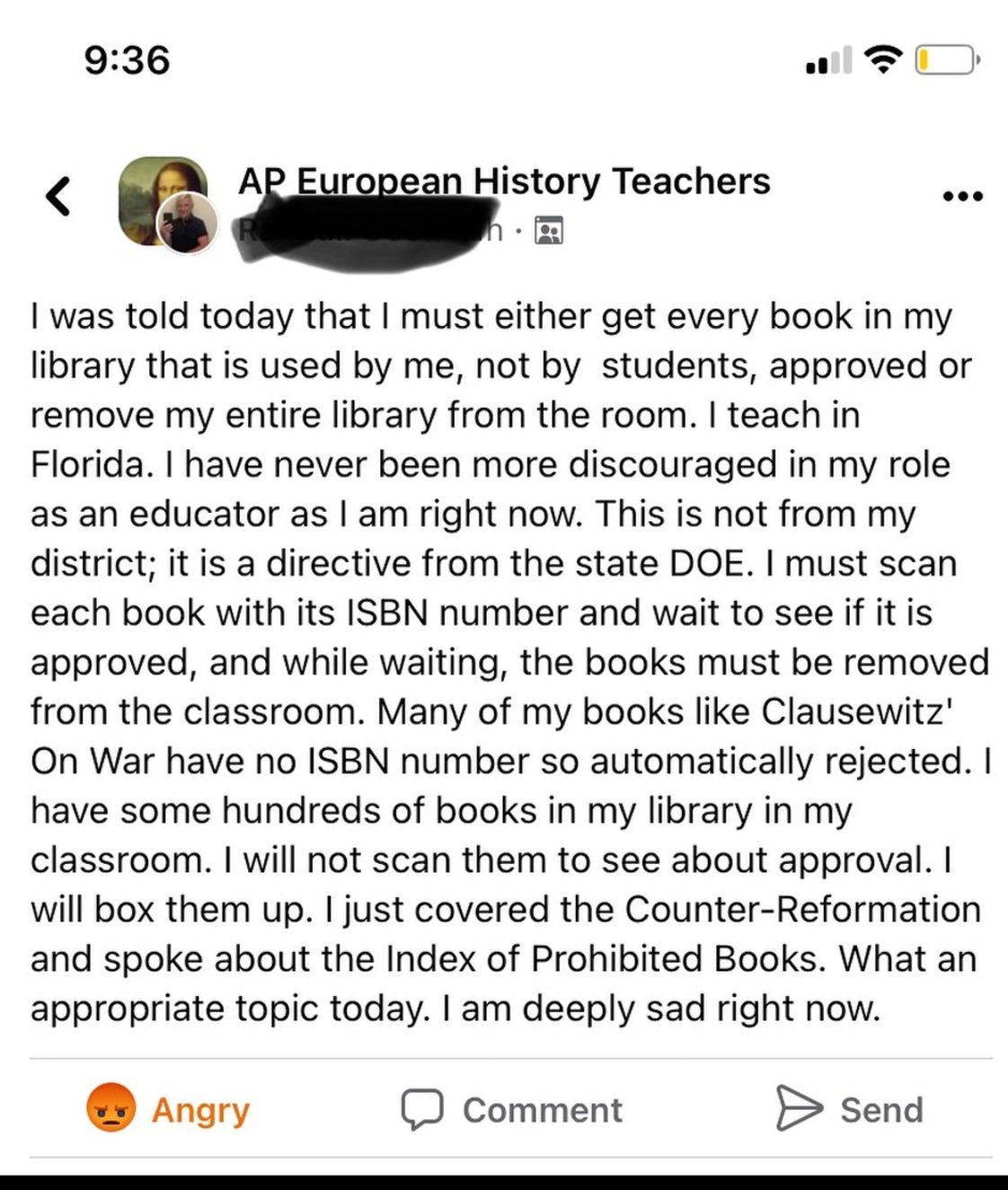
Please, don’t make make America Florida! Fascism starts with book censorship. In this case, a world history must remove his personal books because they are not on the state’s approved list. A book without an ISBN number can’t be in the list. We may assume that The Constitution, the Bible, and The Federalist Papers do not have ISBN numbers.

The more we learn about Ron DeSantis, the more obvious it is that he is unfit for any office due to his lack of ethics, his vindictiveness, and his authoritarianism. The Orlando Sentinel published an article about an investigation into the abusive behavior of a DeSantis appointee, who was appointed by DeSantis—without any background check, references or resume— to lead the state’s multi-billion dollar affordable housing program.

TALLAHASSEE — Gov. Ron DeSantis’ affordable housing executive director yelled and screamed at staff, made sexist comments, talked about their weight and threatened their jobs, employees of the Florida Housing Finance Corp. told an inspector general during an investigation.


The behavior of Mike DiNapoli, a former New York City financial adviser chosen by DeSantis to lead the corporation, created a hostile work environment that violated the organization’s policies, the corporation’s inspector general told board members Thursday.


“The conduct is severe and pervasive enough to create a work environment that a reasonable person would consider intimidating, hostile or abusive,” said Chris Hirst, the inspector general.


The investigative report into DiNapoli, which was not released publicly, was highly anticipated by those in Florida’s affordable housing community. Since the board approved hiring DiNapoli in February, 15 employees — 10% of the corporation’s workforce — were either fired by DiNapoli or quit.

DiNapoli was placed on paid administrative leave by the board in July. Last month, DeSantis reinstated him, with a spokesperson for the governor telling Politico that he never should have been suspended and that the investigation “has found nothing to justify the placement of Mr. DiNapoli on administrative leave….”

DeSantis’ press secretary lashed out at the board in a statement Thursday, calling members “clearly incapable of exercising prudent judgment.”

“If anyone wonders what the deep state looks like, this is it,” Jeremy Redfern said. “It’s clear to us that at least some members of this Board believe they can wield unchecked power to recklessly disparage a public official and tarnish his reputation without basic fairness and due process.”

He added, “We will explore every available tool to ensure proper management and oversight of the board and its staff, including the Inspector General, and to ensure further that this agency ultimately remains accountable to the people of Florida….”

DiNapoli also serves on the board of the First Housing Development Corp. of Florida, which has contracts with the corporation. Three of the corporation’s general counsels, who doubled as ethics officers, said it was a conflict of interest. Hirst agreed and concluded it was a violation of the corporation’s policies.

When asked about the conflict, DiNapoli said it was a “gray line,” and “an appearance of a conflict is not a conflict,” Hirst said….

Hirst also found that the corporation violated its hiring policies when it chose DiNapoli.

The corporation was supposed to advertise the executive director position, conduct interviews, do background checks and call work references. None of that happened, Hirst said. The corporation doesn’t even have an application or a resume on file for DiNapoli, he added.

Instead, DiNapoli was simply appointed by DeSantis, with the only letter of recommendation coming from James Uthmeier, DeSantis’ chief of staff who is currently leading DeSantis’ campaign for president.

The Times/Herald has previously reported that, before taking the job with the Florida Housing Finance Corp., DiNapoli had struggled with financial issues, including a bankruptcy, debtors garnishing his wages and a foreclosure on an Ocala home.

So DeSantis hired a guy with no background checks, not even a resume or references, to oversee the disbursement of billions of dollars for affordable housing. What could possibly go wrong?

A 15-year-old boy in New Hampshire, Quinn Mitchell, asked candidate Ron DeSantis a question he couldn’t or wouldn’t answer. At other appearances in New Hampshire, DeSantis’s security guards kept the boy away from the governor.

“Do you believe that Trump violated the peaceful transfer of power, a key principle of American democracy that we must uphold?” Quinn Mitchell asked Mr DeSantis during a town hall event in Hollis, New Hampshire, in June.

“Are you in high school?” the governor asked before he avoided answering the question, instead saying that Americans shouldn’t obsess about the past.

Quinn, who has seen 35 presidential candidates since 2019, also told The Daily Beast that he was physically intimidated when allegedly grabbed by DeSantis campaign security at two events for the governor.

But DeSantis eventually said that he couldn’t comment because he wasn’t there on January 6.

A tweet cited in the article:

Gov. Ron DeSantis (R-FL), when asked if Donald Trump violated the peaceful transfer of power on January 6th: “I wasn’t anywhere near Washington that day. I have nothing to do with what happened that day. Obviously, I didn’t enjoy seeing what happened.”

In response to reporter Kaitlin Collins: Chris Christie ripped DeSantis’s canned response:

@kaitlancollins

Chris Christie on Ron DeSantis’s Jan. 6 answer: “’He wasn’t anywhere near Washington’? Did he have a TV? Was he alive that day? Did he see what was going on? I mean, that’s one of the most ridiculous answers I’ve heard in this race so far.”

The governor’s security guards kept Quinn away from him.

Quinn said he was followed by two guards at an event on 19 August and an attendee told the outlet that they spotted a staffer from DeSantis Super PAC Never Back Down post a photo of him on Snapchat with the caption, “Got our kid”.

The Daily Beast reported that seven other sources confirmed Quinn’s version of events.

Quinn said the campaign’s treatment of him was “really stupid in a small state like New Hampshire”.

Politicians should choose their words with care. When they whip up animus towards any group, there are mentally ill people who take them seriously and act out violently on their impulses.

That’s what a Black man said to DeSantis. He accused DeSantis of responsibility for the murder of three innocent Black people in a Dollar General store by unleashing a hate campaign against “woke” and against teaching the history of racism. And by making it easier to buy guns.

Gov. Ron DeSantis railed at a Black questioner in Jacksonville on Thursday who suggested his policies bore some blame for the racist shooting there last month that left three Black people dead.
“You have allowed people to hunt people like me,” the man said, leading DeSantis to angrily respond, “I’m not going to let you accuse me of committing criminal activity! I am not going to take that.”

The confrontation happened at the end of an event in which DeSantis and state Surgeon General Joseph Ladapo continued their longstanding campaign attacking masks, vaccine boosters and other COVID measures.

The man said the governor his policies have “allowed weapons to be put on the street in the hands of immature, hateful people that have caused the deaths of the people that were murdered.”

“You don’t get to come here and blame me for some madman,” DeSantis said as his supporters cheered. “That is not appropriate, and I’m not going to accept it. That is nonsense.”

DeSantis noted how gunman Ryan Palmeter was temporarily held for a mental health examination in 2017 under the Florida law known as the Baker Act.

“That guy was Baker Acted,” DeSantis told the questioner. “He should have been ruled ineligible [to own firearms], but they didn’t involuntarily commit him.”

DeSantis signed a bill this year allowing people to carry guns without getting a state permit.

The questioner was escorted out of the restaurant where the event was being held….

Behind a lectern sign reading “Mandate Freedom,” DeSantis and Ladapo slammed some of the COVID measures being done in other states in response to rising infections. They also attacked the new round of COVID booster shots expected to be made available soon.

“We will not allow the dystopian visions of paranoid hypochondriacs to control our health policies, let alone our state,” DeSantis said.

Ladapo, who was admonished by U.S. public health agencies earlier this year that his fueling of vaccine hesitancy is harming the public, told residents they should ignore expert guidance on vaccines if “you have an intuition about what the right thing is.”

Watch the number of COVID deaths in Florida. DeSantis and Lapado will both have blood on their hands for urging people not to get vaccinated.

Florida used to have four Black members of Congress. Ron DeSantis took personal charge of redrawing the state’s districts and changed the lines to make them more Republican, eliminating three Black seats. A judge just tossed DeSantis’s map as unconstitutional. The decision will be appealed.

The Miami Herald reported:

A state judge struck down North Florida’s congressional districts Saturday, rebuffing Gov. Ron DeSantis’ open defiance of anti-gerrymandering protections, finding the governor’s map illegally reduced Black voters’ electoral power.

DeSantis had wagered the state’s Fair Districts Amendment against the U.S. Constitution, arguing mandatory protections for Black voters violated the Equal Protection Clause. Second Judicial Circuit Judge J. Lee Marsh flatly rejected that gamble, rendering a decision that could reverberate from the halls of Tallahassee to the streets of Jacksonville, paving the way for a new, Democratic district where Jacksonville’s Black voters have more influence.

Marsh refused to bite on DeSantis’ claim that the state’s Fair Districts Amendment violated the U.S. Constitution, saying DeSantis’ secretary of state and the Legislature didn’t even have standing to make such an argument…

DeSantis conceded that his map did not meet the state’s “non-diminishment” standard, which mandates that new districts must not undermine the voting power of racial minorities. The protection mirrors language in Section 5 of the Voting Rights Act, and the state argued Marsh should strike down that protection as violating the Equal Protection Clause of the 14th Amendment. At a hearing last month, Marsh questioned why Florida Attorney General Ashley Moody wasn’t defending the state’s Constitution in the case.

He also expressed sharp skepticism that he could make such an expansive ruling. Marsh said that if he ruled for the state, “this court will be the first in the country to say that even the Voting Rights Act is unconstitutional.” If the Florida Supreme Court sides with DeSantis, it could have national implications. It means the court, a majority of whom DeSantis appointed, would go further than the U.S. Supreme Court has in advancing a legal argument, pushed by many conservatives, that it’s inherently wrong to take race into account, even if it’s done to preserve the political voice of Black voters.

DeSantis’ veto of the initial map and the GOP-controlled Legislature’s decision to adopt his new one sparked an historic protest in the Florida House where Reps. Angie Nixon (D-Jacksonville) and Travaris McCurdy (D-Orlando) led a sit-in to disrupt the proceedings. After that protest, DeSantis vetoed all of Nixon’s appropriations in the current budget, and legislative leadership put her office in the basement of the Florida Capitol. [Bold added.]

Read more at: https://www.miamiherald.com/news/state/florida/article278906479.html#storylink=cpy

The Orlando Sentinel reported that the $8,000 voucher handed out to every student in a non-public school may be used for non-educational purchases. Florida endorsed universal vouchers so family income doesn’t matter. Rich families get vouchers too just so long as their children do not attend a public school.

As Florida lawmakers expanded eligibility for school vouchers this year, they also gave parents more ways to spend the money.

Theme park passes, 55-inch TVs, and stand-up paddleboards are among the approved items that recipients can buy to use at home. The purchases can be made by parents who home-school their children or send them to private schools, if any voucher money remains after paying tuition and fees.

The items appear in a list of authorized expenses in a 13-page purchasing guide published this summer by Step Up For Students, the scholarship funding organization that manages the bulk of Florida’s vouchers. Many of the items are similar to what was permitted for vouchers to students with disabilities in the past, but now they’re available to anyone who receives an award of about $8,000.

The list quickly raised eyebrows as it circulated.

“If we saw school districts spending money like that, we would be outraged,” said Damaris Allen, executive director of Families for Strong Public Schools, who recently started speaking out publicly on the issue. “We want to be conservative with our tax dollars. We want to be sure it is being used for worthwhile things.”

By comparison, Allen and others noted, teachers who want some of the same items for their classrooms would have to pay out-of-pocket or turn to other fundraising sources such as GoFundMe because schools won’t pay for them…

Supporters of the expansion don’t consider the program as wasting taxpayer money. They see it as allowing families to customize education according to their children’s interests.

“We need to stop thinking like it’s 1960 — that the only answer is four walls with traditional districts leading the charge,” Jeanne Allen, founder of the national Center for Education Reform, said in an email.

Heather Cox Richardson, a historian, analyzed the controversial Florida social studies curriculum and explains how they attempt to minimize racism and slavery. Their fault lies not in one or two sentences but in their central ideas. The influence of Hillsdale College is blatant in the document’s apologetics. Richardson posted this keen analysis on July 22, but I missed it. I’m pleased to share it now.

She wrote:

The Florida Board of Education approved new state social studies standards on Wednesday, including standards for African American history, civics and government, American history, and economics. Critics immediately called out the middle school instruction in African American history that includes “how slaves developed skills which, in some instances, could be applied for their personal benefit.” (p. 6). They noted that describing enslavement as offering personal benefits to enslaved people is outrageous.

But that specific piece of instruction in the 216-page document is only a part of a much larger political project.

Taken as a whole, the Florida social studies curriculum describes a world in which the white male Founders of the United States embraced ideals of liberty and equality—ideals it falsely attributes primarily to Christianity rather than the Enlightenment—and indicates the country’s leaders never faltered from those ideals. Students will, the guidelines say, learn “how the principles contained in foundational documents contributed to the expansion of civil rights and liberties over time” (p. 148) and “analyze how liberty and economic freedom generate broad-based opportunity and prosperity in the United States” (p. 154).

The new guidelines reject the idea that human enslavement belied American principles; to the contrary, they note, enslavement was common around the globe, and they credit white abolitionists in the United States with ending it (although in reality the U.S. was actually a late holdout). Florida students should learn to base the history of U.S. enslavement in “Afro-Eurasian trade routes” and should be instructed in “how slavery was utilized in Asian, European, and African cultures,” as well as how European explorers discovered “systematic slave trading in Africa.” Then the students move on to compare “indentured servants of European and African extraction” (p. 70) before learning about overwhelmingly white abolitionist movements to end the system.

In this account, once slavery arrived in the U.S., it was much like any other kind of service work: slaves performed “various duties and trades…(agricultural work, painting, carpentry, tailoring, domestic service, blacksmithing, transportation).” (p. 6) (This is where the sentence about personal benefit comes in.) And in the end, it was white reformers who ended it.

This information lies by omission and lack of context. The idea of Black Americans who “developed skills” thanks to enslavement, for example, erases at the most basic level that the history of cattle farming, river navigation, rice and indigo cultivation, southern architecture, music, and so on in this country depended on the skills and traditions of African people.

Lack of context papers over that while African tribes did practice enslavement, for example, it was an entirely different system from the hereditary and unequal one that developed in the U.S. Black enslavement was not the same as indentured servitude except perhaps in the earliest years of the Chesapeake settlements when both were brutal—historians argue about this— and Indigenous enslavement was distinct from servitude from the very beginning of European contact. Some enslaved Americans did in fact work in the trades, but far more worked in the fields (and suggesting that enslavement was a sort of training program is, indeed, outrageous). And not just white abolitionists but also Black abolitionists and revolutionaries helped to end enslavement.

Taken together, this curriculum presents human enslavement as simply one of a number of labor systems, a system that does not, in this telling, involve racism or violence.

Indeed, racism is presented only as “the ramifications of prejudice, racism, and stereotyping on individual freedoms.” This is the language of right-wing protesters who say acknowledging white violence against others hurts their children, and racial violence is presented here as coming from both Black and white Americans, a trope straight out of accounts of white supremacists during Reconstruction (p. 17). To the degree Black Americans faced racial restrictions in that era, Chinese Americans and Japanese Americans did, too (pp. 117–118).

It’s hard to see how the extraordinary violence of Reconstruction, especially, fits into this whitewashed version of U.S. history, but the answer is that it doesn’t. In a single entry an instructor is called to: “Explain and evaluate the policies, practices, and consequences of Reconstruction (presidential and congressional reconstruction, Johnson’s impeachment, Civil Rights Act of 1866, the 13th, 14th, and 15th Amendments, opposition of Southern whites to Reconstruction, accomplishments and failures of Radical Reconstruction, presidential election of 1876, end of Reconstruction, rise of Jim Crow laws, rise of Ku Klux Klan)” (p. 104).

That’s quite a tall order.

But that’s not the end of Reconstruction in the curriculum. Another unit calls for students to “distinguish the freedoms guaranteed to African Americans and other groups with the 13th, 14th, and 15th Amendments to the Constitution…. Assess how Jim Crow Laws influenced life for African Americans and other racial/ethnic minority groups…. Compare the effects of the Black Codes…on freed people, and analyze the sharecropping system and debt peonage as practiced in the United States…. Review the Native American experience” (pp. 116–117).

Apparently, Reconstruction was not a period that singled out the Black population, and in any case, Reconstruction was quick and successful. White Floridians promptly extended rights to Black people: another learning outcome calls for students to “explain how the 1868 Florida Constitution conformed with the Reconstruction Era amendments to the U.S. Constitution (e.g., citizenship, equal protection, suffrage)” (p. 109).

All in all, racism didn’t matter to U.S. history, apparently, because “different groups of people ([for example] African Americans, immigrants, Native Americans, women) had their civil rights expanded through legislative action…executive action…and the courts.”

The use of passive voice in that passage identifies how the standards replace our dynamic and powerful history with political fantasy. In this telling, centuries of civil rights demands and ceaseless activism of committed people disappear. Marginalized Americans did not work to expand their own rights; those rights “were expanded.” The actors, presumably the white men who changed oppressive laws, are offstage.

And that is the fundamental story of this curriculum: nonwhite Americans and women “contribute” to a country established and controlled by white men, but they do not shape it themselves.

Notes:

https://www.fldoe.org/core/fileparse.php/20653/urlt/6-4.pdf