Dan Rather analyzed Trump’s primary wins and spots signs that he is vulnerable because his well-defined base is limited. Due to his extremism, he is not able to have a big tent that would attract independents and even dissident Democrats. Even more telling is that Trump is not unifying the Republican Party. As soon as Trump won the South Carolina, he proclaimed that he had never seen the Republican Party more united. As Rather explains, that’s not really true.
He writes:
NBC’s “Meet The Press” this morning characterized Donald Trump’s South Carolina primary victory as “delivering a crushing blow to [Nikki] Haley in her home state on Saturday, trouncing her by 20 points with nearly 60 percent of the vote. The former president dominated nearly every key group.”
While he did indeed win handily, a deep dive into the numbers provides some interesting context.
The part of the story missing from many news reports is that Trump is slipping from his 2020 numbers. His support is strongest among his MAGA base, which pollsters put at no more than 33% of the electorate. Clearly, he will need more than MAGA to win the White House again.
President Biden won the South Carolina Democratic primary with 96.2% of the vote. Trump, who is essentially an incumbent up against a novice at running for national office, could not muster even 60% of his party’s vote. Exit polls from Saturday night should have GOP leaders nervous.
The makeup of South Carolina’s Republican voters does not mirror the country. They are heavily weighted with hard-right “conservatives,” older, white, male, evangelical election deniers. Trump won overwhelmingly among them. But Haley won among independents, moderates, and those who care about foreign policy. And that’s the crux of it.
To win the presidency again, Trump will need to bring all Republicans into the tent. Gallop estimates that 41% of the electorate identifies as Republican. Then it gets really tough. He has to convince a large number of independents and Democrats to vote for him. But how?
Not by favoring a 16-week national abortion ban
Not by threatening to pull out of NATO
Not by defunding Ukraine and supporting Putin’s invasion
Not by promising “ultimate and absolute revenge” against his political opponents
Not by refusing to accept the results of elections he’s lost
Not by promising to be a dictator on day one of his second term
Not by saying things like: “These are the stakes of this election. Our country is being destroyed, and the only thing standing between you and its obliteration is me.”
Trump is winning primaries while underperforming. Dan Pfeiffer, a former adviser to President Obama and current host of “Pod Save America,” writes: “You cannot win the White House with the coalition that Trump is getting in these primaries. He must expand his coalition, persuade people who aren’t already on board and get beyond the Big Lie-believing MAGA base. Through three primary contests, Trump has gained no ground.”
Polls also indicate a majority of voters in swing states would be unwilling to vote for Trump if he’s convicted of a crime. That could happen as soon as April or May.
As Axios writes: “If America were dominated by old, white, election-denying Christians who didn’t go to college, former President Trump would win the general election in as big of a landslide as his sweep of the first four GOP contests.” Fortunately, it is not. America is a rich tapestry of heritages, races, and creeds. Immigrants have long been one of our strengths.
But the likely GOP nominee continues to feed fears about immigration using language tailored to his MAGA base. “They’re coming from Asia, they’re coming from the Middle East, coming from all over the world, coming from Africa, and we’re not going to stand for it … They’re destroying our country,” Trump said Saturday at CPAC, a conference of extreme-right Trump supporters.
“No, Mr. Trump, they’re not,” is the answer of many Americans. There is strong public opinion that what is tearing our country apart is the divisiveness and rancor that comes from Trump, the Republican Party, and their right-wing media machine.
The mainstream press may begin to offer more of this context and perspective as we get deeper into the presidential campaign. One of the things Steady was created to do was offer reasoned context and perspective to news stories. This writing is an example.
Trump remains a real and present threat to win the presidency again in November. But that is not assured. Not nearly, as a deep analysis of early primary results indicates.
There is still a long way to go and many rivers to cross for both major candidates.
Thom Hartmann connects the dots: the Republican Party is now controlled by Vladimir Putin. The Republicans do only what is in the interest of Putin. His goal, as it was in 2016 and 2020, is to get Trump elected. Trump is subservient to Putin. Trump wants to block American aid to Putin. So does House Speaker Mike Johnson, who called a two-week recess as Ukrainian forces are running out of ammunition. How do you define GOP these days? Guardians of Putin? Goons of Putin? Other ideas?
Thom Hartmann
There’s little doubt that Russian President Vladimir Putin has succeeded in achieving near-total control over the Republican Party. They’re gutting aid to Ukraine (and have been for over a year), working to kneecap our economy, whipping up hatred among Americans against each other, promoting civil war, and openly embracing replacing American democracy with authoritarian autocracy.
Putin has declared war on queer people, proclaimed Russia a “Christian nation,” and shut down all the media he called “fake news.” Check, check, check.
Over the past two years, as America was using Russia’s terrorist attacks on Ukraine to degrade the power and influence of Russia’s military, Putin was using social media, Republican politicians, and rightwing American commentators to get Republican politicians on his side and thus kill off US aid to Ukraine.
The war in Gaza is making it even easier, with Putin-aligned politicians like Senator Josh Hawley (R-MO) tweeting: “Any funding for Ukraine should be redirected to Israel immediately.”
Most recently, the three-year “Biden bribery” hysteria Republicans in the House have been running — including thousands of hits on Fox “News” and all over rightwing hate radio — turns out to have been a Russian intelligence operation originally designed to help Trump win the 2020 election. The Russian spy who’d been feeding this phony info to “Gym” Jordan and James “Gomer Pyle” Comer is now in jail.
Russia’s battlefield, in other words, has now shifted from Ukraine to the US political system and our homes via radio, TV, and the internet, all in the hopes of ending US aid to the democracy they’ve brutally attacked.
And the momentum is following that shift: Russia is close to having the upper hand in Ukraine because of Putin’s ability — via Trump and Johnson — to get Republican politicians to mouth his talking points and propaganda.
Now, with Speaker “Moscow Mike” Johnson shutting down the House of Representatives so nobody can offer a discharge petition that would force a vote on Ukraine aid (and aid for Palestinian refugees, Taiwan, and our southern border), it’s becoming more and more clear that Vladimir Putin is running the Republican party via his well-paid stooge, Donald Trump.
I say “well paid” because Donald Trump would have been reduced to homelessness in the early 1990s if it weren’t for Russian money, as both of his sons have said at different times. He’d burned through all of his father’s estate, even stealing a large part of it from his siblings. He’d lost or hidden almost two billion dollars running a casino.
As Michael Hirsch noted for Foreign Policymagazine:
“By the early 1990s he had burned through his portion of his father Fred’s fortune with a series of reckless business decisions. Two of his businesses had declared bankruptcy, the Trump Taj Mahal Casino in Atlantic City and the Plaza Hotel in New York, and the money pit that was the Trump Shuttle went out of business in 1992. Trump companies would ultimately declare Chapter 11 bankruptcy two more times.”
He’d been forced to repeatedly declare bankruptcy — sticking American banks for over a billion dollars in unpaid bills — after draining his businesses of free cash and stashing the money in places he hoped nobody would ever find.
No American bank would touch him, and property developers in New York were waiting for his entire little empire to collapse. Instead, a desperate Trump reached out to foreign dictators and mobsters, who were more than happy to supply funds to an influential New York businessman…for a price to be paid in the future.
He sold over $100 million worth of condos to more than sixty Russian citizens during that era, and partnered with professional criminals and money launderers to raise money for Trump properties in Azerbaijan and Panama. According to Trump himself, he sold $40 to $50 million worth of apartments to the Saudis.
He then partnered with a former high Soviet official, Tevfik Arif, and a Russian businessman, Felix Sater, who’d been found guilty of running a “huge stock-fraud scheme involving the Russian mafia.”
As the founders of Fusion GPS wrote for The New York Times in 2018:
“The Trump family’s business entanglements are of more than historical significance. Americans need to be sure that major foreign policy decisions are made in the national interest — not because of foreign ties forged by the president’s business ventures.”
Thus, when it came time to run for president, Trump had to pay the price. He and the people around him were inundated with offers of “help” from Russians, most associated directly with Putin or the Russian mafia.
Trump’s campaign manager, Paul Manafort, had been paid millions by Putin’s oligarchs and ran Trump’s campaign for free. Reporters found over a dozen connections between Russia and the Trump campaign, and during the 2016 campaign Trump was secretly negotiating a deal to open a Trump tower in Moscow. Trump’s son and his lawyer met with Putin’s agents in Trump Tower.
Putin’s personal troll army, the Internet Research Agency (IRA) based out of St. Petersburg but operating worldwide, began a major campaign in 2016 to get Trump elected president.
Manafort fed Russian intelligence raw data from internal Republican polling that identified a few hundred thousand individuals in a half-dozen or so swing states the GOP thought could be persuaded to vote for Trump (or against Hillary), and the IRA immediately went to work, reaching out to them via mostly Facebook.
Mueller’s report and multiple journalistic investigations have noted that the most common message out of Russia then was directed at Democratic-leaning voters and was, essentially, “both parties are the same so it’s a waste of time to vote.”
A report from Texas-based cybersecurity company New Knowledge, working with researchers at Columbia University, concluded, as reported by The New York Times:
“‘The most prolific I.R.A. efforts on Facebook and Instagram specifically targeted black American communities and appear to have been focused on developing black audiences and recruiting black Americans as assets,’ the report says. Using Gmail accounts with American-sounding names, the Russians recruited and sometimes paid unwitting American activists of all races to stage rallies and spread content, but there was a disproportionate pursuit of African-Americans, it concludes.
“The report says that while ‘other distinct ethnic and religious groups were the focus of one or two Facebook Pages or Instagram accounts, the black community was targeted extensively by dozens.’ In some cases, Facebook ads were targeted at users who had shown interest in particular topics, including black history, the Black Panther Party and Malcolm X. The most popular of the Russian Instagram accounts was @blackstagram, with 303,663 followers.
“A Senate inquiry has concluded that a Russian fake-news campaign targeted ‘no single group… more than African-Americans.’ …
“Thousands of Twitter, Facebook, Instagram and You Tube accounts created by the St. Petersburg-based Internet Research Agency (IRA) were aimed at harming Hillary Clinton’s campaign and supporting Donald Trump, the committee concludes.
“More than 66% of Facebook adverts posted by the Russian troll farm contained a term related to race.
“African-American community voters were discouraged from voting, and from supporting Hillary Clinton.”
Between the information compiled by Oxford Analytica and the details passed along from the GOP to Prigozhin via Manafort, a mere margin of 43,000 votes across a handful of swing states —all mictotargeted by Russia — handed the electoral college to Trump, even though he lost the nationwide vote to Hillary Clinton by almost 3 million ballots.
So now Trump has succeeded in making the entire GOP a party to his long-term debt to Putin and his oligarchs. “Moscow Mike” Johnson has blocked any aid to Ukraine for over a year; the last congressional appropriation for foreign aid was passed in 2022, when Nancy Pelosi ran the House.
Meanwhile, under Trump’s and Putin’s direction, Republicans in Congress are doing everything they can to damage the people of the United States.
They believe it will help them in the 2024 election if they can ruin the US economy while convincing American voters that our system of government is so corrupt (“deep state”) that we should consider replacing democracy with an autocratic strongman form of government like Putin’s Russia. Tucker Carlson is even suggesting that Russia is a better place to live than the US.
They revel in pitting racial, religious, and gender groups against each other while embracing a form of fascism that pretends to be grounded in Christianity, all while welcoming Putin’s social media trolls who are promoting these divisions.
Republican-aligned think tanks are working on Project 2025, a naked attempt to consolidate power in the White House to support a strongman president who can override the will of the people, privatize Social Security and Medicare, shut down our public school system, fully criminalize abortion and homosexuality (Sam Alito called for something like that this week), and abandon our democratic allies in favor of a realignment with Russia, China, and North Korea.
Trump got us here by openly playing to the fears and prejudices of white people who are freaked out by the rapid post-1964 “browning” of America. Putin jumped in to help amplify the message a thousandfold with his social media trolls, who are posting thousands of times a day as you read these words.
Now that Putin largely controls the GOP, today’s question is how far Republicans are willing to go in their campaign to bring the USA to her knees on behalf of Putin and Trump.
— When Congress comes back into session next week, will they take up Ukraine aid?
— Will they continue their opposition to comprehensive immigration and border reform?
— Will they keep pushing to privatize Social Security with their new “commission”?
— Will they work as hard to kneecap Taiwan on behalf of President Xi as they have Ukraine on behalf of Putin?
— Will they continue to quote Russian Intelligence propaganda in their effort to smear President Biden?
— Instead of just 7 Republicans going to Moscow to “celebrate” the Fourth of July, will the entire party move their event to that city like the NRA did? Or to Budapest, like CPAC did?
Or will the GOP suddenly start listening to the rational voices left in their party, the Mitt Romneys and Liz Cheneys who still believe in democracy (even if they want to gut the social safety net and turn loose the polluters)?
The Network for Public Education released a report card today grading the states on their support for democratically-governed public schools. Which states rank highest in supporting their public schools? Open the report to find out.
Measuring Each State’s Commitment to Democratically Governed Schools
EXECUTIVE SUMMARY
Neighborhood public schools remain the first choice of the overwhelming majority of Ameri- can families. Despite their popularity, schools, which are embedded in communities and gov- erned by elected neighbors, have been the target of an unrelenting attack from the extreme right. This has resulted in some state legislatures and governors defunding and castigating public schools while funding alternative models of K-12 education.
This 2024 report, Public Schooling in America: Measuring Each State’s Commitment to Democratically Governed Schools, examines these trends, reporting on each state’s commit- ment to supporting its public schools and the children who attend them.
What We Measure
We measure the extent of privatization in each state and whether charter and voucher laws promote or discourage equity, responsibility, transparency, and accountability. We also rate them on the strength of the guardrails they place on voucher and charter systems to protect students and taxpayers from discrimination, corruption and fraud.
Recognizing that part of the anti-public school strategy is to defund public schools, we rate states on how responsibly they finance their public schools through adequate and equitable funding and by providing living wage salaries for teachers.
As the homeschool movement grows and becomes commercialized and publicly funded, homeschooling laws deserve public scrutiny. Therefore, we rate states on laws that protect children whose families homeschool.
Finally, we include a new expansive category, freedom to teach and learn, which rewards states that reject book bans, and the use of unqualified teachers, intolerance of LGBTQ stu- dents, corporal punishment, and other factors that impinge on teachers’ and students’ rights.
Heather Cox Richardson writes about the ascendancy of “the Putin wing of the Republican Party.” It’s headed, of course, by Donald Trump, who remains deferential to Putin. He continued to compare himself to Navalny, who was murdered by Putin, since he thinks of his trials as akin to Navalny’s experience.
Aid to Ukraine is stalled in the House of Representatives, where Marjorie Taylor Greene leads the opposition.
Richardson writes:
Both global and national affairs appeared to shift over the holiday weekend. Events of the past week or so highlighted the global stakes of not stopping the aggression of Russia’s president Vladimir Putin. In turn, those global stakes highlighted that Trump’s MAGA Republicans are strengthening Putin’s hand.
Since October, MAGA Republicans have managed to delay a national security supplemental bill that would provide additional aid to Ukraine. Although a bipartisan majority of Congress supports the measure, House speaker Mike Johnson (R-LA) recessed the House on Thursday without taking it up, just days after former president Trump attacked the North Atlantic Treaty Organization (NATO) and suggested he would urge Russia to “do whatever the hell they want” to U.S. allies if they didn’t meet a guideline of spending 2% of their gross domestic product on their own military forces.
On Friday, February 16, Russian authorities murdered opposition leader Alexei Navalny in prison, where he was being held on trumped-up charges, and on Saturday, Russian forces advanced into the front-line city of Avdiivka.
The Munich Security Conference, the world’s largest gathering on international security policy, met this year in the midst of these events, from Friday, February 16, to Sunday, February 18. At Saturday’s lunch, Prime Minister Mette Frederiksen of Denmark made a surprise announcement. Denmark, she said, will donate all its artillery to Ukraine. She suggested other countries, too, could do more than they already have.
According to Jack Detsch and Robbie Gramer of Foreign Policy, Frederiksen’s announcement “left attendees grappling with some existential questions: Are they prepared not just to help Ukraine but also to defend Europe from a possible Russian attack on a NATO country? Are democracies capable of standing up against the threat of territory-grabbing dictatorships like Russian President Vladimir Putin’s?”
Sweden today announced it will donate about $682 million in equipment and cash to Ukraine, its 15th aid package to Ukraine since the 2022 Russian invasion. The European Union today announced it is committing 83 million euros, or about $89 million, in humanitarian aid for those in Ukraine and Moldova affected by the war. Three weeks ago it approved $54 billion in military aid.
There is increasing pressure, as well, to transfer Russia’s frozen assets to Ukraine. On Saturday, February 17, the U.S. Justice Department, which is in charge of a task force called “KleptoCapture,” transferred $500,000 in forfeited Russian funds to Estonia for fixing Ukraine’s electrical transmission and distribution systems. Biden promised more sanctions against Russia on Friday and has again called for House Republicans to pass the national security supplemental bill.
Indeed, the real elephant in the room is the fact that MAGA Republicans in the House are refusing to commit more U.S. aid. The Institute for the Study of War, a nonprofit research organization, assessed on Sunday that “delays in Western security assistance to Ukraine are likely helping Russia launch…offensive operations along several sectors of the frontline in order to place pressure on Ukrainian forces along multiple axes.”
MAGA Republicans are refusing that aid although it is popular both in Congress and among Americans at large. A Pew study released Friday, before news of Navalny’s murder broke, showed that 74% of Americans believe the war in Ukraine is important to U.S. interests; 59% say it’s important to them personally.
House speaker Johnson condemned Putin as “a vicious dictator” over the weekend and said he was “likely directly responsible” for Navalny’s death. But on Monday he posted to Twitter a photograph of him standing alongside Trump, apparently at Trump’s West Palm Beach golf club, flashing a smile and a thumbs-up sign. Representative Marjorie Taylor Greene (R-GA) has vowed to try to throw Johnson out of the speaker’s chair if he even brings Ukraine funding to the floor. Trump himself referred to Navalny’s murder on Sunday simply by calling it a “sudden death” before launching into an attack on the United States.
On Sunday, former representative Liz Cheney (R-WY) came out and said it: the Republican Party has a “Putin wing.” She said: “The issue of this election cycle is making sure the Putin wing of the Republican Party does not take over the West Wing of the White House.” Conservative pundit Bill Kristol agreed, in italics: “The likely nominee of one of our two major political parties is pro–Vladimir Putin.This is an astonishing fact. It is an appalling fact. It has to be a central fact of the 2024 campaign.”
Russian authorities have cracked down on those expressing sorrow for the death of opposition leader Alexei Navalny and are refusing to hand over his body to his mother and lawyer, who flew to the penal colony north of the Arctic Circle to reclaim it, saying they need to keep the body for “chemical analysis.”
Meanwhile, a Russian who defected to Ukraine last year has been killed in Spain, and Russian authorities have arrested for “treason” a dual Russia-U.S. citizen who lives in Los Angeles as she traveled in Russia after having participated in pro-Ukraine rallies.
Putin is facing an election next month, and he may have intended the murder of Navalny to frighten other opponents and intimidate Russian voters. But it is possible it had the opposite effect.
Yesterday, Navalny’s widow, Yulia Navalnaya, stepped into his place, saying: “Putin didn’t only kill Alexei Navalny as a person. He wanted to kill our hope, our freedom, our future. But the most important thing we can do for Alexei and for ourselves is to go on fighting. I will continue Alexei Navalny’s work. Continue to fight for our country. I call on you to stand alongside me. To share not only the grief and unending pain that has enveloped us and won’t let go. I also ask you to share the fury and hate for those who dared to kill our future. I speak to you in the words of Alexei, in which I believe truly: There is no shame in doing little. There is shame in doing nothing. In allowing them to scare you…. By killing Alexei, Putin has killed half of me. Half of my heart and my soul. But I have another half and it tells me that I don’t have the right to give in.”
Today she urged the European Union not to recognize the results of Russia’s March election, saying that “a president who assassinated his main political opponent cannot be legitimate by definition.”
In the U.S., there has not been any apparent move from House Republicans to come back into session to approve the national security package. Indeed, Trump appears to be strengthening his hand over the mechanics of the Republican Party, with the state parties he salted with loyalists lining up behind him, supporters in Congress killing legislation at his demand, and lawmakers who are interested in actually making laws exiting Congress out of fear or frustration.
But the apparent support of MAGA Republicans for Putin is unlikely to play well in the U.S. Today, Republican candidate for president Nikki Haley, former governor of South Carolina, tricked the Fox News Channel into covering live what she said was a major speech, likely leading producers to think she was withdrawing. Rather than doing so, she came out swinging with an attack on Trump.
Aaron Rupar of Public Notice recorded her comments, spoken with the backdrop of the past week in everyone’s mind. Americans “deserve a real choice,” she said, “not a Soviet-style election where there’s only one candidate and he gets 99 percent of the vote.”
Since I started following the cruel and unusual policies of Florida’s Governor Ron DeSantis, I have seen him repeatedly attack public schools, divert public money to private and religious schools, and remove whatever offends him from the curriculum (such as accurate histories of Black people).
I have also discovered some fearless bloggers who are not afraid of DeSantis. Billy Townsend and Jason Garcia. They take on political corruption without flinching.
Jason Garcia, an investigative reporter, wrote recently about how conservative billionaires have shaped DeSantis’s political agenda. The part I don’t understand is why someone of vast personal wealth would want to take food stamps away from impoverished children or make the lives of homeless people even more miserable. What kinds of sadists are they?
And last week, the Republican governor came out in support of a plan to round up homeless people across Florida and — potentially — put them into secured camps.
Each move was, at least on the surface, a disparate executive decision. But they share something in common: They are all ideas promoted by conservative billionaires and the right-wing think tanks they fund.
Taken together, the moves offer a window into how super-rich mega donors shape action across DeSantis’ state government.
Let’s start with the food stamps.
Though it didn’t get much attention at the time, the Florida Department of Children and Families late last year changed the rules for the state’s food-stamps program, which is formally known as the “Supplemental Nutrition Assistance Program.”
Funded by the federal government but administered by the states, food stamps currently help more than 3 million impoverished Floridians buy groceries and keep food on the table for themselves and their families.
But the state of Florida makes it much harder for some people to qualify for food stamps, by imposing what are commonly called “work requirements” — mandatory employment and training programs that someone must participate in each week in order to obtain and continue receiving aid.
Florida had previously imposed work requirements on adults without children between the ages of 18 and 52. But late last year, the state expanded work requirements to adults without children up to age 59 — sweeping up somewhere around 100,000 more very low-income Floridians, according to materials provided to the governor’s office and obtained in a public-records request.
Anti-poverty activists and advocates for working families have long argued that work requirements don’t actually work. Rather than helping people find sustainable employment in which they can work themselves out of poverty, mandatory work requirements merely create barriers that block some people from receiving any aid at all and push others into erratic, poor-paying and poverty-entrapping jobs — all while enriching a few private contractors that administer the programs.
And the FGA isn’t just promoting work requirements generally. Records show it pitched this exact idea to DeSantis’ staff.
It happened in December 2022, when, emails show, the FGA met with senior staffers in the Governor’s Office and provided a series of policy proposals. One of the ideas they pitched? Forcing Floridians as old as 59 years old to participate in mandatory work requirements before they can get food stamps.
The recommendation was contained in a memo provided to the Governor’s Office tiled, “Taking Florida’s Food Stamp Work Requirements to the Next Level.”
One reason the FGA may have the ear of the DeSantis administration: Tax records show that its largest funder in recent years has been Richard “Dick” Uihlein, a Midwestern billionaire who is one of the biggest conservative donors in American politics.
More specifically, Uihlein is one of DeSantis’ top funders: Records show he has given DeSantis roughly $3 million in recent years — including $1.5 million to the Super PAC that supported DeSantis’ failed presidential campaign.
It’s important to note that the FGA wants DeSantis to go even further: The organization has also urged the Governor’s Office to extend food stamp work requirements to adults with children as young as six years old.
Kicking kids off health insurance
Food stamps aren’t the only safety net program that has come into DeSantis’ crosshairs recently.
Earlier this month, the state of Florida surprised anti-poverty advocates by suing the federal government over new rules related to Florida KidCare — a program that provides health insurance for low-income children whose families do not qualify for Medicaid.
KidCare is funded jointly by the federal government and the state. And Florida has long required families participating the program to pay monthly premiums in order to get coverage for their kids.
But new federal rules require the state to provide at least one year of continuous health insurance coverage for any child who enrolls in the program — even if the child’s family misses a monthly premium payment.
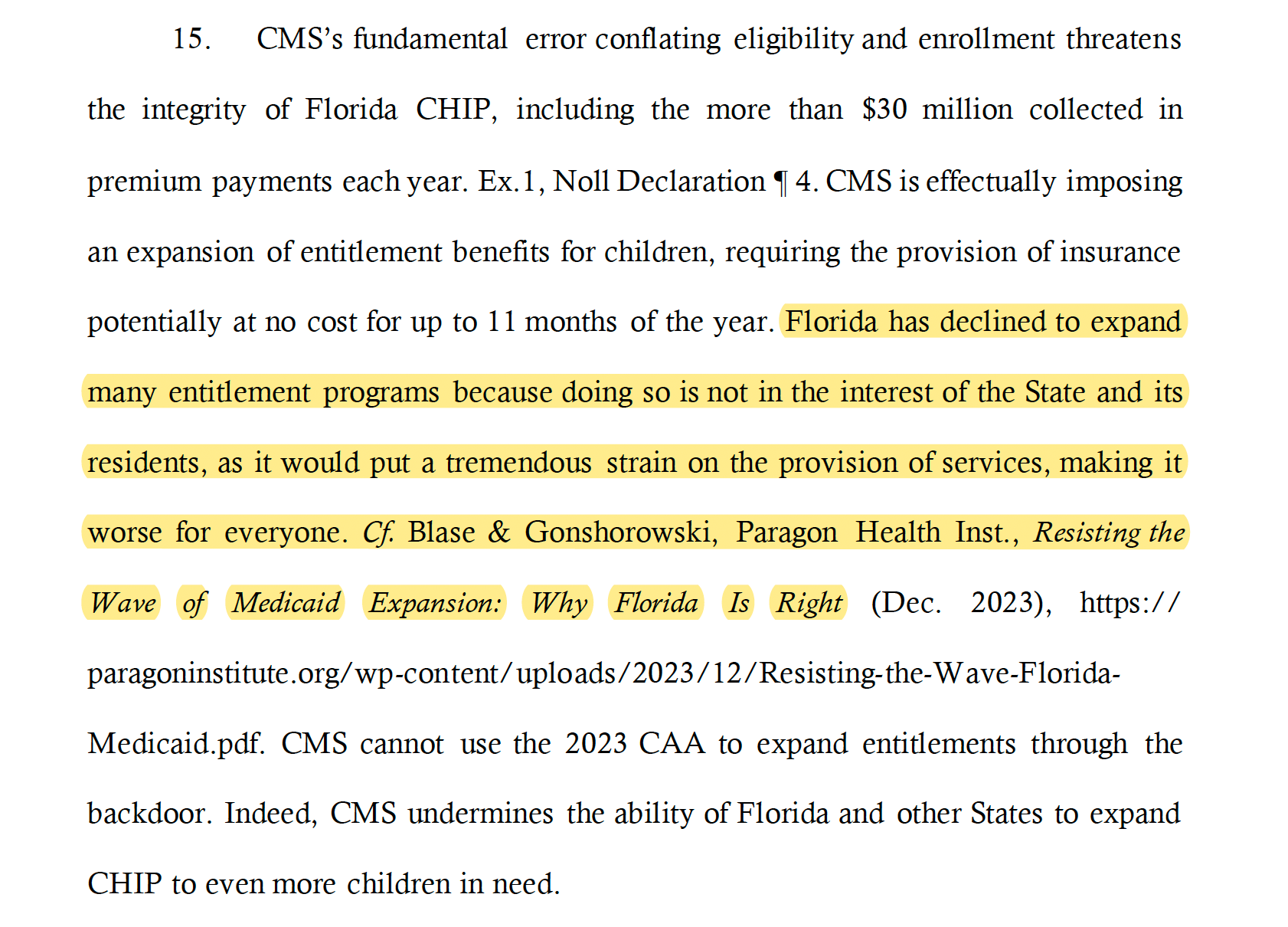
The DeSantis administration has sued to overturn that rule. The suit argues that federal officials have overstepped their authority, and that forcing Florida to continue providing health insurance to kids whose parents have missed a payment would undermine the integrity of the KidCare program.
An excerpt from Florida’s lawsuit against the federal government regarding eligibility rules for children’s health insurance.
The report was produced by a two-year-old organization called the Paragon Health Institute. Tax records show it is largely funded by the nonprofit network of billionaire industrialist Charles Koch, another of the nation’s biggest conservative political donors.
All of Paragon’s first-year funding came from one of Koch’s “Stand Together Trust.” Most of its second-year funding came from the Koch group, too.
Paragon is also intertwined with the FGA. The institute’s president — and the lead author of the report Florida cited in its lawsuit — is Brian Blase. Blase is also a visiting fellow with the FGA, according to the group’s website.
Blase said he wasn’t consulted by anyone from the state about the litigation and that he didn’t know anything about the lawsuit before it was filed.
Asked if the Governor’s Office conferred with anyone from the Paragon Health Institute or the FGA before launching its suit, DeSantis spokesperson Jeremy Redfern responded, “Not to my knowledge.”
But this is a relationship that DeSantis likely wants to repair as tries to rehabilitate his political reputation and prepare for a second presidential run. Politico Florida reported last week that DeSantis allies expect him to run again in 2028 — and to restart his political fundraising operation later this year.
Jonathan V. Last writes for The Bulwark, which was founded by Republican Never Trumpers. It is one of the most engaging websites I read. This post is newsworthy, since so many Trumpers were citing Dinesh D’Souza’s book about election fraud.
Last writes:
Last August we talked about True the Vote, the group whose “data” on election fraud in Georgia constituted a large part of Dinesh D’Souza’s 2000 Mules.
Let me refresh your memory:
True the Vote is a Texas-based group which filed a complaint with the Georgia State Election Board alleging fraud in the 2020 presidential campaign.
The Georgia State Election Board (the SEB) investigated this complaint and found no fraud. So it asked True the Vote to share its evidence. True the Vote declined and instead said—whoopsie!—they’d like to just take the complaint back.
The SEB explained that that’s not how it works with sworn statements and subpoenaed the extensive evidence that True the Vote claimed in its complaint to have.1 The whole thing devolved into litigation that bore a striking resemblance to George Costanza’s attempt to convince his dead fiancée’s parents that he owned a house in the Hamptons.
Anyway, this week the Atlanta Journal-Constitution broke the news that True the Vote finally gave up and told the judge in the case that they don’t have any of the so-called evidence, or data, or names, or identities—or any of those other fancy legal whosywhatsits:
True the Vote said in a recent court filing that it doesn’t know the identity of its own anonymous source who told a story of a “ballot trafficking” scheme allegedly organized by a network of unnamed groups paying $10 per ballot delivered.
True the Vote also told the court it doesn’t have documents about illegal ballot collection, the name of its purported informant or confidentiality agreements it previously said existed.
You can read True the Vote’s filing here. It’s wild. But the cajones on these guys! In a non-court-filed public statement, True the Vote went on to say that while they don’t have any of this stuff they said they had, they know that the Georgia Election Board could come up with it if they really wanted:
“The [Georgia Bureau of Investigation] consequently has ready access to the underlying data, and could, we believe, reconstruct it, but it declines to do that,” True the Vote said in a statement. “At this point, it would be redundant and cost-prohibitive for True the Vote to do so on its own. It is in that sense that there is nothing more for True the Vote to provide that it has not already provided to the GBI.”
Translation:The real evidence of voter fraud isn’t in a computer. It’s in our hearts.
Alexei Navalny’s mother went to the penal colony in the Arctic to claim her son’s body and was lied to at every turn. The story was reported by Emma Burrows at ABC news.
For the mother of Alexei Navalny, the Russian opposition leader who died at age 47in an Arctic penal colony, the journey to recover her son’s body Saturday was an odyssey with no clear destination.
In the end, she didn’t get what she came for.
Lyudmila Navalnaya, 69, received an official note Saturday stating that the politician had died in prison at 2:17 p.m. local time a day earlier, Kira Yarmysh, Navalny’s spokesperson said Saturday.
Together with members of Navalny’s legal team, Lyudmila traveled to the town of Kharp in the Yamalo-Nenets region, some 1,900 kilometers (1,200 miles) northeast of Moscow.
It was there that Russia’s Federal Penitentiary Service said Friday that Navalny felt unwell after a walk and fell unconscious. When Lyudmila arrived less than 24 hours later, officials said that her son had died from “sudden death syndrome,” said Ivan Zhdanov, the director of Navalny’s Anti-Corruption Foundation. He did not elaborate.
Navalny’s death removed the Russian opposition’s most well-known and inspiring politician less than a month before an election that will give President Vladimir Putin another six years in power.
Prison employees told Navalny’s mother Saturday that they did not have her son’s body. They said it had been taken to the nearby city of Salekhard, a little over an hour’s drive away, as part of a probe into his death.
When Lyudmila arrived in the town with one of Navalny’s lawyers, however, they found that the morgue was closed, Navalny’s team wrote on their Telegram channel. When the lawyer called the morgue, they were told that the politician’s body was not there either.
This time, Lyudmila headed directly to Salekhard’s Investigative Committee office. A small group of journalists watched as Lyudmila walked toward the office, dressed in a thick black coat as temperatures hovered close to minus 25 degrees centigrade (minus 13 degrees Fahrenheit). Occasionally, she took the arm of one of those walking next to her as the group made their way along paths edged with thick piles of snow.
Here, she was told that the cause of her son’s death had, in fact, not yet been established, said Navalny’s spokesperson, Kira Yarmysh. Officials told Lyudmila that the politician’s relatives would not receive his body until they had completed additional examinations.
Initially, it seemed as if Lyudmila might head to another morgue. Instead, she returned to her hotel in the town of Labytnangi, another 30-minute drive. Navalny’s team, meanwhile, said they were still no closer to finding out where the politician’s body was being held.
“It’s obvious that they are lying and doing everything they can to avoid handing over the body,” Yarmysh wrote on X, formerly known as Twitter, after Lyudmila’s visit to the Investigative Committee office. The spokesperson also said that Navalny’s team “demand that Alexei Navalny’s body be handed over to his family immediately.”
Navalny, who had been serving a 19-year prison term since January 2021 after being convicted three times for extremism, has spoken several times about whether he might die while in custody.
After the last verdict, which Navalny believed to be politically motivated, he said that he understood he was “serving a life sentence, which is measured by the length of my life or the length of life of this regime.”
Alexei Navalny returned to Russia in January 2021. Right before he boarded the plane, he posted a film titled “Putin’s Palace: The Story of the World’s Largest Bribe” on YouTube. The video, nearly two hours long, was an extraordinary feat of investigative reporting. Using secret plans, drone footage, 3-D visualizations, and the testimony of construction workers, Navalny’s video told the story of a hideous $1.3 billion Black Sea villa containing every luxury that a dictator could imagine: a hookah bar, a hockey rink, a helipad, a vineyard, an oyster farm, a church. The video also described the eye-watering costs and the financial trickery that had gone into the construction of the palace on behalf of its true owner, Vladimir Putin.
The film was viewed, she says, by one of every four Russians.
How could Putin, a vain and bitter little man, let Navalny live after this massive insult?
Leslie Stahl interviewed Alexei Navalny when he was in Germany, having survived an attempt to kill him with a military-grade poison.
You can see why Putin was afraid of him: he was smart and charismatic, handsome and youthful. Left alone, he might have led an uprising against Putin’s dictatorship.



 Diane Ravitch's blog