Archives for category: Corporate Reform

Mayor Rahm Emanuel continues his crusade to push public schools out of Chicago.

In a wave of closings and consolidation, the mayor found room for a new charter school run by a megachurch and a hip hop artist. The mother of the hip hop artist serves on the zchicago Board of Education.

“Chicago Public Schools on Friday moved ahead with school closing and merger proposals that would affect thousands of kids next school year.

“Under a previously announced plan, four South Side schools would close over the summer and the district would send hundreds of displaced students to surrounding schools. One building would be demolished to make way for a new high school, and privately operated charter schools would take over two other sites, under the district’s plan.

“Students at two predominantly African-American elementary schools near downtown would merge with more diverse campuses. One of those buildings, in the growing South Loop area, would gradually convert into a new high school.

“In addition, Hirsch, one of the city’s lowest-enrolled high schools, would share space for a privately run charter school program that’s backed by a local megachurch and a foundation headed by hip-hop artist Common…

“Hirsch, one of the city’s most underenrolled neighborhood high schools, would open its campus to the Art In Motion charter school next fall. CPS said the charter program, which is backed in part by the New Life Covenant Church and Common Ground Foundation, would first open to seventh- and eighth-graders before expanding to include a high school program.

“Mahalia Hines, a member of the Chicago Board of Education and mother of the hip-hop performer Common, also serves on the board of her son’s foundation.”

Does Illinois have conflict of interest laws?

This is my review of two very important books: Nancy MacLean’s “Democracy in Chains: The Deep History of the Radical Right’s Stealth Plan for America” and Gordon Lafer’s “The One Percent Solution: How Corporations Are Remaking America One State at a Time.”

Both books are important for understanding the undermining and capture of our democracy.

Both books explain the theory and practice of destroying the public sector for ideology and/or profit.

Read the review for a better understanding of the roles played by the Koch brothers, the DeVos family, and ALEC.

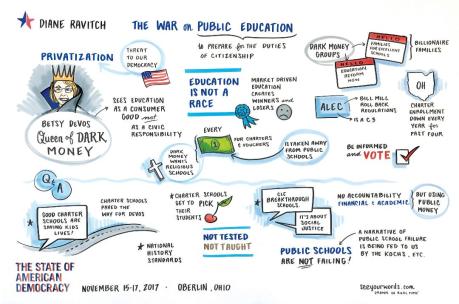
This fabulous graphic is a summary of my speech at the conference on “The State of American Democracy,” identified by the acronym SAD. The conference was sponsored by Oberlin College at the college in Oberlin, Ohio, and it will be held with different participants in three other locations over the next several months. I spoke about the “War on Public Education.” In my talk, I forgot to mention that more than 90-95% of charters are non-union, and that their primary sponsor is the Walton Family Foundation, which is anti-union. That was an important omission in an audience that is mostly comprised of progressives. Jonathan Alter, who is very knowledgeable about national politics, leapt up to defend charter schools and objected to being lumped in with the DeVos agenda, which includes both charter schools and vouchers; Jon loves KIPP. I cited Katherine Stewart, who said in her article in “The American Prospect” that religious extremists had made “useful idiots” of the charter movement.

Early in my talk, I asked how many of those in the room had gone to public schools, and about 90% of the 300 or so people raised their hands. That included the new President of Oberlin College, Carmen Twillie Ambar, who graduated from public schools in Little Rock, Arkansas. She is the first African American female president of this historic college.

This is the wonderful graphic that was created as I spoke, by a brilliant artist, Jo Byrne (seeyourwords.com):

devos

Educators for Excellence occasionally pops up when the privatization movement is looking for “teachers” who will speak out against hard-earned rights of teaching professionals.

Two years ago, the Boston Teachers Union compiled research on E4E to warn their members about this AstroTurf group.

It was founded by two TFA teachers in New York City who are no longer teachers. It is funded by the reactionary anti-union Walton Family Foundation, the Rightwing William E. Simon Foundation, the anti-union Bodman Foundation, and the Arnold Foundation, which wants to eliminate pensions.

It favors merit pay based on test scores, teacher evaluation based on test scores, and opposes seniority.

BTU warned its members:

“Bottom line—Beware of E4E and its tactics

“E4E is getting funded to set up a chapter here in Boston. They tend to target early career teachers and try to build their membership through coffee hours, free lunches, raffles, and happy hours. Please help spread the word about E4E so that our members are aware of their tactics! If you see them in your school, please let us know.”

I was tempted to give an entire day to this post about the Dark Money group deceptively called Families for Excellent Schools.

The “families” are financiers, billionaires, and garden-variety multimillionaires. They enjoyed great success in New York, where they made an alliance with Governor Cuomo and launched a $6 Million TV buy to promote charter schools. Under pressure from Cuomo, the state legislature compelled the City of New York to provide free space to charter schools and to give Eva Moskowitz whatever she wanted.

Then, Families for Excellent Schools opened shop in Massachusetts, where they launched a multimillion dollar campaign to increase the number of charter schools.

Parents, teachers, the teachers unions, Rural and suburban communities turned against charter schools. Bernie Sanders and Elizabeth Warren joined the opponents of charter schools. Before the vote, the backers of Question 2 were revealed in the media (though not all of their names), and the referendum to expand the charter sector went down to a crashing defeat.

After the election, things went bad for FES.

“This September, the Massachusetts Office of Campaign and Political Finance fined Families for Excellent Schools a comparatively nominal $426,500. But it also forced the charter group to reveal its donors — a who’s who of Massachusetts’ top financiers, many of whom are allies of Gov. Charlie Baker — after it had promised them anonymity.”

In addition to the fine, FES was banned from the Bay State for four years.

One of the big donors to FES was the rightwing, anti-union Walton Family, which gave FES more than $13 Million between 2014 and 2026. The chairman of the Massachusetts Board of Education gave FES nearly $500,000.

Now FES is trying to redefine itself.

Here is a suggestion: support the public schools that enroll nearly 90% of children. Open health clinics in and near schools. Invest in prenatal care for poor women. Lobby for higher taxes for the 1%.

I intended to make this the only post of the day, but late last night I learned of the lawsuit in Florida challenging the disastrous HB 7069, a gift to charter operators.

So this is the last post you will see today. I want you to read it in full. The post was written by veteran journalist John Merrow with Mary Levy, a civil rights and education finance lawyer, and an education finance and policy analyst.

One of the key episodes in the short and divisive history of the corporate reform movement was the appointment of Michelle Rhee as Chancellor of the D.C. public school system. Rhee became the public face of the movement. Rhee was idolized by the media because of her take-no-prisoners style and her evident contempt for teachers and unions. Amanda Ripley wrote a cover story about Rhee for TIME magazine, which suggested that Rhee knew how to fix America’s schools. The cover showed her scowling and wielding a broom, ready to sweep out the bad teachers in D.C. Newsweek put her on its cover. I wrote a chapter about her in my book, Reign of Error, describing the adulation she received and the cheating scandal that broke on her watch. As it happened, Rhee identified one elementary school principal as exactly the kind of relentless, data-driven, no-excuses sort of person that she wanted more of. He received bonuses because of the incredible improvement of test scores. Incredible indeed, because his school was at the nexus of the cheating scandal, identified by the unusual number of erasures from wrong-to-right on standardized tests. He was soon gone. Immediately after Mayor Adrian Fenton was defeated in 2010, Rhee resigned, vowing to create a group called StudentsFirst, which would raise $1 Billion and enlist one million members. The name of the group typified Rhee’s divisive approach: education works best when students, teachers, parents, and the community work together. She never raised $1 Billion or one million members, but she actively supported vouchers and charters and gave substantial funding to candidates who would vote in the state legislature for privatization and against unions. She married the mayor of Sacramento, where she lives now. StudentsFirst merged with another anti-public school group.

But the myth of the transformation of the D.C. schools under Rhee and her successor Kaya Henderson lives on, Because to acknowledge the failure of teacher-bashing would harm the movement.

John Merrow contributed to the myth of Michelle Rhee, in a major way. To understand his credibility now, it is necessary to recognize his role in building that myth. As the PBS education correspondent, he featured her work in D.C. about a dozen times. He was a believer. But when he was doing his last show, a full hour about Rhee, he had an epiphany. Was it because she invited him to film her firing a principal? Was it the cheating scandal? Was it the effort to cover up the cheating? I don’t know. What I do know is that Merrow had the courage to change his mind. His admiration changed to doubt then to skepticism then to criticism. I understand his transformation because I have been there. I too once believed in what is deceptively called “Reform.” I saw the light. So did Merrow.

Merrow and Levy call this post “A Complete History” of Rhee’s reforms. It is one part of the history, but it is not THE Complete History. “The Complete History” would be a job of deep investigative research that would determine why Rhee, who had never been a principal or a superintendent and had taught only briefly in a privately-run contract school in Baltimore, was chosen to lead the D.C. system. It would examine the claims she made about the spectacular score gains in her classes (which G.F. Brandenburg debunked on his blog). It would investigate the negotiations among funders like Gates and Broad, who let it be known that their money would be cut off if Rhee left the district. It would delve into the district’s relations with the reactionary Walton Family Foundation, which targeted D.C. for charter saturation.

John Merrow’s knowledgeable perspective is important. The story is not all bad. He calls attention to the positive changes that occurred on Rhee’s watch. But where he comes down hard is on the mistaken idea that the route to success requires administrators who “crack down” on teachers, who offer rewards and punishments for teachers based on test scores. That strategy produces teaching to the test, score inflation, gaming the system, and narrowing the curriculum.

That is why this is the only post you are likely to see today. It is long, and it deserves your full attention.

Steven Singer has noticed that the hired hands of the billionaire “reformers” like to play the role of victim.

They are bravely standing up to those teachers’ unions on behalf of “the kids.” All they have on their side are the Koch brothers, the DeVos family, Bill Gates, Eli Broad, the Waltons and a long list of other billionaires who want to privatize public schools and get rid of those unions.

Who is Goliath? Who is David?

Who are the real grassroots activists?

Don’t be fooled.

The Economist magazine published an article about an alarming phenomenon: the large amounts of money entering local school board races, much of it from mysterious political action committees, often from out-of-District and out-of-State sources.

Races in Denver, Douglas County, and Aurora County in Colorado attracted at least $1.65 Million.

Last spring’s School Board Race in Los Angeles was the most expensive in U.S. history, at $15 Million. Billionaires like Reed Hastings and Eli Broad make clear that they will spend whatever it takes to install true believers in privatization. In most such races, you are likely to encounter the same names, whether it is Hastings, Broad, Bloomberg, or members of the Walton family. You are likely to see other names associated with hedge funds or other parts of the financial industry. They have two goals in common: they love charter schools and they don’t like unions.

The intrusion of this kind of money into school board races is a danger to democracy. School boards are supposed to reflect the wishes of the local communities, not the purposes of out-of-State billionaires in search of willing puppets.

How can a local citizen, a parent or community leader, have any chance of running for school board if their opponent has a kitty of $100,000-300,000 to millions of dollars? I recall visiting a city where I was told that, in the past, a candidate could run by raising $40,000. Those days are over. That’s not good for democracy.

Heidi Schauble describes her disheartening experience as a student at the University of Washington at Bothell, when she signed up for an education policy course and found that her instructors worked for the Center for Reinventing Public Education (CPRE). CPRE is a major advocate of the “portfolio” model for school districts, wherein the school board treats its schools like a stock portfolio, keeping the good ones and getting rid of the bad ones. It advocates on behalf of charter schools. Schauble refers to CPRE as an “anti-public education think tank.” It might be more accurate to call it an advocacy group, not a think tank.

The amazing aspect of this article is that the author had sufficient information to question what she was taught and to know that she was getting a one-sided presentation.

Here is an excerpt. It is worth reading in full:

As a UW student, who signed up for the only “Education Policy” elective offered in my program, I learned first-hand how CRPE views public education, and witnessed first-hand how they conduct their own classroom.

Robin Lake and Bethany Grove, the co-instructors of the CRPE course, presented the argument that business models were more equitable and efficient than traditional public schools, and that the only way to reform education was to dismantle it and replace it with charters that will constantly open and close according to their “results”. The goal was never “better schools overall”. The goal was the ability to close “bad” schools.

These instructors argued the education system is supposed to have mixed results, to compare outcomes (test scores), and shut down “ineffective” schools; they argue that it is good to create a continuous, responsive cycle for “improvement”. They argue that public institutions are too bureaucratic, too slow to change and adapt to the 21st century. Their goal is to privatize public education.

Robin and Bethany, the instructors of the CRPE course, blamed teachers, parents and students in the process of demonizing public education. They didn’t mention the factors of poverty or low school funding, nor did they mention budget cuts or how since Federal education policies from No Child Left Behind, and every version since then, drain resources from public education. According to Robin and Bethany, “money doesn’t make a difference and we need to stop throwing it at education”. When have we ever done this?

That quarter, we read from business models how shutting down and “starting from a clean slate” was the best way to turn around failing businesses. We did not read a single piece of educational literature that did not come directly out of CRPE. I was shocked..

I don’t doubt that these two upper middle class white women care a great deal about children like theirs. I do doubt CRPE’s ability to question their unwavering faith in Neo-Liberal Market reform.

How material is taught is just as important as the curriculum itself. Does the instructor value debate as a tool of learning? Or is repetition of subject material the leading indicator of learning?

I recall watching “Waiting for Superman” in previous classes. This video is a popular marketing tool for Charter Reformers. One of the central arguments of the video, is that students are currently taught as passive recipients of knowledge. Where the teacher is the ultimate authority and attempts to “dump” knowledge; rather that teaching students to engage with material.

If the fundamental argument of Charter reformers is that you can break up the “bureaucracy” and “monopoly” of public ed so that teachers are able to engage with students; why are their reformers teaching in the very authoritarian style they critique?
The Walton-funded Center for Research on Education Outcomes published a study containing a finding that almost everyone knew:

The strategy of closing schools because of their test scores disproportionately affects children of color.

A little less than half of displaced closure students landed in better schools.

• Closures of low-performing schools were prevalent but not evenly distributed.

• In both the charter and traditional public school sectors, low-performing schools with a larger share
of black and Hispanic students were more likely to be closed than similarly performing schools with a
smaller share of disadvantaged minority students.

• Low-performing schools that were eventually closed exhibited clear signs of weakness in the years
leading to closure compared to other low-performing schools.

•The quality of the receiving school made a significant difference in post-closure student outcomes. Closure
students who attended better schools post-closure tended to make greater academic gains than did their
peers from not-closed low-performing schools in the same sector, while those ending up in worse or
equivalent schools had weaker academic growth than their peers in comparable low-performing settings.

• The number of charter closures was smaller than that of traditional public school closures, however, the percentage of low-performing schools getting closed was higher in the charter sector than in the traditional public school sector.

Peter Greene wrote about this study here. Peter asks: The staggering bottom line here remains– we are closing schools that serve black, brown and poor students because they serve black, brown and poor students. How is that even remotely okay?

Steven Singer wrote about it here.

This was Steven’s takeaway:

If Sally moves to School B after School A is closed, her success is significantly affected by the quality of her new educational institution. Students who moved to schools that suffered from the same structural deficiencies and chronic underfunding as did their original alma mater, did not improve. But students who moved to schools that were overflowing with resources, smaller class sizes, etc. did better. However, the latter rarely happened. Displaced students almost always ended up at schools that were just about as neglected as their original institution.

Even in the fleeting instances where students traded up, researchers noted that the difference between School A and B had to be massive for students to experience positive results.

Does that mean school closures can be a constructive reform strategy?

No. It only supports the obvious fact that increasing resources and providing equitable funding can help improve student achievement. It doesn’t justify killing struggling schools. It justifies saving them.

This study leaves the observer to wonder why so much money was spent by Arne Duncan, Michael Bloomberg, and Rahm Emanuel to disrupt schools instead of investing in improving them with proven strategies like class-size reduction?