Archives for category: Colorado

The following story was published by The Denver Post:

A man shot through a window and broke into the Colorado Supreme Court building early Tuesday morning and caused “significant and extensive” damage in several areas of the building before surrendering to police, according to the Colorado State Patrol.

The man was involved in a crash about 1:15 a.m. near 13th Avenue and Lincoln Street a short time before he forced his way into the Ralph L. Carr Colorado Judicial Center, which houses the Colorado Supreme Court, the Colorado Court of Appeals and several other state agencies, according to a Colorado State Patrol news release.

This comes two weeks to the day after the state Supreme Court ruled Donald Trump cannot appear on the state’s primary ballot based on his actions surrounding the Jan. 6, 2021, U.S. Capitol breach and riot by his supporters, Jacob Factor reports.

Jeanne Kaplan was a tireless champion of public schools in Denver. She was elected to two terms on the Denver school board. She fought for better, more equitable, fully funded schools. She opposed charter schools because they drained funding from public schools. She was a long-time crusader for civil rights, and she appalled by the takeover of the Denver schools by charter interests, who flew a false flag, pretending to care about equity.

Jeannie learned that she had lung cancer last April. Her medical treatment did not slow the disease. She died yesterday. She was 78.

I met Jeannie in Denver in 2010 as I was traveling the country to promote my book The Death and Life of the Great American School System: How Testing and Choice Are Undermining Education. When I met her, we became fast friends. We were on the same page, and she told me about the damage that charter schools were doing to Denver’s public schools. Candidates for the Denver school board were funded by Dark Money, privatizers, and out-of-state billionaires. It was almost impossible for a parent to raise the money to be competitive with the corporate reform candidates.

Jeannie was a warm and caring person who inspired others to get involved, despite the odds crested by Big Money. She started her own blog called “Kaplan for Kids,” and I reposted some of them here.

I think the best way to honor her memory here is to post what seems to be her last commentary, which overflows with wisdom, candor, experience, and common sense. I humbly add her name to the honor roll of the blog.

Jeannie Kaplan wrote:

CHARTERS, CHOICE, and COMPETITION = CLOSURES, CHAOS, and CHURN Principles of Privatization

Posted on November 1, 2022 by Jeannie Kaplan

Reap what you sow and the chickens come home to roost. The elephant in the room.  Aphorisms appropriate to describe what is happening in public education in Denver. 

After 20 years,  more than 5  superintendents, and 11 different school boards, the results of education reform in Denver have become clear, and they aren’t pretty. After opening 72 charters in the last 20 years, 22 of which have closed, the declining enrollments in neighborhood schools have forced the prospect of school closures.  Who knew opening 26 privately run elementary charter schools in competition with district-run schools would ultimately force the district to make some hard financial decisions?  And who knew that ignoring its own 2007 data showing stagnant population growth would lead to less demand for elementary school seats in the 2020s?  Apparently, not those with the power for the last 20 years.  And, as an ironic aside, many of the same people who were the decision-makers in the past and who were unable to make substantive change then, have now decided they will somehow make these previously unattainable changes from their outside “oversight” committee, EDUCATE Denver. In fact one of the co-chairs, Rosemary Rodriguez, was a DPS board member when on March 16, 2017, a Strengthening Neighborhoods Resolution passed, stating:

NOW, THEREFORE, BE IT RESOLVED, that a citywide committee be formed to review changing demographics and housing patterns in our city and the effect on our schools and to make recommendations on our policies around boundaries, choice, enrollment and academic programs in order to drive greater socio-economic integration in our schools.

BE IT FURTHER RESOLVED, that in the face of the sharp decline in the number of school-aged children in gentrifying neighborhoods, the committee is also charged with how to think about school choice and school consolidation to ensure that our schools are able to offer high-quality, sustainable programs for our kids.

These former school board members and former and current civic leaders have formed a “shadow school board” to evaluate and oversee the current superintendent and school board.  Why?  It appears they don’t like what they are seeing being proposed by the current superintendent. What don’t they like?  It appears they have determined the current superintendent is not committed enough to their reform agenda.  You know – the one that has been in place when they were in power, the one that has produced the biggest gaps in the nation, more segregation, and more resource inequity.

As school closures have risen to the fore this week Chalkbeat disclosed these statistics:

“Over the past 20 years, Denver Public Schools has added a lot of schools. It has added students, too — but at a much slower rate.

  • The number of public schools in Denver grew 55% between the 2001-02 and 2021-22 school years, while the number of students grew just 12%.
  • Denver went from having 132 schools serving about 72,000 students in 2001-02 to 204 schools serving nearly 89,000 students in 2021-22.
  • The number of elementary schools in Denver grew 23% over the past 20 years, while the number of students grew just 4%.”

Through expensive marketing and often false narratives, charter schools have had free reign to prey on susceptible families resulting in DPS losing 7400 elementary school students who would have otherwise most likely attended a neighborhood school. Then add in:

  • a state law that prohibits a district from shutting down low enrollment charters, 
  • a district that has ignored demographic information predicting declining enrollment, 
  • a district that employs “attendance zones” and a secretive CHOICE system to often force place students into heavily marketed, often unwanted CHARTER SCHOOLS, and 
  • a competitive financial model called Student Based Budgeting (SBB – money follows the kid) to fund schools, depending on student needs, the goal of which is to close the achievement and resource gaps.  The 2010 Denver Plan/ Strategic Vision and Action Plan describes SBB this way:  
  • Established student-based budget formulas that increase dollars for middle and high school students, special education, English language learners, gifted and talented programs, and students living in poverty. Resource distribution is now more closely aligned with the costs of serving these students. p. 51
  • Refine Student-Based Budgeting formulas to ensure they are best meeting the needs of all of the district’s students. Continue to evaluate and adjust student-based budgeting formulas to 1) meet student needs, 2) make progress on closing the achievement gap, and 3) grow the number of high school graduates and college-ready students. p. 53

No one should be surprised the DPS superintendent is saying schools must be closed (new word is UNIFIED but it still means CLOSURE), given the quagmire he entered.  What would you expect to happen when 72 new charter schools are opened in a landscape of stagnant or declining population growth? Who should be held responsible for the chaos and churn caused by this over-expansion of new charter schools? 

I know, I know. One isn’t supposed to talk about charters any more. But it is the elephant in the room. Education “reformers” want you to believe charters are an irrevocable fact of life in public education, stare decisis if you will. But as we have recently witnessed, that precedent is non-binding. So let’s use it to the advantage of neighborhood school advocates. Let us not assume charters are inevitable, especially given the chaos and poor academic outcomes charters are producing. Denver isn’t the only place experiencing the madness of so many charters. Just this week lifelong educator Arthur Camins wrote:

It is time for Democrats–voters and the politicians who represent them–to abandon charter schools as a strategy for education improvement or to advance equity. Charter schools, whether for- or non-profit, drain funds from public schools that serve all students, increase segregation, and by design only serve the few.

It is worth repeating that in 20 years, DPS has added 72 charter schools, 22 of which have closed.  As students of public education repeatedly attest to, charters have been particularly harmful to neighborhood schools for they gut these schools of resources. Charters have also been disruptive to communities and have contributed to increasing inequity and segregation in our schools. It is not possible to have an honest conversation without addressing that elephant in the room.  Charter schools along with their partners – choice and competition – have had their chance in Denver and their biggest accomplishment has been to pressure neighborhood schools to close.

Let us not overlook the demographic projections DPS has been aware of since the mid 2000’s. 

“It’s really simple, we’ve seen a slow down in births,” said Elizabeth Garner, demographer for the state. “Starting back in 2007, that was our peak birth year, we’ve seen a slowing in births ever since. So with fewer kiddos, that means lower school enrollment.”

Let us not overlook who was supporting and approving this unchecked expansion.  DPS had strong indicators from as early as 2007 onward the population of the city and the number of school-age children was flattening, and yet the district with the strong support of many of the aforementioned  “oversight committee”, EDUCATE Denver, pushed for this proliferation of new charter schools without giving demographics its proper due.

Loss of students = loss of funding (SBB) = loss of programming and supports = closure

Superintendent Alex Marerro has been charged with improving student outcomes and reducing gaps by implementing his strategic plan.  School unifications are one way he has chosen to start this process.  He inherited a district suffering from years of “feel good” oversight from boards and the nonprofit world determined to paint a rosy picture of reform education success, a district more focused on good public relations stories than actual educational outcomes. Now he has to try to provide solutions to problems that have not been dealt with honestly for years. And yes, “unification” has raised as many questions as it has provided answers such as how transportation and language services will be provided and what will be done with these empty buildings. And there is the elephant in the room – again.  Charter schools. Why are they not included in his recommendations? Again, he has no authority to recommend closing them, even though several are also suffering from declining enrollment.  Given this reality, it will be interesting to see how he chooses to address this issue. In the end, how can the board fairly evaluate him according to measures both they and he just agreed on, if it rejects his operational ideas?

As for what neighborhoods these closures would most heavily affect – What would one expect to happen when new charters are opened in neighborhoods heavily populated by families of color and families struggling economically?  Why is there any surprise that most of the schools on the “unification” list affect these neighborhoods?  How could it be otherwise when these are the sites of uncontrolled, privately run options to public schools.  Sadly, it only makes sense that these are the neighborhoods that would suffer the highest impact of school closures.

Few like to close schools.  It is a heart-wrenching, disruptive, negative process. But given the lack of thoughtful planning and oversight for 20 years, what is the better option? Keeping schools open without the financial ability to provide necessary services and supports, or providing unified schools with the money to provide language support,  art, music, nurses, librarians, psychologists, speech therapists?  

Imagine a great school district that had paid attention to population warnings and  hadn’t opened so many charter schools over the last 20 years. Imagine all those charter school children filling those neighborhood schools.

The chickens have come home to roost.

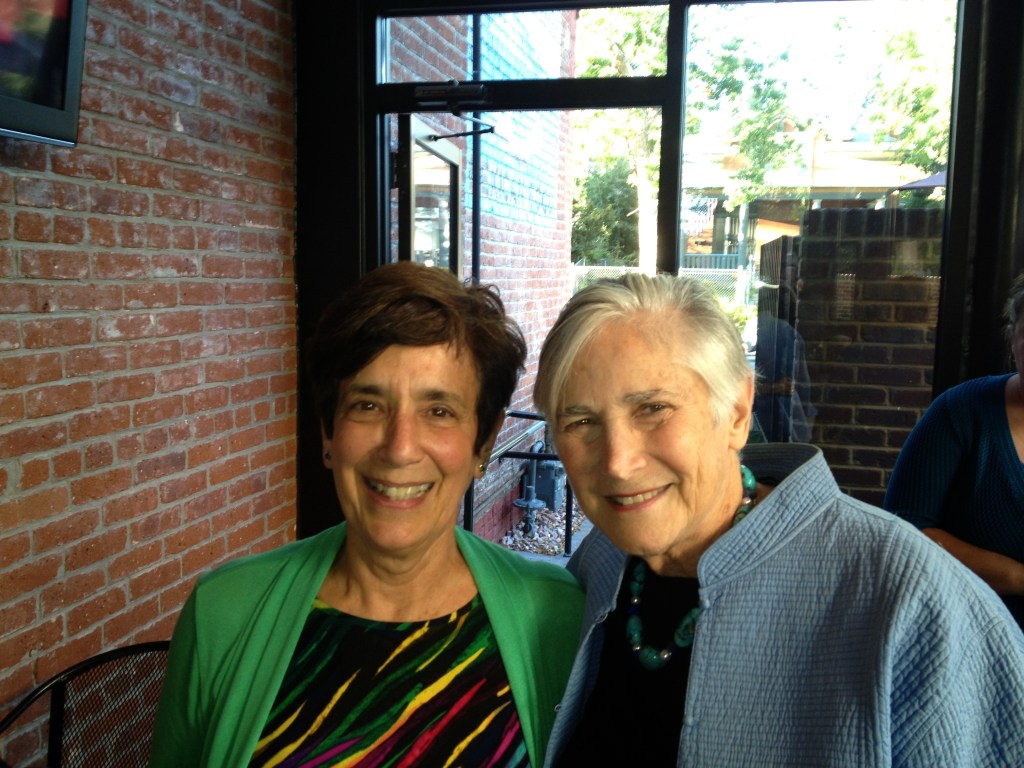
Jeannie and I in Denver, 2013.

Mike DeGuire is a veteran educator in Denver who has been a teacher and a principal in the public schools. He has researched the heavy hand of billionaires in expanding charter schools in Denver. He explains here that the current school board elections have been heavily influenced by billionaires, mostly out-of-state. As usual, they are hiding behind the name of a “parent” group. He predicts that their candidates will have a 10-1 funding advantage over those they run against. The billionaires plan to buy control of the school board.

He writes:

The Denver school board race is off and running, and several key groups have announced their endorsements.

The Denver Classroom Teachers Association, the local teacher organization, endorsed Charmaine Lindsay, Scott Baldermann, and Kwame Spearman. Denver Families Action endorsed Kimberlee Sia, John Youngquist, and Marlene Delarosa.

Who is Denver Families Action? Chalkbeat says it is the “political arm of a relatively new organization,” Denver Families for Public Schools,formed with the backing of several local charter school networks, and they get funding from The City Fund, a pro-charter education reform national organization.

What is City Fund? How much funding did they give to this new group called Denver Families for Public Schools? What Denver Public Schools “families” do they represent?

According to Influence Watch, The City Fund is an “education organization that funds initiatives that promote the growth of charter schools and other school choice organizations. It also funds activist organizations that support increasing charter school access and school choice programs.” Chalkbeat reports that City Fund was started in 2018 by two billionaires, Reed Hastings and John Arnold, who donated over $200 million to “expand charter schools or charter-like alternatives in 40 cities across the country.”

Reed Hastings has called for the elimination of democratically elected school boards, he serves on the national KIPP charter school board, and he built a training center in Bailey, Colorado, to house the Pahara Institute, an education advocacy and networking group that supports the expansion of charter schools. In December, 2020, he spelled out his vision. “Let’s year by year expand the nonprofit school sector … for the low-performing school district public school — let’s have a nonprofit public school take it over.”

The City Fund set up its own political group, a PAC, called Campaign for Great Public Schools (also called City Fund Action), to give money to organizations that promote charter schools and lobby to privatize education. Since its formation, the Campaign for Great Public Schools has given millions to Education Reform Now, which is the political arm of Democrats for Education Reform. DFER is a “New York-based political action committee which focuses on encouraging the Democratic Party to support public education reform and charter schools.”

Campaign for Great Public Schools also gave millions to the American Federation for Children, which is “a conservative 501(c)(4) dark money group that promotes the school privatization agenda via the American Legislative Exchange Council (ALEC) and other avenues. It is the 501(c)(4) arm of the 501(c)(3) non-profit group the Alliance for School Choice. The group was organized and is funded by the billionaire DeVos family.”

The City Fund Action PAC also funds the National Alliance for Charter Schools, 50 CAN, and numerous other organizations that support the expansion of charter schools.

Denver Families for Public Schools received $1.75 million in 2021 from the Campaign for Great Public Schools to promote their three selected candidates in the current Denver school board race. Denver Families for Public Schools functions as a 501(c)(4), which means it can donate unlimited amounts of money in political elections without disclosing its donors. It functions as an “astroturf” group by engaging in the practice of creating the illusion of widespread grassroots support for a candidate, policy, or cause when no such support necessarily exists. It set up a website, Facebook page, hired staff and recruited others to lobby for its cause. It posts videos of parents who say they don’t like the current school board candidates if they are opposed to them. It participates in forums to promote its selected candidates.

When Denver Families Action announced its school board endorsements in August, the leading fundraiser in the at-large seat at that time, Ulcca Hansen, withdrew from the race since she did not gain its endorsement. Hansen stated she could not win without the significant financial resources that come from “soft side spending.”

This money is also referred to as outside spending or “dark money,” because the funders of the outside groups often remain secret. Hansen felt the dark money would outpace campaign spending by a 10 to 1 margin. The $1.75 million that Denver Families for Public Schools received from The City Fund will be a major factor in the DPS school board race.

Denver citizens need to know who is behind the endorsements, who pays money for the ads, the flyers, the canvassing, the messaging on social media, and why they are supporting their candidates for the school board.

The web designer who won her case today in the Supreme Court has not yet opened her business and has not been asked to design a wedding website for a gay couple. I’m not sure why she had standing to overturn the state’s anti-discrimination law when she has no business.

The case, though framed as a clash between free speech and gay rights, was the latest in a series of decisions in favor of religious people and groups, notably conservative Christians, who celebrated the ruling on Friday as a victory for religious freedom.

In dissent, Justice Sonia Sotomayor called the ruling “profoundly wrong,” arguing that the Colorado anti-discrimination law “targets conduct, not speech, for regulation, and the act of discrimination has never constituted protected expression under the First Amendment. Our Constitution contains no right to refuse service to a disfavored group.”

The designer, Lorie Smith, said her Christian faith requires her to turn away customers seeking wedding-related services to celebrate same-sex unions. She added that she intends to post a message saying the company’s policy is a product of her religious convictions.

A Colorado law forbids discrimination against gay people by businesses open to the public as well as statements announcing such discrimination. Ms. Smith, who has not begun the wedding business or posted the proposed statement for fear of running afoul of the law, sued to challenge it, saying it violated her rights to free speech and the free exercise of religion.

But when the Supreme Court agreed to hear the case, 303 Creative L.L.C. v. Elenis, No. 21-476, it agreed to decide only one question: “whether applying a public-accommodation law to compel an artist to speak or stay silent violates the free speech clause of the First Amendment.”

In a news conference Friday in Washington, Ms. Smith said she was grateful to the court, who “affirmed today that Colorado can’t force me or anyone to say something we don’t believe.”

Here’s what else to know:

  • Progressive interfaith groups and L.G.B.T.Q. advocacy organizations around the country condemned the ruling. Kelley Robinson, president of the Human Rights Campaign, said in a statement that the ruling was “a deeply troubling crack in our progress and should be alarming to us all.”
  • Both sides have said that the consequences of the court’s ruling could be enormous, though for different reasons. Ms. Smith’s supporters said a decision for the state would allow the government to force all sorts of artists to state things at odds with their beliefs. Her opponents said a ruling in her favor would blow a hole through anti-discrimination laws and allow businesses engaged in expression to refuse service to, for example, Black people or Muslims based on odious but sincerely held convictions.
  • The decision appeared to suggest that the rights of L.G.B.T.Q. people, including to same-sex marriage, are on more vulnerable legal footing, particularly when they are at odds with claims of religious freedom. At the same time, the ruling limited the ability of the governments to enforce anti-discrimination laws.
  • Lower courts have generally sided with gay and lesbian couples who were refused service by bakeries, florists and others, ruling that potential customers are entitled to equal treatment, at least in parts of the country with laws forbidding discrimination based on sexual orientation.

On her dissent, Justice Sotomayer wrote:

The unattractive lesson of the maiority opinion is this: What’s mine is mine, and what’s yours is yours. The lesson of the history of public accommodations laws is altogether different. It is that in a free and democratic society, there can be no social castes. And for that to be true, it must be true in the public market. For the “promise of freedom” is an empty one if the Government is “powerless to assure that a dollar in the hands of lone person] will purchase the
same thing as a dollar in the hands of another].” Jones v. Alfred H. Mayer Co., 392 U. S. 409, 443 (1968). Because the Court today retreats from that promise, I dissent.

NBC News reported on the takeover of Woodland Park, Colorado, by rightwing extremists. Woodland Park is a mostly white district with 8,000 residents. Colorado is a bluish state. The governor is a Democrat, as are the two Senators. But the state, like other states, has deep red districts. The new board wasted no time in pushing their ideological agenda, which apparently concerns even some Republicans.

WOODLAND PARK, Colo. — When a conservative slate of candidates won control of the school board here 18 months ago, they began making big changes to reshape the district.

Woodland Park, a small mountain town that overlooks Pikes Peak, became the first — and, so far, only — district in the country to adopt the American Birthright social studies standard, created by a right-wing advocacy group that warns of the “steady whittling away of American liberty.” The new board hired a superintendent who was previously recalled from a nearby school board after pushing for a curriculum that would “promote positive aspects of the United States.” The board approved the community’s first charter school without public notice and gave the charter a third of the middle school building.

As teachers, students and parents began protesting these decisions, the administration barred employees from discussing the district on social media. At least two staff members who objected to the board’s decisions were later forced out of their jobs, while another was fired for allegedly encouraging protests.

These rapid and sweeping shifts weren’t coincidental — instead it was a plan ripped from the MAGA playbook designed to catch opponents off guard, according to a board member’s email released through an open records request.

“This is the flood the zone tactic, and the idea is if you advance on many fronts at the same time, then the enemy cannot fortify, defend, effectively counter-attack at any one front,” David Illingworth, one of the new conservative school board members, wrote to another on Dec. 9, 2021, weeks after they were elected. “Divide, scatter, conquer. Trump was great at this in his first 100 days.”

The leaders of the Woodland Park School District are enacting an experiment in conservative governance in the middle of a state controlled by Democrats, with little in the way so far to slow them down. The school board’s decisions have won some praise in heavily Republican Teller County, but opposition is growing, including from conservative Christians and lifelong GOP voters who say the board has made too many ill-advised decisions and lacks transparency.

“I think they look at us as this petri dish where they can really push all their agenda and theories,” said Joe Dohrn, a Woodland Park father who described himself as a staunch Republican and “very capitalistic.” “They clearly are willing to sacrifice the public school and to put students presently in the public school through years of disarray to drive home their ideological beliefs. It’s a travesty.”

Teachers grew particularly alarmed early this year when word spread that Ken Witt, the new superintendent, did not plan to reapply for grants that covered the salaries of counselors and social workers.

At Gateway Elementary School in March, Witt told staff members he prioritized academic achievement, not students’ emotions. “We are not the department of health and human services,” he said, as teachers angrily objected, according to two recordings of the meeting made by staff members and shared with NBC News.

Someone in the meeting asked if taxpayers would get a say in these changes, and Witt said that they already did — when they elected the school board.

Over the past two years, school districts nationwide have become the center of culture war battles over race and LGBTQ rights. Conservative groups have made a concerted effort to fill school boards with ideologically aligned members and notched dozens of wins last fall.

In Colorado, conservatives started making gains earlier because school board elections are held in off years. Woodland Park offers a preview of how quickly a new majority can move to reshape a district — and how those battles can ripple outward into the community. Some longtime residents say that the situation has grown so tense, they now look over their shoulder when discussing the school board in public to avoid confrontation or professional consequences.

David Rusterholtz, the board’s president, believes that chasm predates his election in November 2021.

“This division is much more than political — this is a clash of worldviews,” Rusterholtz said at a board meeting in January. He concluded his remarks with a prayer for the district: “May the Lord bless us and keep us, may His face shine upon us and be gracious to us…”

When asked to respond to criticism from school personnel and parents, Illingworth, the board’s vice president, replied in an email: “I wasn’t elected to please the teacher’s union and their psycho agenda against academic rigor, family values, and even capitalism itself. I was elected to bring a parent’s voice and a little common sense to the school district, and voters in Woodland Park can see I’ve kept my promises.”

As the school year winds down, many of the Woodland Park School District’s employees are heading for the exit, despite recently receiving an 8% raise. At least four of the district’s top administrators have quit because of the board’s policy changes, according to interviews and emails obtained through records requests. Nearly 40% of the high school’s professional staff have said they will not return next school year, according to an administrator in the district.

The board’s critics have pinned their hopes on the next election in November — when three of the five school board members are up for a vote — to claw back control of the community’s schools.

“This is an active case study on what will happen if we allow extremist policies to start to take over our public education system,” said David Graf, an English teacher who recently resigned after 17 years in the district. “And the scariest part about it, they knew that this community would bite on it.”

The new board approved the district’s first charter school without any public notice. The approval of Merit Academy was listed on the board agenda as “board housekeeping.”

The district’s teachers union complained in an email to middle school staff that the board’s action was “underhanded, and at worst illegal.” A parent sued, aiming to force the board to follow open meetings law. A trial court judge did not rule on the legality of the board’s actions but ordered the board to list agenda items “clearly, honestly and forthrightly.”

In response to the teachers’ complaints, Illingworth accused the union of attempting to organize a “coup,” and instructed then-Superintendent Mathew Neal to make “a list of positions in which a change in personnel would be beneficial to our kids” and “help the union see the wisdom in cooperation rather than conflict.”

Illingworth’s emails spread after parents obtained them through open records requests. Subsequent board meetings attracted boisterous crowds, as teachers accused board members of creating a hostile environment, while other community members spoke in favor of the board for supporting “school choice” and quoted Scripture. A handful of parents, including some lifelong Republicans, tried to organize a recall, but failed to get enough signatures to force a vote.

The district’s superintendent resigned and was replaced by Ken Witt, who had been active in conservative politics in Jefferson County, CO., schools.

A week before Witt was hired, on Dec. 13, students in a class called Sources of Strength, which is part of a national suicide prevention program, asked their teacher what should they know about him as the sole finalist for the superintendent job.

Sara Lee, a longtime teacher at Woodland Park High School, responded, “You should Google him.”

The students did, and they didn’t like what they learned.

They discovered that Witt, as president of the school board in neighboring Jefferson County, supported a plan in 2014 to ensure the district’s curricula would promote patriotism and not encourage “social strife.” Witt said students who protested the board policies at the time were “pawns” of the teachers union. After he and two other conservative members of the board were recalled, Witt became executive director of an organization that oversees charter, online and other schools and helped launch Merit Academy.

The teacher, Sara Lee, had taught high school for 25 years, 18 of them in the district. The board reassigned her to an elementary school to punish her for sharing information about Witt. She resigned and was promptly hired by another district.

Please open the link and keep reading. The story gets worse. Parents and teachers tried to persuade Witt to reapply for mental health funds to support counselors and social workers. He refused, insisting that such problems should be handled by parents, not schools. The district’s mental health supervisor, unable to persuade him to ask for the funds, submitted her resignation.

Denver Post columnist Krista Kafer worries that crazy people now control the state GOP. The man who was just elected state chairman, Dave Williams, had his name legally changed to add “Let’s Go Brandon” as his middle name.

She writes:

After the Colorado GOP chose former state Rep. Dave Williams as party chair, many sane Republicans wonder if there is a place for them within the Colorado Republican Party. By sane, I mean rational, evidence-based thinkers who get, at a minimum, that Trump lost the 2020 election, vaccines save lives, and Trump’s repellent, mendacious style has hurt Republicans’ standing in a once purple state.

Williams, an election denier and conspiracy theorist, believes Trump won in 2020 sans evidence. He alleged without proof that 5,600 dead people voted in the 2020 Colorado election. Despite 300 years of vaccine science and millions of saved lives, Williams is a proud anti-vaxxer. Upon beating out six contenders for chair (all but one of the conspiracy theorists or tinfoil hat-lite variety), Williams stated, “Our party doesn’t have a brand problem. Our party has a problem with feckless leaders who are ashamed of you,” implying that GOP leaders lost because they were insufficiently Trumpist, an assertion belied by evidence that such candidates fared worse in Colorado and around the country.

Speaking of feckless, Williams tried and failed to have the tacky phrase “Let’s Go Brandon” added to his name on the ballot for the 2022 primary against Rep. Doug Lamborn.

Williams has vowed to be a “wartime leader” leaving many of us to wonder if mainstream Republicans are a battlefield target. Former Minority Leader of the Colorado House of Representatives Mark Waller queried Williams via social media about the future, “I have been called a RINO and told I no longer belong in our Party. I don’t believe the election was stolen, and I believe the events of January 6th were a disgrace to our Country and our Party. I am also a proud Republican who believes in our foundational principles. Please let me know if I have a place in our fractured Party.”

Some Republicans have determined that there is no place for the sane, and they do not want to be associated with the lunatic fringe. Popular center-right KOA radio host Mandy Connell and the former Republican University of Colorado Regent Sue Sharkey are no longer affiliated with the party. They are two of the more than 133 Republicans who changed their voter registration since Williams won, according to an analysis by 9 News reporter Marshall Zelinger.

As I noted in a previous column, Republicans have been lagging behind unaffiliated voters since 2014 and behind Democrats since 2017. Today, Republicans account for 24% of Colorado registered voters. If sane Republicans leave the party, the con artist-crackpot contingent will gain more influence and visibility, prompting the flight of other mainstream Republicans. Unmitigated, this could trap the Colorado GOP in a death spiral just when the party should be rebounding as Trump sinks into ignominious insignificance.

Colorado isn’t alone. In Michigan, the state GOP picked Kristina Karamo for party chair. A rabid conspiratorialist, she has yet to concede her loss in the Michigan secretary of state race. The Kansas and Idaho GOP chose election deniers to chair their state parties. In Arizona, former chief operating officer for Trump’s campaigns, Jeff DeWit, beat out other contenders with the endorsement of uber-Big Lie proponents like failed gubernatorial candidate Kari Lake, state Sen. Wendy Rogers, and the former president. Fortunately, the contagion has not spread to other states.

The Network for Public Education posts regular features from the perspective of parents about their public schools. Some stories have a happy theme, some don’t. This post was written by Matt Gawkowski, a parent in Colorado who was very happy with the local public school. Then a slate of extremists took control of the local school board and created disruption. Matt became an activist. He had to.

I Never Thought I’d Become a Public School Activist. Then Extremists Took Over the School Board.

Matt Gawlowski

Like so many school districts across the country right now, rural Woodland Park, Colorado is being torn apart by politics. School board meetings are contentious, students are afraid and teachers are threatening to leave. Our community is fracturing.

It hasn’t always been this way. While Woodland Park is a politically conservative place, the schools have always felt isolated from politics. The political affiliation of parents, teachers and school board members didn’t matter because everyone worked together and took pride in the local schools. I was one such proud parent.

When I was asked to join the School Accountability Committee at my daughter’s school many years ago, I jumped at the chance. As a data nerd, I came away feeling deeply impressed by the school’s fiscal responsibility. When I sat in on a presentation by the superintendent at the time about the district budget, the fiscal conservative side of me was similarly dazzled. This was a school district that had its act together, I recall thinking.

Then in the fall of 2021, a group of four candidates who’d promoted themselves as ‘the conservative choice’ were elected to the school board. They quickly moved to transform the district, starting with the adoption of a sharply adversarial tone. In an email, one board member described teachers and their union as ‘the enemy.’ The founder of our local Christian bible college, an uncredited evangelical school that set up shop here several years ago, bragged about taking over the school board and announced that he’d sent a spy into the district to identify “homosexual books.”

And that was just the start. The new board approved a controversial charter school, one that the previous board had rejected, in part because enrollment in our rural district is declining. The rushed process not only violated open meeting laws but saddled the district with enormous consulting and legal fees. The board also terminated the previous superintendent’s contract, once again at great expense to the district, then chose controversial former school board member Ken Witt to serve as interim. Witt briefly served on the school board in Jefferson County but was recalled by voters after he accused the AP US history course of being insufficiently patriotic.

During a raucous meeting, the board voted to hire Witt over widespread opposition from students, parents, teachers and community members. The last member of the original school board, and the lone voice of reason in meetings, resigned. Students led two walkouts to protest and began showing up at board meetings to voice their opposition. The board blamed a teacher for the students’ actions and put her on administrative leave.

We fear that much worse is still to come. Radical curriculum reform (the board recently adopted the conservative American Birthright civics program, even after the state rejected it as too extreme), merit pay for teachers, and an effort to transform Woodland Park into an all-charter district will likely be on the agenda. Already, dozens of teachers have indicated that they’ll be leaving at the end of the school year. I am not opposed to honest, well-planned efforts to improve our district. But this board’s politically motivated actions have created massive disruption in the schools and the community.

My front row view of the battles taking place in my daughter’s school district has turned me into something I never thought I’d become: an activist. I certainly never thought I’d see the day when I’d be called a “hard left union lap dog wanna be thug,” as one director of the school board recently referred to me. In fact, I’m neutral on unions. A former registered Republican who once purchased a book by Rush Limbaugh I like low taxes, balanced budgets, and limited government. The truth is that I’d much rather just go back to being a dad and an introverted engineer, not the guy who is now an expert on submitting open records requests, and is a prominent voice in a Facebook group of similarly minded parents and community members.

I love our public schools and look at the country they have helped mold with pride. When I saw that the teachers and students in our local schools needed parents like me to speak up when they couldn’t, I had no choice but to step up. I hope that my story will inspire folks in communities where similar battles are raging to do the same.


Matt Gawlowski is a longtime parent in the Woodland Park RE-2 school district in Colorado. When not working as a mechanical engineer, you’ll find him outside trail running, backpacking, or skiing, depending on the season. You can follow him on Twitter and Instagram at @EspressoMatt or at http://supportwpschools.com

Aaron Brink is the father of Anderson Andrews, who (allegedly) shot and killed five people and wounded nearly two dozen others at the gay bar Club Q in Colorado Springs recently.

Brink is a Mormon, a porn star and a former meth addict. When he heard that his son had been arrested for multiple murders, he was stunned to hear that his son was in a gay bar but relieved to think that he was not gay. He abandoned his son and his wife years ago. In his mind, being gay was far, far worse than being a mass murderer.

Look for this guy on video, probably YouTube. Abandoned his family. Hates gays. calls himself a “conservative Republican.”

Brink reflects the free-floating hatred that is regularly spouted by conservative Republicans.

The Denver Post reported that extremist Lauren Boebert has taken the lead by almost 800 votes. But thousands of ballots have not yet been counted—mail-in ballots, military ballots.

Keep fingers crossed.

The polls said that extremist Colorado Republican Lauren Boebert was a shoo-in for re-election to Congress. No way the gun-toting Christian fundamentalist could be beaten.

But they were wrong.

Boebert is now in a near tie with her Democratic opponent, Adam Frisch, slightly behind him with more votes to be counted.

VOX wrote:

As of late Wednesday afternoon, Boebert was narrowly trailing Democrat Adam Frisch, 49.7 percent to 50.3 percent, in the House race for Colorado’s Third District, which includes much of the western half of the state.

The closeness of the race is surprising given the district’s Republican lean and polling that heavily favored Boebert ahead of Election Day. A loss for her would suggest that voters are fed up with the controversy and antics that Boebert has trafficked in since taking office, and would be a notable rebuke of one of former President Donald Trump’s most vocal and bombastic backers in Congress. It also would nod to concerns expressed by her constituents — some of whom have said that she seems to care more about her celebrity than addressing issues in the district, including funding for infrastructure, which would bolster steel jobs in the area.

During her tenure in the House, Boebert, previously a gun rights activist, has spent much of her time on attention-grabbing stunts including Islamophobic comments targeting Rep. Ilhan Omar, attempts to carry a gun throughout the Capitol, and heckling President Joe Biden during his State of the Union address. She’s faced scrutiny for these actions as well as for controversial social media posts advancing false and dangerous theories suggesting that LGBTQ people “groom” children.

Frisch, a moderate businessman and former Aspen city council member, has attempted to appeal to voters tired of what he described as the “angertainment” Boebert provides. He’s also leaned into qualms constituents have had about the focus Boebert has put on her own image versus delivering for the district. A Frisch win would be a surprising pick-up for Democrats in a place that Cook Political Report, a nonpartisan political analysis firm, has rated as Solid Republican…

Polling up until this point had Boebert as the likely winner: FiveThirtyEight’s predictive model, for example, gave Frisch a 3 in 100 chance of taking the district.