Archives for category: Childhood, Pre-K, K

Denisha Jones, an expert in early childhood education and a lawyer (and a member of the board of the Betwork for Public Education) has prepared an excellent report for Defending the Early Years.

DEY advocates for sound educational practices for young children, and their advice in this report is balanced and humane.

Be sure to read the recommendations at the end of the report.

It begins:

Though the push to online learning/remote schooling was necessary to deal with a global pandemic, it ushered in fundamental changes to the lives of young children, their families, and their teachers. The speed at which schools were closed and how quickly we expected children and families to learn online or at home made it difficult for parents and teachers to prepare children for this new reality adequately. Now that another school year has begun, time to adjust to hybrid or full online/remote schooling has slipped away. As children and families spent their summer trying to regain a sense of normalcy, they now face the reality that a return to schooling as we knew it might not happen for quite some time. Some families will send their children back to socially distant schooling while others will keep them home and hire tutors or teachers and replace traditional schooling with “pandemic pods.” We recognize that all families, regardless of the option they can choose, continue to want the best for their child’s education and health and need support, resources, and guidance. We propose the following recommendations to assist families of young children and their teachers to reap as many benefits from online learning/remote schooling as possible and mitigate the challenges.

1. Do not try to replicate school at home.
This might seem unrealistic faced with another quarter, semester, or year of online learning/remote schooling, but it is essential to recognize that we cannot do at home all the things we do at school. First, parents are not teachers and even if you are a teacher, teaching your child is different than teaching someone else’s child. If you are homeschooling your child during the 2020-2021 school year, then you are your child’s teacher, but if you are working from home, you should not expect to be a full-time teacher, full-time parent, and full-time or part-time employee. Online learning/remote schooling is not traditional schooling. It is a substitute for the educational environment we typically provide children and, just like when your child has a substitute teacher at school, things cannot be precisely the same. Traditional schooling is set up to function very differently than online teaching/ remote schooling. We expect children to spend an entire day in a room with many other children and at least one adult and to complete a variety of tasks in a variety of different formats. Teachers come prepared to facilitate this environment, and, over time, many children adjust to it. Online teaching/remote schooling should not have the same expectations. Yes, children are at home all day, and yes, parents who are working from home need to keep them engaged, but that does not mean we should sit them down in front of a computer or tablet and expect them to do the same things they would do in school. In-person instruction cannot transform into online teaching for young children. Remote schooling should not mean that we expect children to do the same things that they did in school at home. For children, their families, and their teachers to gain benefits from online learning/remote schooling, we must separate the functions of traditional schooling from the realities of online learning/remote schooling.

2. 2. Use screens and technology sparingly and wisely.
Many of us are aware that an increase in screen use can be harmful to young children. But we also know
that Zoom and other platforms provide valuable connections for children whose lives have been disrupted by COVID-19. Even before the pandemic, many families used technology-based communication platforms to stay connected when they lived in different geographical locations. Infants, toddlers, and preschoolers love seeing grandma and grandpa on the tablet, and many love seeing their teachers and peers as well. Thus, we must find ways to incorporate these platforms that maximize their benefits but also limit their exposure. We should
not expect young children to spend more than 30 minutes a day, a few days a week, on technology. Brief opportunities to connect with their teacher and classmates that are engaging and developmentally appropriate are crucial to maximizing the use of technology. Reading stories, sharing items from home, singing songs, watching a puppet show, and playing are good examples of how technology can bring young learners and their teachers together. However, we must keep these sessions brief and optional. We know not all children want or need to be on Zoom every day. Even if the teacher offers daily 30-minutes class meetings, families should be able to decide whether to attend as many or as few as their child can handle each week. We do not recommend longer remote schooling sessions that include online teaching for young children. Just as we did not (or should not) expect young children to sit still at a desk and listen to a teacher for extended periods of time in schools, we cannot expect them to do the same at home. Remote schooling does not mean that all teaching and learning has to happen through direct online instruction.

3. Prepare children to be s 2. Use screens and technology sparingly and wisely.
Many of us are aware that an increase in screen use can be harmful to young children. But we also know that Zoom and other platforms provide valuable connections for children whose lives have been disrupted by COVID-19. Even before the pandemic, many families used technology-based communication platforms to stay connected when they lived in different geographical locations. Infants, toddlers, and preschoolers love seeing grandma and grandpa on the tablet, and many love seeing their teachers and peers as well. Thus, we must find ways to incorporate these platforms that maximize their benefits but also limit their exposure. We should
not expect young children to spend more than 30 minutes a day, a few days a week, on technology. Brief opportunities to connect with their teacher and classmates that are engaging and developmentally appropriate are crucial to maximizing the use of technology. Reading stories, sharing items from home, singing songs, watching a puppet show, and playing are good examples of how technology can bring young learners and their teachers together. However, we must keep these sessions brief and optional. We know not all children want or need to be on Zoom every day. Even if the teacher offers daily 30-minutes class meetings, families should be able to decide whether to attend as many or as few as their child can handle each week. We do not recommend longer remote schooling sessions that include online teaching for young children. Just as we did not (or should not) expect young children to sit still at a desk and listen to a teacher for extended periods of time in schools, we cannot expect them to do the same at home. Remote schooling does not mean that all teaching and learning has to happen through direct online instruction.

The report goes on to identify ways that parents can best help their young children navigate these difficult times.

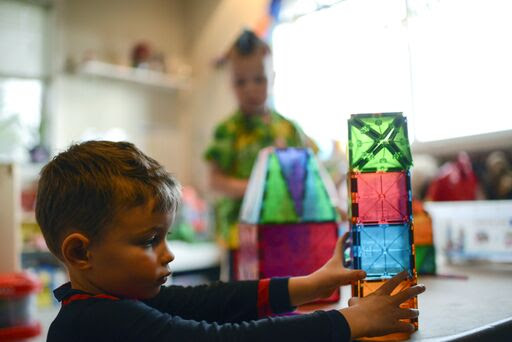
A reader with the anonymous sobriquet “Kindergarten Interlude” writes:


For my kindergartners distance-learning was never fun. And Lord knows for me it is not just a challenge but truly sad. How do you connect with five and six-year-olds through a computer screen? And the parents are losing it. I give them a lot of credit!

Of course I am trying to make the best of this for my students, but gone is the essence of teaching and learning in kindergarten: The human touch, the facial expressions, the spontaneous moments, the joy – reading and singing and dancing and yoga and Simon Says and Thumbs Up at the end of the day. And Discovery Centers (my code word for play centers)- teamwork and problem-solving and using one’s imagination and learning basic social skills like taking turns and sharing. There is great satisfaction (and joy!) in learning and practicing these skills and working together as a team. It is how friendships are planted and take root over the weeks and months of working and playing and learning together. Deep feelings of security and acceptance come from belonging to a community. A REAL community, not a screen.

So no, this was never fun and it is an untenable way to teach kindergarten and I imagine pretty much every grade.

Because at the end of the day, it is all about that beautiful community that is established. That’s the essence of successful teaching and learning in kindergarten.

Every Wednesday at 7:40 pm EST, the Network for Public Education has hosted a conversation about education. All the conversations are archived here.

In the first one, I discussed my new book SLAYING GOLIATH with Carol Burris.

In the second one, I talked to Pastor Charles Foster Johnson of Pastors for Texas Children about their fight against vouchers and for public schools.

In the third one, I asked Mercedes Schneider about her new book and her skill at investigative reporting.

In the fourth one, I discussed the effects of the pandemic on early childhood education with ECE experts Denisha Jones and Susan Ochshorn.

Today is the birthday of Patty Smith Hill, who wrote “Happy Birthday to You.”

I recall that she was a leading advocate for early childhood education and play while a professor at Teachers College, Columbia University, in New York.

Garrison Keillor wrote this about her.

It’s the birthday of the woman who wrote “Happy Birthday to You,” Patty Smith Hill, born in Anchorage, Kentucky (1868). Most of her life was spent as a kindergarten teacher. She began teaching in Louisville, Kentucky, and it was there, in 1893, that Hill first wrote the lyrics to the song. But it was originally meant as a welcome to start the school day and was first called “Good Morning to All.” Hill’s sister Mildred, an accomplished musician, provided the melody. Hill was 25 when she wrote the lyrics to the famous song.

But wait? Where is her professional life?

Wikipedia says this:

Hill taught nursery school, kindergarten, and was a “key founder of the National Association for Nursery Education (NANE) which now exists as the National Association For the Education of Young Children (NAEYC).”

Not only was she famous for composing the Happy Birthday song, but she was a prominent advocate for early childhood education.

Hill was an authority and leader in the progressive education movement of the late 19th and early 20th centuries. Patty developed the Patty Hill blocks and in 1924 helped create the Institute of Child Welfare Research at Columbia University Teachers College.[2] The Patty Hill blocks were large blocks with which children could create giant constructions. She was a member, President, and lifetime support of the Association for Childhood Education International.

When Arne Duncan was Secretary of Education, he touted the idea that every student should be college ready. There has been considerable debate about which was Arne’s most memorable utterance. Some say it was his claim that Hurricane Katrina “was the best thing that ever happened to the schools of New Orleans,” despite the deaths of over 1,000 people. Others think it was his crack that the reason suburban moms hated Common Core was because it showed that their child was “not as brilliant” as they thought. The Common Core, he believed, was the key to “College and Career” readiness, and it was never to soon to start.

My favorite line is his statement when he visited a New York City public elementary school and said, “I want to be able to look into the eyes of a second-grader and know that he was on track to go to college.” It seemed to me that the typical second grader would have more immediate concerns and dreams (a cowboy? A fireman? An astronaut? A doctor?  A prince or princess?).

Our blog poet, SomeDAM Poet, wrote here:

College Ready in Kindergarten

College Ready in Kindergarten
Bachelor’s in First
PhD in Second grade
A life that’s well rehearsed

The Economic Policy Institute has created an interactive state-by-state analysis of the cost of high-quality early childhood education.

At present, most ECE workers/teachers are grossly underpaid, some well below the poverty line.

It is fair to assume that policymakers today are unlikely to pay the cost of high-quality ECE. In many states, and at the federal level, policymakers do not believe in investing in the future. They prefer to give tax cuts to the wealthiest people and to corporations.

Consult the EPI website to see what it would cost your state to have first-rate ECE:

Explore the cost of high-quality early child care and education

Thanks to a new interactive online report from EPI and the Center for the Study of Child Care Employment at U.C. Berkeley, readers can find out what it would cost to create a high-quality early child care and education (ECE) system in their state and how many teachers, parents, and children could benefit. The report acknowledges what policymakers are beginning to recognize: we can’t solve the child care crisis without a major investment. A companion reportoutlines the resources currently invested in early care and education in the U.S., including some of the unspoken costs of our chronically underfunded system—underpaid ECE teachers living in poverty, parents forgoing paid work to care for their children, and compromised quality of care. Visit the interactive report »
Share the interactive online report:

Explore the cost of high-quality early child care and education


Nancy Bailey describes here the determined effort by policymakers to stamp out play and childhood, all in the name of teaching reading long before children are ready to learn to read.

Because kindergarten has become more advanced, preschool is seen as the time children must have prereading skills for kindergarten. If they don’t, it’s seen as a red flag. This makes teachers and parents push children to learn to read early.

Children are expected to know letters and numbers, even basic sight words. They’re supposed to be able to sit and focus on tasks for longer periods. But preschool wasn’t always about teaching prereading skills, and we should question if children that young are being pushed to read too soon.

In 2002, Newsweek published an article entitled “The Right Way to Read.” The title was conjecture. Reporters visited the Roseville Cooperative Preschool in northern California. Children there were called “masters of the universe” because they oversaw play. Children played most of the time. The school based everything on play.

Children played at a science table. They used magnifying glasses to explore flowers, cacti, and shells. They donned smocks to do art, lots of art. They were able to climb and stay active. They had access to books and a dollhouse.

There were no letters or numbers on the wall.

Director and founder Bev Bos told teachers, “Forget about kindergarten, first grade, second grade. We should be focusing on where children are right now.”

But Newsweek didn’t praise the preschool. They were there to show the controversy surrounding it.

The Bush administration had claimed research indicated that 50,000 Head Start teachers were going to have to learn how to provide explicit instruction on how to teach the alphabet, letter sounds, and writing to young children.

Not only that. Preschool teachers were to use a detailed literacy-screening test. Forty-five million was being earmarked for preschool-reading research.

Children were no longer masters of their world. Adults were in control.

Yes, the adults were in control but they made horrible decision that stole childhood and play from children.

For all the hundreds of millions and billions poured into the Great Crusade to Teach Preschoolers to Read, there has been minimal change in NAEP scores for reading, in fourth or eighth grades. Despite the pressure to raise test scores in reading, scores remained stagnant, and no academic progress was made at all for the lowest performing students since the implementation of NCLB almost two decades ago.


This is a wonderful article that appeared in Education Week, written by Margaret Pastor, a veteran educator in Maryland.

When I started reading, I recoiled at the thought of giving standardized tests to babies in kindergarten. Disgusting. But keep reading, as I did (if you are a subscriber).

Many of us in education have deep misgivings about the role standardized tests play in our schools. As a principal, I’ve had a front-row seat to incidents that illustrate why we should be seriously concerned. Let me tell you about one of them.

A few years ago, an assistant superintendent approached me about the performance of my kindergarten teachers. He had looked at the school’s scores from a commonly used standardized test and had identified an underperforming kindergarten teacher.

He pointed out that in one of my four kindergarten classes, the student scores were noticeably lower, while in another, the students were outperforming the other three classes. He recommended that I have the teacher whose class had scored much lower work directly with the teacher who seemed to know how to get higher scores from her students.

Seems reasonable, right? But here was the problem: The “underperforming” kindergarten teacher and the “high-performing” teacher were one and the same person.

I had just two kindergarten teachers. They each taught one morning and one afternoon class.

The idea that I should have the “high performing” teacher coach her lower-performing colleague was suddenly very concerning to me, not to mention impossible. It was clear to me that I couldn’t use standardized tests to distinguish high-performing from low-performing teachers. And this incident fed the doubts that I already harbored about using those same tests-which are meant to be “scientific”-to measure student learning.

I am married to a scientist. He runs tests on plant pathology, analyzes the results, draws conclusions, and uses the results to develop solutions to the problems he studies. I am in awe of the tidiness of the whole process.

I, on the other hand, am an educator. At best, every child is an experiment of one. We test the children’s learning with admittedly limited instruments-standardized tests-that were never designed to be used as a standalone analysis. A lot of classroom time is dedicated to preparing for these tests and giving them. Results are affected by dozens of variables that we can’t control: illness, hunger, sleep deprivation, unfamiliar forms of a test, limited command of English.

It gets better and better but I have quoted as much as I can.


Corporate Reformers in Oregon joined with their allies in the business community to kill a bill (HB 2318) called “Too Young to Test,.” Modeled on laws in New York and New Jersey, the bill would have prohibited mandatory standardized testing from pre-k through grade twoMost of the testimony favored the bill.

The purpose of HB 2318:

Prohibits State Board of Education from requiring, and school districts from administering, certain assessments to students enrolled or preparing to enroll in prekindergarten through grade two. Makes exception for assessments administered for diagnostic purposes as required under state or federal law.

The Corporate Reformers and the business community killed it. 

No one, the Corporate Reformers insist, is ever too young to test.

They also focused on killing a bill to strengthen Oregon’s opt-out law.Then they killed a bill to strengthen Oregon’s opt out law. (SB 433). Here is their letter of opposition to SB433.

They claim they need the test scores so they can effectively advocate to meet student needs. No one should be allowed to opt out of testing, no matter how young.

Apparently they don’t know that standardized testing is highly correlated with family income and family education. They should read Daniel Koretz’s The Testing Charade: Pretending to Make Schools Better.

Stand for Children was part of the pro-testing lobby. SFC is heavily funded by the Gates Foundation and other pro-testing, pro-privatization foundations. Stand for Children advocates for high-stakes testing, charter schools, and test-based evaluation of teachers. Dana Hepper of “The Children’s Institute” also lobbied against these bills and in support of standardized testing of kindergartners; she previously worked for Stand for Children. In addition to endorsing the joint statements, here is her testimony supporting mandated standardized tests for children of all ages and opposing opt out.

They say they need the scores so they know what children need.

BUT, THE CORPORATE REFORMERS HAVE THE TEST SCORES NOW AND THEY ARE NOT ADVOCATING FOR STUDENT NEEDS.

Teachers in Oregon are on strike to advocate for smaller classes, nurses, mental health counselors, librarians, and social workers.

Where are the corporate reformers?

Fighting for more standardized testing, even for kindergartners! Fighting parents’ right to opt their children out of standardized testing!

Are they joining the teachers to demand more investment in schools? No.

Are they on the picket lines demanding smaller classes? No.

Are they lobbying for increased funding for nurses, social workers, librarians, and mental health counselors? No.


The Campaign for a Commercial-Free Childhood is outraged that The Audacious Project is honoring the Waterford online preschool program, which will use this platform to expand their efforts to open additional  online preschools. Early childhood experts agree that this is harmful to children. I say it is a mean and stupid idea. Efforts to put little children in online schools should be denounced, not celebrated. Children need real interaction with real human beings.

Please sign the petition.


For Immediate Release

Contact:
David Monahan, CCFC: david@commercialfreechildhood.org; (617) 896-9397

Early Childhood Advocates Call On The Audacious Project to Reconsider Major Award for Online Preschool
A TED philanthropy project would widen educational inequality and deprive children of the hands-on preschool experiences they deserve.

BOSTON, MA – April 12, 2019 – Early childhood advocates are calling on The Audacious Project, housed at TED and designed to fund ideas for social change, to postpone plans to designate Waterford UPSTART, an online “preschool” program, as one of the participants in its funding program for 2019.  Award winners will be announced at TED2019 in Vancouver on April 16. Last year’s award winners averaged $63 million in new funding. According to a Waterford representative, the funding will allow UPSTART to dramatically increase the number of children enrolled in its program.

In their call for The Audacious Project to postpone funding, Campaign for a Commercial-Free Childhood (CCFC) and Defending the Early Years (DEY) point to their October 2018 Position Statement on Online Preschool, which has been endorsed by more than 100 experts in child development and early education. The experts and advocates say that online preschool programs like UPSTART are poor substitutes for high-quality early education, and that funding online programs instead of high-quality early education will make inequality worse, not better.

“There is a tremendous need for universal pre-K, and it’s admirable that The Audacious Project wants to address educational inequalities, but online preschool is not the answer,” said Nancy Carlsson-Paige, EdD, Professor Emerita at Lesley University and DEY Senior Advisor. “Kids learn by playing, exploring, and interacting with peers and caring adults – not by memorizing letters, numbers, and colors presented to them on screens. Children who receive UPSTART’s screen-based version of a preschool experience will be disadvantaged compared to children from more resourced communities who have play-based, experiential early education. A truly audacious project would take the funding intended for these online programs and direct it instead to giving low-income, rural, or otherwise underserved children the high quality, face-to-face education they deserve.

UPSTART, which started with public funding from the state of Utah and has spread to at least seven other states, claims to promote “kindergarten readiness” through 15 – 20 minutes per day of online instruction. But advocates say that UPSTART’s lessons are poorly designed and developmentally inappropriate. An analysis of one UPSTART lesson by DEY found it was pedagogically unsound, “confusing” and “overloaded with distracting images.” UPSTART also recommends that children wear headphones and complete lessons alone, contrary to the American Academy of Pediatrics’ recommendation that parents “co-view with your children [and] help children understand what they are seeing.”

“Online preschool should never be rewarded or considered a legitimate alternative to high-quality early care and education,” said Denisha Jones, PhD, JD, Director of Teacher Education at Trinity Washington University and Director of Organizing for DEY.  “I implore The Audacious Project to reconsider giving money to a screen-based program at a time where early childhood experts are increasingly concerned with screen time and the loss of high-quality interactions between children and educated early childhood teachers. Programs like UPSTART may be less expensive than real universal preschool, but those savings come at the expense of the low-income kids and kids of color they purport to help. We should be investing our money, time, and resources to ensure all children have access to affordable, high-quality, early childhood education.”

Last year, seven of The Audacious Project designees were granted a total of $441 million from partners including the Bill and Melinda Gates Foundation and the MacArthur Foundation. It is not yet known which groups are funding UPSTART, or exactly how much money the program will receive, but an email from a Waterford PR representative indicated that the award will be enough to “provide an opportunity for every four-year-old to be ready for kindergarten.” (Emphasis in original.)

The DEY/CCFC letter pointedly states, “We don’t believe your impressive list of funders and partners would be satisfied if their own children spent 75 minutes a week on a computer in isolation as a substitute for face-to-face preschool rooted in caring relationships and social interaction.” It also warns that a major expansion of online preschool could derail the growing movement for real universal preschool. It asks The Audacious Project to postpone the award and meet with advocates to better understand their concerns.

Added Josh Golin, Executive Director of CCFC, “Over and over, we’ve seen educational technology such as 1:1 programs, virtual charter schools, and personalized learning software falsely marketed as a panacea for inequality. Now the EdTech evangelists have set their sights on preschoolers. Isolated children on computers guided by algorithms can never replicate the joyful exploration and interactions at the core of the preschool experience. We urge The Audacious Project to rethink this award.

The DEY/CCFC letter can be read in full here.