Archives for category: Charter Schools

The leader of Paramount Charter School in Broward County, now closed, was indicted for theft of federal funds. The school opened in 2015, promising to provide an education that would meet “the highest academic and personal standards.” Didn’t happen, say parents. After compiling a terrible academic record, the school closed in 2017.

Shauta Freeman, who said she sent three children there from 2015 to 2016, said the lights cut off at times, the water wouldn’t run, and so many teachers were fired that students from various grade levels were crowded into one room. “It was a nightmare.”

Now, the former president of the school, Jimika Williams, has been federally indicted on the charge of stealing federal funds from the school and committing wire fraud.

The indictment accuses Williams of embezzling nearly $389,000 in funds intended to go toward the school’s operating expenses. Instead, the indictment says they were used to buy a new car, pay her rent at a lavish Davie home and other expenses.

According to the indictment, Williams transferred funds from the school’s bank account to a shell account she set up to “deceive” other members of the governing board, auditors, local education authorities and others...

Freeman said the school initially sounded amazing when she first enrolled her children. But shortly after starting school she said her kids reported being left outside for long stretches of time, little to no instruction, days without lunch, and fighting between teachers and students...

According to the indictment, while Paramount struggled to staff classrooms and properly educate students, Williams made off with hundreds of thousands of dollars meant for the school.

Between 2015 and 2017, the indictment says she made almost monthly transfers between the school’s account and a shell account she created for sums ranging from $3,000 to $50,000 at a time.

This kind of behavior can be expected in states where anyone can open a charter school, and where oversight, accountability, and transparency are lax.

Journalist Florina Rodov taught for several years in a New York City public schools, but she was turned off by the testing craze and the paperwork. Then she heard about these remarkable new schools called “charter schools.” She heard they were academically superior, safe, free of the bureaucracy of public schools, and she applied to work in a charter school in Los Angeles. The principal told her that the school was like a family. It sounded wonderful.

But then her eyes were opened.

I soon realized there was a gulf between charter school hype and reality. Every day brought shocking and disturbing revelations: high attrition rates of students and teachers, dangerous working conditions, widespread suspensions, harassment of teachers, violations against students with disabilities, nepotism, and fraud. By the end of the school year, I vowed never to step foot in a charter school again, and to fight for the protection of public schools like never before.

On August 15, my first day of work, I dashed into the school’s newest home, a crumbling building on the campus of a public middle school in South Los Angeles. Greeting my colleagues, who were coughing due to the dust in the air, I realized most of us were new. It wasn’t just several people who had quit over the summer, but more than half the faculty — 8 out of 15 teachers. Among the highly qualified new hires were a seasoned calculus teacher; an experienced sixth grade humanities teacher; a physics instructor who’d previously taught college; an actor turned biology teacher; and a young and exuberant special education teacher.

When the old-timers trickled in, they told us there’d been attrition among the students, too: 202 of 270 hadn’t returned, and not all their seats had been filled. Because funding was tied to enrollment, the school was struggling financially.

Her first-person tell-all pulls the curtain away from the charter myth. On Twitter, Rodov describes herself as a “fierce advocate for public schools.” Read this article and you will understand why.

Ken Rice was an elected member of the Oakland Unified School District from 1997-2000. That was before the billionaire disrupters decided to take control of Oakland and turn it into their own petri dish for “reform” (i.e., privatization). Rice wrote the following description of the recent school board election, in which grassroots organizations stood together and beat the candidates of the out-of-district/out-of-state billionaires. He is a member of Educators for Democratic Schools (EDS), an Oakland-based organization composed primarily of retired public school teachers, administrators and school board members. When Ken Rice ran for school board, his race cost $12,000. Due to the intrusion of big money, grassroots groups are always outspent and usually overwhelmed. But Rice explains here how Oakland parents and educators fought back and won.

He writes:

Apparently Money Isn’t Always Everything–$300,000 Beats $900,000 In The Oakland School Board Elections!

In nearly 20 years of privatization push into Oakland, this is the first time since 2003 that Oakland schools will be returned to local control by a school board that values and embraces authentic public education. Remaining hopeful for the future, and look forward to strengthening and improving Oakland’s schools.” ~ Diane Ravitch 

The Oakland Unified School District (OUSD), the petri dish for school privatization for the past two decades, might have an answer.  I ran and was elected to the Oakland school board and served one term (1997-2000).  I raised $12,000.  My opponent raised about the same amount.  In those days the school board elections were neighborhood races funded by local supporters. There was no out of state money or PACs involved. 

That began to change about ten years ago:  huge donations from individuals and foundations began to pour into Oakland school board races.  The money was funneled through the California Charter School Association and GO (Great Oakland Public Schools), a pro-charter organization.  The money also came from Michael Bloomberg, the Walton Foundation, Eli Broad, Laurene Jobs (Steve Jobs’ widow), and several more.  The goal was to elect a pro-charter, Board of Education. Unsurprisingly, the pro-charter organizations were successful.  

The Oakland school board has approved about 65 charter school applications over the last twenty years–many of them in the last 12 years.   Of those charters, about twenty have closed their doors—in some cases during the academic year, causing great dislocation to families who had to find another school for their children mid-year.  OUSD now has 30% of its 50,000 students in charter schools—the highest percentage of students in charters of any school district in California. 

What is surprising is what happened in the 2020 election.  For the first time in memory no incumbents were running for any of the four of the seven school board seats up for election.  Thus, there was a possibility of greatly changing the make-up of the school board, whose majority has opted for policies of charter school approval, school closures and lack of responsiveness to the greater Oakland educational community.  This was an opportunity to flip the board . . . and flip it did!

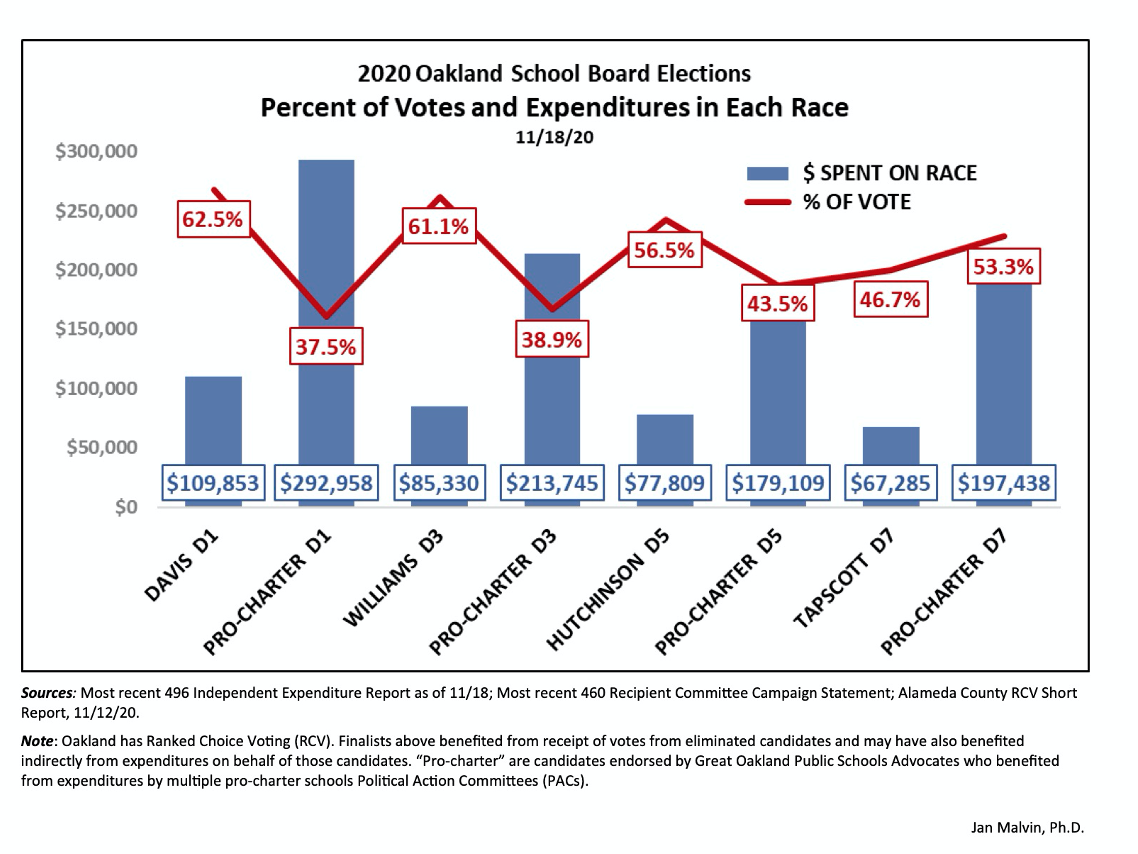
The charter community recognized this opportunity, and poured almost $900,000 into electing their candidates for the four open seats! Yet when the votes were counted, three of their four candidates lost.

Trying to understand how and why this happened can provide an insight into the educational landscape of not only Oakland, but urban cities nationally.  While it might be early to know for certain why the charter candidates were defeated, we can make some educated guesses.

Strong Local Candidates

Two of the three candidates who won had deep Oakland roots.  Two had been teachers (one in Oakland, one in San Francisco) and the other had worked in Oakland’s after school programs.   Two had been community activists around school issues for years.  

Oakland elections are calculated by ranked choice voting (RCV).  When the RCV was tabulated, Sam Davis, the candidate in District 1 received 62% of the vote.  Sam built a stellar campaign focused around school communities. He held zoom meetings with each school community in his district hosted by a combination of parents and teachers who worked in those schools.  VanCedric Williams, in District 3, got 61%.  VanCedric, a public school teacher for almost twenty years, had strong support from the teacher’s union as well as other unions. Mike Hutchinson in District 5 got 56%.  Mike had run for the Board previously, networked with other education activists nationwide, and had built a reputation of challenging Board policies by going to Board meetings for years and reaching out on social media. 

Backing of the Teacher’s Union

Last year, teachers in Oakland led a successful strike. The union’s ability to drum up enthusiasm with their members was one contributor to that success.  Teachers recognized that if their future demands were to be met, they needed to have a responsive Board.  Specifically, the current Board was considering a plan that would close up to 24 schools in Oakland, mostly in Brown and Black communities.  At the same time, none of the 44 charter schools in Oakland were under threat of closure.  Teachers made the connection between a charter friendly board and school closures of the public schools and were determined to change the direction of the district’s “blueprint”.

Teachers phone banked, texted, walked to drop off literature, and held zoom meetings in support of the three candidates who won.  As Sam Davis noted, many voters tend to rely on their friends and neighbors who know something about the schools.  The friends and neighbors were telling each other to vote for the candidates they trusted.

Backing of Other Groups:  Building a Coalition

The three candidates were endorsed by the Democratic Party.  This wasn’t an accident.  Educational activists pushed the local democratic clubs to endorse candidates who would not be friendly to charters and wouldn’t owe their election to big money.  These clubs, in turn, pushed the local Democratic party.  In California the state Democratic party has taken a critical stance towards charter schools, and this was replicated locally.  Organizers noticed that as people walked to the polls on election day, many of them carried the Democratic Party door hanger with them. Some of these candidates were also endorsed by :

  • The Alameda Central Labor Council
  • SEIU 1021
  • State Assemblyperson Rob Bonta
  • State Superintendent of Schools Tony Thurmond
  • Network for Public Education

Also, other community organizations like Educators for Democratic Schools, Democratic Socialists of America, and Wellstone Democratic Renewal Club helped to call, text, and walk precincts.

The Word is Out

You can fool some of the people all of the time but you can’t fool all of the people all of the time, or so Lincoln believed.  Over time, the general public has begun to understand that there is an attempt to buy their votes.  As I dropped off a flier at one home, a parent came to the door and asked, with hostility, “This isn’t the candidate who is getting all that money from Bloomberg, is it?”  Several media sources reported on money from Bloomberg ($500,000 from Bloomberg alone!) and others pouring into Oakland.  

After recovering from the astonishment that anyone would spend that kind of money for a school board election, voters became leery of candidates receiving those huge amounts of money.  In District 1 where I live–and the charter candidate received nearly $300,000!–I found glossy fliers in my mailboxes more times than I could keep track of.

It is profoundly disturbing and a huge threat to our democracy that this big money trend has filtered down to local school board races. The Oakland community fought back against the billionaires’ spending advantage, and when the new board is seated in January, it will have a clear pro-public school majority.  With appealing candidates and strong ground games, Oakland voters have shown that big money can be defeated. While Oakland will never go back to the days when a local neighborhood candidate spent only $12,000 to be elected, this recent victory over out of state billionaire bucks and their agenda sends a clear signal that our community will not be bought.

(Ken Rice is former OUSD board member, a member of Educators for Democratic Schools and currently has a daughter attending an OUSD school.) 

Jeff Bryant writes that while we were all celebrating the pending departure of Betsy DeVos, the usual suspects were buying control of local school board elections. We are all aware of her efforts to direct federal funding to private schools and charter schools. But, he warns, we should pay attention to the “threat to democratically governed schools that preceded DeVos and will continue when she is long gone.”

In midsized metropolitan areas like Indianapolis and Stockton, California, parents, teachers, and public school advocates warn of huge sums of money coming from outside their communities to influence local politics and bankroll school board candidates who support school privatization. In phone conversations, emails, and texts, they point to a national agenda, backed by deep-pocketed organizations and individuals who intend to disrupt local school governance in order to impose forms of schools that operate like private contractors rather than public agencies—an agenda not dissimilar from that of DeVos.

In the 2020 school board election in Indianapolis, local teachers and grassroots groups the Indiana Coalition for Public Education and the IPS Community Coalition backed four candidates against a slate of opponents whom locals accuse of representing outside interests. At stake, according to WFYI, was “an ideological tilt” over whether the district would continue to “collaborate with outside groups and charter organizations” or “return to more traditional methods of improving struggling schools.”

Both sides raise the banner of “improving struggling schools,” but locals say what’s really at stake is whether voters retain democratic control of their public schools or see them turned over to private, unelected boards and their corporate supporters and funders.

Similarly, in Stockton, the clash between opposing slates of candidates in the 2020 school board election included controversies over charter school expansion and the influence of outside money in the district.

The controversy broke into public view in July 2020 when 209 Times reportedthat “[p]aid operatives” connected to Stockton’s outgoing mayor Michael Tubbs and three school board members were engaged in “a coordinated campaign of undue influence from outside of the city whose aim is… charter school expansion” into the district.

In both elections, candidates backed by outside organizations and individuals massively outspent candidates supported by local teachers and public school advocates.

In Indianapolis, WFYI reported that political action committees supporting the candidates aligned with charter school interests had contributed more than $200,000 into the election by October 9, while the “[f]our candidates backed by the IPS Community Coalition… [had by then] raised less than $20,000 in total.”

In Stockton, 209 Politics reported independent expenditure committees supporting candidates favoring charter school expansion outspent their opponents 25 to 1.

While the language used by these outside organizations and their benefactors is different from the rhetoric DeVos wields—substituting a message of rescuing struggling schools for DeVos’s calls for libertarian autonomy—the result is much the same: local citizens see democratic governance of their schools being swept aside as private actors get more control to do what they want.

This effort to squelch local democracy is funded by the usual billionaires:  the Bill and Melinda Gates Foundation; the Walton Family Foundation, of Walmart fame; Arnold Ventures, the private foundation of former hedge fund manager and Enron trader John Arnold; and the City Fund, a nationwide organization providing financial support for city-level charter school expansions.

The City Fund is a relatively new organization of experienced charter school promoters that started on day one with $200 million from billionaires John Arnold and Reed Hastings. Its mission: to use the money to undermine democratic control of local school boards and to see that charter-friendly candidates are elected.

The other organization used by the billionaires to funnel money into the Indianapolis school board election was the notorious Stand for Children, which has played the same role in other districts. “Stand” worked closely with the Mind Trust, a local cheerleader for privatization, also funded by billionaires who don’t like local control or democracy.

Bryant reports that another PAC, aligned with Stand for Children, entered the race on behalf of the Alice Walton and Michael Bloomberg, neither of whom lives in Indianapolis or in Indiana.

Bryant relies on the careful research of Thomas Ultican, who has been documenting the billionaires’ determination to take control of urban districts. Their strategy is to promote the “portfolio model” of schools. This is basically a rightwing business agenda that aligns with a corporate model of governance. Outsource management and control. Close low-performing schools, open new schools; repeat.

In the Indianapolis contest, the billionaire-backed candidates outspent the teacher union-backed candidates by a margin of 11-1. All four of the charter-friendly candidates won.

In Stockton, the teacher- and community-backed candidates won.

Please read the article. There is much to learn from it as a cautionary tale.

Here’s the question that lingers: Charter schools are no longer an innovation. The first charter school opened in 1992, almost three decades ago. There is no evidence that charters as such have produced miraculous improvement. Some get high test scores, but typically because they can choose their students and kick out the ones they don’t want. Some are far worse than the public schools they replaced. Some close mid-year, either for financial or academic reasons or low enrollment.

Why are these billionaires so devoted to imposing their ideas on local communities without regard to results? Is it because they disdain democracy?

In 2012, Tennessee created the “Achievement School District” (ASD) and promised that it would catapult the state’s lowest performing schools into high-performing schools. So confident were state leaders that they hired Chris Barbic, who ran a celebrated charter chain in Houston, and he was confident that the state’s weakest schools could be transformed within five years by handing them over to charter operators. Other states were excited by the idea and created their own state takeover districts.

The ASD failed, even though it was funded by $100 million in Race to the Top money. But Tennessee refuses to accept that taking over struggling schools and giving them to charter operators is a bad idea.

The North Carolina Policy Watch reported on Tennessee’s insistence on protecting failure. North Carolina created an “Innovative School District,” modeled on the ASD.

Greg Childress writes:

The state-run school district in Tennessee, the one on which this state’s Innovative School District (ISD) is modeled, has failed.

According to reports out of Tennessee, the Achievement School District (ASD), is working on a plan to return 30 ASD schools in Memphis and Nashville to their local districts by 2022.

State officials in Tennessee contend the district, which was established in 2012 to improve achievement in low-performing schools, “grew too quickly” and that “demand outpaced supply and capacity.”

Still, Tennessee officials aren’t giving up on the ASD. They’re billing the new proposal as a “reset” of the district, which has fallen short of its goals to move low-performing schools from the bottom 5 percent and into the top 25 percent.

Most ASD schools were handed over to charter school operators after being pulled from local districts.

“The Achievement School District remains a necessary intervention in Tennessee’s school framework when other local interventions have proven to be unsuccessful in improving outcomes for students,” officials said in a presentation obtained by Chalkbeat.

“The Commercial Appeal” in Memphis reports that most of the schools remain in the bottom 5 percent and that several have closed due to low enrollment. Teacher retention has also been a major challenge, the paper reports.

Tennessee school officials plan to stand by their Big Idea, even though its failure is clear even to them.

North Carolina’s “Innovative School District” has not fared any better. Although the state wanted the ISD to be a major reform effort, like the ASD, only one school entered the new district. NC had other low-performing schools, but whenever one was told to join the ISD, its leaders ran to their elected officials and got exempted.

To put it mildly, NC’s ISD has “struggled to get off the ground.”

Childress writes:

After only one year, state officials made wholesale leadership changes at ISD. The ISD got a new superintendent, the lone ISD school got a new principal and a new president was hired to lead the private firm that manages the school.

James Ellerbe, the ISD superintendent hired in July, reported this week that there are 69 schools on the state’s 2019 qualifying list, meaning the low-performing schools are at risk of being swept into the ISD.

The ISD will bring only one school into the state-run district next year. The school with the lowest performance score among Title I schools in the bottom 5 percent will be brought into the ISD.

The ISD was approved in 2016 by state lawmakers even though the ASD had showed little signs of success after being in business four years.

Not only is the NC ISD based on a failed model, its one school has both a principal and a superintendent!

All of which leaves unanswered question, why do failed reforms never die?


Jennifer Berkshire and Jack Schneider have written a valuable new book called A Wolf at the Schoolhouse Door: The Dismantling of Public Education and the Future of School. They recently published an opinion article in The New York Times in which they demonstrate the role of Betsy DeVos in the “school reform” movement. They point out that Congress rejected her primary policy goal–sending public funding to private voucher schools–and that the new Biden administration is certain to reverse her assault on civil rights enforcement in education.

Her major accomplishment, they argue, was not one that she aimed for. She managed to disrupt the bipartisan consensus on national education policy, embraced by both the Bush and Obama administrations. That consensus consisted of high-stakes testing and charter schools. Because DeVos advocated for charters and vouchers, many Democrats now view them warily and recognize that school choice was always a conservative policy. DeVos was never a huge supporter of high-stakes standardized testing except to the extent that test scores could be used to harm public schools. Her primary interest was defunding public schools and helping religious schools. Thanks to DeVos, the Democratic party may have fallen out of love with school choice.

They write:

More than three decades ago, conventional Republicans and centrist Democrats signed on to an unwritten treaty. Conservatives agreed to mute their push for private school vouchers, their preference for religious schools and their desire to slash spending on public school systems. In return, Democrats effectively gave up the push for school integration and embraced policies that reined in teachers unions.

Together, led by federal policy elites, Republicans and Democrats espoused the logic of markets in the public sphere, expanding school choice through publicly funded charter schools. Competition, both sides agreed, would strengthen schools. And the introduction of charters, this contingent believed, would empower parents as consumers by even further untethering school enrollment from family residence...

Through her attention-attracting assault on the public education system, Betsy DeVos has actually given the next secretary of education an opportunity — to recommit to public education as a public good, and a cornerstone of our democracy.

Carol Burris, executive director of the Network for Public Education (NPE), keeps close watch on the federal Charter Schools Program. Two reports by NPE (linked in the article below) have demonstrated that the program, with an annual budget of $440 million, is rife with waste, fraud, and abuse. Nearly 40% of the charters it has funded either never opened or closed soon after opening.

In this article, which appeared in Valerie Strauss’s blog in the Washington Post, Burris describes an unusually ridiculous grant of $1.2 million in federal funds to a soccer club to open a charter school. The federal Charter Schools Program is the single largest source of funding for new charter schools. For the past four years, it has been Betsy DeVos’s personal slush fund, which she has used to undermine and disrupt public schools. The new Biden administration should give serious thought to zeroing out this waste of federal funds.

Burris writes:

In late September 2020, amid the covid-19 pandemic, the U.S. Department of Education awarded nearly $6 million to five organizations to open new charter schools. One of the five awardees was “The All Football Club, Lancaster Lions Corporation,” located in Lancaster, Pa. The club had no experience running either a private school or a charter school, yet nevertheless pitched the AFCLL Academy Charter School for a grant from the federal Charter School Program (CSP).


The CSP awarded the football club $1,260,750 to be spent within its first five years, even though their submitted application only received 70 of 115 possible points by reviewers — a failing grade of 61 percent. And the club did not have permission from the local school board to actually open the school.


That award of tax dollars to an unauthorized charter school shines a light on how the federal CSP is driven by an ideology with only one aim — to push taxpayer dollars into the hands of would-be private charter operators, even if the school appears doomed to fail from the start.


As the Network for Public Education explained in two recent reports on the CSP program, the application reviewers, who are all connected to charter schools, assign points based on the submitted application alone. Here’s the description of the prospective school’s mission, verbatim:


“The goal of the program was to ultimately to increase the attitudes of inner-city, at risk youth toward post-secondary education; as well as to inculcate values and skills that are necessary for success in a college environment. We are constant communication on the progress of AFCLL Academy and they are valuable resource for AFCLL Academy.”


The application lists the founding team members of the prospective school. In addition to Brian Ombiji, a former professional soccer player and chief executive officer of the city’s soccer club, other members include Dean Kline, a local venture capitalist, and Daniel Perry, the deputy regional director for the for-profit online school K12, Inc.


Kline is the senior manager of Rossier EdVentures. Perry, in addition to working for K12, is described as — again, verbatim from the application — “the Founder and Lead Consultant Daniel Education Group, where they, Provide leadership development and support for new school leaders. consulting for schools and districts in the areas of instructional leadership, assessment, student and staff culture, and special education. Provide consulting for organization in the areas of leadership development, role identification, team development, and strategic planning.”


Reading the entire application and comparing it to how it was rated provides insight into how frivolous the granting of a CSP award of over $1 million can be. Some of the application is nearly incoherent and fraught with grammatical errors, as illustrated above. Other parts appear to be written by a different author who is familiar with education jargon and the state laws that would be relevant to school operations. Raters are not allowed to probe any deeper than the application itself. So as long as an applicant knows the right things to say, it is likely to be approved.


Nevertheless, significant flaws were found by the CSP reviewers, including a lack of letters of support from the community. That lack of documentation is unsurprising. The school is not a community-led effort, which became evident at the Lancaster school board’s hearing to decide whether the charter school should be authorized.


According to a Sept. 1, 2020, local news report of that evening’s meeting, the All Football Club did not bring any letters of support from community groups. Residents, representatives of a local charter school, and the NAACP spoke out against the new charter school.
The Rev. Al Williams, speaking on behalf of the Lancaster NAACP, said his organization doubted that the proposed school would provide equitable opportunity for the city’s students, especially its English language learners. The school district’s attorney asked, “Why not just have an independent soccer club? It almost sounds like this is a soccer club in search of a charter school as opposed to a charter school itself.”


The Football Club did not provide a list of prospective students or a site for the school. Its application projected a deficit of $5 million in five years.


When Ombiji returned to the Board on Oct. 7, he had three letters of support — two from local businesses, whose names he would not share, and one from a parent. And he announced he had gotten the federal CSP grant, although he did not share the amount. The school board was unmoved. On Oct. 20, 2020, the members unanimously voted to decline to authorize the school.


Will that be the end of the AFCLL Academy Charter School and the $1.26 million CSP grant? Not necessarily.
Ombiji can appeal to the state charter board or go to another district with his proposal. Meanwhile, he will likely have access to CSP planning funds. That is because having the approval to open a charter school is not required to turn on the spigot of federal money.


The revelation that millions of federal tax dollars go to charter schools that never educate even one student shocked readers of our Network for Public Education 2019 reports, “Asleep at the Wheel” and “Still Asleep at the Wheel.” In those studies, we provided evidence that between 2006-07 and 2013-14, there were 537 proposed charter schools that never opened received, or were due to receive when data collection ended, a total of $45,546,552 million. In Michigan, for example, those funds were generally in the order of $100,000, with large amounts going into the pockets of the operators and their preferred vendors.


[Report: U.S. government wasted up to $1 billion on charter schools and still fails to adequately monitor grants]
[Report: Federal government wasted millions of dollars on charter schools that never opened]


In the state of Pennsylvania, where the proposed charter school would be located, we identified 41 charter schools that got federal money but never opened for even one day. And yet, the day after the announcement of the grant to the Lancaster Football Club, DeVos gave the Pennsylvania Coalition of Public Charter Schools $30 million to open new charters in the Commonwealth. In 2018, this organization reported that it spent in excess of $74,000 of its income on “government relations” (translate lobbying) — a substantial amount, given that its total income that year was only $457,065.


Thanks to the CSP program, the Pennsylvania Coalition’s half-million dollar-a-year income will be boosted by an additional $3.67 million in the first year of the grant alone. Of that amount, the charter advocacy organization will be allowed to keep approximately $367,000 for administration and technical assistance to charter schools. By the end of the grant period, the administrative/assistance amount will rise to a total of $3 million — a boost in money and power for a charter advocacy organization that defends online charter schools, including those run by for-profit management companies. Meanwhile, Pennsylvania’s cash-strapped public school districts have begged for relief from the excessive tuition bills they must pay to the online schools.


In the 2020 cycle, other nonprofit charter advocacy organizations received multi-million dollar grants to disburse to prospective charters. Charter advocacy organizations in New Jersey and Nevada got tens of millions each; the New Jersey Public Charter Schools Association received a $63,232,945 five-year grant, which means that over $6 million will go to the organization itself.


The ability of private charter advocacy organizations to receive and disburse millions of CSP dollars is a recent change.


Before 2017, only state education departments were eligible for these mega-grants. But due to pro-charter lobbying efforts, the 2015 federal K-12 Every Students Succeeds Act — the successor law to the 2001 No Child Left Behind — increased the total amount that the applicant could retain for services and to allow private charter support organizations to apply for grants.


A consequence of that change is the pressure that state education departments now feel to apply for these grants themselves, even if they have no need or desire to expand charter schools in their states.
Insiders in both the California and Michigan State Education Departments told me they applied for and received CSP grants in order to keep private organizations from obtaining the funds during the year their state was eligible. As one official told me, “At least we can maintain some quality control on charter expansion.”

The big battle this coming year in the Texas Legislature is about whether public agencies will be allowed to lobby for their interests. No one argues that private interests should be banned from advocating for what they want. Only public agencies—like public schools—would be banned because they use public money.

You can see where this is going. Supporters of public institutions would be gagged and censored, but promoters of privatization would be free to wine and dine legislators.

The Dallas Morning News tells both sides of the story here.

The issue, which has been dubbed “taxpayer-funded lobbying” by supporters and “community censorship” by its detractors, is a major divider between traditional Republicans — particularly those in rural areas who support public schools and their local county governments — and hard-line conservatives who see it as wasteful spending by local officials.

Local officials and the organizations that represent them — like the Texas Association for Counties, the Texas Municipal League and the Texas Association of School Boards — say such a lobbying ban would hurt local jurisdictions and make it more expensive for them to advocate for their constituents. They say the ban is nothing more than an effort to silence the voices of local officials.

Democrats and some Republicans banded together to block the bill last year. That vote resulted in House Speaker Dennis Bonnen and one of his top lieutenants, Rep. Dustin Burrows of Lubbock, meeting with conservative activist Michael Quinn Sullivan to target several fellow Republicans who voted against the bill.

The scandal forced Bonnen into early retirement and Burrows had to resign as chairman of the House Republican Caucus. Nonetheless, the bill’s backers say it will return next session.

Arch conservatives claim that cities, counties, public schools, and other public agencies should not be allowed to use taxpayer money to defend the public interest. Profiteers, buccaneers, entrepreneurs, and raiders of the public treasury would be allowed to lobby with no restraints.

Just one more loathsome effort to cripple the public interest by Governor Abbott and his allies.


Parent advocate Carl J. Peterson writes here about a charter school in Los Angeles that figured out to game the system for more money and space.

He writes that “Citizens of the World” collects signatures of parents who are not likely to apply for the school and uses them as expressions of intent to enroll.

A Facebook post by Jirusha Lopez, the principal of COW’s Hollywood campus, provides some insight into how this charter chain scams the system. While the estimate of attendance is supposed to be based on students who have expressed a “meaningful interest” in the program, Lopez took to social media to ask parents to sign a Prop 39 form even if they had no plans to attend the charter school. In fact, she promised that completing the form would “not impact your family’s plans for what school you would like to attend or currently attend.”

While Lopez seems to think that the collection of these signatures is a “fun game schools get to play each year”, it is actually part of a legal process. By submitting names of students who never expressed any interest in attending the school, COW committed fraud against the students of the LAUSD. The district needs to take this action seriously and hold the charter chain responsible, to whatever the greatest extent possible might be. Additionally, all data provided by COW to the LAUSD needs to be audited by the Inspector General to ensure that there are not any other cases of inaccurate information being submitted.

You may recall the iconic painting of little Ruby Bridges, a first-grader, who was the first African American student to enroll in a previously all-white segregated school in New Orleans. If you don’t, be sure to read this article, which tells what happened to the William Franz Public School.

Three scholars–Connie L. Schaffer, Martha Graham Viator, and Meg White–tell the story. The three are also the co-authors of a book titled: William Frantz Public School: A Story of Race, Resistance, Resilience, and Recovery in New Orleans, which I am reading now and expect to review.

They write:

If that building’s walls could talk, they certainly would tell the well-known story of its desegregation. But those same walls could tell another story, too. That story is about continued racism as well as efforts to dismantle and privatize public education in America over the past six decades.

When little Ruby Bridges enrolled in November 1960, she was escorted by four federal marshalls. Crowds of angry whites jeered day after day. Parents of the white children in the school withdrew their children and sent them mostly to private segregated schools.

Racism drove many white families from the neighborhoods near the school and other areas of New Orleans to abandon the city. White enrollment steadily declined throughout New Orleans’ public schools, dropping more than 50% between 1960 and 1980.

By 2005, only 3% of the students enrolled in the city’s public schools were white – far below average for midsize American cities.

Racially segregated, underfunded William Frantz Public School suffered through the imposition of standards and accountability in the 1990s, which did nothing to help the school, but did result in its being labeled a “failing” school. By 2005, the school board voted to close it.

In 2013, the school reopened as Akili Academy, a charter school directed by a private corporation. The authors wonder whether the public school system that Ruby Bridges dared to desegregate, overseen by an elected board, is “a relic of the past.”