Archives for category: Charter Schools

Carl Petersen, a veteran of the charter wars in Los Angeles, writes her about the serious defect in the charter reform law.

The law finally allows local school boards to determine whether proposed charter schools will damage the fiscal stability of the public schools, a welcome change.

But it also allows the unelected County Board of Education to overturn the decisions of the elected district school board. If the elected school boards determine that the proposed charter will damage the district, the unelected County Board can reject the decision of the local elected board. That is just plain wrong.

And nowhere is it wronger than in Los Angeles, where Corporate Reformers funded by billionaires fight to control the LAUSD school board. When the public manages to get the upper hand, the decisions of the school board can be overruled by a charter-friendly unelected county school board.

The county board in LA is dominated by phony Reformers, including the candidate who lost to George McKenna, a true friend of public schools, and Kate Braude, the executive director of astroturf Speak Up, the voice of the charter industry.

Elected officials should have the last word, not charter shills.

With so much billionaire cash sloshing around California to promote charter schools and to disparage public schools, it can be difficult to know which groups are real and which are Memorex.

Here is one that definitely is not a real parents’ group. It is called Speak Up and it is populated with people who are embedded in the charter sector. It recently chastised L.A. Superintendent Austin Beutner for not moving swiftly enough to clamp ratings on every school, the better to close them with and set them up for privatization. How will parents know how to choose a school if the district doesn’t give it a grade or a rating? They say he is in danger of “breaking a promise” to the parents of Los Angeles, who are longing to have their schools rated.

Schools should be evaluated based on such issues as their class size; the experience of their teachers; the resources invested by the district, such as: does the school have a library with a librarian? Does it have a school nurse? Does it have classes in the arts for all students?

But Speak Up seems to be interested mostly in test scores. Are they going up or down? Most people these days recognize that test scores measure the demographics of the students enrolled, not the quality of the school.

So who is this group?

Its founder and executive director is Katie Braude, a former KIPP executive. Until recently, she was on the Los Angeles County Board of Education, which has the power to overrule the LAUSD Board of Education on charter school decisions.

On Speak Up’s board of directors is Russell Altenburg, who is also connected to KIPP, was a program officer at the Broad Foundation, and a fellow at the NewSchools Venture Fund. And he was part of the “inaugural cohort” at the Pahara Next Gen Network.

Mary Najera was a founder of the Los Angeles Parents Union, now known as the Parent Revolution, which used the Parent Trigger law to try to convert public schools into charter schools. Parent Revolution was funded by Walton, Broad, Gates, Arnold and other billionaires. She is “chief community officer” at the Extera Public Schools charter chain.

Rene Rodman is another member of the board of directors of Speak Up. She is a also on the board of the Palisades Charter High School, where she served as president.

Aida Rodriguez is Vice President of Advocacy and Government Relations at Alliance College-Ready Public Schools, a charter school network. She too worked for Parent Revolution.

Speak Up is an organization led by charter school advocates. Twenty percent of the students in Los Angeles are enrolled in charter schools. Eighty percent are not.

Nowhere on Speak Up’s website does it list the names of its funders. One can only guess. Waltons? Broad? Hastings? Gates?

When you see a press release from Speak Up, remember that they are speaking up for Eli Broad, Reed Hastings, the Waltons, Bill Gates, and the charter industry, not for the 80 percent of students in the public schools.

The original rationale for charter schools was that they would be innovative, would be accountable, and would have lessons to share with public schools. We now know that the only innovation associated with charter schools is the adoption of stern discipline, reminiscent of schools a century or more ago.

We now know that charter lobbies fight any accountability.

They no longer see themselves as collaborators but as competitors. If they have anything to share, they are not doing it.

Their biggest innovations are diverting resources from the public schools and choosing the students they want. As a sector, the charter industry has produced a plethora of frauds and scandals, which is what you would expect to happen when entrepreneurs get government money without supervision, oversight or accountability.

Charter advocates claimed they would “save poor kids from failing schools,” but in most states the poor kids are better off staying in their public school.

Texas is about to be flooded with dozens of new charter schools, thanks to recent brats by Betsy DeVos to big charter chains IDEA and KIPP. These grants came from the federal Charter Schools Program, which DeVos uses as her personal slush fund to undermine public schools.

Here is a report from Texas:

By: William J. Gumbert

The State’s Efforts to Privatize Local Public Schools is NOT Improving Student Outcomes –
The State’s Academic Accountability Rating System Provides the Evidence

The Texas Education Agency (“TEA”) has released its 2019 Academic Accountability Ratings for taxpayer funded schools. In this regard, ratings were assigned to both locally governed, community-based school districts and State approved, privately-operated charters that comprise the State’s “dual education” system (see “TXSchools.gov”). In total, 1,089 taxpayer funded entities received ratings from TEA: 1,020 community-based school districts and 169 State approved, privately-operated charters (“charters”).

Charters are private organizations that the State unilaterally approves to operate schools in local communities with taxpayer funding. Originally authorized by the Texas Legislature in 1995, the State has provided privately-operated charters with over $20 billion of taxpayer funding to improve student learning in local communities. The “charter promise” was that in exchange for the State transferring the control of local schools to private organizations and allowing charters to be more autonomous with taxpayer funding, charters would produce better student outcomes.

However, the State’s 2019 Academic Accountability Rating System documents that privately-operated charters are producing lower student outcomes than community-based school districts. As a result, students and taxpayers are both paying the price for the State’s ongoing policies that support the operation and expansion of lower performing, privately-operated charters in local communities.

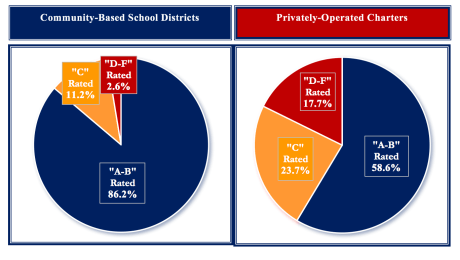
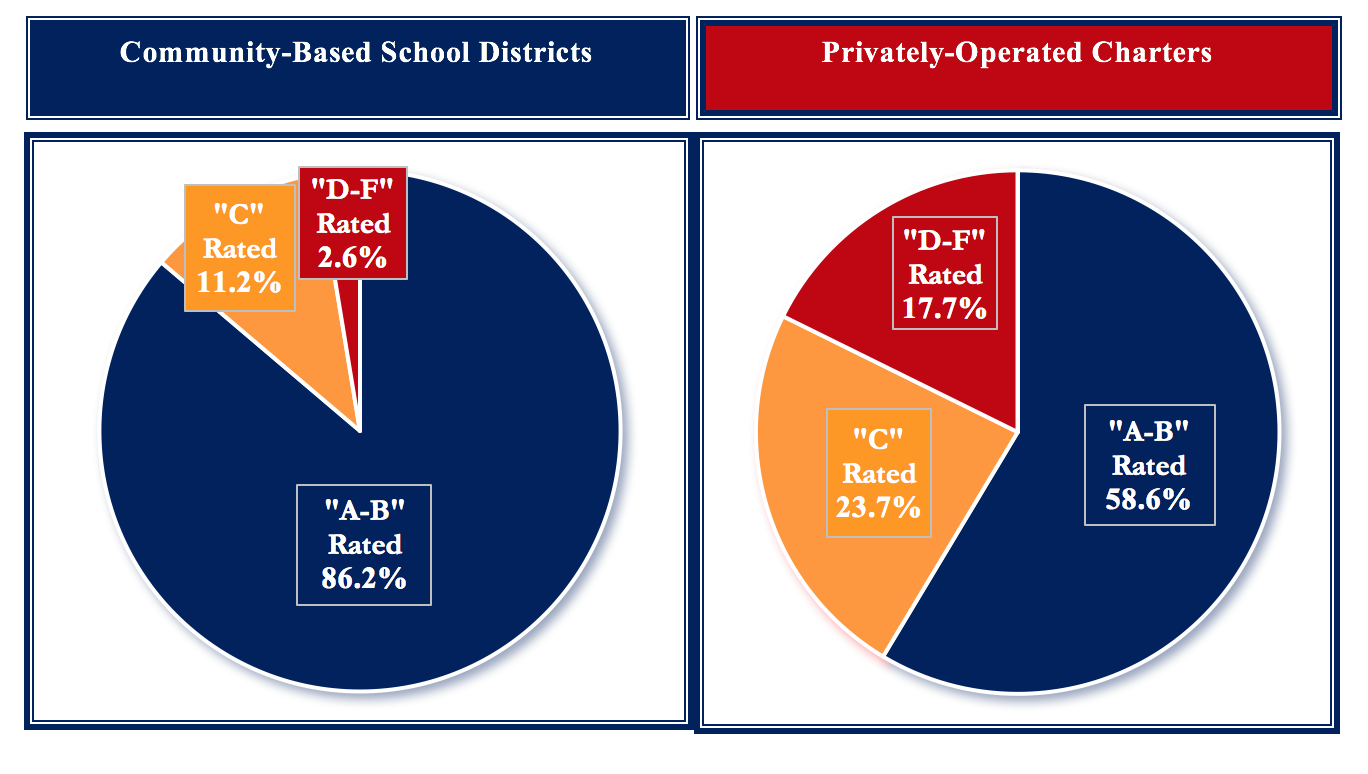
Rating Summary: According to the State’s ratings, an impressive 86.2% of community-based school districts received an “A” or “B” rating and only 2.6% of community-based school districts were assigned a “D” or “F” rating. In other words, 97.4% of the 1,020 community-based school districts were awarded the “good housekeeping seal of approval” by the State.

In comparison, the percentage of charters receiving an “A” or “B” rating was significantly lower at 58.6%, which is 27.6 percentage points lower than the percentage of community-based school districts with “A” or “B” ratings. The differences do not stop there. The percentage of charters receiving a rating of “C” or below was 41.4%, while the percentage of community-based school districts rated “C” or below was only 13.8%. In addition, an alarming 17.7% of State approved charters received a “D” or “F” rating. In other words, almost 1 of every 5 charters was deemed “low performing” by the State.
 

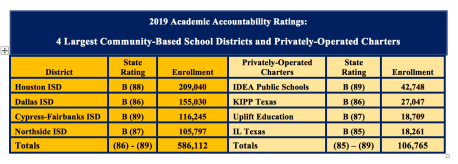
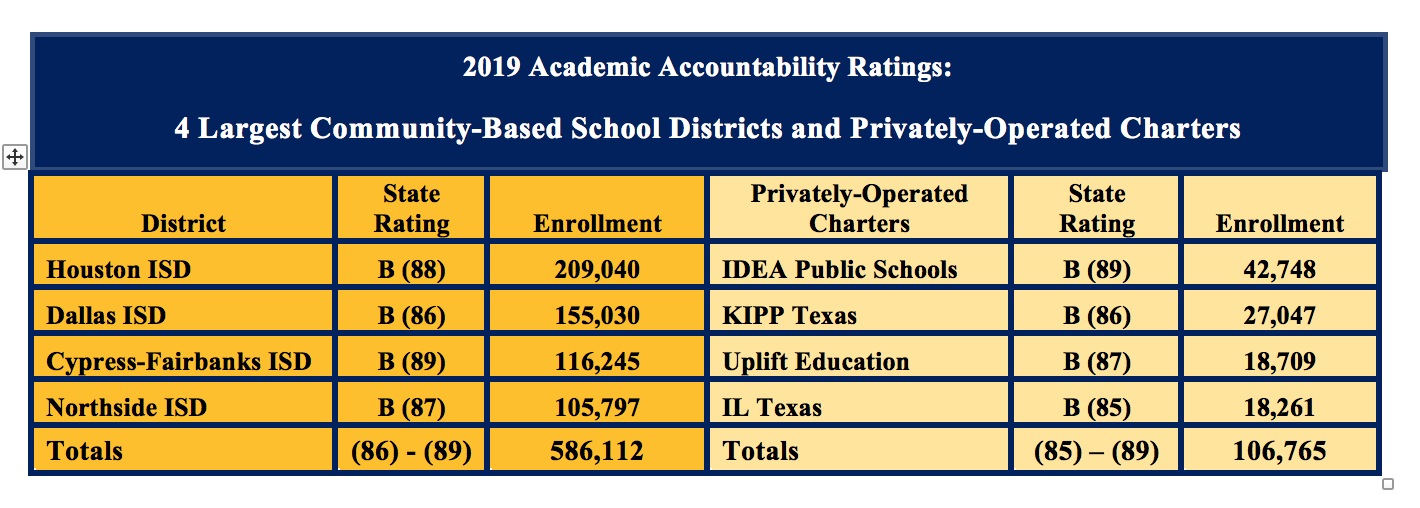
Largest Community-Based School Districts and Privately-Operated Charters – Rating Summary: The 4 largest community-based school districts in Texas serve the unique needs of 586,112 students and these school districts are not immune to scrutiny and criticism. Often, the criticism is from politically motivated State legislators, privately funded charter school advocacy organizations and charter school leaders that claim community-based school districts are failing students.

Despite these “self-serving” criticisms to promote the need for more charter schools, these claims are simply NOT true according to the State’s Academic Accountability Ratings. The reality is that although the largest community-based school districts enroll and serve the diverse needs of all students in their community, each received a high “B” rating (86-89) from the State. In comparison, despite the benefits of excluding enrollment to certain students and serving 479,347 fewer students, the 4 largest privately-operated charters that the State approved to improve student learning also received a “B” (85-89) rating.
 

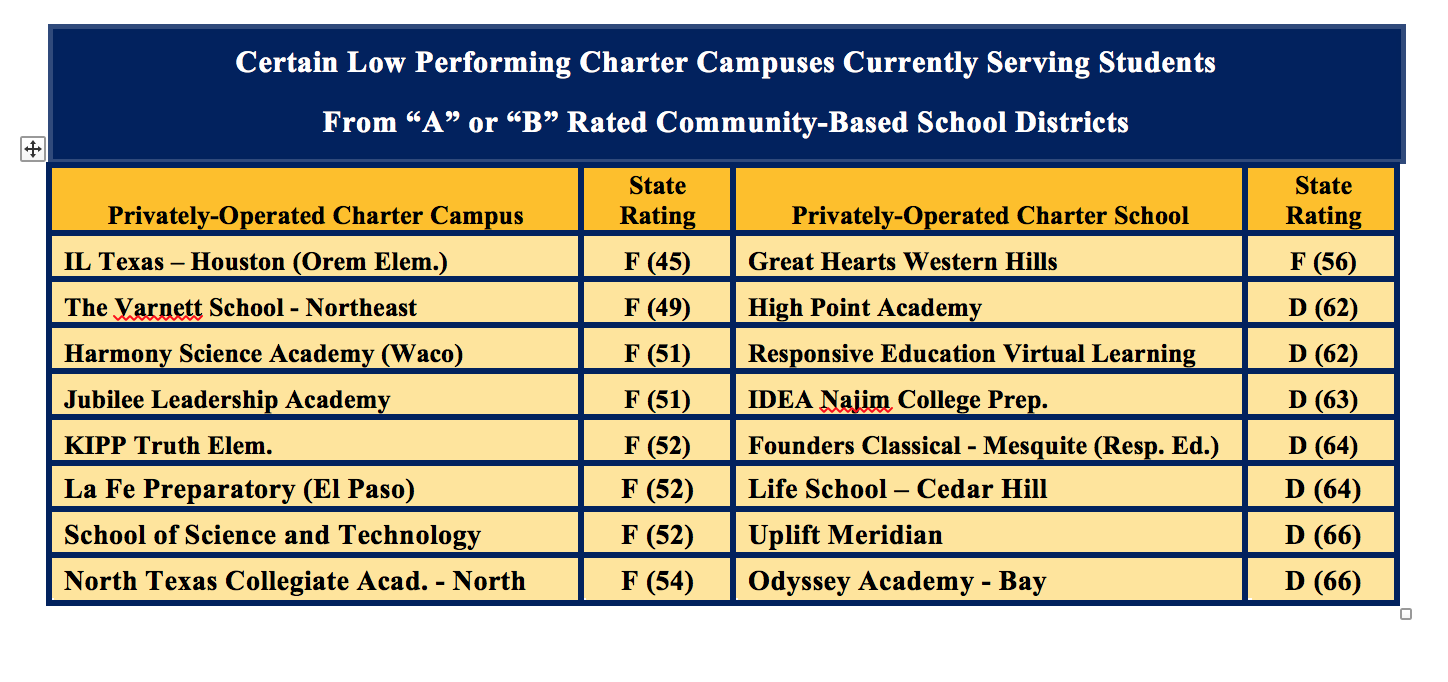
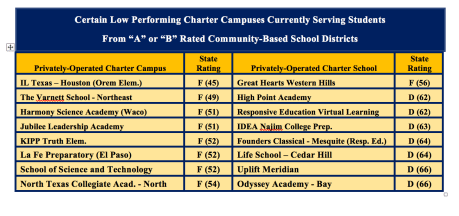
Low Performing Charter Campuses: The State has approved 288 separate charters to operate in local communities. To date, 110 of these charters have been surrendered or mandatorily closed and are no longer permitted to serve students. Despite these closures, many charters are still negatively impacting student outcomes. According to the State’s academic ratings. 17.3% of privately-operated charter campuses were rated “D” or “F” and many of these campuses serve students in higher performing community-based school districts. The table below summarizes a few of the “low performing” charter campuses that currently serve students from community-based school districts with “A” or “B” academic ratings.
 

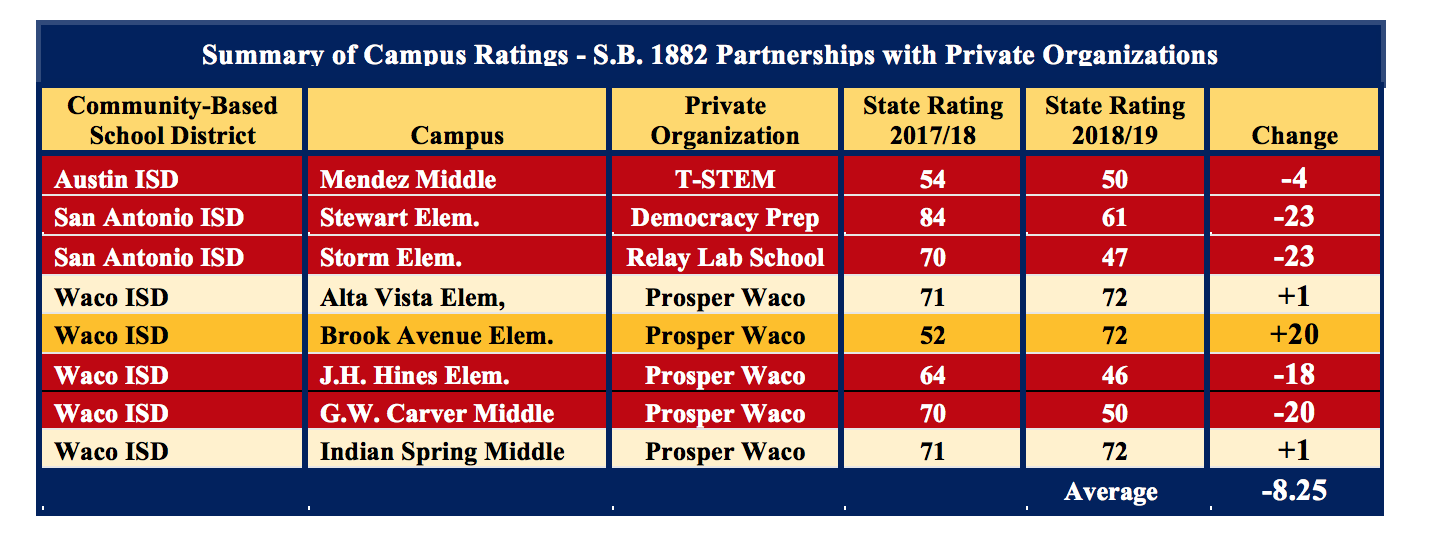
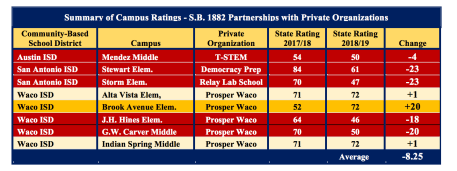
S.B. 1882 Partnerships – Results: In 2017, the Legislature approved S.B. 1882 that provides financial and accountability incentives for community-based school districts to partner with private organizations to operate existing schools. S.B. 1882 and TEA rules also require that any community-based school district campus with a “D” or “F” rating for 5 consecutive years must be turned over to a private charter/non-profit or closed. If neither of these occur, the community-based school district becomes subject to a State takeover.

S.B. 1882 is based upon the premise that “privatization” will improve the results of low performing campuses. However, the State’s premise is not based upon documented research or fact. For the 2018/19 school year, the 8 community-based school district campuses listed below were turned over to privately-operated charters/non-profits pursuant to S.B. 1882 partnerships. Unfortunately, most of these privately-operated campuses experienced a decline in student performance. In fact, the average academic ratings of these campuses declined by 8.25 points with private organizations at the helm. In addition, 4 of the campuses that had previously been rated “met standard” were relegated to an “Improvement Required” (“F”) rating under the control of private organizations.
 

Conclusion: While it can certainly be debated that the State’s Academic Accountability Rating System does not accurately reflect the effectiveness of a school, especially since it relies upon the performance of students on the standardized STAAR test and it ignores the many other positive educational attributes that schools provide to students every day. However, the system is the measuring stick that the State has chosen to evaluate student learning. It is also the accountability system that the State has chosen to govern the quality of public education deployed in local communities.

So:

♣ The purpose of privately-operated charters was to “improve student learning” by providing a State controlled, taxpayer funded alternative to community-based school districts; but

♣ The State’s Academic Accountability Rating System documents that:

⎫ Community-based school districts have significantly higher academic ratings than State approved charters;
⎫ Charters continue to operate a higher percentage of the “low performing” schools in local communities; and
⎫ The “privatization” of campuses pursuant to S.B. 1882 partnerships has primarily resulted in reduced student outcomes.

So why is the State continuing to support the operation and rapid expansion of privately-operated charter schools in community-based school districts? Why is the State offering financial incentives to “privatize” local schools? Could the answer be that politics and “special interests” are driving the State’s efforts to “privatize” schools in local communities?

The State created privately-operated charters to improve student learning in community-based school districts and it created the Academic Accountability Rating System which documents that State approved charters are producing lower student outcomes than community-based school districts. This creates quite a dilemma for the current policies of the State, but that is usually what happens when a “politically motivated” bad policy is exposed by another bad policy.

If it is truly about the “kids” and providing the highest quality education to students, it is time for parents, taxpayers and communities to hold the State accountable. It is time to return the control of public schools to taxpayers and democratically governed, community-based school districts that have proven to consistently produce better outcomes for students!

DISCLOSURES: The author is a voluntary advocate for public education and this material solely reflects the opinions of the author. The author has not been compensated in any manner for the preparation of this material. The material is based upon information provided by the Texas Education Agency, TXSchools.gov and other publicly available information. While the author believes these sources to be reliable, the author has not independently verified the information. All readers are encouraged to complete their own review and make their own independent conclusions.
Jessica Bakeman and a team of investigative reporters at WLRN in Florida report here on the state’s takeover and privatization of Jefferson County, the state’s first all-charter district. It was forced on the district by the state against the wishes of local elected officials and funded by state legislators with close financial ties to the charter school company (and its for-profit parent) that took over the district. It’s also setting the stage for a massive expansion of charter schools in the state.

http://chartered.wlrn.org/

The Republicans who run state government in Florida have abandoned local control. They worship the Almighty Dollar.

Bakeman writes:

Florida’s first and only all-charter school district was engineered by unelected state bureaucrats at then-Gov. Rick Scott’s Department of Education, funded by the Legislature and carried out by Somerset Academy, Inc., a rapidly expanding network that’s affiliated with a politically connected for-profit company in Miami.

Two years into Jefferson County’s transformation, the still-unproven charter-district “experiment” is being used to justify a potentially massive expansion of charter schools in the state’s poorest communities. A state law dubbed “schools of hope,” first passed in 2017 and broadened this year, offers millions of dollars to charter schools that open near traditional public schools that have struggled for years.

Jefferson County is home to the first charter “schools of hope.” Neighborhoods in Miami, Tampa and Jacksonville are next…

South Florida legislators with close financial ties to Somerset and its for-profit contractor, Academica, played a key role in facilitating and bankrolling the all-charter district, which critics argue is a conflict of interest.

Nina Turner of the Bernie Sanders campaign speaks out against charter school expansion.

Watch this.

Every Democratic Presidential Candidate should follow Bernie’s lead. He has the pulse of the people on this issue.

The headquarters of the Walton/Walmart billionaires is in Bentonville, Arkansas, so it is not surprising that the Walton Family Foundation and the members of the family (net worth: $100 billion) have decided to privatize the public schools of Arkansas.

Arkansas is a poor state. It doesn’t have an abundance of private schools that are as good as its underfunded public schools but the Waltons want every child to have a voucher or a charter school to attend.

Legislators are easy to buy in a poor state. The Waltons own quite a few.

The Arkansas Education Association did the research and described the empire that the Waltons have constructed in service to their goal of owning and privatizing the public schools of Arkansas. In the Walton plan, there will be no “public schools,” only privately managed charter schools and vouchers for religious schools.

The AEA report lays out the Walton Empire of Privatization in detail, with their bought and paid for think tanks and academics.

Although this report includes a lot of names, it is just one slice of the nationwide effort to plunder our public schools. These organizations have a vast infrastructure and deep pockets that can seem daunting, but our students are counting on us to stand up and speak out.

While they may have more cash, we have the power of numbers and common sense. Arkansas’s taxpayers and students would be better served by investing our scarce resources to improve our neighborhood public schools and helping all of the students who attend them.

Our public schools are the anchor of our communities, and the best way to expand opportunity for all. This idea does not require twisted statistics, or market tested language to trick people into supporting it. It’s as old as the country itself.

Do you think any member of the Walton Family ever feels ashamed of the damage they are wreaking on our democracy?

What about their minions? Have they no shame?

Betsy DeVos was sad to see that Alabama had only four charter schools. So she awarded $25 million to an organization tasked with generating more private charters to drain money away from the state’s underfunded public schools.

The state charter commission has been mired in controversy since giving its approval to a Gulen charter school in a rural district where it was not wanted.

The rationale for charters is that they have more flexibility than public schools, but if flexibility from state regulations is needed, why doesn’t the state grant flexibility to its real public schools? Why doesn’t it abolish burdensome regulations and mandates for community public schools?

Next time you hear a pundit say that DeVos doesn’t have the power to do damage, think of her unilateral control of $440 million in the federal Charter Schools Program, which has become her personal slush fund.

Davis Guggenheim, director of the ill-fated agitprop anti-public school, anti-union film “Waiting for ‘Superman,'” has directed a paean to the genius of billionaire Bill Gates called “Inside Bill Gates’ Brain,” a frightening thought when you think about it. The last place I would want to be trapped is inside the brain of a guy who thinks he is as smart as he is rich. Yech!

Steven Singer didn’t like the experience either. He reviews the premise of the show, which will appear on Netflix, the personal cable network of billionaire Reed Hastings.

Singer writes:

Once upon a time, the world was run by rich men.

And all was good.

But then the world was conquered by other rich men.

And that is something the first group of rich men could not allow.

That is the reason behind Netflix’s new film “Inside Bill’s Brain: Decoding Bill Gates.”

The three-part documentary goes live on Sept. 20. But the film’s aims are clear from the trailer.

It’s a vanity project about Bill Gates, the second richest man in the world.

By examining his mind and motivations, director and executive producer Davis Guggenheim will show us how Gates deserves his billionaire status and that we should allow him to use his philanthrocapitalist ventures to rule the world.

After all, shouldn’t the best and richest among us make all the decisions?

It’s a cry for oligarchy in an age of idiocracy, a love letter to neoliberalism in a time of neofascism.

The pity is that Donald Trump and the “Make America Great Again” crowd have goose stepped all over their new world order.

But instead of showing the world why we need to return to democratic principles, strengthen the common good and empower the people to govern themselves, some would rather continue the same plutocracy just with a different set of plutocrats at the wheel.

Bill Gates has the extraordinary brain that has concocted one harebrained scheme after another in his quest to reinvent American education. He may have been impaired by the simple fact that he knew nothing at all about American education, having never been a student, a teacher, or anything else in an American public school. But being very very very rich means you don’t have to know much in order to proclaim yourself ready to redesign American education. It has been a playground for billionaires for at least the past 20 years, though none with as much hubris as Bill Gates.

Michael Kohlhaas has been drip-drip-dripping emails between and among the charter industry’s bigwigs in Los Angeles.

He reveals in this post that he filed a public records request for the emails and his request was granted by the in-house counsel for Green Dot charter chain, Keith Yanov. Lo and behold, Mr. Yanov has “transitioned” to the private sector, meaning that he either quit or was fired.

Kohlhaas writes:

KEITH YANOV — FORMERLY GENERAL COUNSEL FOR GREEN DOT CHARTER SCHOOLS — HAS “TRANSITIONED TO PRIVATE PRACTICE” — WHICH MEANS HE QUIT OR WAS FIRED — AND GIVEN THAT IT WAS ALMOST CERTAINLY HIS DECISION TO FOLLOW THE LAW AND RELEASE THAT MASSIVE SET OF EMAILS TO ME IN JUNE — REVEALING THE APPALLING INNER WORKINGS OF THE CALIFORNIA CHARTER SCHOOL ASSOCIATION — THE WORLD-SHAKING MAGNITUDE OF WHICH IS STILL ONLY BARELY KNOWN — I WOULD VENTURE A GUESS THAT THE LATTER IS NOT IMPOSSIBLE — FIRING SOMEONE FOR FOLLOWING THE LAW CERTAINLY WOULDN’T BE OUT OF CHARACTER OVER THERE AT GREEN DOT — OR ANY OF THESE CHARTER SCHOOL CRIMINAL CONSPIRACIES FOR THAT MATTER

Kohlhaas began publishing the bombshell contents of the emails, Howard Blume of the Los Angeles Times wrote about Kohlhaas’s revelations, and all hell broke loose.

Kohlhaas wrote:

And then things really blew up, as you may already know. Howard Blume of the Los Angeles Times published two separate articles based on this material, the first one and the second one. The material revealed that Austin Beutner was letting the CCSA write his speeches for him and Nick Melvoin was letting them write actual board resolutions and also slipping them confidential info from LAUSD’s general counsel at the very same time that CCSA was suing LAUSD.

These documents recently showed that CCSA’s ultimate goal is to have every kid in California essentially in a charter school by 2030. And, friend, the revelations are not done even now, just wait and see. And the silence from CCSA has been amazing. The day I put out the news about CCSA writing Beutner’s speech charter school PR flack Cassy Horton dismissively tweeted (and since deleted) that this was all perfectly normal.

Yanov left for the private sector. And it is now a matter of public record that the California Charter Schools Association gives orders to Austin Beutner and Nick Melvoin.

Is this legal?

This expose is not finished. Kohlhaas has more.

Mike Klonsky, veteran activist in Chicago, reports that Governor J.B. Pritzker signed a bill abolishing the state Charter School Commission.

As Mike says, “We count our victories one by one,” and this is a big one. It spells the end to the reckless charter expansion encouraged by Republican Governor Bruce Rauner and Democratic Mayor of Chicago Rahm Emanuel, concentrated in Chicago. Rauner and Rahm believed in the magic of privatization.

No doubt about it, the glow is off the charter school hoax. The bloom is off the rose, or as we said in years past in New York City, the bloom is off the berg.

Since 2011, when the Commission was established and signed into law by former Gov. Pat Quinn (yes a Democrat), I’ve worked with several struggling school districts around the state when they’ve had to go before the Commission to plead their case. Together we built a research base which was used to debunk the false claims of the charter operators in an effort to stop invasions by powerful, charter school networks. In some cases we were successful and others we weren’t.

I found the decisions by commission members to be be completely arbitrary and biased. Keep in mind that the commission was originally the dream of the American Legislative Exchange Council (ALEC) and that the money for the commission’s original staffing and other expenses came from the pro-charter Walton Foundation. The Commission has been riddled with conflicts of interest from the start.

Commission members have been generally charter-friendly political appointees chosen by the governor and approved by the Illinois State Board of Education (ISBE). In the eight years prior to Pritzker’s election, commission members were handpicked by Rauner, a right-wing governor hellbent on starving and ultimately taking over local school systems, including CPS, using charters and school vouchers as weapons.

But Rauner wasn’t the only problem. You might remember when the Commission, acting under pressure from House Speaker Mike Madigan, reversed CPS’s rejection of Concept (Gulen) charter schools’ application at a time when the FBI was investigating Concept’s operations. Records show that the Commission’s Springfield lobbyist, Liz Brown-Reeves, a former Madigan aide, accompanied him on his Gulen sponsored trip to Turkey in 2012….

Currently, there are 140 charter schools in Illinois, 126 of which operate within Chicago Public Schools diverting money, students and teachers away from regular CPS schools. So far there is no evidence that these charters outperform the CPS schools they are trying to replace. In the CPS budget for next year, the district expects to receive $4 million less funding than expected from the state this past school year because “diversions to schools approved by the Illinois State Charter School Commission (SCSC) were higher than expected.”

The power to overrule the decisions of local districts now goes to the state board, which is appointed by the governor.