Archives for category: California

Bruce Baker of Rutgers University reviewed three policy briefs produced by the pro-charter, pro-choice Center for Reinventing Public Education at the University of Washington and found them to be “generally superficial and misleading.” The apparent intent of these briefs was to influence the policy debate in California, in which Governor Newsom and the Legislature are considering whether to take into account the fiscal impact of charters on public schools. Baker’s review was sponsored by the National Education Policy Center at the University of Colorado.


Reviewed by:

Bruce D. Baker University of Colorado Boulder

May 2019

Executive Summary

The Center on Reinventing Public Education (CRPE), based at the University of Washington, Bothell, recently released a series of three policy briefs on the financial impact of charter schools on nearby school districts in California. The briefs arrive at a time when a Task Force convened by California Gov. Gavin Newsom is deliberating on these exact matters. CRPE’s founder, Paul Hill, was a key source of testimony to the task force, serving as an expert viewed as “sympathetic to charter schools.”

The three briefs make note of the task force in their introduction and are seemingly intended to inform these ongoing debates over charter school financing and expansion in the state of California. The briefs are as follows.

  • The first brief, Charter Schools and District Enrollment Loss, posits that charter school enrollment growth is not a significant factor in large district enrollment decline in California.
  • The second brief, Do Charter Schools Cause Fiscal Distress in School Districts?, argues that charter school expansion is not a significant contributor to fiscal distress (fiscal stress and/or fiscal impact) in California school districts.
  • The final brief, Do the Costs of California Charter Schools Outweigh the Benefits?, contends that there are “tangible benefits” and “few quantifiable costs” to charter schooling in California, though it does concede that a more thorough cost-benefit analysis is warranted.


The first brief acknowledges that over the long run, California charter school expansion has resulted in some district enrollment decline. But the brief contends that this decline has been modest and in recent years is no longer occurring. Further, the report asserts that whether charter schools expand or not, many districts will face continuing enrollment decline and “the financial challenges it brings” (p. 10).

The second brief lays out a set of figures showing charter school enrollment shares and comparing this to county-assigned classifications of district fiscal distress. It concludes boldly that (a) there is no relationship between charter enrollment share and host district fiscal distress; (b) instead, fiscal distress is most often caused by financial mismanagement; and (c) fiscal distress is too important to get wrong.

The third brief first asserts that there are benefits to, but few if any tangible costs associated with, charter schooling in California. Those benefits are illustrated by reports of differences in test score gains for children in some urban California charter schools versus matched peers in host districts. The brief also cites a handful of studies to support its contention that charter expansion also benefits, or at least does not harm, children in host district schools. Finally, it notes other potential benefits for children enrolled in charter schools, for which quantifiable values are more difficult to assign, including: “The option to choose” (p. 4).

On the potential-costs side of charter expansion, the third brief provides a short list, including, (a) lacking/losing economies of scale, (b) transfers/fiscal impact, (c) capital costs, (d) educating high-cost students, and (e) social cohesion and societal concerns. The authors then dismiss these five concerns, offering the conclusion that there are “few quantifiable costs to charter schooling” in California (p. 6). Yet they provide little analysis or reference to any valid, rigorous analysis by any other researchers.

Robin Lake, Ashley Jochim, Paul Hill, and Sivan Tuchman wrote these briefs and qualify their work with identical wording: “Given the time constraints for informing the commis- sion’s and legislator’s questions, we were limited to data available from earlier studies and from federal, state, and local databases, as cited in the three briefs” (p. 2 of each brief).

These limitations did impair the usefulness of the briefs, but other problems are also evi- dent. The first brief is misleading in its assertion that charter enrollment growth is not to blame for district enrollment decline. It is, and has been for some time, whether in districts with declining, stable or growing overall student enrollments. The brief also attempts to minimize the import of the considerable role played by charters in districts’ enrollment loss, offering up the non sequitur that enrollment loss can arise from other sources as well. The second brief relies on overly simplistic comparisons of charter enrollments and county-assigned “fiscal distress” classifications to conclude that there is no association between charter enrollments and fiscal distress. The contention here is that there can’t be an illness if the patient isn’t dead. In order to rely on this problematic approach, the brief erroneously dismisses a significant, more rigorous, detailed, peer-reviewed and published body of research that illustrates the fiscal impact of charter schools on host districts, and how those fiscal impacts may lead to fiscal stress. The third brief, which presents itself as an analysis of costs and benefits, merely touts the benefits of charter schooling as tangible while being entirely dismissive of numerous known and often measurable costs. Taken together, the briefs are useful only in pointing to some important issues that policymakers should consider; their analyses of those issues are, however, generally superficial and misleading.
 

The California Legislature failed to take action on bills to impose a moratorium on new charter schools, and charter lobbyists were exultant.

Despite the ongoing scandals in the charter industry, the Legislature was unable to act.

Only this week, eleven charter leaders were indicted for misappropriating millions of dollars that ended up in their personal bank accounts.

Only last week, the founder of a charter chain was sentenced to thirty months in prison for theft of millions of dollars.

The California Charter School Association, funded by billionaires such as Reed Hastings and Eli Broad, want predators to go unsupervised and unregulated. They want no limits on charter growth, public schools be damned.

If it is not there already, I place the CCSA on this blog’s Wall of Shame.

Let’s see what happens to AB 1505, which enables districts to have some say over whether charters can open in their space, which would curb the rapacious appetite of sleazy operators who are able to get a charter in Rural District Z and open the school in an urban district that doesn’t want them.

Ten percent of the students in California are enrolled in privately managed charter schools; 90% are enrolled in public schools. Why undermine and deprive the 90% for the (possible) benefit of the 10%? Only one group benefits from the legislators’ inaction: the charter industry. This is insane. And corrupt.

Erika Jones is an experienced teacher in California. In this post, she responds forcefully to the claim by charter advocates that privately managed charter schools “save” children of color.

They don’t.

I urge all charter advocacy groups and individuals to read her eloquent article and consider her words carefully.

She begins:

As a public-school educator who is African-American, I am keenly aware of what it means to be a student of color within the public school system and the role institutional racism has played.

We have faced decades of funding and resource inequities, which have left our current public schools in marginalized communities unable to fully serve their students. Historically, acknowledging these inequities can lead to strategies to combat institutional racism in our schools and across the country.

The last 20 years of exploding charter school growth in communities of color also make it clear that many proposed solutions can have serious negative consequences for the overwhelming majority of public school students. The time is now for our elected leaders in Sacramento to pass laws to support students by curtailing the worst parts of this broken, decades-long experiment.

Often within the conversation of supporting communities of color, school choice and specifically charter schools frequently are presented as the answer. When looking at institutional racism within public education, instead of being the panacea for children of color, more often than not the charter school industry actually leads to worsening conditions for a majority of students of color. This is because many school districts in California, whose students are overwhelmingly students of color, are in crisis mode: seeing upwards of a 200 percent growth in charter schools, lacking facilities and averaging hundreds of millions of dollars in fiscal impact directly attributed to this growth.

Yet the achievement gap for students of color has continued to widen. We see a select group of children of color leaving the traditional public school setting to attend charter schools, while the majority of children of color remain in the traditional setting.

I taught both 3rd grade and kindergarten in South Los Angeles at Angeles Mesa Elementary and during the years I was there multiple new charter schools popped up surrounding my school. I saw firsthand how our families of color were lured away by the promise of free tablets for their kids, nicer uniforms and so-called college readiness. I hugged parents as they brought their children back to my school, feeling devastated that their child had been kicked out of one of the charters or their children found themselves in schools with higher class sizes and less student support. Some of my families had even been misled to believe that the new charter school was their new home school.

The original intent of charter schools was to be educator-driven incubators of change where innovations that lead to student success could be shared with all schools within the public school system. Here we are 20 years later and instead of sharing methods, many traditional public schools in communities of color find themselves competing for resources, having disproportionate numbers of students with high needs and having larger populations of English learners. All this while for the most part charters are performing about the same as traditional public schools.

Erika Jones answers all the questions with facts and evidence. Please read the rest of her article.

Thousands of public school teachers in Los Angeles went on strike in February, demanding basic services for their students: smaller class sizes (many classes have more than 40 students), classes in the arts and music, a librarian and nurse and other support staff in every school. The strike won broad public support. The teachers won an agreement from the school board.

Now comes the hard part: Paying for the agreement.

On Tuesday June 4, voters in Los Angeles will go to the polls and vote on Measure EE.

It is a parcel tax that would raise $500 million additional dollars every year for the public schools for the next twelve years.

Please show up and vote for Measure EE.

The money is desperately needed to provide the students of Los Angeles the schools they need and deserve. Why should they attend schools that are deteriorating, where the library is open only on occasion or not at all, where a nurse is available once a week, a guidance counselor has hundreds of students, and a school psychologist is available never?

Please show up and vote for Measure EE.

California is one of the richest states in the nation, with a roaring and dynamic economy.

But California spends less on education than most other states. Shockingly, it is on par with Kansas, Louisiana, and South Carolina.

Los Angeles spends far less than other big cities on its students.

Los Angeles Times columnist Steve Lopez met with Superintendent Austin Beutner and UTLA President Alex Caputo-Pearl at an elementary school in the school library, which is closed two or three days a week.

He wrote:

“The two most powerful people in Los Angeles public education are like a tag team now, practically completing each other’s sentences.”

California, he wrote, “ranks at the top in wealth and near the bottom in funding per pupil.”

What would EE cost the taxpayer? The owner of a 1,500 square foot home would  pay an additional $240, twice as much for a house twice as large. About 82% of the revenue would come from commercial, industrial and apartment building owners, while senior homeowners (over 65) and disabled homeowners are exempted from the tax.

Who is fighting EE? The Los Angeles Chamber of Commerce, which opposes taxes and apparently opts for an undereducated workforce; the Howard Jarvis Taxpayers Association is also opposed, that being the organization responsible for Proposition 13, which undermined school funding in 1978 by setting strict limits on property taxes. The Chamber prefers a regressive flat tax, one that is the same for the owner of a small house and the owner of a skyscraper.

Beutner and Caputo-Pearl pointed to business leaders who understand that the future success of Los Angeles depends on the success today of the students in the city’s public schools and who support EE.

Measure EE includes strict accountability requirements, meaning an independent financial audit to assure that every dollar goes to the schools for the intended purposes of reducing class size and providing needed services, such as nurses, counselors, and librarians.

Measure EE needs a two-thirds majority to pass, and that’s a high bar, but other cities in California have met it. Beutner listed them: Oakland, San Francisco, Santa Monica, and Torrance.

The people of Los Angeles cheered the teachers when they struck and marched in the rain. They honked their horns and gave them thumbs-up because they were doing what was best for their students.

Now comes the voters’ turn.

Will they too stand up for the children who are the future of Los Angeles?

Will they agree that every school should have a working library, a school nurse, a psychologist, and reasonable class sizes?

Will they agree that all children deserve equality of educational opportunity?

Tuesday June 4 will be a decisive day for the children of Los Angeles.

They are OUR children.

If you live in Los Angeles, please vote and urge your friends, family, and neighbors to vote.

Vote as if your future depends upon it.

It does.


The California Legislature is considering four bills to reform the state’s massive charter school industry (1,300 schools, mostly unregulated and unsupervised). One of the bills would prohibit school districts from authorizing charters in other districts. The following story is a classic example of rural school districts authorizing online charters in San Diego and Los Angeles, solely to get the commission attached to each student. In this case, the online charters were cash cows for their owners. [A personal aside: Last February, I was in Newport Beach, California, having breakfast at a hotel. The man at the next table was loudly discussing his schools with someone who was selling athletic services, $5 a student. When he got up to leave, I asked him if he was “in the charter school business.” He said, “Yes,” and said he owned 40 schools under six different corporate names. I asked him his name. He said, “Sean McManus.” I should have asked him to join us. He is one of the key figures in the following article.]

The San Diego Union-Tribune reports that eleven people connected to online charter schools have been indicted for “criminal charges of conspiracy, personal use of public money without legal authority, grand theft and financial conflict of interest.“

The online charters operate in San Diego and Los Angeles, but were authorized by other districts that get a slice of the revenues. This is one of the corrupt practices that have been rampant in California, where lax state law allows sharp operators to get public money and cheat students with no consequences. The Legislature is currently debating a proposal to stop allowing District A to authorize a charter in District B, a practice that is mercenary and predatory. Until now, the powerful California Charter Schools Association—enriched by billionaires like Reed Hastings and Eli Broad—has fought all accountability for charter schools.

At the center of the allegations are leaders of the charter school management corporation A3 Education, a Newport Beach corporation whose leaders control 13 charter schools across California, according to an indictment filed May 17.

A3’s chairman, Sean McManus, and president, Jason Schrock, essentially owned and operated the charter schools throughout California at the same time that A3 contracted with those schools, according to the indictment.

McManus and Schrock operated multiple businesses that charged their own charter schools millions of dollars for services. Then they channeled money from those businesses into their own charitable trust and personal bank accounts, according to the indictment.

A3 Education and the businesses affiliated with McManus and Schrock together have invoiced at least $83.3 million from the 13 charter schools, according to the indictment.

From the affiliated businesses, at least $8.18 million went into personal bank accounts, some in Australia, and into charitable trust accounts for McManus, Schrock and their wives, and $500,000 went to a family member of McManus, according to the indictment.

McManus and Schrock also used $1.6 million of A3 Education’s funds to buy a private residence for McManus in San Juan Capistrano, the indictment states.

Also according to the indictment, six people, including McManus and Schrock, conspired to collect state money for students who were listed as being enrolled in Valiant Charter Schools but were not receiving services.

The two Valiant schools will close permanently on June 30. Several thousand students will need to find new schools. The San Diego online charter was authorized by the Dehesa School District, and the one in Los Angeles was authorized by the Acton-Agua Dulce Unified School District.

The children were not assigned to teachers who have state-required professional certificates, the indictment said. The students were not in contact with the schools or provided with educational services during the summer months, as some of the co-conspirators claimed, according to the indictment…

Also indicted is Nancy Hauer, who is superintendent of Dehesa School District, which authorized several charter schools, including Valiant Academy of Southern California. The Dehesa district office did not immediately provide a comment Tuesday.

Also among the indicted is Steve Van Zant, a former Mountain Empire Unified superintendent who three years ago pleaded guilty to violating conflict-of-interest laws, after he brokered deals with charter schools to operate in other school districts, prosecutors said at the time.

Valiant Academy had 43 students two years ago, 726 last year, and 2,250 this year. It’s academic performance was so poor that even the California Charter School Association recommended that it be closed.

Betsy DeVos says that parents always know what’s best. Why were they enrolling their children in these failing “schools.”?


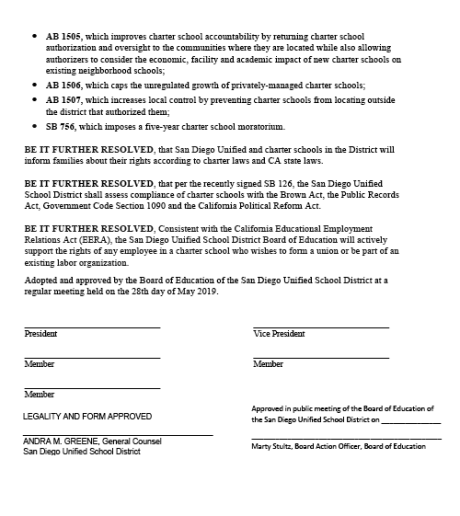
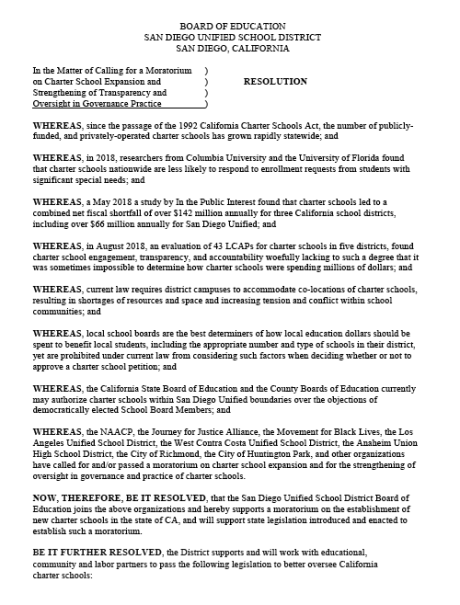
Last night, the elected Board of Education of the San Diego Unified School District passed a strong resolution endorsing four bills in the State Legislature that would impose discipline on the Wild West unregulated charter industry. The bills are described in the resolution. They would impose a moratorium on charter school expansion, revive local control, and increase oversight of charters. This resolution demonstrates that the board is willing to stand up to the rapacious charter industry.

Screen Shot 2019-05-28 at 5.40.05 PMScreen Shot 2019-05-28 at 5.40.16 PM

Julian Vasquez Heilig is a leading authority on the subjects of equity and social justice. His blog is one of the brightest spots on the Internet because of his scholarship and creative use of graphics. He has been a prominent member in the California chapter of the NAACP.

In this post, he refutes the claim that charter schools in California produce results better than public schools. Despite their advantages, their academic results are about the same as public schools. The hype for them comes from their well-funded propaganda and lobbying operation.

He writes:

Even with the limited (and selection biased?) sample of comparison neighborhood public schools, charter school students nearly perform statistically the same as neighborhood school students. The differences are in the hundredths of a standard deviation in Central California and Southern California and tenths of a standard deviation in Bay Area and South Bay. By comparison, other education policies such as class size reduction and high quality Pre-K show 400% more overall impact on student success than charter schools.[5]Considering the data, charter schools are not having the instant impact that proponents purport….

The education policy discourse in the Trump and Obama eras has been focused on empowering schools choice while remaining silent about the purposeful inequality in financial resources that plague low-income schools in the United States. The latest research has identified the inequality and shown the positive impacts of properly funding schools. The problem is that the wealthy have improperly influenced the equalization mechanisms in each state and have stacked the deck against low-income districts, schools and students. We must substantially change the political conservation about education policy away from school choice to resource inequality if we are to offer a quality education to every student in the United States.


Capitol & Main reports that the Healdsburg school district in Sonoma County in wine country was worried about white flight, so it opened a charter school and put it in the same building with the public school. That’s called co-location.

However, the two schools in the same building have very different demographics.

Taking advantage of California’s co-location rules regarding charters, 266 charter school students share the same campus with the public elementary school’s 323 kids. The two student bodies aren’t exactly similar, however. The public school is 89 percent Latino, while Latinos only account for 36 percent of the charter’s enrollment. The divide vividly extends to learning achievement…

Last year only 23 percent of the public elementary school’s students in grades three to five met or exceeded state math standards, while the figure was 55 percent for Healdsburg Charter kids in the same grades. A full 88.5 percent of the public school students were socioeconomically disadvantaged, compared to just 33.5 percent of the charter school students. And 70.6 percent of public school students were English-language learners, while only 13.7 percent of charter school students were ELLs.

One school mostly for white kids, another mostly for Latino kids. One for the middle-class and affluent, the other for the farmworkers’ children.

Last year, In the Public Interest, a nonpartisan advocacy group in California published Professor Gordon Lafer’s seminal study of the fiscal impact of charters on three school districts in California. Oakland alone lost $67 million in “stranded costs” because of the flooding of the district with charter schools. Stranded costs are the costs beyond the per-pupil tuition that leaves the district, like heating, cooling, transportation, and other fixed costs.

ITPI has released a new report that demonstrates the fiscal impact of charters in one other district. The report is timely, since the Legislature is currently considering four bills to regulate charters so that they stop damaging the public schools that enroll the most students.

Jeremy Mohler of In the Public Interest writes:


Been wondering what’s causing all the hoopla about charter schools? You’re not alone — it’s a complicated issue.

I’m going to explain one aspect of the issue, in as simple terms as possible, to try to convince you that charter schools are worth paying attention to.

This morning, we released a new report on the cost that charter schools create for just one school district, West Contra Costa Unified (WCCUSD) in California’s Bay Area.

What do I mean by “cost?” I mean that, because some students that would’ve otherwise attended WCCUSD’s traditional public schools instead attend charter schools in the area, the district has $27.9 million less in funding to work with each year. That comes out to $978 less for each traditional public school student the district serves.

Here’s why. When a student transfers to a charter school, public funding for their education follows — but costs remain. Because charter schools pull students from multiple schools and grade levels, it’s rare that individual traditional public schools can reduce expenses enough to make up for the lost revenue.

Say a district loses 14 percent of its students to charter schools in the area. Its schools can‘t adjust expenses by, for example, cutting 14 percent of their principal, heating bill, parking lot paving, internet service, or building maintenance. The district also can’t proportionately cut administrative tasks such as bus route planning, teacher training, grant writing, and budget development.

This forces districts to cut services provided to traditional public school students.

WCCUSD recently did just that. Faced with a budget deficit, its board approved $12.5 million in budget cuts in December 2018 eliminating 82 positions, closing an academic tutoring program, and cutting services for English learners.

We found the same dynamic last year when we studied districts in Oakland, San Diego, and San Jose.

Keep in mind, we’re making conservative estimates here. Our totals don’t even include the often inequitable proportion of state funding districts receive for educating high-needs students.

Long story short: California’s traditional public school students are bearing the cost of the state allowing charter schools to grow in number at a rapid clip.

Of course, charter schools aren’t the only financial pressure that districts are facing. Regressive taxation, declining birth rates, and other forces are impacting districts from Los Angeles to Sacramento.

But, so far, the cost of charter schools has gone unmeasured and ignored in California educational planning. That can’t go on — students are paying the price.
Can anyone explain the rationale of public funding of two different school systems? Seventy years ago, we had public funding of two different systems in 17 states. That was called a dual school system, one for whites, one for blacks. What’s the rationale now for a dual system?


The Legislature in California is considering four bills to regulate the state’s unregulated, unaccountable charter industry.

Under current law, charters can locate wherever they want, without regard to the fiscal impact on the district they choose. They first apply to the local district; if they are turned down because the local district doesn’t want or need a charter, they can appeal to the county board of education. If they lose there, they can appeal to the state board, which Gov. Jerry Brown packed with pro-charter allies. Ten percent of students in the state attend charters, as do 20% in L.A., and even more in Oakland. Small rural districts may authorize charters that are located in districts hundreds of miles away, ensuring that the charters will never have supervision. The rural district collects a fee for every student who enroll in the far-away district.

The first law—AB 1505– passed the Assembly yesterday in a close vote. Its purpose is to give more control to districts to decide whether to allow charters to open and compete with district schools. It passed by a vote of 42-19. The bill required 41 votes to advance to the State Senate. Here is the text of the bill.

For nearly an hour, Assembly Bill 1505 stood just shy of a handful of the 41 votes required to advance to the Senate, in part because of concerns the bill went too far in limiting the ability of charter schools to appeal authorization denials from local school districts to county and state education boards.

Moderate Democrats in particular were reluctant to support the measure. When the bill finally passed 42-19, it was with an assurance from  Assemblyman Patrick O’Donnell, the bill’s author, that the bill would be amended to include a “fair” appeal process.

“We knew this was going to be a fight because this is a heavily political matter,” O’Donnell said following the floor vote. “Charter schools have a lot of resources that public schools don’t on the political front, and they employ them in the state Capitol, and we saw that today.”

AB 1505, 1506 and 1507 and Senate Bill 756, put forth as a charter regulation package, have pitted teachers unions and supporters of traditional public schools against advocates of charter schools, which are public but mostly non-union. The two education interests are among Sacramento’s most powerful, and until this past election, when union candidates triumphed in races for governor and statewide schools chief, they have largely fought to a draw.

If passed, the package of proposals would make the most significant changes in a generation to the state’s 27-year-old charter school laws. They would give local school boards more power over authorizations, enact a statewide cap on charters, prohibit districts from authorizing charters outside their geographic boundaries—and impose a two-year moratorium if the Legislature doesn’t make specific reforms by the end of this two-year session.

California has more charter schools than any other state—nearly 1,300. Their freedom from regulation or accountability has been zealously guarded by the powerful California Charter Schools Association, which sPends more than $20 million each year lobbying the Legislature.

Will California’s Legislature finally say “no” to Eli Broad, Reed Hastings, and other billionaire guardians of the charter industry?

Sure, the California Teachers Association lobbies for public schools but its resources don’t match those of the billionaires and its  funds come from the dues of teachers, not equities and corporate profits.