Archives for category: Billionaires

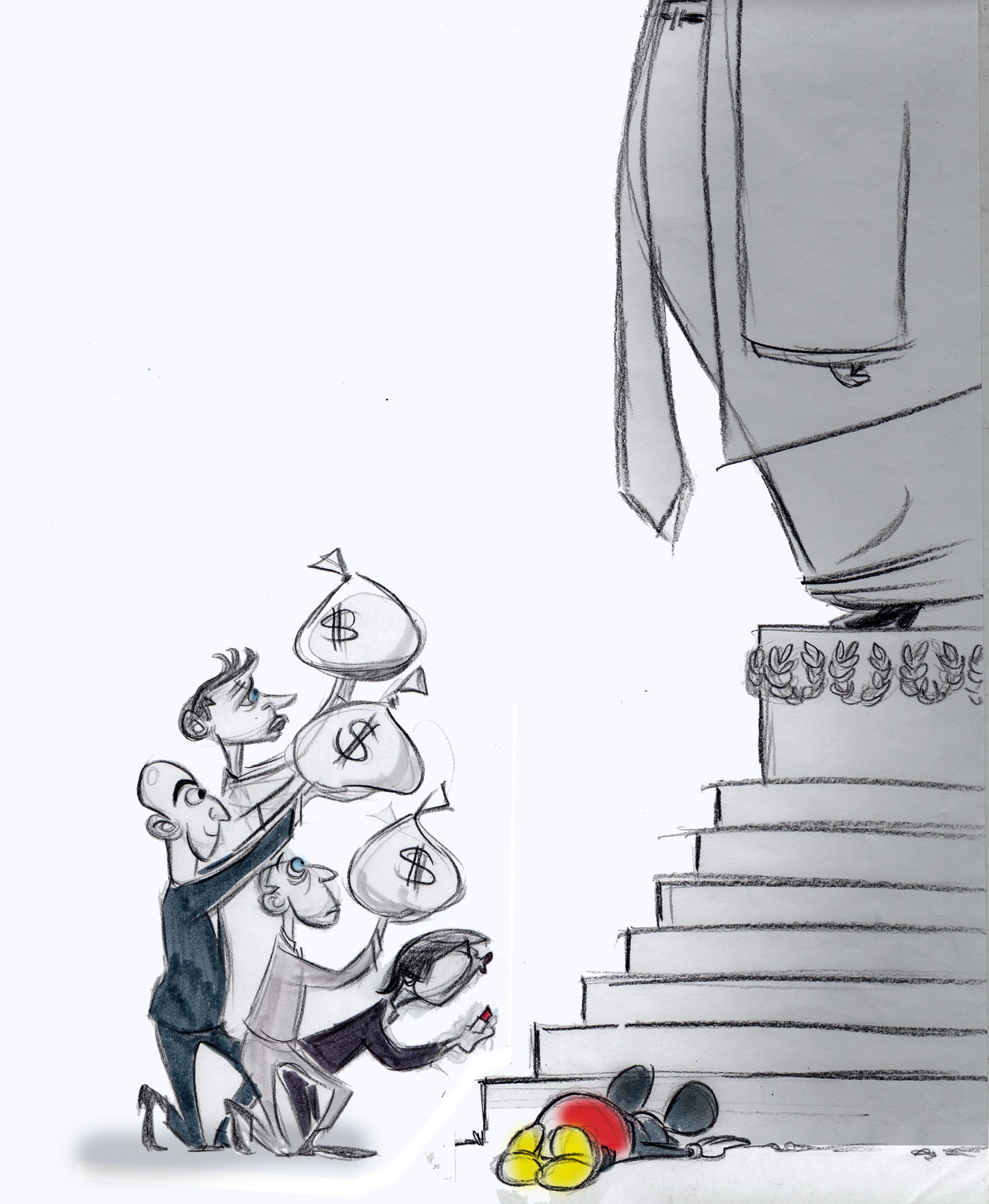
Ann Tolnaes is a brilliant cartoonist who resigned from The Washington Post when her latest cartoon was cancelled. It depicted the media and tech oligarchs bowing and scraping to Trump, including the owner of The Washington Post, Jeff Bezos.

The editor of the opinion section said he killed the cartoon because the paper had run a story on the same topic, and the cartoon was repetitious. I found that hard to believe because cartoons typically comment on stories in the news; they don’t break news.

He also said she had been invited to return. We will see what happens. The whole episode was widely publicized and is a stain on the newspaper’s reputation, especially since Jeff Bezos intervened and canceled the paper’s endorsement of Kamala Harris in the closing days of the campaign.

For another telling of this important story, read the article by Mike Peterson in The Daily Cartoonist about the controversy and about Ann Tolnaes’s importance. He reprints several of her cartoons, explains how to order a book of her cartoons (bypassing Amazon), and suggests we show our support by subscribing to her Substack blog. I just subscribed.

Thanks to reader John Ogozalek for directing me to this insightful commentary.

Ann Telnaes, editorial cartoonist for the Washington Post since 2008, quit her job after one of her cartoons was censored by higher-ups. The cartoon at issue depicted tech and media billionaires paying obeisance and money to Donald Trump. The cartoon included portrayals of Mark Zuckerberg (META), Sam Altman (AI), Patrick Soon-Shiong (Los Angeles Times), and Jeff Bezos, owner of the Washington Post. And, of course, Disney, which settled with Trump for $15 million rather than defend George Stephanopoulos in court. Each has given Trump $1 million or more to underwrite his inauguration. If Telnaes had waited a day, she would have added Tim Cook, CEO of Apple, to her list of suck-ups and sycophants.

The motto of the Washington Post is: “Democracy dies in darkness.” Conservative (but anti-Trump) lawyer George Conway wrote on BlueSky:

I guess the new slogan for the Washington Post ought to be:

“Newspapers die in cowardice.”

Ann Telnaes’ resignation is an act of courage that should inspire all of us to stand by our principles.

Telnaes wrote about her decision to resign on her Substack blog:

I’ve worked for the Washington Post since 2008 as an editorial cartoonist. I have had editorial feedback and productive conversations—and some differences—about cartoons I have submitted for publication, but in all that time I’ve never had a cartoon killed because of who or what I chose to aim my pen at. Until now.

The cartoon that was killed criticizes the billionaire tech and media chief executives who have been doing their best to curry favor with incoming President-elect Trump. There have been multiple articles recently about these men with lucrative government contracts and an interest in eliminating regulations making their way to Mar-a-lago. The group in the cartoon included Mark Zuckerberg/Facebook & Meta founder and CEO, Sam Altman/AI CEO, Patrick Soon-Shiong/LA Times publisher, the Walt Disney Company/ABC News, and Jeff Bezos/Washington Post owner. 

While it isn’t uncommon for editorial page editors to object to visual metaphors within a cartoon if it strikes that editor as unclear or isn’t correctly conveying the message intended by the cartoonist, such editorial criticism was not the case regarding this cartoon. To be clear, there have been instances where sketches have been rejected or revisions requested, but never because of the point of view inherent in the cartoon’s commentary. That’s a game changer…and dangerous for a free press.

(rough of cartoon killed)

Over the years I have watched my overseas colleagues risk their livelihoods and sometimes even their lives to expose injustices and hold their countries’ leaders accountable. As a member of the Advisory board for the Geneva based Freedom Cartoonists Foundation and a former board member of Cartoonists Rights, I believe that editorial cartoonists are vital for civic debate and have an essential role in journalism. 

There will be people who say, “Hey, you work for a company and that company has the right to expect employees to adhere to what’s good for the company”. That’s true except we’re talking about news organizations that have public obligations and who are obliged to nurture a free press in a democracy. Owners of such press organizations are responsible for safeguarding that free press— and trying to get in the good graces of an autocrat-in-waiting will only result in undermining that free press.

As an editorial cartoonist, my job is to hold powerful people and institutions accountable. For the first time, my editor prevented me from doing that critical job. So I have decided to leave the Post. I doubt my decision will cause much of a stir and that it will be dismissed because I’m just a cartoonist. But I will not stop holding truth to power through my cartooning, because as they say, “Democracy dies in darkness”.

Thank you for reading this.

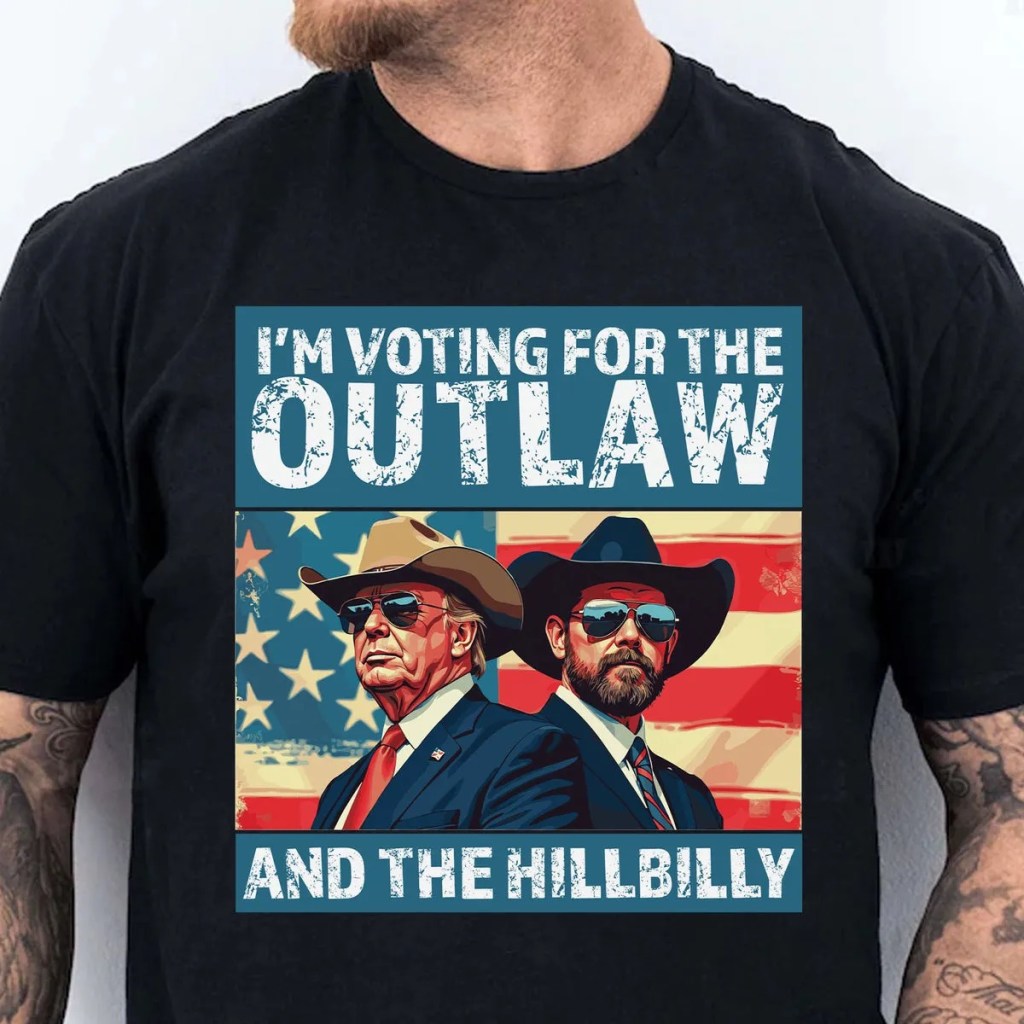
In the post at 9 a.m today, Joyce Vance included a photo of a T-shirt of Trump and Vance, billed as “the Outlaw and the Hillbilly.” Now, that’s clever marketing!

An Outlaw is often an admirable figure in westerns. He’s a folk hero. He’s the guy who goes up against the Establishment. He’s the Sundance Kid, he’s Robin Hood, he’s the handsome guy who gets the girl, he’s a lot of characters who live on the fringes of society and stand up for the little guy.

This is not Donald Trump. He is reverse Robin Hood. He steals from the poor and fattens the bank accounts of the rich. He doesn’t defend the helpless damsel, he sexually asssults her, then laughs about it and defames her. He does not stand outside society on its fringes, he owns the biggest, gaudiest mansion and installs solid gold toilet seats. Far from being handsome and buff, he is an obese old man with thinning hair and sagging jowls. He is a coward who dodged the draft five times yet pretends to be a tough guy.

As for J.D. Vance, he was once a hillbilly but that was long, long ago. Now he plays a hillbilly. He is a graduate of Yale Law School who made millions of dollars in the financial sector, where his patron was Peter Thiel, the woman-hating billionaire.

Not an Outlaw! Just a womanizing convicted felon who is a superb liar, braggart, and bully.

Not a Hillbilly! Just another far-cat who attached himself to super-rich patrons.

Trump passed one piece of legislation in his first term: a big tax cut for his billionaire buddies, corporations, and himself.

We know what his priorities are. Ego. Money. Power. Control.

He’s already forgotten about the people who voted for him. They can’t do anything for him any more. He won’t lower the price of food or gasoline or home insurance. He might take away their Social Security or Medicaid. He might cut programs they rely on.

He will take care of the people rich enough to belong to Mar-a-Lago.

While her ex-husband Jeff Bezos gave $5 million to help house the homeless in central Florida, McKenzie Scott gave $65 million to an organization in Maryland aiming to solve the affordable housing crisis. Four years ago, she gave the same organization $50 million.

Think of it: he helps with a small (by his standards) gift to house the homeless. Scott makes a gift more than 12 times larger to address the problem of homelessness.

Let’s be clear: in a better society, large social and economic problems would be addressed by government, not by philanthropists. But Republicans oppose any attempt to help people who are unable to help themselves. They block all efforts to expand the role of government. They cling to the belief that everyone should take care of themselves; those that can’t should turn to church, family, or local charities, they believe. In the age of Trump, the organizations that help others are likely to get less or no government support.

Scott divorced Bezos in 2019. Since then, she has given $19.2 billion to charitable groups. She is still worth more than $30 billion, based on the Amazon stock she received in her divorce. She’s determined to give away a substantial amount every year.

She represents the very best of philanthropy. No one applies for help. She has a team to research possible recipients. When she decides who are the lucky winners, they get a call from out of the blue telling them the size of their reward. The winners are free to use the money as they see fit.

Entrepreneur magazine reported:

Billionaire philanthropist MacKenzie Scott, 54, donated $65 million to Enterprise Community Partners last month, a national nonprofit based in Maryland that aims to address the U.S.’s shortage of affordable housing.

The surprise donation left the organization shocked, reps said in a statement.

“Some of us probably wanted to cry for joy,” Janine Lind, president of Enterprise’s community development division, told the Baltimore Banner. “This came at a moment where the affordable housing sector certainly is being put to test and is struggling.”

It’s Scott’s second gift to the 42-year-old organization—the first was $50 million in 2020. The organization noted in a press release that Scott’s gift is “one of the largest reported gifts to an affordable housing organization.”

Jeff Bezos’ foundation gave $5 million to expand homeless shelters in Florida. Bezos has assets of about $200 billion. There are many thoughts swirling in my head about this gift. Like, should Bezos have given more? To him, $5 million is pocket change. Should he have underwritten an expansion of affordable housing instead of expanding shelters? And more. Like, what are the consequences of online shopping replacing brick-and-mortar stores? Why is Jeff’s ex-wife McKenzie Scott so much more generous in her philanthropy than he is?

Amazon founder Jeff Bezos’ philanthropic fund has donated $5 million to the Coalition for the Homeless of Central Florida, which will use the money to expand its existing shelter and support its family outreach program.

This is the second time Bezos’ Day One Fund has supported the coalition. In 2021, the nonprofit received a $2.5 million grant.

“With the increase in individuals and families struggling with homelessness, specifically because of this affordable housing crisis, being able to utilize this grant to help those families who are unsheltered is huge for us,” said Trinette Nation, director of development for the coalition.

The Bezos Day One Fund is a $2 billion fund started in 2018 by the Amazon billionaire and his then wife, MacKenzie Scott, to support homeless families.

The Network for Public Education announces the winners of the non-prestigious “Coal in the Stocking” Award for 2024.

This is an award given to those who have done the most damage to our public schools.

They should feel ashamed and humiliated for gaining this recognition of their odious and undemocratic behavior.

They hurt children and communities. They hurt the future of our great nation.

Open the link to see the names of the winners.

Writing at Wonkette, Gary Legum describes what Elon Musk will get for the $250 million he invested in Trump’s campaign. He may seek waivers from regulations, he may seek contracts. Trump is very grateful. No one, to our knowledge, has ever given so much money to a Presidential campaign. What will he get in return?

Legum writes:

Compare and contrast if you will the two senators from the great state of Connecticut.

The first senator, Richard Blumenthal, spent time this week rallying support for his Kids Online Safety Act (KOSA) by verbally fellating sentient staph infection Elon Musk, calling him “the foremost champion of free speech in the tech industry.” This was a naked attempt to get Musk to try and influence the other tech bros infesting the incoming administration to support the bill even though any sort of regulation of the Internet goes against their core beliefs. Unless the regulations somehow bother liberals, in which case they get a thumbs-up.

Thus did Blumenthal violate yr Wonkette’s rule about lending any legitimacy to the right-wing billionaire who just spent a quarter of a billion dollars to buy the election for the other party and has been rewarded with the highest of high-level access to the incoming president. We don’t particularly care about the cause one is fellating in support of, although KOSA is a problematic bill that no one should want passed. But that’s a whole other post.

Now consider Connecticut’s other senator, Chris Murphy. Thursday night on MSNBC, Murphy told Alex Wagner in no uncertain terms that America is about to become the sort of oligarchy represented by Musk’s ascent to Trump’s inner circle that we used to be able to at least pretend was beneath us:

“What it means is a handful of really rich people run the government, and they steal from ordinary people using their access to government in order to make themselves and their families even richer.”

Whoa, that’s no way to get invited to the DOGE Christmas party, Senator.

Murphy’s description really applies to how our government has been for some decades, the difference being that now we have an incoming president and administration that are not bothering to pretend otherwise. But okay, we won’t split hairs with Murphy. We are where we are, so any tiny voices in opposition to the coming nightmare are appreciated.

Anyway, Murphy got us thinking that you really have to hand it to the sentient staph infection. Musk spent a quarter of a billion dollars buying himself a president who will roll over at the soft snap of the billionaire’s doughy fingers, and it has paid off again and again and again. And Sweet Potato Suharto’s coronation isn’t even for another five weeks.

A quarter of a billion dollars. Thanks a pantsload, Anthony Kennedy and the Supreme(ly Stupid) Court.

The latest atrocity to benefit Musk is a report on Friday that the incoming administration may drop the federal government’s car crash reporting rules. See, Tesla has a minor problem, in that it has had to report over 1,500 crashes to the National Highway Traffic Safety Administration, partly because the automated-driving systems that are supposed to set the cars apart from normie vehicles don’t work very well, turning them into fiery mobile deathtraps and causing untold misery and suffering to not just crash victims but their families as well.

Musk probably doesn’t believe this, but pain and suffering by humans is in fact bad. It’s true! Just ask us!

Please open the link to finish reading.

Maurice Cunningham, a retired professor of political science, reviewed the Boston Globe’s bad habit of treating billionaire-funded groups as authoritative on education issues.

He wrote recently, as posted on the blog of the Network for Public Education:

Maurice Cunningham finds that looking at the Boston Globe tells us too much about the folks who think education is just to prepare children to become useful tools for business. Reposted with permission. 

When I was a kid in the Sixties we’d occasionally hear stories about some poor Japanese soldier, abandoned on a Pacific island after WWII, finally being rescued while believing he was still fighting the war. That’s sort of where the Boston Globe’s post-MCAS coverage is. But as a lesson in the biased media approach to interest group coverage, it is a real education.

The latest is by reporter Mandy McLaren, With no more MCAS requirement, graduation standards vary widely among state’s largest districts. What interests me is the sources used in the story, which include a heavy presence of billionaire funded and tax deductible “non-profits” aka interest groups. That’s because non-profit, while it sounds eleemosynary ( I just wanted to use that word in a sentence) actually represents the policy preferences of the moneyed few; or as the media like to say the Massachusetts business community; or as I like to say: capital.

Let’s meet the Globe’s eleemosynary sources starting with “The risk moving forward, said Andrea Wolfe, president and CEO of MassInsight, a Boston-based education nonprofit.” Mass Insight’s donors include the Bill and Melinda Gates Foundation and the Boston Foundation (you will remember them from The Globe Puffs Up Another Dubious “Science of Reading” Program) and Fidelity Investments Charitable Gift Fund (also from Puffs Up).

Then there is “Erin Cooley, Massachusetts managing director for Democrats for Education Reform, a group that advocated against Question 2.” Don’t make me go through the Oligarch Party funding of Democrats for Education Reform again, but you can catch the gist at Democrats for Education Reform: Let’s Meet the Funders and How to Understand Democrats for Education Reform Using Two Quotes from Democrats for Education Reform.

Finally,

Erika Giampietro, executive director for the Massachusetts Alliance for Early College, said she hopes whatever path the state takes next focuses on the ‘competencies’ students graduate with, especially those that truly matter in the real world.”

“[Employers] are not saying, ‘I wish kids had taken two years of foreign language, four years of English and four years of math.’ They’re saying, ‘Yeah, kids aren’t coming with strong enough executive functioning and clear enough communication skills and showing up to work every day and realizing how important that is to be on time,‘” Giampietro said.

Funders include Gates, Boston Foundation, Fidelity Charitable Gift (also in Puffs Up).

Employers=business=capital. Ms. Giampietro offers the interest group frame: employers would like taxpayer paid employee training (while not increasing taxes). The focus is employers and not children. If you read enough of these stories, that comes through. Not that kids should be introduced to foreign cultures, discover a love of literature or art, or heaven forbid, question the prevailing structures of society. Such concerns are not the “the real world” issues of business.

The article did quote Max Page, president of Massachusetts Teachers Association. But when you also quote two superintendents who miss MCAS and three eleemosynary business group interests, well . . . does three from capital equal one from labor?

Money never sleeps. Follow the money.

“Imagine movie critics who either did not know, or did not care to know, that movies have producers, script writers, directors, financiers, or casting directors, and so based their reviews on the premise that it was the actors alone who created the storyline, dialogue and mise en scene, and that the most successful actors were those who best understood the audience. That is essentially how all politics is covered in 21st century America.”—Michael Podhorzer.

Network for Public Education

P.O. Box 227
New York, New York 10156
(646) 678-4477

Jan Resseger lives in Ohio. Before retiring, Jan staffed advocacy and programming to support public education justice in the national setting of the United Church of Christ—working to improve the public schools that serve 50 million of our children; reduce standardized testing; ensure attention to vast opportunity gaps; advocate for schools that welcome all children; and speak for the public role of public education.  Jan chaired the National Council of Churches Committee on Public Education for a dozen of those years.

Jan recently wrote this post for the National Center on Education Policy at the University of Colorado.

She writes:

I suppose many of us think about the classes we wish we had signed up for in college.  Right now, as somebody who believes public schools are among our nation’s most important and most threatened public institutions, I wish that in addition to enrolling in The Philosophy of Education, I had also taken a class in political philosophy—or at least Political Science 101. How have groups like the Heritage Foundation, the Lynde and Harry Bradley Foundation, Betsy DeVos’s American Federation of Children and their proxies like Moms for Liberty managed to discredit public schooling and at the same time spawn an explosion of vouchers, which, according to the editors of last year’s excellent analysis, The School Voucher Illusion: Exposing the Pretense of Equity, are failing to serve our society’s poorest children even as they are destroying the institution of public schooling?

Here are that book’s conclusions: “As currently structured, voucher policies in the United States are unlikely to help the students they claim to support. Instead, these policies have often served as a facade for the far less popular reality of funding relatively advantaged (and largely White) families, many of whom already attended—or would attend—private schools without subsidies. Although vouchers are presented as helping parents choose schools, often the arrangements permit the private schools to do the choosing… Advocacy that began with a focus on equity must not become a justification for increasing inequity. Today’s voucher policies have, by design, created growing financial commitments of taxpayer money to serve a constituency of the relatively advantaged that is redefining their subsidies as rights—often in jurisdictions where neighborhood public schools do not have the resources they need.” (The School Voucher Illusion: Exposing the Pretense of Equity, p. 290)

As I watch the wave of school privatization washing across conservative states and read about universal school choice as one of the priorities of presidential candidate Donald Trump as well as a goal of the Heritage Foundation’s Project 2025, I find myself wishing I had a better grasp of how our society has gone off the rails.  I wonder what I would have learned about the difference between democracy and extreme individualism in that political theory class I missed, and I find myself trying to catch up by reading—for example—on the difference between a society defined by individualist consumerism and a society defined by citizenship.

Back in 1984, the late political theorist Benjamin Barber published Strong Democracy, a book defining the principles our federal and state constitutions and laws are presumed to protect:  “Strong democracy … rests on the idea of a self-governing community of citizens who are united less by homogeneous interests than by civic education and who are made capable of common purpose and mutual action by virtue of their civic attitudes and participatory institutions rather than their altruism or their good nature. Strong democracy is consonant with—indeed depends upon—the politics of conflict, the sociology of pluralism, and the separation of private and public realms of action… The theory of strong democracy… envisions… politics as… the way that human beings with variable but malleable natures and with competing but overlapping interests can contrive to live together communally not only to their mutual advantage but also to the advantage of their mutuality…  It seeks to create a public language that will help reformulate private interests in terms susceptible to public accommodation… and it aims at understanding individuals not as abstract persons but as citizens, so that commonality and equality rather than separateness are the defining traits of human society.” (Strong Democracy, pp 117-119)

In that same book, Barber describes the consumer as a representative of extreme individualism—the opposite of the public citizen: “The modern consumer is the… last in a long train of models that depict man as a greedy, self-interested, acquisitive survivor who is capable nonetheless of the most self-denying deferrals of gratification for the sake of ultimate material satisfaction. The consumer is a creature of great reason devoted to small ends… He uses the gift of choice to multiply his options in and to transform the material conditions of the world, but never to transform himself or to create a world of mutuality with his fellow humans.” (Strong Democracy, p. 22)

Two decades later, Barber published Consumed, in which he explores in far more detail the danger of a society defined by consumerism rather than strong democracy. As his case study he contrasts parent-consumers who prioritize personal choice to shape their children’s education and parent-citizens: “Through vouchers we are able as individuals, through private choosing, to shape institutions and policies that are useful to our own interests but corrupting to the public goods that give private choosing its meaning.  I want a school system where my kid gets the very best; you want a school system where your kid is not slowed down by those less gifted or less adequately prepared; she wants a school system where children whose ‘disadvantaged backgrounds’ (often kids of color) won’t stand in the way of her daughter’s learning; he (a person of color) wants a school system where he has the maximum choice to move his kid out of ‘failing schools’ and into successful ones. What do we get?  The incomplete satisfaction of those private wants through a fragmented system in which individuals secede from the public realm, undermining the public system to which we can subscribe in common. Of course no one really wants a country defined by deep educational injustice and the surrender of a public and civic pedagogy whose absence will ultimately impact even our own private choices… Yet aggregating our private choices as educational consumers in fact yields an inegalitarian and highly segmented society in which the least advantaged are further disadvantaged as the wealthy retreat ever further from the public sector.  As citizens, we would never consciously select such an outcome, but in practice what is good for ‘me,’ the educational consumer, turns out to be a disaster for ‘us’ as citizens and civic educators—and thus for me the denizen of an American commons (or what’s left of it).” (Consumed, p. 132)

Barber concludes: “It is the peculiar toxicity of privatization ideology that it rationalizes corrosive private choosing as a surrogate for the public good.  It enthuses about consumers as the new citizens who can do more with their dollars… than they ever did with their votes. It associates the privileged market sector with liberty as private choice while it condemns democratic government as coercive.” (Consumed, p. 143)  “The consumer’s republic is quite simply an oxymoron… Public liberty demands public institutions that permit citizens to address the public consequences of private market choices… Asking what “I want’ and asking what ‘we as a community to which I belong need’ are two different questions, though neither is altruistic and both involve ‘my’ interests: the first is ideally answered by the market; the second must be answered by democratic politics.” “Citizens cannot be understood as mere consumers because individual desire is not the same thing as common ground and public goods are always something more than an aggregation of private wants…. (W)hat is public cannot be determined by consulting or aggregating private desires.” (Consumed, p. 126)

So that is today’s lesson from the political philosophy class I was never able to fit into my schedule in college: “Freedom is not just about standing alone and saying no. As a usable ideal, it turns out to be a public rather than a private notion… (N)owadays, the idea that only private persons are free, and that only personal choices of the kind consumers make count as autonomous, turns out to be an assault not on tyranny but on democracy. It challenges not the illegitimate power by which tyrants once ruled us but the legitimate power by which we try to rule ourselves in common. Where once this notion of liberty challenged corrupt power, today it undermines legitimate power… It forgets the very meaning of the social contract, a covenant in which individuals agree to give up unsecured private liberty in exchange for the blessings of public liberty and common security.” (Consumed, pp.119-123)

Elon Musk recently became the first person to post a net worth of $400 billion. Tax laws require foundations to give away 5% of their assets every year. Surely, a man with that kind of fabulous wealth must be a major donor to the arts, medical research, homelessness, or education? Not him.

The New York Times reported that Musk’s foundation has repeatedly failed to meet the 5% mark. It gives only in its own neighborhood and to the private school that Musk intends to create.

The Times reports:

For the third year in a row, Elon Musk’s charitable foundation did not give away enough of its money.

And it did not miss the mark by a small amount.

New tax filings show that the Musk Foundation fell $421 million short of the amount it was required to give away in 2023. Now, Mr. Musk has until the end of the year to distribute that money, or he will be required to pay a sizable penalty to the Internal Revenue Service.

Mr. Musk, in his new role as a leader of what President-elect Donald J. Trump is calling the Department of Government Efficiency, is promising to downsize and rearrange the entire federal government — including the I.R.S. But the tax records show he has struggled to meet a basic I.R.S. rule that is required of all charity leaders, no matter how small or big their foundations.

Mr. Musk’s is one of the biggest. His foundation has more than $9 billion in assets, including millions of shares in Tesla, his electric vehicle company. By law, all private foundations must give away 5 percent of those assets every year. The aim is to ensure that wealthy donors like Mr. Musk use these organizations to help the public instead of simply benefiting from the tax deductions they are afforded…

The I.R.S. appears to be among Mr. Musk’s early targets as a leader of Mr. Trump’s government efficiency initiative. The tax agency serves as the federal government’s charity regulator and thus oversees Mr. Musk’s foundation.

Mr. Musk, who on Wednesday became the first person with a net worth of over $400 billion, has been an unusual philanthropist. He has been critical of the effectiveness of large charitable gifts, and his foundation maintains a minimal, plain-text website that offers very little about its overarching philosophy. That is different from some other large foundations that seek to have national or even worldwide impact by making large gifts to causes like public health, education or the arts.

The Musk Foundation’s largess primarily stays closer to home. The tax filings show that last year the group gave at least $7 million combined to charities near a launch site in South Texas used by Mr. Musk’s company SpaceX.

Mr. Musk’s charity, which he founded in 2002, has never hired paid employees, according to tax filings.

Its three directors — Mr. Musk and two people who work for his family office — all work for free. The filings show they did not spend very much time on the foundation: just two hours and six minutes per week for the past three years.

By giving its foundation Tesla stock, Musk has saved about $2 billion in federal taxes.

Musk gives away as little as possible.

Do you think the IRS might investigate him in the next four years?