Archives for category: Billionaires

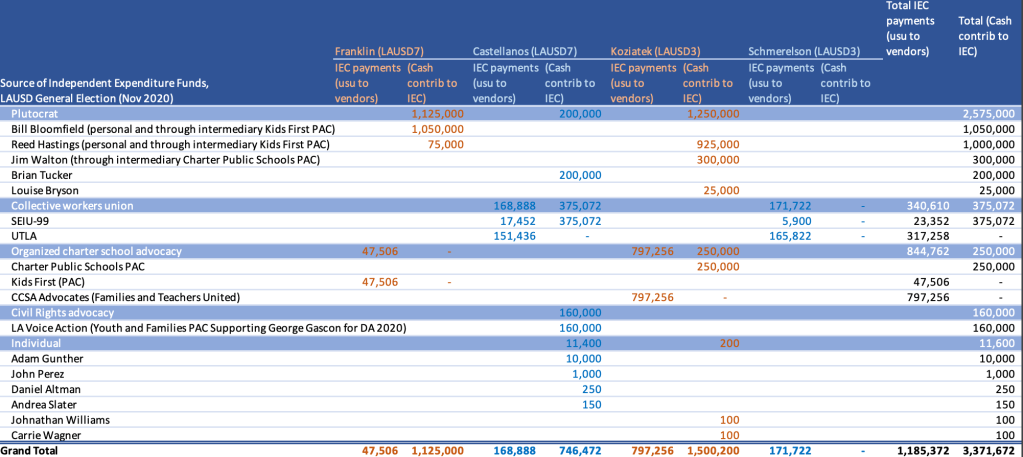
Once again, control of the Los Angeles Unified School Distict school board is up for grabs, and once again the billionaires hope to buy control so they can expand the number of charter schools. The latest financial disclosures show that Reed Hastings of Netflix has contributed $925,000 to try to defeat veteran educator Scott Schmerelson. Billionaire Jim Walton of the Walmart family added another $300,000. The charter lobby is flush with money to buy TV ads and flyers that smear Schmerelson and use vicious anti-Semitic tropes in their attack ads. The charter lobby is angry at Schmerelson for two reasons: 1. He fights fearlessly for the 80% of students in public schools. 2. He released the explosive fact that 80% of Los Angeles’ charter schools have vacancies, not waiting lists. His opponent Marilyn Koziatek has no experience in the public schools; she holds an administrative job in a charter school.

Download the .pdf here.

Note: Sara Roos of Los Angeles (blogger Red Queen in LA) prepared the graph of political expenditures based on public records.

Dan Alexander, a senior editor at Forbes who covers Trump’s businessses, writes that Trump really is a billionaire. His net worth, he says, is about $2.5 billion. That’s after taking into account more than $1 billion in Trump debts.

That makes it even more scandalous that Trump employs every accounting trick to pay no taxes in most years (while deducting $70,000 for his hair stylist), and only $750 in two years when he actually paid something to the government.

Thomas Ultican, retired teacher of physics and advanced mathematics, has been researching the tentacles of the Destroy Public Education movement in various cities.

In this post, he reviews the plutocrats’ lavish spending in California. It’s tapered of since 2018, he writes, but it’s still enough to outspend and overwhelm citizens who want to have a role in choosing their local school board.

The biggest battle in the state this year is the competition to control the board of the Los Angeles Unified School district. Ultican gives a succinct overview of the candidates, then examines the spending of the plutocrats.

The issue in L.A., again, is whether the plutocrats will win control so they can expand the charter sector or whether advocates of public education will overcome the money spent by the plutocrats and limit privatization.

Our blog poet on the work of the Bill & Melinda Gates Foundation:

Gates never gives without getting a tax break and never gives without strings attached.

That’s how you know it is not real philanthropy, but Billyanthropy.

“The Billyanthropist”

Billyanthropist am I
I gave you Common Core
And testing to the sky
I’d like to give you more

Billyanthropist am I
I gave you teacher VAMs
A lovely Chetty pie
And lots of charter scams

Billyanthropist am I
I gave you pseudo-science
And sellebrate the lie
With test and VAM reliance

Billyanthropist am I
Billyanthropy I do
Democracy I buy
Impose my will on you

Jan Resseger reviews here a new book that explains the full-blown triumph of plutocracy. Trump is the culmination, not the cause. Wealth and power are now concentrated, more than ever, in the hands of a small minority, and Trump has persuaded his followers that plutocracy works for them!

She begins:

For ten years Jacob Hacker, the Yale political scientist, and Paul Pierson, the Berkeley political scientist, have been tracking exploding economic inequality in the United States. In this summer’s book, Let Them Eat Tweets, Hacker and Pierson explicitly identify our government as a plutocracy. And they track how politicians (with the help of right-wing media) shape a populist, racist, gun-toting, religious fundamentalist story line to distract the public from a government that exclusively serves the wealthy. In a new article published in the Columbia Journalism Review, Journalism’s Gates Keepers, Tim Schwab examines our plutocracy from a different point of view: How is the mainstream media, the institution most of us look to for objective news, shaped increasingly by philanthropists stepping in to fill the funding gaps as newspapers go broke and news organizations consolidate?

In their 2010 classic, Winner-Take-All Politics, Hacker and Pierson present “three big clues” pointing to the tilt of our economy to winner-take-all: “(1) Hyperconcentration of Income… The first clue is that the gains of the winner-take-all economy, befitting its name, have been extraordinarily concentrated. Though economic gaps have grown across the board, the big action is at the top, especially the very top… (2) Sustained Hyperconcentration… The shift of income toward the top has been sustained increasingly steadily (and, by historical standards, extremely rapidly) since 1980… (3) Limited Benefits for the Nonrich… In an era in which those at the top reaped massive gains, the economy stopped working for middle-and working-class Americans.” Winner-Take-All Politics, pp. 15-19) (emphasis in the original)

Hacker and Pierson’s second book in the recent decade, the 2016 American Amnesia explores America’s loss of faith in government, our massive forgetting about the role of government regulation and balance in a capitalist economy: “(T)he institution that bears the greatest credit often gets short shrift: that combination of government dexterity and market nimbleness known as the mixed economy. The improvement of health, standards of living, and so much else we take for granted occurred when and where government overcame market failures, invested in the advance of science, safeguarded and supported the smooth functioning of markets, and ensured that economic gains became social gains.” (American Amnesia, p. 69)

In their new Let Them Eat Tweets, Hacker and Pierson no longer avoid the label. They now call America a full blown plutocracy: “This is not a book about Donald Trump. Instead, it is about an immense shift that preceded Trump’s rise, has profoundly shaped his political party and its priorities, and poses a threat to our democracy that is certain to outlast his presidency. That shift is the rise of plutocracy—government of, by, and for the rich. Runaway inequality has remade American politics, reorienting power and policy toward corporations and the super-rich (particularly the most conservative among them)… The rise of plutocracy is the story of post-1980 American politics. Over the last forty years, the wealthiest Americans and the biggest financial and corporate interests have amassed wealth on a scale unimaginable to prior generations and without parallel in other western democracies. The richest 0.1 percent of Americans now have roughly as much wealth as the bottom 90 percent combined. They have used that wealth—and the connections and influence that come with it—to construct a set of political organizations that are also distinctive in historical and cross-national perspective. What makes them distinctive is not just the scope of their influence, especially on the right and far right. It is also the degree to which the plutocrats, the biggest winners in our winner-take-all economy, pursue aims at odds with the broader interests of American society.” (Let Them Eat Tweets, pp. 1-2)…

But there is another hidden element of the power of plutocrats. Philanthropies led by the wealthy make charitable gifts which subtly shape news reporting itself. And the subject here is not merely Fox and Breitbart and the other right-wing outlets. Tim Schwab’s important report from the Columbia Journalism Review is about one of America’s powerful plutocrats, Bill Gates. Schwab explores, “a larger trend—and ethical issue—with billionaire philanthropists’ bankrolling the news. The Broad Foundation, whose philanthropic agenda includes promoting charter schools, at one point funded part of the LA Times’ reporting on education. Charles Koch has made charitable donations to journalistic institutions such as the Poynter Institute, as well as to news outlets such as the Daily Caller, that support his conservative politics. And the Rockefeller Foundation funds Vox’s Future Perfect, a reporting project that examines the world ‘through the lens of effective altruism’—often looking at philanthropy. As philanthropists increasingly fill in the funding gaps at news organizations—a role that is almost certain to expand in the media downturn following the coronavirus pandemic—an unexamined worry is how this will affect the ways newsrooms report on their benefactors.”

Those of us who have been following public education policy over two decades know that the Bill and Melinda Gates Foundation has invested in policy itself—funding think tanks like the Center on Reinventing Public Education—which brought us “portfolio school reform” charter school expansion—which led to Chicago’s Renaissance 2010— which led to Arne Duncan’s bringing that strategy into federal policy in Race to the Top. We know that the Gates Foundation funded what ended up as an expensive and failed small high schools initiative, and, after that failed—an experiment with evaluating teachers by their students’ standardized test scores—and later experimenting with incentive bonuses for teachers who quickly “produce” higher student scores. We remember that the Gates Foundation brought us the now fading Common Core. And we remember that Arne Duncan filled his department with staff hired directly from the Gates Foundation.

I urge you to read it all. It’s important!

Tom Ultican, retired teacher of physics and advanced mathematics in California, writes frequently about school “reform,” aka school choice, as a substitute for adequate funding.

In this post, he explains the fraud of school choice and why billionaires and rightwing zealots promote it. To read it in full,as well as his kinks, open the full post.

He begins:

Birthed in the bowels of the 1950’s segregationist south, school choice has never been about improving education. It is about white supremacy, profiting off taxpayers, cutting taxes, selling market based solutions and financing religion. School choice ideology has a long dark history of dealing significant harm to public education.

Market Based Ideology

Milton Friedman first recommended school vouchers in a 1955 essay. In 2006, he was asked by a conservative group of legislators what he envisioned back then. PRWatch reports that he said, “It had nothing whatsoever to do with helping ‘indigent’ children; no, he explained to thunderous applause, vouchers were all about ‘abolishing the public school system.”’ [Emphasis added]

Market based ideologues are convinced that business is the superior model for school management. Starting with the infamous Regan era polemic, “A Nation at Risk,” the claim that “private business management is superior” has been a consistent theory of education reform promoted by corporate leaders like IBM’s Louis Gerstner, Microsoft’s Bill Gates, Wal-Mart’s Walton family, Bloomberg LP’s founder, Michael Bloomberg and SunAmerica’s Eli Broad. It is a central tenet of both neoliberal and libertarian philosophy.

Charles Koch and his late brother David have spent lavishly promoting their libertarian beliefs. Inspired by Friedman’s doyen, Austrian Economist Friedrich Hayek, the brothers agreed that public education must be abolished.

To this and other ends like defeating climate change legislation, the Kochs created the American Legislative Exchange Council (ALEC). This lobbying organization has contributing members from throughout corporate America. ALEC writes model legislation and financially supports state politicians who promote their libertarian principles.

Like the Walton family and Betsy DeVos, Charles Koch promotes private school vouchers.

Maurice Cunningham, a political science professor at the University of Massachusetts, specializes in exposing the role of Dark Money in education. If you read my book, Slaying Goliath, you know that Cunningham’s research and blog posts helped to turn the tide against a state referendum in 2016 to expand the number of charter schools in Massachusetts. Cunningham showed that “Yes on Two” Organization was funded by billionaires and that the billionaires were hiding their identities. Despite being outspent, the parent-teacher-local school committee won handily.

In this post, originally from February, Cunningham explains why the Waltons and Charles Koch are so devoted to privatizing public school governance. He’s right that they want to lower their taxes. They also want to smash teachers’ unions; more than 90% of charters are non-union. The corporate sector doesn’t like unions, and most private unions have been eliminated. The teachers’ unions are still standing, which annoys the billionaires.

Thomas Ultican has yet again performed a public service by investigating a reformy think tank, where people get huge amounts of money from billionaires to tell the world that public schools are terrible and private management is the way to go.

In the linked post, he delves into the philosophy and fundraising genius of the Center for Reinventing Public Education at the University of Washington.

As Tom shows, it is very lucrative to knock the public schools. Foundations stand in line to offer millions for more evidence that our nation’s public schools, which educated 90% of us (but NOT Donald Trump!), are rotten.

We have been waiting thirty years to see the miracle of charter schools and vouchers and the portfolio model, but no matter. It’s a good living for them that bring bad news.

Leonie Haimson writes here about Bill Gates and his successful efforts to buy positive media coverage for himself and the projects he funds.

She read the excellent investigative research on Gates’ strategic funding of influential media outlets by Tim Schwab.

She writes:

Reporter Tim Schwab just had a must-read piece in the Columbia Journalism Review about how the Gates Foundation provides grants to news outlets such as NPR, BBC, NBC, Al Jazeera, ProPublica, National Journal, The Guardian, Univision, Medium, the Financial Times, The Atlantic, the Texas Tribune, Gannett, Washington Monthly, Le Monde, the Seattle Times, and many others. These outlets frequently provide favorable coverage of the Foundation and its grantees, and potential conflicts of interest are too rarely admitted by these outlets.

Haimson goes on to describe in detail her own efforts to persuade the New York Times to acknowledge that one of its regular columns, called “Fixes,” is written by two journalists who are funded by Gates. “Fixes” has repeatedly praised Gates’ programs without identifying their conflict of interest.

She writes:

One of the media organizations Schwab discusses, Solutions Journalism, has received $7.6 million from the Gates Foundation since 2014 to write articles suggesting practical solutions to social problems and train other reporters to do so as well. Since then, as Schwab points out, SJ has repeatedly produced stories praising projects and companies that are Foundation grantees and/or have received personal investments from Bill Gates himself.

Solutions Journalism was founded by David Bornstein and Tina Rosenberg in 2013 and they continue to run the organization and receive six figure salaries as CEO and VP for Innovation respectively…

Bornstein and Rosenberg also have a regular column in the NY Times called “Fixes”, which according to Schwab has run at least 15 favorable stories promoting the work of the Gates Foundation by name, without any mention that the columnists are funded by the Foundation as well.

Haimson goes on to document the praise that these columnists have lavished in Gates-funded projects, and their failure to mention criticism. In effect, they operate as a PR team for Bill Gates and his pet projects.

She cites the ethical standards of the Times as well as the organization Solutions Journalism and points out that they don’t meet their own professed standards.

What are Bill Gates’ ethical standards?

It’s rare indeed to read a critical article about how Bill & Melinda Gates use their vast wealth to burnish their image as the greatest benefactors of all time. This article by freelance journalist Tim Schwab, published in the Columbia Journalism Review, documents how the Gates have purchased a larger-than-life portrayal of themselves by strategic investments in the media.

With rare exceptions, the Gates’s have subsidized publications likely to write about them and guaranteed that they would be portrayed favorably. By doing so, they have undermined freedom of the press while assuring favorable treatment for themselves.

Schwab writes:

LAST AUGUST, NPR PROFILED A HARVARD-LED EXPERIMENT to help low-income families find housing in wealthier neighborhoods, giving their children access to better schools and an opportunity to “break the cycle of poverty.” According to researchers cited in the article, these children could see $183,000 greater earnings over their lifetimes—a striking forecast for a housing program still in its experimental stage.

If you squint as you read the story, you’ll notice that every quoted expert is connected to the Bill & Melinda Gates Foundation, which helps fund the project. And if you’re really paying attention, you’ll also see the editor’s note at the end of the story, which reveals that NPR itself receives funding from Gates.

NPR’s funding from Gates “was not a factor in why or how we did the story,” reporter Pam Fessler says, adding that her reporting went beyond the voices quoted in her article. The story, nevertheless, is one of hundreds NPR has reported about the Gates Foundation or the work it funds, including myriad favorable pieces written from the perspective of Gates or its grantees.

And that speaks to a larger trend—and ethical issue—with billionaire philanthropists’ bankrolling the news. The Broad Foundation, whose philanthropic agenda includes promoting charter schools, at one point funded part of the LA Times’ reporting on education. Charles Koch has made charitable donations to journalistic institutions such as the Poynter Institute, as well as to news outlets such as the Daily Caller, that support his conservative politics. And the Rockefeller Foundation funds Vox’s Future Perfect, a reporting project that examines the world “through the lens of effective altruism”—often looking at philanthropy.

As philanthropists increasingly fill in the funding gaps at news organizations—a role that is almost certain to expand in the media downturn following the coronavirus pandemic—an underexamined worry is how this will affect the ways newsrooms report on their benefactors. Nowhere does this concern loom larger than with the Gates Foundation, a leading donor to newsrooms and a frequent subject of favorable news coverage.

In Gates-funded articles, the rule seems to be: write whatever you want so long as you don’t criticize Bill or Melinda. Presenting them as saviors of society is good.

Strategic media investments pay off for Bill Gates.

Gates’s generosity appears to have helped foster an increasingly friendly media environment for the world’s most visible charity. Twenty years ago, journalists scrutinized Bill Gates’s initial foray into philanthropy as a vehicle to enrich his software company, or a PR exercise to salvage his battered reputation following Microsoft’s bruising antitrust battle with the Department of Justice. Today, the foundation is most often the subject of soft profiles and glowing editorials describing its good works.

During the pandemic, news outlets have widely looked to Bill Gates as a public health expert on covid—even though Gates has no medical training and is not a public official. PolitiFact and USA Today (run by the Poynter Institute and Gannett, respectively—both of which have received funds from the Gates Foundation) have even used their fact-checking platforms to defend Gates from “false conspiracy theories” and “misinformation,” like the idea that the foundation has financial investments in companies developing covid vaccines and therapies. In fact, the foundation’s website and most recent tax forms clearly show investments in such companies, including Gilead and CureVax.

In the same way that the news media has given Gates an outsize voice in the pandemic, the foundation has long used its charitable giving to shape the public discourse on everything from global health to education to agriculture—a level of influence that has landed Bill Gates on Forbes’s list of the most powerful people in the world. The Gates Foundation can point to important charitable accomplishments over the past two decades—like helping drive down polio and putting new funds into fighting malaria—but even these efforts have drawn expert detractors who say that Gates may actually be introducing harm, or distracting us from more important, lifesaving public health projects.

The PBS Newshour has received millions from Gates and reliably gushes over Bill and Melinda and their munificence.

In 2011, the Seattle Times published an article critical of the Gates Foundation, then two years later received a generous grant to pay for education coverage, and criticism stopped.

NPR receives Gates largesse, and regularly cites Gates as an authority on everything. The most delicious irony is NPR treating Gates—one of the richest men in the world—as an authority on income inequality and poverty. That’s a good one.

Those of us who concentrate on education are aware that everything Gates has funded in a large way has been an abject failure—from his absurd claim that he had knew how to produce and measure good teachers to his huge investment in the Common Core. We won’t hear about those failures in the Gates-funded media.

What I find most puzzling about the Bill and Melinda is their vanity. Their need to be recognized and praised is boundless. I guess no one ever told them that the highest form of philanthropy is to be completely anonymous: to give without knowing who will receive your gift and to give with no expectation of gratitude. The lowest form of giving is the gift where one expects recognition. Sadly, they use their philanthropy to exercise power, to win praise, and to stoke their needy egos.