Archives for category: Billionaires

McKenzie Scott is the ex-wife of Jeff Bezos. She was at his side when he founded Amazon and was the company’s first accountant. She played a role in the success of the company. When they divorced (he left her for another woman), McKenzie received a share of his Amazon stock. She is now one of the richest people in the world. The Bloomberg Billionaires Index ranks her as the 18th richest person in the world, right behind Alice Walton, with a net worth (on Tuesday) of of $62.4 billion (Jeff Bezos is the richest person in the world, with a net worth of $189 billion).

In a better world, there would be no billionaires. Everyone would pay a fair share of their income and wealth in taxes, and there would be no extremes of wealth or poverty. The rich would still be richer than everyone else, but not obscenely rich, with billions that they could never spend in ten lifetimes.

McKenzie Scott is giving away more than any other billionaire. Last week, she revealed that she had given away $4.1 billion to more than 384 organizations in every state and Puerto Rico. Advised by a team, she selected the recipients to focus on directly helping those who were actively involved in serving the most vulnerable members of society. In late July of this year, she gave away almost $1.7 billion to 116 organizations focused racial equity, LGBT equity, gender equity, economic mobility, empathy, democracy, public health, global development, and climate change.

She wrote on Medium about the groups that received grants:

Some are filling basic needs: food banks, emergency relief funds, and support services for those most vulnerable. Others are addressing long-term systemic inequities that have been deepened by the crisis: debt relief, employment training, credit and financial services for under-resourced communities, education for historically marginalized and underserved people, civil rights advocacy groups, and legal defense funds that take on institutional discrimination.

To select these 384, the team sought suggestions and perspective from hundreds of field experts, funders, and non-profit leaders and volunteers with decades of experience. We leveraged this collective knowledge base in a collaboration that included hundreds of emails and phone interviews, and thousands of pages of data analysis on community needs, program outcomes, and each non-profit’s capacity to absorb and make effective use of funding. We looked at 6,490 organizations, and undertook deeper research into 822. We put 438 of these on hold for now due to insufficient evidence of impact, unproven management teams, or to allow for further inquiry about specific issues such as treatment of community members or employees. We won’t always learn about a concern inside an organization, but when we do, we’ll take extra time to evaluate. We’ll never eliminate every risk through our analysis, but we’ll eliminate many. Then we can select organizations to assist — and get out of their way.

We do this research and deeper diligence not only to identify organizations with high potential for impact, but also to pave the way for unsolicited and unexpected gifts given with full trust and no strings attached. Because our research is data-driven and rigorous, our giving process can be human and soft. Not only are non-profits chronically underfunded, they are also chronically diverted from their work by fundraising, and by burdensome reporting requirements that donors often place on them. These 384 carefully selected teams have dedicated their lives to helping others, working and volunteering and serving real people face-to-face at bedsides and tables, in prisons and courtrooms and classrooms, on streets and hospital wards and hotlines and frontlines of all types and sizes, day after day after day. They help by delivering vital services, and also through the profound encouragement felt each time a person is seen, valued, and trusted by another human being. This kind of encouragement has a special power when it comes from a stranger, and it works its magic on everyone. We shared each of our gift decisions with program leaders for the first time over the phone, and welcomed them to spend the funding on whatever they believe best serves their efforts. They were told that the entire commitment would be paid upfront and left unrestricted in order to provide them with maximum flexibility. The responses from people who took the calls often included personal stories and tears. These were non-profit veterans from all backgrounds and backstories, talking to us from cars and cabins and COVID-packed houses all over the country — a retired army general, the president of a tribal college recalling her first teaching job on her reservation, a loan fund founder sitting in the makeshift workspace between her washer and dryer from which she had launched her initiative years ago. Their stories and tears invariably made me and my teammates cry.

It is obvious that the tax code is not going to be changed any time soon. Trump and McConnell revised it to favor the 1%, and McConnell will fight to keep it skewed toward big donors and corporations.

In the meanwhile, I salute McKenzie Scott for singling out the worthiest organizations and giving money without strings. Unlike the Billionaire Boys and Girls Club (think Gates, Broad, the Waltons), she does not choose organizations that are doing her bidding. She funded organizations serving those in need and gave them unconditional grants.

Not everyone is impressed by her generosity:

Some point out that in a different America, Scott wouldn’t have billions of dollars to give away – instead, more of that wealth would be paid in taxes that could benefit all Americans, and in higher wages to Amazon employees who could use the money directly.

Anand Giridharadas, author of the book Winners Take All: The Elite Charade of Changing the World, said in a tweet, which has since been removed, that it was “union-busting and tax avoidance that made the fortune possible.”

As well as praising a billionaire for giving money to HBCUs, Giridharadas said rank-and-file Amazon workers should be praised for their contribution to the company’s success: “Let us salute some folks barely holding on, running up and down warehouse aisles, whose wages did this.”

But even critics of income inequality recognize that McKenzie Scott is far more generous than her fellow billionaires, most of whom signed “The Giving Pledge” (promising to give away most of their wealth) but are taking their time dispensing their vast riches. (Look at the pictures of billionaires on the website of The Giving Pledge. Think Scrooge. Think French Revolution. Liberté, Fraternite, Egalite.)

Chuck Collins, director of the Program on Inequality and the Common Good at the Institute for Policy Studies, wrote at CommonDreams that while Scott is a newcomer on the billionaire-giving scene, she is doing it better than others in her cohort.

“She still has a long way to go in her stated intention of giving away all the wealth. But she’s now made two bold moves, putting to shame the other 650 U.S. billionaires who haven’t figured out comparable ways to boldly share,” he said.

“During a pandemic when US billionaire wealth has increased $1 trillion since March, other billionaires should draw inspiration from her approach to move funds to urgent needs, to historically marginalized groups, to share decision-making with non-wealthy people, and to avoid warehousing funds in private legacy foundations.”

Our society has a long way to go to create an economy where everyone has a chance to live a decent life, find satisfying work, have access to good health care, good housing, good schools.
Ken Rice was an elected member of the Oakland Unified School District from 1997-2000. That was before the billionaire disrupters decided to take control of Oakland and turn it into their own petri dish for “reform” (i.e., privatization). Rice wrote the following description of the recent school board election, in which grassroots organizations stood together and beat the candidates of the out-of-district/out-of-state billionaires. He is a member of Educators for Democratic Schools (EDS), an Oakland-based organization composed primarily of retired public school teachers, administrators and school board members. When Ken Rice ran for school board, his race cost $12,000. Due to the intrusion of big money, grassroots groups are always outspent and usually overwhelmed. But Rice explains here how Oakland parents and educators fought back and won.

He writes:

Apparently Money Isn’t Always Everything–$300,000 Beats $900,000 In The Oakland School Board Elections!

In nearly 20 years of privatization push into Oakland, this is the first time since 2003 that Oakland schools will be returned to local control by a school board that values and embraces authentic public education. Remaining hopeful for the future, and look forward to strengthening and improving Oakland’s schools.” ~ Diane Ravitch 

The Oakland Unified School District (OUSD), the petri dish for school privatization for the past two decades, might have an answer.  I ran and was elected to the Oakland school board and served one term (1997-2000).  I raised $12,000.  My opponent raised about the same amount.  In those days the school board elections were neighborhood races funded by local supporters. There was no out of state money or PACs involved. 

That began to change about ten years ago:  huge donations from individuals and foundations began to pour into Oakland school board races.  The money was funneled through the California Charter School Association and GO (Great Oakland Public Schools), a pro-charter organization.  The money also came from Michael Bloomberg, the Walton Foundation, Eli Broad, Laurene Jobs (Steve Jobs’ widow), and several more.  The goal was to elect a pro-charter, Board of Education. Unsurprisingly, the pro-charter organizations were successful.  

The Oakland school board has approved about 65 charter school applications over the last twenty years–many of them in the last 12 years.   Of those charters, about twenty have closed their doors—in some cases during the academic year, causing great dislocation to families who had to find another school for their children mid-year.  OUSD now has 30% of its 50,000 students in charter schools—the highest percentage of students in charters of any school district in California. 

What is surprising is what happened in the 2020 election.  For the first time in memory no incumbents were running for any of the four of the seven school board seats up for election.  Thus, there was a possibility of greatly changing the make-up of the school board, whose majority has opted for policies of charter school approval, school closures and lack of responsiveness to the greater Oakland educational community.  This was an opportunity to flip the board . . . and flip it did!

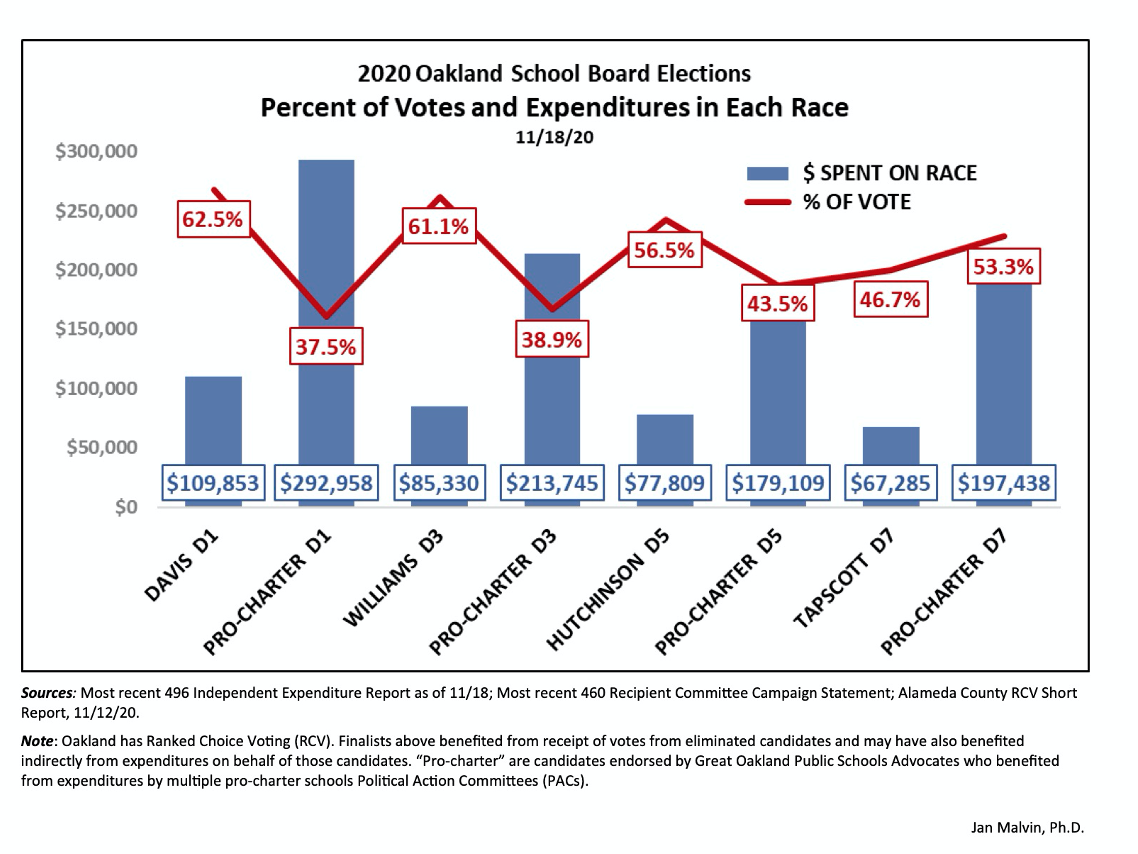
The charter community recognized this opportunity, and poured almost $900,000 into electing their candidates for the four open seats! Yet when the votes were counted, three of their four candidates lost.

Trying to understand how and why this happened can provide an insight into the educational landscape of not only Oakland, but urban cities nationally.  While it might be early to know for certain why the charter candidates were defeated, we can make some educated guesses.

Strong Local Candidates

Two of the three candidates who won had deep Oakland roots.  Two had been teachers (one in Oakland, one in San Francisco) and the other had worked in Oakland’s after school programs.   Two had been community activists around school issues for years.  

Oakland elections are calculated by ranked choice voting (RCV).  When the RCV was tabulated, Sam Davis, the candidate in District 1 received 62% of the vote.  Sam built a stellar campaign focused around school communities. He held zoom meetings with each school community in his district hosted by a combination of parents and teachers who worked in those schools.  VanCedric Williams, in District 3, got 61%.  VanCedric, a public school teacher for almost twenty years, had strong support from the teacher’s union as well as other unions. Mike Hutchinson in District 5 got 56%.  Mike had run for the Board previously, networked with other education activists nationwide, and had built a reputation of challenging Board policies by going to Board meetings for years and reaching out on social media. 

Backing of the Teacher’s Union

Last year, teachers in Oakland led a successful strike. The union’s ability to drum up enthusiasm with their members was one contributor to that success.  Teachers recognized that if their future demands were to be met, they needed to have a responsive Board.  Specifically, the current Board was considering a plan that would close up to 24 schools in Oakland, mostly in Brown and Black communities.  At the same time, none of the 44 charter schools in Oakland were under threat of closure.  Teachers made the connection between a charter friendly board and school closures of the public schools and were determined to change the direction of the district’s “blueprint”.

Teachers phone banked, texted, walked to drop off literature, and held zoom meetings in support of the three candidates who won.  As Sam Davis noted, many voters tend to rely on their friends and neighbors who know something about the schools.  The friends and neighbors were telling each other to vote for the candidates they trusted.

Backing of Other Groups:  Building a Coalition

The three candidates were endorsed by the Democratic Party.  This wasn’t an accident.  Educational activists pushed the local democratic clubs to endorse candidates who would not be friendly to charters and wouldn’t owe their election to big money.  These clubs, in turn, pushed the local Democratic party.  In California the state Democratic party has taken a critical stance towards charter schools, and this was replicated locally.  Organizers noticed that as people walked to the polls on election day, many of them carried the Democratic Party door hanger with them. Some of these candidates were also endorsed by :

  • The Alameda Central Labor Council
  • SEIU 1021
  • State Assemblyperson Rob Bonta
  • State Superintendent of Schools Tony Thurmond
  • Network for Public Education

Also, other community organizations like Educators for Democratic Schools, Democratic Socialists of America, and Wellstone Democratic Renewal Club helped to call, text, and walk precincts.

The Word is Out

You can fool some of the people all of the time but you can’t fool all of the people all of the time, or so Lincoln believed.  Over time, the general public has begun to understand that there is an attempt to buy their votes.  As I dropped off a flier at one home, a parent came to the door and asked, with hostility, “This isn’t the candidate who is getting all that money from Bloomberg, is it?”  Several media sources reported on money from Bloomberg ($500,000 from Bloomberg alone!) and others pouring into Oakland.  

After recovering from the astonishment that anyone would spend that kind of money for a school board election, voters became leery of candidates receiving those huge amounts of money.  In District 1 where I live–and the charter candidate received nearly $300,000!–I found glossy fliers in my mailboxes more times than I could keep track of.

It is profoundly disturbing and a huge threat to our democracy that this big money trend has filtered down to local school board races. The Oakland community fought back against the billionaires’ spending advantage, and when the new board is seated in January, it will have a clear pro-public school majority.  With appealing candidates and strong ground games, Oakland voters have shown that big money can be defeated. While Oakland will never go back to the days when a local neighborhood candidate spent only $12,000 to be elected, this recent victory over out of state billionaire bucks and their agenda sends a clear signal that our community will not be bought.

(Ken Rice is former OUSD board member, a member of Educators for Democratic Schools and currently has a daughter attending an OUSD school.) 

Jeff Bryant writes that while we were all celebrating the pending departure of Betsy DeVos, the usual suspects were buying control of local school board elections. We are all aware of her efforts to direct federal funding to private schools and charter schools. But, he warns, we should pay attention to the “threat to democratically governed schools that preceded DeVos and will continue when she is long gone.”

In midsized metropolitan areas like Indianapolis and Stockton, California, parents, teachers, and public school advocates warn of huge sums of money coming from outside their communities to influence local politics and bankroll school board candidates who support school privatization. In phone conversations, emails, and texts, they point to a national agenda, backed by deep-pocketed organizations and individuals who intend to disrupt local school governance in order to impose forms of schools that operate like private contractors rather than public agencies—an agenda not dissimilar from that of DeVos.

In the 2020 school board election in Indianapolis, local teachers and grassroots groups the Indiana Coalition for Public Education and the IPS Community Coalition backed four candidates against a slate of opponents whom locals accuse of representing outside interests. At stake, according to WFYI, was “an ideological tilt” over whether the district would continue to “collaborate with outside groups and charter organizations” or “return to more traditional methods of improving struggling schools.”

Both sides raise the banner of “improving struggling schools,” but locals say what’s really at stake is whether voters retain democratic control of their public schools or see them turned over to private, unelected boards and their corporate supporters and funders.

Similarly, in Stockton, the clash between opposing slates of candidates in the 2020 school board election included controversies over charter school expansion and the influence of outside money in the district.

The controversy broke into public view in July 2020 when 209 Times reportedthat “[p]aid operatives” connected to Stockton’s outgoing mayor Michael Tubbs and three school board members were engaged in “a coordinated campaign of undue influence from outside of the city whose aim is… charter school expansion” into the district.

In both elections, candidates backed by outside organizations and individuals massively outspent candidates supported by local teachers and public school advocates.

In Indianapolis, WFYI reported that political action committees supporting the candidates aligned with charter school interests had contributed more than $200,000 into the election by October 9, while the “[f]our candidates backed by the IPS Community Coalition… [had by then] raised less than $20,000 in total.”

In Stockton, 209 Politics reported independent expenditure committees supporting candidates favoring charter school expansion outspent their opponents 25 to 1.

While the language used by these outside organizations and their benefactors is different from the rhetoric DeVos wields—substituting a message of rescuing struggling schools for DeVos’s calls for libertarian autonomy—the result is much the same: local citizens see democratic governance of their schools being swept aside as private actors get more control to do what they want.

This effort to squelch local democracy is funded by the usual billionaires:  the Bill and Melinda Gates Foundation; the Walton Family Foundation, of Walmart fame; Arnold Ventures, the private foundation of former hedge fund manager and Enron trader John Arnold; and the City Fund, a nationwide organization providing financial support for city-level charter school expansions.

The City Fund is a relatively new organization of experienced charter school promoters that started on day one with $200 million from billionaires John Arnold and Reed Hastings. Its mission: to use the money to undermine democratic control of local school boards and to see that charter-friendly candidates are elected.

The other organization used by the billionaires to funnel money into the Indianapolis school board election was the notorious Stand for Children, which has played the same role in other districts. “Stand” worked closely with the Mind Trust, a local cheerleader for privatization, also funded by billionaires who don’t like local control or democracy.

Bryant reports that another PAC, aligned with Stand for Children, entered the race on behalf of the Alice Walton and Michael Bloomberg, neither of whom lives in Indianapolis or in Indiana.

Bryant relies on the careful research of Thomas Ultican, who has been documenting the billionaires’ determination to take control of urban districts. Their strategy is to promote the “portfolio model” of schools. This is basically a rightwing business agenda that aligns with a corporate model of governance. Outsource management and control. Close low-performing schools, open new schools; repeat.

In the Indianapolis contest, the billionaire-backed candidates outspent the teacher union-backed candidates by a margin of 11-1. All four of the charter-friendly candidates won.

In Stockton, the teacher- and community-backed candidates won.

Please read the article. There is much to learn from it as a cautionary tale.

Here’s the question that lingers: Charter schools are no longer an innovation. The first charter school opened in 1992, almost three decades ago. There is no evidence that charters as such have produced miraculous improvement. Some get high test scores, but typically because they can choose their students and kick out the ones they don’t want. Some are far worse than the public schools they replaced. Some close mid-year, either for financial or academic reasons or low enrollment.

Why are these billionaires so devoted to imposing their ideas on local communities without regard to results? Is it because they disdain democracy?

Tom Ultican discovered a fascinating study of tech philanthropists and their self-serving gifts. Gates, Zuckerberg, and other tech giants are “giving” in a way that supports their self-interest.

The study that Ultican reviews is “Education, Privacy, and Big Data Algorithms: Taking the Persons Out of Personalized Learning,” by Priscilla M. Regan and Valerie Steeves.

They argue:

“We argue that, although there has been no formal recognition, personalized learning as conceptualized by foundations marks a significant shift away from traditional notions of the role of education in a liberal democracy and raises serious privacy issues that must be addressed.”

“It presents yet another example of the transformation of the traditional role of public education as educating citizens to one of educating future workers and consumers, a contrast of liberal democracy with neoliberal democracy.”

“The edtech sector has been focused on the notion [of personalized learning] …. While companies have generated hundreds of products and a smattering of new school models are showing promise, there is little large-scale evidence that the approach can improve teaching and learning or narrow gaps in academic achievement.”

The authors also review Education Week as a model of education journalism that is underwritten by edtech foundations and helps to market their wares. Reporting by Benjamin Herold on Ed tech, however, is exceptionally critical.

Meanwhile, the U.S. Department of Education has become “a de facto Ed tech sales firm.”

I have been saying for a long time that “personalized learning” is actually depersonalized learning because it attempts to replace human teachers with computer instruction. Education requires human interaction, not a connection between a human and a machine.

Despite my cynicism about the tech billionaires and their relentless pushing of Ed tech, I don’t think they are motivated by greed. When you are already a billionaire, what difference does more money make? I believe they promote Ed tech because that’s all they know. When the only tool you have is a hammer, everything looks like a nail. Actually, I don’t think the tech billionaires have given much thought to their concept of education. They display little or no interest in literature, the arts, or any of the humanities. This reflects their limits and their ignorance. The fact that they have so much money and power threatens the very heart and soul of education. Education is not, should not be merely trading or transactions. It is and should be a way of life. Try explaining that to Bill Gates or Mark Zuckerberg or any of the other tech titans—or state legislators or members of Congress.


Farhad Manjoo is an opinion writer for the New York Times. In this column, he says that the wealth of American billionaires has grown dramatically during the pandemic. We know that millions of Americans are facing hunger, poverty, and evictions. Inequality is expanding.

He writes:

When I called up Chuck Collins on Tuesday afternoon, I found him glued to one of the grimmest new metrics documenting America’s economic and social unraveling.

Collins is a scholar of inequality at the Institute for Policy Studies, a progressive think tank, and since March he has been tracking how the collective wealth of American billionaires has been affected by the coronavirus pandemic. In previous recessions, Collins said, billionaires were hit along with the rest of us; it took almost three years for Forbes’s 400 richest people to recover losses incurred in 2008’s Great Recession.

But in the coronavirus recession of 2020, most billionaires have not lost their shirts. Instead, they’ve put on bejeweled overcoats and gloves made of spun gold — that is, they’ve gotten richer than ever before.

On Tuesday, as the stock market soared to a record, Collins was watching the billionaires cross a depressing threshold: $1 trillion.

That is the amount of new wealth American billionaires have amassed since March, at the start of the devastating lockdowns that state and local governments imposed to curb the pandemic.

On March 18, according to a report Collins and his colleagues published last week, America’s 614 billionaires were worth a combined $2.95 trillion. When the markets closed on Tuesday, there were 650 billionaires and their combined wealth was now close to $4 trillion. In the worst economic crisis since the 1930s, American billionaires’ wealth grew by a third.

It is difficult to think of a more succinctly obscene illustration of the unfairness of the American economic and political system.

“The economy is now wired ‘heads you win, tails I lose,’ to funnel wealth to the top,” Collins told me.

Billionaires amassed their new billions just as millions of other Americans plunged into dire financial straits. More than 20 million people lost their jobs at the start of the pandemic. As Congress lazily contemplates whether or not to bother to continue to provide economic assistance to America’s neediest, as many as 13 million people are at risk of losing the expanded benefits that keep them just beyond the grip of hunger and homelessness.

Food banks across the country are bracing for another surge in demand. If a federal moratorium on evictions is allowed to expire at the end of the year, millions of Americans will have to pay months of back rent — making them vulnerable to what housing advocates warn will be a wave of evictions.

Why are American billionaires doing so well while so many other Americans suffer? Part of the story is garden-variety American inequality. Stocks are overwhelmingly owned by the wealthy, and the stock market has recovered from its early-pandemic depths much more quickly than other parts of the economy.

But some billionaires are also benefiting from economic and technological trends that were accelerated by the pandemic. Among these are the owners and investors of retail giants like Amazon, Walmart, Target, Dollar Tree and Dollar Generalwhich have reported huge profits this year while many of their smaller competitors were clobbered as the coronavirus spread.

Then there are companies that have bet on the rapid digitization of everything. Eric Yuan, the chief executive of Zoom, became a billionaire in 2019. Now he is worth almost $20 billion. Apoorva Mehta, the founder of the grocery-delivery company Instacart, was not a billionaire last year; this year, after a spike in orders that led to a new round of investment that pumped up the value of his company, he’s safely in the club. Dan Gilbert, the chairman of Quicken Loans, was worth less than $7 billion in March; now he commands more than $43 billion.

But like in the rest of the economy, there is a great deal of stratification even among billionaires — richer billionaires got even richer in 2020 than the poorer ones did.

Some of the numbers are staggering. Jeff Bezos, Amazon’s founder, was worth about $113 billion at the start of the pandemic. Now he is worth $182 billion — an increase of about $69 billion. Jim, Alice and Rob Walton, three of the largest shareholders of Walmart, saw their combined wealth grow by $47 billion during the pandemic.

This is a good time to urge you to read The Spirit Level: Why Greater Equality Makes Societies Stronger.

The more equal societies are, the happier they are. We are sinking into an abyss of anger, hopelessness, envy, and despair.

If you have not read Duke Professor Nancy MacLean’s Democracy in Chains, you should. I reviewed it for the New York Review of Books here. It describes in great detail how the Koch brothers created an academic foundation for their extremist libertarian views. In this paper, MacLean goes into new detail about the workings of the Koch network and its efforts to undermine democracy. The Koch network knows that it does not have popular support so it has developed ways to “work around” the will of the majority. Currently, its major project is to block any effort to confront climate change.

The paper is titled “Since We Are Greatly Outnumbered: Why and How the Koch Network Uses Disinformation to Thwart Democracy.” The essay appears in a publication called The Disinformation Age, published by Cambridge University Press.

Thanks to “Unkoch My Campus” for bringing this paper to a large audience.

SomeDAM Poet wrote these verses.

“The Billionaire and the Reformer” (after “The Walrus and the Carpenter,” by Lewis Carroll)

The pol was pining for a charter,
pining with all his might:
He did his very best to make
The regulations sleight —
Which wasn’t hard, because the pol
Was charter acolyte

The public was pining sulkily,
Because they thought the pol
Had got no business to be there
After the charter stole —
“Incredible of him,” they said,
“To work for charter dole”

The money was tight as tight could be,
The coffers were bare as bare.
You could not see a dollar, cuz
No dollar was in there:
No Race was funding overhead —
There was no Race to fund.

The Billionaire and the Reformer
Were talking under bleachers;
They wept like anything to see
Such qualities of teachers:
If these were only cleared away,’
Our schools would be like peaches!’

If seven Chetty’s with seven VAMs
VAMmed for half a year,
Do you suppose,’the Billionaire said,
That they could get them clear?’
I doubt it,’ said the Reformer,
And shed a bitter tear.

O students, come and walk with us!’
The Billionaire did beseech.
A pleasant walk, a pleasant talk,
A better way to teach
We cannot do with more than four,
To give a hand to each.’

The eldest student looked at her
But never a word he said:
The eldest student winked his eye,
And shook his heavy head —
Meaning to say he did not choose
To go with Jobs, and fled

But four young students hurried up,
All eager for the fest:
Their hair was brushed, their faces washed,
Their shoes were clean and best —
And this was odd, because, you know,
They’re going to a test.

Four other students followed them,
And yet another four;
And thick and fast they came at last,
And more, and more, and more —
All hopping through the student waves
And scrambling to the door.

The Billionaire and the Reformer
Walked on a mile or so,
And then they rested on a rock
Conveniently low:
And all the little students stood
And waited in a row.

The time has come,’ the Billionaire said,
To talk of many things:
Of Common Core — and standard tests — of passing score — and VAM—
And why the schools are failing [Not!] —
And whether pigs have wings.’

But wait a bit,’ the students cried,
Before we have our talk;
For some of us are out of breath,
And some of us can’t walk!’
No hurry!’ said the Reformer.
As patient as a hawk.

A lot of bread,’ the Billionaire said,
Is what we chiefly need:
Testing and Common Core besides
Are very good indeed —
Now if you’re ready, students dear,
We can begin to weed.’

But not with us!’ the students cried,
Turning a little blue.
After such kindness, that would be
A dismal thing to do!’
The day is fine,’ the Billionaire said.
Do you admire the view?

It was so kind of you to come!
And you are very nice!’
The Reformer said nothing but
‘That cut score won’t suffice:
I wish you were not quite so deaf —
I’ve had to tell you twice!’

It seems a shame,’ the Billionaire said,
To play them such a trick,
After we’ve brought them out so far,
And made them test so quick!’
The Reformer said nothing but
The opt-out’s spread too thick!’

I weep for you,’ the Billionaire said:
I deeply sympathize.’
With sobs and tears he sorted out
The scores of lesser size,
Holding his pocket-handkerchief
Before his streaming eyes.

O students,’ said the Reformer,
You’ve had a pleasant run!
Shall we be trotting home again?’
But answer came there none —
And this was scarcely odd, because
They’d flunked out every one.”

Tom Ultican writes here about three major school board elections: Oakland, Los Angeles, and Indianapolis. These are districts that are in the crosshairs of the billionaire privatizers. No one can explain why billionaires want to privatize the public schools in these three districts (as well as dozens more). We now have nearly 30 years of evidence that neither charters nor vouchers produce educational miracles. New Orleans is not a national model: Last year, half the charter schools in this all-charter district were identified by the state as D or F-rated schools. Assignment to anyone: Why do the billionaires keep funding failure?

Ultican reports that the pro-privatization candidates vastly outspent the pro-public education candidates. In Oakland, the pro-public education slate won all but one seat (in that race, the pro-public education groups were divided, or they would have had a clean sweep).

In Los Angeles, the billionaires won one seat, enough to give them a single-seat majority of the school board.

In Indianapolis, the billionaires swamped the pro-public education candidates with their vast spending power.

It is an attack on democracy when billionaires from out-of-state (or from in-state) can drop a few million into a local school board race and make it impossible for ordinary citizens to compete. The individuals and the groups funding this assault on democracy–Michael Bloomberg, William Bloomfield, Stacey Schusterman, Arthur Rock, the Walton family, Reed Hastings, Doris Fisher, and other billionaires should hang their heads in shame. So should Stand for Children (which funnels billionaire money into races against public school advocates) and The Mind Trust.

For their ceaseless efforts to dismantle public schools and replace them with privately managed charters, I hereby place the following billionaires on this blog’s “Wall of Shame”: Michael Bloomberg, the Walton family, Reed Hastings, William Bloomfield, Doris Fisher, Arthur Rock, and Stacy Schusterman.

The same richly deserved dishonor goes to the infamous servant of the billionaires, Stand for Children.

Jane Nylund, parent activist in Oakland, reports on the good news from that district. Oakland has been the Disrupter/Reformer playground for nearly twenty years. For most of those years, billionaire Eli Broad picked the superintendents.

Jane Nylund writes:

Good morning, the good news out of Oakland is that our grassroots campaigns for 4 school board seats beat back Bloomberg and his privatization machine. The board flipped 3 out of 4 seats, to elect the following:


District 1-Sam Davis

District 3-VanCedric Williams

District 5-Mike Hutchinson

District 7-Clifford Thompson


In addition, Oakland’s Measure Y, which passed by a whopping 77%, will provide $750 million for new school building construction/rehabilitation for our crumbling infrastructure. 


Measure QQ, giving 16 and 17-year olds the right to vote in school board elections, also passed by a wide margin.


In nearly 20 years of privatization push into Oakland, this is the first time since 2003 that Oakland schools will be returned to local control by a school board that values and embraces authentic public education. Remaining hopeful for the future, and look forward to strengthening and improving Oakland’s schools. 


Chalkbeat reports that the privatizers at “Democrats” for Education Reform have identified their candidates for Biden’s Secretary of Education. They are three big-city superintendents who have worked harmoniously with charter schools.

DFER is an organization of hedge fund managers and financiers who are supporters of charter schools, merit pay, high-stakes testing, and value-added evaluation of teachers. In 2008, DFER successfully advocated for the appointment of Arne Duncan, a supporter of their goals.

Democrats for Education Reform is coordinating a behind-the-scenes push for Chicago schools chief Janice Jackson, the head of Baltimore schools Sonja Brookins Santelises, or Philadelphia superintendent William Hite, according to an email sent to supporters Monday by the group’s presidentShavar Jeffries and obtained by Chalkbeat. All three, Jeffries wrote, would represent a “‘big tent’ approach to education policy making….”

DFER was an influential actor in policy during the Obama administration, but those policies have mostly proved ineffective and/or rejected by teachers. In light of Betsy DeVos’ fierce advocacy for charter schools, DFER’s agenda is out-of-step with the Democratic Party.

In general, though, DFER has found some of its favored policies moving further from the Democratic Party’s mainstream. As a presidential candidate, Biden has proposed a slew of new federal restrictions on charter schools and been critical of standardized testing — a clear shift from the Obama administration, which promoted the growth of charter schools and teacher evaluations linked to test scores. 

“It is certainly the Biden plan,” the campaign’s policy director Stef Feldman said at a recent event, describing the candidate’s agenda for schools. “The vice president is pretty committed to the concept that we need to be investing in our public neighborhood schools and we can’t be diverting funding away from them.”

A number of factors have driven the shift within the Democratic party — including disillusionment with Obama-era reforms, the increased political strength of teachers and their unions, and Education Secretary Betsy DeVos, who is highly unpopular among Democrats and became a figurehead for school choice.

This shifting ground is reflected in DFER’s recent policy agenda, which was signed onto by a few civil rights groups; the Center for American Progress, a progressive think tank; and major charter school organizations, including the National Alliance for Public Charter Schools. The document emphasizes areas of likely agreement with a Biden administration, including expanding access to early childhood education, increasing federal funding for low-income students and students with disabilities, and raising teacher pay. Charter schools get only a brief mention in a section about “choices in quality public schools.”

The Center for American Progress is not a “progressive” think tank. It has long advocated the Obama-era education policies that align with DFER.