Archives for category: Billionaires

Lisa Graves and Alyssa Bowen recently reviewed the tax returns of some well-known “parent” groups and discovered what we suspected to be true. They are funded by Dark Money, specifically by billionaire Charles Koch, who longs to eliminate public education.

They write in Truthout:

Right-wing operatives are increasing their attacks on U.S. public education with an expanding number of legal complaints to censor books and target teachers on an array of issues —preventing them from teaching U.S. history accurately, treating LGBTQ+ students with the respect they deserve, and forming support groups for kids and teachers of color. These attacks will likely continue to escalate through 2024 as wedge issues intended to feed the right-wing voting base and lay the groundwork for redirecting funds from public schools to private recipients.

One of the main players in these attacks is Parents Defending Education (PDE), a dark money nonprofit group launched in 2021 in the midst of the Virginia state election cycle. Over the past two years, PDE has become a central actor in the right-wing assault on public schools across the nation. The group has trained local agitators to grab media attention, sued school districts for supposed anti-white discrimination, and railed against the teaching of social emotional learning, accurate U.S. history, and even ethnic studiesin schools.

Lawyers affiliated with PDE filed at least four complaints in January with the U.S. Department of Education claiming affinity groups for kids or teachers are illegal. These are just a few of the many complaints the group has filed over the past two years.

As dark money in education expert Maurice Cunningham has written, PDE’s “real goal” in filing lawsuits and complaints appears to be to “create media attention and promote chaos and disruption.” Then groups like PDE can claim the solution to the chaos is increased right-wing “parental supervision” over school boards. That supervision appears to involve a minority of vocal, politically motivated parents dictating what other people’s kids are taught or what they can read, based on whether such lessons or books are consistent with their right-wing religious beliefs and political opinions.

Illustration of Leonard Leo and a rain of judge's gavels

Groups Connected With Leonard Leo Have Funneled $31 Million to State Court Races

PDE’s speakers are often portrayed in the media as simply “concerned parents,” despite the group’s ties to the network of oil billionaire Charles Koch, far right politicians and school privatization efforts. Due to the timetables for the filing of nonprofit IRS forms, the amount PDE had raised to mount these attacks was unknown — until now.

PDE’s 2021 990 nonprofit IRS form shows that the group raised more than $3.1 million in its first year, even though many genuinely local grassroots efforts take years to raise that much money. That form does not reveal how much money PDE raised in 2022, during the congressional midterm elections; the amount it received to fuel its operations last year is likely even higher than 2021. The $3.1 million disclosed for 2021 also does not include any money raised that year by PDE Action, its (c)(4) advocacy arm.

Please open the link and keep reading this deep dive into astroturf parent groups funded by the far right billionaires.

Mimi Swartz, a writer for the Texas Monthly, explored the background, the funders, and the consequences of the well-coordinated campaign to privatize public schools—by defaming them and discrediting those who run for local school board seats. She focuses on the travails of one dedicated school board member, Joanna Day in Dripping Springs, Texas, who contended with insults and threats in her life.

The following is a small part of a long article, which I encourage you to read in full:

The motivations for these attacks are myriad and sometimes opaque, but many opponents of public education share a common goal: privatizing public schools, in the same way activists have pushed, with varying results, for privatization of public utilities and the prison system. Proponents of school privatization now speak of public schools as “dropout factories” and insist that “school choice” should be available to all. They profess a deep faith in vouchers, which would allow parents to send their children not just to the public schools of their choice but to religious and other private schools, at taxpayers’ expense.

But if privatizing public education is today cloaked in talk of expanded liberty, entrepreneurial competition, and improved schools for those who need them most, its history tells a different story. In 1956, two years after the U.S. Supreme Court handed down its landmark Brown v. Board of Education decision, a group of segregationist legislators in Texas, with support from retiring governor Allan Shivers, began concocting work-arounds for parents appalled by the prospect of racial integration of public schools. One idea: state-subsidized tuition at private schools. That never came to pass, but it was Texas’s first flirtation with vouchers.

Privatization proponents have since switched up their rhetoric, pitching vouchers as an opportunity for poor urban families to save their children from underperforming neighborhood schools. That hasn’t worked out either. In various experiments across the nation, funding for vouchers hasn’t come close to covering tuition costs at high-quality private schools, and many kids, deprived of the most basic tools, haven’t been able to meet the standards for admission.

School funding in Texas is based largely on attendance—as the saying goes, the money follows the child. Considerable evidence suggests that vouchers would siphon money from underfunded public schools and subsidize well-to-do parents who can already afford private tuition. Critics frequently cite a program in Milwaukee, where four out of ten private schools created for voucher students from 1991 to 2015 failed.

“I don’t think that vouchers serve any useful purpose at all,” said Scott McClelland, a retired president of H-E-B who now chairs Good Reason Houston, an education nonprofit. Ninety-one percent of Texas students attend public schools. “There isn’t enough capacity in the private school network to make a meaningful difference in their ability to serve economically disadvantaged students in any meaningful numbers, and it will divert funding away from public schools.”

In Texas, an unusual alliance of Democratic and rural Republican leaders has for decades held firm against voucher campaigns. The latter, of course, are all too aware that private schools aren’t available for most in their communities and that public schools employ many of their constituents. But the spread of far-right politics and the disruption of public schools during the pandemic created an opening for activists to sow discontent and, worse, chaos. “If they can make the public afraid of their public school, they will be more likely to support privatizing initiatives. Then that puts us back to where we used to be with segregation of public schools,” says former Granbury school board member Chris Tackett, who, with his wife Mendi, has become an outspoken advocate for public education and a relentless investigator of the attempts to undermine it.

They have their work cut out for them. In the past, just a few right-wing legislators pushed for privatization and were routinely ignored. After all, the state constitution spelled out “the duty of the Legislature of the State to establish and make suitable provision for the support and maintenance of an efficient system of public free schools.” But as times have changed, so has the interpretation of that guarantee.

Betsy DeVos, President Donald Trump’s former Education Secretary, set up shop in Dallas with her American Federation for Children to push against “government schools” in favor of “school choice.” Political PACs such as Patriot Mobile Action, an arm of a Christian wireless provider in North Texas, continue pouring millions into school board races and book bans to promote more religious education. Patriot has joined other recently formed PACs with inspirational names such as Defend Texas Liberty and Texans for Excellent Education, all of which supposedly support better public schools but are actually part of the privatization push. But by far the most powerful opponents of public schools in the state are West Texas oil billionaires Tim Dunn and the brothers Farris and Dan Wilks. Their vast political donations have made them the de facto owners of many Republican members of the Texas Legislature through organizations such as the now dissolved Empower Texans and the more recent Defend Texas Liberty, which the trio uses to promote restrictions on reproductive rights, voter access, and same-sex marriage. Almost as influential is the Texas Public Policy Foundation, where Dunn is vice board chair.

A November 2021 TPPF fund-raising letter, sent to supporters in advance of the Eighty-eighth Legislature convening, argued that “public education is GROUND ZERO” in the fight for freedom. “The policy team and board of the Texas Public Policy Foundation (TPPF) believe it is now or never,” it read, signaling that the long-standing and robust alliance against vouchers was unusually vulnerable. “The time is ripe to set Texas children free from enforced indoctrination and Big Government cronyism in our public schools.” The letter went on to herald a $1.2 million “Set the Captives Free” campaign to lobby legislators to save Texas schoolchildren from “Marxist and sexual indoctrination” funded by “far-Left elites for decades.”

Lieutenant Governor Dan Patrick, generously backed by Dunn, the Wilks brothers, and their organizations, has long been a proponent of privatizing public education (and of starving it through reductions in property taxes). He has made vouchers a primary legislative goal of the current session. Mayes Middleton, of Wallisville, a Republican state senator and former chair of the TPPF-aligned Texas House Freedom Caucus, filed a bill to create the “Texas Parental Empowerment Program,” proposing education savings accounts that are essentially a form of vouchers. Representative Matt Shaheen, of Plano, who is a member of the Texas Freedom Caucus, has introduced a measure that would guarantee state tax credits for those who donate to school-assistance programs—such as scholarships for kids wishing to go to private schools.

Governor Greg Abbott, knowing all too well the political headwinds that vouchers have faced, has long been wary of publicly supporting them, so he has undermined public schools in other ways. While campaigning early last year, he promised to amend the Texas constitution with a “parental bill of rights,” even though most, if not all, of those rights already existed. By then, “parental rights” had become a dog whistle to animate opponents of public education. (As the Texas Tribune put it: “Gov. Greg Abbott taps into parent anger to fuel reelection campaign.”)

During the recent intensifying crisis on the border, Abbott publicly floated a challenge to the state’s constitutional obligation to give all Texas children, including undocumented ones, a publicly funded education—a step his Republican predecessor, Rick Perry, had denounced years earlier as heartless. Then last spring, Abbott made headlines with his first full-throated public endorsement of a voucher program.

So here we are, with distrust in public schools advancing as fast as the latest COVID-19 variant. The forces behind the spread of this vitriol are no mystery. Those who would destroy public schools have learned to apply three simple stratagems: destabilize, divide, and, if that doesn’t work, open the floodgates of fear


The Network for Public Education posted this article about the billionaires behind the voucher legislation that recently passed. None of the billionaires live in Idaho.

New post on Network for Public Education.

Kelcie Moseley-Morris: Records show powerful, wealthy funders outside Idaho back school choice campaign

Reporting for the Idaho Capital Sun, Kelcie Moseley-Morris explains how Idaho’s big voucher push is the product of carpetbagger astroturf. What has been presented as a grassroots movement is fueled by other players.

The national special interests groups who have poured millions of dollars into efforts to make education savings account programs a reality in states like Arizona, Utah, Wyoming, Wisconsin and New Hampshire are the same donors who spent hundreds of thousands of dollars during Idaho’s midterm election to ensure school choice-friendly legislators occupied as many seats as possible in the Idaho Legislature, records show.

The American Federation for Children and the State Policy Network are two of those groups that are coordinated and funded by millionaires and billionaires dedicated to conservative policy positions across the U.S. — and now in Idaho. Sen. Tammy Nichols, R-Middleton, introduced an education savings account bill Tuesday for parents to use per-pupil funding from state funds at the institution of their choice.

The Federation is focused on school choice, while State Policy Network’s affiliates also demonstrate opposition to unions, a reduction in public services, opposition to climate change efforts and advocate for school choice.

The State Policy Network’s donors are largely not known to the public, but investigations have determined donors include foundations run by David and Charles Koch and large corporations such as Microsoft, Verizon, GlaxoSmithKline and Kraft Foods.

[One of the players is one of the DeVos family’s favorite charities.]

During the 2022 primary election in Idaho, a group called the American Federation for Children Action Fund gave $200,100 to an entity called the Idaho Federation for Children. It gave the entity another $140,500 in contributions between September and Dec. 28.

It is unclear how much the entity is connected to Idaho. It is not registered as an entity with the Idaho Secretary of State, and campaign finance records do not indicate any Idaho individuals or companies have donated to the PAC. Records show the Idaho Federation for Children’s street address is the same as the American Federation for Children’s offices in Washington, D.C., although the “state” section of the address says “ID” rather than D.C.

The group’s chairman as listed on Idaho’s campaign finance portal is Tommy Schultz, CEO of the D.C.-based organization.

[The piece also quotes Charles Siler, a former conservative operative who became disenchanted with the anti-public school workings. He places this advocacy in a larger context.]

Siler said his job often involved meeting with legislators to persuade them to support a certain policy ideal, which included welfare reform, efforts to fight subsidies for public transportation and ballot access restrictions, along with education programs.

Siler said the policies are aimed at disrupting the political power of regular people.

“It’s all funded by people who have a world view that’s really in opposition to any kind of collective action to resolve inequities in our society,” Siler said. “It’s all about undermining and destroying collective power, because it’s the only opposition that wealthy people actually face.”

Read the full piece here. 

You can view the post at this link : https://networkforpubliceducation.org/blog-content/kelcie-moseley-morris-records-show-powerful-wealthy-funders-outside-idaho-back-school-choice-campaign/

Oklahoma Governor Kevin Stitt wants voters to believe that his push for vouchers comes from the “grassroots.” Not true. The last time vouchers came to a vote in the legislature, they were defeated by Republicans, especially rural Republicans who understand the importance of their public school.

Ben Felder of The Oklahoman got copies of internal correspondence and learned that the voucher campaign is funded by the Walton Family Foundation and organizations created by Charles Koch.

Is Governor Stitt believes that the people of Iklahoma want vouchers, why doesn’t he put it to a vote? Why let out-of-state billionaires defund the already underfunded public schools of Oklahoma. Take it to the people! Let them decide!

Charlie Sykes used to be a conservative Republican. Then Trump became President, and Sykes became a Never Trumper (maybe before the election, I’m not sure). Charlie and other Never Trumpers and their friends created a website called The Bulwark. It is consistently interesting. Charlie wrote the following post.

He wrote:

When Twitter banned neo-Nazi Nick Fuentes back in December 2021, the site’s Head of Safety and Integrity, Yoel Roth said, “Hateful conduct has no place here.”

But Roth is gone, Elon Musk is in charge, and the Nazis are back.

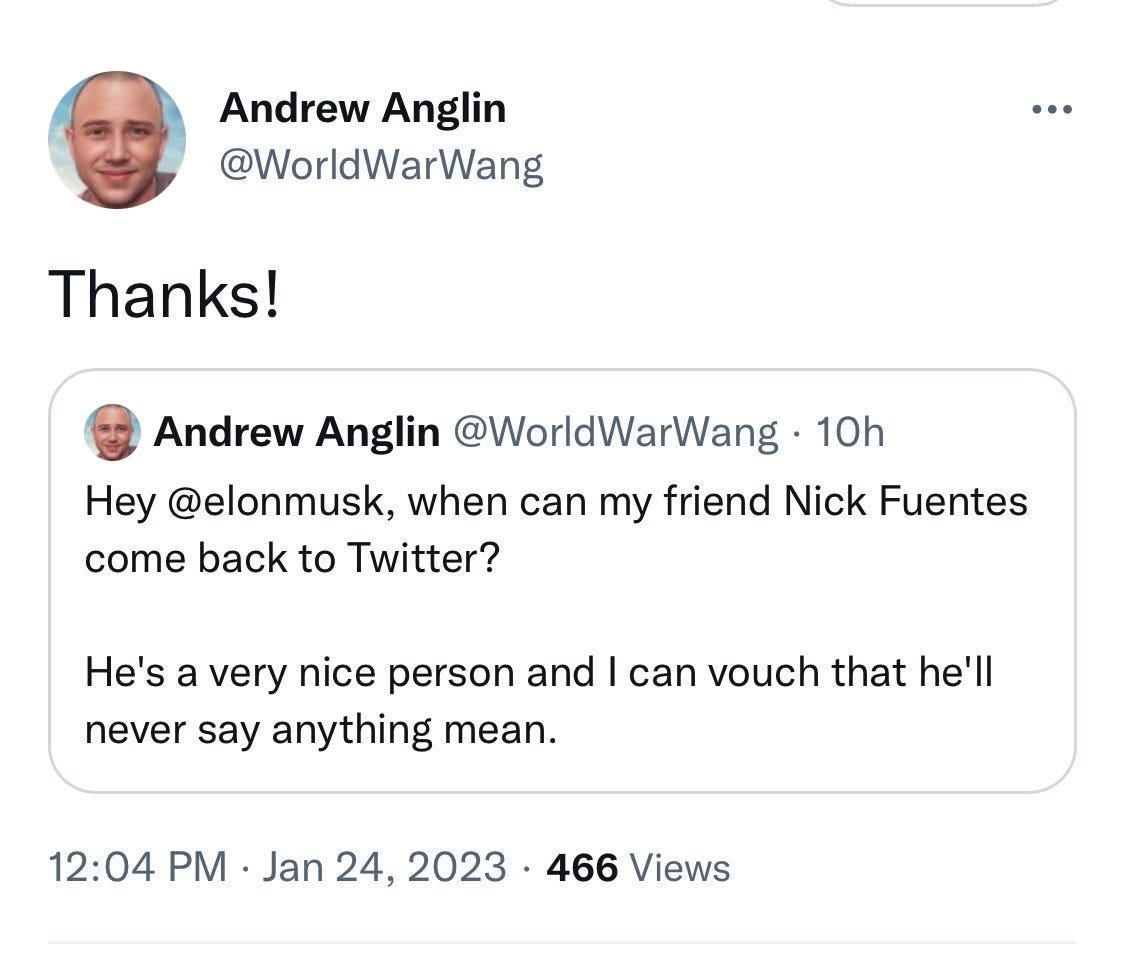
Fuentes, last seen here as Donald Trump’s dinner guest, was reinstated just hours after another actual Nazi, Andrew Anglin— who once described his approach as “Non-ironic Nazism masquerading as ironic Nazism” — asked Musk to bring his friend back on Twitter.

Anglin tweeted Musk that the Holocaust-denying, Jew-baiting Fuentes is “a very nice person and I can vouch that he’ll never say anything mean.”

Leah McElrath @leahmcelrathThe reinstatement of the Twitter account of Nick Fuentes came hours after Andrew Anglin—editor of the neo-Nazi website the Daily Stormer—publicly asked Elon Musk to let Fuentes back on Twitter: 2:51 PM ∙ Jan 24, 202393Likes66Retweets

Musk, apparently took him at his word, and Fuentes made his triumphant return, with his usual restraint, dignity, and class.

Image

**

Who is this new Musk-whisperer?

Back in 2017, The Atlantic profiled Anglin: “The Making of An American Nazi.”

Anglin is an ideological descendant of men such as George Lincoln Rockwell, who created the American Nazi Party in the late 1950s, and William Luther Pierce, who founded the National Alliance, a powerful white-nationalist group, in the 1970s. Anglin admires these predecessors, who saw themselves as revolutionaries at the vanguard of a movement to take back the country. He dreams of a violent insurrection.

But where Rockwell and Pierce relied on pamphlets, the radio, newsletters, and in-person organizing to advance their aims, Anglin has the internet. His reach is exponentially greater, his ability to connect with like-minded young men unprecedented.

Since then, Anglin has tried to rebrand himself as just a garden-variety American Nationalist, but this is mostly eye-wash for clueless billionaires. Notes the Anti-Defamation League:

In an effort to validate their leap from neo-Nazis to flag-waving American patriots, he and his followers equate American nationalism to white nationalism by claiming America was founded on anti-Semitic and racist principles.

**

Anglin is also one of the most vicious trolls on the far-right. I wrote about him in my book, “How the Right Lost Its Mind,” describing the explosion of harassment aimed at Jewish critics of Donald Trump at the time.

Many of the worst instances of harassment were connected to a website known as the Daily Stormer and its founder, a neo-Nazi activist named Andrew Anglin.

I first became aware of the site when I received, via email, a photoshopped image of my picture inside a gas chamber. A smiling Donald Trump wearing a German military uniform is poised to press the red “gas” button. The photoshopping tool had been created by the website and was widely used to troll both Jewish and non-Jewish critics of the Trump campaign.

The site takes its name from the German Nazi newspaper Der Stürmer,which was notorious for the viciousness of its anti-Semitic caricatures of Jews. After World War II, Der Stürmer’s publisher, Julius Streicher, was executed for crimes against humanity.

Anglin created the site in 2013 as an updated version of his previous website, which he called Total Fascism. As of this writing, the new website features pictures of Ronald Reagan and Donald Trump and the slogan “Daily Stormer— The World’s Most Goal-Oriented Republican Website.”

It is important to emphasize again that the Alt Right is a mansion with many rooms and some very real divisions. Anglin, for example, is not a fan of Milo Yiannopoulos, who is depicted on the Daily Stormer with a cartoon of the Jewish nose superimposed on his face and is referred to as “Filthy Rat Kike Milo.”

But Anglin is also interested in emphasizing the common ground among the various disparate groups and interests that make up the white nationalist movement. In his own guide to the Alt Right, Anglin notes that the movement included various factions, but that they had all been led “toward this center-point where we have all met. The campaign of Donald Trump is effectively the nexus of that centerpoint.”

Impressed by Trump’s rhetoric on illegal immigrants, Anglin endorsed Trump in 2015 and urged the readers of the Daily Stormer to “vote for the first time in our lives for the one man who actually represents our interests.”

After Trump called for barring Muslims from the country, the site declared: “Heil Donald Trump— The Ultimate Savior.” But Anglin’s greatest accomplishment was the creation of what he calls his “Troll Army,” which he uses to attack political opponents, deployed to great effect in early 2016.

After GQ magazine published a profile of Melania Trump by writer Julia Ioffe, the future First Lady took to Facebook to denounce the piece as “yet another example of the dishonest media and their disingenuous reporting.” Anglin quickly mobilized his Troll Army, posting an article headlined: “Empress Melania Attacked by Filthy Russian Kike Julia Ioffe in GQ!”

The post featured a picture of Ioffe wearing a Nazi-era yellow star with the word “Jude” and a call to action from Anglin:

“Please go ahead and send her a tweet and let her know what you think of her dirty kike trickery. Make sure to identify her as a Jew working against White interests, or send her the picture with the Jude star from the top of this article.”

The result was a torrent of abuse, including death threats against the journalist.

On Twitter, she was sent pictures of Jews being shot in the head and pictures of her wearing concentration camp stripes. When she answered her phone, a caller began playing a recording of a speech by Adolf Hitler.

“The irony of this is that today,” Ioffe told the British newspaper the Guardian, “I was reminded that 26 years ago today my family came to the US from Russia. We left Russia because we were fleeing antisemitism. It’s been a rude shock for everyone.”

The response from the GOP nominee was also troubling. When Trump was asked by CNN’s Wolf Blitzer about the anti-Semitic attacks and death threats, the future president pointedly refused to condemn them, pleading ignorance and saying, “I don’t have a message to the fans. A woman wrote an article that was inaccurate.”

Trump’s refusal to denounce the Troll Army was greeted with delight by Anglin, who immediately posted: “Glorious Leader Donald Trump Refuses to Denounce Stormer Troll Army.” He exulted:

“Asked by the disgusting and evil Jewish parasite Wolf Blitzer to denounce the Stormer Troll Army, The Glorious Leader declined. The Jew Wolf was attempting to Stump the Trump, bringing up Stormer attacks on Jew terrorist Julia Ioffe. Trump responded to the request with “I have no message to the fans” which might as well have been “Hail Victory, Comrades!”

**

Fast-forward to 2023:

Image

Jan Resseger looks behind the daily news and ties together fast-moving events in the red states. The sudden proliferation of voucher programs is no accident, she writes, nor is it a response to public demands. It is a carefully crafted, well-funded strategy to defund public schools, to smash teachers’ unions, and to implement a rightwing ideology that does not benefit students or improve education.

She writes:

This week in Iowa, Governor Kim Reynolds signed an Education Savings Account, universal voucher program into law. And last week in Utah, the same kind of voucher plan took the first step toward adoption when it was passed by Utah’s House of Representatives.

The Des Moines Register reports on Iowa’s new vouchers. The program will “phase in over three years and eventually allow all Iowa families to use up to $7,598 a year in an ‘education savings account’ for private school tuition. If any money is left over after tuition and fees, families could use the funds for specific educational expenses, including textbooks, tutoring, standardized testing fees, online education programs and vocational and life skills training. The $7,598 per private school student is the same amount of funding the state provides to public school students and is expected to rise in future years… The bill allows the Iowa Department of Education to contract with a third party to administer the education savings accounts, but the state has not yet issued a request for proposals from companies seeking to manage the funds.”

It would appear that the Iowa Legislature tried to calm the fears of the public school community by promising that, “Public school districts would also receive an additional $1,205 in funding for students receiving education savings accounts who live within the public school district’s boundaries.” But despite that promise, a drop in overall public school funding is expected: “By the fourth year, the (Legislative Services) agency estimates public school districts will receive $49.8 million in new per-student funds for private school students within the public district’s boundaries. The agency also expects a net decrease of $46 million in public school funding as a result of more students attending private schools.”

It is hard to keep track of all the states that now have school vouchers or are considering voucher programs and to know which states have the latest flavor of vouchers—Education Savings Accounts (ESAs). Most ESA programs, unlike Iowa’s, don’t even require that families use the vouchers at private schools. In most places, ESA’s can be used for educational programs, for educational tools and materials like books and computers, and for homeschooling. In some states families can use the money for so-called micro-schools in which families come together and hire a teacher to work with children in someone’s home.

Why is there so much so much legislative activity about expanding vouchers? Several factors are important to consider, and many of them were the subject of economist Gordon Lafer’s analysis in The One-Percent Solution. Lafer’s book focused on the public policy that flowed from state legislatures after the Tea Party wave election in 2010, but his observations are still on point as we begin 2023. Lafer enumerates all the reasons why far-right ideologues and big corporate moneyed interests seek to undermine and privatize public schools: “At first glance, it may seem odd that corporate lobbies such as the Chamber of Commerce, National Federation for Independent Business, or Americans for Prosperity would care to get involved in an issue as far removed from commercial activity as school reform. In fact, they have each made this a top legislative priority… The campaign to transform public education brings together multiple strands of the agenda… The teachers’ union is the single biggest labor organization in most states—thus for both anti-union ideologues and Republican strategists, undermining teachers’ unions is of central importance. Education is one of the largest components of public budgets, and in many communities the school system is the single largest employer—thus the goals of cutting budgets, enabling new tax cuts for the wealthy, shrinking the government, and lowering wage and benefit standards in the public sector all coalesce around the school system… There are always firms that aim to profit from the privatization of public services, but the sums involved in K-12 education are an order of magnitude larger than any other service, and have generated an intensity of corporate legislative engagement unmatched by any other branch of government. Finally, the notion that one’s kids have a right to a decent education represents the most substantive right to which Americans believe we are entitled, simply by dint of residence… (F)or those interested in lowering citizens’ expectations of what we have a right to demand from government, there is no more central fight than around public education. In all these ways, then, school reform presents something like the perfect crystallization of the corporate legislative agenda.” (The One-Percent Solution, pp 128-129)

It is hard for public school advocates to mobilize nationally against the expansion of vouchers. Voucher battles are fought state by state because public education and the funding of public education is a state-by-state issue. Advocates are likely to focus on public education legislation in their own state and not to pay attention to what’s happening elsewhere. And citizens are not likely to pay much attention to what is happening in the legislature. Once again, Gordon Lafer identifies the problem: “(M)any of the factors that strengthen corporate political influence are magnified in the states. First, far fewer people pay attention to state government, implying wider latitude for well-funded organized interests… Apart from labor unions and a handful of progressive activists, the corporate agenda… encounters little public resistance at the state level because hardly anyone knows about or understands the issues… So, too, corporate lobbies’ financial advantage is magnified in the states. Citizens United marked a sea change in state as well as federal politics.” (The One Percent Solution, pp. 34-36)

Christopher Lubienski, a professor of education policy at Indiana University who has studied the impact of school privatization and the politics around privatizing public schools, recently published a reminder that school privatization is driven by the power of the corporate agenda. Expansion of vouchers has never been an expression of voters’ overall preference: “School choice is continuing to expand across the United states…. But these successes often come in spite of overwhelming voter opposition to school choice programs… According to the pro-voucher organization EdChoice.org, the U.S. has over 75 publicly funded private school choice programs, including vouchers, and education savings accounts, as well as another 45 charter school programs. But all of these programs have been implemented by legislators, not the electorate… In fact, voters have been allowed to weigh in on school choice programs only nine times since 2000, and they almost always reject them, often by overwhelming margins. Only twice did school choice programs pass through the ballot box. In 2012, Georgia voters empowered their legislature with the ability to create charter schools. That same year… Washington voters passed a charter school referendum.”

Who are the far-right advocacy groups and think tanks powerfully promoting Education Savings Account vouchers? They include the usual suspects: the American Legislative Exchange Council and a state- by-state group of think tanks that are ALEC’s partners in the State Policy Network, EdChoice, the Goldwater Institute, the Heritage Foundation, and the Institute for Justice, which provides two model laws—“Education Savings Account Act: Publicly Funded,” and “Education Savings Account Act: Tax-Credit Funded“—so that state legislators can merely adapt a canned statute to their own state’s particular needs. SourceWatch reports corporate funding streams for these and other far-right think tanks that promote vouchers—funding from the Koch Brothers, the Bradley Foundation, and investments from the Donor’s Capital Fund, a powerful investor of corporate dark money since the 2010, U.S. Supreme Court ruling in Citizens United.

In the past two years, the campaign to undermine public schooling and promote the expansion of vouchers has developed a new strategy to convince parents that their children in public schools are being brainwashed by critical race theory and surrounded by discussion of gender and sexual orientation. In a new report published by the Network for Public Education this week, political scientist Maurice Cunningham traces the money behind what may appear to be a spontaneous emergence of parents’ groups—Parents Defending Education, Moms for Liberty, and No Left Turn in Education. Cunningham points to clues that these are not local grassroots groups of parents; their websites, for example, betray a big investment in communications. And while, for example, the founders of Parents Defending Education (PDE) claim to be a bunch of working moms, Cunningham explains: “PDE took in $3,178,272 in contributions and grants in 2021… Donor’s Trust, a dark money donor associated with the Koch network donated $20,250 to PDE in 2021. The Achelis & Bodman Foundation which funds voucher and charter school programs and targets public education, contributed $25,000. Searle Freedom Trust, another right-wing donor with ties to Donors Trust, contributed $250,000 in 2021. We don’t know all the names on the checks, but we do know that those checks had to be pretty large, that the attorneys and consultants sit at the hierarchy of right-wing operatives, and that the board members and staffers are connected to the highest levels of conservative donors including the Koch network.”

The same people who are promoting vouchers are working to scare parents with the huge, culture war campaign driven by identifiable funders and a mass of dark money supporting an education marketplace and undermining parents’ confidence in public schools. But as Christopher Lubienski, the scholar who has studied the effect of the privatization of public education reminds us, expanding vouchers has not improved the outcomes for our children: “(R)ecent research is repeatedly showing that… vouchers are not a good investment. Although publicly funded vouchers may be propping up some private schools that might otherwise go out of business, they are not really helping the people they purport to help. In fact… study after study shows that students using vouchers are falling behind where they would have been if they had remained in public schools. Thus, policymakers might think twice about defying voters on initiatives that actually cause harm to children.”

The political theorist Benjamin Barber warns that school choice does not really provide freedom for families: “We are seduced into thinking that the right to choose from a menu is the essence of liberty, but with respect to relevant outcomes the real power, and hence the real freedom, is in the determination of what is on the menu. The powerful are those who set the agenda, not those who choose from the alternatives it offers. We select menu items privately, but we can assure meaningful menu choices only through public decision-making.” (Consumed, p. 139)

John Thompson is a historian and a retired teacher in Oklahoma. He is also a meticulous researcher. Emily Oster is an economist at Brown University who said early in the pandemic that it was safe to open schools.

Thompson writes:

New post on Network for Public Education.

John Thompson: COVID and Schools

John Thompson takes a look at Emily Oster’s crusade to get school buildings open.

He writes:

When I started following Emily Oster’s links and critiquing her analyses of COVID in schools, I first worried about her simplistic conclusions such as, “The evidence is pointing in one direction. Schools do not, in fact, appear to be major spreaders of COVID-19.” Since Diane Ravitch posted on epidemiologists Abigail Cartus’ and Justin Feldman’s research, I better understand where Oster was coming from, and how “Oster’s emphasis on individualism and personal choice ring sweetly in the ears of the rightwing philanthropists.”

Oster went “viral” when arguing that educators’ fears were “overblown,” and that kids are “simply very unlikely to be infected.” But, as she made those claims, Oster ignored evidence that schools were significant spreaders, such as the CDC’s summaryof Wisconsin infections from Sept 3 to Nov16, 2020. That state’s schools were the 4th largest source of infections, following long term care and corrections facilities, and colleges; an estimated 14% of infections were linked to schools.

On the eves of Thanksgivings, when common sense said that holiday surges through Christmas and the New Year would be inevitable, Oster would double down on attacks on educators for not immediately reopening classrooms.As Rachel Cohenexplained, Oster’s 2020 data “reflected an extremely small and unrepresentative sample of schools.” There was not a single urban traditional public school reporting data across 27 states in her dataset, including from Florida [and] Texas…” Then, in November, Texas became the first state to have a million infections.

Worse, Cohen reported, “Rebekah Jones, a former Florida Department of Health data scientist who says she was fired in May over a refusal to manipulate her state’s COVID-19 stats, has publicly pushed back on Oster’s claims.” Jones “offered Oster full and free access to their data. ‘But she [Oster] basically decided to just pick what data she wanted, not what’s available.’” Jones added, “‘It’s offensive to researchers, when you see something so unabashedly unscientific, and when the opportunity to do something scientific was there.’”

Before long, I worried that Oster, an economist, was following in the path of economists who didn’t know what they didn’t about public schools and didn’t listen to educators regarding the flaws in their data-driven corporate school reforms. For instance, Oster seemed to disregard about 20% of the U.S. population [who] lived in homes with at least two adult generations or grandparents and grandchildren under 25 in 2016, according to an analysis of census data by the Pew Research Center. And the dangers of spreading COVID from students to older family members was greater in low-income Black and Brown households.

Also, Oster ignored qualifications made by researchers, such as the Duke University study finding that masks can minimize the spread in schools. Inresponse to my questions on methodology, co-author Daniel Benjamin volunteered what it takes to safely reopen schools:

Is that there is 99% mask compliance for every person in the mainstream curriculum that steps on school property. It’s the mitigation strategies—distancing, masking, hand hygiene that are crucially important. If a school district does not do these things, they will likely make the pandemic worse by being open. This is why we don’t advise “you should open” or “you should go remote”…. It’s all about the public health measures.

At that time, I worried about Gov. Ron DeSantis and Oklahoma Gov. Kevin Stitt citing Oster while pressuring schools to open up and drop protections. Neither did I understand why more journalists were not challenging her misuse of sources, and her repeated attacks on teachers unions, especially in publications funded by the Billionaires Boys Club. I sensed Oster’s methodology would cost lives. But, I didn’t want to prejudge researchers at a time when lives were on the line, so I didn’t connect the dots.

But Cartus and Feldman connect the dots and write about Oster’s important role in making:

The “data-driven” case for peeling away successive layers of COVID mitigations: first ending remote instruction in favor of hybrid learning, then ending hybrid learning in favor of a full return to in-person instruction, then eliminating quarantine for those exposed to the virus. … Her vision for schooling during the pandemic ultimately involves abandoning universal public health measures altogether, turning masking and vaccination into individual, personal choices.

Cartus and Feldman address my question why her work “attracted little scrutiny.” It was more than journalists and experts being unaware of the differences between the highest poverty schools and the schools their children attend. Most importantly her work:

Has been funded since last summer by organizations that,without exception, have explicit commitments to opposing teacher’s unions, supporting charter schools, and expanding corporate freedom. In addition to grants from the Chan Zuckerberg Initiative, the Walton Family Foundation, and Arnold Ventures, Oster has received funding from far-right billionaire Peter Thiel. The Thiel grant awarded to Oster was administered by the Mercatus Center, the think tank founded and financed by the Koch family.

Cartus and Feldman went deeper than I did in explaining the damage that Oster prompted. For instance, in her “2020 article in The Atlantic, ‘Schools Aren’t Super-Spreaders,’ Oster “assured readers in no uncertain terms that COVID transmission simply did not occur in schools at a rate that would necessitate closures.” But the analysis underlying the piece “drew on a sample of miniscule size—a mere two weeks of school data, reported in the second half of September 2020.” The sample was also biased by the fact that it was collected only from schools voluntarily participating in the Dashboard.

Cartus and Feldman then noted what so many journalists ignored, “The second half of September 2020 coincided with the very beginning of a national uptick in cases that would eventually become the punishing surge of winter 2020-21.”

When the press mostly failed to investigate the red flags that Oster’s work should have raised, “it became an article of faith that the laws of physics governing viral transmission don’t apply to schools, even as evidence of in-school viral transmission has mounted throughout the pandemic.”

Oster et.al’s “declarations of victory ignore[d] a growing body of research that has found schools contribute substantially to community coronavirus transmission, especially in the absence of adequate mitigation. The proclamation of “choice” that she justifies is really:

The ‘choice” to cast off obligations to others: the permission she offers affluent parents to disengage from the social contract. While the privileged seek a return to normalcy—or some sicker, poorer approximation of it—COVID will continue to infect and kill the working class and people of color at disproportionate rates.”

Now, history may be repeating itself. To quote National Public Radio, “People say they are done with COVID, but COVID is not done with us.” When we take stock of the interrelated harm done by anti-vaxers, anti-maskers, rightwingers, and their funders, as well as mistakes made by the CDC, we must draw upon Cartus’ and Feldman’s first draft of the history Emily Oster’s stardom.

You can view the post at this link : https://networkforpubliceducation.org/blog-content/john-thompson-covid-and-schools/

———-

Nancy MacLean, professor of history at Duke University, and Lisa Graves, board president of the Center for Media and Democracy, warn readers not to be fooled by billionaire Charles Koch’s efforts to rebrand himself as a nice guy who has mellowed, who no longer wants to fund divisive, hateful organizations. A nice guy.

The media fell for it. The new, nice Charles Koch.

MacLean and Graves write: Don’t believe it. Koch won’t stop until democracy is dead.

They write:

Koch, the single most influential billionaire shaping American political life, never changed course. And the head fake he pulled off in 2020 succeeded in securing for his vast donor network—and the hundreds of organizations they underwrite—the freedom to operate, virtually without scrutiny, over the two years since. In that time, far from ceasing their efforts to divide the country, they have ramped them up. Like a snake shedding its skin as it grows, Koch was merely rebranding—yet again after exposure—and grouping his numerous operations under a sunny new name: Stand Together.


In August, the Center for Media and Democracy (CMD) reported that Koch-funded organizations spent over $1.1 billion in the 2020 election cycle. At the same time his book claiming to have changed course was in press, Koch spent almost 50 percent more than the record amount the Koch network had raised in the 2016 cycle: $750 million. Koch did not endorse Trump, though his spending buoyed the top of the ticket and helped maintain a GOP Senate majority to secure Koch-backed policies and judicial nominees embraced by Trump.

One of these organizations, Koch’s Americans for Prosperity (AFP), a 501(c)(4) tax-exempt organization, claimed it was involved in more than 270 races in the 2020 election, reaching almost 60 million voters with door-knocking, phone calls, postcards, digital ads, and more. AFP also played heavily in the battle for U.S. Senate seats in Georgia, in January 2021—even as Koch was still getting favorable coverage for his supposed withdrawal from divisive electoral politics. AFP Action, the super PAC arm, alone raised and spent $60 million nationwide in that election cycle.

Meanwhile, other key organizing enterprises, think tanks, litigation outfits, campus centers, and more that were previously backed by the Koch network continue operating today, sometimes under new names, and with expanded funding. These include endeavors we consider unethical, only some of which we have the space to highlight here.

Take, for example, Koch’s longest running quest: enchaining democracy by rigging the rules of governance to free corporations from customary oversight and to prevent the will of the vast majority of Americans from securing federal, state, and local policies to improve their lives. With the connivance of Trump, the generalship of Federalist Society leader Leonard Leo, and the well-funded campaigning of Leo’s Judicial Crisis Network, the arch-right billionaire succeeded in capturing a supermajority in the U.S. Supreme Court. Koch had told his allied billionaire backers that this was one of his top priorities for the Trump Administration—along with the dramatic tax cuts for corporations and the wealthy that he also secured.

Senator Sheldon Whitehouse, Democrat from Rhode Island, a climate hero and senior member of the Senate Judiciary Committee, exposes how they did it in a recently published book, The Scheme: How the Right Wing Used Dark Money to Capture the Supreme Court. The long effort to reshape the judicial system, going back to the notorious Lewis Powell Memo of 1971, culminated in the Trump Administration’s appointment of more than 230 “business-friendly” federal judges, including three Supreme Court Justices, in a project overseen by longtime Koch allies Leo and Donald McGahn, who served as Trump’s legal counsel until 2018. The 6-3 stacked court is already delivering bombshell decisions for the coalition that put it in power, from undermining our options for mitigating devastating climate change and limiting the power of agencies to regulate corporations, to revoking people’s Constitutional freedom to decide whether and when to bear children. The current court term with the Koch-backed faction in control is expected to soon overthrow affirmative action and other hard-won reforms.

The Koch-funded American Legislative Exchange Council (ALEC) also continues its long campaign to shackle democracy on behalf of its corporate backers. Passing voter ID restrictions that make it harder for Americans to exercise their right to vote became a top ALEC priority after the United States elected its first Black President, Barack Obama. That measure was first voted on at an ALEC task force meeting co-chaired by the National Rifle Association in 2009.

ALEC is one of the nation’s leading promoters of charter schools, vouchers, and anti-union legislation. You can learn more about ALEC by reading Gordon Lafer’s The One Percent Solution.

Please open the link and read the article. Learn about the “new” Charles Koch, same as the old one.

If you are looking for a good read, read Nancy MacLean’s Democracy in Chains, which provides the context for understanding the links between the Koch brothers, Milton Friedman, and free-market economics. Suffice it to say that one of their goals was to privatize Social Security. Still working on that.

Anne Nelson writes in The New Republic about 10 people you probably never heard of. Each of them is intent on destroying democracy. At the center of this group is the Bradley Foundation, a major funder of vouchers since the 1990s. Vouchers play a central role in the effort to undermine democracy. If they can take down and privatize public schools, they can do the same to other public institutions.

Here are a few of the malefactors:

Larry Arnn
President, Hillsdale College

For decades, Michigan-based Hillsdale has served as an academic partner for the religious right. The college has had a close relationship to the Council for National Policy, the secretive Christian right umbrella organization that directs so much right-wing activism, through Arnn and his predecessor, George Roche III (who left in a cloud of scandal). Hillsdale’s major donors have constituted a who’s who of the radical right, including the Koch network and leading figures from the CNP. Arnn has expanded Hillsdale’s role as a platform for the CNP’s network of megadonors, fundamentalist activists, and media outlets, providing their policy prescriptions with a thin veneer of academic respectability. The college enrolls around 1,500 students, but its leaves an outsize footprint in political messaging. Its highly politicized publication Imprimis is sent to more than six million recipients. Hillsdale operates the Kirby Center in Washington, D.C., where it has groomed young conservatives at the Capitol Hill Staff Training School, run by the Leadership Institute (see Morton Blackwell, below). Hillsdale is also playing a role in the current disruption of public education, which has been used for political leverage in Virginia and beyond. In 2020, Donald Trump appointed Arnn chair of the 1776 Commission, to promote a “patriotic” rebuttal to the 1619 Project’s racially inclusive approach to U.S. history. Hillsdale has led an ongoing campaign to politicize public schools, promoting anti–critical race theory campaigns and assisting in the launch of “affiliate” charter schools in 11 states.


Joe Seales
CEO, Right Side Broadcasting Network

RSBN serves as the equivalent of a Trump-specific C-SPAN that has carried nearly every Trump speech, rally, and town hall since July 2015, as well as full coverage of the pro-Trump Conservative Political Action Conference (CPAC). It also broadcasts a show called The Right View, with Trump daughter-in-law Lara Trump. On January 6, it livestreamed Trump’s speech inciting the march on the Capitol, and it gave live coverage to the Florida “Freedom Rally to Show Support for President Trump and January 6th Political Prisoners” a year later. In July 2021, RSBN was temporarily suspended by YouTube, but the network looked to its own app and the new pro-Trump platform Rumble to continue to carry Trump’s rallies. The radical right has been assiduously constructing a parallel media system in recent decades. RSBN, Rumble, and Trump’s new Truth Social platform complement other media initiatives, ranging from traditional fundamentalist broadcasters like American Family Radio to social sites like Gettr and Parler, in the ongoing construction of an alternate political reality for millions of followers. In March 2022, after the height of the Ottawa truckers’ protests, RSBN promoted a truckers’ convoy roundtable hosted by Representatives Matt Gaetz and Marjorie Taylor Greene, and it has offered ongoing amplification of Trump’s false election fraud claims. We can be sure that whatever Trump fabricates for future news cycles, RSBN will be repeating it.

There are eight more. How many do you know?

Jelani Cobb, a staff writer for The New Yorker, wrote that he abandoned Twitter after Elon Musk took over. I have been on Twitter for at least ten years, and I am as upset as Cobb. Unfortunately there is no social media platform comparable to Twitter. Its competitors—Mastodon and the Post—each have less than a million followers. Twitter has 250 million. I rely on Twitter to spread my blog posts to about 150,000 followers, who retweet them to their followers. I registered at Post, which says it will be a site for civility. I tried to register for Mastodon, but it’s segmented in a way that made no sense to me.

I don’t know what I will do in the future. But if Twitter becomes a haven for racists, anti-Semites, and conspiracy mongers, I have to go. The Washington Post reported yesterday that Musk has restored the accounts of a flock of QAnon folk, theofascists, and white supremacists. Their comments appeared alongside the ads of major corporations, which may well abandon Twitter.

Musk likes to say that he is restoring free speech by restoring the accounts of Nazis and other haters. He sees Twitter as the nation’s or the world’s town square. But it’s ludicrous to imagine that the richest man in the world owns the town square and freely silences his own critics.

Apparently, he is purging left wing accounts from Twitter and inviting rightwingers to help identify Antifa and “pedo” accounts, according to The Intercept.

I read the other day that some rightwing group had compiled a list of 5,000 Antifa accounts and asked Musk to suspend them. I couldn’t read the whole list, but I saw Senator Bernie Sanders and Governor Gavin Newsom on it, as well as others who have nothing to do with Antifa. I was reminded of Senator Joe McCarthy’s list of Communists in the government, which he kept in his breast pocket. The number kept changing.

Among other Musk-directed changes, Twitter will no longer block publication of misinformation about COVID-19. Musk has invited the anti-maskers, the anti-vaxxers, and the peddlers of Ivermectin back to Twitter.

When I read Elon Musk’s personal Twitter feed, I get alarmed. He posted a meme of a cartoon frog (Pepe the Frog) that the alt right has used to make anti-Semitic and racist allusions, according to the Anti-Defamation League. He tweeted a picture of his night table, which held a gun and four empty cans of Coca-Cola. In the background was another gun, apparently an antique. He has a lot of children. What if one picked up his pistol and fired it, thinking it was a toy. His next Tweet was an apology for not putting the cokes on coasters. His Tweets skewer anything he perceives as liberal or left.

Cobb wrote that Twitter was important in spreading news, that it played a unique role in disseminating the George Floyd video, which set off widespread demonstrations. In the past, Twitter has been a valuable platform for information.

Cobb wrote:

The singular virtue of the fiasco over which Musk has presided is the possibility that the outcome will sever, at least temporarily, the American conflation of wealth with intellect. Market valuation is not proof of genius. Ahead of the forty-four-billion-dollar deal that gave Musk private control of Twitter, he proclaimed that he would “unlock” the site’s potential if given the chance. His admirers hailed his interest with glee. Musk has been marketed as a kind of can-do avatar, a magical mix of Marvel comics and Ayn Rand, despite serial evidence to the contrary, like the allegations of abusive treatment of Tesla workers.

Mike Tyson famously observed that “everyone has a plan until they get punched in the mouth.” The facile idea was that, as Kara Swisher pointed out on her podcast, Musk was potentially the one person who could solve Twitter’s long-term profitability problem. Such praise paved the way for the current state of affairs, where many, including Musk himself, believe Twitter’s collapse might be imminent. (Swisher, to her credit, later pointed out where Musk went astray, taking particular note of his tweet, which she deemed homophobic, regarding the assault on Paul Pelosi.)

My decision to leave yielded a tide of farewells but also two other types of responses. The first was low-grade trolling that had the effect of validating my decision to depart. But the second was more nuanced and complicated, an argument that leaving offered a concession to the abusive, reactionary elements whose presence has become increasingly prominent since Musk took over. One person paraphrased the writer Sarah Kendzior, urging users to “never cede ground in an information war.” Those arguments are increasingly frail, though. If there is, in fact, an information war raging on Twitter, Musk is a profiteer. Twitter is what it always was: a money-making venture—just more nakedly so. And it now subsidizes a billionaire who understands free speech to be synonymous with the right to abuse others. (While claiming to champion free speech, Musk has selectively granted it, suspending accounts that are critical of him and firing employees who dissented from his view of how the company should be run.) The tech industry’s gimmick to monetize our attention has been astoundingly successful even if Twitter has habitually struggled to be profitable. In the end, Musk’s leadership of the company appears to be a cynical form of trolling—creating a welcoming environment for some of the platform’s worst actors while simultaneously hailing his new order for its inclusivity.

To the extent that people remain active on Twitter, they preserve the fragile viability of Musk’s gambit. The illusory sense of community that still lingers on the platform is one of Musk’s most significant assets. No matter which side prevails, the true victor in any war is the person selling weapons to both sides. It seems likely that this experiment will conclude with bankruptcy and Twitter falling into the hands of creditors who will have their own ideas of what it should be and whom it should serve. But at least in the interim it’s worth keeping in mind that some battles are simply not worth fighting, some battles must be fought, but none are worth fighting on terms set by those who win by having the conflict drag on endlessly. ♦