Archives for category: Billionaires

David Shipley, editor of the Washington Post editorial page, took responsibility for spiking the cartoon by Ann Telnaes, an act that touched off a firestorm of controversy.

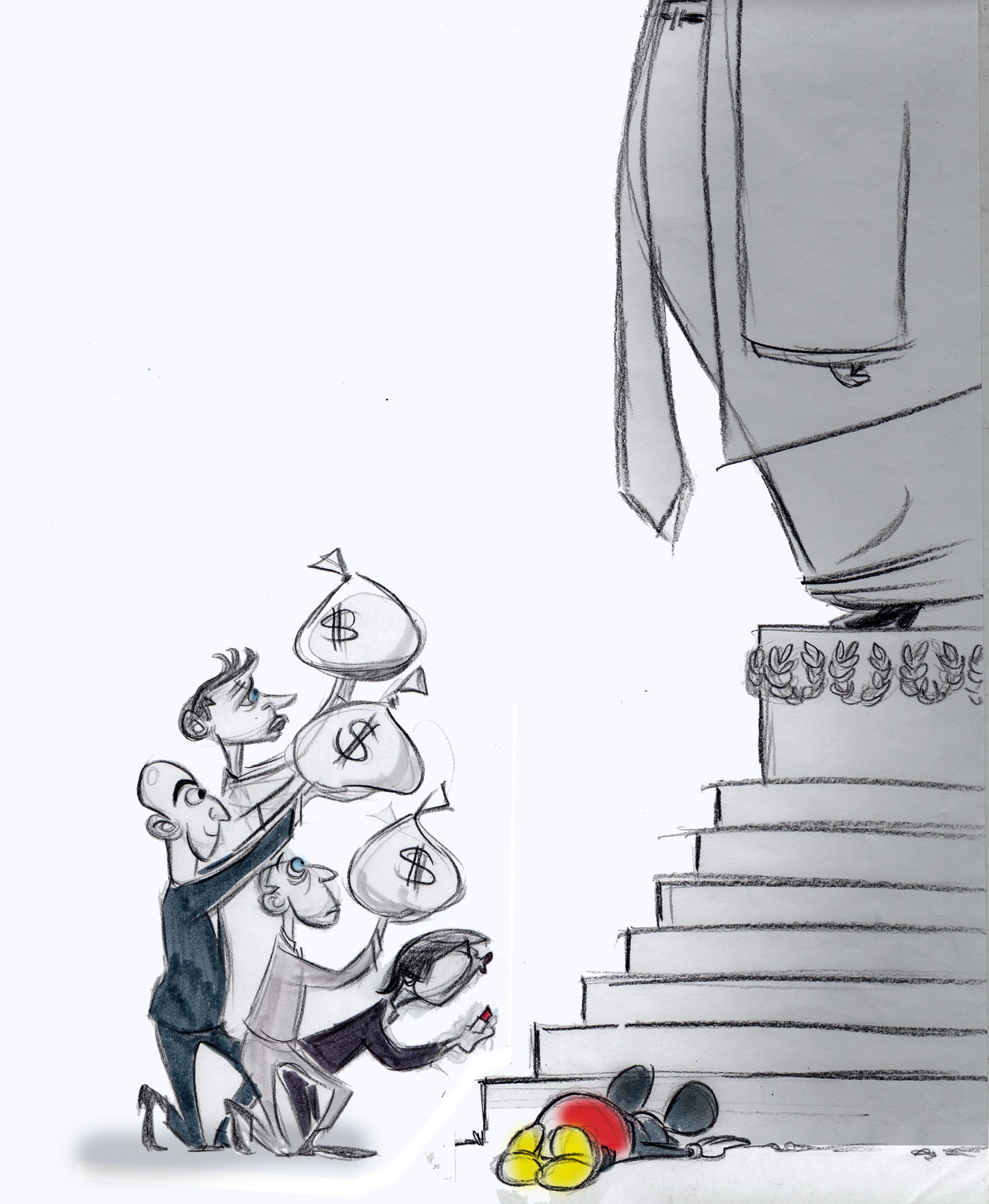
The cartoon showed several billionaires, including Jeff Bezos, paying homage to Trump.

Shipley stopped publication because, he said, the cartoon was repetitious of articles on the same subject.

Telnaes announced her resignation in a sharply worded piece on Substack.

Shipley sent the following letter to staff at the Post. By now, they must be deeply demoralized, given Bezos’ intervention to block the editorial board’s endorsement of Kamala Harris., his gift of $1 million to Trump for his inauguration, and the Amazon payment of $40 million to Trump for the license to the life story of Melania, produced by Melania. Bezos owns Amazon.

Shipley wrote:

Dear DOO,

It’s been nearly a week since Ann Telnaes resigned. I’ve been gathering my thoughts in that time and there are a few things I’d like to share. Given the depth of the response, and some of the assumptions that have been made, I hope you’ll read to the end.

Let me start with the basics.

Our owner, in his own words, is a “complexifier.” Jeff supports a news organization while having significant interests (and work) elsewhere. His support allows The Post to exist and produce excellent, independent journalism; it also means that editorial decisions can be viewed by the outside world through the prism of his ownership.

My decision not to run a cartoon by Ann in which Jeff was depicted is being viewed through this prism. I believe I made a sound editorial decision. Ann felt otherwise. She offered her interpretation. I’d like to offer mine.

First, I decided not to run the cartoon because it was repetitive. When I learned of Ann’s piece, we had just published a column on billionaire visits to Trump (with a clear mention of our owner) and we had a satire piece on the same topic underway (also with a clear reference to our owner). Yet another piece in the span of a few days struck me as overkill.

This is a subjective judgment, but it is a subjective judgment in sync with a longstanding approach. In my time here, we have focused on reducing the number of articles we publish on a given topic and from the same point of view within a given time frame – all as a way to improve the overall quality and variety of our report.

To that same end, I did not feel the cartoon was strong. Could it have been made better? Possibly. In fact, we’d recently worked with Ann on a cartoon that had gone through edits and was published after she and editors had finished working together.

In this regard, I regret that we did not have the opportunity to revisit this possibility. In what (unfortunately) turned out to be my final conversation with Ann last Friday afternoon, it was my understanding that she and I had agreed to take the weekend to consider options and that we would speak on Monday. I respect Ann’s work and was actively considering her suggestions bar one – the idea that we add language to her contract restricting editing – when she put out her Substack on Friday night, closing the door on any possibility of further discussion.

The decisions on redundancy and quality were both judgments on my part. I stand by them. At no point did I discuss any of this with Will Lewis or Jeff Bezos. This was my call.

Now let me share a couple broader thoughts. Do I pay extra attention if Jeff is in a column or a cartoon or the subject of a story? Of course I do. Does this prevent us from commenting on him? No. Look at the record. The two other pieces we ran – pieces I saw and was aware of – should dispel that bit of mythology. Do we allow dissent? Yes. Erik Wemple published a chat taking issue with my actions. Letters to the editor will do the same. If you have additional doubts, look at our published response to the decision not to run a presidential endorsement. If the work is good, if it is relevant, if it advances the story, we’ll publish it. This is my prism.

My job is a balancing act. Was I extra careful here? Sure. It’s obviously true that we have published other pieces that are redundant and duplicative. We have also published things that others judged strong and effective, and I did not. So, yes, scrutiny is on high when it comes to our owner.

But this extra scrutiny has a purpose. I am trying to ensure the overall independence of our report. Though we have a “complexifying” owner, I will not use that as a reason to exempt him from the evenhandedness we ought to extend to any public figure (an evenhandedness other news organizations extend to their owners). Nor will coverage of him be an exception to our strategic turn toward heightened curation and diminished repetition. By exercising care, we preserve the ability to do what we are in business to do: To speak forthrightly and without fear about things that matter.

I know many of you are concerned that we might be wavering in this regard. I get that concern, but I don’t think it’s true. I believe that The Post’s business success depends on its integrity and its independence. These things cannot be separated. If you don’t have them, you don’t have a business – nor are you adhering to the mission that this newspaper has always held dear. As the person responsible for this department, I am guided by this belief. And if I believe we can’t act on it any longer, I will share that feeling with you and act accordingly. But that’s not what’s happening now.

America and the world are entering a complicated moment. It’s one in which honesty, clarity of thought, fair-mindedness and courage will be required. These are the values that will guide our coverage – and my judgments. This is who we are, and it’s my belief that our work shows it.

D.

P.S. Many of you have already shared your (varied) views on the situation; please know that my door is always open to discuss decisions. I want to hear your thoughts about how we do what we do.
Dan Rather, the fearless reporter for “60 Mibutes,” now retired, writes about Jeff Bezos’ ham-handed interference with the editorial independence of The Washington Post. The moral of the story is that newspapers should not be owned by billionaires with other financial interests, especially those who need a good relationship with the President, like Bezos. Why should Bezos cut staff because the Post is losing money? His net worth is more than $200 billion. Why destroy one of the nation’s greatest newspapers to recoup $77 million in losses? That’s chump change for Bezos.

When a journalistic institution is the one making headlines, it’s rarely good news. Such is the case for a revered American newspaper, The Washington Post. A mothership of American journalism, whose reporters helped topple an American president and inspired generations of young reporters, is listing and taking on water.

As Donald Trump and his army of “alternate” truth-tellers get ready to take the reins of government again, the country desperately needs the best and brightest journalists watching and reporting on their every move. And yet we wake to news that the Post is expected to lay off dozens more staffers the very month Trump returns to power.

The 147-year-old newspaper is apparently bleeding money, a problem of its own making. When billionaire Post owner Jeff Bezos pulled the newspaper’s endorsement of Kamala Harris just days before the election, a reported 250,000 readers cancelled their subscriptions in protest. That accounts for 10% of the paper’s online audience.

“I just cancelled my Washington Post subscription. The web site asked why, and the closest option was ‘concern with the content.’ There was no option about surrendering to fascism, but that’s the real reason,” a former subscriber posted on X.

For Bezos, founder of Amazon, the Post’s financial losses are peanuts considering his $200 billion plus net worth. But his love of the paper and his passion for quality journalism seem to be shrinking.

Back in 2013, when Bezos bought the Post from the family of venerated publisher Katharine Graham, he said he wanted to transform it from a regional newspaper to a global one. He provided money — big money — to expand the newsroom and encouraged reporters to extend their reach by embracing the “gifts of the internet.”

Over the ensuing decade, his interest in the paper ebbed and flowed, but he mostly stayed out of the editorial decision-making. Then he pulled the Harris endorsement causing an exodus of top editors, opinion writers, and reporters.

But Bezos wasn’t done burnishing his rep with the former president. After the election, he pledged $1 million to help pay for Trump’s inauguration and agreed to stream it live on Amazon Prime (an additional $1 million in-kind contribution). Just before Christmas, he was seen at Mar-a-Lago, kissing the ring with fellow super-rich guy Elon Musk. And he has green-lit a documentary about Melania Trump to air on Prime. I’m guessing it will be what’s known in the trade as a “sweetheart profile.”

While it isn’t great that the owner of one of the most important papers in the country is cozying up to an incoming president who says he will be a dictator on “day one,” Bezos’s actions aren’t surprising. He didn’t become a billionaire by being selfless.

But on Friday, things took another turn at the Post. Pulitzer Prize-winning editorial cartoonist Ann Telnaes quit in protest after a cartoon of hers was killed.

In a piece she published on Substack, Telnaes explained that “there have been instances where sketches have been rejected or revisions requested, but never because of the point of view inherent in the cartoon’s commentary. That’s a game changer…and dangerous for a free press…”

Since 2005, a third of newspapers in the United States have folded, and two-thirds of newspaper reporters are gone. On an Axios podcast, Victor Pickard, a professor of media policy and political economy at the University of Pennsylvania, explained that “We no longer have a commercial market that can support the levels of journalism that democracy requires.”

Another model needs to be found, and fast. We’ve learned the hard way that benevolent billionaires aren’t going to rescue American journalism. Smarter people than I are working on ways to do just that … an important topic for another Steady down the road.

In the meantime, fingers crossed. As I have said over the years and repeat now for emphasis: A free and independent — fiercely independent when necessary — press is the red beating heart of democracy.

Bloomberg.com reported that the 500 richest people in the world have $10 trillion in wealth.

The biggest winners were leaders of the tech industry. Elon Musk is the richest man in the world, with a fortune exceeding $400 billion.

The world’s 500 richest people got vastly richer in 2024, with Elon Musk, Mark Zuckerberg and Jensen Huang leading the group of billionaires to a new milestone: A combined $10 trillion net worth.

An indomitable rally in US technology stocks played a key role in turbocharging the trio’s wealth, as well as the fortunes of Larry Ellison, Jeff Bezos, Michael Dell and Google co-founders Larry Page and Sergey Brin. The eight tech titans alone gained more than $600 billion this year, 43% of the $1.5 trillion increase among the 500 richest people tracked by the Bloomberg Billionaires Index.

But consider this: The United States is considered the richest country in the world, and yet 37.9 million (11.5%) of its residents live in poverty.

The tech bros could pool their excess billions and end poverty in America. Imagine if each of the top 500 contributed $1 billion to a fund to end poverty. What’s $1 billion to someone with $10 billion or $50 billion or $400 billion. Pocket change.

Another thought: as the richest grew richer, homelessness soared. The Boston Globe reported on the homelessness statistics for every state.

Homelessness is on the rise across the country, including in Massachusetts, which had the third largest increase among all states in 2024.

The number of people experiencing homelessness across the nation rose 18.1 percent between 2023 and 2024, according to new data from the federal housing agency’s annual report to Congress. In New England, the data showed diverging trends, with two states, Massachusetts and Rhode Island, reporting steep increases, while two others, Maine and New Hampshire, had smaller homeless populations.

In Massachusetts, the homeless population increased by 53 percent, to about 29,300 in 2024, from just over 19,100 the year before. That’s nearly three times the national rate, and behind only Illinois and Hawaii. Massachusetts is unusual among states in that it has a right-to-shelter law, so the majority of homeless families had a place to sleep indoors in a state-sponsored facility.

In New York State, where I live, 158,000 people are homeless, a 53% increase from 2023 to 2024.

In California, 187,000 are homeless, an increase of 3%.

During the pandemic, the Biden administration expanded the child tax credit, and child poverty plummeted. But Republicans refused to renew the higher payments proposed by Biden, and child poverty rate more than doubled from 5.2% in 2021 to 12.4% in 2022, according to the US Census Bureau.

I recommend to you a book called The Spirit Level: Why Greater Equality Makes Societies Stronger. It was written by British sociologists Richard Wilkinson and Kate Pickett. The more equality, the happier people are. Extreme inequality contributes to envy, rage, and despair.

Again, the fabulously wealthy tech bros could end poverty in America. But I’m not holding my breath. They are too engaged in competing to see who can amass the biggest fortune.

Ann Tolnaes is a brilliant cartoonist who resigned from The Washington Post when her latest cartoon was cancelled. It depicted the media and tech oligarchs bowing and scraping to Trump, including the owner of The Washington Post, Jeff Bezos.

The editor of the opinion section said he killed the cartoon because the paper had run a story on the same topic, and the cartoon was repetitious. I found that hard to believe because cartoons typically comment on stories in the news; they don’t break news.

He also said she had been invited to return. We will see what happens. The whole episode was widely publicized and is a stain on the newspaper’s reputation, especially since Jeff Bezos intervened and canceled the paper’s endorsement of Kamala Harris in the closing days of the campaign.

For another telling of this important story, read the article by Mike Peterson in The Daily Cartoonist about the controversy and about Ann Tolnaes’s importance. He reprints several of her cartoons, explains how to order a book of her cartoons (bypassing Amazon), and suggests we show our support by subscribing to her Substack blog. I just subscribed.

Thanks to reader John Ogozalek for directing me to this insightful commentary.

Ann Telnaes, editorial cartoonist for the Washington Post since 2008, quit her job after one of her cartoons was censored by higher-ups. The cartoon at issue depicted tech and media billionaires paying obeisance and money to Donald Trump. The cartoon included portrayals of Mark Zuckerberg (META), Sam Altman (AI), Patrick Soon-Shiong (Los Angeles Times), and Jeff Bezos, owner of the Washington Post. And, of course, Disney, which settled with Trump for $15 million rather than defend George Stephanopoulos in court. Each has given Trump $1 million or more to underwrite his inauguration. If Telnaes had waited a day, she would have added Tim Cook, CEO of Apple, to her list of suck-ups and sycophants.

The motto of the Washington Post is: “Democracy dies in darkness.” Conservative (but anti-Trump) lawyer George Conway wrote on BlueSky:

I guess the new slogan for the Washington Post ought to be:

“Newspapers die in cowardice.”

Ann Telnaes’ resignation is an act of courage that should inspire all of us to stand by our principles.

Telnaes wrote about her decision to resign on her Substack blog:

I’ve worked for the Washington Post since 2008 as an editorial cartoonist. I have had editorial feedback and productive conversations—and some differences—about cartoons I have submitted for publication, but in all that time I’ve never had a cartoon killed because of who or what I chose to aim my pen at. Until now.

The cartoon that was killed criticizes the billionaire tech and media chief executives who have been doing their best to curry favor with incoming President-elect Trump. There have been multiple articles recently about these men with lucrative government contracts and an interest in eliminating regulations making their way to Mar-a-lago. The group in the cartoon included Mark Zuckerberg/Facebook & Meta founder and CEO, Sam Altman/AI CEO, Patrick Soon-Shiong/LA Times publisher, the Walt Disney Company/ABC News, and Jeff Bezos/Washington Post owner. 

While it isn’t uncommon for editorial page editors to object to visual metaphors within a cartoon if it strikes that editor as unclear or isn’t correctly conveying the message intended by the cartoonist, such editorial criticism was not the case regarding this cartoon. To be clear, there have been instances where sketches have been rejected or revisions requested, but never because of the point of view inherent in the cartoon’s commentary. That’s a game changer…and dangerous for a free press.

(rough of cartoon killed)

Over the years I have watched my overseas colleagues risk their livelihoods and sometimes even their lives to expose injustices and hold their countries’ leaders accountable. As a member of the Advisory board for the Geneva based Freedom Cartoonists Foundation and a former board member of Cartoonists Rights, I believe that editorial cartoonists are vital for civic debate and have an essential role in journalism. 

There will be people who say, “Hey, you work for a company and that company has the right to expect employees to adhere to what’s good for the company”. That’s true except we’re talking about news organizations that have public obligations and who are obliged to nurture a free press in a democracy. Owners of such press organizations are responsible for safeguarding that free press— and trying to get in the good graces of an autocrat-in-waiting will only result in undermining that free press.

As an editorial cartoonist, my job is to hold powerful people and institutions accountable. For the first time, my editor prevented me from doing that critical job. So I have decided to leave the Post. I doubt my decision will cause much of a stir and that it will be dismissed because I’m just a cartoonist. But I will not stop holding truth to power through my cartooning, because as they say, “Democracy dies in darkness”.

Thank you for reading this.

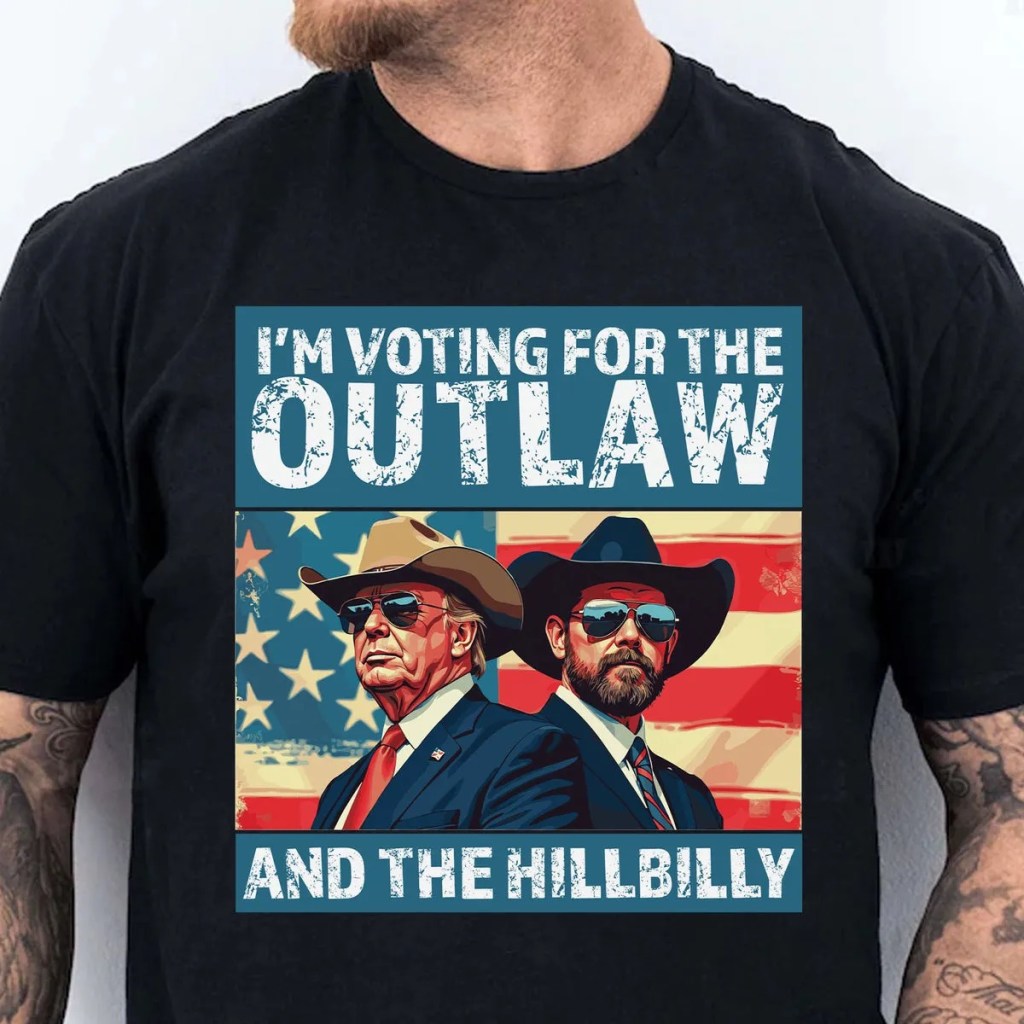
In the post at 9 a.m today, Joyce Vance included a photo of a T-shirt of Trump and Vance, billed as “the Outlaw and the Hillbilly.” Now, that’s clever marketing!

An Outlaw is often an admirable figure in westerns. He’s a folk hero. He’s the guy who goes up against the Establishment. He’s the Sundance Kid, he’s Robin Hood, he’s the handsome guy who gets the girl, he’s a lot of characters who live on the fringes of society and stand up for the little guy.

This is not Donald Trump. He is reverse Robin Hood. He steals from the poor and fattens the bank accounts of the rich. He doesn’t defend the helpless damsel, he sexually asssults her, then laughs about it and defames her. He does not stand outside society on its fringes, he owns the biggest, gaudiest mansion and installs solid gold toilet seats. Far from being handsome and buff, he is an obese old man with thinning hair and sagging jowls. He is a coward who dodged the draft five times yet pretends to be a tough guy.

As for J.D. Vance, he was once a hillbilly but that was long, long ago. Now he plays a hillbilly. He is a graduate of Yale Law School who made millions of dollars in the financial sector, where his patron was Peter Thiel, the woman-hating billionaire.

Not an Outlaw! Just a womanizing convicted felon who is a superb liar, braggart, and bully.

Not a Hillbilly! Just another far-cat who attached himself to super-rich patrons.

Trump passed one piece of legislation in his first term: a big tax cut for his billionaire buddies, corporations, and himself.

We know what his priorities are. Ego. Money. Power. Control.

He’s already forgotten about the people who voted for him. They can’t do anything for him any more. He won’t lower the price of food or gasoline or home insurance. He might take away their Social Security or Medicaid. He might cut programs they rely on.

He will take care of the people rich enough to belong to Mar-a-Lago.

While her ex-husband Jeff Bezos gave $5 million to help house the homeless in central Florida, McKenzie Scott gave $65 million to an organization in Maryland aiming to solve the affordable housing crisis. Four years ago, she gave the same organization $50 million.

Think of it: he helps with a small (by his standards) gift to house the homeless. Scott makes a gift more than 12 times larger to address the problem of homelessness.

Let’s be clear: in a better society, large social and economic problems would be addressed by government, not by philanthropists. But Republicans oppose any attempt to help people who are unable to help themselves. They block all efforts to expand the role of government. They cling to the belief that everyone should take care of themselves; those that can’t should turn to church, family, or local charities, they believe. In the age of Trump, the organizations that help others are likely to get less or no government support.

Scott divorced Bezos in 2019. Since then, she has given $19.2 billion to charitable groups. She is still worth more than $30 billion, based on the Amazon stock she received in her divorce. She’s determined to give away a substantial amount every year.

She represents the very best of philanthropy. No one applies for help. She has a team to research possible recipients. When she decides who are the lucky winners, they get a call from out of the blue telling them the size of their reward. The winners are free to use the money as they see fit.

Entrepreneur magazine reported:

Billionaire philanthropist MacKenzie Scott, 54, donated $65 million to Enterprise Community Partners last month, a national nonprofit based in Maryland that aims to address the U.S.’s shortage of affordable housing.

The surprise donation left the organization shocked, reps said in a statement.

“Some of us probably wanted to cry for joy,” Janine Lind, president of Enterprise’s community development division, told the Baltimore Banner. “This came at a moment where the affordable housing sector certainly is being put to test and is struggling.”

It’s Scott’s second gift to the 42-year-old organization—the first was $50 million in 2020. The organization noted in a press release that Scott’s gift is “one of the largest reported gifts to an affordable housing organization.”

Jeff Bezos’ foundation gave $5 million to expand homeless shelters in Florida. Bezos has assets of about $200 billion. There are many thoughts swirling in my head about this gift. Like, should Bezos have given more? To him, $5 million is pocket change. Should he have underwritten an expansion of affordable housing instead of expanding shelters? And more. Like, what are the consequences of online shopping replacing brick-and-mortar stores? Why is Jeff’s ex-wife McKenzie Scott so much more generous in her philanthropy than he is?

Amazon founder Jeff Bezos’ philanthropic fund has donated $5 million to the Coalition for the Homeless of Central Florida, which will use the money to expand its existing shelter and support its family outreach program.

This is the second time Bezos’ Day One Fund has supported the coalition. In 2021, the nonprofit received a $2.5 million grant.

“With the increase in individuals and families struggling with homelessness, specifically because of this affordable housing crisis, being able to utilize this grant to help those families who are unsheltered is huge for us,” said Trinette Nation, director of development for the coalition.

The Bezos Day One Fund is a $2 billion fund started in 2018 by the Amazon billionaire and his then wife, MacKenzie Scott, to support homeless families.

The Network for Public Education announces the winners of the non-prestigious “Coal in the Stocking” Award for 2024.

This is an award given to those who have done the most damage to our public schools.

They should feel ashamed and humiliated for gaining this recognition of their odious and undemocratic behavior.

They hurt children and communities. They hurt the future of our great nation.

Open the link to see the names of the winners.

Writing at Wonkette, Gary Legum describes what Elon Musk will get for the $250 million he invested in Trump’s campaign. He may seek waivers from regulations, he may seek contracts. Trump is very grateful. No one, to our knowledge, has ever given so much money to a Presidential campaign. What will he get in return?

Legum writes:

Compare and contrast if you will the two senators from the great state of Connecticut.

The first senator, Richard Blumenthal, spent time this week rallying support for his Kids Online Safety Act (KOSA) by verbally fellating sentient staph infection Elon Musk, calling him “the foremost champion of free speech in the tech industry.” This was a naked attempt to get Musk to try and influence the other tech bros infesting the incoming administration to support the bill even though any sort of regulation of the Internet goes against their core beliefs. Unless the regulations somehow bother liberals, in which case they get a thumbs-up.

Thus did Blumenthal violate yr Wonkette’s rule about lending any legitimacy to the right-wing billionaire who just spent a quarter of a billion dollars to buy the election for the other party and has been rewarded with the highest of high-level access to the incoming president. We don’t particularly care about the cause one is fellating in support of, although KOSA is a problematic bill that no one should want passed. But that’s a whole other post.

Now consider Connecticut’s other senator, Chris Murphy. Thursday night on MSNBC, Murphy told Alex Wagner in no uncertain terms that America is about to become the sort of oligarchy represented by Musk’s ascent to Trump’s inner circle that we used to be able to at least pretend was beneath us:

“What it means is a handful of really rich people run the government, and they steal from ordinary people using their access to government in order to make themselves and their families even richer.”

Whoa, that’s no way to get invited to the DOGE Christmas party, Senator.

Murphy’s description really applies to how our government has been for some decades, the difference being that now we have an incoming president and administration that are not bothering to pretend otherwise. But okay, we won’t split hairs with Murphy. We are where we are, so any tiny voices in opposition to the coming nightmare are appreciated.

Anyway, Murphy got us thinking that you really have to hand it to the sentient staph infection. Musk spent a quarter of a billion dollars buying himself a president who will roll over at the soft snap of the billionaire’s doughy fingers, and it has paid off again and again and again. And Sweet Potato Suharto’s coronation isn’t even for another five weeks.

A quarter of a billion dollars. Thanks a pantsload, Anthony Kennedy and the Supreme(ly Stupid) Court.

The latest atrocity to benefit Musk is a report on Friday that the incoming administration may drop the federal government’s car crash reporting rules. See, Tesla has a minor problem, in that it has had to report over 1,500 crashes to the National Highway Traffic Safety Administration, partly because the automated-driving systems that are supposed to set the cars apart from normie vehicles don’t work very well, turning them into fiery mobile deathtraps and causing untold misery and suffering to not just crash victims but their families as well.

Musk probably doesn’t believe this, but pain and suffering by humans is in fact bad. It’s true! Just ask us!

Please open the link to finish reading.