Archives for category: Betsy DeVos

Arianna Prothero writes in Education Week of the growing evidence that vouchers do not improve achievement and may actually reduce it.

Yet that body of research seems to have no impact on the voucher advocates. At Senate hearings for the #2 spot in the U.S. Department of Education, Mick Zais (Superintendent of Schools in South Carolina) expressed his enthusiasm for School Choice. When about the studies showing the negative effects of vouchers in Ohio, Louisiana, Indiana, and D.C., Zais admitted he was “unaware” of this research. Zais, a former Brigadier General, made his mark in South Carolina by lifting limits on class sizes.

She writes:

“What does the research say? In a nutshell: The most recent findings are mixed, but they lean more toward negative.

“I spoke at length with researchers from most of these studies for story I did on how private schools receiving public money in Florida face little state oversight.

“Studies out of Indiana, Louisiana, Ohio, and the District of Columbia have found that students, most of whom are low-income, fare worse academically after leaving their public schools.

“But a separate study that looked at low-income students attending private school in Florida with state aid, found that students enrolled in college at higher rates than their peers in public school.

“I think the best evidence from the best recent research … if anything, it looks like that maybe kids going to private school on voucher programs might do worse in reading and math than they do in public [schools],” said David Figlio, an economist at Northwestern University, whose study of vouchers in Ohio for low-income students attending poor-performing districts found voucher students performed significantly worse on state tests than their peers who were eligible for vouchers but remained in public schools.

“His research on Florida’s biggest private-school choice program—the Florida Tax Credit Scholarship—found that on average, attending a private school on an FTC scholarship had zero effect on student academic achievement—which was generally true of most early voucher research, said Figlio.

“There are possible explanations: they’re getting a worse education … they’re getting a different form of education … and I don’t think we really know the truth,” Figlio said. “But I think there’s precious little evidence so far that these kids do better academically.”

“Similarly, negative results were found in a recent study of Washington D.C.’s voucher program as well—the only federally funded voucher program in the nation.

“Students, at least in the Indiana and Louisiana voucher programs, recouped their academic losses after being in private schools for a few years.”

The “recouping” of academic losses may reflect attrition from these programs, especially of the lowest performing students, who return to public schools, worse off than they were before.

Similarly, those voucher programs that show higher college attendance rates (despite zero academic gains) must be viewed in the light of high attrition rates from the voucher programs. If 100 students start ninth grade in voucher schools and only 40 finish twelfth grade, that reduced number may have a higher graduation rate than the public schools that inherited their dropouts.

The best way to understand the ideology of voucher advocates is to remember what Betsy DeVos said when she learned that the federal evaluation of the D.C. voucher program had negative results:

[From the Washington Post]

“DeVos defended the D.C. program, saying it is part of an expansive school-choice market in the nation’s capital that includes a robust public charter school sector.


“When school choice policies are fully implemented, there should not be differences in achievement among the various types of schools,” she said in a statement. She added that the study found that parents “overwhelmingly support” the voucher program “and that, at the same time, these schools need to improve upon how they serve some of D.C.’s most vulnerable students.”

In other words, vouchers should not be expected to improve test scores.
This is my review of two very important books: Nancy MacLean’s “Democracy in Chains: The Deep History of the Radical Right’s Stealth Plan for America” and Gordon Lafer’s “The One Percent Solution: How Corporations Are Remaking America One State at a Time.”

Both books are important for understanding the undermining and capture of our democracy.

Both books explain the theory and practice of destroying the public sector for ideology and/or profit.

Read the review for a better understanding of the roles played by the Koch brothers, the DeVos family, and ALEC.

Education Week reports that Betsy DeVos’ Brother Erik Prince May run for Senate Against the incumbent GOP Senator John Barrasso. If he runs, Prince would have the blessing of Steve Bannon, who has threatened to run a challenger against any Republican incumbent who does not share his extremist views and his nativism.

Bannon’s first foray into ousting Republicans was his intervention in the Alabama Senate Race, where he is supporting the eccentric Roy Moore. Moore has been removed from the bench twice for defying the laws. He has also been accused by several women of sexual assault when he was in his 30s.

“In recent weeks, DeVos’ younger brother, has reportedly shown interest in running for the Wyoming U.S. Senate seat in 2018 that’s currently held by GOP Sen. John Barrasso. Prince is the founder of Blackwater, a private security firm that drew attention and controversy during the Iraq War, and now runs Frontier Services Group, an aviation, logistics, and security firm. Barrasso was first elected in 2006 and reelected in 2012, although CNN reported last month that Steve Bannon, President Donald Trump’s former chief strategist, put Barrasso on a list of Republicans he wants to defeat in the primary process. Bannon has supposedly supported Prince’s interest in a Senate run…

“Prince’s views on education aren’t clear. He attended Hillsdale College, a private college in Michigan whose president, Larry Arnn, was briefly mentioned as a possible Trump nominee for education secretary before DeVos got picked. According to a Grand Rapids Press story cited by Business Insider and Newsweek, Prince said he became disillusioned with Washington while working as a White House intern under President George H.W. Bush because he saw “homosexual groups being invited in.”

The DeVos family has given millions to anti-gay groups including the Family Research Council and Focus on the Family.

Carol Burris and Darcie Cimarusti of the Network for Public Education argue here that the candidates who forcefully stand up for public schools and speak out against privatization will win in November 2018.

Their evidence is the Elections of 2017.

Start with the remarkable results in Virginia.

“The most important race of 2017 was the hotly contested race for the governor of Virginia, in which a strong public education advocate, Democrat Ralph Northam, faced off against Republican Ed Gillespie. Gillespie fully embraced the entire DeVos agenda — charter expansion, online virtual schools, home schools, and vouchers in the form of tax credits and education savings accounts. There was not an inch of policy daylight between Gillespie and DeVos.

“This should come as no surprise. Gillespie received over $100,000 in campaign contributions from the DeVos family, including a donation from the Secretary’s husband, Dick DeVos. Americans for Prosperity, which is controlled by the Koch brothers, launched a digital video in which a charter school leader criticized Northam for being the vote that stopped the neo-voucher “educational savings accounts.”

“Northam, who was supported by the teachers union, has been a strong and consistent supporter of public education. As stated on his website, “Ralph took tie-breaking votes to protect Virginia’s public education from being raided with unconstitutional private school vouchers and to keep decisions about public charter schools in the hands of local school boards.”

“The election of Gillespie would have been a game changer for public education in the Commonwealth. Virginia is one of a handful of states that allow charter schools to only be authorized by local school boards. In Virginia, charters are subject to the same transparency guidelines as public schools in the state. There are only eight charter schools in Virginia, much to the chagrin of charter advocates.”

Northam, who calls himself a “friend of public schools,” will keep privatization out of the state and instead work to strengthen and improve Virginia’s public schools.”

Friends of public schools will win. Democrats who abandon public schools will not be able to take advantage of “The DeVos Effect.”

Some readers have asked for a copy of the speech that was so beautifully illustrated by the graphic posted earlier today.

I didn’t have a speech. I made notes and used them as talking points, on which I elaborated. When some in the audience (composed of progressives) insisted that charter schools were saving lives, I should have pointed out that the single biggest funder of charters is the anti-Union Walton Family Foundation, which is known for low wages and resistance to workers’ rights. About 95% of charters are non-union. The best kind of social justice that could be done by the Waltons is to pay their one million employees $15 an hour and allow them to unionize, in the stores and the charters they fund.

Here are my talking points.

“War on public sector.

“Take any public sector activity and google it with the word “privatization.”
Police, firefighters, prisons,hospitals, libraries, parks, schools—and what we once thought of as public is either privatized or under threat of privatization.

“Powerful movement—some driven by profit, some by libertarian ideology—seeks to shrink the public sector and monetize it.

“My area of specialization is education.

“There is today a full court press to privatize public education.

“How many in this room went to public schools?

“The fundamental purpose of public schools is to develop citizens, to sustain our democracy. To prepare young people to assume the duties of citizenship, to vote wisely, to understand issues, and to sit on juries.

“Our current obsession with standardized testing has corrupted the purpose of schooling. Clinton, Bush, Obama. We are now locked into a marketization approach to education: Testing, Accountability, competition, Choice. This is market-driven education, with winners and losers.

“The Bush program: NCLB. The same children were left behind.
THE Obama program: Race to the Top. Same as NCLB. Where is the top? Education is not a race.

“Test scores are fundamentally a reflection of family income and education. They are now cynically used by rightwing politicians to declare schools to be failures and set them up for privatization.

“Public education is one of the foundation elements of our democracy.
The movement to privatize public schools is a threat to democracy.

“Education Policy today is decided not by deliberation and debate but by big money.

“The Queen of Dark Money in education is now Secretary of Education.

“Betsy DeVos sees education as a Consumer good, not a civic responsibility
She has Compared choosing a school to choosing an Uber or choosing which food truck to buy lunch from. These are trivial choices, consumer choices. They are not public goods.
She really doesn’t understand the role of the public school in a community, as part of our democracy

“Dark Money, major philanthropies, and Wall Street billionaires have collaborated in attacking democratic control of schools. They have encouraged State takeovers, Charters, Vouchers. Private management. Mayoral control.

“Goals:

“School Choice, which promotes segregation by race and social class
Get rid of unions
Attacks on teaching profession.

“Venture philanthropies back Privatization: Gates, Broad, Walton, Arnold Foundation, Fisher Foundation, the Helmsley Foundation, the Wasserman Foundation, the Bloomberg Foundation, Dell Foundation, Jonathan Sackler, many more

“Dark Money funneled to state and local elections— by such groups as: Education Reform Now, Stand for Children, Families for Excellent Schools, Democrats for Education Reform, the Koch brothers, the DeVos family, the Walton family. All have the same goal: Privatization.

“Half the states now have vouchers for private schools, enacted by the legislature, despite the fact that vouchers have always been defeated in state referenda.

“Betsy DeVos paid for a voucher referendum in Michigan in 2000. It was defeated overwhelmingly. So Michigan went for unbridled Choice with charter schools, no district lines. 80% of the charters in Michigan operate for profit, more than any other state. Michigan’s standing on national tests dropped from the middle of the pack, to the bottom, between 2003 and 2013. Detroit is overrun with charters yet it continues to be the lowest scoring district in the nation.

“Milwaukee has public schools, charters, and vouchers, and all three sectors are low performing.

“Demand for vouchers is actually very low: Indiana, only 3% use them, less in Louisiana. Only 6% in charters. Yet every dollar for vouchers and charters is taken away from the schools that educate the great majority of children.

“Katherine Stewart in the current American Prospect: “Proselytizers and Profiteers.” Religious extremists in the voucher movement made “useful idiots of the charter movement.” Community public schools replaced by Corporate charter chains. Some of the biggest charter chains are owned and run by evangelicals and fundamentalists.

“The real Dark Money wants vouchers, religious schools, homeschooling, charters, anything but public schools.

“DeVos, American Federation for Children
Koch brothers, Americans for Prosperity (Libre Initiative) (AZ referendum)
ALEC— model legislation for charters, vouchers, ending certification, breaking unions.

“Public schools struggle where there is high poverty.

“Income inequality is the scourge of our society.

“Privatizing public schools won’t solve poverty.

“Hopeful signs:

*Virginia election: pro-public schools, many of the winning candidates are teachers

*Douglas County, CO, rebuff to vouchers

*upcoming referendum in AZ on vouchers, which Koch brothers want to knock off the ballot

*In 20 State referenda, vouchers have lost every single time.

*support for charters dropped from 51% to 39% in the past year, among both Democrats and Republicans, largely in response to scandals, prosecutions, and also NAACP criticism of charters.

“The origin of school choice was in segregated states fighting the Brown decision.

“Betsy DeVos is such a polarizing figure that she reminds us of the importance of public schools.”

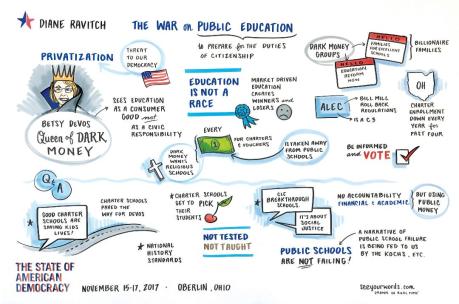
This fabulous graphic is a summary of my speech at the conference on “The State of American Democracy,” identified by the acronym SAD. The conference was sponsored by Oberlin College at the college in Oberlin, Ohio, and it will be held with different participants in three other locations over the next several months. I spoke about the “War on Public Education.” In my talk, I forgot to mention that more than 90-95% of charters are non-union, and that their primary sponsor is the Walton Family Foundation, which is anti-union. That was an important omission in an audience that is mostly comprised of progressives. Jonathan Alter, who is very knowledgeable about national politics, leapt up to defend charter schools and objected to being lumped in with the DeVos agenda, which includes both charter schools and vouchers; Jon loves KIPP. I cited Katherine Stewart, who said in her article in “The American Prospect” that religious extremists had made “useful idiots” of the charter movement.

Early in my talk, I asked how many of those in the room had gone to public schools, and about 90% of the 300 or so people raised their hands. That included the new President of Oberlin College, Carmen Twillie Ambar, who graduated from public schools in Little Rock, Arkansas. She is the first African American female president of this historic college.

This is the wonderful graphic that was created as I spoke, by a brilliant artist, Jo Byrne (seeyourwords.com):

devos

Betsy DeVos visited Douglas County before the recent election. She came, as expected, to promote vouchers. She met with a couple who had taken their child out of public school and placed him in a school for autistic children, where he is happy.

DeVos saluted their courage in seeking a different placement for their child.

But the parents are not pleased to be used as Betsy DeVos’ poster family for vouchers.

As Chalkbeat reported, the parents said they did not get a voucher for their child. The voucher would not have been much help for them. The school he attends costs $70,000 a year. The voucher, if it existed, would be worth $5,000.

“DeVos’s public words were particularly hard to take, Jennifer and Joe said, because they had met with the education secretary privately at her request. They were flattered by her interest, but felt she didn’t understand why private school vouchers would never work for them — or many other families who have children with disabilities.

“First, the dollar amount of most voucher programs is paltry compared to what it costs to pay for specialized private schools like Firefly. Tuition there is more than $70,000 a year.

“Say, there was a voucher system in place and let’s pick $5,000.” Jennifer said. “That’s not enough for placement at Firefly. It doesn’t do anything.”

“Jennifer and Joe, who own a company that sells industrial equipment, pay around half of Firefly’s tuition and their health insurance pays the rest, they said.”

With the sweeping victory of an anti-voucher slate in Douglas County, there won’t be any vouchers for the foreseeable future.

https://www.chalkbeat.org/posts/co/2017/11/15/parents-of-colorado-student-to-betsy-devos-we-are-not-a-poster-child-for-your-school-choice-agenda/

Betsy DeVos is not shy about revealing her priorities. She must cut positions to downsize the Department, making way for tax cuts for the 1%.

Look where the buyouts are concentrated:

CIVIL RIGHTS OFFICE COULD TAKE BIGGEST HIT IN ED BUYOUTS: The Education Department’s Office for Civil Rights could lose 45 employees because of early separation offers – a big hit to an office that many argue is understaffed to handle the number of complaints it receives each year. In fiscal 2017, the office was funded to employ 569 staff members, according to the department’s budget request from earlier this year.

– It would be the most of any division within the agency, according to a document obtained by POLITICO from a congressional office. Of the 255 voluntary offers made Nov. 1 to employees to separate or retire early, 45 people work in the civil rights office, the document says. The Trump administration’s budget proposal had called for cutting 46 positions from the office, which the administration said it would do through attrition.

– The office receives 10,000 complaints of discrimination annually, but has half of the staff it had in 1980, when it received fewer than 3,500 complaints, according to Education Department figures. Sen. Patty Murray (D-Wash.), the ranking member of the HELP Committee, said in a statement Thursday she was “appalled” that Secretary Betsy DeVos “would use a lack of staffing and resources as an excuse to roll back civil rights investigations and protections, and then turn around and attempt to shrink these critical offices … I will continue to work to give the Department the resources it needs to better aid students and families, and I strongly urge Secretary DeVos to stop putting her ideological agenda above students and work with us.”

– An Education Department spokeswoman noted in a statement that the offers are voluntary and approved by the federal Office of Personnel Management. “Keep in mind, these positions can be backfilled as the workload demands,” said the spokeswoman, Liz Hill.

If you are near a TV at 2:30 pm and afterwards, please report back on these hearings:

From Politico:

TWO EDUCATION NOMINEES FACE CONGRESS TODAY: The Senate Health, Education, Labor and Pensions Committee this afternoon will take up the nominations of two people for top Education Department jobs – Mick Zais for deputy secretary and Jim Blew for assistant secretary of the Office of Planning, Evaluation and Policy Development. Both are expected to face tough questions from Democrats about Education Secretary Betsy DeVos’ record on education issues and her decisions this year. They could field a number of tough questions about their own records as well.

– Zais, a retired Army brigadier general, checks off a lot of conservative boxes. He was most recently superintendent of South Carolina schools until he announced in 2014 that he wouldn’t run for reelection. As superintendent, Zais refused to participate in the Obama administration’s signature Race to the Top program, which encouraged states to adopt more rigorous academic standards like the Common Core in exchange for federal grants. Zais saw the standards, which were never mandated by the Obama administration, as federal overreach.

– Ranking Democrat Patty Murray could raise concerns about Zais’ past support for expanding school choice and his skepticism over early childhood education, according to prepared remarks shared by a Democratic aide with Morning Education. Zais previously opposed expanding public kindergarten for 4-year-olds, citing costs and that it could put private- and faith-based programs out of business. He has also been skeptical about the lasting benefits of early childhood education, citing studies of Head Start, a federal preschool program for low-income families.

– Murray could also raise concerns about Zais’ past support for abstinence-based sex education and about comments he made in 2014, reported by The Post and Courier at the time, about the teaching of natural selection in schools. Zais said, “We ought to teach both sides” of the principle “and let students draw their own conclusions.” Murray is expected to tell Zais that his comments “make me question your ability to help set a course for this agency based on facts, science and evidence.”

– Blew, in turn, is the director of the advocacy group Student Success of California, which advocates for performance-based systems for teachers and supports charter schools. He has also served as president of Students First, the national advocacy organization founded by former D.C. Chancellor Michelle Rhee. Murray plans to raise concerns about Blew’s history of supporting school choice, noting that the office he has been nominated for “is critical in developing and implementing policy – which impacts every student in the country. So your record of promoting school vouchers gives me pause that you will not stand up for students and public schools.”

– Chairman Lamar Alexander is expected to say that Zais “has an excellent and deep background” for the position of deputy secretary, according to prepared remarks provided by a Republican aide. Alexander will also note that Blew has spent two decades working to improve “educational opportunities for families and children by overseeing grants to low-income, high risk schools.”

– Absent from the hearing will be Michigan state Rep. Tim Kelly, after the Trump administration this week formally pulled his nomination for a top career and technical education post at the Education Department. Kelly, a Republican, was axed because of statements that he made on his blog, the “Citizen Leader,” between 2009 and 2012. In his blog, Kelly called for banning all Muslims from air travel, said that women aren’t interested in science careers and labeled low-income preschool parents “academically and socially needy.” In an interview with POLITICO last week, Kelly accused the “deep state,” “haters” and federal employees who don’t like President Donald Trump for making the nomination process “toxic” and “intrusive.”

– The hearing starts at 2:30 p.m. in 430 Dirksen. Watch the livestream here.

If you watch one video today, watch Yohuru Williams take apart the rhetoric of the reformers, piece by piece, word by word.

Yohuru gave this dynamic talk at the annual conference of the Network for Public Education.

He deconstructed Betsy DeVos’ speech at Harvard University. He gave it a close reading.

He literally brought down the house with his humor and sharp intellect.

Yohuru Williams is Dean of Arts and Sciences at the University of St. Thomas University in Minneapolis and St. Paul.

He is an expert on African American history. You have probably seen him on one of his many appearances on PBS and the History Channel.

We are fortunate that he is a member of the board of the Network for Public Education.

I was blown away by his presentation. I think you will be too!