Writing in The Atlantic, Anne Applebaum questions Trump’s ability to think through his decisions. Is he acting on a whim, an impulse? Does he remember today what he said the day before?
She writes:
Donald Trump does not think strategically. Nor does he think historically, geographically, or even rationally. He does not connect actions he takes on one day to events that occur weeks later. He does not think about how his behavior in one place will change the behavior of other people in other places.
He does not consider the wider implications of his decisions. He does not take responsibility when these decisions go wrong. Instead, he acts on whim and impulse, and when he changes his mind—when he feels new whims and new impulses—he simply lies about whatever he said or did before.
For the past 14 months, few foreign leaders have been able to acknowledge that someone without any strategy can actually be president of the United States. Surely, the foreign-policy analysts murmured, Trump thinks beyond the current moment. Surely, foreign statesmen whispered, he adheres to some ideology, some pattern, some plan. Words were thrown around—isolationism, imperialism—in an attempt to place Trump’s actions into a historical context. Solemn articles were written about the supposed significance of Greenland, for example, as if Trump’s interest in the Arctic island were not entirely derived from the fact that it looks very large on a Mercator projection.
This week, something broke. Maybe Trump does not understand the link between the past and the present, but other people do. They can see that, as a result of decisions that Trump made but cannot explain, the Strait of Hormuz is blocked by Iranian mines and drones. They can see oil prices rising around the world and they understand that it is difficult and dangerous for the U.S. Navy to solve this problem. They can also hear the president lashing out, as he has done so many times before, trying to get other people to take responsibility, threatening them if they don’t.
NATO faces a “very bad” future if it doesn’t help clear the strait, Trump told the Financial Times, apparently forgetting that the United States founded the organization and has led it since its creation in 1949. He has also said he is not asking but ordering seven countries to help. He did not specify which ones. “I’m demanding that these countries come in and protect their own territory, because it is their territory,” Trump told reporters aboard Air Force One on the way from Florida to Washington. “It’s the place from which they get their energy.” Actually it isn’t their territory, and it’s his fault that their energy is blocked.
But in Trump’s mind, these threats are justified: He has a problem right now, so he wants other countries to solve it. He doesn’t seem to remember or care what he said to their leaders last month or last year, nor does he know how his previous decisions shaped public opinion in their countries or harmed their interests. But they remember, they care, and they know.
Specifically, they remember that for 14 months, the American president has tariffed them, mocked their security concerns, and repeatedly insulted them. As long ago as January 2020, Trump toldseveral European officials that “if Europe is under attack, we will never come to help you and to support you.” In February 2025, he told Ukrainian President Volodymyr Zelensky that he had no right to expect support either, because “you don’t have any cards.” Trump ridiculed Canada as the “51st state” and referred to both the present and previous Canadian prime ministers as “governor.” He claimed, incorrectly, that allied troops in Afghanistan “stayed a little back, a little off the front lines,” causing huge offense to the families of soldiers who died fighting after NATO invoked Article 5 of the organization’s treaty, on behalf of the United States, the only time it has done so. He called the British “our once-great ally,” after they refused to participate in the initial assault on Iran; when they discussed sending some aircraft carriers to the Persian Gulf conflict earlier this month, he ridiculed the idea on social media: “We don’t need people that join Wars after we’ve already won!”
At times, the ugly talk changed into something worse. Before his second inauguration, Trump began hinting that he wouldn’t rule out using force to annex Greenland, a territory of Denmark, a close NATO ally. At first this seemed like a troll or a joke; by January 2026, his public and private comments persuaded the Danes to prepare for an American invasion. Danish leaders had to think about whether their military would shoot down American planes, kill American soldiers, and be killed by them, an exercise so wrenching that some still haven’t recovered. In Copenhagen a few weeks ago, I was shown a Danish app that tells users which products are American, so that they know not to buy them. At the time it was the most popular app in the country.
The economic damage is no troll either. Over the course of 2025, Trump placed tariffs on Europe, the United Kingdom, Japan, and South Korea, often randomly—or again, whimsically—and with no thought to the impact. He raised tariffs on Switzerland because he didn’t like the Swiss president, then lowered them after a Swiss business delegation brought him presents, including a gold bar and a Rolex watch. He threatened to place 100 percent tariffs on Canada should Canada dare to make a trading agreement with China. Unbothered by possible conflicts of interest, he conducted trade negotiations with Vietnam, even as his son Eric Trump was breaking ground on a $1.5 billion golf-course deal in that country.
Europeans might have tolerated the invective and even the trade damage had it not been for the real threat that Trump now poses to their security. Over the course of 14 months, he has, despite talking of peace, encouraged Russian aggression. He stopped sending military and financial aid to Ukraine, thereby giving Vladimir Putin renewed hope of victory. His envoy, Steve Witkoff, began openly negotiating business deals between the United States and Russia, although the war has not ended and the Russians have never agreed to a cease-fire. Witkoff presents himself to European leaders as a neutral figure, somewhere between NATO and Russia—as if, again, the United States were not the founder and leader of NATO, and as if European security were of no special concern to Americans. Trump himself continues to lash out at Zelensky and to lie about American support for Ukraine, which he repeatedly describes as worth $300 billion or more. The real number is closer to $50 billion, over three years. At current rates, Trump will spend that much in three months in the Middle East, in the course of starting a war rather than trying to stop one.
The result: Canadian Prime Minister Mark Carney has declared that Canada will not participate in the “offensive operations of Israel and the U.S., and it never will.” German Defense Minister Boris Pistorius says, “This is not our war, and we didn’t start it.” The Spanish prime minister refused to let the United States use bases for the beginning of the war. The U.K. and France might send some ships to protect their own bases or allies in the Gulf, but neither will send their soldiers or sailors into offensive operations started without their assent.
This isn’t cowardice. It’s a calculation: If allied leaders thought that their sacrifice might count for something in Washington, they might choose differently. But most of them have stopped trying to find the hidden logic behind Trump’s actions, and they understand that any contribution they make will count for nothing. A few days or weeks later, Trump will not even remember that it happened.
Jim Bourg, a writer for Reuters for many years., now writes a blog on Substack called Public Impact News.
This is a story that I found ominous. Is Trump planning to revive the military draft? Will he begin drafting young men to fight in Iran? Why? In recent years, we have been told repeatedly that the future of warfare will be high-technology, drones and drone interceptors, not trench warfare.
Note that the report does not mention adding women to the Selective Service registry. Is that because Pete Hegseth, Secretary of Defense, doesn’t want women in the military?
No one has forgotten that Trump ran for office as a “peace candidate,” or that he shamelessly campaigned for a Nobel Peace Prize, or that he created a new entity called the “Board of Peace,” of which he is chairman for life and sole manager of the billions it has already collected from its members.
And yet the “peace president” wants to reinvigorate the Selective Service register. Young people between the ages of 18-26, their parents and grandparents, should ask why.
Bourg reported:
Congress Quietly Approved Automatic Selective Service (Draft) Registration in 2026 Defense Bill
WASHINGTON – (Public Impact News) – In another recent move that has gotten very little coverage or attention, prior to the start of hostilities between the U.S. and Iran, the U.S. Congress approved a significant change to the way the United States registers young men (18-26 years old) for potential military conscription, passing a provision in the 2026 National Defense Authorization Act that will automatically enroll eligible males into the Selective Service draft system using federal government databases. The change is scheduled to take effect on Dec. 18, 2026.
Under current law, men between the ages of 18 and 26 are required to register with the Selective Service System themselves. Failure to do so can lead to penalties and may make individuals ineligible for certain federal benefits, including student financial aid and government employment.
The provision included in the annual defense policy bill directs federal agencies to share certain identifying information with the Selective Service System so eligible men can be registered automatically. Lawmakers say the goal is to ensure that the registration requirement already on the books is enforced consistently without relying on young people to complete the process manually.
The measure appears in the final compromise version of the NDAA approved by both chambers of Congress and signed into law by President Donald Trump.
Supporters say the change modernizes an outdated administrative system while preserving the existing legal framework.
Senator Jack Reed, Democrat of Rhode Island and chairman of the Senate Armed Services Committee, said the provision does not expand the government’s authority to draft Americans into military service.
“This does not create a draft and it does not change the underlying requirement that young men register with Selective Service,” Reed said during debate on the bill. “It simply ensures the system works as intended and that eligible individuals are properly registered.”
Some Republicans also supported the change as a practical step to maintain military readiness. Senator John Cornyn, Republican of Texas and a member of the Senate Armed Services Committee, said the voluntary registration system has left gaps that could complicate mobilization in a national emergency.
“Ensuring the Selective Service system has accurate and complete records is part of responsible national preparedness,” Cornyn said. “Automatic registration makes the process more reliable and fair.”
The automatic registration proposal was championed in the House by Representative Chrissy Houlahan, a former Air Force officer, who argued that the existing system leaves too many eligible men unregistered simply because they are unaware of the legal requirement.
Opponents, however, said the provision was adopted with little public attention and raises concerns about government data sharing and individual privacy. Several lawmakers also questioned the timing of the change as the United States remains engaged in an ongoing war with Iran.
Senator Rand Paul, Republican of Kentucky, criticized the provision during debate. “I do not support quietly expanding the federal government’s reach into personal data to track young Americans for potential military service,” Paul said. “If Congress wants to debate conscription, that debate should happen openly.”
Representative Thomas Massie, Republican of Kentucky, raised similar concerns in the House, warning that the change could create unnecessary anxiety among families at a time of international conflict
“Americans are already worried about escalation in the Middle East,” Massie said. “Implementing automatic draft registration during a war sends the wrong message and risks making people think a draft is coming.”
Defense officials and congressional leaders have emphasized that the policy change does not activate military conscription. A draft would require a separate act of Congress and approval by the president.
The Selective Service System has remained in place since the end of the Vietnam War draft in 1973, maintaining a database of potential recruits in the event Congress authorizes conscription during a national emergency.
Officials say automatic registration is intended to ensure the database remains accurate if it is ever needed. Still, the change has renewed public attention to the Selective Service system, particularly as the United States confronts a widening conflict with Iran. Whether the provision becomes a routine administrative update or the beginning of a broader debate about military service may depend in part on how that conflict develops in the months ahead.
Timothy Snyder, scholar of European history, of tyranny and genocide, warns about the consequences of Trump threatening to wipe Iran and its ancient Persian civilization, off the earth. That’s genocide. Trump is an immoral monster.
“A whole civilization will die tonight, never to be brought back again.”
These are not the words of Hitler, or Stalin, or Mao, or Pol Pot, or Assad, or Putin. These are the words of the president of the United States, today.
Do not be distracted by circumstances. Of course there are emotions, personalities, politics, a war. None of this excuses that sentence. The reason we have a notion of genocide, and a convention on genocide, is to define certain actions as always and definitively wrong.
Are these “only words”? No, they cannot be “only words.” As any historian of mass atrocity knows, there is no such thing as “only words.” The notion of killing a whole civilization, once spoken, remains. It enables others to say similar things, as when another elected representative compared the entire country of Iran to a cancer that had to be removed.
Whatever happens tonight, the president, by saying such things, has already changed the world for the worse, and made acts of mass violence more likely. If we are Americans, he has also changed our country. He has changed us, because he represents us; we voted for him, or we didn’t vote and allowed him to come to power, or we didn’t do enough to stop him. These words are America’s words, until and unless Americans reject them.
Yes, there have been other genocides, and there are other politicians who endorse genocide. That makes the words of the president worse, not better. Yes, the United States has undertaken atrocities before. That makes it all the more important, all the more urgent, that we catch ourselves now. Neither the evil nor the good in our history determines who we are. It is what we do now.
If we do not say something ourselves about this horror, we allow ourselves to be changed.
Around the president there will be people, sadly, who work deliberately to normalize the language of genocide. There will be other politicians who find the right words to reject it. One can hope that there will be politicians who find the courage to remove the man who speaks genocide from office. And these words should lead to resignations by everyone who works closely with the president.
But we cannot count on politicians. This is ultimately up to us, the citizens: for our own sake, for the sake of the future of the country, for the sake of a possibility of new beginnings, we need to say something, to someone else, to ourselves: this is simply wrong.
Whatever happens tonight, or any other night in this war, is now legally defined by the president’s statement. In the practical application of the law of genocide, the Genocide Convention of 1948, the difficulty is usually in proving “the intent to destroy, in whole or in part, a national, ethnical, racial or religious group.” Henceforth the intent is on the record, in the published words of the president of the United States and the commander-in-chief of the armed forces about the death of “a whole civilization.”
We all have good ethical and political reasons to reject the president’s words. But those who serve in government, and in the armed forces, have been placed under the legal shadow of genocide by what Trump wrote. To bomb a bridge or a dam or a power plant or a desalinization facility, very likely a war crime in any event, could very well have a different legal significance, a genocidal one, if it takes place after the expression of genocidal intent by the commander and head of state.
The concept of genocide was created by a survivor and an observer of atrocities, Rafał Lemkin, so that we could see ourselves, judge ourselves, stop ourselves. But genocide is not only a concept. It is also a crime under international law, signed by the United States in 1948 as a convention, ratified by the United States as a treaty in 1988. That makes the words I have quoted here the law of the land.
The president speaks genocide. And so we too must speak. Not only about crimes, but about their legal punishment.
Appalled by Trump’s erratic behavior and his threats to commit war crimes in Iran–as he said in a news conference, to destroy every bridge and every power plant in Iran–many political commentators are calling for the implementation of the 25th Amendment to remove him from office.
Last night, Laurence O’Donnell devoted most of his news program on MS NOW to the claim that Trump is insane, and it is time to activate the 25th Amendment.
Trump’s vulgar message to Iranian leaders, posted on Easter Sunday morning, set off a new round of demands to get this unhinged man out of the Oval Office, far away from the power to start a nuclear war on a whim.
After reading Trump’s message, even former Congresswoman Marjorie Taylor Greene, once close to Trump, wrote in a tweet:
Everyone in his administration that claims to be a Christian needs to fall on their knees and beg forgiveness from God and stop worshipping the President and intervene in Trump’s madness. I know all of you and him and he has gone insane, and all of you are complicit.
Certainly Democrats and most independents would like to see this menace to world peace, the global economy, democratic institutions, and national security removed from office. No doubt JD Vance, despite his sycophancy, quietly would love to be catapulted into the presidency.
BUT…..it’s not going to happen.
To remove a President from office, the Vice President and a majority of his Cabinet must agree that the President is incapable of fulfilling the duties of his office.
Trump’s Cabinet would never agree to remove him from office unless he did something unthinkable. They were chosen not for their competence, but for their personal loyalty to him. Can you imagine Pete Hegseth or wrestling queen Linda McMahon voting to remove Trump? The unthinkable that might change even their minds might be…Trump running around the White House grounds stark naked; Trump ordering the military to drop a nuclear bomb on some country, friend or foe, because they disrespected him; Trump ordering ICE or the FBI to murder his political enemies; Trump engaging contractors to demolish the entire White House so he can erect a high-rise replacement, with his name at the bottom and the top in flashing lights ….The possibilities are limited.
But let’s imagine that Trump does something beyond my poor imagination, something so awful that a majority of his lackeys and sycophants vote to remove him.
That’s not enough. Their recommendation goes to the Congress, where two-thirds of both Houses must approve his removal.
How likely is that?
I say zilch, unless a black swan happens to build a nest on his bleached blonde tresses. A black swan, you may recall, is a metaphor for a totally unprecedented event, one that almost no one anticipates.
The 25th Amendment is not going to remove Trump, because those around him and Republicans in Congress are afraid of him or idolize him. There is only one way to curb Trump’s rage, incompetence, and boundless narcissism: Turn out the vote in November 2026. Sweep every Trump enabler out of office. Restore checks and balances. Elect a Congress that will investigate corruption, grifting, and profiteering. Elect a Congress that will stop his demolition of federal agencies and departments. Elect a Congress prepared to fight his attacks on enforcement of civil rights laws. Elect a Congress that will encourage and protect the votes of every citizen, not seek to suppress them.
The 25th Amendment will not save us. But a Congress devoted to the Constitution and to democracy can limit the damage that Trump has imposed on our government and on our relations with the rest of the world.
A historical note:
The National Constitution Center summarized the 25th Amendment, passed by Congress after the assassination of President John F. Kennedy.
AMENDMENT XXV. Passed by Congress July 6, 1965. Ratified February 10, 1967. Note: Article II, section 1, of the Constitution was affected by the 25th amendment.
The relevant content–removing a President who is unfit but unwilling to resign–is Section Four.
Section 4 addresses the dramatic case of a President who may be unable to fulfill his constitutional role but who cannot or will not step aside. It provides both a decision-maker and a procedure. The initial deciding group is the Vice President and a majority of either the Cabinet or some other body that Congress may designate (though Congress has never done so). If this group declares a President “unable to discharge the powers and duties of his office,” the Vice President immediately becomes Acting President. If and when the President pronounces himself able, the deciding group has four days to disagree. If it does not, the President retakes his powers. But if it does, the Vice President keeps control while Congress quickly meets and makes a decision. The voting rule in these contested cases favors the President; the Vice President continues acting as President only if two-thirds majorities of both chambers agree that the President is unable to serve.
Heather Cox Richardson reviews Trump’s erratic behavior since he started a war against Iran. He repeatedly announces that he has won the war, that negotiations are going well, and then threatens Iran with obliteration. Is this incoherence “the art of the deal” or is something else going on?
Remember the days when foreign policy was debated by experienced diplomats of the National Security council behind closed doors? When policies were the result of deliberation, not announced at 3 am on social media by the President, acting alone to vent his grievances? Remember when negotiations were led by the Secretary of State, not the President’s son-in-law?
That’s the way it used to be done. That’s the way it’s done in other countries. In the U.S., today, in the Trump era, one man makes policy in the middle of the night, depending on his whim.
At 8:03 this morning, Easter Sunday, President Donald J. Trump’s social media account posted: “Tuesday will be Power Plant Day, and Bridge Day, all wrapped up in one, in Iran. There will be nothing like it!!! Open the F*ckin’ Strait, you crazy b*stards, or you’ll be living in Hell—JUST WATCH! Praise be to Allah. President DONALD J. TRUMP”
There are many things that could be going on with this ultimatum, which actually doesn’t sound like Trump’s usual style, in the same way the post of yesterday morning didn’t.
The post appears to be threatening to commit war crimes by attacking civilian infrastructure, and it appears to suggest Trump is considering using tactical nuclear weapons. He emphasized the production of such weapons in his first administration. He seemed to encourage this interpretation in an interview with Rachel Scott of ABC News today. She said Trump “told me the conflict should be over in days, not weeks but if no deal is made he’s blowing up the whole country with ‘very little’ off the table. ‘If [it] happens, it happens. And if it doesn’t, we’re blowing up the whole country,’ he said. I asked if there’s anything off limits. ‘Very little,’ he said.”
In 2023 a book by New York Times Washington correspondent Michael Schmidt alleged that in 2017, when Trump was warning North Korean leader Kim Jong-un on social media that North Korea would be “met with fire and fury and frankly power, the likes of which this world has never seen before,” behind closed doors he was talking about launching a preemptive strike against North Korea and of using a nuclear weapon against the country and blaming someone else for the strike .
Schmidt reports that Trump’s White House chief of staff at the time, retired U.S. Marine Corps General John Kelly, brought military leaders to try to explain to Trump why that would be a bad idea and finally got him to move away from the plan by telling him he could prove he was the “greatest salesman in the world” by finding a diplomatic solution to his fight with the North Korean leader.
In his own book about that period, journalist Bob Woodward wrote: “The American people had little idea that July through September of 2017 had been so dangerous.”
But Trump’s secretary of state Mike Pompeo told Woodward: “We never knew whether it was real or whether it was a bluff.”
And that is another way to look at the post from Trump’s social media account: that he is panicked that he has not been able to bully other countries into fixing the mess he created by attacking Iran and precipitating the closure of the Strait of Hormuz, and is now simply trying to bully Iran. In The Guardian last Monday, Sidney Blumenthal noted that Trump “has declared ‘victory’ more than eight times,” says he has “won” more than ten times, and said Iranian forces have been “obliterated” or suffered “obliteration” more than six times. Blumenthal noted Trump is now threatening to “obliterate” Iran’s power grid and has used the words “decimate” or “decimation” at least six times.
Trump’s crazy post does, after all, push back yet again the deadline for his threats to rain destruction on Iran, which he then extended again in another post at 12:38 P.M. saying: “Tuesday, 8:00 P.M. Eastern Time!”
This dynamic was not lost on Allison Gill of Mueller, She Wrote, who noted: “It was March 23rd. Then March 27th. Then March 30th. Then he gave that weird address on April 1st. [N]ew deadline April 4th. Then April 6th at 7 AM. Then April 7th at 8 PM. And now another address tomorrow at 1 PM. The chaos is intentional.” She also noted that his deadlines and his abandonment of them often seem tied to the rhythms of the stock market.
In an interview with Barak Ravid of Axios today shortly after this morning’s post, Trump reiterated that “if they don’t make a deal, I am blowing up everything over there” but also said the U.S. is “in deep negotiations” with Iran and that he thinks a deal can be reached. Trump told Ravid that his envoys Steve Witkoff and Jared Kushner—not Secretary of State Marco Rubio—are talking with the Iranians. Sources told Ravid that mediators from Pakistan, Egypt, and Türkiye are facilitating the talks.
But Iranian officials are refusing to deal with Witkoff and Kushner after they apparently misunderstood earlier negotiations and instead told Trump the talks weren’t going well before he launched strikes. Neither Witkoff nor Kushner is a trained diplomat, and both have deep financial ties to the Middle East. Notably, Saudi Arabia’s Crown Prince Mohammed bin Salman (MBS), who urged Trump to start the Iran war, has invested at least $2 billion in Kushner’s private equity firm.
On March 13, Rob Copeland and Maureen Farrell of the New York Times reported that Kushner is trying to raise $5 billion or more for his private equity firm from Middle East governments at the same time as he is also supposed to be negotiating peace in the region.
But Stephen Kalin, Eliot Brown, and Summer Said of the Wall Street Journal reported today that the closure of the Strait of Hormuz has already cost the Saudis about $10 billion, and the grand plans of MBS were already falling short of money. Some of those plans were U.S. investments. The reporters note that even before the war, the Saudi’s sovereign-wealth fund, the same one that invested in Kushner’s private equity firm, had sold much of its U.S. stock portfolio. Last year, MBS promised to invest up to $1 trillion in the U.S. Those investments are now under review.
Regardless of the inspiration for Trump’s post, by itself it tells a very clear story. The Federal Bureau of Investigation’s former assistant director for counterintelligence Frank Figliuzzi posted: “The American president has lost his mind.”
Journalist Steven Beschloss wrote: “This is an actual post. This is not funny. This is beyond desperate. This is a deeply unwell man who doesn’t belong anywhere near the levers of power. Every member of his cabinet and Congress is complicit in not demanding his removal now.”
Senator Chris Murphy (D-CT) posted: “If I were in Trump’s Cabinet, I would spend Easter calling constitutional lawyers about the 25th Amendment. This is completely, utterly unhinged. He’s already killed thousands. He’s going to kill thousands more.”
The 25th Amendment establishes a process through which a majority of the Cabinet and the Vice President, or another body Congress designates, can remove a president deemed “unable to discharge the powers and duties of his office.”
Murphy was not the only one thinking along those lines. Hollie Silverman of Newsweekreported that on the prediction market platform Kalshi, which allows traders to buy “yes” or “no” shares on the question “Will the 25th Amendment be used during Trump’s presidency?” “yes” has moved in recent days from 28.6% to 35.1%.
You’re currently a paid subscriber to Letters from an American. If you need help receiving Letters, changing your email address, or unsubscribing, please visit our Support FAQ. You can also submit a help request directly.SHARELIKECOMMENTRESTACK
John Thompson, retired teacher and historian in Oklahoma, was stunned by some survey results released about parents’ opinions on education. He took a deep dive, read the raw data, and discovered that the survey was conducted by ExcelInEd, Jeb Bush’s organization. Excel promotes high-stakes accountability for public schools but no accountability whatsoever for voucher schools, which they also promote.
ExcelinEd has familiar game plan: they use inaccurate NAEP statistics to defame public schools, demand more accountability to crush the morale of principals, teachers, and parents, then insist that vouchers and charters are the way forward. As Josh Cowen showed in his book The Privateers, voucher schools get far worse results than public schools, and numerous studies have shown that charter schools are usually no better than public schools and often much worse.
Thompson writes:
Patricia Levesque, the executive director of ExcelinEd, recently wrote a commentary about a survey of 500 Oklahoma parents, claiming that more than 80% of them want “a state testing and accountability system to measure student achievement, and they expect honesty and accuracy about their children’s grade level performance.”
So, I took a dive into the survey. My reading of it was very different than Levesque’s.
In some ways, the survey she described is consistent with the Education Department parent survey that State Superintendent Lindel Fields released. But Levesque’s interpretation of the results was very different than Fields’ analysis of the state’s parent feedback.
The survey Levesque cited found that 74% of parents want a pay raise for teachers, and another 74% say we spend too little on education. Her study found that 80% of parents were very or somewhat satisfied with their school but, for some reason, it adds, “While overall positive, this fails to hit the common 95% satisfaction sought in commercial endeavors.”
While 78% of parents support retention by 3rd grade of students who don’t read on “level,” parents estimate that about 83% students read at or above grade level; and 78% are confident in the way their schools teach reading.
FYI, in 1998, 80% of Oklahoma 8th graders read at that level, but now about 59% do. My reading of the research, and classroom experience, attributes the subsequent decline to the way that No Child Left Behind and the Race to the Top undermined the teaching of History, Science, Arts, and of the background knowledge that is essential for reading comprehension; huge funding cuts; COVID; and Ryan Walters; as well as the rise of social media.
Yes, 83% of the survey are supportive of student testing, which is no surprise. But, the study doesn’t dig into the difference between testing for tracking student progress, as opposed to high-stakes testing. After all, there is great support for testing for diagnostic purposes, as opposed to the reward-and-punish testing that has been rampant since the NCLB was enacted.
Conversely, the Education Departments’ parent survey seems to be calling for schools to tackle the crucial issues that they were forced to ignore, as districts invested in high-stakes test-prep.
When Superintendent Fields explained that the results of statewide surveys of educators and parents, informed the budget priorities he is seeking. Superintendent Fields reported, “Early literacy, support systems to improve behavior and mental health resources and teacher recruitment and retention are among the top three concerns for all groups surveyed.”
The parents survey included repeated calls for teaching critical thinking skills, and media literacy; identifying misinformation; and early grade emphasis on literacy.
It explained that parents “highlighted the importance of both academic and life skills, emphasizing the need for students to be well-prepared for real-world challenges.”
Parents said that misinformation is very prevalent, and children need to be taught how to tell fact from fiction. They understand that learning how to be critical consumers of information is “literally the foundation of a successful life.” They know that social media and A.I. can make kids “susceptible to conspiracy theories and propaganda.”
What I didn’t see in the parents’ responses was calls for data-driven accountability; online, as opposed to personal tutoring for 3rd graders; or simple “miracles.”
What I saw was a desire to return to personal connections. I saw goals that would require more support for educators, as well as requiring cooperation with social workers, health providers, and mentors that are necessary for preparing children for a full life in the 21st century.
PublicSchoolsFirstNC reacted with outrage at the decision of the North Carolina Supreme Court, overturning the Leandro Decusion of 1994.
The long-awaited North Carolina Supreme Court ruling on the state’s landmark Leandro school funding case is out.
PRESS ALERT: NC Supreme Court Dismisses Case, Does Not Enforce State Constitution
For immediate release: April 2, 2026
In a reversal of its 2022 ruling, which required lawmakers to fund public schools according to the Leandro Comprehensive Remedial Plan (designed to bring lawmakers into constitutional compliance on school funding), the current court majority “dismissed the case” ruling that a 2017 NC Trial Court ruling was made in error and all subsequent Leandro rulings are invalid.
More than thirty years of fact finding and four prior NC Supreme Court rulings had established that the North Carolina State (legislative and executive branches) had not fulfilled its obligation to North Carolina’s students.
Statewide, students’ right to a sound basic education under the North Carolina State Constitution had been violated, affirming the initial 1994 claim that became the landmark Leandro case. These facts were not disputed.
The North Carolina State Constitution clearly states that all children across our state, no matter their circumstances or background, are entitled to a sound basic education funded by the state. While the court’s decision is disappointing and shocking in the degree to which it removes the courts from responsibility, it does NOT absolve legislators of their legal duty to adequately fund public schools.
Individually and collectively, we must take action to remind our lawmakers of their responsibility to abide by the state constitution’s requirement to ensure our children’s civil and human rights by fully funding a free, uniform public education.
In her dissent, Justice Anita Earls writes that, “The Court today betrays these constitutional commitments.
The majority dismisses North Carolina’s landmark constitutional education rights litigation with prejudice and with no relief for any injured party because no plaintiff formally filed an amended pleading to challenge the current statewide funding system. In other words, the majority concludes that it will not order the State to correct the way it has harmed public school students, even in very low-wealth school districts like Hoke County, and even as two previous Courts concluded that the State is failing to adequately educate students and must act to fix the public education system. In reaching that decision, the majority relies on a hyper-technicality that is not even lawful grounds to dismiss these proceedings and was not argued by any party. Specifically, no party asked this Court to dismiss this case because it was an improper “facial” challenge. The majority’s narrow holding rests on stunning and unsupported assertions.”
PSFNC agrees! The ruling today highlights the judicial and legislative neglect facing our public schools. They have been operating the entire school year without a 2025-26 budget even though their operating costs have increased. Later this month, the legislative short session begins. North Carolina’s students can wait no longer.
PSFNC calls on all North Carolinians to urge legislators to fulfill their obligations—fully fund public schools including Leandro, pay teachers professional, competitive salaries, and invest in the future of our children.
Media Contact: Heather Koons, Communications Director
Supporters of public schools in North Carolina have relied on the Leandro decision for more than three decades as they demanded fair funding of the schools. The North Carolina Supreme Court, now with a Republican majority, just overruled Leandro, which was decided in 1994. The new decision ruled that courts can’t tell the legislature to spend money.
For 32 years, North Carolina leaders have struggled to define what it means when the state constitution says “equal opportunities shall be provided for all students.” The long-running Leandro school lawsuit has seen the courts go back and forth on what the courts can do to provide a “sound basic education” for North Carolina’s 1.5 million public school students. Thursdays ruling by the N.C. Supreme Court marks the latest and potentially final chapter in that fight….
T. Keung Hui of the North Carolina News & Observer wrote:
The North Carolina Supreme Court has overturned a 2022 decision that allowed judges to order the transfer of hundreds of millions of taxpayer dollars to fund public schools.
In a decision released on Thursday, the Supreme Court’s Republican majority ruled that state courts do not have the constitutional authority to order the spending of state dollars for schools. The decision was 4-3 with Republican Associate Justice Richard Dietz joining the two Democratic justices in dissenting.
The decision reverses a 2022 ruling by the former Democrat majority that the courts can require state officials to transfer funds to try to provide students with their constitutional right to a sound basic education. The court dismissed the lawsuit, apparently putting an end to the nearly 32-year-old court case.
“As this litigation comes to a close a few weeks shy of its thirty-second anniversary, we are reminded of these principles from our prior cases: In our constitution, the people established a tripartite system of government,” Chief Justice Paul Newby wrote in the majority ruling.
“In doing so, the people did not vest the judicial branch with the power to resolve policy disputes between the other branches of government or to set education policy. We would be especially ill-equipped to resolve such questions in any event.”
Decision disappointment for school supporters
The long-delayed ruling had been expected after the 2022 elections flipped the court majority to Republicans. The court’s Republican majority then agreed to block the money transfer and rehear the case over the objections of the Democratic justices.
“Today’s decision is disappointing — but not surprising,” Keith Poston, president of the Wake Ed Partnership, said in a statement Thursday. “The Court ruled on process, not whether students are getting what they need. That responsibility now sits squarely with state leaders. The needs in our schools haven’t changed—and neither has the urgency to act.”
It has been 770 days since oral arguments were heard in February 2024. The lengthy wait for the new ruling had raised questions.
This year’s Supreme Court election won’t shift the court’s majority. Only Democratic Associate Justice Anita Earls, who is running against GOP state Rep. Sarah Stevens, will be on the midterm ballot
The decision comes at a turning point in how the state funds education. A report released in December by the Education Law Center ranked North Carolina last in the nation in school funding effort and 50th out of the 50 states and the District of Columbia in funding level.
State Republican legislators fought the judicial money transfer, arguing that only the General Assembly can order state dollars to be spent. Democratic lawmakers have supported the 2022 court decision.
“Today’s decision rightly recognizes the constitutional role of the North Carolina General Assembly, since the state Constitution entrusts sole appropriations authority to the legislature,” Demi Dowdy, a spokesperson for House Speaker Destin Hall, said in a statement Thursday. “House Republicans remain committed to investing in public education, including through our budget proposal to raise starting teacher pay to $50,000 and provide 8.7% average raises to our public school teachers.”
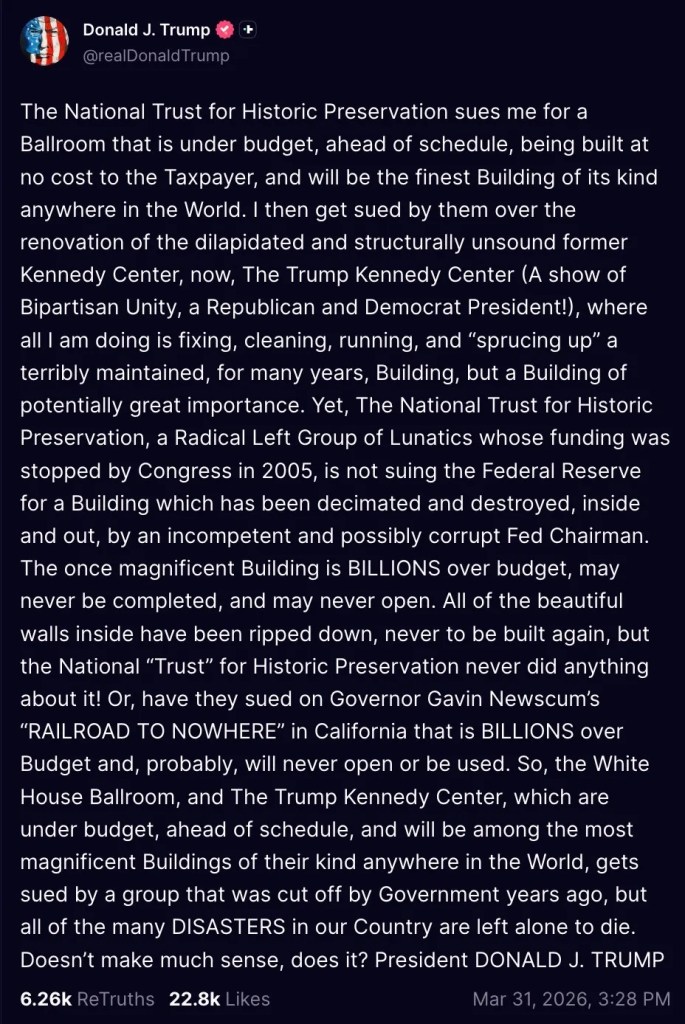
Federal Judge Richard Leon issued a decision stopping work on Trump’s Hideous Grand Obsession: the ballroom that will replace the East Wing of the White House. Trump demolished the East Wing without going through the legal requirements and permissions.
Judge Leon, appointed by President George W. Bush, opened his decision with two sentences:
The President of the United States is the steward of the White House for future generations of First Families. He is not, however, the owner!
Trump responded with this cry of outrage:
Trump is determined to leave his garish mark on D.C.
Not only did he tear down the East Wing of the White House, but he plans other major alterations to the White House and the city.
Of course, he added his name to the Kennedy Center, which was dedicated by Congress as a memorial to the assassinated President. After Trump took control of the Center, artists began canceling their performances and ticket sales fell. To cover his embarrassment, he is closing the Center for two years while “renovating” it. Critics fear that it will emerge as a gold-encrusted monument to Trump.
The New York Times reported that Trump is fixated on making changes to the White House:
He plans to turn the historic Treaty Room into a guest bedroom. Really! He has zero respect for history, and he thinks the White House is his personal property.
Mr. Trump already has torn down the East Wing to make room for his $400 million, 90,000-square-foot ballroom; he remade the bathroom attached to the Lincoln Bedroom in marble and gold; he paved over the Rose Garden grass; he added marble floors and a chandelier to the Palm Room; he covered the Oval Office in gold; and he has a new, 33,000-square-foot security screening center for White House visitors in the works.
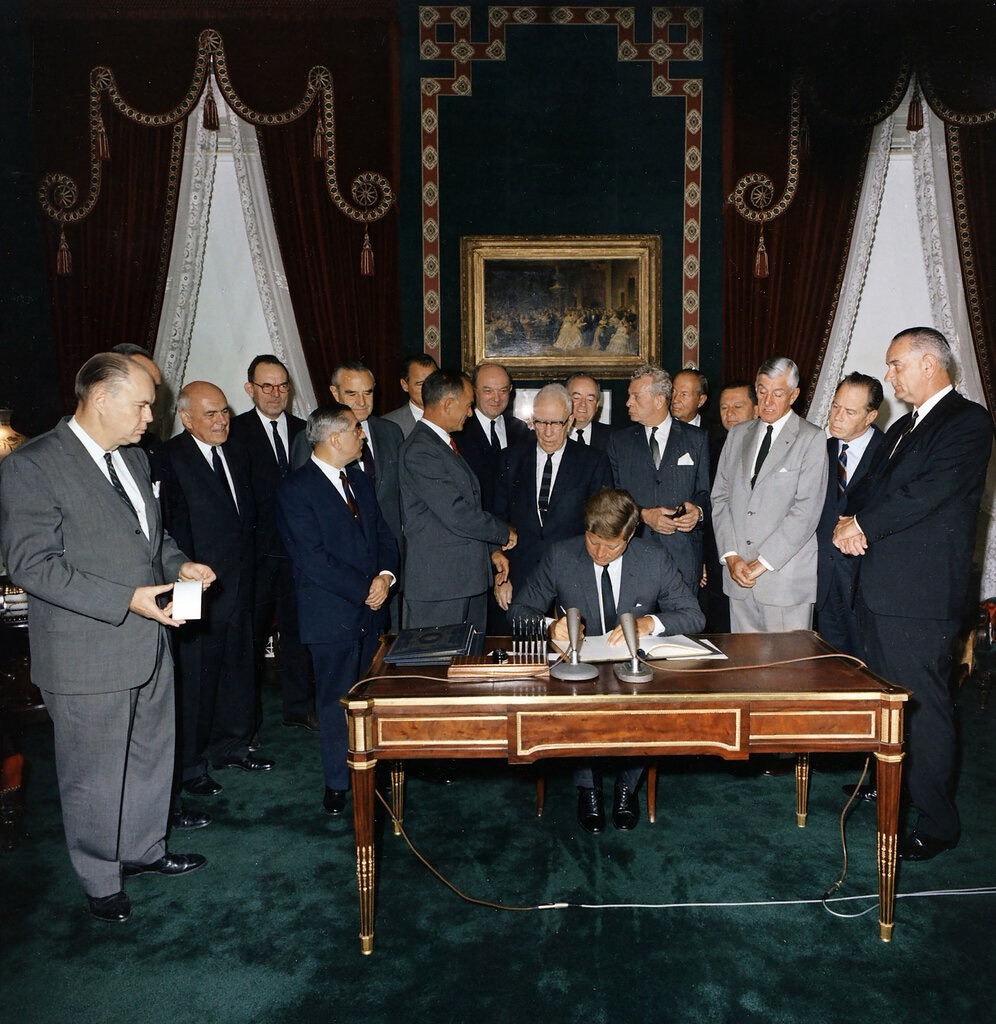
His latest plans involve the more private spaces of the White House, in the second-floor presidential residence. The Treaty Room — which is separate from the Indian Treaty Room in the Eisenhower Executive Office Building — is one of the most historic rooms in the White House. Presidents Ulysses S. Grant and William McKinley used it as a Cabinet room, and it was where the Spanish-American War peace protocol of 1898, and the nuclear test ban treaty of 1963, were signed.
This is a photograph of President John F. Kennedy signing the Nuclear Test-Ban Treaty in the Treaty Room.
Trump wants to turn this historic room into a guest bedroom.
Trump’s egomania doesn’t stop there. It’s boundless. The U.S. Treasury will mint a $1 coin with his face on it to honor the 250th anniversary of the United States. It will also release a large gold coin with his image that will cost thousands of dollars. And in an unprecedented move, the U.S. Treasury will add Trump’s signature to paper currency. No other President has placed his signature on the nation’s currency. Presently, our paper currency has the signatures of the Secretary of the United States and the Treasurer of the United States. Not the President.
Trump wants to build a gigantic arch on the Virginia side of the D.C.-Virginia border. It will be the Arch of Independence, but is colloquially called the “Arc d’Trump.” It will tower over the nearby Lincoln Memorial. Some renderings show the arch slathered in gold, Trump’s favorite decoration.
The most devastating critique of Trump’s efforts to reshape the District of Columbia and the White House was written by Phillip Kennicott, the Pulitzer-Prize winning critic of art and architecture for The Washington Post. It was published before Judge Leon stopped work on the ballroom. Trump, Kennicott says, is the greatest threat to D.C. and the White House since 1812, when the British burned the Capitol and the White House to the ground.
He wrote:
A loosely circular driveway sweeps through the White House grounds, just below the beloved South Portico of the mansion. Its shape echoes a larger park, known as the Ellipse, which connects the president’s home to the National Mall. It also mirrors the curving pathways of nearby Lafayette Square, on the north side of the complex.
The simple symmetry of this modest roadway and the grace of the White House south grounds are no accident: They were the vision of the great landscape architect Frederick Law Olmsted, Jr., one of the original members of the Senate Park Commission, which created the monumental core of Washington as we know it, more than a century ago.
The geometry of this driveway — a small but resonant element of Olmsted’s master plan for the White House campus — will soon be erased, now that a federal judge has allowed President Donald Trump to proceed at least temporarily with construction of his 90,000-square-foot, $400 million ballroom. The ballroom, which will be larger than the original mansion, is so gargantuan that the original curving road simply won’t fit. To make room for Trump’s entertaining and fundraising space, a large notch will be clawed out of the driveway, according to drawings released by Shalom Baranes Associates, the D.C.-based architecture firm overseeing one of the most unpopular projects of the president’s second term.
Washington has a composed geometry built up from significant details like this elliptical drive. As with the diagonal avenues that connect symbolically important circles, squares and civic landmarks, the Platonic perfection of this shape is best appreciated from the air. But it is a vital reminder of the care taken, over the past 200 years, in the design of the capital city, and the deference paid to a set of aesthetic and cultural values that came out of the Enlightenment, including a love of symmetry, repetition, iterative patterns and a fine balance between grandeur and grandiosity.
Trump is the most significant threat to the city’s architectural and design legacy since British forces burned the Capitol and White House during the War of 1812. He has already demolished the East Wing of the White House, which dates to the administration of Franklin D. Roosevelt. He will replace it with a building that makes James Hoban’s neo-Classical executive mansion a mere appendage to a space meant to function like a hotel-convention-center-entertainment venue. He has proposed (but temporarily delayed) painting the next-door Eisenhower Executive Office Building a blinding shade of white, which preservation groups argue could irreversibly damage the stone facade.
He wants to build a 250-foot-tall memorial arch near the most hallowed ground in the country, Arlington National Cemetery. His “Independence Arch,” which he has said will honor himself personally, would dwarf the largest victory arches in the world, including the arch in Pyongyang, built in 1982 to honor North Korea’s murderous dictator, Kim Il Sung. Only Eero Saarinen’s slender ribbon of steel, the Gateway Arch in St. Louis, would be taller. Although it would be built in a traffic circle on the Virginia side of the Potomac, the Trump arch would compete with some of the tallest buildings in Washington, including the Washington Monument and Washington National Cathedral, fundamentally altering a meticulously preserved skyline.
The president’s proposed “National Garden of American Heroes” would introduce a forest of quickly designed statues to the banks of the Potomac almost opposite the new triumphal arch. A sylvan space defined by monumental memorials to Roosevelt, Martin Luther King, Jr. and Thomas Jefferson would be cluttered, wax museum-style, with hundreds of stubby tributes to showbiz stars, folk heroes and sports celebrities.
These proposals, the rush to realize them, the stacking of key oversight groups with Trump loyalists and flunkies and the collaboration of firms like Shalom Baranes Associates, have upended and effectively destroyed the process of design review — which has until now preserved Washington as a monumental, picturesque capital.
They would also manifest in stone, cement and steel a vision of the city fundamentally at odds with the democratic ideals of the city’s founders, the stewards of its expansion in the 19th and 20th centuries, and the vigilance of its latter-day defenders against shabby development, cheapness and commercialization.
In 1806, Benjamin Latrobe, perhaps the first great architect in America, sent a letter to Congress, defending his work on the U.S. Capitol, which was then under construction. Latrobe, who also contributed to the interiors of Hoban’s White House, was a proud and difficult man, and his letter to Congress, which exercises authority over the design of the nascent city — a duty it is now shirking — was prickly and defensive. But in it, he articulated foundational principles for the aesthetics and architecture of the new republic, which recognized no kings, and no absolute authority beyond the laws and the Constitution. “Nothing appears so clear,” he wrote, “as that a graceful and refined simplicity is the highest achievement of taste and art.” American buildings should be “chaste and simple,” and to ornament them just for the sake of surface attraction was folly.
“We find ornaments increase in proportion as art declines, or as ignorance abounds,” he maintained.
This was the common language of American architecture at the time — stately, chaste, simple, dignified — and it echoed ideas from a half-century earlier, as capitalism and representational government were together forging a new, bourgeois worldview. In Adam Smith’s 1759 “Theory of Moral Sentiments,” the Scottish philosopher and economist sometimes called the Father of Capitalism wrote that two new aesthetics were in competition as the world industrialized and broke down the old, feudal orders.
One was based on greed, power and avidity; the other on equity, justice and humility. These values would express themselves in our political systems, our economies, our ethics, our art and our architecture.
“Two different models, two different pictures, are held out to us, according to which we may fashion our own character and behaviour,” he wrote. “The one more gaudy and glittering in its colouring; the other more correct and more exquisitely beautiful in its outline; the one forcing itself upon the notice of every wandering eye; the other, attracting the attention of scarce anybody but the most studious and careful observer.”
The elliptical drive at the White House, about to be disappeared by a gaudy new ballroom, was the exact sort of subtle detail that delighted the designers of early Washington, a pattern hidden in plain sight that would attract the attention of only “the most studious and careful observer.”
The ballroom itself, which Trump has promoted as spectacular and ornate, exemplifies the aesthetic — and moral value system — that Smith found both dangerous and abhorrent. How did we get here? How have we strayed or been misled so far from the values, ideals and aesthetics that gave Washington its current form?
Trump doesn’t have a coherent or consistent aesthetic ideal. Rather, the veteran real estate developer has reflexive responses and aesthetic tics when it comes to design — and for a president, an unprecedented willingness to assert them. Three of these habits are easy to see in his plans for Washington, mirroring his style of politics and his use of rhetoric and language. He has a primitive attraction to the big, the grand, the colossal. When he speaks, he uses superlatives reflexively, and he brings the same sensibility to architecture. And just as nature abhors a vacuum, Trump abhors anything he sees as empty. There is no value in silence, no beauty in open, uncluttered spaces. Everything must be filled, branded, made busy. Finally, he has no sense of context or formal relationships, no understanding of the hierarchies of how buildings (and institutions) relate to each other, to history, to formal plans.
The design of beautiful cities, and the design of effective governments, are predicated on “gentleman’s agreements,” voluntary deference to precedents and conventions. Trump respects none of this.
But there is a fourth deficiency in his understanding of architecture and design, which arises from and amplifies his other three failures of taste and judgment: He appears utterly uninterested in basic American values, history and symbols, and so there are no guardrails, no limits, to the damage done by his other failings.
Trump’s single-minded and unwavering preference for the biggest, his equating of size with significance, has become so familiar we have started to overlook it. But the architectural consequences for Washington will be devastating. When Stanford White — whose architecture firm McKim, Mead & White designed several branches of New York’s Public Library and the original Pennsylvania Station — drafted a memorial arch, he included in an 1892 rendering the figure of a man holding a measuring stick to offer a sense of its size. The arch, built in Manhattan’s Washington Square Park to honor the nation’s first president, rose to 77 feet, a bit taller than the ancient Roman Arch of Titus on which it was loosely modeled. But while grand and imposing, it still had a relationship to human scale.
Trump’s arch will dwarf this, and all other ancient precedents. Only the monuments erected by modern governments that rule by terror and dehumanization offer any comparable examples. And it is larger than many of those, too, dwarfing the Victory Arch in the North Korean capital of Pyongyang.
It will also fundamentally alter one of the essential elements of what is known as the McMillan Plan, the Senate Park Commission’s 1902 redesign of the capital city which created the National Mall and the monumental core of Washington. The McMillan Plan forged a grand, axial vision of national healing and reconciliation that symbolically reconnected the North and the South by a bridge across the Potomac, joining a city of the dead at Arlington Cemetery to the city of the living, with the Lincoln Memorial as a hinge point. Long vistas and clear views drew the eye from the memorial to the military architect of Civil War victory, Ulysses S. Grant, at the base of the U.S. Capitol, to the temple devoted to the political architect of reunification, Lincoln, more than two miles away. The men and women who sacrificed their lives for reunification were honored by the Arlington Memorial Bridge leading to the cemetery and low-lying hills of Virginia just beyond.
That open view across the Potomac River to the hallowed burial ground was essential. A winning design in an early competition for a bridge at that crossing included two massive arches over its central piers — small compared to Trump’s arch, but large enough to impede views. The leaders of the McMillan Plan not only rejected these arches, they took particular care to keep sight lines open and the design of the shallow, low-slung bridge (by McKim, Mead & White) simple and elegant. They also stripped away a complex plan for some 40 decorative sculptures. The closer they got to the final resting place of Civil War soldiers, the more the planners insisted on dignity, sobriety and simplicity.
All of Trump’s proposed designs for a victory arch that he has shared on social media would block that carefully preserved view. One would also be laden with gilded statues, eagles and other glittering ornamental forms.
To understand the true scale of Trump’s ballroom, you have to get beyond the mere size of its floor plan — at 90,000 square feet, almost twice as large as the original structure’s 55,000 square feet. Rather, you need to take into account the context of the White House grounds and the surrounding federal buildings. The scale of the addition will destroy any sense of symmetry between the East and West wings and reorient the White House campus to the east, where it faces the massive Treasury Department building, a dispiriting, fortresslike phalanx of Ionic columns that natter on like someone discoursing on the infallible wisdom of free markets. Renderings of the new structure make it look like the old White House mated with Treasury, spawning a grotesque creature that has traded the livability of a domestic space for the untrammeled power of a banking colossus.
Trump’s gilded arch, ballroom and his redesign of the Oval Office with incrustations of historically anachronistic gold ornament, introduce a fussiness and busyness into a Washington aesthetic that has generally favored the chaste and simple, at least when it comes to the profile of classical buildings. His hanging of banners — in many cases featuring gigantic portraits of himself — as well as projecting images onto the blank face of the city’s most sublime and minimalist structure, the Washington Monument, suggest a need to fill in blank space, animating planes that are meant to be spare and quiet. The ballroom isn’t simply too big, it is also too busy.
Like the news cycle, architectural and urban spaces are treated as mere voids, waiting to be filled with Trumpian noise. Once filled, he owns them, at least in his own mind. Once owned, they can be monetized, and it’s likely only a matter of time until advertising is projected onto the Washington Monument and other structures.
All of this has consequences on a deeper, symbolic level. The ballroom reorients the White House to suggest that it is fundamentally responsive to economic rather than civic power, confirming visually what is too often the case politically: The executive serves the financial class first and foremost. The triumphal arch will be placed on the Virginia side of the Potomac River, effectively crowning the South as the victor in the Civil War. That too reaffirms in visual terms what is too often the case in civic life: That the values of the Confederacy, including its deeply entrenched racism and violence, remain extraordinarily powerful in American culture.
The gilding of the arch echoes the tinsel applied to American history through entrenched mythologies like the Lost Cause.
There is no final price tag on all of this, beyond a few figures floated by the president, who has said that his $400 million ballroom will be financed privately — by billionaire donors and corporations maintaining contracts with the federal government in the hundreds of billions of dollars. Some of the funding for the National Garden of American Heroes will come from siphoning money out of the National Endowments for the Arts and Humanities. We may never know how much it all costs, or who curried favor by paying for it, or what conflict-of-interest lines were crossed.
But the larger, less tangible costs can be roughly tabulated. The Commission of Fine Arts, which was created in 1910 to oversee the design of the city and execute and protect the vision of the McMillan Plan, is now a toothless organization stacked with loyalists including some with no expertise in design or architecture — among them a 26-year-old White House aide who has served as the president’s executive assistant.
Design review is dead, and with it the values of simplicity, chastity and modesty celebrated by Latrobe and Smith. Washington is now subject to design by fiat, by whim, by executive orders, whether legal or not. Trump is moving quickly to introduce noise, disorder and incoherence into the design of the capital city. It will be a lot less beautiful. And people who live here and those who visit may not know why, but they will sense that disorder and incoherence and tune it out, like just more noise.
Paul Waldman was one of my favorite reporters at The Washington Post. He left and started his blog, “The Cross Section.” In this post, he says that most of Trump’s economic setbacks are the result of his own disastrous policies, not forces beyond his control.
I do think Walkman is unfair to Hoover. Unlike Trump, Hoover had a distinguished career and tried to make the right decisions for the right reason.
Waldman writes:
As spring arrives and the cherry blossoms bloom around Washington, Donald Trump’s approval ratings are officially in the toilet:
There are many reasons why he keeps falling lower and lower, but the single most important is likely that Trump has utterly failed on what the foolish and gullible believed was his great strength: the economy. While he does a lot of distasteful but symbolic things like demolishing the East Wing and plastering his name on everything in sight, all of Trump’s most consequential screwups and authoritarian abuses have an economic component. And they all make things worse.
In fact, you’d have to go back to Herbert Hoover to find a president whose decisions were so directly and willfully disastrous for the economy. That’s not because this is the worst economy since the Great Depression; it isn’t, not yet anyway. But in all the downturns and crises we’ve had over the last century, the causes were largely outside of the president’s control.
Those presidents might have made some different decisions or found a way to improve things more quickly, but one wouldn’t say that George W. Bush created the economic crisis of 2008, or that the inflation that crossed the presidencies of Richard Nixon, Gerald Ford, and Jimmy Carter happened only because of the decisions they made. Most of the judgments we make of them in retrospect were about how they responded once the crisis arrived. They may have been blamed when things turned bad, but one could argue in every case that it wasn’t really their fault. The latest example is from 2022, when inflation spiked all over the world and here at home Joe Biden got the blame.
But what’s happening now is different. Consider the major policy initiatives of Trump’s second term:
Tariffs: Trump believes fervently in the power of tariffs to produce boundless prosperity, and so he has imposed an ever-shifting program of tariffs on foreign materials and products. The nearly universal conclusion of economists is that this policy has been a failure; not only hasn’t it created the manufacturing boom Trump promised, it has increased prices for American consumers and led our trading partners to begin constructing a new global trade system to circumvent the U.S.
Immigration: Trump’s sweeping crackdown on immigration — both deporting immigrants already here and making it all but impossible for new immigrants to come — has been an economic disaster. As a Brookings Institution report notes, “Reduced migration will dampen growth in the labor force, consumer spending, and gross domestic product” in years to come. Multiple economic sectors from construction to agriculture are facing labor shortages, and job growth has slowed to a crawl. And because the crackdown is motivated by naked animus toward all immigrants but especially non-white ones, it extends to a large and growing number of policy areas. For instance, the Small Business Administration just announced that it will cut off loans to green card holders, despite the fact that immigrants start more businesses and create more jobs than native-born Americans. One could hardly imagine a dumber economic own-goal, done for no reason other than the fact that the Trump administration hates immigrants.
Energy: Trump has waged an outright war on renewable energy, one of the most dynamic and fast-growing sectors of the world’s economy. As a result, we’ve ceded the green manufacturing sector to China, which now makes most of the world’s wind turbines, solar panels, and lithium-ion batteries. While the Chinese electric car industry is leaping ahead, ours is pulling back, a direct consequence of Trump’s decision to kill EV subsidies. In its lust to prop up the fossil fuel industry, the administration is literally forcing utilities against their will to keep coal plants open so customers can pay more for electricity and get dirtier air in the bargain. And speaking of fossil fuels…
The Iran War: We don’t know how long this war will go on, but the economic effects are already being felt. Gas has now crossed $4 a gallon (which will cause a broad increase in prices for all kinds of goods), farmers are facing a spike in the cost of fertilizer, and as Paul Krugman points out, the real effects of the constriction in oil supplies haven’t even been felt yet, which is why some energy analysts are predicting that this could be a worse crisis than the oil shock of the 1970s. The Pentagon wants an additional $200 billion to fund the war, and congressional Republicans are considering health care cuts to pay for it. There are now serious worries that the war could produce a global recession.
He’s a business guy, he knows the economy and stuff
To call this a record of economic incompetence would be too kind. In every case, Trump chose to do what he did for the most stupid, petty, and malicious reasons, despite the fact that the economic effects his decisions would produce were obvious and predicted by anyone with half a brain. It’s especially notable given that in his first term, Trump operated with a kind of benign neglect on many economic fronts, the consequence of which was that before he utterly screwed up his response to the covid pandemic, things were going pretty well. Yes, he restricted immigration and imposed some tariffs, but it was on a much smaller scale. For the first three years of his term, job growth was reasonable, inflation was low, and the economy largely rolled along.
Which probably reinforced the widespread and completely false notion that because Trump was a business guy who knows business stuff, he would be skilled at managing the economy. Even if Trump had been a traditional business leader and not a scam artist with a checkered record of successes and spectacular failures (including multiple bankruptcies), that wouldn’t have meant he knew anything about macroeconomic policy; as I’ve been shouting for far too many years, government and business are not remotely alike, and the skills and knowledge one needs to succeed in one do not transfer to the other.
Yet despite the crushing weight of all available evidence, one still heard voters in 2024 say that because Trump knows business, he could come into office, business away all that inflation (which was largely gone by the time of the election anyway), and bring us to a new age of prosperity. The fact that people thought that is a tribute to the propagandistic power of repetition: Say a thing often enough, no matter how ridiculous it is, and at least some people will believe it. (The same is true of the idea that Trump is a great deal-maker, when in fact he is the world’s worst negotiator.)
To their credit, Americans are now giving Trump dreadful ratings on the economy; in the latest Reuters/Ipsos poll (which was taken a week ago, before the national average for gas topped $4 a gallon), his economic approval was only 29%, worse than Joe Biden’s at the height of the 2022 inflation:
It would be nice if this were the result of the American public’s discerning judgment, but it almost certainly isn’t. That’s not to say that a majority of them favor fascism, because they don’t. But to drive your approval as low as Trump’s has gotten, you have to really muck up the economy. And on that score, we haven’t seen anything yet.



 Diane Ravitch's blog