Archives for category: Accountability


The PISA results were released, and they put the test-and-punish reforms of the past two decades in a harsh light. Billions have been spent on testing and spurious teacher evaluations.

Dana Goldstein writes in the New York Times:

The performance of American teenagers in reading and math has been stagnant since 2000, according to the latest results of a rigorous international exam, despite a decades-long effort to raise standards and help students compete with peers across the globe.

And the achievement gap in reading between high and low performers is widening. Although the top quarter of American students have improved their performance on the exam since 2012, the bottom 10th percentile lost ground, according to an analysis by the National Center for Education Statistics, a federal agency.

If you recall, the Disrupters claimed that their method would both “Race to the Top” and “close achievement gaps.”

Their strategies did neither. Time for a change.


During the 2016 campaign, Donald Trump spoke of his commitment to protect the rights of LGBT people.

He lied.

ProPublica released a report documenting the Trump administration’s step-by-step dismantling of federal protections of LGBT persons–in the military, in public housing, in schools, in health care, and in enforcement of civil rights in the courts.

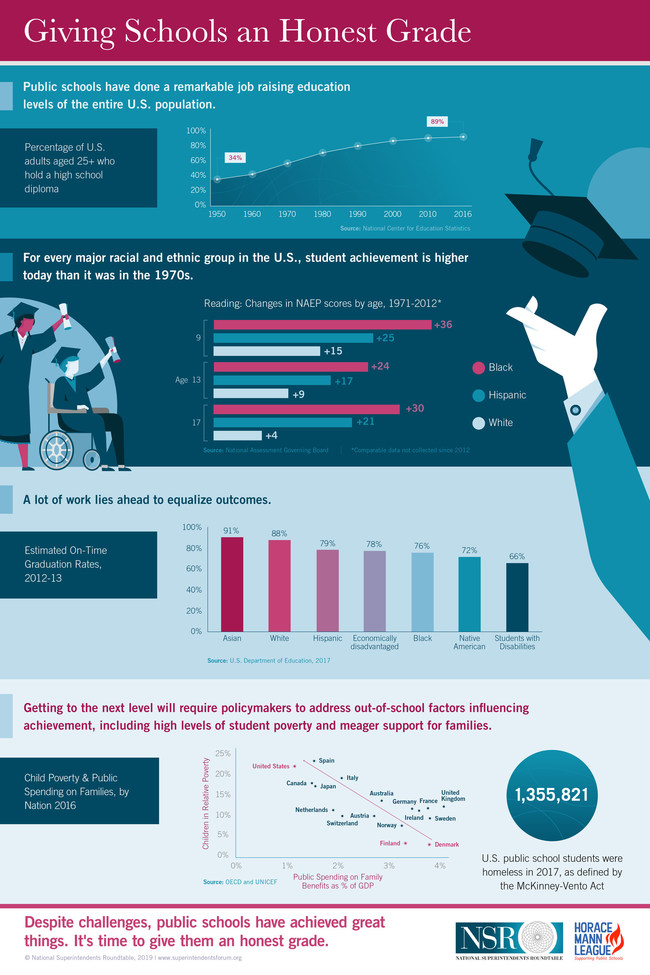
The National Superintendents Roundtable has a message for the public: be fair when judging our public schools. Schools today are far better than they were 40 or 50 years ago, by all conventional measures. what they might have added was that schools made steady progress until about 2007 or so, when No Child Left Behind took hold, then things were made worse by Race to the Top and Common Core. The proliferation of choice has flattened the progress made from 1970 to 2007.

Helen Ladd is one of our nation’s most distinguished economists. She has written extensively about education and poverty, as well as school choice.

Dr. Ladd informed me that she has written some new scholarly articles about charter schools.

I read them and was impressed.

I asked if she would let me post them here. She said that they are on a website that has limited access.

However, she said, the articles are now available and accessible to individuals who download them.

You can find the links on her web site:

https://sanford.duke.edu/people/faculty/ladd-helen-f

Or You may go directly to the links to the articles on the web site.

https://sanford.duke.edu/sites/sanford.duke.edu/files/images/Ladd-2019-Journal_Policy_Analysis_and_Management_Charter%20Schools.pdf

https://sanford.duke.edu/sites/sanford.duke.edu/files/images/Ladd-2019-Journal%20Policy%20Analysis%20%26%20Management%20Experimentation.pdf

Dr. Ladd asked me to point out that she was invited to write as part of a Point-Counterpoint discussion in the Journal of Policy Analysis and Management.  The author of the pro-charter paper and response, which are not posted here,  was  Philip Gleason from Mathematica.

I do not have access to links for the Gleason part of the exchange.


I never thought about sitting down and writing out my “rules for life,” but Peter Greene did.

They are good as anything I could write, actually better, so I share them here with you.

Many people have written to me to complain about an article that appeared Wednesday on the front page of the New York Times, saying it was pro-charter propaganda. The article claims that black and brown parents are offended that the Democratic candidates (with the exception of Cory Booker, now polling at 1%) have turned their backs on charter schools.

This is not true. Black parents in Little Rock, Arkansas, are fighting at this very moment to stop the Walton-controlled state government from controlling their district and re-segregating it with charter schools. Jitu Brown and his allies fought to keep Rahm Emanuel from closing Walter Dyett High School, the last open enrollment public high school on the South Side of Chicago; they launched a 34-day hunger strike, and Rahm backed down. Jitu Brown’s Journey for Justice Alliance has organized black parents in 25 cities to fight to improve their neighborhood public schools rather than let them be taken over by corporate charter chains. Black parents in many other districts–think  Detroit–are disillusioned with the failed promises of charter schools. Eve Ewing wrote a terrific book (Ghosts in the Schoolyard: Racism and School Closings on Chicago’s South Side) about resistance by parents, grandparents, students, and teachers in the black community to Rahm Emanuel’s mass closings of public schools to make way for charter schools; Ewing called their response “institutional mourning.” When Puerto Rico teetered on the verge of bankruptcy, parents, teachers, and students rallied against efforts to turn the Island’s public schools over to charter chains.

The article’s claim that “hundreds of thousands” of students are on “waiting lists” to enroll in charters links to a five-year-old press release by a charter advocacy group, the National Alliance for Charter Schools. In fact, there has never been verification of any “wait list” for charters. Although there are surely charters that do have wait lists, just as there are public schools that have long wait lists, there is no evidence that hundreds of thousands of students are clamoring to gain admission to charters. That claim appears to be a marketing ploy. Earlier this year, a member of the Los Angeles school board revealed that 80% of the charters in that city have empty seats. Just this past week, a well-established Boston charter announced that it was closing one campus and consolidating its other two because of declining enrollments. Four of Bill Gates’ charter schools in Washington State have closed due to low enrollments. The only effort to verify the claim of “waiting lists” was carried out by Isaiah Thompson, a public radio reporter in Boston; his review showed that the list contained many duplications, even triplications, since many students applied to more than one school, and the same lists held the names of students who had already enrolled in a charter school or a public school.

Perhaps the Times will now interview Dr./Rev. Anika Whitfield in Little Rock to learn about the struggles of Grassroots Arkansas to block the Walton campaign to destroy their public schools. Perhaps its reporters will interview Jitu Brown to hear from a genuine civil rights leader who is not funded by the Waltons or the Bradley Foundation or Betsy DeVos. Perhaps they will dig into the data in Ohio, where 2/3 of the state’s charter schools were rated either D or F by the state in 2018, and where the state’s biggest cyber charter went into bankruptcy earlier this year after draining away over $1 billion from public schools’ coffers. Perhaps they will cover the news from New Orleans, the only all-charter district in the nation, where the state just posted its school scores and reported that 49% of the charters in New Orleans are rated either D or F. Perhaps they will cover the numerous real estate scandals that have enabled unscrupulous charter operators to fleece taxpayers.

Fairness requires that the New York Times take a closer look at this issue, not by interviewing advocates for the charter industry but by trying to understand why so many Democrats, especially progressives, have abandoned the charter crusade. Why, as the Times asked in July, have charter schools lost their luster?  (I asked the same question last April.) [Editor’s note: I added these two links to refer to use of the term “lost their luster.”] Why have the number of new charters plummeted nationally despite the expenditure of $440 million a year by the federal government and even more by foundations like Gates, Broad, DeVos, Bloomberg, Koch, and Walton. Maybe it was disappointment in their lackluster, often very poor, academic performance. Or maybe it was the almost daily revelations of waste, fraud, and abuse that occurs when public money is handed to entrepreneurs without any accountability of oversight.

The question that must be answered is whether it is just and sensible to create two publicly funded school systems, instead of appropriately funding the public schools that enroll 47 million students, almost 90% of all students. It serves the interests of billionaires to keep people fighting about governance and structure, but it serves the interest of our society to invest in great public schools for everyone.


ON TAP Today from the American Prospect

NOVEMBER 27, 2019

Kuttner on TAP

The Times: In the Tank on Charter Schools. The Times ran an overwrought and overwritten front-page story Wednesday under the breathless headline, “Minority Voters Feel Betrayed Over Schools.” Betrayed? The headline on the jump page where the story continues is even more exaggerated: “Minority Voters Chafe as Democrats’ Charter School Support Wanes.”

The piece reads as if it were dictated by the charter school lobby. Read the story very carefully, if you bother to read to the end, and you will learn that some black and Hispanic voters see charters as a good alternative to public schools, while others are concerned that charters, which serve only a fraction of minority kids, drain resources from the larger number of kids in public schools, as the Prospecthas documented.

And if you read all the way to paragraph 38 (!), you will learn that according to a poll by Education Next, a journal that supports charters, black opinion on charter schools is in fact evenly divided, 47 percent supportive to 47 percent opposed. But that kind of nuance doesn’t get your story on the front page, while quoting fervent charter school activists and making unsupported generalizations does.

Other 2017 polling by Peter Hart Associates showed that large majorities of voters, black and white, oppose shifting funds from public schools to charters. Black parents were opposed, 64 to 36. Hart’s Guy Molyneux says there’s no evidence that these views have changed.

Does the Times have fact-checkers? Editors? Do they hold writers accountable?

Back to school!

Robert Kuttner’s new book is The Stakes: 2020 and the Survival of American Democracy.

A few weeks ago, I wrote about the firing of a charter school founder who had written an essay that offended some students and/or teachers at his charters, who accused him of “white supremacy.” At the time, I commented in response to my own post that Steven Wilson of Ascend should be more sympathetic to teacher “due process rights” (tenure) in light of what happened to him.

Checker Finn and Rick Hess wrote about this situation and blamed it on “woke” reformers. They concluded it was time to “stand up” against this sort of injustice.

Peter Greene writes that Finn and Hess made the case for teacher tenure. Steven Wilson and future Wilsons won’t be saved by expecting anyone to “stand up” for them. No one will.

http://curmudgucation.blogspot.com/2019/11/finn-and-hess-accidentally-argue-for.html

The superintendent of the New Orleans’ all-charter school district recommended the closure of two charter schools that received a grade of F, but parents and students turned out at the Orleans Parish School Board meeting to demand that the board override his decision and keep their schools open.

Students, parents and leaders of two Orleans Parish charter schools turned out by the dozens on Thursday night to protest Superintendent Henderson Lewis Jr.’s decision to pull the school’s charters, prompting the president of the Orleans Parish School Board to say he’s considering a board vote on overriding the decision.

President John Brown said he was responding to the two schools’ request after Lewis confirmed his recommendation not to renew their charters because of failing grades.

The protests, which included emotional speeches by parents and students, and the response from Brown set up a potential clash between the superintendent of NOLA Public Schools, the new name of Orleans Parish’s all-charter school district, and the leader of the city’s school board…

If the board were to override Lewis’ decision not to renew the two charters, it would be the first time a board took that step since the city’s all-charter network of schools returned to local control.

More than 50 representatives from the schools showed up at Thursday’s board meeting to urge Lewis to reconsider. 

A ruling by five of the board’s seven members can overturn the superintendent’s decision.

In a private email to me, Lance Hill, an education activist in New Orleans, explained:

The subtext of this is that there a few charters that began early on that were controlled by black former OPSB teachers and administrators that were islands of local control (MLK in particular) in a white-dominated, outsider controlled charter system. These schools have struggled in part because they would not cherry-pick and force out  challenging students (Treme in particular) and have always been resented by the NSNO (New Schools for New Orleans) people.  They have also moved toward unionizing lately.  
But it is a good example of how some charters build their own constituencies, even if they are failing, because they are perceived as more locally and black controlled.  I imagine the school board will give them a pass just to avoid the conflict. 


The Wall Street Journal published an expose of the College Board’s practice of selling student data, which is illegal in some states. The colleges buy the names and addresses of students, encourage them to apply, then reject them so they can claim they are “exclusive.” It looks good on the US News phony ratings when colleges have a low acceptance rate.

For 47 cents, the College Board will sell an individual’s information, feeding admissions frenzy

Jori Johnson took the practice SAT test as a high-school student outside Chicago. Brochures later arrived from Vanderbilt, Stanford, Northwestern and the University of Chicago.

The universities’ solicitations piqued her interest, and she eventually applied. A few months later, she was rejected by those and three other schools that had sought her application, she said. The high-school valedictorian’s test scores, while strong by most standards, were well below those of most students admitted to the several schools that had contacted her.

“A lot of the rejections came on the same day,” said Ms. Johnson, a 21-year-old senior film major at New York University, one of three schools that accepted her out of 10 applications. “I just stared at my computer and cried.”

The recruitment pitches didn’t help Ms. Johnson, but they did benefit the universities that sent them. Colleges rise in national rankings and reputation when they show data suggesting they are more selective. They can do that by rejecting more applicants, whether or not those candidates ever stood a chance. Some applicants, in effect, become unknowing pawns.

Feeding this dynamic is the College Board, the New York nonprofit that owns the SAT, a test designed to level the college-admissions playing field.

The board is using the SAT as the foundation for another business: selling test-takers’ names and personal information to universities.

That has helped schools inflate their applicant pools and rejection rates. Those rejection rates have amplified the perception of exclusivity that colleges are eager to reinforce, pushing students to invest more time and money in preparing for and retaking exams College Board sells. Colleges say the data helps them reach a diverse pool of students they might have otherwise missed.

“The top 10% of universities don’t need to do this. They are buying some students’ names who don’t have a great chance of getting in,” said Terry Cowdrey, an enrollment consultant for universities and Vanderbilt University’s acting dean of undergraduate admission in 1996 and 1997. “Then the kids say, ‘well why did you recruit me if you weren’t going to let me in?’ They do it to increase the number of applications; you’ve got to keep getting your denominator up for your admit rate.

If anyone doubts that big money is buying our democracy, read Mercedes Schneider’s post about the recent election in Louisiana.

Anyone who doubts that ueber-wealthy ed reformers are purchasing elections in other states need only consider this November 10, 2019, campaign finance reportfor the Louisiana Federation for Children (LFC) Action Fund PAC. Even so, as one quickly realizes when following ed reform money, the connections readily become numerous and complicated.

Let’s see how concise I can keep this this post centered on a single, LFC campaign finance report.

LFC is a state-level tentacle of the American Federation for Children (AFC), the school choice vehicle formerly chaired by US ed sec, Betsy DeVos. Louisiana gubernatorial challenger, Eddie Rispone is the former LFC chair. and also the former treasurer of the LFC Action Fund PAC.

According to LFC Action Fund PAC’s November 10, 2019, filing, three out-of-state donors (two individuals and one PAC), donated a combined $825K in October 2019. The same three donated a combined $2.6M in 2019 alone. They are Arkansas billonaire and Walmart heir, Jim Walton; California billionaire William Oberndorf, who succeeded DeVos as AFC chair, and a school choice PAC, Public School Allies:

  • William Oberndorf (CA): $275K in 10/19; $550K YTD (year to date).
  • Jim Walton (AR): $350K in 10/19; $912K YTD.
  • Public School Allies (VA): $200K in 10/19; $1.2M YTD.

Public School Allies lists as its address “6312 Seven Corners Center #354
Falls Church, VA 22044,” which is a UPS drop box. However, the October 24, 2019, Chlakbeat reports that Public School, Allies is the “political arm” of the City Fund, created in 2018 to spread school choice by three individuals, including former New Schools for New Orleans (NSNO) CEO, Neerav Kingsland. From Chalkbeat:

The political arm of The City Fund, the organization with ambitions to spread charter schools and the “portfolio model” of school reform across the country, plans to spend $15 million to influence state and local elections over the next three years.

That political group, known as Public School Allies, has already directed money toward to school board races in Atlanta, Camden, Newark, and St. Louis, and state elections in Louisiana, Georgia, and New Jersey. Donations have ranged from $1 million to as little as $1,500.

The information was shared by Public School Allies and, in a number of cases, confirmed by campaign finance records. The $15 million comes from Netflix founder Reed Hastings and former hedge-fund manager John Arnold, the organization said.

According to his Linkedin bio, Kingsland worked for both Hastings and Arnold “leading education giving” immediately prior to establishing the City Fund.

Sure makes it read like the City Fund “belongs” to billionaires Hastings and Arnold.

But they are not alone. In 2018, billionaire Bill Gates gave the City Fund $10M “to increase the number of high-quality public schools in Oakland.” Of course, to the City Fund, a “public school” is a charter school.

Those complex ed-reform funding paths always seem to end with a few millionaires and billionaires, tossing their cash and puppeting the strings of American K12 education.

Open the link to read the list of officials who were elected by out-of-state billionaires.

Here is the thing: They can buy the seats, but once they have bought them, they have no plans that will actually improve anything. They love power. They buy elections.

Big money is a malignant force in our democracy.