Archives for category: Accountability

Harold Meyerson adds a few reasons to believe that Michael Bloomberg is not the right candidate to beat Trump:

ON TAP Today from the American Prospect

January 2, 2020

Meyerson on TAP

Bloomberg: The Manchurian Candidate. If there’s anyone out there who believes Michael Bloomberg would be a strong candidate to unseat Donald Trump, a very well-documented story in today’s Washington Post should tank any such delusions. Some of the particular weaknesses that Post reporter Michael Kranish documents have been in plain view for some time, while others are getting their first exposure, but no one has assembled them into a coherent narrative comparable to Kranish’s.

In case you didn’t know, Bloomberg is up to his neck in business relations with China and the Chinese government. His company has had offices in Beijing for the past 25 years and has made a tidy sum selling its computers and financial information to the nation’s multitude of capitalists and to its Leninist-capitalist government. Two years ago, the Bloomberg Barclays Global Aggregate Bond Index elected to include Chinese government bonds in its listings, enabling Western investors to fund the Chinese government’s myriad endeavors. Kranish reports that financial experts believe that $150 billion in such investments will flow to China in the next couple of years.


Also in 2018, Bloomberg initiated the Bloomberg New Economy Forum, his very own Asian-oriented Davos, which held its meeting that year in Singapore, and its 2019 confab in Beijing.


Not surprisingly, seldom is heard a discouraging word from Bloomberg about the Chinese government. One searches in vain for his criticisms of the government’s mass incarceration of the Uighurs or its threats to Hong Kong. On the contrary, he told a television audience that Chinese President Xi Jinping “is not a dictator.”

In short, Bloomberg is the man who opened the door to major American investments in the Chinese government. Can I see the hands of those who think this will help him if (as, happily, will not happen) he’s the designated Democrat to take on Trump? ~ HAROLD MEYERSON

The following statement was released on New Year’s Day by Community Voices for Public Education, a coalition of parents and students in Houston. As their statement demonstrates, the state takeover is a fraud intended to strip the school district of its elected school board and to replace it with a hand-picked governing board selected by a non-educator who wants to privatize public education.


It is New Years’ Day and public education is on our minds.

Will you make a commitment to fight the immoral, unAmerican and racist takeover of HISD?  Call your elected officials and then bring five friends with you to the January 9 rally opposing this takeover. 

Recently, the Houston Chronicle editorial board used misleading facts and misrepresentation to misinform its readers. The Chronicle seems mission-driven to legitimize the state takeover of HISD no matter the cost to its journalistic integrity or actual facts.

When they do this over three editorials, it is no longer an accident; it is propaganda. 

Here are some examples from the most recent editorials.

HISD at a crossroads: Looming State Takeover: The editorial compared HISD’s 81% graduation rate to Dallas’ 88% and Fort Worth’s 87% leaving the reader with the impression that they were better school districts.  The reality is Fort Worth has a TEA 2019 Accountability Rating of “C”(79) and only 53% of their graduates are college, career or military ready versus HISD’s “B”(88) and 63% graduate readiness. Dallas ISD has a “B” (86) rating and only 57% of their graduates are college, career or military ready. By the TEA’s own standards HISD is the better district. How did the Houston Chronicle and Mr. Morath manage to come to a completely different conclusion? Didn’t any of them bother to check the Texas Schools website? https://txschools.gov 

HISD must learn from others and our own past:  This editorial starts with the statistic of 56% of HISD students not meeting grade level expectations as measured by the STAAR test but it never mentions that Dallas ISD has the exact same STAAR performance rating as HISD. Once again, the Chronicle incorrectly leaves readers with the impression that Dallas is a better school district. (Source https://txschools.gov) 

HISD needs improvement, but where to start? How could the Chron fail to mention the Superintendent? The person who actually runs the district. The person who hires and places the all important principals. The person who would have to actually implement the LBB recommendations. This piece misleads the reader into thinking the Board of Trustees run the district. They don’t! They are a governing body elected by us and accountable to us. If the state takeover proceeds, our democratically elected school board members, four just elected, will be replaced with a board of managers serving at the pleasure of the governor and the TEA.

A call to all Houstonians to participate: In its final editorial in the series, the Chronicle asks us to put blind faith in TEA Commissioner Mike Morath as our unelected torchbearer. His educational experience is one term as Dallas ISD Trustee in which he unsuccessfully tried to turn Dallas ISD into a “home rule” giant charter using the same tactics he is now employing in Houston ISD. Truly, his resume is thinner than most substitute teachers. 

Throughout the series, the Houston Chronicle disregards overwhelming evidence that state takeovers harm students and communities. They also turn a blind eye to the fact that takeovers have been used disproportionately against school districts of color. Furthermore, they have ignored a preponderance of evidence that high stakes testing is a flawed method for evaluating students, teachers and schools. 

And the series pays the barest lip service to poverty/inequity and the effect on children and families. When seven children share one mattress, they do not need a state takeover to do better in school; they need six more mattresses.

If the Editorial Board wanted to facilitate meaningful change in HISD, their editorials should have been grounded in complete facts and they should have used data to inform, not obfuscate. There is no such thing as problem solving through propaganda.

Community Voices for Public Education
http://www.houstoncvpe.org/


The public schools of Houston are going to be taken over by the incompetent State Education Department, which has never run a school district of any size and which has failed in its previous takeover efforts.

The Houston Chronicle hailed the pending takeover, while noting that the Houston Independent School District has been acknowledged in the recent past as the best urban school district in the nation (by the disreputable Broad Institute or Academy). Its editorial saluting the takeover by the state notes that 21 of HISD’s 280 campuses received “failing grades” from the state, and one (1) school–Wheatley High School–has a persistent record of low test scores. The failure of Wheatley–which has an even higher proportion of the neediest students than the rest of the district–triggered the state takeover.  This is a district where 80% of the students are “economically disadvantaged” and many are English learners. So, of course, the state commissioner and the editorial board of the newspaper blame low test scores on the elected school board. Apparently, they believe that democracy is the culprit, not poverty.

The citizens of Houston should rise up in protest. I am a graduate of the Houston public schools. The teachers are not the same. The schools are now majority-minority. The state would not dare to pull a stunt like this in one of its majority white districts.

The state commissioner, Mike Morath, is a software developer who was never a teacher or an administrator in a public school or any school. He served on the Dallas school board, which presumably makes him an expert. Despite the high rate of poverty in HISD, the graduation rate is 81%, but in Dallas it is 88%. This is considered a disgrace for Houston, but who knows how those graduation rates were manipulated? How many were the result of a one-week online credit recovery program?

It is understandable that the rightwing governor Greg Abbott would enjoy stripping democracy from the people of Houston, who don’t vote the way he likes. It is incomprehensible that the Houston Chronicle salutes this blatant removal of democracy from the people of Houston.

Don’t they know that the most important mission of public education is to teach democracy and the skills of citizenship, not to manufacture test scores?

What lesson do they think they are teaching the students of Houston?

I hereby name Governor Greg Abbott and Commissioner Morath to this blog’s Wall of Shame. People whose names are on the Wall of Shame have trouble looking at themselves in the mirror.

HISD at a crossroads: A four-part series by the Editorial Board

Thursday Dec. 26: Time for radical improvement
Friday Dec. 27: Learning from others, and our own past
Sunday Dec. 29: Road map to transformation
Monday Dec. 30: A call to action
Tell us what you think about HISD: What works? What doesn’t? What needs to change? Please use this online form to send letters to the editor. To access the form, point your browser to https://www.houstonchronicle.com/opinion/submit.
https://www.houstonchronicle.com/opinion/editorials/article/HISD-in-crisis-Looming-state-takeover-presents-14929858.php

HISD at a crossroads: Looming state takeover presents rare opportunity [Editorial]

The Editorial Board


A dark cloud has loomed over Houston ISD almost as long as Naomi Doyle-Madrid’s children have been enrolled in the district.
The nonprofit director despaired over the elimination of the arts program at the elementary school her oldest son attended — part of a round of “devastating” cuts to HISD’s magnet programs about seven years ago.
She had to slash through layers of bureaucracy to get special education services for her third-grader. She has seen school safety funds held up by red tape and shaken her head in frustration at school board squabbling and mismanagement that have brought the district to the brink of a total takeover by state education officials.
Now, as the Texas Education Agency prepares to appoint a board of managers to replace HISD’s elected trustees, Doyle-Madrid hopes crisis will turn into opportunity — and that the state intervention will serve as a wake-up call for district leaders and for everyone who cares about educating Houston’s children.
“We have to really shake up the structure in order to have any kind of relevant, effective long-term change,” she told the editorial board.
This is a defining moment for HISD which, at about 209,000 students, is the largest public school system in Texas and the seventh-largest in the country. Once regarded nationally as a leader in education reform, HISD has failed to end a cycle of low performance that has paved the way for state takeover. Among its challenges are a cluster of perpetually struggling schools, a dysfunctional board of trustees that has often placed petty politics above the needs of students, and the abrupt resignation of a superintendent.
Add to that the destructive legacy of segregation and racism, a student population where about 80 percent are economically disadvantaged and many are immigrants with limited English skills, and high teacher and principal turnover at low-performing schools.
It is a recipe for a school district sorely in need of repair. Or, as TEA Commissioner Mike Morath told the editorial board recently, “It is a story, essentially, of chronic neglect.”
HISD’s boosters, and we certain count ourselves among them, may flinch at that description of their district — still home to some of the nation’s best schools. For those in the right school zone or with the know-how to navigate magnets, HISD can deliver an excellent education. The district has an overall B rating and by some measures has improved year over year. But 21 of HISD’s 280 campuses received failing grades from the state this year, including Wheatley High School, whose seventh consecutive failure triggered a state law requiring TEA to either close the school or install a board of managers.
A pattern of inequity that harms low-income, black and Hispanic students persists across the district — as evidenced by wide achievement gaps and schools that underperform on standardized tests year after year. About one-third of elementary and middle school campuses have received at least one failing grade in the past five years under the state’s academic accountability system.
More than half of HISD students — about 117,000 — are not meeting grade-level expectations, Morath told the editorial board. Of those, the vast majority — about 104,000 — are low-income students.
In 2018, the district had an 81 percent four-year graduation rate, which is up from 64.3 percent in 2007 but still not where it should be. In Dallas, which also contends with many of the same challenges facing HISD, 88 percent of students graduated; in Fort Worth, 87 percent did. Houston cannot be OK with a system that sees 1 out of every 5 students fail to even complete high school.
Of those who do graduate, far too many HISD students are unprepared for college and the workforce. Only one-fourth of graduates enroll in college and earn an associates or bachelor’s degree within six years. Many needed remedial courses once they got to college.
The status quo simply cannot be allowed to continue. Not if we care about children. Not if we care about the future of Houston, a city hoping to produce a workforce and citizenry capable of powering one of the nation’s largest cities through the 21st century.
Not everyone agrees that a state-appointed board is the solution. At a series of community meetings in November, hundreds of parents, residents and educators spoke out in opposition to the move, saying it disenfranchises voters in mostly black and Latino district and puts a Republican-led state bureaucracy in control of local schools.
Those concerns are valid and must be taken into account by Morath. He has pledged to appoint a board that is representative of the city and to select members who “believe every child can learn.” That’s a good start, but he must also accept that even good ideas imposed by Austin without significant buy-in from the voters who pay for, and depend on, HISD will be doomed to fail. In our meeting with him earlier this month, he did not seem to have fully embraced the need to leaven with humility the extraordinary authority state lawmakers have vested in him, a sweeping power triggered by Wheatley’s failure.
But for all that, Doyle-Madrid’s optimism is well-founded. Finally, with so much at stake, the takeover will provide a means for great changes for the good. State takeovers of local districts have had a poor track record in the U.S., but we believe in Houston’s case a board of managers can serve as a springboard to revamp ineffective practices and initiate bold, innovative reforms.
If done correctly, and through close dialogue with stakeholders, nothing should be off the table. Regardless of who runs the district — a state-appointed board or an elected one — the main focus should be on meeting the needs of students by drawing from established best practices and turnaround models from other districts around the country.
District leaders should also make use of a scathing but detailed performance review of HISD conducted by the state Legislative Budget Board, which found dozens of flaws in operations, governance, education delivery and oversight, and issued 94 recommendations for change. The audit could serve as a road map for improvement.
The need for improvement is clear. But that doesn’t mean there isn’t also a lot that works well in HISD. Those programs — from wrap-around services to full-day pre-K to the district’s magnet program — should be targets for investment and expansion. Their success and the district’s overall B rating are why parents like Doyle-Madrid stick by the district. Her youngest child is in kindergarten, which she says gives her a vested interest in the long-term success of the district.
For far too long, district leaders have failed the children and parents of our community. It’s time for even HISD’s strongest defenders to recognize how urgently it must change. The state takeover presents challenges all its own, but it is also the best chance in years for the district to reinvent itself.

HISD at a crossroads: Learning from others, and our own past [Editorial]

While Houston has some of the highest performing public schools in the state and the country, the system overall is failing too many children. About 56 percent of students are not meeting grade-level expectations. That’s about 117,000 students who with each passing grade they are left further and further behind.
Even with a state takeover and the best intentions to improve the district, there is no magic formula that can work overnight. In some ways it’s the toughest job in Houston.
“It’s about getting the right teachers in front of kids,” former HISD trustee Cathy Mincberg, president of the Center for Reform of School Systems, told the editorial board. “Sounds simple, but it islike brain surgery, it is like rocket science, to learn what works with what kid.”
But as big a challenge as turning HISD around is, it’s certainly possible. In fact, school districts and states around the country have recovered from far worse positions than HISD finds itself in, and proof of that, with lessons for HISD, is as close as Texas’ second-largest district four hours to the north, and in HISD’s own storied past.
The Dallas model
The Dallas Independent School District’s improvement strategy, known as Accelerating Campus Excellence, or ACE, is based on strong leadership, incentives for highly effective teachers and a data-driven approach to education.
Under the ACE model, targeted schools were given an experienced principal with a track record of improving struggling schools. Those principals could then replace their entire staffs, if need be, with teachers who scored high on the district’s educator evaluation. Top-rated teachers could receive bonuses ranging from $6,000 to $12,000 if they worked at an ACE school.
While HISD has tried something similar to attract talent to poorly performing schools through its Apollo 20 and Achieve 180 program, it hasn’t had the success yet that Dallas has found with its ACE approach. Instead of very large investments in a small number of schools each year, Achieve 180 makes smaller investments in dozens of campuses. And while it has steered $5,000 bonus to teachers in the program, HISD does not require strong performance ratings from teachers, has seen high turnover, and failed to attract enough highly-rated educators to make an impact.
Dallas also renovated ACE campuses, invested in additional social services and extended the school day. The results: In just two years after it launched for the 2015-2016 school year, ACE students had made double-digit gains in reading and math scores and the achievement gap between minority and other students virtually disappeared.
Titche Elementary, for instance, had consistently failed state standards for more than a decade. It went from an ‘F’ rating to a ‘B’ by 2018, jumping from one of the worst campuses in the district for student progress to one of the best under Dallas’ internal School Effectiveness Indices.
All of this takes money — each ACE school costs an extra $1 million a year, and early data shows that some of the improvements fall out when the extra money was redirected. To sustain these and other reforms, Dallas-area voters approved an 13-cent tax rate increase in 2018.
But even more than additional funds, turning the district around required leadership. Though many of the reforms began under a predecessor, many credit Dallas ISD’s success to veteran superintendent Michael Hinojosa, a savvy leader and zealous advocate for the district in the community and in Austin.
“Offering reforms is one thing, implementing them is another — and you’ve got to have both,” DISD trustee Ben Mackey told The Dallas Morning News in September, when the board extended Hinojosa’s contract to 2024. “If leadership doesn’t say this is what we’re going to move forward on, it doesn’t happen.”
The kind of momentum Dallas is experiencing is something HISD has found before.
Best urban district in America
In 2002, HISD won the first-ever Broad Prize for Urban Education. The national award, which came with a $1 million prize to give scholarships to district students, recognized Houston for its student achievement and reduction in the achievement gap.
The award capped a decade of work by the trustees and superintendents to turn around a struggling district, even in the throes of political infighting, scandal and initial public disappointment. In his book, “Fighting to Save Our Urban Schools… and Winning! — Lessons from Houston,” former trustee Donald McAdams details this decade of growth and renewal.
As McAdams recounts, the district improved through reforms such as decentralization, school-improvement plans, school-based budgeting, changes in school attendance boundaries, management audits, employee performance evaluations, performance contracts for administrators, district charter schools and incentive pay for teachers.
“We once made a list of all the things we were working on, and it was, like, 99 things — and all 99 things had to happen in order for us to turn around,” said Mincberg, who was on the board from 1982 to 1995.
The leadership the district needed flowed from a joint belief by the board and the superintendent that student success had to be at the center of every decision they made
.
“There were mistakes all along the way, nothing was perfect,” Mincberg said. “But the board supported the superintendent and the superintendent supported student achievement.”
The changes made and continued efforts by stakeholders eventually netted HISD another Broad Prize in 2013, the only district to repeat the honor.
Even TEA Commissioner Mike Morath, who will hold ultimate authority over the district for several years, says HISD has plenty of strengths on which to build.
“This was an award-wining urban school system that had seen massive improvement and much of those bones are still in existence,” Morath said.
Whether HISD learns from other urban districts or finds the lost spirit that once propelled its highly praised successes, the district has turned itself around before. It can do it again.

Perhaps you have been confused by the proliferation of organizations that claim to be all about fixing schools and teachers. Perhaps you can’t figure out who is who in the galaxy of billionaire-funded world of fake reformers.

Buy this reference book! It names names! It is the glossary you have been waiting for!

EDSPEAK AND DOUBLETALK: A Glossary to Decipher Hypocrisy and Save Public Schooling.

It was written by Nancy Bailey and me. It is published by Teachers College Press. Not only does it have a definitive deconstruction of reform blarney and baloney, but it will be continuously updated online as the billionaires spin out new AstroTurf groups and impose new fads and terrible ideas on the schools and the teaching profession.

Confession: Nancy and I have never met face to face. We met by reading each other’s commentaries about the fraudulent language now current in education. We emailed. I invited her to help me rewrite “Edspeak,” a now dated and obsolete glossary that I had published in 2006. She threw herself and her deep classroom experience into the task. I was the beneficiary of her wisdom and her keen eye for phoniness.

All of the royalties from the sale of the book will be donated to the Network for Public Education. Nancy and I look forward to meeting at the NPE conference in Philadelphia in late March.

Thomas Ultican, retired teacher of advanced mathematics and physics in California, has written the first review of my new book SLAYING GOLIATH: THE PASSIONATE RESISTANCE TO PRIVATIZATION AND THE FIGHT TO SAVE AMERICA’S SCHOOLS.

He liked it!

He calls it “spiritually uplifting” and describes it (accurately) as a “fight to save the commons.”

Enjoy!

I just opened my email and discovered this brilliant post by Audrey Watters, whose critical voice on EdTech is indispensable.

Watters lists the 100 biggest EdTech debacles of the past decade, and seeing them all in one place is astonishing.

What strikes me is the combination of unadulterated arrogance (i.e., chutzpah), coupled with repeated failures.

What is also impressive are the number of entries that were hailed by the media or by assorted journalists, then slipped quietly down the drain, without impairing the reputation of the huckster who took the money and ran.

Again and again, we encounter EdTech start-ups and innovations that are greeted with wild acclaim and hype, but whose collapse is ignored as the parade moves on to the next overpromised miracle technology.

Whatever happened to the promise that half of all courses in school would be taught online by this year (false) or that most colleges and universities would die because of the rise of the MOOC (false)? Why do virtual charter schools make money even though they have horrible outcomes for students (lies, lies, lies)?

This post is stuffed with flash-in-the-pan technological disruptions that planned to “revolutionize” education, from K-12 through higher education but then tanked.

Please read it. Share it with your friends and colleagues.

Lessons: Learn humility. Believe in the power of human beings, not machines designed to replace them. Don’t let them sell you stuff designed to control the brains, emotions, and social development of students. Be wary. Be skeptical. Protect your privacy and the privacy of children.

Protect your intellectual freedom.

Read Audrey Watters.


Bob Shepherd writes, tongue in cheek:

New Years Resolutions, 2020: A Report from Trumplandia

Peace derives, of course, from within—from detachment of the kind I seek in my daily mindfulness meditation practice. But it’s not about me, never about me. For this reason I shall continue to engage in worldly affairs despite my instinctive, bookish reticence. Nothing’s really changed in my priorities for the new year: we need to meet the needs of the poor. To extend generosity and compassion to immigrants fleeing starvation and violence. To avoid petty infighting among political factions. To strengthen relations with our allies. To protect our environment from pollution and the ravages of climate change. To build more windmills. To correct racial and economic disparities. To make sure the rich pay their fair share. To stand against autocratic despotism around the globe. To protect the rights of our gay, lesbian, and transgender brothers and sisters from narrow-minded, fundamentalist extremism. To take a calm, informed, scholarly, heedful, respectful, and compassionate approach to such issues, which I try to model, of course, for the sake of our children.

–Donald Trump

I think I’ll continue to build on all the goodwill I’ve generated over the past couple years.

–Ghislaine Maxwell

Well, since countries with Medicare for All have HALF the per capita healthcare cost we do and BETTER health outcomes, I’ll continue to fight to make sure that it never becomes law here in America so that the racketeers who run our “healthcare” system can afford to send campaign contributions to me and Pete and to buy their hunting lodges with heliports in Montana while the teeth of older Americans rot out of their mouths and people who have paid into their employer-provided insurance all their lives have their polices cancelled or premiums increased to a zillion dollars a month when they get sick. It’s the American way.

–Status Quo Joe Biden

I’ll have the curly fries. No, the Super Jumbo Ragin’ Cajun Tater Tots.

–Marc Loofaman, Cedar Rapids

I’m committing, this year, to making sure that we do fresh, original, thought-provoking, and culturally important programming. For instance, I’ve got this great idea for a new movie about a group of teenagers who rent a cabin in the woods, only, you see, there is SOMETHING OUT THERE, and then they start disappearing, one by one.

–Reed Hastings, CEO, Netflix

Not sure yet. Awaiting instructions from my handler in Moscow.

–Mitch McConnell

Write “Mr. Shepherd is some kinda pinko libtard snowflake” on a stall wall in the downstairs boyz bathrum. Make fun of the anime drawings by that nerdy girl in English III. Spit down the four stairwells when the hall monitors aren’t looking.

–Kyle Moronis

Post lots and lots and lots of pictures of ME in yoga pants on Instagram and Tik Tok because I’m fabulous that way.

–Rep. Jim Jordan

Sending a fleet to seed the earth with intelligent life for the first time in its history.

–The Zorg, Alpha Draconis System

Send out my annual enormous contribution to the Network for Public Education because kids matter.

–Bill Gates

I don’t know. Flood’s out. Maybe a gamma-ray burst or a plague of Republicans.

–G*D

John Merrow writes here about the Governor’s Inaugural Address. It could be delivered in any state. It should be delivered in every state.

It is about the importance of education to creating the future we all hope for.

Read the entire address and email it to your governor. Perhaps he or she will crib a few lines.

Let’s remind ourselves that public education serves an important public purpose.  Yes, of course there is an undeniable private benefit to getting education: children who finish high school and college will earn significantly more over their lifetimes than high school dropouts.  Parents know that, which is why they seek out communities reputed to have ‘the best schools.’

However, in addition to the individual’s private gain, education provides significant public benefits.  Investing in one child’s education helps all of us.

Think about it: Educated citizens have better jobs, pay more taxes, are more likely to vote, get involved in civic life, and work cooperatively with their neighbors.  Educated citizens are less likely to be on welfare, live in homeless shelters, or require public benefits.

It’s a win-win when people are educated.  That’s why we–government–cannot stand by and leave it to parents to see their children get educated. We need to enable, and we need to provide.  And we need to pay the bills!

Let me remind you that, until fairly recently, America understood that. The GI Billpaid for the college education of millions of returning World War II veterans, creating the middle class and the greatest economic boom in history.  In the mid-1960’s generous Pell Grants opened the door to college opportunity for millions of low income young people, creating another economic surge.

But during the Reagan years government walked away from a public commitment to education. Pell Grants were cut.  States cut their commitments to their public colleges and universities. Government began making students borrow for college, rather than using public dollars to help them.  Basically, we swapped grants for loans, and now student debt is over $1.5 trillion!

There have been other harmful changes.  For the past 20 or more years, those controlling public education have emphasized test scores to the detriment of just about everything else.  Adding to those bad policies, two major economic downturns did serious damage to school budgets, harm that most of our communities have not yet recovered from.  School spending here in _______ is down from 2008, just as it is in 31 other states.  And because too much money is being spent on testing and too much time on test-preparation, our young people are not enjoying art, music, drama, physical education, field trips, and other extra curricular activities–all the good stuff that (at least for me) made school enjoyable.

Schools need less testing and more money.  Making that happen will require the courage cited in the ‘Serenity Prayer,’ because we also must change how we pay for schools here in _______.  Back in 1973, the US Supreme Court ruled that education is not a federal constitutional right; it’s the job of individual states to educate its citizens.  As in most states, here in ______ we have passed down the job to cities and towns and let them figure out how to pay for it.


The Education Law Center is one of the nation’s pre-eminent civil rights organizations committed to improving equality of educational opportunity. It points out in the following release that the charter schools have never signed the legally required contracts to participate in court-ordered universal pre-school programs in the state’s poorest districts, the “Abbott Districts.”


December 9, 2019
ELC CALLS FOR END TO SEPARATE CHARTER SCHOOL PRE-K PROGRAMS IN ABBOTT DISTRICTS
Education Law Center is calling for the NJ Department of Education (NJDOE) to immediately end the unauthorized practice of allowing charter schools in poor urban Abbott districts to operate separate preschool programs outside the districts’ universal “Abbott Preschool Program.”
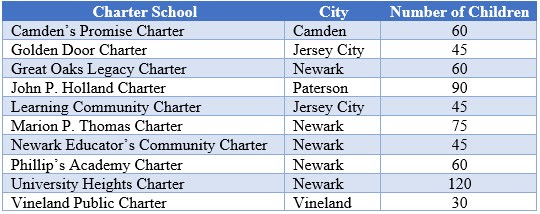
The administration of former Governor Chris Christie allowed 10 charter schools in five Abbott districts to operate their own preschool programs, despite not having a contract from the districts to participate in the districts’ universal program, as required by the landmark Abbott v. Burke rulings. In 2019-20, the 10 charter preschool programs enrolled 630 three- and four-year-olds, funded by over $8 million in state preschool aid.
ELC’s December 2019 letter to the NJDOE emphasizes that, under the NJ Supreme Court’s detailed Abbott preschool mandates, only Abbott districts are authorized to offer high quality preschool to all resident three- and four-year-olds through an NJDOE-approved universal enrollment program. While community providers and Head Start are eligible to operate preschool classrooms in Abbott districts, they can only do so under a contract with the districts. The district contract requires strict adherence to teacher quality, class size, and other Abbott preschool standards, as well as enrollment through the district’s universal outreach and recruitment process.
As the Supreme Court has made clear, these requirements are essential elements of the constitutional obligation imposed on Abbott districts to provide high quality preschool to all eligible three- and four-year old children residing in their communities. The districts are mandated to enroll at least 90 percent of the universe of those children. The requirement for community-based providers to operate only under district contracts ensures that only those providers capable of and willing to deliver high quality preschool through district coordination, support and supervision, can participate in the Abbott program.
The NJDOE’s decision to allow the 10 charter schools to operate separate preschool programs not only violates the Abbott rulings and the agency’s own regulations, but also undermines the cornerstone of the nationally-recognized success of the Abbott Preschool Program: a district-supervised, mixed delivery system of early education unifying community-based providers and district classrooms under a common set of high quality standards, backed by adequate funding. This well-established legal and policy framework does not permit any entity, including charter schools, to provide preschool wholly outside of the district-run, universal Abbott program.
“The NJDOE has no authority to permit a charter school to run a parallel preschool program that competes with the district’s Abbott program for students and funding,” said David Sciarra, ELC Executive Director and lead counsel in the Abbott litigation. “Charter schools in Abbott districts cannot operate preschool classrooms unless they enter into a contract with the district, as is required of every community-based provider and Head Start program participating in Abbott preschool.”
In 2019-20, the following charter schools are providing preschool without obtaining the legally required contract to participate in the Abbott district program:
In addition to calling for an end to the unauthorized practice of allowing charter schools to operate their own preschool programs, ELC is also demanding the NJDOE immediately notify the 10 charter schools that to continue to provide preschool in the 2020-21 school year, they must secure a contract with their district to participate in the district-wide Abbott preschool program.
Press Contact:
Sharon Krengel
Policy and Outreach Director
Education Law Center
60 Park Place, Suite 300
Newark, NJ 07102
973-624-1815, ext. 24

Kentucky passed a law authorizing charters but never provided funding for them. The new governor of Kentucky, Democrat Andy Beshears, was elected in part because of his strong support by teachers and his commitment to public schools.

First charter school application in Kentucky rejected

NEWPORT, Ky. (AP) — The first charter school application filed in Kentucky has been unanimously denied. News outlets report Newport Independent Schools rejected the application Thursday night. The superintendent says the documents submitted by the proposed River Cities Academy lacked planning in multiple areas. A review committee says there was significant plagiarism in the application process. The committee also found a lack of authentic community support for the school. River Cities Academy can appeal the decision to the state board of education. The state approved charter schools in 2017 but a funding source for the schools hasn’t been provided