Archives for category: Accountability

For the past thirty years, school choice advocates have claimed that the best way to improve education was to give families public money to send their child to a private or religious school. The very fact of “privateness,” they said, meant better quality. This turns out not to be the case. Students never receive a voucher that is enough to pay for elite private schools. Typically, the voucher schools are lesser quality than the public school the cHold leaves, because voucher schools are not required to have certified teachers. In recent years, numerous studies show that children who leave a public school and go to a voucher school lose ground academically.

This study was published in 2018. Its findings are consistent with studies of voucher effects in the District of Columbia, Ohio, Indiana, and other states. Voucher schools are free to teach scientific nonsense and fake history. In Florida and elsewhere, they are free to discriminate against groups of people they don’t like.

Atila Abdulkadiroğlu, Parag A. Pathak, and Christopher R. Walters write in the Journal of the American Economic Association that participation in Louisiana’s voucher program “lowers math scores by 0.4 standard deviations and also reduces achievement in reading, science, and social studies. These effects may be due in part to selection of low-quality private schools into the program.”

Despite the negative effects of vouchers, Betsy DeVos, Charles Koch, and a host of school choice advocacy groups have continued to demand more and more funding for low-quality, unaccountable voucher schools. This funding is subtracted from public school funding, through a variety of schemes. Whether it’s a tax creditor a “scholarship,” individuals and corporations are diverting money to private schools that belongs in the state coffers to support public schools.

Nathan Bomey explained the tax avoidance strategies of the super-rich in an article in USA Today.

Tax evasion is illegal but tax avoidance is not. Clever accountants can find loopholes and strategies to reduce the taxes of their clients.

It is far better to be an investor than to have a salary.

Wealthy Americans are the largest source of underreported income, according to IRS data analyzed by researchers. The top 1% of American taxpayers account for about 34% of misreported income, according to a study published in the National Tax Journal.

Many wealthy Americans deploy complex, arcane but wholly legal strategies to minimize their tax obligations. Some use fairly straightforward strategies that allow them to minimize their taxes under the tax code…

It’s much harder to avoid taxes on your paycheck than on your investments.

In general, the federal government taxes regular wages at higher rates than investment income. The long-term capital gains tax rate maxes out at 20%, and the highest income tax rate is 37%.

In other words, if you make a salary of $1 million, the government keeps $370,000. If you make $1 million on stocks or similar investments, the government keeps $200,000.

Taxes on assets such as stocks and real estate investments aren’t owed until they are sold. That helps people such as Jeff Bezos, the Amazon CEO, founder and richest person in the world, grow their wealth rapidly while avoiding a huge tax bill. Then they can be strategic about when they sell.

Very wealthy people have lobbyists. They make large campaign contributions to key members of Congress, who protect the interests of their donors.

It is not fair, and Trump’s tax returns should make more people aware of the need for genuine tax reform, not the kind of sham tax plan passed by Trump and Mitch McConnell to benefit corporations and the wealthy.

Rebekah Ray responded to another Florida teacher who complained the changes by the State Legislature has destroyed the promises made to him when he became a teacher. It’s method of evaluating teachers is one of the worst in the nation. If they don’t teach reading or math in grades 3-8, they are assigned ratings for students they never taught in subjects they never taught.

Ray writes:

I would not sign that evaluation. The first year Florida started its detrimental evaluation system I taught all 11th grade classes. I was asked to meet with the principal and the AP of curriculum (my evaluator) and was told I was a “Needs Improvement Teacher”. I was devastated because prior to that year, I had always received outstanding evaluations. I was also an NBCT teacher. Additionally, for that first year of the insane evaluation system, all teachers on campus who did not teach 9th and 10th grade were supposed to receive the school-wide VAM. I pointed out that I should have received the SW VAM scores because I taught all 11th grade students. The AP looked at me and said, “No, you have one 10th grade class.” At that point, my devil horns came out, and I asked for specific data that they based their scoring on. The principal called the district office and spoke to the one mathematician who did the calculations for each teacher. He stated that I had received that score because over the course of three years of teaching, nine of my students did not pass the FCAT re-takes. I asked, “What about the 300 other students who had passed; don’t they count?” They did not have a clue how to respond. I refused to accept their evaluation and did not sign it. The principal told me to send him an email once I had time to think about the situation, so I did. I asked for all sorts of data on those nine specific students: When did they enroll in my class?; How many absences did they have?; Are they on free or reduced lunch?… and lots more data. I received no response, but the a-holes gave me the SW VAM, and the next year, they moved me to 10th grade in an effort to set me up for failure. At the end of that year, I met with my evaluator to sign my evaluation, and she commented, “You are one of those teachers.” My defense mechanism immediately went into high gear, and I asked, “What does that mean?” She replied, “You are responsible for our A+ rating.” I had no idea because I’m that rebellious teacher who refuses to look at data; I look at the students in front of me and tell them point blank, “I will never treat you like a data point; I will treat you as a human being, and you will work harder in this English class than any other ones you have been in, and you will pass that stupid state test with no problem!!” Then I never mention the test again until a month before its administration. (I also ignore the scripted common core curriculum). Ergo, my students excelled, and for consecutive years, I earned perfect VAM scores (unbeknownst to me). I only learned about it because the department chair told me. (Again, I rarely look at the data; I always look at the child). My next evaluator consistently awarded me with high scores such as 99/100. The following year a new evaluator came on board, an academic with a doctorate in Reading, but zero classroom experience. She tried to lower my rating, but I refused to sign until she changed her scores, explaining, “Nothing has changed; I cannot help that you never came to my classroom to observe those specific activities, and I still have perfect VAM scores, so why do you think it’s okay to lower my score in categories I have always been rated as Highly Effective?” She changed my scores both years she evaluated me.

The tragedy of it all is that I had to consistently fight to get what was rightfully mine from the outset. No teacher should have to suffer such denigration and demoralization at the hands of administrators who have been given district and state directives to assign lower scores because “Too many of your teachers are being rated as ‘Highly Effective’”.

I have five years before I can retire, but my heart is no longer in it, so I will be leaving this profession and the children who I dearly love teaching. The stress that comes with teaching has taken a massive toll on my health, and I am currently on an LOA because of it. (Yes, I also had to fight for my FMLA benefit; it’s always a fight, with the district and admin on one side, and the teachers on the opposite side). It’s not supposed to be that way; we are all supposed to be on the same side, but it’s not like that here.

I have two pieces of advice for anyone thinking of going into education: 1. Don’t do it!! 2. If you really believe it is your true calling, then go straight through and get your masters degree; subsequent to that, teach in the U.S. for a minimum of three years, so you can get some experience; apply to teach overseas where your efforts will be appreciated and rewarded. Most of all, you will be respected and honored everywhere else in the world because you are a teacher.

A well-educated citizenry is essential to democracy. The Education Law Center reports good news for the schools and students of Illinois:

On September 30, the Illinois Supreme Court agreed to hear an appeal in Cahokia Unit School District No. 187 v. Pritzker, a case challenging inadequate and inequitable school funding that could potentially alter the landscape of school funding jurisprudence in the state.

The plaintiffs in the Cahokia lawsuit are twenty-two, low-wealth school districts across the state. They filed their lawsuit in 2018, charging that the State of Illinois has persistently underfunded their schools, depriving their students of their right to a high quality education under the Education Clause of the Illinois constitution.

The plaintiffs are represented by Thomas Geoghegan of the law firm Despres, Schwartz & Geoghegan, Ltd. in Chicago.

In 1996, in Committee for Educational Rights v. Edgar, the Illinois Supreme Court ruled that the Education Clause was a non-justiciable political question because the “quality of education” was not “capable of or properly subject to measurement by the courts.” The Court held that defining the quality of education was a matter for the State Legislature.

In the ensuing years, the Legislature took up that mantle, adopting the Illinois Learning Standards, which detail the specific educational experience to which all students in Illinois are entitled. The State also adopted tests to measure students’ progress on the Learning Standards.

In 2017, in response to intense political pressure, the Legislature enacted the Funding Act of 2017, designed to provide the resources essential for all students to achieve the State’s Learning Standards. In 2018, the State Board of Education determined, pursuant to the Funding Act’s criteria, that an additional $7.2 billion was required to provide adequate and equitable resources for all students. The Funding Act established a deadline of 2027 for full funding of the adequacy amount.

However, even in the first year of the Act’s decade-long phase-in to full funding, the state failed to provide the requisite installment of state school aid. This failure lies as the heart of the Cahokia lawsuit, in which the plaintiffs contend that the State is already so far behind on funding the new formula that full funding will not be achieved even by 2047.

The Cahokia plaintiffs presented data establishing a correlation between inadequate State and local per-pupil funding and failure rates on state assessments. The plaintiffs also demonstrated a wide disparity in passing rates on state assessments between students in low-wealth districts, which are inadequately funded, and in affluent districts.

In July 2018, the State defendants moved to dismiss the lawsuit, contending that the case was beyond the reach of the courts, or “not justiciable,” based on the Supreme Court’s 1996 Edgar ruling. The trial court agreed and dismissed the complaint. In April 2020, in a split decision, the Appellate Court of Illinois affirmed the dismissal, noting that the Legislature’s enactment of the Illinois Learning Standards did call into question the holding in Edgar. However, the appeals court also ruled that overturning this precedent is the exclusive province of the Illinois Supreme Court.

Appellate Court Justice Milton S. Wharton filed a vigorous dissent, asserting that the court has a duty to address the issues in the case “instead of ignoring or postponing this critical issue of utmost urgency and importance to our citizens and our State with an overly broad application of Edgar ‘s holding.” Justice Wharton concluded that since Edgar, the Legislature has “determined the education students must receive” and, as a result, “courts no longer need to make that determination in order to resolve claims that students in under-resourced districts are not receiving the high quality education mandated by our State constitution.”

The Cahokia plaintiffs filed a petition for leave to appeal in the Illinois Supreme Court in July. The Supreme Court’s decision to accept the case provides the opportunity to revisit its decision in Edgar in light of the Legislature’s actions since 1996 that have defined the substantive contours of a quality education for Illinois public school students.

In 2017, in a case very similar to Cahokia, the Pennsylvania Supreme Court reconsidered its previous ruling that constitutional education adequacy claims were non justiciable. In William Penn School District, et al., v. Pennsylvania Department of Education, et al., the Pennsylvania Supreme Court held that the plaintiffs (a coalition of school districts, parents, children and advocacy groups) were entitled to proceed to trial on their school funding claims. The Court declined to follow its earlier decision, now holding that it was possible to devise a judicially enforceable standard of educational adequacy. The Court further held that failure to adjudicate school funding claims would make a “hollow mockery of judicial review.”

A similar decision by the Illinois Supreme Court would allow the plaintiffs to proceed to trial to prove their case and would finally provide, as Justice Wharton declared, “an avenue [for] under-resourced school districts like the plaintiffs to insist on funding that is adequate to serve their students” in the manner to which they are entitled under the Illinois constitution.

Education Law Center is providing assistance to the Cahokia plaintiffs’ attorneys and working with the Chicago Lawyers Committee for Civil Rights Under Law on an amicus brief before the Illinois Supreme Court.

Press Contact:
Sharon Krengel
Policy and Outreach Director
Education Law Center
60 Park Place, Suite 300
Newark, NJ 07102
973-624-1815, ext. 24
skrengel@edlawcenter.org

James Hohmann of the Washington Post gathered interesting post-debate happenings.

Joe Biden left Cleveland on a chartered Amtrak train and made a six-city whistlestop trip through areas of Ohio and a Pennsylvania that Trump won in 2016.

Meanwhile, Trump continues to face negative responses and from Republican leaders, silence, due to his inability to denounce white supremacists, and his dog whistle that inspired the violent rightwing “Proud Boys,” which the Anti-Defamation League calls a hate group.

Pennsylvania’s 20 electoral votes make it one of the most critical battlegrounds, and Biden predicted that over the next month he will be able to win over more Trump 2016 voters in rural counties like the ones he visited on Wednesday. “Even if we just cut the margin, it makes a gigantic difference,” Biden said at the airport named for Murtha. “A lot of White working-class Democrats thought we forgot them and didn’t pay attention. I want them to know – I mean sincerely – that I’m going to be your president. I hear them. I listen to them. I get it. I get their sense of being left behind…”

Trump promised in 2016 to fight for “the forgotten man,” reviving a term that President Franklin Roosevelt had used during the New Deal. “But once he got into office, he forgot about them,” Biden said everywhere he went on Wednesday.

During his speech in Johnstown, Biden spoke directly to former Democrats who have perhaps grown disillusioned. He said that the debate showed that Trump is “a self-entitled, self-serving president who thinks everything is about him.”

“The truth is he never respected us,” Biden said. “Behind closed doors, it’s been reported he calls his own supporters disgusting. He looks down his nose at working families just trying to do the right thing. And it’s been confirmed by multiple sources that he thinks that those of you who sign up to put their lives on the line for our country — our veterans and service members — are just a bunch of ‘suckers’ and ‘losers.’ It’s despicable. It’s not how I was raised, and I bet it’s not how any of you were raised either.”
Biden recounted how his mom used to always say to him, “Joey, nobody’s better than you, but everyone is your equal.”

“Donald Trump may think there ought to be a different set of rules for him and his rich buddies: rules that let him get out of his taxes, get out of his responsibilities and get out of the consequences for every one of his mistakes,” Biden said. “I don’t. I think it’s about time we start rewarding work in this country, not wealth. I think it’s time working families get a break and the super wealthy and big corporations pay their fair share. They’re still going to be doing just fine.”

The Democratic nominee framed the race as a choice between Park Avenue and Scranton, Pa., where he grew up. “Look, I’ve dealt with guys like Trump my whole life,” Biden told the crowd. “Guys who look down on you because they’ve got a lot of money. Guys who think they’re better than you. Guys who might let you park their car at the country club – but would never let you in. Guys who inherited everything they ever got in life – then squandered it.”

Biden said he will never raise taxes on anyone who makes less than $400,000 a year. “Maybe you didn’t believe me that we could do it without raising taxes on the middle class, but I bet that was before you found out Donald Trump paid just $750 in income tax,” Biden said. “If Donald Trump and his Park Avenue pals start paying their fair share, we’ll have more than enough to finally build an economy that works for everyone…”

Biden accused Trump of caring more about the strength of the Dow Jones Industrial Average than the numbers of jobless claims. “He doesn’t have a plan to help you get back on your feet or deliver relief to the people who most need the help,” Biden said in Johnstown. “He’s too busy planning his next big tax give away to the 100 richest folks in the country.”

During the debate, Trump said everyone tries to pay as little in federal tax as possible “unless they are stupid.” He even tried to blame Biden for creating the tax credits not closing the loopholes in the tax code that allowed him to reduce how much he paid. “I don’t want to pay tax,” Trump said. “Like every other private person, unless they’re stupid, they go through the laws, and that’s what it is.”

Hohmann points out that Trump got his deductions due to claims of massive losses, which undercuts his claim to be a business genius.

Meanwhile, extremists took Trump’s advice to “stand by” as encouragement for election day trouble.

The president’s “stand by” remark has already become a galvanizing movement for the reactionary right. “By Wednesday morning, the hashtag #WhiteSupremacy was trending on Twitter in the United States,” Derek Hawkins, Cleve Wootson Jr. and Craig Timberg report. “Trump’s comments were enshrined in memes, including one depicting Trump in one of the Proud Boys’ signature Fred Perry polo shirts.

Another meme showed Trump’s ‘stand by’ quote alongside an image of bearded men carrying American flags and appearing to prepare for a fight. … One prominent Proud Boys supporter on Parler said Trump appeared to give permission for attacks on protesters, adding that ‘this makes me so happy.’ … For many members, the president’s remark was the validation they craved, quickly turning into a fundraising and recruitment drive while, experts worried, legitimizing the group’s violent tactics.”

“Trump’s debate-stage call for volunteers to stand watch at voting locations has prompted an enthusiastic response from known neo-Nazis and right-wing activists, leading many state election and law enforcement officials to prepare for voter intimidation, arrests and even violence on Election Day,” Amy Gardner, Joshua Partlow, Isaac Stanley-Becker and Josh Dawsey report.

“The Trump campaign and Republican National Committee for months have promised to recruit as many as 50,000 poll watchers to monitor voting locations on Election Day. The campaign’s ‘Army for Trump’ website has contributed to that effort. … But more-extremist supporters appeared to be joining that effort Wednesday, raising the prospect for confrontation and intimidation at polling locations. ‘I got shivers,’ Andrew Anglin, the founder of the neo-Nazi website the Daily Stormer, wrote in a post Wednesday. ‘I still have shivers. He is telling the people to stand by. As in: Get ready for war.’ …The Oath Keepers, a militia group that formed more than a decade ago that comprises current and former law enforcement and military members, also has pledged to have ‘volunteer security teams’ at Trump rallies and out on Election Day. …

And Hohmann added this bit of good news:

Former RNC chairman and Montana governor Marc Racicot announced he will vote for Biden. In an interview with Yellowstone Public Radio, Racicot spoke of the need for a president to have patience, decency and openness to contrary opinion, “qualities Racicot suggested are absent in the Trump administration,” the Missoulian reports.
The National Center for the Study of Privatization in Education at Teachers College, Columbia University, recently released a major study of segregation and charter schools by Dr. Helen Ladd and Muvzana Turaeva of Duke University.

Dr. Samuel Abrams introduced it here.

The issue of school choice and segregation has been central to education policy debates for decades. In his initial argument for vouchers, published in 1955, Milton Friedman conceded that segregationists stood to employ vouchers to enroll their children in all-white private schools instead of public schools mandated to integrate a year earlier by Brown v. Board of Education. But to Friedman, the answer was not regulation but moral suasion. Friedman’s opinion was rendered technically moot in 1976 by Runyon v. McCrary, which barred private schools from making admissions decisions based on race, yet it nevertheless indicated a fundamental problem with systems of school choice.

With the introduction of charter schools in the early 1990s, commentators raised concerns about school location, inadequate transportation, contracts mandating significant parental involvement, and shared parental proclivities as implicit mechanisms or pathways to segregation. In “Parental Preferences for Charter Schools in North Carolina: Implications for Racial Segregation and Isolation,” Helen F. Ladd and Mavzuna Turaeva add substantially to the literature validating these concerns.

Using data for the nearly 11,000 North Carolina families who transferred their children from traditional public schools to charter schools in 2015-16, Ladd and Turaeva document that the migration of white, though not minority, switchers from traditional public schools to charter schools increased segregation. “We find that by switching to charter schools that are whiter than the traditional public schools they leave behind,” they write, “white switchers contribute to racial segregation across schools.” At the elementary level, 67 percent of white switchers enrolled in charter schools with lower shares of minority students; at the middle-school level, 72 percent of white switchers did so.

To buttress their analysis, Ladd and Turaeva employ a conditional logit model to estimate revealed preferences. To infer parental preferences by race as well as socioeconomic status, Ladd and Turaeva use five criteria to define the value of charter schools for parents: racial composition; proximity; academic achievement; availability of transportation and lunch; and mission. Ladd and Turaeva conclude that with these dimensions considered together, it is clear that white parents disproportionately favored white charter schools and exhibited a pronounced aversion to significantly minority charter schools.

With this working paper, Ladd, a professor emerita of public policy and economics at Duke University, and Turaeva, a doctoral candidate in public policy (with a specialization in economics) at Duke as well as a research associate at the Duke Center for Analysis of Longitudinal Data in Education Research, build on research Ladd did with Charles Clotfelter and John Holbein for an article published by Education Finance and Policy in 2017 on growing segregation across the charter sector in North Carolina from 1999 to 2012. In addition, Ladd and Turaeva’s analysis complements a 2019 NCSPE working paper on charter schools in Kansas City by Patrick Denice, Michael DeArmond, and Matthew Carr, who found a disproportionate number of white students transferring from traditional public schools to new charter schools from 2011 to 2015.

Lucid, rigorous, and supported with eight tables of telling data, this study advances our understanding of school choice and raises important questions about how choice systems should be designed.

Samuel E. Abrams
Director, NCSPE

Blogger G.F. Brandenburg discovered a very clever post by Bill Svelmoe advising Democrats how to handle the hearings for Supreme Court nominee Amy C. Barrett.

Don’t attack her personally. Don’t question her religious views. Don’t ask her how she will rule on abortion or Obamacare (nominees never answer questions about cases which they may hear.)

Ask her about Trump’s actions.

Here are a few of his ideas:

Instead Democrats should focus on the past four years of the Trump administration. This has been the most corrupt administration in American history. No need for hypotheticals. The questions are all right there.

Judge Barrett, would you please explain the emoluments clause in the Constitution. [She does.] Judge Barrett, if a president were to refuse to divest himself of his properties and, in fact, continue to steer millions of dollars of tax payer money to his properties, would this violate the emoluments clause?

Then simply go down the list of specific cases in which Trump and his family of grifters have used the presidency to enrich themselves. Ask her repeatedly if this violates the emoluments clause. Include of course using the American ambassador to Britain to try to get the British Open golf tournament at a Trump property. Judge Barrett, does this violate the emoluments clause?

Then turn to the Hatch Act.

Judge Barrett, would you please explain the Hatch Act to the American people. [She does.] Judge Barrett, did Kellyanne Conway violate the Hatch Act on these 60 occasions? [List them. Then after Barrett’s response, and just fyi, the Office of the Special Council already convicted her, ask Barrett this.] When Kellyanne Conway, one of the president’s top advisors openly mocked the Hatch Act after violating it over 60 times, should she have been removed from office?

Then turn to all the other violations of the Hatch Act during the Republican Convention. Get Barrett’s opinion on those.

Then turn to Congressional Oversight.

Judge Barrett, would you please explain to the American people the duties of Congress, according to the Constitution, to oversee the executive branch. [She does so.] Judge Barrett, when the Trump administration refuses time and again [list them] to respond to a subpoena from Congress, is this an obstruction of the constitutional duty of Congress for oversight? Is this an obstruction of justice?

The Tennessee Court of Appeals upheld a lower court decision that Governor Bill Lee’s voucher plan is unconstitutional.

The voucher plan was supposed to be installed only in Memphis and Nashville, over the objections of their representatives. The deciding vote was cast by a legislator from Knoxville, after he was promised that the voucher program would not include his district.

A victory for friends of public schools and communities in Tennessee!

[intro]

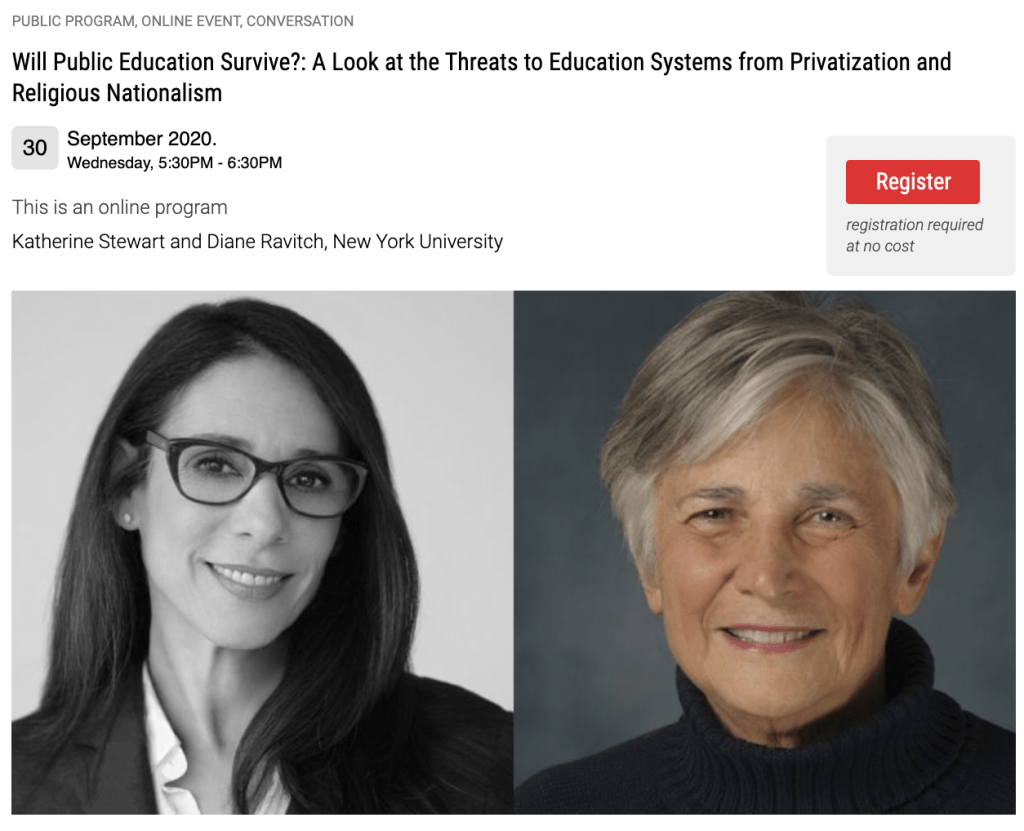
The rise of the Religious Right has coincided with the privatization movement in public schools. While some may feel that this is coincidental, there is reason to believe there is a directly causal relationship between these two factors. Two scholars, from different disciplines, will discuss how their work comes together to help explain the history and current state of efforts to diminish, if not dismantle, the American public education system. Katherine Stewart has written on the rise and increasing power of the Religious Right in her book The Power Worshipers. She will be joined by Diane Ravitch who has written extensively on education and, in her recent book Slaying Goliath, explores the history of the school privatization movement and the efforts to oppose it.

Please note, this is an online event held on the video conference platform, Zoom. Registrants will receive an email with links to join the program.

Link to register: https://18308a.blackbaudhosting.com/18308a/Will-Public-Education-Survive-A-Look-at-the-Threats-to-Education-Systems-from-Privatization–Reli

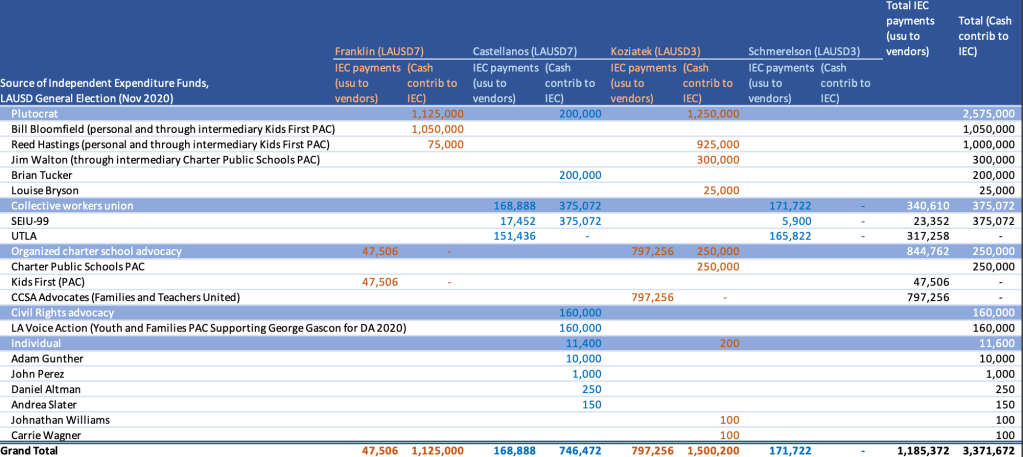
Once again, control of the Los Angeles Unified School Distict school board is up for grabs, and once again the billionaires hope to buy control so they can expand the number of charter schools. The latest financial disclosures show that Reed Hastings of Netflix has contributed $925,000 to try to defeat veteran educator Scott Schmerelson. Billionaire Jim Walton of the Walmart family added another $300,000. The charter lobby is flush with money to buy TV ads and flyers that smear Schmerelson and use vicious anti-Semitic tropes in their attack ads. The charter lobby is angry at Schmerelson for two reasons: 1. He fights fearlessly for the 80% of students in public schools. 2. He released the explosive fact that 80% of Los Angeles’ charter schools have vacancies, not waiting lists. His opponent Marilyn Koziatek has no experience in the public schools; she holds an administrative job in a charter school.

Download the .pdf here.

Note: Sara Roos of Los Angeles (blogger Red Queen in LA) prepared the graph of political expenditures based on public records.