Archives for category: Accountability

Charter school lobbyists have poured out lamentations about the U.S. Department of Education’s proposals to regulate the federal Charter Schools Program, which gives out $440 million to open new charter schools or expand existing charter schools. These lamentations are false, because the regulations have no effect at all on the 7,000+ existing charter schools. They are a good faith effort to clean up a program that has been riddled with waste, fraud and abuse, a program in which nearly 40% of the funding goes to charter schools that either never open or close soon after opening. The CSP under Betsy DeVos was a slush fund for large charter chains, which was far from its original intent in 1994, when it offered a few million to help jump-start mom-and-pop charters or teacher-led charters.

Carol Burris writes here, on Valerie Strauss’s Answer Sheet blog in The Washington Post, about the falsehoods now promulgated by the charter lobby in their desperate effort to protect for-profit charter schools and to avoid the need to analyze the impact of new charters in the community where they intend to locate.

Burris, the executive director of the Network for Public Education, writes:

For the first time since the federal Charter Schools Program was established in 1994, the U.S. Department of Education is setting forth meaningful regulations for its grant applicants. While these proposed rules are aimed at ensuring greater transparency and control on how nearly a half-billion tax dollars are spent each year, charter supporters oppose them. We’ve also seen objections to reform — many of which I believe are misinformed — in op-eds, including those in the Wall Street Journal, The Washington Post, and the New York Post (though these don’t all mention the same concerns). What follows is an explanation of the program and why these regulations are needed to protect taxpayers as well as the families who use charter schools.

Let’s begin with an explanation of the CSP. The program began in 2006. It is a competitive program that, among other things, gives awards to states, charter chains (known as CMOs), and sometimes directly to charter school developers to open or expand a charter school. The CSP program does not determine which charter schools can open and which cannot. The majority of charter schools that have opened over the past few decades never received a penny from the CSP. The average grant to a school is $499,818, although charter chains have received hundreds of millions of dollars.

Congress mandates that the Education Department give away a large proportion of the money appropriated to the program each year. The rush to spend the money helps explain why low-rated schools can get grants and unqualified or deceitful applicants whose schools never open can dip into those federal funds for planning. The mandate to spend the money is a problem only Congress can fix. Nevertheless, the proposed regulations would put in some solid rules of the road to better protect the tax dollars that are spent. What follows is an explanation of what the proposed regulations say and do not say.

*The proposed regulations say charter schools that for-profit operators fully or substantially control would not be eligible to get grants. They do not say that charter schools cannot use for-profit vendors.

The federal definition of a public school under the federal laws IDEA (Individuals With Disabilities Education Act] and ESEA (the Every Student Succeeds Act) is that it must be a nonprofit. When the department challenged for-profit charter schools in Arizona over a decade ago, the for-profits created nonprofit facades to allow the for-profit and its related organizations to run the charter school and still receive federal funds, including CSP dollars.

The present provisions in the CSP are not now strong enough to close this loophole; thus, the proposed regulations say:

Each charter school receiving CSP funding must provide an assurance that it has not and will not enter into a contract with a for-profit management organization, including a nonprofit management organization operated by or on behalf of a for-profit entity, under which the management organization exercises full or substantial administrative control over the charter school and, thereby, the CSP project.

Why is this important? Because for-profits have used CSP dollars to enrich their bottom line at the expense of students for years. I offer as examples the recent CSP expansion grant awarded to Torchlight Academy Charter School of North Carolina, which is now being shut down, as well as a grant to Capital Collegiate Preparatory Academy of Ohio, which has been passed from one for-profit operator to another.

The State Comptroller of New York specifically chided a school run by the for-profit National Heritage Academies (NHA) in New York for letting NHA take oversized fees for its services. NHA uses its schools to acquire and sell real estate and operates them with “sweeps contracts,” requiring the school to pass all or nearly all funding and operational control to NHA.

When taxpayer dollars go into the pockets of owners or corporations, fewer dollars go into the classroom for students.

Some argue that public schools do business with private vendors for books or transportation and that is true. However, the relationship between a for-profit management organization (EMO) is quite different from the relationship between a vendor who works with a district or a charter school to provide a discreet service. A school or district can sever a bus contract and still have a building, desks, curriculum, and teachers. This is not the case when a sweeps contract is in place. In cases where charter schools have attempted to fire the for-profit operator, they find it impossible to do without destroying the schools in the process. And public schools are subject to bidding laws to ensure that nepotism does not drive vendor choice. Charter schools are not.

13 ways charter schools shape their enrollment

The Network for Public Education identified more than 440 charter schools operated by a for-profit that received CSP grants totaling approximately $158 million between 2006 and 2017, including CSP grants to schools managed with for-profit sweeps contracts. It is a way to evade the law, and it must stop. It is remarkable that the IRS has not, to date, stepped in.

*The proposed regulations say an applicant must include an analysis of school enrollment in the area from which it would draw students. Regulations do not say that grants only go to charter schools in districts facing over-enrollment.

More than one in four parents who walk their kindergartners into a new charter school will have to find another school for their children by the time they reach the fifth grade. That is how alarming the charter closure rate is. Over one in four closes during the first five years; by year 10, 40% are gone. Between 1999 and 2017, nearly 1 million children were displaced due to the closure of their schools.

One of the primary reasons charters close is under-enrollment — they cannot attract enough students to their school to keep it going. Sometimes that occurs because of school quality. But often, it happens because a new, shiny charter school with great marketing opens nearby and draws students away.

New Orleans, a district where virtually all nonprivate schools are charter schools, is facing a crisis because they allowed the charter sector to grow out of control; they no longer have sufficient enrollment, and the district cannot force schools to merge because they are charter, not district-run, schools.

The proposed regulations do not preclude applicants who want to open a charter school in a district already saturated with public and charter schools from getting a CSP grant. It simply asks them to provide information on enrollment trends — specifically:

include any over-enrollment of existing public schools or other information that demonstrates demand for the charter school, such as evidence of demand for specialized instructional approaches.

In other words, it is asking the applicant to make their case for why the school is needed. That information will be used by reviewers of applications when they evaluate applications and rank them. Sounds like common sense to me.

*The proposed regulations say that applicants must provide assurances that they would not get in the way of district-mandated or voluntary desegregation efforts. They do not say that you cannot open a charter in a non-diverse or economically disadvantaged neighborhood.

Charter schools have been magnets for white flight from integrated schools in some places. Other charter schools attract high-achieving students while discouraging students with special needs from attending. In this letter submitted to the Department of Education last year, 67 public education advocacy and civil rights groups provided documentation that the North Carolina SE CSP sub-grants were awarded to charter schools that actively exacerbated segregation, serving in some cases as white flight academies.

The proposed regulations clarify that an application from “racially and socio-economically segregated or isolated communities would still be eligible for funding.” Nevertheless, it is repeated over and over in editorials that schools in non-diverse neighborhoods would not apply as well as “schools that don’t prioritize racial diversity,” a polite way to refer to white flight charters.

*The regulations do not say charter schools must engage in a cooperative activity with districts. The regulations state that they may receive some bonus points on their application if they do.

According to the op-ed in the Wall St. Journal: “The administration also plans to require applicants to ‘collaborate’ with a traditional public school or school district on an ‘activity’ such as transportation or curriculum.” It doesn’t, actually.

When deciding which schools get a grant, reviewers rate applications using a point system. Every grant cycle, the department puts forth priorities as a way for applicants to get a few bonus points on their applications. The majority of schools get CSP grants without them.

The regulations propose two priorities. One gives points if the school is commonly referred to as a “community school.” The second provides points to schools that work cooperatively with a district on a transportation plan, curriculum, or another project. Neither priority is required to apply for or to receive a grant.

The 72 pages of proposed regulations are tedious reading. Because they apply to three separate programs in the CSP, there is much repetition. But the details matter. Read the new regulations. You can see the Network for Public Education’s statement of support for them here, and submit your own comments before April 13, 2022.
While Tennessee Governor Bill Lee is eagerly expanding the charter school sector, a state panel decided to close a Memphis charter school because of its leaders “misappropriating” nearly $800,000.

MEMPHIS, Tenn. — Charter revoked. Today a state panel agreed with the Memphis Shelby County School board to pull the plug on a local charter school.

The Memphis Academy of Health Sciences (MAHS) appealed a January 12th decision by the board to revoke the charter and close the school. Today, the appeal was denied, MSCS’ ruling was upheld by the Tennessee Public Charter School Commission.

The decision follows allegations of former school administrators misspending school money, accused of misappropriating nearly $800,000 in funding.

“At least six years of mismanagement, and it’s hard to un-ring that bell,” said a member of the state charter school board.

The parents and students were disappointed but the missing money mattered.

President Zelenskyy has repeatedly pleaded with every nation that would listen: Send us jets so we can protect our citizens. Thus far, President Biden has stood firm in opposition because he fears a wider war. Ukraine is not a member of NATO so NATO is not obliged to defend it.

But as awareness of the war crimes and atrocities committed by the Russian military increase, the necessity of helping Ukraine defend itself grows more compelling.

Ukraine wants MIGS. Poland wants to give them to Ukraine. Let it happen.

What is the difference between sending tanks to Ukraine and sending jets? What’s the difference between sending Stingers and Javelins and sending jets?

Putin threatened war if the West defends Ukraine. But the West is already defending Ukraine.

Putin already said that economic sanctions are a declaration of war. So in his mind, he is already at war with the West. But he sets the ground rules.

He was outraged that Ukraine bombed a fuel depot inside Russia. But he invaded Ukraine and bombed fuel depots, homes, schools, hospitals, and theaters. He has made ferocious war on civilians, trapping the people of Mariupol in their devastated city and barring access to those bringing humanitarian aid, including the International Red Cross.

We should not allow Putin to decide how much or what kind of defensive weapons the West should supply to an innocent nation that is being pulverized by Putin’s military. Putin must not be allowed to do to Ukraine what he did to Chechnya.

Send Ukraine the jets it needs to defend itself!

**************

An important historical footnote from TIME magazine:

Kaja Kallas has clear memories of the Soviet occupation. She was a teenager when Estonia became independent, and she remembers growing up before that with empty shop shelves, a passport that would not allow her to travel to countries outside the Eastern bloc, and a chilling atmosphere that kept people from speaking freely outside their homes. She also remembers the stories about the harsher deprivations—deportations, imprisonment— that her parents and grandparents faced. So now that Kallas is Estonia’s Prime Minister, it makes sense that she has become one of the most vocal advocates for taking an unyielding stance against Putin.

“If Putin wins, or if he even has the view that he has won this war, his appetite will only grow,” Kallas, 44, said in late March, sitting in the elegant neoclassical building—its salons lined with paintings of Estonian patriots—that serves as the seat of government. “And that means he will consider other countries. That’s why we have to do everything we can to stop him now.”

Like other countries in the region, Estonia has had painful experiences with Russian oppression. Occupied by the Soviet Union in the 1940s, the country’s farms were forcibly collectivized and tens of thousands of its citizens deported to Siberia. It was not until 1991, when the USSR was collapsing, that the country regained its independence. Quickly reverting to democracy, Estonia joined the European Union in 2004, and put a forward-looking emphasis on digitalization—all of its public services and much of its business is conducted online. It has since become one of the fastest-growing economies in Europe. But it has never relinquished its mistrust of its powerful neighbor to the east, with whom it shares nearly 200 miles of border.

Ohio knows charter schools. A lobbyist for the charter school industry wrote the law. Charter schools are mistakenly called “community schools.” Most charter schools in the state are failing schools, but that does not dim the enthusiasm of the GOP legislature for them. Ohio welcomes for-profit charter schools. Charters drain money from public schools.

For the first time in the history of the federal Charter Schools Program, which started in 1994, the federal U.S. Department of Education has proposed regulations to exclude for-profit management of charters that seek federal funding to expand and to require charters seeking federal funding to present a summary of their charter on the locality where they plan to open.

Jan Resseger, who lives in Ohio, sent the following appeal to her followers.

Please Support the Proposed USDOE Rule Changes for the Federal Charter Schools Program

Submit a comment supporting the Department’s new stronger regulations. You can submit your comment HERE, and you must submit the comment before April 13, 2022.

Please read Ohio Public Education Partners’ explanation of an urgently important development that requires our immediate attention. The U.S. Department of Education has published a notice in the Federal Register proposing new rules to strengthen oversight of the federal Charter Schools Program (CSP). It is urgently important for each one of us to write and submit a formal comment expressing support for stronger oversight of the Charter Schools Program.

First, even though the Elementary and Secondary Education Act forbids the allocation of federal dollars to for-profit charter schools, the owners of for-profit charter management organizations (CMOs) have learned how to get around the law. The U.S. Department of Education has proposed to stop the misallocation of federal Charter Schools Program (CSP) dollars to for-profit charter school management companies that hide behind the nonprofit charter schools they manage under sweeps contracts.

Second, when a charter school asks for Charter Schools Program startup funds, the Department has declared its intention to require a community impact statement to ensure that there is a need for a new charter school in the community and that the school won’t promote racial segregation. Neither should rapid expansion of charter schools undermine urban neighborhoods. The most serious consequence of out-of-control charter school expansion has been evident in large cities, where charter schools advertise lavishly to attract families from public schools.

Here is the language of the two urgently important rules the U.S. Department of Education proposes to add:

First — “Each charter school receiving CSP funding must provide an assurance that it has not and will not enter into a contract with a for-profit management organization, including a non-profit management organization operated by or on behalf of a for-profit entity, under which the management organization exercises full or substantial administrative control over the charter school and, thereby, the CSP project.”

Second — “Each applicant must provide a community impact analysis that demonstrates that there is sufficient demand for the proposed project and that the proposed project would serve the interests and meet the needs of students and families in the community or communities from which students are, or will be, drawn to attend the charter school, and that includes the following: (a) Descriptions of the community support and unmet demand for the charter school, including any over-enrollment of existing public schools or other information that demonstrates demand for the charter school, such as evidence of demand for specialized instructional approaches. (b) Descriptions of the targeted student and staff demographics and how the applicant plans to establish and maintain racially and socio-economically diverse student and staff populations, including proposed strategies (that are consistent with applicable legal requirements) to recruit, enroll, and retain a diverse student body and to recruit, hire, develop, and retain a diverse staff and talent pipeline at all levels (including leadership positions).”

Please submit a comment supporting the Department’s new stronger regulations. Don’t let yourself be intimidated by the complicated language and presentation of the new rules in the Federal Register. Begin your comment by thanking the Department of Education for strengthening long-needed accountability in this program. In simple prose, explain your support for each of the proposed new rules for the Charter Schools Program. In your comment, if you like, you may quote the language (above) of each rule followed by your reason for believing the new regulation is so important. Your comment may be as long or as short as you like—a few sentences or several paragraphs. Longer comments must be submitted as attached documents.

You can submit your comment HERE, and you must submit the comment before April 13, 2022.

If you are not planning to write your own comment, you may send the Network for Public Education’s action alert letter, but I urge you to personalize your letter by adding a few sentences of your own.

Jan Resseger


The federal Charter Schools Program was launched in 1994 with a few million dollars, when the Clinton administration decided to offer funding for start-ups. At the time, there were few charter schools. In the early, idealistic days, charter enthusiasts asserted that charters would set lofty goals and close their doors if they didn’t meet them. They were sure that charters would be far better than public schools because they were free to hire and fire teachers.

Right-wingers jumped on the charter bandwagon as a way to undermine public schools and to bust teachers’ unions. In short order, a gaggle of billionaires decided that charter schools would succeed because they operated with minimal or no regulation, like a business.

What no one knew back in 1994 was that the charter industry would grow to be politically powerful, with its own lobbyists. No one knew that the “most successful” charter schools were those that excluded the students who might pull down their test scores. No one knew that for-profit entrepreneurs would set up or manage charter chains and make huge profits, mainly by their real estate deals. No one knew that one of the largest charter chains would be run by a Turkish imam. No one knew that charter schools would develop a very old-fashioned militaristic discipline that prescribed every detail of a student’s life in school. No one knew that the little program of 1994 would grow to $440 million a year, with much of it bestowed on deep-pocketed chains that had no need of federal money to expand. No one knew that charter schools would become a favorite recipient of big money from Wall Street hedge-fund managers and billionaires like Bill Gates, the Walton family, Eli Broad, Michael Bloomberg, John Arnold, Betsy DeVos, Reed Hastings, and many other billionaires and multi-millionaires. No one anticipated that by 2022, there would be 3.3 million students in more than 7,400 charter schools.

Perhaps most important, no one expected that charter schools, on average, would perform no better than public schools. And in many districts and states, such as Ohio, Nevada, and Texas, charter schools perform far worse than the public schools.

School choice has been a segregationist goal ever since the Brown Decision of 1954, when southern states created segregation academies and voucher plans to help white students escape from racial integration. It should be no surprise, then, to see that the same states that are passing laws to restrict discussion of racism, to ban teaching about sexuality and gender, and to censor books abut these topics are the same states that demand more charter schools. Coincidence? Not likely. These are culture war issues that rile the Republican base.

How strange then, given this background, that the Washington Post published an editorial opposing the Department of Education’s sensible and modest effort to impose new regulations on new charter schools that seek federal funding. The education editorial writer Jo-Ann Armao very likely wrote this editorial, since she has that beat. Armao was a cheerleader for Michelle Rhee when she was chancellor of the D.C. schools and imposed a reign of terror on the district’s professional staff, based on flawed theories of reform and leadership.

In the following editorial, she makes no effort to offer two sides of the charter issue (yes, there are two, maybe three or four sides). She writes a polemic that might have been cribbed from the press releases of the National Alliance for Public Charter Schools, the amply endowed lobbyist for the industry. She gives no evidence that she has ever heard of the high closure rate (nearly 40%) of the charters that received federal funds from the Charter Schools Program. She seems unaware of the scores of scandals associated with the charter industry, or the number of charter founders who have been convicted of embezzlement. She doesn’t care about banning for-profit management from future grants. She thinks it’s just fine to set up new charters in communities where they are not needed or wanted. She seems unaware that the new regulations will not affect the 7,000 charters now in existence. Charters can still get start-up funding from Michael Bloomberg, the Waltons, or other privatizers. New charters can still be opened by for-profit entrepreneurs like Academica, but not with federal funds.

Here is the editorial, an echo of press releases written by Nina Rees of the National Alliance for Public Charter Schools (Rees previously worked at the right-wing Heritage Foundation, served as education advisor to Vice-President Dick Cheney, and worked for financier Michael Milken).

The editorial’s title is: “The Biden Administration’s Sneak Attack on Charter Schools.”

Advocates for public charter schools breathed easier last month when Congress approved $440 million for a program that helps pay for charter school start-up expenses. Unfortunately, their relief was short-lived. The Biden administration the next day proposed new rules for the program that discourage charter schools from applying for grants, a move that seems designed to squelch charter growth.


On March 11, a day after the funding passed, the Education Department issued 13 pages of proposed rules governing the 28-year-old federal Charter Schools Program, which funnels funds through state agencies to help charters with start-up expenses such as staff and technology. “Not a charter school fan” was Mr. Biden’s comment about these independent public schools during his 2020 presidential campaign, and the proposed requirements clearly reflect that antipathy.


The Biden administration claims that the proposed rules would ensure fiscal oversight and encourage collaboration between traditional public schools and charter schools. But the overwhelming view within the diverse charter school community is that the proposed rules would add onerous requirements that would be difficult, if not impossible, to meet and would scare off would-be applicants. Those most hurt would be single-site schools and schools led by rural, Black and Latino educators.


Consider, for example, the requirement that would-be applicants provide proof of community demand for charters, which hinged on whether there is over-enrollment in existing traditional public schools. Enrollment is down in many big-city school districts, which would mean likely rejection for any nonprofit seeking to open up a charter. “Traditional schools may be under-enrolled, but parents are looking for more than just a seat for their child. They want high quality seats,” said Nina Rees, president of the National Alliance for Public Charter Schools.Hence the long waiting lists for charter school spots in cities with empty classrooms in traditional schools. Also problematic is the requirement that charters get a commitment of collaboration from a traditional public school. That’s like getting Walmart to promise to partner with the five-and-dime down the street.

The Biden administration surprised the charter school community by what charter advocates called a sneak attack. There was no consultation — as is generally the case with stakeholders when regulations are being drafted — and the public comment period before the rules become final ends April 14.The norm is generally at least two months.

The proposed changes, according to a spokesperson for the Education Department, are intended to better align the Charter Schools Program with the Biden-Harris administration’s priorities. “Not a charter fan,” Mr. Biden said, and so bureaucratic rulemaking is being used to sabotage a valuable program that has helped charters give parents school choice.

If you disagree with this editorial, as I do, please send a comment thanking the Department of Education for proposing to regulate a program that has spun out of control and urging them to approve the regulations. Give your reasons.

If you think that charter schools have no need for federal funding when so many billionaires open their wallets for them, if you think that your community has enough charter schools, if you think that public schools must be strengthened and improved, if you want to stop federal funding of for-profit entrepreneurs, if you are tired of funding schools that never open, please write to support the U.S. Department of Education’s reasonable proposal to regulate the federal Charter Schools Program.

Peter Greene reports here on the battle plans of the radical rightwing “Moms for Liberty,” as revealed by its leader Tiffany Justice on the Steve Bannon show. In short, take over all the school boards, fire everybody, and replace then with conservatives who share the hateful views of Tiffany Justice.

Greene writes, and adds his comments:

BANNON: Are we going to start taking over the school boards?


JUSTICE: Absolutely. We’re going to take over the school boards, but that’s not enough. Once we replace the school boards, what we need to do is we need to have search firms, that are conservative search firms, that help us to find new educational leaders, because parents are going to get in there and they’re going to want to fire everyone. What else needs to happen? We need good school board training. We need lawyers to stand up in their communities and be advocates for parents and be advocates for school board members who are bucking the system. Right now, parents have no recourse within any public education district.

The “no recourse” talking point sits awkwardly next to a description of the recourse (democratic elections) that Justice (who was defeated when she ran for re-election to her own school board seat) plans to take, but sure. Parents will take over school boards, fire everybody, and hire The Right Sort to replace them. And while some training is needed for school board members, the main thing is to run, because

But what my message today is – get out and run for school board. It’s a part-time job. It’s not a full-time job. Anyone can do it. You do not need to have a background in education and we need more people.

Justice was on Bannon’s show War Room: Pandemic, because angling for political victories and advocacy spins is just like what folks are going on in Ukraine these days. She talked about the heroism of Ron DeSantis, and of course parental rights:

Parental rights are rights that every parent has, and the government does not give them to you, and they cannot take them away. Every parent has the fundamental right to direct the upbringing of their children, their medical care. That includes mental health, by the way, their education and their values, education, their morals, their religious and character training. All of these things lie within the responsibility of the parent. We, as parents, are happy to own those responsibilities within our rights.

It underlines the way in which the parental rights movement at its most extreme seems to have nothing at all to do with a children’s rights movement. I’m a parent, and I absolutely get the rights and responsibilities that parents have to protect and guide their children, but there’s a line past which it all starts to become creepy, as if you own this child and will engineer the tiny human to turn out to be exactly what you choose them to be, and much of the parental rights activist rhetoric lives close to that line. “I have total ownership and control of my child” is exactly how you get to the notion of “My child didn’t turn out exactly the way I demanded they turn out, so somebody else must have messed with their head.” Parental rights are a real thing, and parental responsibilities are a very real thing, but children are actual human beings and not lumps of clay to be crafted by other adult humans.

Justice and Bannon are sad that folks are lying about Florida’s bill, which is just a parental rights and anti-grooming bill and not– they interrupt themselves before they can say what it is. But Justice says she doesn’t see the big deal “We said no sexual orientation instruction or gender identity instruction in grades K through three” and many of her fans and Bannon think it should be K through twelve. Yes, why is everyone so upset that supporters of the bill equate teachers, LGBTQ persons, and pedophiles? (Also, implying that Disney only opposes the law because they are interested in sexualizing children.) As with all talk in support of the law, Justice and Bannon skip past the part where any parent can decide for themselves what constitutes “instruction” about sexual orientation or gender identity, so teachers now have to watch out for any lesson that could lead to Pat talking about having two Mommies at home. Though it would be entertaining if the first parent lawsuit under the bill is some parent arguing that boys and girls restrooms are a means of instructing about gender identity. Maybe fans of the law should just wait until we see how the court challenge turns out.

Justice throws around some numbers about public school failure, which serve mostly as a good example of why school board members and other people who want to talk about education policy should know something about it (she cites 29.8% of Kentucky third graders reading on grade level, but she appears to be talking about proficiency, which is above grade level). This, somehow, is related to talking about gender identity and sexual orientation in first grade.

Justice could be on the show because she was in DC to talk to some GOP House members. She can’t imagine why Dems don’t want to talk to her (I’m not sure, but one possible explanation that comes to mind is that she didn’t call their offices to make an appointment). Which brings us back to the point at the top– Moms For Liberty wants to talk about how to take over the states (because states rights are at the heart of all this stuff).

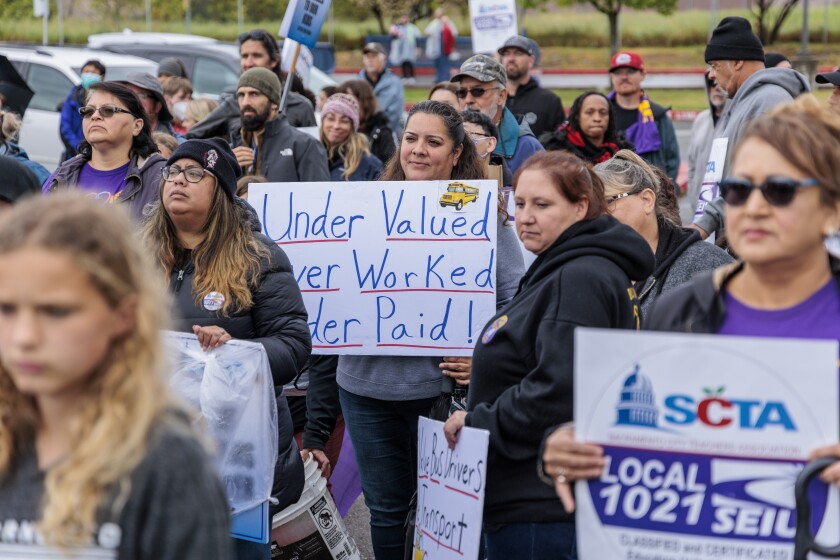
Sacramento City Unified School District teachers, school staff and supporters take part in a rally at Rosemont High School

Sacramento City Unified School District teachers, school staff and supporters take part in a rally at Rosemont High School on March 28 as they have been gone on strike due to the staffing crisis in the district . All SCUSD schools shut down and will remain closed for the duration of the strike.

I have read many articles about the shortage of teachers and school staff. I have read many that were laden with statistics. This is one of the best. It appeared in the Los Angeles Times.

BY ANITA CHABRIA COLUMNIST

A few weeks ago, Sacramento teacher Kacie Go had 56 kids for second period.

That day, there were 109 students at her eighth- through 12th-grade school who were without an instructor because of staff shortages. So she crammed the students into her room and made it work, but “it’s not sustainable,” she said.

No kidding.

Go told me the story standing with hundreds of other teachers and support staff Tuesday morning in the parking lot of an empty high school, as “We’re Not Gonna Take It” blared from speakers and the mostly female workers gathered for day five of a strike that has closed down schools in the Capitol City.

Like Go, these teachers, cafeteria workers, bus drivers and instructional aides are fed up with being asked to do more with less. It’s a problem that goes beyond the Sacramento City Unified School District, with 48,000 students in 81 schools. Frustration among teachers and school workers is rampant across California — pushed to a breaking point by the pandemic and a shortage of more than 11,000 credentialed teachers and thousands of support staff as the state tries to expand pre-kindergarten and bring 10,000 mental health counselors on campuses.

From school closure protests in Oakland to Sacramento’s all-in strike, those who work in our schools are telling us they cannot do this job under the conditions we are imposing. These include mediocre pay, sometimes vicious political blowback from COVID-19 safety measures, a witch-hunt-like scrutiny around hot-button topics, a mental health crisis, the reality of too few people doing the work, and the general disrespect of a society that swears it loves teachers and values education but does little to invest in it. Worrying about school shooters, once an urgent concern of educators and parents, doesn’t even make the top three problems anymore.

It’s the same story playing out in hundreds of other districts not just in California but across the country. Minneapolis teachers just ended a 14-day strike that shared some of the same issues of pay and support, underscored by the same teacher chagrin that we talk a good game about supporting public education but don’t always come through with actions. Minneapolis Federation of Teachers Chapter President Greta Callahan summed it up, sounding like she could be standing in Sacramento.

“We shouldn’t have had to [have] gone on strike to win any of these things, any of these critical supports for our students, but we did,” she said.

Go, who has been a teacher for 20 years and earned a master’s degree along the way — bringing her to the top of the district’s salary scale at just more than $100,000 a year — estimates she’s losing about $500 a day during the walkout.

But she’s more worried about support staff such as Katie Santora, a cafeteria worker who was also on the picket line.

Santora is the lead nutrition services worker at a high school, expected to churn out 1,500 meals a day between breakfast and lunch — with a staff of nine people (though they started the year with only five). Most are part-timers because the district doesn’t want to pay them benefits, and they make about minimum wage.

Santora, with 13 years at the district, makes $18.98 an hour for what is essentially a management role. She’s in charge of ordering, planning, receiving and keeping the joint running.

On the last day before the strike, that included making popcorn chicken bowls for lunch. What does that look like? Five 30-pound cases of chicken, oven-baked, 22 bags of potatoes, boiled and mashed, corn and gravy — all assembled after her staff finished making steak breakfast burritos and scrambled egg bowls. Did I mention every student is required to take a piece of fruit, which means washing somewhere along the lines of 1,700 apples?

Santora says high schoolers are the “most misunderstood” people on the planet, teetering between child and adult. Their well-being, she says, depends on being fed so “their bellies aren’t rumbling in class” and seeing a friendly face when they walk in her cafeteria. She loves delivering both.

“When they come through the line, I like to say, ‘Thank you for having lunch with me,’” she says.

But the money isn’t enough to pay her bills. Four or five nights a week, she gets about an hour at home before she heads to her second job loading grocery bags for delivery drivers at Whole Foods. She’s working two jobs just to pay for the privilege of doing the one she likes.

Go, the teacher, feels the hardships in other ways. One of her twin daughters recently had a “pretty severe concussion,” she said, but Go felt like she couldn’t stay home with her. If she did, one of her co-workers would likely be stuck with a jampacked classroom — and all the other unofficial jobs she has to do on a daily basis, from fill-in parent to police officer to relationship advisor when her teenage students’ hormones go into overdrive. Substitutes are hard to come by, she thinks, because the pay — $224 a day — isn’t competitive compared with other jobs with less stress.

“Subs don’t have an easy life,” Go said. “Why would you want to do that when you could go to In-N-Out and worry about if it’s animal-style or not for the same amount of money?”

The unions involved in the Sacramento strike contend that there are hundreds of open positions in the district in virtually every job. Nikki Milevsky, a school psychologist and vice president of the teachers union, puts it at 250 vacancies for teachers and 400 for classified staff — in a district with 2,069 teachers and 1,656 classified staff. That classified staff and teachers walked out together shows the depth of problems in Sacramento — it’s unusual for both to strike at the same time, and it has forced schools to shut down because there was no one left but administrators to watch kids.

Chris McCarthy, a first grade teacher in the Sacramento Unified School District, joined other teachers, parents, students and supporters, in the rain at a rally in support of their strike against the school district at Rosemont High School in Sacramento.

The teachers union says that 10,000 students lack a permanent instructor, and on some days, up to 3,000 don’t even have a substitute. About 547 kids who signed up for independent study haven’t been given a teacher yet, meaning they are learning nothing.

The district says it’s down 127 certificated staff and 293 classified positions. Take the difference as you will, but the district doesn’t dispute it’s in a staffing crisis.

Sacramento teachers want a pay raise to make the district more competitive in hiring. Right now, some surrounding districts pay more but have lesser benefit packages. (Please don’t make me tell you that healthcare is a right, not a privilege.) The teachers want the district to back off of a proposal to make current and retired teachers pay hundreds more to keep a non-HMO health plan. The district says it has made an offer of a pay increase and recruitment bonus and a one-year stipend to offset the health plan issue.

From there it turns contentious. Teachers reject the district’s offer as lowball and assert there is money available to do better, just not the will to invest it in staff. The district says the teachers need to compromise because it can’t afford all of their asks.

For days, there were no negotiations. State Supt. of Public Instruction Tony Thurmond tried to bring everyone to the table, only to be rebuffed by the district. Back home again instead of in the classroom, my eighth grader, a student in Sacramento schools, ate lots of chocolate chip pancakes and watched “Turning Red” on repeat.

There is no end in sight. Though negotiations with both unions have resumed, the shutdown is another blow to parents and families already anxious and stressed out. The last time my daughter had a normal school year, she was in fifth grade. So I understand the frustration, and even anger, of parents that schools are once again closed — and the resentment of parents across the state who are sick and tired of problems with schools, many of which predate the pandemic.

But I went to the strike line three times and I can tell you this — it’s not about the money for these teachers. You can roll your eyes at the unions all you want, but these teachers and support staff want their schools to work, for their students, for themselves, and for our collective future. Because democracy depends on an educated populace and education is a right. And because they are educators, and they’re invested in our kids.

Go doesn’t want to do anything else but teach, even if it means 56 kids sometimes. Even if it means losing $500 a day and striking. Even if it means making some people mad to make schools better.

“I freakin’ love it,” she said. “I do.”

A friend forwarded this message from her friend in St. Petersburg, Russia:

1. Russia did not attack Ukraine, but Ukraine must definitely stop defending itself.

2. A special operation is not a war, but economic sanctions are a war.

3. The war began so that the war would not start.

4. Conscripts were not sent to Ukraine, but some of them died there.

5. The maternity hospital was bombed because the Nazis were sitting there dressed as pregnant women, but it was still not bombed.

6. The special operation is proceeding according to plan, the troops do not meet resistance, but in 20 days they only managed to capture Kherson and surround Mariupol.

7. All Ukrainian planes were destroyed by missiles at airfields. But 2 weeks later, Ukraine vilely bombed Belarus.

8. You can wish death on Ukrainians on Russian TV, but wishing death on Russian invaders on Facebook is extremism. 9. Russian troops are fighting not with civilians, but with the Nazis. All 40 million Nazis. You will be surprised, but it easily fits and in all seriousness coexists in the minds of a significant part of Russians.

I added this one, since I recently read a statement from a spokesman for the Russian Defense Agency stating that Russia never targets civilians.

9. Russia never attacks civilians or civilian facilities, like hospitals, apartment buildings, homes, theaters, or civilian evacuees.

People often wonder how charter entrepreneurs make money. This article by Carol Burris, executive director of the Network for Public Education, appeared on Valerie Strauss’s Answer Sheet blog in 2019. It’s a cautionary tale that is as important now as it was then. The new regulations for the federal Charter Schools Program would ban “sweeps contacts” in which for-profit corporations control the funding of charters they manage.

Burris writes:

National Heritage Academies (NHA), the third-largest for-profit charter chain in the nation, is selling 69 of its more than 90 schools to a new corporation created just for the purchase. Charter Development Co., the real estate arm of NHA, will receive the payout from a sale that requires nearly $1 billion to finance. This massive transfer of public dollars into private wealth is running into some roadblocks, however, in NHA’s home state of Michigan.

Both Charter Development Co. and NHA are owned by J.C. Huizenga, an education reform entrepreneur who refers to himself as “the son of a garbage man.” His father was hardly the typical garbage collector, however. In 1971, his successful business joined forces with those of his cousin, H. Wayne Huizenga, to create Waste Management, a trash disposal company worth almost $64 billion today.

The sale of the 69 NHA campuses in seven different states, like the operation of Huizenga’s charter schools, is wrapped in secrecy, even though taxpayers have paid the mortgages for years.

According to the documentation provided to the Wayne County, Mich., Commission, which was asked to approve the deal for 15 schools, the buyer is Campus Partners 1, which describes itself as a Michigan nonprofit organization.

Campus Partners 1’s charitable tax-exempt status, however, has not yet been granted by the Internal Revenue Service. The corporation has no website. It has no records filed with the Michigan attorney general, which is a requirement for nonprofit organizations in that state. Its November 2020 articles of incorporation provide scant information other than an incorporation date and boilerplate bylaws.

The president of Campus Partners 1, according to the documentation given to Wayne County, is John Grant, who serves as general counsel to J.C. Huizenga and his interests. Campus Partners 1 will contract with NHA’s related Charter Development Co. for a facility maintenance contract and “ground lease” so that the buildings can continue to be a cash cow for the for-profit organization. While ownership may technically change hands for the cash-out, control will still be in the hands of NHA.

One might wonder what organization would loan $853,600,000 to a corporation of unsettled status that is less than a year old. Apparently, one that frequently finances for-profit private prisons will. The Industrial Development Authority of the County of La Paz in Arizona is issuing municipal bonds to finance the sale. National Heritage Academy has no charter schools in that county or even the state.

According to this 2014 report in Bloomberg News, La Paz issues municipal bonds to charter schools and for-profit prisons as a means to raise revenue. Arizona is one of only three states that allow the sale of municipal bonds to out-of-state entities. The bonds, according to Bloomberg, are intended to give “riskier borrowers from charter schools to private prisons access to the $3.7 trillion municipal market.”

This is not the first time an Arizona county has financed a charter school cash-out with municipal bonds. Jim Hall, founder of Arizonans for Charter School Accountability, studies the state’s for-profit charter sector. “Bill Coats sold his Leona charter chain for $72 million,” he said. On his website, Hall detailed the sale of Coats’s charter school real estate in 2007.

Coats sold his schools to a Michigan nonprofit he founded by persuading the Pima Industrial Authority of Arizona to issue $82 million in bonds to pay for the sale of 10 of his charter schools, plus expenses.

Like its counterpart in La Paz County, Pima sold municipal bonds, which are attractive to the wealthy for their potential high returns on which they pay neither federal nor state taxes. From mortgage payments to the tax-exempt payouts from the bonds, taxpayers fund charter cash-out deals.

The questionable nature of these dealings has not been lost on some local authorities — at least two of which are putting on the brakes.

Earlier this month, Mount Clemens City Commission refused to approve the sale of the bonds to Campus Partners 1 when it found out that the board of directors of Prevail Academy had no idea that its building was to be sold and had no input into the new lease.

According to reporter Mitch Hotts of the Macomb Daily, Prevail’s board of directors approached the city manager for details regarding the transaction. The firm representing Campus Partners 1 acknowledged that the board of the supposedly independent nonprofit school might have been left in the dark but said that although the board of the school was not briefed, “the owners were in favor of the sale.” The commission is putting the sale on hold, pending further information.

The board’s concern about the new lease is understandable. If the sale goes through, the board will be committing to a 30-year lease with Campus Partners 1.

Casandra Ulbrich, president of the Michigan State Board of Education, is concerned with the terms of the lease as well. “Most charter schools are authorized for five-year intervals,” she wrote in an email on Aug. 25. “What happens if a school closes or isn’t reauthorized? Who will end up ‘holding the bag’?”

Mount Clemens was not the only location where NHA encountered a roadblock. NHA wants to sell 46 of its Michigan charter schools, 15 of which are in Wayne County.

When advocates of the sale made their pitch to a standing committee of that county’s commissioners, they were met with skepticism and resistance to the sale.

“I just can’t help but think that for every charter school that opens up, one of our public schools closes. … I am going to be a no vote on this one,” council member Irma Clark-Coleman said at the meeting. The Arizona lawyer representing the deal pushed back by describing the requested action as “a technical, administrative thing.”

Council members in attendance unanimously approved a motion to reject approving the bonds for the sale, making it clear that they did not want to be what they called a “one-stop-shop” for the 15 schools.

After the meeting, I spoke with council member Tim Killeen, who was outspoken in his opposition to the deal, and asked him why. “It did not pass the smell test,” he said. “This was not a normal request. It felt like they thought we were going to roll over.”

The representatives of NHA told the Wayne County Commission’s standing committee that if they did not approve the sale, they would ask the localities where the schools are located, or if need be, use private bonds that do not need approval. Denial would just slow the deal down. They also said they might approach the full commission but never did, perhaps not wanting to draw attention to their multi-state efforts.

Can the boards of the charter schools themselves block the sale? In theory, any NHA schools that might not like the new lease agreements should be able to negotiate with the new owner or find another home. They should also be able to fire the for-profit management company pushing the sale. But theory meets reality when charters run by for-profits try.

In 2014, the Detroit Free Press reported what occurred when one NHA school, Detroit Enterprise Academy, attempted to break free of NHA. The board had questioned why the school spent almost $1 million a year on its building lease. According to the story, when the board sought financial information, they were “treated as a student council.”

The board president resigned when she pressed for financial details and was told by NHA that it was “none of the board’s business.” When the board tried to fire the for-profit management company, the school’s authorizer, Grand Valley State University, said the school would not have its charter renewed if the board fired NHA.

According to the letter from the authorizer, the evaluative measures that Grand Valley would use would “cease to exist” because “NHA employs the faculty and administration, NHA owns the building, curriculum and all of the equipment.”

According to reporter Jennifer Dixon, when NHA’s Metro Charter Academy sought a cheaper lease and asked for financial records, Grand Valley “suggested the entire board resign — and summarily reduced the term of office for two who refused.”

Detroit Enterprise Academy is now up for sale for $14.5 million and Metro Academy for $16 million, according to the document presented to the Wayne County Commission.

How does absolute control of a school that a corporation is supposed to work for happen? It happens because NHA operates its schools via sweeps contracts, in which the nonprofit board turns over school control and taxpayer funding to the for-profits. Such contracts are not uncommon in the for-profit-run charter world.

Other examples of sweeps contracts include the contract between the Ohio Distance and Electronic Learning Academy and the for-profit chain Accel Online Ohio, a Nevada limited liability company; the contract between Northeast Raleigh Charter Academy and its for-profit management Torchlight Academy Schools, and the contract between Ohio Virtual Academy and K12 Virtual Schools.

While agreements between for-profit management companies and their schools are hard to find because of the lack of transparency built into state charter laws, as we searched across states, we found the contracts for chain schools and the for-profit management companies to be consistent.

In most cases, for-profit management is an attempt to get around Title 20 of the Elementary and Secondary Education Act, which requires schools to be nonprofit organizations to be eligible to receive federal funding. The nonprofit school is a facade for the for-profit corporation.

And it is the reason the charter lobby unsuccessfully fought so hard to defeat Section 314 of the Departments of Labor, Health and Human Services, and Education 2022 appropriations bill. If adopted by the Senate, it would close the loophole that allows nonprofit schools to be cash cows for for-profit operators.

Ultimately, Huizenga’s charter school cash-out financed by the taxpayers will probably go forward. Unless Congress acts and closes the loophole, the 139 for-profit corporations that manage more than 1,100 charter schools in the United States will continue to put profits before taxpayers and kids. And more cash-outs funded at taxpayers’ expense will occur.

Jan Resseger writes here about the U.S. Department of Education’s proposed new regulations for the federal Charter Schools Program. To a significant extent, the Department has incorporated recommendations offered by the Network for Public Education aimed at blocking for-profit entrepreneurs from winning federal funding. The charter lobby is fighting furiously to block these new regulations. Public comment is open until April 13.

Open this link and send your comment.

https://www.federalregister.gov/documents/2022/03/14/2022-05463/proposed-priorities-requirements-definitions-and-selection-criteria-expanding-opportunity-through#open-comment