Will the federal voucher program benefit public schools? Peter Greene says no. It is not intended to send funds to public schools, but to subtract them. How else can states afford the tuition of almost every child currently enrolled in religious and private schools? The states don’t intend to increase the funding pie. As voucher schools grow–with your tax dollars–public schools will experience budget cuts. Some will close. This is what Linda McMahon, Betsy DeVos and their allies want.
Peter Greene writes on his blog Curmudgucation:
Remember “backpacks full of cash”? It was a phrase coined by reformster Jeanne Allen that captured the way that taxpayer-funded vouchers turned private school students into couriers, bagmen who simultaneously delivered and laundered taxpayer dollars so that public money could be directed to private religious schools. We may someday be nostalgic for the era in which such manipulations were necessary– “Once upon a time, not only was the government not required to fund religious organizations, but they were actually rquired NOT to.”
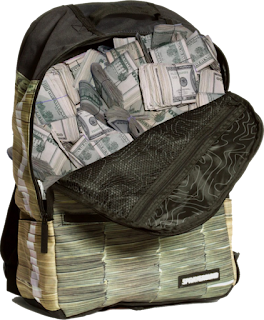
Vouchers were always an elegant solution to the question of “How do we get public money to private schools?” Private schools were already funded by a stream of students carrying backpacks stuffed with their parents’ cash. To get government-to-school funding going would require a whole other stream to be created, but vouchers could just hop onto the stream that already existed. Parents could stuff the backpacks with taxpayer dollars as well as their own.
It’s important to keep this model in mind when discussing one of the hot issues around the federal voucher system.
Voucher fans argue that federal vouchers will benefit public schools, which is a careful choice of wording because the federal vouchers will not go to schools– they will go to families, to shove into their child’s cash backpack.
For private schools, that’s a distinction without much difference, because vouchers pack new cash into the same old funding stream. But for public schools, it’s a completely different issue.
The public school funding stream is taxpayer to government to school district. There is no public school version of a funding stream fed by individual students carrying backpacks full of cash. That is, in many ways, antithetical to the public school mission.
In the private school backpack model, the size of the student’s backpack determines where they can go with that load of money. A large backpack full of loads of cash? You get to go to Philips Exeter. A fanny pack loaded with a small, lonely stack? You get to go to Bob’s Strip Mall Academy.
How the market treats you depends on how big and how stuffed your backpack full of cash is.
The public system is designed to work differently. All the cash comes into one big pool, and every student gets to swim in it regardless of what their family’s contribution might have been. (Does it work perfectly? No, particularly because of the ties to housing. The irony here is that the public mission is undermined by market forces in the housing market).
Point is– federal voucher dollars are not going to go to public schools unless the public schools can figure out a way to create the new funding stream for students carrying cash backpacks, and that create a whole new set of issues. If a special tutoring program is available to Susie because she has a backpack of federal voucher money, then why shouldn’t that tutoring be available to any or all students, regardless of backpack status?
Addendum: If a district already has a program that charges fees, then the federal voucher would help families pay that fee, but that would result in zero new revenue for the district.
If a public school sets up a program for backpack-bearing students to pay for a basic service, how do we square that with the mission of providing the same basic service for all? If a public school sets up a program for backpack-bearing students to “buy” an extra service, how do we justify only providing that special service to some students?
These dilemmas are unavoidable because, again, the federal voucher program will not give money to schools, but to students. For private schools, that will mean business as usual. For public schools, that will mean a new business model that will have to somehow co-exist with the traditional public service mission. There are undoubtedly some public districts out there well-positioned to wrestle with this issue, but it would be great if governors and districts put some real thought and discussion into the issue, because federal voucher dollars will only make it to public schools via a new and potentially troubling path.


It used to be whiskey given out at the polls. Now it is vouchers given in legislation. The former was an illegal practice. The latter is fully legal and for all to see. But it’s all the same.
LikeLike
While vouchers provide no actual academic value, they serve to undermine public education and have the potential to destabilize them. Their main goal is disrupt and close public schools.
I already see the impact on my grandson’s school in Texas. My grandson is on the school’s wrestling team in Texas. Last year with a lot of help from parents, they were able to go to the state championships and placed 3rd out of 12 invited teams. This year the coach left. Over the summer my daughter considered sending him to another public school, which is possible, when a sport in not available in a student’s home school. In the interim his school district made a deal with a local sports club to offer wrestling this year in the school district, and my daughter decided to keep him at his school to avoid the disruption and keep him with his peers. Parents or grandparents had to pay a $300 fee to participate in the team, and this year students will only compete locally. While it is better than no team at all, it is a symptom of of further decline in public schools due to budget cuts.
LikeLiked by 1 person